





Introduction
Eighty-nine percent of the global population agrees on the urgency of climate action and would like their respective governments to do more to combat climate change. More than two-thirds are even willing to contribute a small share of their personal income to the effort (Andre, Boneva, Chopra et al. Reference Andre, Boneva, Chopra and Falk2024). Within electoral competition, green parties are the quintessential issue owners of climate and environmental protection (Spoon and Williams Reference Spoon and Williams2021). Yet, green parties consistently fail to translate this overwhelming public support for climate action into lasting electoral success. Although green parties have established themselves in many European countries (Dolezal Reference Dolezal2010), their success at the polls remains limited, and they have entered few national governments (Close and Delwit Reference Close and Delwit2016). Research on the determinants of green party success is ongoing (Grant and Tilley Reference Grant and Tilley2019). Probing a micro-level mechanism, my analysis demonstrates that personal economic strain depresses support for green parties, underscoring the pivotal role of economic considerations in climate politics.
Economic considerations have long been recognized as central to political behavior (Downs, Reference Downs1957; Kinder and Kiewiet Reference Kinder and Kiewiet1979; MacKuen, Erikson, and Stimson Reference MacKuen, Erikson and Stimson1992). The dominant view holds that economic voting is largely sociotropic and driven by evaluations of the national economy (Healy, Persson and Snowberg, Reference Healy, Persson and Snowberg2017). Research also shows that recessions can dampen climate concern (Shum Reference Shum2012; Hoffmann, Muttarak, Peisker et al. Reference Hoffmann, Muttarak, Peisker and Stanig2022). However, recent studies challenge the sociotropic consensus, arguing that standard approaches understate the role of personal economic conditions (Healy, Persson and Snowberg Reference Healy, Persson and Snowberg2017; Tilley, Neundorf and Hobolt Reference Tilley, Neundorf and Hobolt2018). Moreover, there is initial evidence that this is true for environmental attitudes and policy preferences as well (Beiser-McGrath and Bernauer Reference Beiser-McGrath and Bernauer2024; Böhmelt and Zhang Reference Böhmelt and Zhang2024). By focusing on green parties as central actors in the politics of climate action, I contribute to this debate over the political relevance of pocketbook concerns. I understand pocketbook concerns as a subjective sense of immediate financial strain: not one’s standing relative to others, but the felt experience of economic pressure in meeting everyday needs, shaped by both objective circumstances and the broader economic context in which households find themselves.
For green parties, the connection of voters’ pocketbook concerns and electoral performance remains unexplored. Public climate action has developed into a domestic distributive conflict in which cost allocation is contested (Aklin and Mildenberger Reference Aklin and Mildenberger2020; Schwander and Fischer Reference Schwander and Fischer2024). Green parties stand for decisive action and immediate costs, as evidenced by backlash to costly policies (Kistinger, Kögel, Koch et al. Reference Kistinger, Kögel, Koch and Kalkuhl2025). The presumed tradeoff between individual economic conditions and environmental preferences has, however, rarely been subjected to rigorous individual-level scrutiny, and existing evidence is mixed (Mildenberger and Leiserowitz Reference Mildenberger and Leiserowitz2017; Hartmann and Preisendörfer Reference Hartmann and Preisendörfer2024). Studies examining economic shocks find divergent results: while Beiser-McGrath (Reference Beiser-McGrath2022) shows that Covid-19 led to a deprioritization of environmental concern in the United Kingdom, Rudolph and Gomm (Reference Rudolph and Gomm2024) find no effect heterogeneity by affectedness following an economic shock in Switzerland. Evidence on the macro-level suggests that green party performance is affected by economic circumstances. Green parties celebrate gains in times of growth and struggle under a recession (Abou-Chadi and Kayser Reference Abou-Chadi and Kayser2017; Gourley and Khamis Reference Gourley and Khamis2023). However, the individual-level mechanisms driving this pattern remain largely unexamined, leaving a crucial gap in our understanding of green party support. I hypothesize that voters facing personal economic strain are less likely to vote for green parties, in addition to, or irrespective of, their sociotropic concerns. This expectation builds on four central observations: (1) personal economic hardship has been shown to influence political behavior (e.g., Healy, Persson, and Snowberg Reference Healy, Persson and Snowberg2017; Tilley, Neundorf, and Hobolt Reference Tilley, Neundorf and Hobolt2018); (2) environmental concern decreases during economic hardship (Scruggs and Benegal Reference Scruggs and Benegal2012; Hoffmann, Muttarak, Peisker et al. Reference Hoffmann, Muttarak, Peisker and Stanig2022; Uba, Lavizzari, and Portos Reference Uba, Lavizzari and Portos2023; Böhmelt and Zhang Reference Böhmelt and Zhang2024); (3) green parties, as the associative issue owners of climate action, are perceived as prioritizing climate action (Farstad Reference Farstad2018; Spoon and Williams Reference Spoon and Williams2021); and (4) on the macro-level, green parties perform better under economic prosperity but struggle during downturns (Abou-Chadi and Kayser Reference Abou-Chadi and Kayser2017; Gourley and Khamis Reference Gourley and Khamis2023).
In Germany, for example, this vulnerability is not shared equally across the party system. Unlike coalition partners such as the Social Democratic Party (SPD), whose electoral appeal rests on a broader issue portfolio, the Greens’ support is disproportionately concentrated among voters with strong environmental preferences (Farstad Reference Farstad2018; Spoon and Williams Reference Spoon and Williams2021). Moreover, as the governing party most closely identified with climate policy, the Greens bear a distinctive accountability burden: voters facing the costs of the green transition have a clear partisan target, while coalition partners can more readily deflect or distribute blame across the government (e.g., Plescia, Kritzinger, and Spoon Reference Plescia, Kritzinger and Spoon2022). Salience theory provides an additional micro-level foundation for this argument. Issue ownership shapes vote choice only when the issue is salient to the individual voter (Bélanger and Meguid Reference Bélanger and Meguid2008), and economic hardship plausibly suppresses the personal salience of environmental concerns, shifting voters’ attention toward more immediate material priorities. In the German context, environmental salience rose sharply from the mid-2010s onward, and Otteni and Weisskircher (Reference Otteni and Weisskircher2022) show that heightened salience around 2019 boosted electoral support for both the Greens and the radical-right Alternative für Deutschland (AfD). The present study operates in a different context: climate salience peaked again around the 2021 federal election and had already begun to decline before Russia’s invasion of Ukraine (see Figure 2). The Greens thus faced a dual challenge: a general erosion of the issue salience on which their electoral success depends and, as I argue, the particular disengagement of financially distressed voters who downgrade environmental concerns in favor of more immediate material priorities. Personal economic strain, in other words, reduces both the salience of climate policy and the electoral relevance of green parties’ issue ownership, making financially distressed voters less likely to support the Greens irrespective of the broader political context.
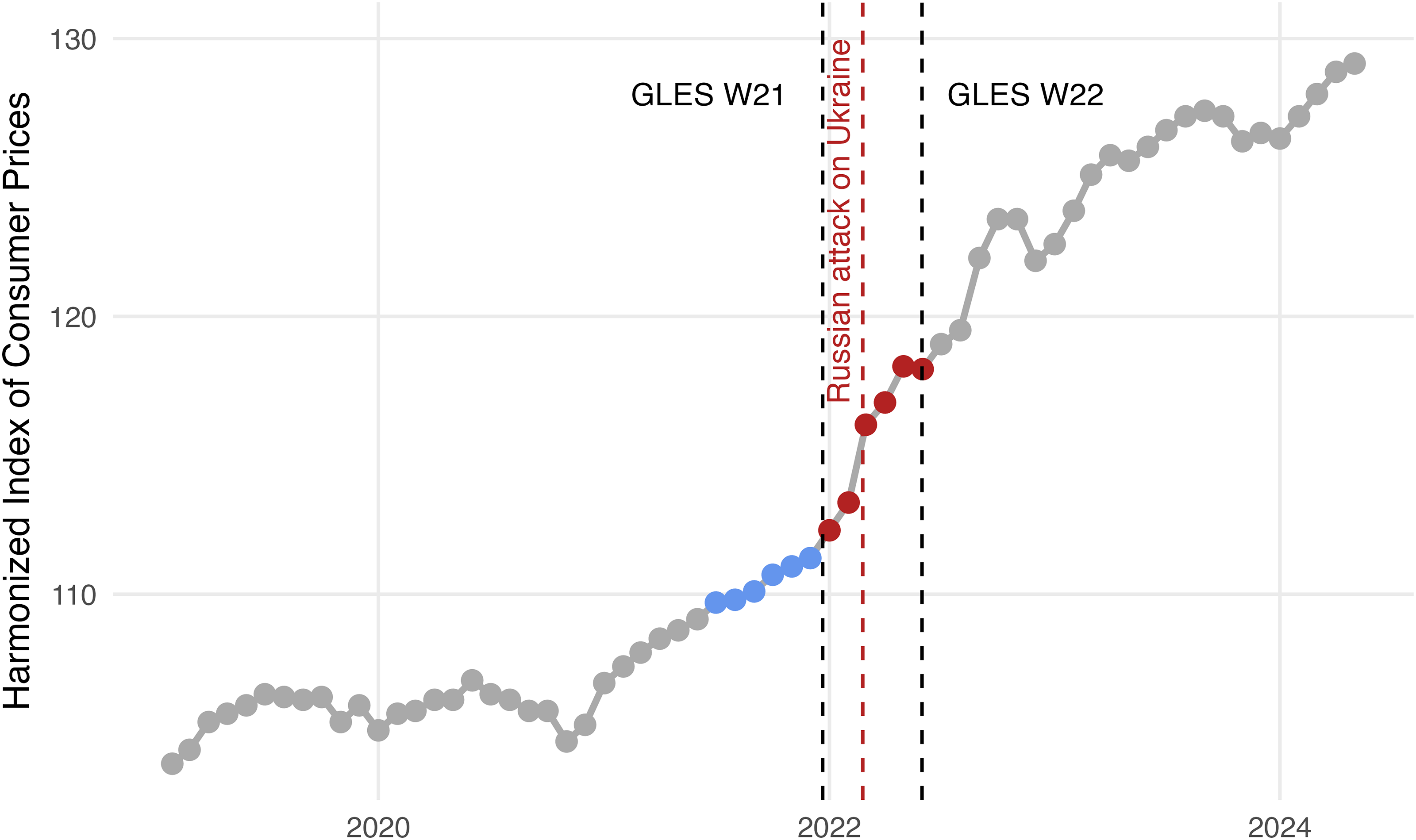
Harmonized index of consumer prices for Germany (2021–2024, Eurostat).
Note: Blue dots represent the 6-month period before the last pre-invasion GLES wave; red dots represent the 6-month period before the first post-invasion GLES wave. Own representation based on Eurostat data (Eurostat 2026).

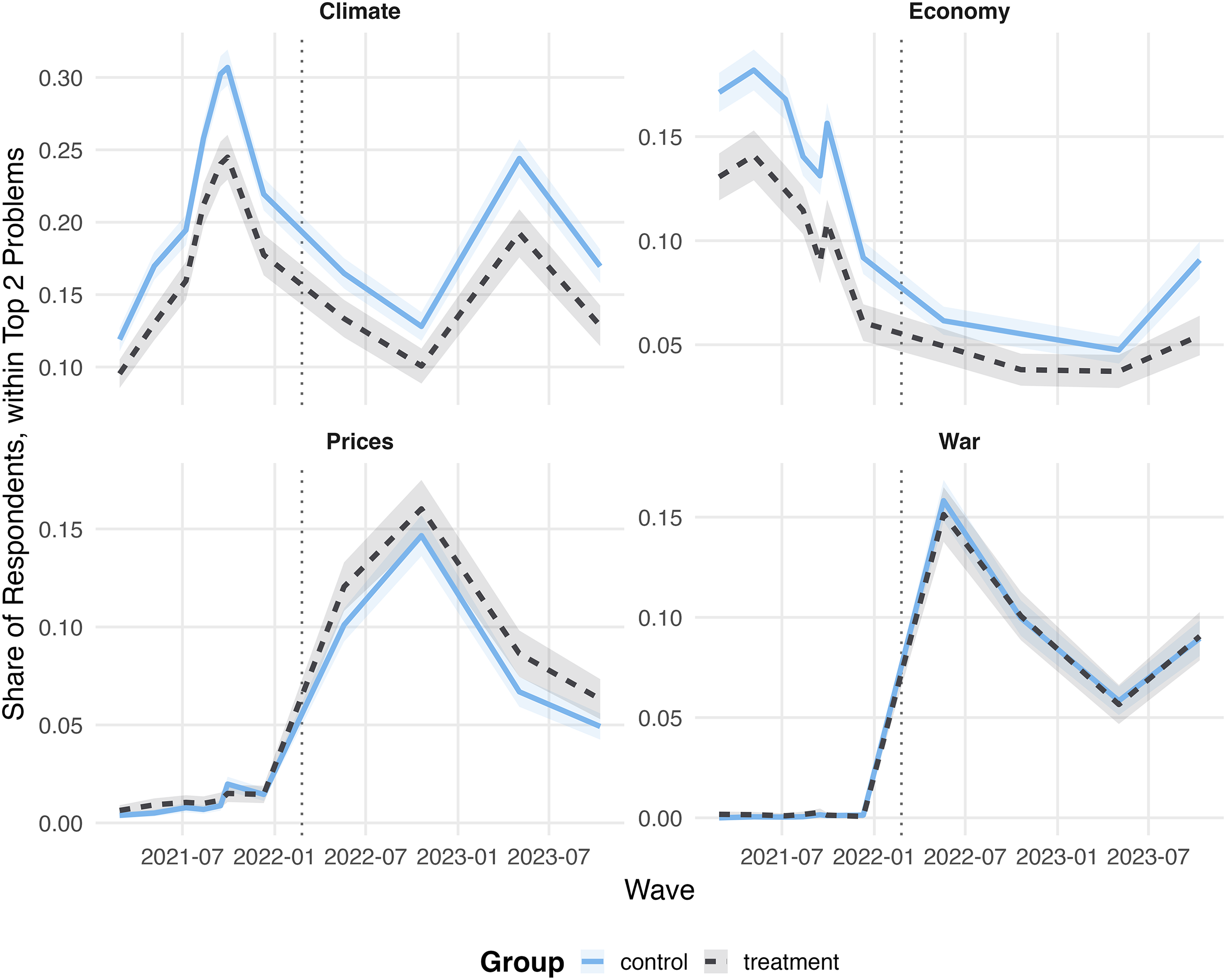
Top problem perceptions in Germany by group leading up to the attack and after.
Note: Displays group means by wave timing with 95% confidence intervals. The Russian invasion is indicated with the dotted vertical line.

This study combines observational and quasi-experimental evidence, using panel data to assess long-term trends and a natural experiment to strengthen causal inference. Using data from the German Longitudinal Election Study (GLES 2024), I first explore the association of personal economic strain and propensity to vote for the Greens over the full set of available data, including 31,000 unique individuals and 27 waves. The second part of the analysis leverages an exogenous shock to consumer prices for causal identification, implementing a difference-in-differences (DiD) design around the Russian attack on Ukraine in 2022 with a subset of 10,000 respondents.
Germany represents an ideal case for studying green party support due to its central role in global climate politics and structural comparability to other postindustrial democracies. As one of the world’s largest historical carbon polluters and currently the sixth-largest emitter, Germany remains a major contributor to global emissions.Footnote 1 Its multiparty parliamentary system aligns with other European democracies, and the German Green Party – the world’s largest – has established itself as a governing force at both the federal and state levels. Economically, Germany mirrors broader postindustrial trends, with declining absolute upward mobility and increasing middle-class economic strain (Bönke, Harnack-Eber, and Lüthen Reference Bönke, Harnack-Eber and Lüthen2024). Economic stagnation and above-average inflation further contribute to a challenging macroeconomic environment.Footnote 2 Additionally, before 2022, Germany was highly dependent on Russian energy, reinforcing the salience of energy security in its political economy. These factors make Germany a compelling case for examining how economic conditions shape support for green parties in a structurally comparable, but politically consequential, setting.
The results provide strong, consistent evidence that personal economic strain erodes support for green parties. First, personal economic strain is robustly associated with declining green party favorability as well as vote intention for the Greens. After controlling for a comprehensive set of individual covariates and wave fixed effects, economically stressed voters are 2.2 percentage points less likely to vote for the Greens. Second, causal evidence from the DiD analysis backs this finding. Green party favorability decreases following the spike in consumer prices, while voters’ perception of their personal economic well-being deteriorates, and they move to prioritize economic growth over climate protection. While the DiD does not show effects on vote intentions in the aggregate, a supplementary within-person analysis confirms the individual-level causal chain: respondents who lowered their favorability rating by at least one scale point reduced their probability of voting for the Greens by 7.5 percentage points.
This study advances research on green party success by providing micro-level evidence for previously observed macro-level patterns. While prior work shows that green party performance fluctuates with economic conditions (Abou-Chadi and Kayser Reference Abou-Chadi and Kayser2017; Gourley and Khamis Reference Gourley and Khamis2023), the individual-level mechanisms remain underexplored. Linking personal economic strain to voters’ electoral preferences, I extend research on the determinants of green party support and clarify how economic conditions shape political behavior beyond aggregate trends. The study also contributes to debates over the role of pocketbook considerations in political decision-making (Healy, Persson, and Snowberg Reference Healy, Persson and Snowberg2017; Tilley, Neundorf, and Hobolt Reference Tilley, Neundorf and Hobolt2018), offering new evidence on how voters’ economic well-being conditions their willingness to back parties advocating ambitious climate policies. Finally, by leveraging war-induced price shocks, the study adds to growing research on the political consequences of economic shocks (Margalit Reference Margalit2019; Hopkins, Margalit, and Solodoch Reference Hopkins, Margalit and Solodoch2024; Cremaschi, Bariletto, and De Vries Reference Cremaschi, Bariletto and De Vries2025).
The findings also speak to broader debates about the distributive politics of climate action. Green parties are not only issue owners of environmental policy but also central actors in the contestation over the economic costs of decarbonization (Aklin and Mildenberger Reference Aklin and Mildenberger2020; Schwander and Fischer Reference Schwander and Fischer2024). The results highlight a core challenge: sustaining electoral support requires not only a commitment to climate action but also a credible vision of inclusive economic growth. The political feasibility of ambitious climate policies thus depends on addressing voters’ material concerns alongside environmental goals – as shown, for example, by evidence that support for carbon taxation is strongly conditioned by its pocketbook implications (Beiser-McGrath and Bernauer Reference Beiser-McGrath and Bernauer2024).
Long-term correlational analysis
To test the expectation that voters under economic strain are less likely to vote for green parties, the analysis follows a twofold empirical strategy. First, a long-term correlational analysis investigates the link between personal economic conditions and green party preferences. Second, a causal analysis exploits the pricing shock following Russia’s attack on Ukraine in 2022. Both analyses rely on panel data from Germany.
Design
First, I examine the association between respondents’ propensity to vote for the Greens and their perception of personal economic conditions across the full available dataset. For analysis, I recode an item asking respondents to rate their personal financial situation into a binary indicator, distinguishing those who report a bad or very bad financial situation from others. Results using the continuous measure appear in the online Supplementary Information (SI, section B.2). Additionally, for respondents with consecutive observations, I assess changes in self-reported economic conditions between waves and report these estimates in the SI (section B.3) as well. I rely on self-assessed rather than objective measures of financial strain throughout. Although GLES collects household income only once upon panel entry, precluding a time-varying objective measure, the reliance on subjective assessments is theoretically motivated independently of this constraint: prior research finds that perceptions, rather than factual positioning, drive political attitudes and behavior, particularly on economic inequality and redistribution (Cruces, Perez-Truglia, and Tetaz Reference Cruces, Perez-Truglia and Tetaz2013; Gimpelson and Treisman Reference Gimpelson and Treisman2018).
To measure green party support, I use two separate items. First, an eleven-point party favorability scale provides a granular measure of respondents’ attitudes toward the Greens. Second, I create a binary indicator from the standard vote intention item (‘Sonntagsfrage’), coding respondents who report they would vote for the Greens if an election were held the following Sunday. Given that vote choice is often more stable than general favorability, this combination captures both attitudinal and behavioral dimensions of support.
I estimate ordinary least squares (OLS) regressions with three specifications: (1) an unadjusted model estimating the baseline association between personal economic strain and green party support; (2) a model with time fixed effects to account for broader economic and political trends across survey waves; and (3) an extended model incorporating a set of individual-level covariates. Standard errors are clustered at the unit and wave level to account for the panel data structure.
To select other individual-level factors influencing green party support as controls, I draw on research on green parties as well as climate-friendly behavior and environmental policy preferences (Dolezal Reference Dolezal2010; Drews and Van Den Bergh Reference Drews and Van Den Bergh2016; Bumann Reference Bumann2021; Steg Reference Steg2023). The final covariate set includes gender, age, education, household income, political interest, left-right self-positioning, urban residence, and East/West German origin, controlling for demographic and ideological factors linked to both economic perceptions and green party support. Given Green parties’ origins in progressive and New Left politics (Dolezal Reference Dolezal2010; Close and Delwit Reference Close and Delwit2016), I also control for attitudes toward immigration, migrant integration, and EU integration – symbolic attitudes that are consistently measured across most waves. Missing values are linearly interpolated based on evidence that such attitudes remain stable over the life course (Alwin and Krosnick Reference Alwin and Krosnick1991; Sears and Funk Reference Sears and Funk1999; Peterson, Smith, and Hibbing Reference Peterson, Smith and Hibbing2020). To isolate pocketbook considerations from broader sociotropic concerns, I control for national economic evaluations. Finally, I include government satisfaction as a covariate, as green party support may reflect retrospective evaluations of their role in government or broader perceptions of government performance.
Results
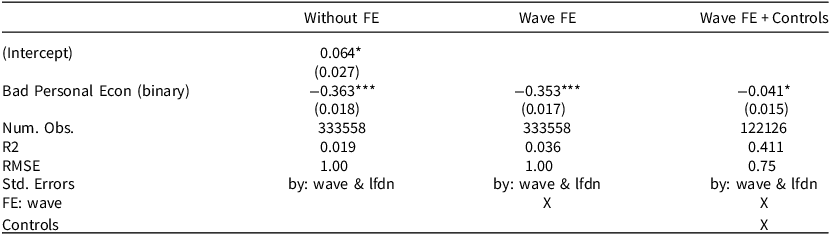
Table 1 reports regression results for green party favorability, using the binary indicator of respondents’ personal economic situation as the predictor. Across all models, I find a significant negative association between personal economic strain and green party favorability (standardized for reference). The effect size decreases with controls, suggesting that economic circumstances are expectedly not the sole determinant of green party evaluations. However, even when accounting for respondents’ sociotropic economic assessments and a full set of individual-level covariates, a small but significant negative effect persists.
Regression results with green party favorability as the outcome

Table 1. Long description
The table presents regression results for green party favorability, focusing on the binary indicator of respondents’ personal economic situation as the predictor. It includes three columns: Without FE, Wave FE, and Wave FE + Controls. Each column lists the intercept, the effect of bad personal economic situation, the number of observations, R-squared value, root mean square error, standard errors, and whether fixed effects and controls are included. The table has 8 rows and 3 columns. Row 1: Intercept, 0.064 (0.027), 0.000 (0.017), 0.000 (0.015). Row 2: Bad Personal Econ (binary), -0.363 (0.018), -0.353 (0.017), -0.041 (0.015). Row 3: Num. Obs., 333558, 333558, 122126. Row 4: R2, 0.019, 0.036, 0.411. Row 5: RMSE, 1.00, 1.00, 0.75. Row 6: Std. Errors, by wave & lfdn, by wave & lfdn, by wave & lfdn. Row 7: FE: wave, X, X. Row 8: Controls, X.
+ p < 0.1, * p < 0.05, ** p < 0.01, *** p < 0.001.
DV: Green Party Favorability, standardized. Note: Full regression table in SI; see Table B.1.1.
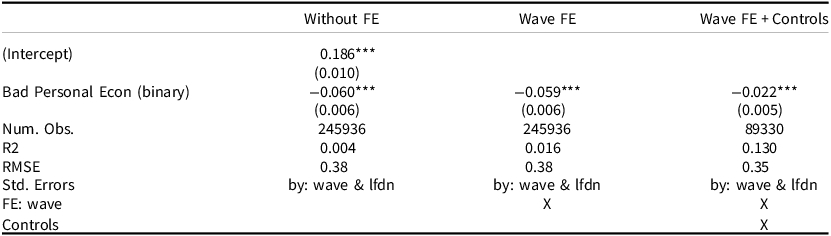
The pattern holds for vote intention (Table 2). After including wave fixed effects and controls, personal economic strain is associated with a 2.2 percentage point decline in Green vote intention. This suggests that lower evaluations of the party translate into reduced electoral support. Especially with elections and coalition options being decided on the margins, this deficit is substantial.
Regression results with vote intention for the Greens as the outcome

Table 2. Long description
A table comparing regression results for vote intention for the Greens. The table has three columns: Without FE, Wave FE, and Wave FE + Controls. Each column presents regression coefficients, standard errors, and additional statistics. Row 1: Intercept, 0.186, 0.059, 0.022. Row 2: Bad Personal Econ (binary), -0.060, -0.059, -0.022. Row 3: Num. Obs., 245936, 245936, 89330. Row 4: R2, 0.004, 0.016, 0.130. Row 5: RMSE, 0.38, 0.38, 0.35. Row 6: Std. Errors, by wave & lfdn, by wave & lfdn, by wave & lfdn. Row 7: FE, wave, X, X. Row 8: Controls, X, X.
+ p < 0.1, *p < 0.05, **p < 0.01, ***p < 0.001.
DV: Vote intention Greens (binary). Note: Full regression table in SI; see Table B.1.2.
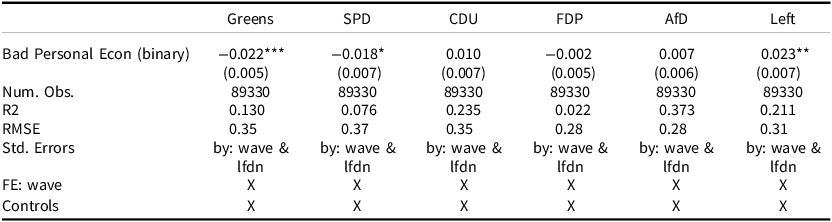
Is this change specific to the Greens? One might argue that economic dissatisfaction, as seen in the rise of populist and radical-right parties, leads voters to abandon mainstream parties in favor of more radical alternatives. Table 3 shows that the negative effects are concentrated on the Greens and SPD, with the third coalition partner, the liberal Free Democratic Party (FDP), unaffected. The SPD result likely reflects a longer-run dealignment of economically distressed voters from social democratic parties as those parties moderated their redistributive profiles (Rennwald Reference Rennwald2020), rather than the issue ownership mechanism argued here. Beyond the coalition parties, a positive association emerges for the Left, while the Christian Democratic Union (CDU) and AfD are largely unaffected. This suggests that economic strain, previously linked primarily to populist voting, also undermines green party support. Among centrist parties, the Greens appear most vulnerable to voters’ financial hardship.
Comparison of effects across parties, additionally controlling for government evaluation

Table 3. Long description
The table presents data on the effects of economic dissatisfaction on different political parties, including Greens, SPD, CDU, FDP, AfD, and Left. It includes columns for each party and rows for various statistical measures such as Bad Personal Econ (binary), Num. Obs., R2, RMSE, Std. Errors, FE: wave, and Controls. Each row provides specific values for these measures across the parties. For example, the Greens have a value of -0.022 for Bad Personal Econ (binary) with a standard error of 0.005, while the SPD has a value of -0.018 with a standard error of 0.007. The CDU shows a value of 0.010 with a standard error of 0.007, and the FDP has a value of -0.002 with a standard error of 0.005. The AfD shows a value of 0.007 with a standard error of 0.006, and the Left has a value of 0.023 with a standard error of 0.007. The table also includes the number of observations, R-squared values, and root mean square errors for each party. The data suggests that economic dissatisfaction negatively affects the Greens and SPD, while the FDP remains unaffected. The Left shows a positive association, and the CDU and AfD are largely unaffected.
+ p < 0.1, *p < 0.05, **p < 0.01, ***p < 0.001.
DV: Binary indicator for vote intention for the party.
Causal exploitation of a short-term pricing shock
The correlational analysis above does not establish causality, as respondents’ financial self-assessments may reflect rather than cause their political attitudes: partisanship or dissatisfaction with the governing coalition could simultaneously depress both green party support and subjective economic evaluations. To address this limitation, I implement a difference-in-differences (DiD) design, leveraging the sharp increase in consumer prices following Russia’s attack on Ukraine as an exogenous shock to household economic conditions. Such shocks have been shown to be consequential for political behavior in various studies (Margalit Reference Margalit2019).
Design
To isolate the effect of personal economic strain from pre-existing attitudes, the shock must differentially impact parts of the population while leaving others relatively unaffected. The war and its anticipation triggered sharp price increases, particularly for fossil fuels and energy. As Figure 1 illustrates, prices had been rising, but the six-month increase around the invasion (red dots) was more than twice as large as in the preceding period (blue dots). Correspondingly, the share of respondents perceiving their financial situation as deteriorating spikes, while the share reporting economic improvement declines sharply (see SI Section C.1).
The key assumption is that short-term price increases disproportionately affect lower-income households, while wealthier households are more insulated (Bach and Knautz Reference Bach and Knautz2022). Thus, I define my treatment group as respondents below 60% of the median household income (poverty risk threshold) and my control group as those earning 150% or more, following OECD conventions (OECD 2019). In the GLES, this corresponds to households with gross incomes below 1,500 € (treatment) and those earning 3,000 € or more (control). I restrict the sample to respondents from the most recent panel extension (2020) to minimize bias from outdated income measures. Given that poorer households allocate a larger share of income to essential goods, they experienced stronger short-term economic strain when energy and fuel prices surged post-invasion (Bach and Knautz Reference Bach and Knautz2022). However, as prices continued to rise, the distinction between groups likely weakened over time. I therefore focus on the first post-attack wave of the GLES, where differential effects should be most pronounced. To ensure the group allocation is not sensitive to household composition, I have tested the robustness of results against an alternative assignment based on equivalized household income following adjustments common in inequality research. Apart from singular changes in magnitude, the results from the test match those presented in the main analysis (see SI Section C.3). Moreover, arguments can be made that depending on their access to liquid assets, even well-off respondents might be very sensitive to sudden price spikes. While the design uses income and not wealth for the group assignment, I still test the sensitivity of effects to control group selection. The results are presented in the SI (Section C.4) and show that – in line with expectations – the contrast between treatment and control intensifies as the control group is limited to more and more affluent respondents.
Figure 2 plots the share of respondents citing key political problems (prices, war, climate change, and the economy) before and after the attack. While concern over climate change and the economy declines, war and inflation gain prominence. Crucially, price concerns rise more sharply among the treatment group than among the affluent control group. Notably, both groups rate the war itself as equally important, mitigating concerns about confounding effects from broader geopolitical anxieties. Overall, this measure is not perfect, as respondents can only name two problems. However, it gives a sense of how priorities of the electorate shifted.
Beyond my primary outcomes, I explore potential mechanisms through additional measures. While GLES does not consistently track attitudes toward the economy or climate change over time, it includes a trade-off item on economic growth versus climate action.Footnote 3 Respondents place themselves on a seven-point scale, ranging from ‘prioritizing climate action even at the expense of growth’ to ‘prioritizing growth even if it hinders climate action’. I examine whether price shocks push individuals toward economic prioritization. Additionally, I construct binary indicators from respondents’ open-ended top problem responses, identifying whether they mention climate change (‘Klima’), the economy (‘Wirtschaft’), or price-related concerns (‘Preise’, ‘Kosten’). As respondents typically reduce their answers to single words or short phrases, the coding is based solely on the presence of key terms and was conducted by the author. These provide further insights into how economic strain shifts political priorities.
For estimation, I employ a two-way fixed effects DiD model, exploiting the uniform treatment timing between GLES waves 21 and 22. This approach accounts for both unit-specific and time-specific heterogeneity, ensuring that estimates capture the differential change between treated and control groups rather than common trends. As in the correlational analysis, I control for national economic evaluations to isolate pocketbook effects from sociotropic concerns. Additionally, I include government satisfaction, given that the Greens were part of the federal governing coalition at the time, ensuring that differential effects are not driven by partisan approval or dissatisfaction.
The key assumption of DiD designs is parallel trends in outcomes before treatment. In the SI, I provide trend graphs (C.8) and event-study plots (C.7) demonstrating the precondition holds for the main outcomes of green party favorability and vote intention. In the latter, I assign placebo treatments at earlier time points, showing that no clear patterns emerge before the actual shock. The section also provides graphs for the intermediate outcomes used to probe potential mechanisms. The assumption of no pre-trends holds for economic perceptions, the climate protection economy trade-off, and prices as the top problem. Thus, for the items most relevant for the underlying expectation that pocketbook concerns drive group differences, the parallel trends assumption holds. For the other intermediate outcomes used to assess potential mechanisms, pre-treatment trends show some patterns, so estimates on climate change and the economy as the major problem should be interpreted with caution.
Results
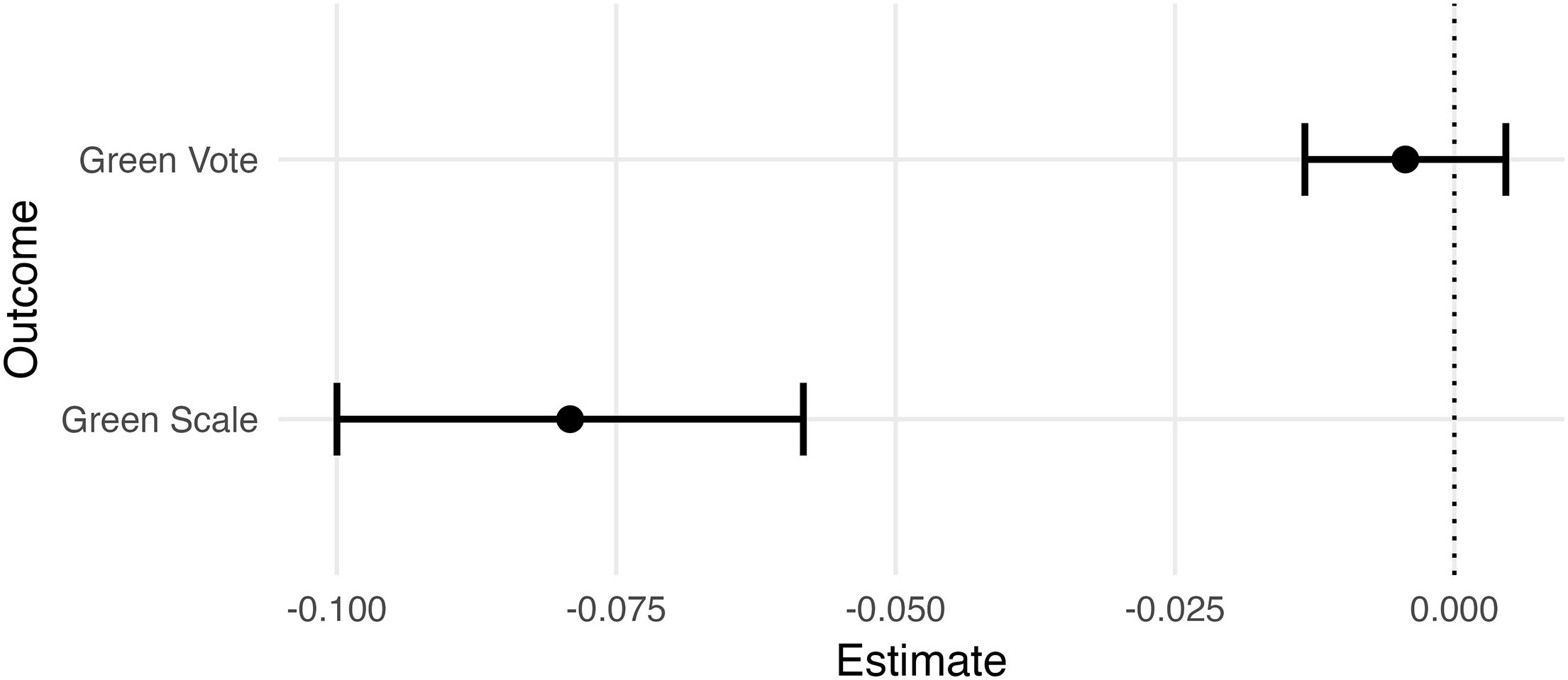
To evaluate whether the presented associations hold in a causally identified setting, I turn to the results from the DiD estimation. Figure 3 presents the estimated average treatment effect on the treated (ATT) for green party favorability and vote intention.
Effects on main outcomes from the DiD estimation (95% CIs).
Note: The full regression table is seen in Table C.2.1 in the SI.

After the price shock, treated respondents significantly downgrade their evaluation of the Greens. As Figure C.8.2 in the SI shows, evaluations diverge sharply post-treatment but later return to a parallel path. Placebo tests also confirm that pre-treatment trends were parallel (see Figure C.7.1 in the SI). However, vote intention remains unchanged. Given that the estimation strategy can only identify immediate effects, I cannot rule out whether negative effects materialized over time. After a brief surge, vote intention for the Greens consistently declined in late 2022 and onwards. The gap between affluent and poor households grew from 2.9 percentage points just after the invasion to 4.9 percentage points three waves later, indicating support for the Greens deteriorated even more among the less affluent. That the favorability decline does translate into reduced vote intentions at the individual level is confirmed by a supplementary within-person analysis, which shows that respondents who lowered their favorability rating by at least one scale point reduced their probability of voting for the Greens by 7.5 percentage points (see SI Section C.5).
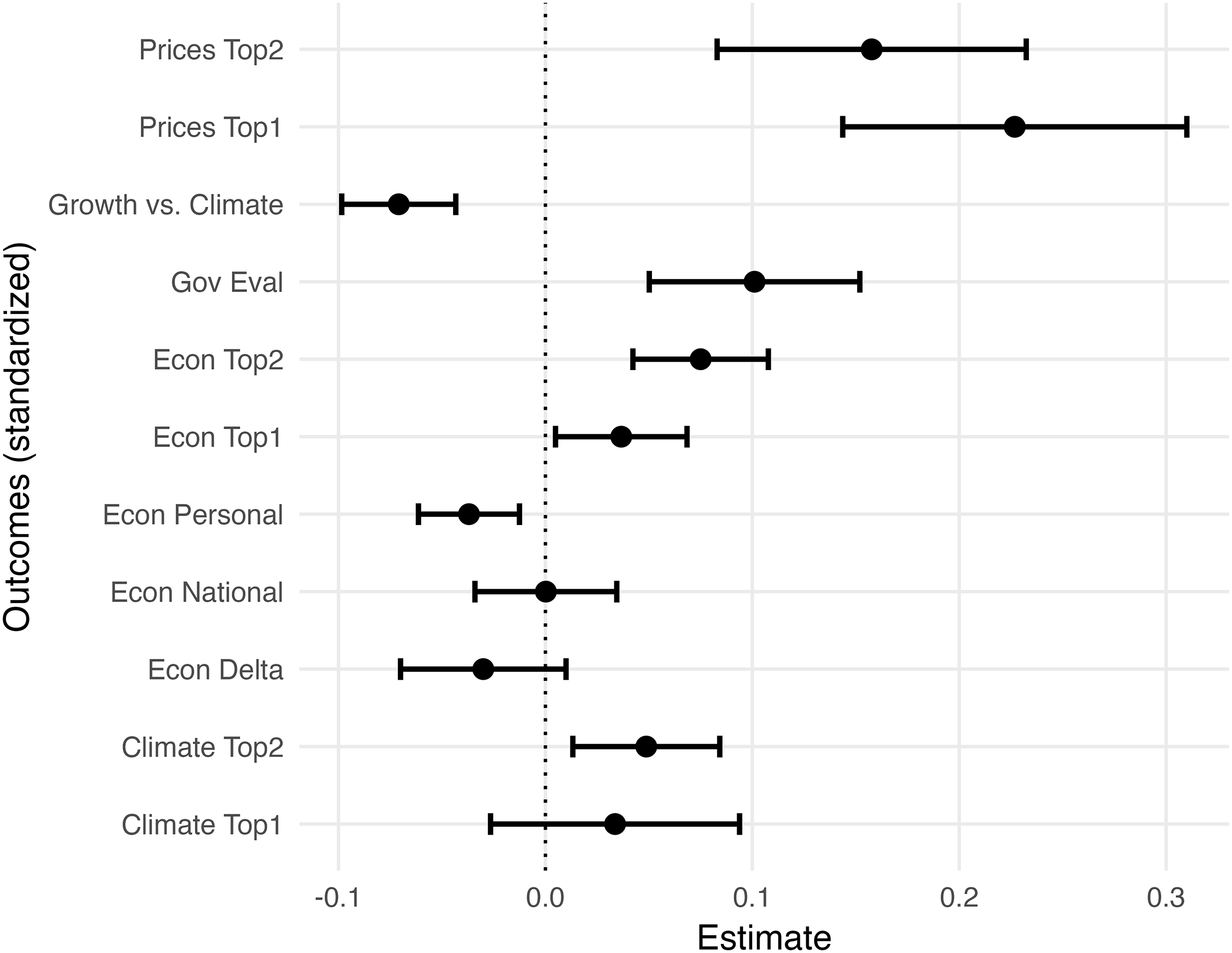
To explore potential mechanisms, I analyze intermediate outcomes (Figure 4). First, treated individuals report a worsened personal financial situation, while their national economic assessments remain stable, reinforcing that pocketbook concerns drive the effect. Second, respondents shift toward prioritizing economic growth over climate action, suggesting that economic hardship reduces the salience of climate protection. Third, price concerns increase sharply in the treatment group, while government satisfaction slightly improves, ruling out an anti-incumbent effect.

The effects on climate concern are more nuanced. An examination of the trend graphs in Figure 2 provides some context. Here, we see that perceptions of climate change as the most important problem were already in decline in the run-up to the war and further declined over its outbreak, probably due to other concerns, namely the war itself, taking its spot. It seems like the control group was a little quicker to deprioritize climate change from its top-two set of relevant issues, resulting in the observed positive effect. The economy also lost in importance in anticipation of the war but gained in importance among the treatment group after the attack. For prices, the trend is most pronounced. While prices were only considered a large issue by a tiny fraction of respondents before the attack, this changed immediately after the outbreak of the war and was much more pronounced for the treatment group.
These shifts extend to party competence perceptions (see SI Section C.9). The Greens remain the party most associated with climate change but lose credibility across issues, including their core environmental agenda. Moreover, when asked which party is best suited to solve their top problem, respondents become less likely to name the Greens across all responses, further suggesting that economic hardship undermines the party’s perceived competence.
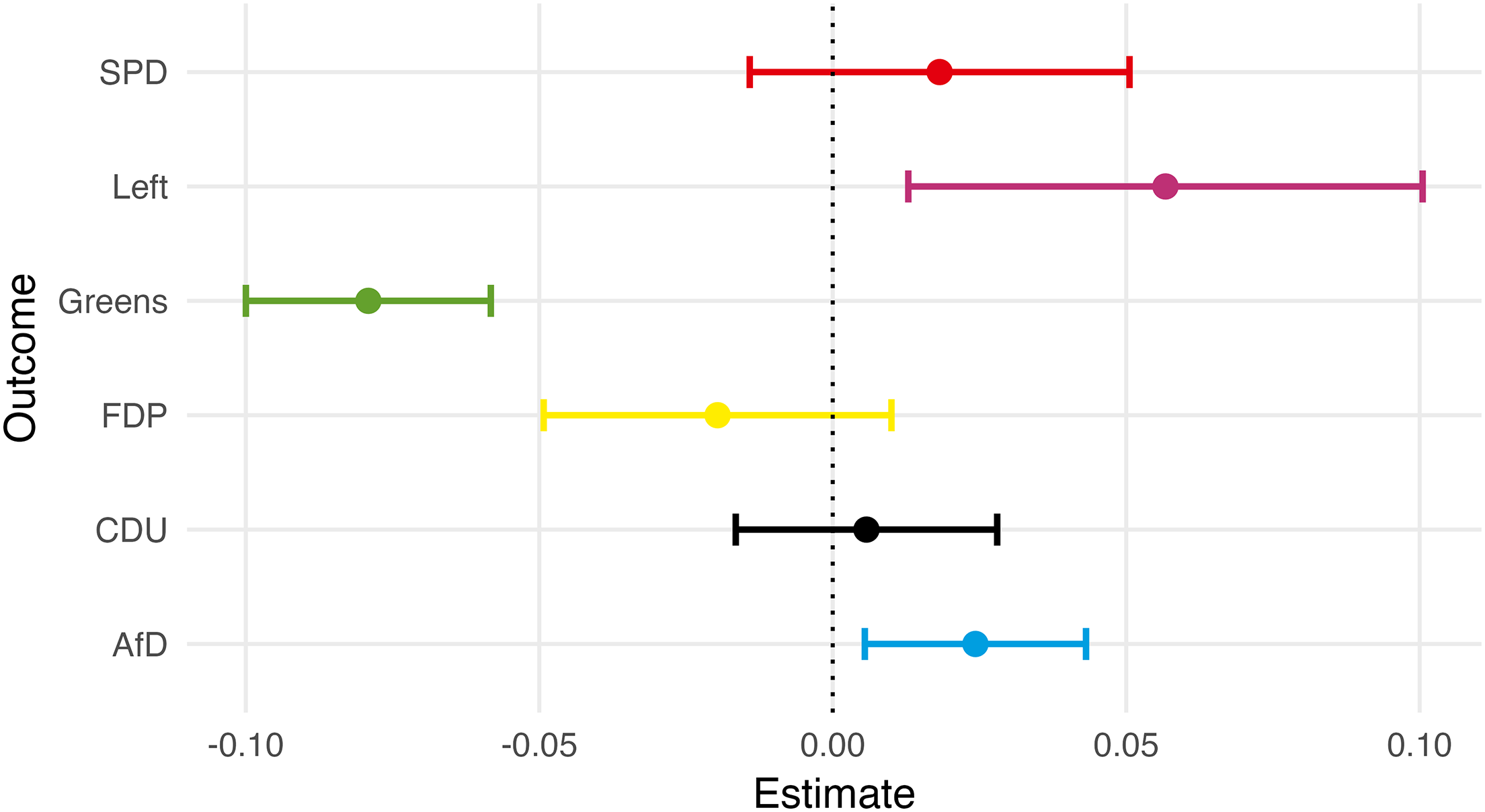
A crucial question is whether these effects extend beyond the Greens. Figure 5 compares changes in party favorability. The results confirm that only the Greens suffer a significant decline. Notably, neither of the Greens’ coalition partners, the SPD or the FDP, shows a significant effect, indicating that the negative reaction is not a general incumbency response but reflects the Greens’ distinctive association with the costs of the energy transition. Among the opposition parties, the CDU likewise remains unaffected, while the radical-right AfD and the Left gain support, consistent with prior research on economic hardship and populist voting (Gidron and Hall Reference Gidron and Hall2017; Hartmann, Kurz, and Lengfeld Reference Hartmann, Kurz and Lengfeld2022). This reinforces that green parties face a distinct electoral vulnerability in times of economic distress, as their core agenda is perceived as costly.
Effects on party evaluations from the DiD estimation (95% CIs).
Note: The full regression table is seen in Table C.2.4 in the SI.

The linear correlations presented earlier capture the association of personal economic perception and green party outcomes. Individuals who constantly feel like they are doing badly economically enter the estimation in the same way that individuals who recently downgraded their assessments do. The presented difference-in-differences estimation rather foregrounds a recent shift in evaluation in reaction to widespread price increases. To also assess the impact of changes in economic evaluations on green party outcomes, SI Section B.6 provides estimates from a two-way fixed effects estimation on the unit and wave level, thus fixing unit-specific characteristics and collective trends. The resulting estimates can be interpreted as the effect of an individual’s change in evaluation on the outcome. While this alone does not provide causal evidence, the strategy more closely mirrors the DiD setup. Providing some further validity to the DiD estimates presented above, the two-way fixed effects regression also shows a negative effect on party favorability, while vote intentions remain unaffected.
Overall, the findings of both analyses indicate a consistent negative relationship between voters’ personal economic hardship and support for the German Greens. The long-term analysis shows that respondents who perceive their economic situation as poor are significantly less likely to evaluate the Greens favorably or express intentions to vote for them. The difference-in-differences analysis provides further causal evidence: individuals affected by the economic shock following Russia’s invasion of Ukraine exhibit lower evaluations of the Greens and an increased tendency to prioritize economic growth over climate protection, while shifting focus to issues such as inflation and economic stability. However, vote intentions remain unaffected. Notably, the negative effects remain specific to the Greens, with fringe parties benefiting from this shift instead. Together, these findings underscore that personal economic strain uniquely undermines support for green parties, framing green politics as vulnerable to material concerns in times of individual financial distress.
Discussion
This paper examined whether personal economic strain shapes electoral support for green parties, arguing that voters facing financial hardship deprioritize green politics due to its perceived costs. Using panel data from the German Longitudinal Election Study and a quasi-experimental design leveraging exogenous price shocks following Russia’s 2022 invasion of Ukraine, the analysis provides both correlational and causal evidence that individual economic hardship reduces green party favorability and, in the long run, vote intentions. Supplementary analysis restricted to the pre-pandemic waves confirms that this association is not specific to the turbulent study period, and the within-person analysis in SI Section C.5 further establishes that respondents who revised their favorability downward reduced their probability of voting for the Greens by 7.5 percentage points, substantiating the individual-level causal chain. In fragmented party systems, elections are regularly decided on the margins, making these findings substantively relevant for Green parties’ electoral success.
The results are specific to the Greens in ways that the paper’s theoretical argument anticipates. The DiD estimates show no significant effects on the Greens’ coalition partners, the SPD and FDP, despite their shared responsibility for government policy during the shock period. This pattern is consistent with the issue ownership logic advanced in the paper: voters attribute the costs of the energy transition to the party most closely identified with climate policy rather than distributing blame evenly across the coalition. While a brief rally-around-the-flag dynamic is visible in a modest positive effect on overall government evaluation, this pattern does not extend uniformly to the Greens’ coalition partners, a finding difficult to reconcile with the undifferentiated cross-party mobilization a standard rally account would predict. If a rally effect was present, it appears to have been short-lived and rapidly conditioned by economic accountability judgments. The supplementary evidence reinforces this interpretation: financially strained respondents increasingly attributed responsibility for their personal economic circumstances to the government while simultaneously revising their economic expectations downward, a pattern more consistent with pocketbook grievance than with diffuse trust erosion rooted in foreign policy discomfort (SI Section C.6). I cannot rule out that geopolitical anxiety played some role in the immediate post-invasion period, but the specificity of the negative effect to the Greens and its absence for their coalition partners suggests that issue ownership rather than a general incumbency or rally dynamic is the operative mechanism. There is also preliminary evidence of a small negative effect on turnout probability among affected respondents, consistent with the broader literature on economic shocks and electoral participation, though the effect on the binary turnout indicator is insignificant, likely reflecting ceiling compression in the GLES sample (SI Section C.6).
This study makes three contributions. First, it provides micro-level evidence for the previously observed macro-level relationship between economic conditions and green party support (Abou-Chadi and Kayser Reference Abou-Chadi and Kayser2017; Gourley and Khamis Reference Gourley and Khamis2023). Second, it advances the debate on pocketbook voting (Healy, Persson, and Snowberg Reference Healy, Persson and Snowberg2017; Tilley, Neundorf, and Hobolt Reference Tilley, Neundorf and Hobolt2018) by demonstrating that personal economic hardship shapes preferences for green parties independently of sociotropic evaluations. Third, it speaks to the broader political economy of climate action (Aklin and Mildenberger Reference Aklin and Mildenberger2020; Schwander and Fischer Reference Schwander and Fischer2024), highlighting that green parties face a distinct electoral risk when climate policy is perceived as economically costly, as shown, for instance, by evidence that support for carbon taxation is strongly conditioned by its pocketbook implications (Beiser-McGrath and Bernauer Reference Beiser-McGrath and Bernauer2024). Although this study focuses on Germany, the underlying mechanism should be operative wherever green parties are prominent electoral actors and their signature issue is perceived as costly. Green parties have faced severe electoral punishment following government participation in both Germany and Ireland, and the present findings offer a micro-level account of one plausible mechanism underlying that pattern. Future research should examine whether similar dynamics hold across institutional settings, party systems, and welfare regimes.
Supplementary material
The supplementary material for this article can be found at https://doi.org/10.1017/S1475676526101868.
Data availability statement
This study uses data from the German Longitudinal Election Study (GLES), freely available from GESIS upon registration. Replication code for all results and supplementary analyses is available at https://doi.org/10.1017/S1475676526101868.
Acknowledgements
I want to thank the editor and the three anonymous reviewers for their constructive and helpful feedback. Additionally, I would like to thank Heike Klüver, Tim Wappenhans, Franziska Veit, and Hanna Schwander, my fellow DYNAMICS doctoral students, as well as participants and the audiences at the European Graduate Network Conference 2024 and EPSA 2024 for their valuable guidance and feedback over different stages of this project.
Funding statement
Frederik Thieme is a member of the RTG DYNAMICS, funded by the Deutsche Forschungsgemeinschaft (DFG, German Research Foundation) – 390285477/GRK 2458.
Competing interests
The author declares no competing interests.
Ethical standards
This study uses publicly available, anonymized survey data provided by GESIS, in compliance with all relevant ethical standards for research involving human subjects.
Use of AI
AI tools were used solely for language editing and code refinement (Claude by Anthropic, Sonnet 5/Opus 4.8). The author remains fully responsible for all content and any remaining errors.


 Open access

