One of the most important factors that affect presidential elections in the United States is the state of the national economy. Scholars have shown that voters' evaluations of the national economy are closely related to election outcomes (see, for example, Erikson, MacKuen, and Stimson Reference Erikson, MacKuen and Stimson2002; MacKuen, Erikson, and Stimson Reference MacKuen, Erikson and Stimson1992). There are also a large number of survey-based studies linking voters' subjective evaluations of the economy to their political preferences (see, for example, Kiewiet Reference Kiewiet1983; Kinder and Kiewiet Reference Kinder and Kiewiet1979; Kinder and Kiewiet Reference Kinder and Kiewiet1981). These studies show that voters are sociotropic—they consider general economic conditions when making political decisions. This pattern contrasts with pocketbook (or egocentric) voting, which relates voters' personal financial situations to their political preferences (see, for example, Fiorina Reference Fiorina1978; Markus Reference Markus1988). Models of economic voting posit that voters' perceptions of the economy translate into their political decisions. This is a relatively straightforward process in the case of pocketbook voting. As Fiorina (Reference Fiorina1981, 5) puts it: “[i]n order to ascertain whether the incumbents have performed poorly or well, citizens need only calculate the changes in their own welfare.” In contrast, few voters learn about the state of the national economy directly from their experiences. Therefore, it is less clear how voters' perceptions of the national economy affect their voting choices.
Arguably, the relationship between voters' economic perceptions and their political preferences documented in previous literature might be spurious. For instance, voters' economic evaluations may reflect their political preferences, not vice versa (see, for example, Duch, Palmer, and Anderson Reference Duch, Palmer and Anderson2000; Evans and Andersen Reference Evans and Andersen2006; Evans and Pickup Reference Evans and Pickup2010; Hansford and Gomez Reference Hansford and Gomez2015). Voters' assessments of the economy may also be affected by their attachments to a political party (see, for example, Bartels Reference Bartels2002). As such, previous studies on sociotropic voting may have exaggerated the effect of voters' perceptions of the economy. However, objective measures of the national economy are shown to have an impact on voters' support for incumbents (see, for example, Markus Reference Markus1988; Markus Reference Markus1992). Furthermore, there are a large number of studies that report a positive correlation between national economic indicators, such as economic growth and the unemployment rate, and the performance of the incumbent presidential party in elections (see, for example, Erikson Reference Erikson1989; Fair Reference Fair1978; Kramer Reference Kramer1971; Lewis-Beck and Stegmaier Reference Lewis-Beck and Stegmaier2000; Markus Reference Markus1988; Tufte Reference Tufte1978). If the state of the national economy matters in elections, as these studies suggest, how does it affect voters' perceptions and their decisions?
One simple answer to this question is the media. In a path-breaking study, Mutz (Reference Mutz1992) documents the importance of mass-mediated information on forming voters' perceptions of collective economic conditions. Recent studies also show that media provide voters with information about the state of the economy and influence their voting choices (Ansolabehere, Meredith, and Snowberg Reference Ansolabehere, Meredith, Snowberg, Aldrich and McGraw2011; Hetherington Reference Hetherington1996; Hopkins, Kim, and Kim Reference Hopkins, Kim and Kim2017; Nadeau et al. Reference Nadeau1999; Sanders and Gavin Reference Sanders and Gavin2004; Soroka Reference Soroka2006; Soroka, Stecula, and Wlezien Reference Soroka, Stecula and Wlezien2015). Previous studies tend to use content analysis to explore the relationship between public perceptions of the economy and objective national economic conditions (Hopkins, Kim, and Kim Reference Hopkins, Kim and Kim2017; Sanders and Gavin Reference Sanders and Gavin2004; Soroka Reference Soroka2006; Soroka, Stecula, and Wlezien Reference Soroka, Stecula and Wlezien2015). However, these studies may suffer from the problem of reverse causality because the media's coverage of economic news can be affected by voters' perceptions of the economy (Hopkins, Kim, and Kim Reference Hopkins, Kim and Kim2017; Soroka, Stecula, and Wlezien Reference Soroka, Stecula and Wlezien2015).
In this study, I overcome this shortcoming by focusing on a major change in the media environment in the United States, namely, the introduction of television. There are scores of studies that show how a change in the media environment can have a profound impact on voter behavior and public policy (Campante and Hojman Reference Campante and Hojman2013; Campante, Durante, and Sobbrio Reference Campante, Durante and Sobbrio2018; DellaVigna and Kaplan Reference DellaVigna and Kaplan2007; Drago, Nannicini, and Sobbrio Reference Drago, Nannicini and Sobbrio2014; Gentzkow Reference Gentzkow2006; Gentzkow, Shapiro, and Sinkinson Reference Gentzkow, Shapiro and Sinkinson2011; Mondak Reference Mondak1995; Prior Reference Prior2007; Strömberg Reference Strömberg2004). I investigate how the information made available by the introduction of television affected the importance of the national economy in the context of the US presidential elections from 1944 to 1964. To assess the effect of television on economic voting, I use a difference-in-differences design by exploiting the differences in the timing of the introduction of television across different counties in the United States, following Gentzkow (Reference Gentzkow2006). The fact that television stations were introduced into counties across the United States at different points in time assists in overcoming the limitation of previous studies that used content analysis to investigate how economic voting is conditioned or mediated by the media.
Background
Television caused a dramatic change in the US media environment. People started receiving political information from the new media that differed in many ways from previous media, most notably, the press. Since television stations provide news to a broad audience, they have the incentive of spending more time on national news compared to local newspapers. Therefore, when television becomes available, voters are likely to hear more about the state of the national economy, which, in turn, would increase the importance of the national economy in elections.
Ideally, analyzing the contents of television news programs would allow me to investigate whether television indeed provided more news about national economy to voters. Unfortunately, however, television script data for this study's period are not available. Instead, I analyze how television covered national versus state politicians during the 1960 presidential election using the Survey of Political Broadcasting published by the Federal Communications Commissions (FCC).Footnote 1 The report includes state-by-state data on appearances of the presidential, vice-presidential, senatorial, US representative, and gubernatorial candidates on broadcasting media. If television stations devoted more news to national than state politicians, it would be safe to assume that they were more likely to cover national than local issues. In addition, as candidates who are running for federal offices would mostly talk about national issues during the campaign, voters would naturally get more information about these issues if television provides greater coverage of national politicians. Therefore, using the FCC's report, I can indirectly test whether voters were able to receive more national news after the introduction of television.
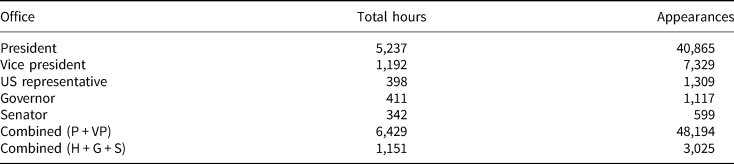
Table 1 indicates the television appearances of the presidential, vice-presidential, US representative, gubernatorial, and senatorial candidates. The first column shows the total number of hours in which candidates appeared on television programs for more than five minutes, while the second shows the number of times candidates appeared on programs for less than five minutes. The last two rows present comparisons of the total numbers for the presidential and vice-presidential candidates, and for the US representative, gubernatorial, and senatorial candidates, respectively.
Appearances by candidates on television during the 1960 presidential election

The first column in Table 1 indicates that presidential and vice-presidential candidates appeared about 5.6 times more often than the US representative, gubernatorial, and senatorial candidates combined on television programs. The difference between presidential candidates and candidates of other offices is even greater in short appearances, as indicated in the second column. If we assume that the short appearances' minutes are evenly distributed, with a mean value of 2, then the total number of hours of appearances of the presidential and vice-presidential candidates would be 8,035 6, 429 + 48, 194/60 × 2;, and the total number of hours of appearances of the US representative, gubernatorial, and senatorial candidates would be 1,252 (1, 151 + 3, 025/60 × 2);. This would suggest that presidential and vice-presidential candidates appeared about 6.4 times more often than the other candidates in the elections.
To see how this result compares to newspaper coverage of politicians, I searched newspaperarchive.com for articles that mentioned presidential and gubernatorial candidates during the same period: September 1–November 7, 1960.Footnote 2 Specifically, I searched for articles that mentioned the word “election” and one of the last names of the candidates from the two major parties. The sample includes 292 newspapers published in 26 states. I found 22,725 articles that mentioned presidential candidates and 10,021 articles that mentioned gubernatorial candidates. Although the sample from newspaperarchive.com may not be representative of the newspapers in the United States, the results can shed some light on how newspapers and television programs cover politics differently. While presidential candidates appear on television about 13 times more than gubernatorial candidates,Footnote 3 they are mentioned only twice as much as gubernatorial candidates in newspapers.
The exercise in this section implies that television news focused more on national political figures than did local newspapers' news. More national news would naturally increase the salience of national issues in elections. Consistent with this expectation, previous studies show that national forces became more important in US presidential elections from the beginning of the 20th century through to the 1950s (Aguiar-Conraria, Magalhães, and Soares Reference Aguiar-Conraria, Magalhães and Soares2013; Bartels Reference Bartels1998), which coincides with the rise of broadcasting media. In the next section, I test whether television increased the saliency of the national economy—one of the most important national issues—in presidential elections.
The Effect of Television on Economic Voting
In this section, I investigate the effect of television on economic voting. The introduction of television can strengthen the relationship between the national economy and the incumbent presidential party's vote share in presidential elections in two ways. First, when voters receive more information about the national economy from television, their assessment of the state of the national economy would become more accurate. Measurement errors in voters' assessment of the national economy would lead to an attenuation bias—a weaker correlation between the national economy and the incumbent party's vote share. Therefore, by providing more information about the national economy, television can make the correlation between the state of the national economy and the incumbent party's vote share stronger. Second, television can increase the importance of the national economy by making it more salient. Previous studies on priming show that the media can increase the importance of a certain issue by emphasizing it (see, for example, Miller and Krosnick Reference Miller and Krosnick2000; Valentino et al. Reference Valentino, Hutchings and White2002). As such, more news on national issues such as the national economy would make it more salient.
In order to test this, I estimate a regression in the following form:
 $$\eqalign{& {\rm Democratic}\;{\rm Vot}{\rm e}_{ct} = \alpha _c + \theta _t + \beta _1{\mkern 1mu} TV_{ct} \cr & \hskip86pt + \beta _2{\mkern 1mu} {\rm T}{\rm V}_{ct} \times \Delta {\rm National}\;{\rm Eco}{\rm n}_t + {\gamma }^{\,\prime}X_{ct} + {\rm \epsilon }_{ct}, \;} $$
where Democratic Votect, the dependent variable, is the share of the two-party vote received by the Democratic Party running for president in county c in year t. The county fixed effects, α c, control for unobserved county attributes that do not vary over time, and the year fixed effects, t, control for year-specific effects common to all counties, such as the popularity of presidential candidates.
TVct is an indicator variable that takes the value of 1 for counties that have access to television and 0 otherwise. Following Gentzkow (Reference Gentzkow2006), I code a county as having a television station if it is located in a media market that has at least one television station.Footnote 4 ΔNational Econt is a one-year change in national economic indicators. The main effect of ΔNational Econt is omitted in the regression equation because it is absorbed by the year fixed effects. I use two indicators of the national economy: a one-year percentage growth in national real per capita income; and a one-year change in unemployment rate.Footnote 5 A one-year percentage change in the unemployment rate is coded such that positive values indicate an improving economy. As the dependent variable is the Democratic vote share, I multiply each economic indicator by a variable indicating the incumbent presidential party (1 for Democrats and −1 for Republicans).Footnote 6 I also standardize the ΔNational Econt variable before running regressions to make it easier to interpret the results.
The vector X ct includes county-level control variables: total population; population per square mile; the share of the white population; the share of females; the share of the population living in cities with 25,000 or more people; population aged 25 years and older with more than 12 years of education as a share of the entire population aged 25 years and older; and the log of the total dollar value of manufacturing output per capita.Footnote 7 Alternatively, I can allow the demographic characteristics of counties before television was introduced to affect the vote differently before and after the introduction of television. I include interaction terms between TVct and pre-treatment demographic control variables fixed in 1944, when television had not yet been introduced into the counties. The main effects of the control variables are excluded with the inclusion of county fixed effects. As I show in Online Appendix A, the results remain similar.
The effect of television on economic voting is estimated by β 2. If television increased the importance of the national economy in presidential elections, the β 2 estimate would be positive, which suggests that an improving national economy increased the vote share received by the incumbent party when television became available.
The main specification mentioned earlier exploits the fact that television stations were introduced into counties across the United States at different times. The expansion of television began in the late 1940s, and by 1960, nearly all US counties had at least one television station. In the sample, about 7 per cent of the counties and about 98.6 per cent of the counties had a television station in 1948 and 1960, respectively. The expansion, however, was temporarily halted by the FCC's freeze on new television station licenses in September 1948, which it announced because of the excessive interference of spectrums. The freeze on licenses lasted until 1952. According to Gentzkow (Reference Gentzkow2006), this plausibly exogenous event helps the identification strategy because it affected the timing of the entry of television into US counties.
In Online Appendix A, I exploit the FCC's freeze further by matching the counties that had television stations before the FCC's 1948 freeze on television licenses (pre-freeze counties) to those where television was introduced after the freeze (post-freeze counties). I match the pre- and post-freeze counties using the control variables described in equation (1) and repeat the main analyses using only the matched sample. Matching addresses the concern that the main results are because of the differences between the media markets that had television stations earlier and those that had stations later.
Another factor that helps the identification strategy is the fact that television entered media markets in heterogenous counties (Gentzkow Reference Gentzkow2006). Gentzkow (Reference Gentzkow2006) points out that the timing of the introduction of television could have been affected by the demographic characteristics of the media market's center (for example, Cook County in the Chicago DMA) but may have had less to do with the demographic characteristics of the counties outside a media market's center (for example, Newton County in the Chicago DMA). As a further robustness check, I use this fact and restrict the sample to pre- and post-freeze counties that happened to be located around each media market's center. I pair each pre-freeze county to one of its contiguous post-freeze counties that is similar in terms of demographic characteristics. This removes all the media centers and isolated counties from the sample. Using geographic proximity and demographic similarity would further address the concern that the results are driven by the fact that the timing of television's introduction is correlated with the characteristics of the counties. Additional information on this pairing procedure and the results of the analyses can be found in Online Appendix A.
In addition to the main specification in the regression equation, I also use the following specifications. First, I include county-specific linear time trends to address the issue that different counties' time trends may cause biased results. Second, I also use a specification in which I include state-specific year fixed effects that control for any unobserved state-level factors that may affect the introduction of television and election outcomes. Standard errors in all models are clustered at the county level. In Online Appendix B, I report standard errors with two-way clustering by county and year because one of the variables in the interaction term, ΔNational Econt, varies by year. The results remain similar.
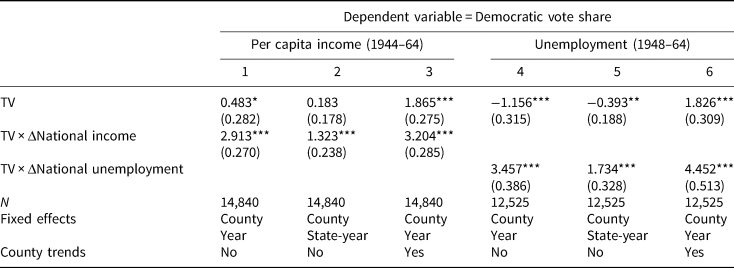
The main results are presented in Table 2.Footnote 8 In columns 1–3, I use a one-year change in per capita income, and in columns 4–6 I use a one-year change in the national unemployment rate. The results suggest that television increased the salience of the national economy. The coefficient of TV × ΔNational Econ is statistically significant and large in magnitude in all specifications.
Economic voting and TV in presidential elections

Notes: Standard errors, clustered by county, are in parentheses. County-level control variables are included in all columns. ΔNational Incomeand ΔNational Unemployment are standardized. ΔNational Unemployment is coded such that positive values indicate an improving economy. *** p < 0.01; ** p < 0.05; * p < 0.1.
To assess the magnitude of the effect, let us assume a one-year change in the national per capita income is one standard deviation above the mean. According to the estimate in column 1, television increased the vote share of the Democratic Party by 3.4 percentage points (2:90:5). The magnitude differs on the basis of specifications; however, the effect is substantial in all cases—it ranges from 1.5 to 5.1 percentage points.
The results are similar when I use a one-year change in the unemployment rate.Footnote 9 When television became available in a relatively good year for the Democratic Party (one standard deviation above the mean), it increased its vote share by 1.3 to 6.3 percentage points.
National Economy, Local Economy, and Television
The results reported in the previous section show that the effect of the national economy on the vote share of the incumbent presidential party increased when television became available. The national economy may have become more important because television provided more accurate news about the national economy. Before the introduction of television, voters may have formed their assessment of the national economy based on the state of the local economy (see, for example, Reeves and Gimpel Reference Reeves and Gimpel2012). If people relied on local information to make an inference about the state of the national economy, the introduction of television should decrease the correlation between the vote share and the local economy.
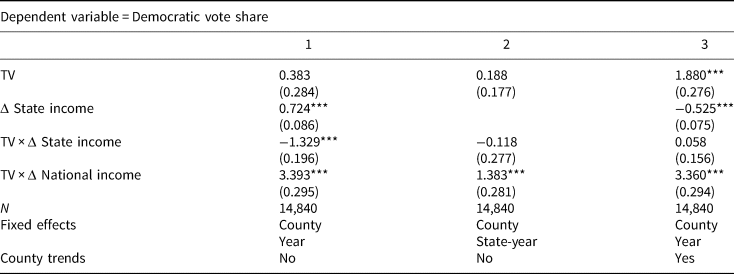
To examine this, I include the state-level economy variable and its interaction with TV to the specification outlined in the regression equation.Footnote 10 Table 3 shows the results,Footnote 11 which suggest that television did not affect how people voted based on the state economy. Although the coefficient of TV × Δ is negative and statistically significant in column 1, it becomes insignificant when I include state × year fixed effects or county-specific time trends, as shown in columns 2 and 3. Perhaps more importantly, the results in Table 3 confirm the findings in Table 2: holding ΔNational Income at one standard deviation above the mean value, television would increase the vote share of the Democratic Party by 1.6 to 5.2 percentage points.
National- and state-level economic voting and TV in presidential elections

Notes: Standard errors, clustered by county, are in parentheses. County-level control variables are included in all columns. Δ National Incomeand Δ State Income are standardized. *** p < 0.01; ** p < 0.05; * p < 0.1.
Although the results show that television did not change the degree to which voters vote based on the state economy, it may have affected the local-level economic voting. Previous studies have used the county-level unemployment rate (see, for example, Wright Reference Wright2012) or wages per worker (see, for example, de Benedictis-Kessner and Warshaw Reference De Benedictis-Kessner and Warshaw2020) to assess the state of the local economy. Unfortunately, however, none of these indicators are available for the time period of this study. Instead, I use the log of manufacturing output as a proxy for the county-level economy.Footnote 12 The county-level wages per worker, which was used by de Benedictis-Kessner and Warshaw (Reference De Benedictis-Kessner and Warshaw2020) as an indicator of the local-level economy, and the log of manufacturing output as they are both measured in 1970 are positively correlated with a correlation coefficient of 0.37.Footnote 13 To assess whether television affected the county-level economic voting, I include the log of manufacturing output and its interaction with the TV variable. The results, reported in Online Appendix C, suggest that television did not affect the local-level economic voting.
Television and Economic Expectations
The results so far indicate that television had a significant effect on economic voting. An important question in the economic voting literature is whether voters' sociotropic or pocketbook considerations matter (see, for example, Kiewiet and Lewis-Beck Reference Kiewiet and Lewis-Beck2011). Survey-based studies on economic voting tend to conclude that sociotropic concerns matter more than pocketbook ones. As Hansford and Gomez (Reference Hansford and Gomez2015, 16–17) state: “the weight of evidence in support of the sociotropic hypothesis over the pocketbook hypothesis is so one-sided that it is fair to say that when political scientists today think about ‘retrospective voting’ they are more than likely thinking ‘sociotropic voting’.” Another issue of economic voting is whether voters are prospective or retrospective (see, for example, Clarke and Stewart Reference Clarke and Stewart1994; MacKuen, Erikson, and Stimson Reference MacKuen, Erikson and Stimson1992). The results reported in previous sections are in line with retrospective sociotropic voting. They indicate that nationally oriented news (provided by television) increased the importance of the national economy (measured as a one-year change in growth and unemployment rates) in presidential elections.
In light of the debate on sociotropic versus pocketbook, and prospective versus retrospective, economic voting, it would be interesting to examine whether the introduction of television indeed made voters more likely to engage in retrospective sociotropic voting using survey data. Previous studies have shown that different sources of economic news have different effects on voters' economic perceptions (see, for example, Goidel et al. Reference Goidel2010). Therefore, when voters started receiving economic news from the new information source, their perception of the economy and its relationship with political preferences could change.
Unfortunately, however, the standard sociotropic and pocketbook questions are not included in the US National Elections Study (NES) during the study period. Instead, I use the following question from the 1952 NES survey: “Do you think it will make any difference in how you and your family get along financially whether the Democrats or Republicans will win?” This question can be used to measure respondents' economic expectations. It taps a respondent's pocketbook rather than sociotropic side of economic expectation. One important difference from the standard prospective pocketbook question is that it makes an explicit connection between the respondent's future economic situation and the results of an election.Footnote 14
Using this question, I examine whether television has affected the degree of prospective pocketbook voting. Goidel et al. (Reference Goidel2010), who examine the relationships between voters' perceptions of the economy and various sources of economic news, show that national networks’ coverage of the economy is significantly related to voters' personal financial expectations. As such, the introduction of television might have affected prospective pocketbook voting.
I first measure how much a respondent thinks that their financial situation will be affected by the results of an election. I create Party Difference, which is a dummy variable that takes the value of 1 if a respondent stated that it will make a difference depending on whether the Democrats or Republicans win and 0 otherwise. If television has increased the importance of prospective pocketbook considerations, the share of respondents who think that their financial situation will be affected by an election would be greater in areas where television was introduced. I also create an Economic Expectation variable, which takes the value of 1 (−1) if a respondent thinks that they would be better off if the Democrats (Republicans) win the election and 0 if otherwise. I regress the support for the incumbent party, the Democratic Party, on a TV dummy variable (which takes the value of 1 if a respondent lives in a county where television is available and 0 otherwise), Economic Expectation, and the interaction term between these two variables. The coefficient of the interaction term would measure the effect of television on prospective pocketbook voting.
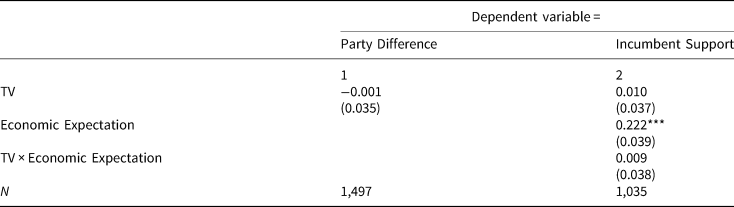
Table 4 shows the results of the regression analyses. All columns include county- and individual-level control variables.Footnote 15 The dependent variable in column 1 is Party Difference, a dummy variable for those who think that their financial situation will be affected by the results of the election. It shows that TV has no effect on Party Difference. Column 2 shows that Economic Expectation has a positive and significant effect on incumbent support. The respondents who think that the Democrats (Republicans) will make them financially better are more likely to support (oppose) the incumbent presidential party, the Democratic Party. More importantly, I find no evidence that television has increased the saliency of prospective pocketbook considerations. The estimate for the coefficient of the TV × Economic Expectation is close to 0 and statistically insignificant.
Television and pocketbook consideration

Notes: The regressions are based on the US NES. Variables are coded as follows. Party Difference = a dummy variable that takes the value of 1 if a respondent stated that it will make a difference depending on which party wins; Incumbent Support = a dummy variable that takes the value of 1 if a respondent supports the incumbent party; Economic Expectation = a variable that takes the value 1 (−1) if a respondent thinks that they would be better off if the Democrats (Republicans) win and 0 otherwise. Standard errors, clustered by county, are in parentheses. County- and individual-level control variables are included in all columns. *** p < 0.01; ** p < 0.05; * p < 0.1.
The results reported in this section suggest that television had no impact on voters' prospective pocketbook voting in elections. They are in line with what Mutz (Reference Mutz1992) calls the “sociotropic priming effect” of mass media. Mutz (Reference Mutz1992) presents evidence that mass media increases the importance of sociotropic concerns and de-emphasizes personal experiences with economic problems. The results are also consistent with those reported in previous sections. If television increased the importance of the national economy in elections because voters received more national news after its introduction, it should increase the effect of voters' sociotropic considerations on political preferences but not their pocketbook considerations.
However, because of the limitation of data, I was not able to directly test whether television affected voters' perceptions of the national economy or the way those perceptions are linked to their political preferences. It should also be noted that, unlike the analyses in previous sections, the regressions in Table 4 only used cross-sectional variation in the availability of television. Using within-county or individual variations would require panel survey data. The NES did conduct a panel study in 1956, 1958, and 1960; however, I was unable to use these data because more than 90 per cent of individuals in the sample already had access to television in 1956. Therefore, an interesting future study could exploit an exogenous change in the media environment, such as the one used in this study, and panel survey data to causally estimate the effects of mass-mediated information on voters' sociotropic and pocketbook considerations, and their relationship with political preferences.
Discussion
My findings suggest that better access to political news can help voters hold politicians accountable for past economic performance. I show that television stations spent more time covering national politicians than local newspapers did in the 1960 presidential election. More national news increased the saliency of national issues in presidential elections. The main results of this article indicate that the importance of the national economy increased when television became available. It is an open question, however, whether political information would still lead to performance-based economic voting in today's fragmented media environment, where news is more biased.
Early television journalists were bound to the norm of “journalistic objectivity” (Schudson Reference Schudson2001) and were expected to give balanced coverage of issues. As televisions were dominated by a few big networks—the American Broadcasting Company, the Columbia Broadcasting System, and the National Broadcasting Company—which faced little competition, they had little incentive to differentiate politically to carve out markets. In addition, politics during this period was less polarized and partisan than today (see, for example, Campante and Hojman Reference Campante and Hojman2013; Rae Reference Rae2007).Footnote 16 In contrast, in today's media environment, media outlets face more fierce competition and their audiences are more polarized than before; therefore, their coverage of economic news is more likely to be biased.
There is a substantial body of empirical research that demonstrates partisan bias of the media (Ansolabehere, Lessem, and Snyder Reference Ansolabehere, Lessem and Snyder2006; Galvis, Snyder, and Song Reference Galvis, Snyder and Song2016; Gentzkow and Shapiro Reference Gentzkow and Shapiro2010; Groeling Reference Groeling2008; Groseclose and Milyo Reference Groseclose and Milyo2005; Larcinese, Puglisi, and Snyder Reference Larcinese, Puglisi and Snyder2011; Puglisi and Snyder Reference Puglisi and Snyder2011).Footnote 17 In particular, Larcinese, Puglisi, and Snyder (Reference Larcinese, Puglisi and Snyder2011) show partisan bias in newspapers' coverage of economic news. They find that pro-Democratic newspapers cover high-unemployment stories more frequently compared to pro-Republican newspapers when the incumbent president is a Republican. Kayser and Peress (Reference Kayser and Peress2021) also document partisan bias in economic news across 16 developed countries. If partisan media exaggerate good economic news and suppress bad economic news when the party they support is in power, economic performance would matter less in elections because economic news would only reinforce voters' partisan preferences. Previous studies have also shown that media outlets tend to cover bad news more frequently than they do good news (Kayser and Peress Reference Kayser and Peress2021; Soroka Reference Soroka2006; Soroka Reference Soroka2012). Negativity bias can also have implications for performance-based economic voting. For instance, it may reduce the incentive for politicians to improve the economy.
My findings also have implications for democratic accountability. They are not unambiguously good or bad news. On the one hand, the results are consistent with the literature on the role of information in improving political accountability (see, for example, Snyder and Strömberg Reference Snyder and Strömberg2010; Strömberg Reference Strömberg2004). When television was introduced, voters were more likely to punish the incumbent presidential candidate for a bad economy and reward them for a good economy. Therefore, it can assist voters in selecting a political party that is better at managing the national economy and also provide incentives for politicians to exert more effort to improve the economy.
On the other hand, the results can also be interpreted as evidence that the media induce voters to base their decisions on the election-year economy (see, for example, Healy and Lenz Reference Healy and Lenz2014), which may provide a greater incentive to politicians to manipulate the economy and create an election-year boom (see, for example, Drazen Reference Drazen2001). Since national economic conditions can be influenced by events beyond politicians' control, such as oil shocks, the results may also imply that voters reward and punish incumbent politicians based on their luck (see, for example, Achen and Bartels Reference Achen and Bartels2017). In addition, television may have depoliticized personal experiences by increasing the salience of national issues. As Mutz (Reference Mutz1992) suggested, the depoliticization of personal experiences may lead to a breakdown of democratic accountability if those who are not exposed to mass-mediated information vote based on inaccurate information instead of aggregated individual reality.
Supplementary Material
Online appendices are available at: https://doi.org/10.1017/S0007123421000545
Data Availability Statement
Replication data for this article can be found in Harvard Dataverse at: https://doi.org/10.7910/DVN/AQ0MM8
Acknowledgements
I thank Jim Snyder for his guidance and support throughout this project. I am also grateful to Jim Alt, Steve Ansolabehere, Anthony Fowler, Andy Hall, Dan Hopkins, Horracio Larreguy, Gary King, Gabe Lenz, Pablo Querubin, Mike Sances, Kay Schlozman, Ben Schneer, Jesse Shapiro, Ken Shepsle, Sidney Verba, seminar participants at Harvard University, and three anonymous reviewers for their helpful comments and suggestions. All remaining errors are mine.
Financial Support
None
Competing Interests
None