Introduction
The introduction of farming into Europe during the seventh and sixth millennia cal BC followed two main paths: the Central European route, mainly represented by the Linear Pottery Culture (or Linearbandkeramik; LBK), and the Mediterranean route, characterised by the Impresso-Cardial Complex (ICC). Many aspects of LBK material culture, such as longhouses and pottery style, can be followed from Central to Western Europe, while ancient DNA (aDNA) analyses show continuity between the first Near Eastern farmers and LBK populations (Lichardus & Lichardus-Itten Reference Lichardus and Lichardus-Itten1985; Price Reference Price2000; Haak et al. Reference Haak, Balanovsky, Sanchez, Koshel, Zaporozhchenko, Adler, Der Sarkissian, Brandt, Schwarz, Nicklisch, Dresely, Fritsch, Balanovska, Villems, Meller, Alt and Cooper2010; Szécsényi-Nagy et al. Reference Szécsényi-Nagy, Brandt, Keerl, Jakucs, Haak, Möller-Rieker, Köhler, Mende, Fecher, Oross, Paluch, Osztás, Kiss, Pálfi, Molnár, Sebők, Czene, Paluch, Šlaus, Novak, Pećina-Šlaus, Ősz, Voicsek, Somogyi, Tóth, Kromer, Bánffy and Alt2015; Hofmanová et al. Reference Hofmanová, Kreutzer, Hellenthal, Sell, Diekmann, Díez-del-Molino, van Dorp, López, Kousathanas, Link, Kirsanow, Cassidy, Martiniano, Strobel, Scheu, Kotsakis, Halstead, Triantaphyllou, Kyparissi-Apostolika, Urem-Kotsou, Ziota, Adaktylou, Gopalan, Bobo, Winkelbach, Blöcher, Unterländer, Leuenberger, Çilingiroğlu, Horejs, Gerritsen, Shennan, Bradley, Currat, Veeramah, Wegmann, Thomas, Papageorgopoulou and Burger2016). Together, these suggest a continuous migratory event. The formation process and the first steps of ICC expansion, characterised by the Impressa stage, are, by contrast, poorly understood. The current dominant interpretation is that the first ICC farmers originated from the Aegean area, expanding via coastal seafaring to Italy, southern France and (mainly in the subsequent Cardial stage) to the Iberian Peninsula (Zilhão Reference Zilhão2001). The striking diversity of the Impressa material culture (notably its pottery styles), however, provides no traceable dispersal route (Binder Reference Binder, Perrin, Manen, Marchand, Allard, Binder and Ilett2013; Manen et al. Reference Manen, Perrin and Guilaine2014). Although aDNA analyses performed in Spain on Cardial individuals suggest human mobility across the Mediterranean (Gamba et al. Reference Gamba, Fernández, Tirado, Deguilloux, Pemonge, Utrilla, Edo, Molist, Rasteiro, Chikhi and Arroyo-Pardo2011; Hofmanová et al. Reference Hofmanová, Kreutzer, Hellenthal, Sell, Diekmann, Díez-del-Molino, van Dorp, López, Kousathanas, Link, Kirsanow, Cassidy, Martiniano, Strobel, Scheu, Kotsakis, Halstead, Triantaphyllou, Kyparissi-Apostolika, Urem-Kotsou, Ziota, Adaktylou, Gopalan, Bobo, Winkelbach, Blöcher, Unterländer, Leuenberger, Çilingiroğlu, Horejs, Gerritsen, Shennan, Bradley, Currat, Veeramah, Wegmann, Thomas, Papageorgopoulou and Burger2016), they lack geographic and chronological resolution, thus preventing a detailed assessment of the spatial, temporal and social dynamics that led to the initial spread of farming ways of life.
Ceramic-manufacturing techniques can act as a high-resolution proxy for the trajectories of the first ICC farmers. The basis for this technological proxy, which has its roots in the ‘French School of Anthropology of Techniques’ (Mauss Reference Mauss1947; Leroi-Gourhan Reference Leroi-Gourhan1964; Latour & Lemonnier Reference Latour and Lemonnier1994), is the assumption that the sequence (chaîne opératoire) of ceramic construction is a powerful marker of the social identity of its producer. Behavioural studies show that the technical steps (or gestures) used during ceramic manufacturing are progressively embodied in the course of learning, and then transformed into motor habits that producers will not be able to easily question nor modify (Bril Reference Bril, Bril and Roux2002). This cognitive mechanism, which systematically involves a tutor and a learner, leads to the transmission, over generations, of gesture sequences within a geographically defined learning network, whose perimeter outlines the spread of a given community of practice (Gosselain Reference Gosselain2000; Roux Reference Roux and Scarcella2011). As emphasised by Roux (Reference Roux and Hunt2016: 102), “this transmission process occurs within groups made up of individuals linked by social ties”. A community of practice, therefore, corresponds to a social group, whose nature varies according to the apprenticeship structure. The transmission process can occur, for instance, within a clan, a lineage, an ethnic group or an ethno-linguistic group (Gosselain Reference Gosselain2000; Livingstone Smith Reference Livingstone Smith and Garcea2001; Gelbert Reference Gelbert2003; Roux Reference Roux and Scarcella2011, Reference Roux and Hunt2016).
This socio-cognitive approach to pottery manufacture was successfully applied in tracing population movements and interactions among the first farmers of the Balkans, Central Europe and West-Central Europe (Commenge Reference Commenge2009; Salanova et al. Reference Salanova, Vieugué and Gomart2010, in press; Gomart Reference Gomart2014, Reference Gomart2016; Gomart et al. Reference Gomart, Hachem, Hamon, Giligny and Ilett2015; Kreiter et al. Reference Kreiter, Marton, Gomart, Oróss, Pánczél and Burnez-Lanotte2017). These studies demonstrate continuity in cognitive schemes from the Balkans to West-Central Europe, which is clearly apparent even in the light of slight variance observed at the regional or site level (Gomart Reference Gomart2014, Reference Gomart2016; Gomart et al. Reference Gomart, Hachem, Hamon, Giligny and Ilett2015). Overall, these studies are consistent with the assumption of a continuous dispersal of the farming economy across these regions.
Spiralled patchwork technology: a complex technical scheme at Abri Pendimoun
To investigate the dispersal route of farming across Southern Europe, we studied the pottery technical practices implemented at Abri Pendimoun in south-eastern France (located less than 1km from the Italian border, in the Ligurian-Provencal Arc). This rockshelter has one of the only stratified ICC contexts (Binder et al. Reference Binder, Brochier, Duday, Helmer, Marinval, Thiebault and Wattez1993; Binder & Maggi Reference Binder and Maggi2001) and has yielded many stratigraphic levels belonging to the Impressa phase, dated to 5730–5480 cal BC (Binder & Sénépart Reference Binder, Sénépart, Manen, Convertini, Binder and Sénépart2010).
The large pottery assemblage associated with the Impressa layers (126 reconstructed ceramics) displays significant morphological and dimensional variability. Strikingly, the study of this diverse assemblage—integrating both macroscopic analysis and micro-computed tomography (µCT)—shows that all of the pottery was produced using a single technology. Differing from all the technical sequences previously recorded in early farming contexts in Europe (Commenge Reference Commenge2009; Salanova et al. Reference Salanova, Vieugué and Gomart2010; Gomart Reference Gomart2014, Reference Gomart2016), this technology has not yet, to our knowledge, been identified archaeologically or ethnographically. All the ceramics, regardless of their size and shape, were constructed entirely by juxtaposing and fusing circular patches, each formed by a spiral coil. The diameter of each patch is on average 44±2.3mm (one standard deviation), irrespective of pottery type. We term this technical sequence ‘spiralled patchwork technology’ (SPT).
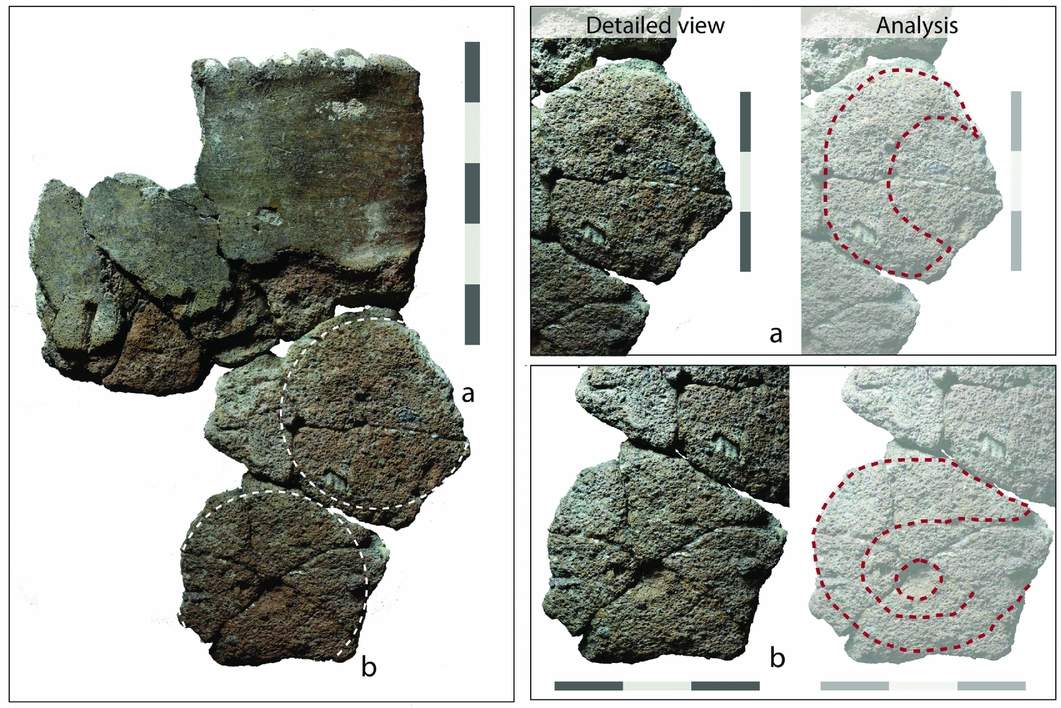
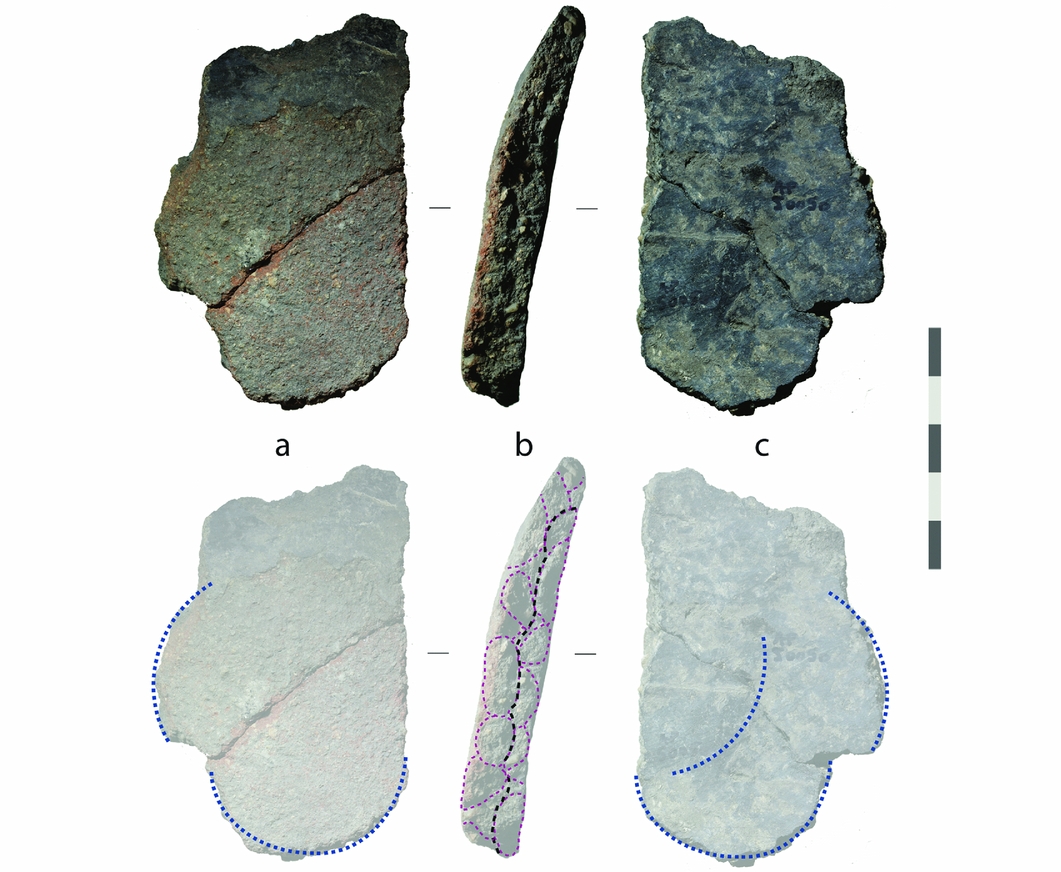
Ceramic macroscopic analysis relies on the fact that the spatial organisation of pores and mineral inclusions, and the surface topography of a vessel, are subject to the specific type of pressure applied to the clay during production (Pierret et al. Reference Pierret, Moran and Bresson1996). Thus, systematic examination of these features provides a coherent and reproducible indication of the pottery-manufacturing technology used (Thér Reference Thér2016). Macroscopic analysis of associated pottery revealed the following features in all ceramics: uneven surface topography; networks of curvilinear fractures and circular convexities on the surfaces; circular organisation of the pores and inclusions; curvilinear discontinuities in the tangential plane (Figure 1); and circular configurations associated with long oblique discontinuities in the radial plane (Figure 2). Together, these features indicate the unequivocal use of SPT in the production of all the ceramics from the Impressa layers at Abri Pendimoun.
Ceramic macroscopic analysis identifies spiralled patchwork technology. Examination of the ceramics of Abri Pendimoun was conducted by direct observation and micro-topographic mapping of the sherds’ surfaces. All ceramics (n = 126) exhibit networks of circular fractures occurring along the edges of juxtaposed patches. A representative sherd with two highlighted patches (A and B) is presented. Circular fractures (white dashed lines) delineate the edge of each patch. Arced discontinuities are observed within the patches (red dashed lines). Micro-topographic mapping of the highlighted patches also shows arced discontinuities (blue). Together these suggest the use of a spiralled coil to form each juxtaposed patch. Scale bars are 50mm (left panel) and 30mm (middle panels).

Traces characteristic of the use of the spiralled patchwork technology identified in the radial and tangential planes on the ceramics of Abri Pendimoun. A) External surface; B) radial plane; C) internal surface. Blue dashed lines: curvilinear fractures and convexities occurring along the edges of the juxtaposed spiralled patches. Black dashed line: long oblique discontinuity corresponding to the line of junction in the radial plane between two juxtaposed patches. Magenta dashed lines: circular configurations corresponding to the sections of the spiralled coil used to produce each patch. Scale bar is 50mm. See also Figure 3d and supplementary video 3.

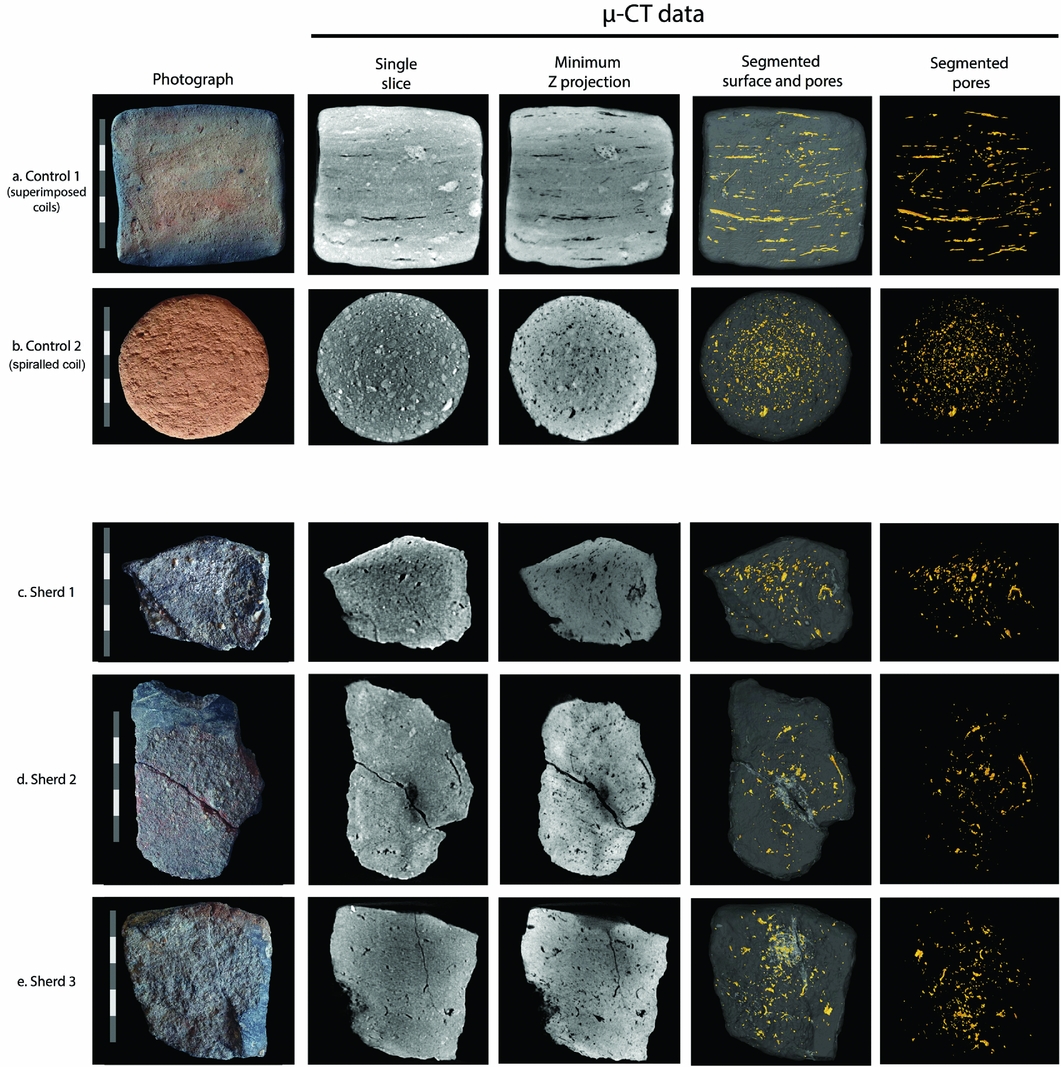
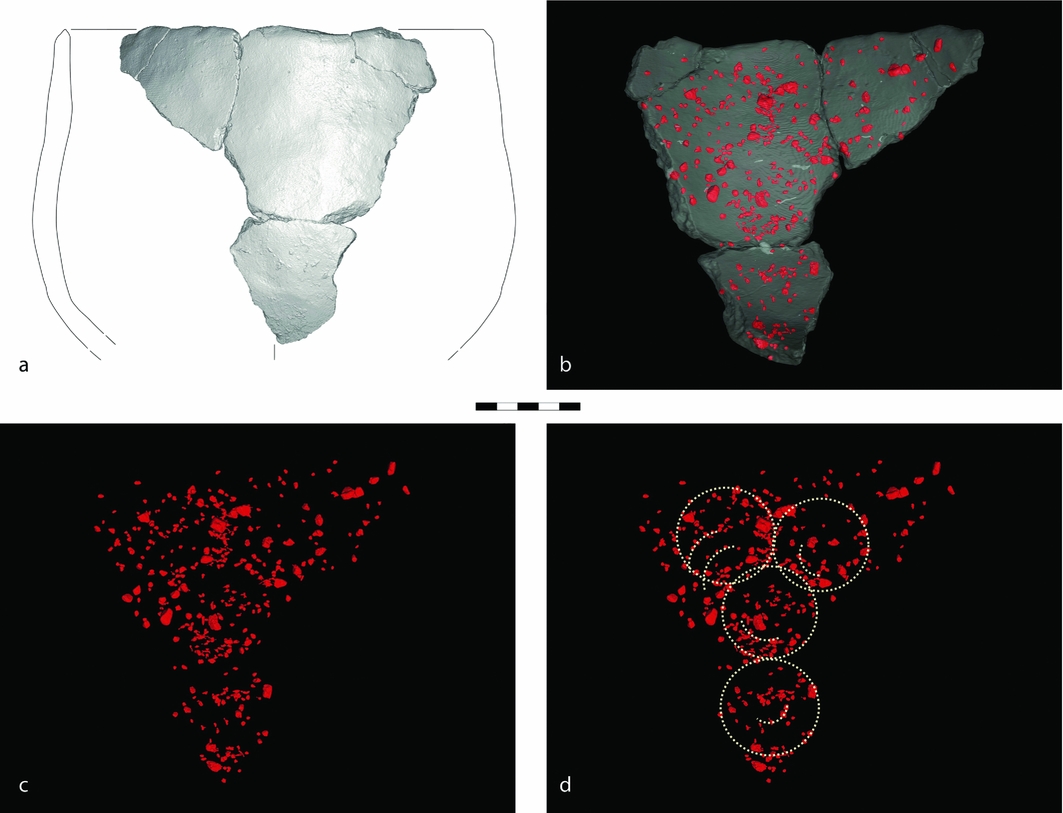
Micro-computed tomography (µCT) has recently emerged as a valuable imaging tool for studying ancient ceramics (Kahl & Ramminger Reference Kahl and Ramminger2012; Sanger et al. Reference Sanger, Thostenson, Hill and Cain2012), as it provides information on their internal microstructure. In this study, we applied µCT to a combination of experimental controls, archaeological sherds and ceramic vessels from the Impressa layers at Abri Pendimoun, thereby establishing a link between macroscopic features and the internal microstructure of the sherds. To provide a frame of reference for the µCT analysis of the archaeological materials, two experimental ceramic controls were produced and subjected to µCT analysis. The first used the regular coiling technique (Figure 3a, supplementary video 1) that is often observed in European early farming contexts (Salanova et al. Reference Salanova, Vieugué and Gomart2010, in press; Gomart Reference Gomart2014, Reference Gomart2016). The second used a spiralled coil, mimicking the patches that we conclude were employed in the construction of the Impressa pottery (Figure 3b, supplementary video 1). µCT analysis of three sherds from the Impressa layers (Figure 3c–e, supplementary videos 2–4) revealed curvilinear patterns that are clearly distinct from the horizontal porous system of the experimental coiled control. Rather, these patterns resemble the circle-shaped porous system of the spiralled coil control. µCT analysis was also applied to a reconstructed archaeological vessel, revealing that mineral inclusions are organised in circular shapes, whose diameter (around 45mm) matches the size of the round fractures and the convexities observed by macroscopic analysis (Figure 4, supplementary video 5). This result further confirms the use of juxtaposed spiralled patches to build the entire vessels, from the base to the rim.
Micro-computed tomography (µ-CT) confirms the use of spiralled patchwork technology in Abri Pendimoun. µ-CT of experimental controls prepared with the superimposed coil technique (A) or the spiralled coil technique (B) are compared with three representative archaeological sherds from Abri Pendimoun (C–E). The 3D tomograms are represented in a single slice, a minimum Z projection (projection of 30 central slices) and a segmentation of the porous system (gold) with and without the surface segmentation (grey). A photograph of each control and sherd is provided for reference. Scale bar is 50mm. See also supplementary videos 1–4.

Micro-computed tomography (µ-CT) of reconstructed archaeological pottery from Abri Pendimoun confirms the use of juxtaposed spiralled patches to build the entire vessel. A) Segmented vessel surface viewed from the outside with rim (top) and base (bottom) placed in context; B) segmented surface (grey) and large inclusions (red) viewed from the inside; C) segmented inclusions only; D) inclusions are spatially organised in juxtaposed circular shapes (white dashed lines). Scale bar is 50mm. See also supplementary video 5.

Spiralled patchwork technology: an ICC technical tradition?
To assess whether SPT was a restricted phenomenon only associated with Abri Pendimoun or a wider ICC technical tradition, we conducted ceramic macroscopic analyses on material from reference sites located in the following early ICC dissemination areas: Ripa Tetta in south-eastern Italy (early phase: 5890–5660 cal BC), Colle Santo Stefano in central Italy (early phase: 5840–5620 cal BC) and Arene Candide in the Ligurian-Provencal Arc (early phase: 5790–5640 cal BC) (Cipolloni Sampò et al. Reference Cipolloni Sampò, Tozzi, Verola and Vaquer1999; Radi & Verola Reference Radi, Verola and Tinè1999; Binder & Maggi Reference Binder and Maggi2001; Tozzi Reference Tozzi, Delpino, Pessina and Tinè2002; Fabbri et al. Reference Fabbri, Petrinelli Pannocchia and Radi2011).
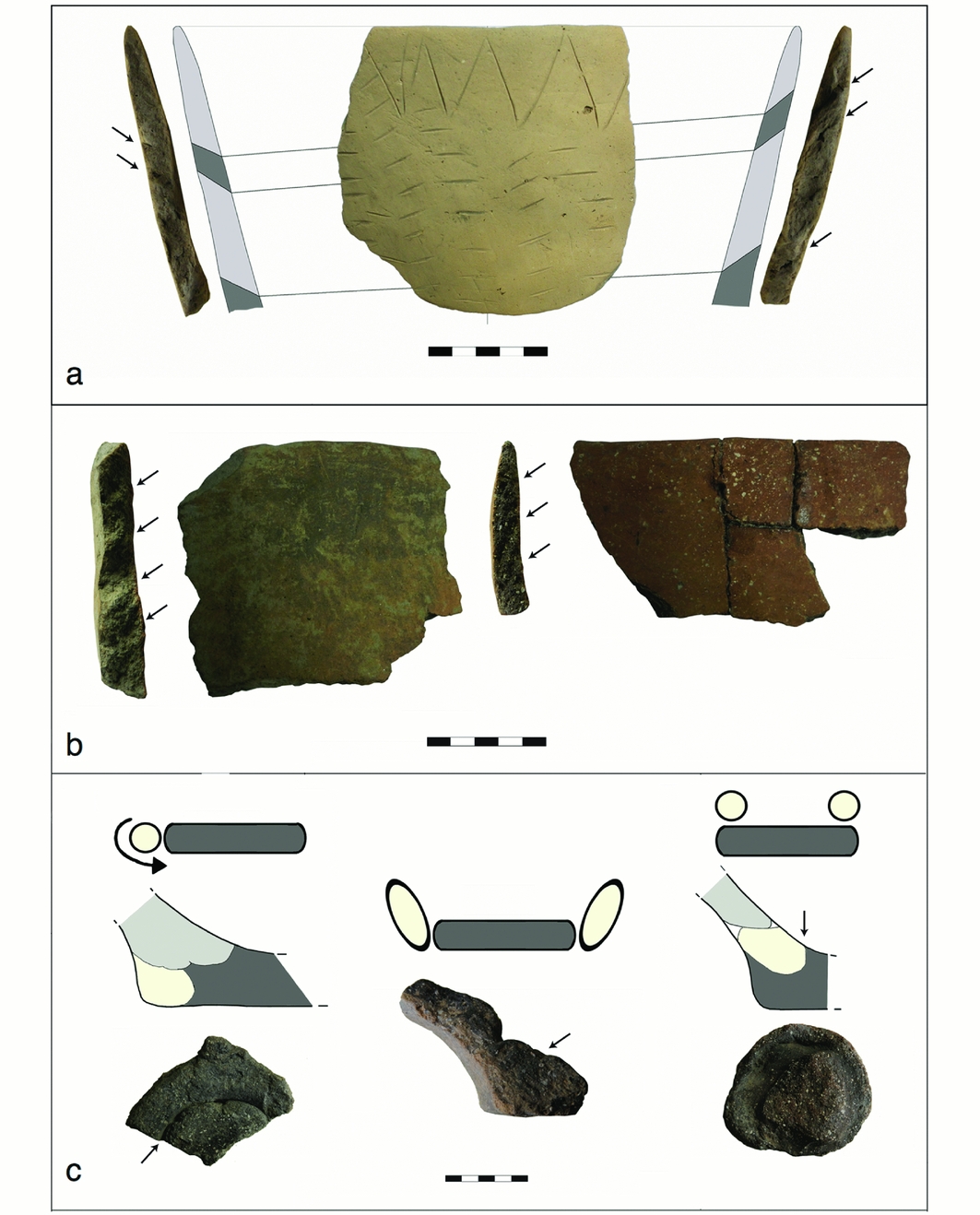
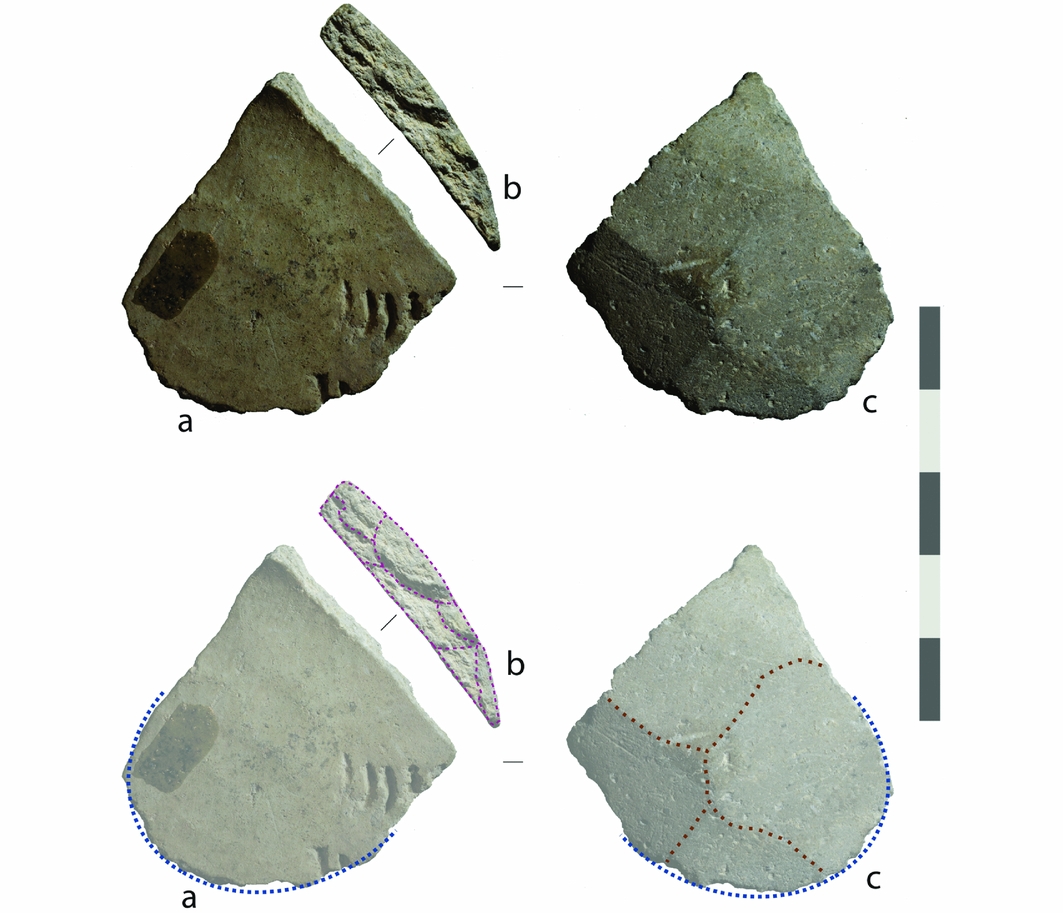
In the earliest ICC features of Ripa Tetta and Colle Santo Stefano, the ceramics (Ripa Tetta: 519 reconstructed pots; Colle Santo Stefano: 755 reconstructed pots) were manufactured using a specific technique already recognised in the earliest farming contexts in the Balkans, dated to c. 6100 cal BC (Lichardus-Itten et al. Reference Lichardus-Itten, Demoule, Perniceva, Grebska-Kulova, Kulov, Lichardus-Itten and Nikolov2002; Salanova et al. Reference Salanova, Vieugué and Gomart2010). The vessel base is formed from a coiled slab and the body is built with thin superimposed coils or thick elongated coils (Figure 5) (Fabbri Reference Fabbri2006; Angeli et al. Reference Angeli, Fabbri, Parisi and Bertini2015; Angeli & Fabbri Reference Angeli, Fabbri and Burnez-Lanotte2017; Colombo in press). In contrast to this coiling technology, all the earliest ceramics from Arene Candide (92 reconstructed pots) show macrotraces typical of SPT (Figure 6), and were thus produced using the same complex operational sequence first recognised at Abri Pendimoun.
Traces characteristic of the use of the coiling technology identified in the radial and tangential planes on the ceramics of A) Ripa Tetta and B) Colle Santo Stefano by macroscopic analysis (after Fabbri Reference Fabbri2006; Angeli et al. Reference Angeli, Fabbri, Parisi and Bertini2015; Angeli & Fabbri Reference Angeli, Fabbri and Burnez-Lanotte2017; Colombo in press). Black arrows indicate the point of junction between each superimposed coil in the radial plane. C) Vessel bases were formed with a slab, before superimposing coils to build the body. Black arrows indicate the point of junction between the slab and the first coil used to form the vessel body. Scale bars are 50mm.

Traces characteristic of the use of the spiralled patchwork technology identified in the radial and tangential planes on the ceramics of Arene Candide. The sherd presented here is a spiralled patch detached from the body of a decorated ceramic. A) External decorated surface; B) radial plane; C) internal surface of the sherd corresponding to the surface of detachment of the patch. Blue dashed lines: curvilinear fracture along the edge of the spiralled patch. Magenta dashed lines: sections of the spiralled coil used to produce the patch. The orange dashed lines border flat areas visible on the surface of the detachment of the spiralled patch. Scale bar is 50mm.

New perspectives: two groups of farmers within the early ICC expansion?
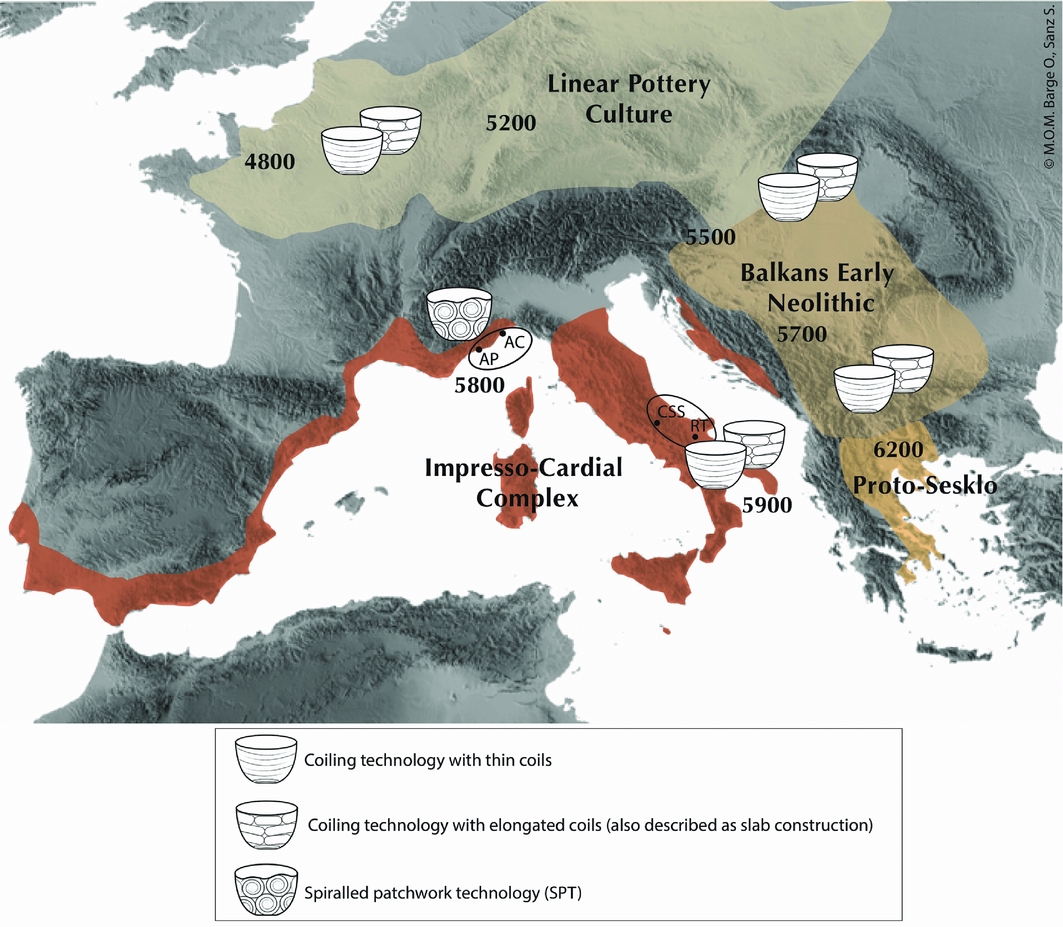
These new data from key sites of the Southern European early farming expansion suggest the coexistence of at least two communities of practice within the earliest ICC expansion (Figure 7). One community, identified at Ripa Tetta and Colle Santo Stefano in south-eastern Italy (5900–5600 cal BC), shows technical continuity with the earliest farmers of the Balkans (c. 6100 cal BC), as indicated by their retention of technical gestures transmitted from distant areas. The other, identified at Arene Candide and Abri Pendimoun in the Ligurian-Provencal Arc (5800–5600 cal BC), used a different pottery technology (i.e. SPT), whose conceptual scheme stands apart from all the operational sequences so far identified.
The main archaeological cultures and pottery-manufacturing traditions associated with early farming in Europe (after Fabbri Reference Fabbri2006; Commenge Reference Commenge2009; Salanova et al. Reference Salanova, Vieugué and Gomart2010, in press; Gomart Reference Gomart2014, 2016; Angeli et al. Reference Angeli, Fabbri, Parisi and Bertini2015; Angeli & Fabbri Reference Angeli, Fabbri and Burnez-Lanotte2017; Colombo in press).
The presence of these two coexistent, contemporaneous groups in Italy possessing distinct ceramic traditions could simply result from the bearers of the coiling technology adopting SPT. Social anthropological and ethnohistorical studies, however, show that technical innovation, and especially a complete transition between two schémas opératoires (i.e. conceptual schemes underlying the chaîne opératoire), requires numerous individual trials and errors. As a result, it occurs gradually on a community level (Roux Reference Roux, O'Brien and Shennan2010, Reference Roux2012; Mayor Reference Mayor2011). Macro-regional studies over a long timescale within Balkan and Central European early farming contexts showed transmission of the same schéma opératoire from Bulgaria in c. 6100 cal BC to Hungary by c. 5500 cal BC (Gomart Reference Gomart2016; Salanova et al. in press). When mixing between different technical procedures does occur, it is through small gradual modifications (Kreiter et al. Reference Kreiter, Marton, Gomart, Oróss, Pánczél and Burnez-Lanotte2017); it does not lead to a complete transition from one operational scheme to another. In fact, the schémas opératoires observed initially in the Balkans and in Hungary are recognised, almost unchanged, among early farmers in the Paris basin c. 5000 cal BC (Gomart Reference Gomart2014). Remarkable continuity was also observed in Near Eastern early farming contexts, where pottery-manufacturing processes remained unchanged from 7000–3000 cal BC (Vandiver Reference Vandiver1987). These examples demonstrate that a rapid transition (i.e. in less than 150 years) from superimposed coils to SPT (two radically different schémas opératoires) within a single learning network is highly unlikely. Where innovation was occurring, one would expect to find evidence of a gradual transition between schémas opératoires, indicated by mixing of the coiling technology and SPT within the Abri Pendimoun and Arene Candide assemblages—in stark contrast to the outright uniformity observed at both sites. Invention of the SPT by local hunter-gatherers is also highly unlikely due to the absence of pottery from contemporaneous hunter-gatherer settlements on the Italian peninsula and the presence of a typical farming economy (e.g. domestic animals and crops) at both Abri Pendimoun and Arene Candide (Binder et al. Reference Binder, Brochier, Duday, Helmer, Marinval, Thiebault and Wattez1993; Binder & Maggi Reference Binder and Maggi2001; Binder Reference Binder, Perrin, Manen, Marchand, Allard, Binder and Ilett2013; Rowley-Conwy et al. Reference Rowley-Conwy, Gourichon, Helmer, Vigne, Colledge, Conolly, Dobney, Manning and Shennan2013).
Thus, the best explanation for the presence of SPT at Abri Pendimoun and Arene Candide is colonisation of the northern Mediterranean by two distinct groups of farmers: one group, socially related to the farmers of the southern Balkans area, reaching the south-eastern Italian coasts; and another group of unknown origin, reaching the Ligurian-Provencal Arc. Our hypothesis is consistent with other evidence, such as clay figurines and painted pottery. Although not initially interpreted as indicating a second group of farmers, both are characteristic of Balkan early farmer material culture and are found in south-eastern Italy—but are surprisingly absent from north-western Italy (Radi Reference Radi, Manen, Convertini, Binder and Sénépart2010; Binder et al. Reference Binder, Hamon, Bellot-Gurlet, Beyries, Pradeau, Vautier and Voldoire2014). Moreover, while goats and pigs feature in the early agricultural regime of the Italian peninsula, they are both absent in the north-west where SPT has been identified (Rowley-Conwy et al. Reference Rowley-Conwy, Gourichon, Helmer, Vigne, Colledge, Conolly, Dobney, Manning and Shennan2013).
This research provides evidence that the expansion of farming into Southern Europe was not a continuous and homogeneous process. Our data show that the first farmers associated with the initial expansion of the Impresso-Cardial Complex represent two distinct social groups. The bearers of the coiling technology in south-eastern Italy show strong social continuity with the first farmers of the southern Balkans, consistent with the current model of continuous expansion of farming from the Aegean area to the Italian coasts. The SPT bearers recognised in the Ligurian-Provencal Arc probably arrived via a different route. These two distinct groups may have already co-existed in distinct areas within the Aegean, subsequently migrating to disparate territories in the northern Mediterranean. Alternatively, the presence of SPT bearers in north-western Italy may reflect the contribution of a population from a completely different region.
Tracing the origin and the paths of the SPT bearers requires systematic examination of the earliest pottery manufacture in southern Italy, on the western side of the Italian peninsula, and in Sicily, where data are still sparse. Future investigations, integrating and comparing all steps of the production sequence (i.e. raw materials, decoration techniques and use), will be required to define the social structure of the two groups identified and their possible interactions within the wider Mediterranean basin.
Acknowledgements
This work was supported by a grant from the Agence Nationale de la Recherche for the project ‘Western Mediterranean Impressed Wares. An interdisciplinary research on Early Neolithic pottery (6th millennium cal BCE): sourcing, production, uses and transfers’ (ANR n°14CE310009; 2015–2018; direction: D. Binder). The Skyscan 1178 housed at the Institute of Biology Valrose was acquired with the support of the Conseil Général des Alpes Maritimes (CG06). We wish to thank the staff from the platform AST-RX (plateau d'accès scientifique à la tomographie à rayons X du MNHN, UMS 2700 outils et méthodes de la systématique intégrative CNRS-MNHN, Paris), where the tomographic data of the reconstructed ceramics from Abri Pendimoun were acquired.
Supplementary material
To view supplementary material for this article, please visit https://doi.org/10.15184/aqy.2017.187
Due to an editorial error, part of Figure 1 was omitted from the article by Gomart et al. The corrected figure is reproduced here.
Ceramic macroscopic analysis identifies spiralled patchwork technology. Examination of the ceramics of Abri Pendimoun was conducted by direct observation and micro-topographic mapping of the sherds’ surfaces. All ceramics (n = 126) exhibit networks of circular fractures occurring along the edges of juxtaposed patches. A representative sherd with two highlighted patches (A and B) is presented. Circular fractures (white dashed lines) delineate the edge of each patch. Arced discontinuities are observed within the patches (red dashed lines). Micro-topographic mapping of the highlighted patches also shows arced discontinuities (blue). Together these suggest the use of a spiralled coil to form each juxtaposed patch. Scale bars are 5cm (left panel) and 3cm (middle panels).