Introduction
As of December 31, 2024, the German population consisted of 21.2 million residents with a migration background (Statistisches Bundesamt 2025).Footnote 1 This corresponds to around a quarter of the overall population. Out of these 21.2 million residents with a migration background, roughly 33%, or 7.1 million, are now German citizens. One of the largest groups of naturalized citizens is those of Turkish or Arab (Middle East/North Africa) origin. For example, Pfündel, Stichs, and Halle (Reference Pfündel, Stichs and Halle2020) estimate from migration data that in 2019 there were roughly 2.2 million citizens of Arab or Turkish origin in Germany, while national estimates of Turkish and Syrian origin people is around 2.5 million as of 2024 (Statistisches Bundesamt, 2024b). We believe that recent reforms in citizenship laws have increased this number and estimate the number of German citizens of Turkish and Arab origin to be between 2.5 and 3 million people, which makes up roughly 3% of the population (see also Bundesministerium des Innern und für Heimat n.d.).
In this study, we are interested in assessing how this significant population performs in elections. We focus on name discrimination and ask the simple question: Do candidates with Arab or Turkish-sounding names face electoral disadvantages in local elections? We know that those with a migrant background, around 28% of the German population as of 2021, are underrepresented in German politics, making up only around 11% of national parliament members (Tosson and Schüle Reference Tosson and Schüle2026; Wüst and Bergmann Reference Wüst and Bergmann2023).Footnote 2 We also know from the broader literature on Arab name discrimination that citizens with Arab and Turkish names face negative judgement in job applications, rental applications, and social interactions (Bagley and Abubaker Reference Bagley and Abubaker2017; Derous, Nguyen, and Ryan Reference Derous, Nguyen and Marie Ryan2009; Portmann and Stojanović Reference Portmann and Stojanović2018; Valfort Reference Valfort2015). It is our goal here to expand the scope of these analyses to Arab citizens’ possible name discrimination in elections. In doing so, we also add to the scarce literature on minority discrimination in elections. This literature has started to look at and confirm the notion that candidates with foreign names face discrimination at elections (Portmann and Stojanović 2018, Schirner and Hessami Reference Schirner and Hessami2023), but has, so far, not looked at citizens with Arab names.
In this article, we examine the minority group that arguably faces the most discrimination, Arabs, and test the degree to which this group faces hurdles when running as candidates. Using the 2019 and 2024 local elections in Germany, we examine the presence of candidates with Arab and Turkish names in the candidate pool, assess their list placement, and evaluate their likelihood of being selected by voters. Analyzing a dataset with more than 6,400 candidates from 100 randomly selected municipalities, we find that the underrepresentation of individuals with Arab-sounding names compared to the population and voting age population stems mainly from a lack of Arab candidates presenting themselves. However, we also find that parties tend to place the few Arabs that make it on electoral lists in less advantageous list positions than other candidates. In contrast, we do not find any additional discrimination by voters.
This article proceeds as follows: first, we will situate this study within the literature on the discrimination of Arabs in the social and political realms. Second, we will present the country case study, data, and methods. Third, and fourth, we will discuss the results and illustrate our contribution to the voting and name discrimination literature, respectively.
Names Matter Not Only in Societal Interactions But Also in Elections
In the increasingly polarized societies in Western countries, Arab minorities face negative stereotyping and discrimination. Several studies including Kalter and Foroutan (Reference Kalter and Foroutan2021), Kassis et al. (Reference Kassis, Schallié, Strube and von der Heyde2014), Marinov and Stockemer (Reference Marinov and Stockemer2020), as well as Ciftci (Reference Ciftci2012), report that there is a large anti-immigrant and anti-Muslim sentiment within many Western societies. This anti-Muslim sentiment builds on the fear of the unknown and of Muslim immigration, as well as of events such as September 11 and more recent terrorist attacks. Populist far-right parties such as the Alternative für Deutschland (AfD) also deliberately cultivate latent and open anti-Muslim sentiment (see Kalter and Foroutan Reference Kalter and Foroutan2021; Kellermann and Winter Reference Kellermann and Winter2022).
Muslims’ discrimination is not restricted to disadvantages in social interactions but also includes name biases. As Khosravi (Reference Khosravi2012) explains, names “can carry strong ethnic and religious connotations and may reveal an individual’s affiliation to a specific group” (65). As a result, names can create and build social relations, as well as social and economic value. In France, for example, Adida, Laitin, and Valfort (Reference Adida, Laitin and Valfort2014) find that French people display discrimination toward African-origin Muslim people (even if they are third generation) “due to the fact that these Muslims maintain recognizable Muslim first names” (1042) (see also Franz Reference Franz2007). More comparatively, Qureshi (Reference Qureshi, Wan, Anne Qureshi and Hussain2024) confirms that Muslim or Arab sounding names specifically face discrimination in many personal and professional settings.
Two of the most central and heavily researched areas in terms of name discrimination are rental and job applications. Most studies use what are called correspondence type experiments, where researchers send out two identical (or equivalent) applications, either to housing/rental units or to respond to job applications, one with an Arab (or Turkish) name and one with a name native to the country of study. In the rental market, applications with Arab names receive much lower response rates from landlords than non-Arab names. This finding applies to room/flat-share applications in London (Carlsson and Eriksson Reference Carlsson and Eriksson2014), to the general housing market in various European countries (Ahmed and Hammarstedt Reference Ahmed and Hammarstedt2008; Antfolk, Szala, and Öblom Reference Antfolk, Szala and Öblom2019), and to rental markets in the USA (Auspurg, Schneck, and Hinz Reference Auspurg, Schneck and Hinz2018). In their U.S. case study, Gaddis and Ghoshal (Reference Gaddis and Ghoshal2015), for example, find that applications with “Arab-origin names receive about 40% fewer replies” (282). Flage’s (Reference Flage2018) systematic review of 25 different housing correspondence studies in OECD countries from 2006 to 2017 confirms/nuances this finding, affirming that the most discriminated-against group in the rental market is Arab/Muslim males. This heightened discrimination against Arab/Muslim males is echoed in Baldini and Federici (Reference Baldini and Federici2011). Finally, Martiniello and Verhaeghe (Reference Martiniello and Verhaeghe2023) report that there is a gradation in discrimination of various ethnicities, with Moroccan names occasionally facing similar discrimination in some situations to Polish names (10) but higher levels of discrimination in others.
Regarding employment/hiring practices, the findings are analogous, no matter which Western country we look at. For instance, Carlsson (Reference Carlsson2009) finds that a Swedish name with an identical application to an Arab name receives 50% more callbacks for an interview. Arai, Bursell, and Nekby (Reference Arai, Bursell and Nekby2016) add that this finding applies more to Arab men than to Arab women, reinforcing the additional gendered factor. Field experiments in France (see Pierné Reference Pierné2013), Great Britain (see Adesina and Marocico 2017; Bagley and Abubaker Reference Bagley and Abubaker2017), and the Netherlands (Derous, Nguyen, and Ryan Reference Derous, Nguyen and Marie Ryan2009) also confirm that there is implicit prejudice in early hiring against Arab or Muslim-sounding names. Finally, Valfort (Reference Valfort2015) displays that there is discrimination in hiring practices in the United States, which, according to the author, is even higher against Arab people than against Black people (29–30). There are also country-specific differences in name discrimination, with Thijssen et al. (Reference Thijssen, Lancee, Veit and Yemane2019) finding that Turkish names are more discriminated against in hiring processes in the Netherlands compared to in Germany. Finally, and more nuanced, Di Stasio et al. (2019) report in their multi-country field experiment that “alarming levels of discrimination, especially towards male applicants from more visible groups.” (1305) exist in several European countries, especially in Norway, as well as the Netherlands and the UK. However, in their study, there was no difference in the applicant treatment of Muslims names and native names in Spain and little difference in Germany (1319).
All these studies demonstrate that Arab and Turkish names put individuals at a disadvantage in social and professional interactions. Do individuals with Arab or Turkish names face similar discrimination in elections? In the election realm, we know that there are some studies that look at the discrimination of minority candidates, without necessarily focusing on Arab, Muslim, or Turkish-sounding names. For example, Jenichen (Reference Jenichen2020) considers party elite treatment of minority women in German politics and finds mixed results, with elites either specifically promoting them or discriminating against them. There is also a rather large body of research concerning the “sacrificial lamb” theory, which argues that parties place or nominate minorities (racial minorities, young people, women…) in districts that are very difficult to win (Gélix and Chassé Reference Gélix and Chassé2024; Lapointe, Ferland, and Turgeon Reference Lapointe, Ferland and Turgeon2024). Focusing precisely on Arab/Turkish candidates as arguably one of the most discriminated-against groups, we build on the sacrificial lamb theory by aiming to detect how parties place Arab/Turkish candidates relative to non-Arab candidates, as well as how voters treat them.
So far, the evidence we have is quite patchy and mainly focuses on immigrant names, rather than Arab or Turkish surnames specifically. For example, Thrasher et al. (Reference Thrasher, Borisyuk, Rallings and Webber2017) use voting data from 1973 to 2012 to show that “vote share is adversely affected when British candidates are replaced by those with European and non-European surnames” (413). Focusing on local elections in Zurich and Switzerland, Portmann and Stojanović (2018) find that double the number of candidates with Swiss names gain election compared to those with foreign names (113). Similarly, Schirner and Hessami (Reference Schirner and Hessami2023) confirm that candidates from 2001 to 2021 in Hesse, Germany with “immigrant names” or an immigrant background faced an “electoral disadvantage” (12).
From this budding research in the electoral arena, we can conclude that there is likely discrimination against name minorities in at least some Western countries. From the more general literature on name discrimination, we can deduce that among all minorities, this name discrimination might be most pronounced against Arab-sounding names. Hence, we can hypothesize: candidates with Arab or Turkish (subsequently, often Muslim) names will face electoral disadvantages compared to candidates with non-Arab/Turkish names.
Yet, we do not know at what stage in the electoral process this discrimination manifests itself the most. We identify three stages: (1) becoming a candidate, (2) becoming a candidate in a winnable district/list position, and (3) being elected by voters. There could potentially be discrimination at each stage. At the candidate stage, candidates with Arab names might just not make it on the ballot. Second, it does not only matter if someone obtains candidate status but also in what district/list position the person gets placed. For example, someone who is placed at the end of the list has few chances of winning an election. Third, and finally, voters need to be willing to vote for a given candidate. In this study, we look at Arab and Turkish name discrimination holistically across the three stages of the electoral process.
Research Design
Case Selection
The German local elections provide a good setting to study not only if Arab or Turkish-sounding names face electoral discrimination but also where in the electoral process they face the (most) disadvantages. In most municipalities, the German local elections operate under an open list proportional representation system, a so-called free list system. There are two different types of free list systems. Under the first type system, which is practiced in Bavaria or Baden-Wuerttemberg, each municipal council has between 8 and 60 seats depending on the size of the municipality. The voter then has the choice to give all her votes to one party, in which case every candidate gets one vote (Graeb and Vetter Reference Graeb and Vetter2024), or she can distribute the votes to any candidates of her choice, with the only caveat that she cannot give more than 3 votes to any candidate. In other federal states, such as Sachsen, voters have a total of 3 to 5 votes to distribute among candidates. In both cases, to determine who is elected, the votes are first counted at the party level (to determine how many seats a party won), and then on the individual level (to determine who are the candidates with the most votes and who make it to the municipal council) (Van der Kolk Reference Van der Kolk2007).
The German local elections allow us to look at the supply of candidates with Arab sounding names and their list placement. More importantly, it also allows us to look at voters and their vote choices. In the German local elections, the list placement is important. Even if the electoral law does not mandate any specific order, parties normally place their top contenders, especially incumbents and local celebrities, at the top of the list (Berz and Jankowski Reference Berz and Jankowski2022). Because of name recognition and the psychological assumptions that top-ranked candidates are the most competent ones and have the highest chances of winning a seat, voters tend to choose top-ranked candidates as well (see Miller and Krosnick Reference Miller and Krosnick1998). Hence, it matters for candidates where on the list they are placed. Yet, there is some openness in the system, considering that voters can vote for whomever they want across party lines. This generates some subtleties concerning how candidates are voted up or down the list. Hence, this electoral arrangement allows us to test: (1) how many candidates of Arab or Turkish name origin make it on the lists, (2) where they get placed on electoral lists, and (3) if voters punish or reward candidates with Arab and Turkish names. For example, voters may seem to vote to reward candidates with Arab or Turkish names if we see that these candidates gain list positions after the election, compared to before the election. Vice versa, if those candidates systematically lose one or several list positions, we could conclude that voters punish candidates with Arab and Turkish names.
Data Collection and Methods
We used publicly available data to determine if and where in the electoral process there is discrimination against Arab or Turkish-sounding names. It was our goal to assess all candidates in 100 municipalities across Germany. To do so, we first randomly selected 100 municipalities out of all municipalities in Germany. If we could not retrieve data either because it was not publicly available, incomplete, or the municipality in question either did not want to provide us with the data or did not respond, we randomly selected a new municipality. In total, we contacted nearly 400 municipalities to achieve the final sample of 100 municipal elections. This means that our response rate was roughly 25%. For each candidate in each municipality, we then collected the following data: age, gender, list placement, and election result. Additionally, we consulted the previous election result (t−1) to determine whether a candidate was an incumbent. In total, the dataset covers election data from 12 of the 16 German federal states, spanning election results from 2019 to 2024.
Before testing the factors in the electoral outcomes of Arab or Turkish-named candidates, we need to define what we consider an Arab or Turkish-sounding name. In our definition, this would be a name identifiable as being common to or linked to an ethnic or regional origin in one of the League of Arab States (including North Africa and the Middle East region) or Turkey. Due to this mix, we use “Arab name” and “Turkish name” interchangeably throughout the text. Additionally, in the very few cases where names were likely Iranian or Afghan, we included these, as they coincide with Arab names as “Muslim sounding,” and the likelihood of a common voter distinguishing this difference is low.
To code Arab/Turkish-sounding names, we use a mixture of hand and machine coding. One of the authors with an Arab background manually went through all the candidate names in the dataset and identified the potentially Arab or Turkish ones. Then, we ran these names through an AI name ethnicity checker (Namsor). If this AI software found these names to originate from an Arab country or Turkey (at least in the top 5 country possibilities), we retained them. Our approach is in line with common practices. When it comes to hand coding, Mateos (Reference Mateos2007) illustrates that “although this methodology cannot entirely replace self-assigned ethnicity information, it provides a sufficient level of classification confidence…” (256). Reviewing various name-based ethnicity classification studies, Mateos (Reference Mateos2007) found no substantial accuracy differences in the manual or automatic (through a type of virtual classification, such as an AI checker) coding methods (254). Relating specifically to Turkish and Arab names, Bouwhuis and Moll (Reference Bouwhuis and Moll2002) carried out a manual test of name-based ethnicity classification, including with Arab and Turkish participants, finding that both name origins had high predictive value and good validity results, and were generally simple to distinguish correctly using only manual/human identifiers with these ethnic backgrounds. Therefore, we utilize a mix of both methods to attempt to stabilize this classification and mitigate errors.
To determine where in the pipeline electoral discrimination against Arab or Turkish-sounding names occurs, we provide some descriptive and inferential statistics. First, we showcase the overall percentage of candidates with Arab names. Second, we display the average list placement before and after the election for these candidates and all other candidates, as well as the electoral chances of both groups of candidates. Third, we run bivariate regression models (ordinary least squares). Models 1 to 3 feature the list placement before the elections, the list placement after the election, and the change in list placement as dependent variables, respectively. Model 4 is a binary logistic regression analysis measuring a candidate’s chance of being elected. To run these models, we use Stata 19. Altogether, our four models test if candidates with Arab or Turkish-sounding names face electoral discrimination at the selection/nomination stage and during voting. The independent variable is a dummy variable coded 1 for Arab/Muslim origin and 0 otherwise.
In a second set of models (i.e., Models 5 to 8), we control for incumbency, gender, age, and the size of the municipality (measured by the natural log of the population), the proportion of foreigners, the GDP per capita (measured by the natural log of the GDP per capita of the administrative unit the municipality is part of), the unemployment rate (measured at the administrative unit the municipality is part of), as well as the electoral system type used in the municipal elections. For the electoral system type, there are three systems in German local elections, which we control for via nominal coding. A small minority of states use closed list PR systems. In our sample, these are a few municipalities in Nordrhein-Westfalen, which make up less than 3% of the total sample. Most municipalities (e.g., in Baden-Wuerttemberg, Bavaria, or Hession) in our sample (i.e., 64%) use open list proportional systems in which voters have as many votes as there are seats. A minority of municipalities (33%) use open list proportional representation and grant voters 3 to 5 votes.Footnote 3 Finally, we add control variables for party (i.e., the seven major parties: the Christian Democratic Union, the Social Democratic Party, the Green Party, the Alternative for Germany, the Left Party, the Buendnis Sarah Wagenknecht (BSW), and “others”) and year.Footnote 4
Results
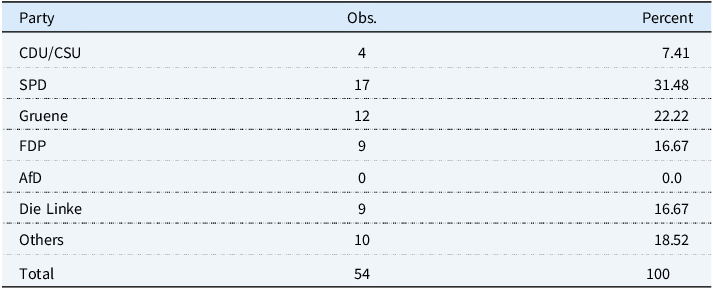
The first finding that stands out is that there is a lack of supply of candidates with Arab names. Out of the total of 6,419 candidates, only 54 (0.8%) candidates have Arab or Turkish names. 30% of these candidates are women, which aligns with the 31% of female candidates in the non-Arab sample. Compared to roughly 3% citizens with Arab/Turkish origin, we witness a strong underrepresentation of Germans with Arab or Turkish origin in the candidate pool. Political parties seem reluctant to put forward candidates with Arab names. The distribution of Arab/Turkish candidates in each party (see Table 1) further details this, confirming research such as Street (Reference Street2013) and Debus and Himmelrath (Reference Debus and Himmelrath2024), who argue that more ideologically traditional parties are less likely to nominate minorities. We see in this data that the right-wing AfD party has no Arab/Turkish candidates nominated, while the Social Democratic Party has the most Arab/Turkish candidates, though the number of candidates with Arab names remains very low for all parties.
Distribution of Arab/Turkish-named candidates nominated in each party

Table 1 Long description
The table presents the distribution of Arab/Turkish-named candidates nominated by various political parties. It has 8 rows and 3 columns. The columns are labeled Party, Obs., and Percent. The rows list the parties: CDU/CSU, SPD, Gruene, FDP, AfD, Die Linke, Others, and Total. The values in the Obs. column are 4, 17, 12, 9, 0, 9, 10, and 54 respectively. The values in the Percent column are 7.41, 31.48, 22.22, 16.67, 0.0, 16.67, 18.52, and 100 respectively. The table shows that the SPD party has the highest number of Arab/Turkish-named candidates, while the AfD party has none.
In addition to their lack of candidacies, Arab candidacies seem to be (somewhat) disfavored at the nomination stage. The average list placement of candidates with Arab names prior to an election is 14.24. This compares to an average higher list placement of 10.93 for all other candidates. However, there is no further discrimination at the election stage; candidates with Arab-sounding names are not relegated further down the list after the election. Rather, the list placement before the election closely mimics that after the election (14.24 before an election and 14.26 after an election).
Nevertheless, because of the lower list placement, it then comes as no surprise that the average chance of election for a candidate with an Arab or Turkish-sounding name is lower than that for the average candidate with a non-Arab/Turkish-sounding name. More precisely, a candidate with an Arab or Turkish-sounding name has a chance of election of 18.52%, compared to other candidates’ 29.74% chance of being elected. If we then look at the total of 1,903 elected councilors, Arab or Turkish Germans only account for 10 councilors, which corresponds to below .2% of councilors.
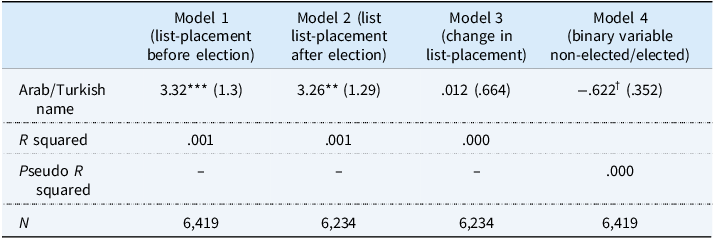
The regression models somewhat nuance our findings. In the bivariate, we see a statistically significantly lower likelihood of Arab/Turkish candidates to be placed high on the list. Looking at list placement before the election (see Model 1), list placement after the election (see Model 2), change in list placement (see Model 3), and the electoral prospects for candidates with Arab/Turkish-sounding names (Model 4) largely confirms the descriptive results from the previous two paragraphs. Model 1 confirms that candidates with Arab-sounding names get relegated to less advantageous list positions. Holding all other variables constant, the regression equation predicts that candidates with Arab or Turkish names will be approximately 3.3 list positions lower than non-Arab candidates. Model 2, which looks at the list placement after the election, roughly confirms this figure (see also Model 3, which confirms that the list placement from before to after the election does not significantly change, both in statistical and substantive terms). Finally, Model 4 confirms that the electoral prospects for a candidate with Arab or Turkish-sounding names are negative, even if the regression coefficient is not statistically significant.
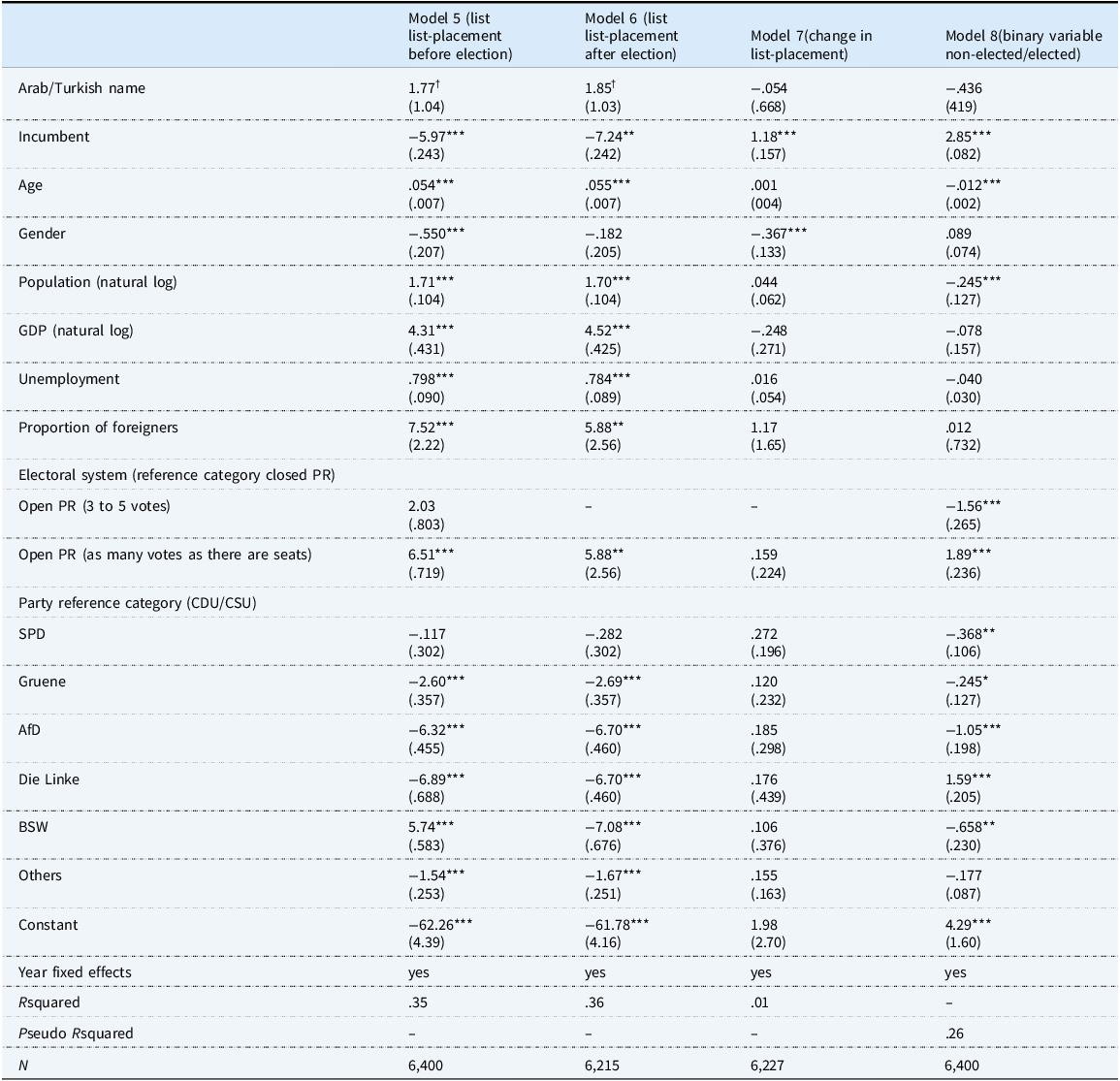
If we add the control variables (see Table 3), the results become slightly weaker and less statistically significant. This reduction in explanatory power of the binary Arab/Turkish name variable stems, in part, from the fact that this dummy variable is correlated with other determinants of electoral success prospects such as incumbency (i.e., the incumbency rate for candidates with Arab/Turkish-sounding names is 17%, but 21% for non-Arab candidates) or population (i.e., most candidates with Arab or Turkish-sounding names run in cities where it is more difficult to win because there are generally more candidates in relation to the number of seats than in the countryside).
Bivariate regression model measuring the electoral prospects of candidates with Arab sounding names in German municipal electionsFootnote 5

Table 2 Long description
A table comparing the electoral prospects of candidates with Arab/Turkish names in German municipal elections. The table has four rows and five columns. Column headers are Model 1 (list-placement before election), Model 2 (list-placement after election), Model 3 (change in list-placement), and Model 4 (binary variable non-elected/elected). Row labels are Arab/Turkish name, R squared, Pseudo R squared, and N. Row 1: Arab/Turkish name, 3.32*** (1.3), 3.26** (1.29), .012 (.664), .622 (.352). Row 2: R squared, .001, .001, .000, .000. Row 3: Pseudo R squared, .000, .000, .000, .000. Row 4: N, 6,419, 6,234, 6,234, 6,419. Notes: Standard errors are in parentheses. Significance: p < .1; **p < .05; ***p < .01 (two-tailed).
Notes: Standard errors are in parentheses. Significance: †p < .1; **p < .05; ***p < .01 (two-tailed).
The electoral prospects of candidates with Arab sounding names in German municipal electionsFootnote 6

Table 3 Long description
The table presents data on the impact of various factors on the electoral prospects of candidates with Arab or Turkish-sounding names in German municipal elections. It includes four models: Model 5 (list list-placement before election), Model 6 (list list-placement after election), Model 7 (change in list-placement), and Model 8 (binary variable non-elected/elected). The table has 18 rows and 4 columns. Column headers are Model 5, Model 6, Model 7, and Model 8. Row labels include factors such as Arab/Turkish name, Incumbent, Age, Gender, Population (natural log), GDP (natural log), Unemployment, Proportion of foreigners, Electoral system, and Party reference category. Each cell contains values and standard errors. Notable trends include the negative impact of being an incumbent and the positive impact of GDP and unemployment on electoral prospects.
Notes: Standard errors are in parentheses. Significance: †p < .1; **p < .05; ***p < .01 (two-tailed).
Conclusion
In recent decades, many people of Arab or Turkish origin have gained German citizenship, joining the large group of Arab/Turkish origin native-born citizens. However, this group’s political representation (at least at the local level) is not on par with that of their representation in society. In fact, councilors with Arab-sounding names are still a rarity in the 100 municipal councils we study. Of the more than 1,900 councilors in our sample, they make up a mere 10 councilors, or less than .2% of all councilors. This lack of representation mainly stems from a lack of candidacies. Candidates with Arab/Turkish names make up less than .8% of all candidates. In addition, those candidates who make it are relegated to less advantageous list positions. In contrast, voters do not seem to further disadvantage candidates with Arab or Turkish names. This finding somewhat confirms Street (Reference Street2013), who finds that minority candidates are not generally discriminated against by their voter base.
The question that arises from our study is why are there so few candidates? Is it that citizens with Arab or Turkish-sounding names do not engage with political parties and come forward as candidates, and if so, why? Or is it that parties systematically avoid nominating candidates with Arab/Turkish-sounding names, despite supply? While we do not currently have data to answer this question, we expect it to be a bit of both. We know from research on rental and job applications that individuals of Arab and Turkish origin face disadvantages in societal interactions and in the professional world. It would then come as no surprise if politically interested individuals felt hesitant to go into politics. A lack of self-confidence due to a feeling that they will not be treated on par with other Germans, coupled with potential cultural hurdles for newer citizens, might further nourish this hesitation to seek a political career. The political parties themselves are likely to exacerbate this feeling. They only have very few candidates of Arab or Turkish origins on their list, and instead of promoting these candidates, they relegate them to less advantageous list positions. Hence, rather than promoting these minority candidates, they hinder the advancement of their careers, something that clearly would not encourage more candidates of Arab/Turkish origin to come forward. Debus and Himmelrath (Reference Debus and Himmelrath2024) prove this in their study on the 2021 German federal election, finding that ethnic minority and female candidates “face difficulties being nominated” (1012), especially by more “ideologically traditional” parties. Research about the demand-side struggles of minority political candidates confirms this finding; studies about women (e.g. Fox and Lawless Reference Fox and Lawless2014) show that the lower political socialization of women compared to that of men results in fewer women running and being disadvantaged when they do, largely due to their list placement by party elites and gatekeepers (Luhiste Reference Luhiste2015). Visible minority candidates, in our case Arab/Turkish candidates in Germany, appear to face the same disadvantage when it comes to list placement.
Future research could also look at geographical variation. For instance, federal states in Eastern Germany and states like Schleswig-Holstein have comparatively lower proportions of residents with a migration background—regardless of ethnic origin—according to recent data from the Federal Statistical Office (Statistisches Bundesamt 2024a). Additionally, the share of specific origin groups also varies considerably between states. As per the Central Register of Foreign Nationals, people of Turkish origin are particularly concentrated in North Rhine-Westphalia (Statistisches Bundesamt 2025). These structural differences may help explain disparities in candidacy rates. Moreover, it might be worthwhile to consider local integration councils (Integrationsbeiräte) as a space for early political engagement. While naturalized citizens are not eligible to vote in these advisory councils in most federal states, they can run for office and be elected. This institutional channel could offer important insights into alternative political participation paths that might precede party-based involvement.
The policy recommendations that emanate from this article are rather straightforward. If we want to encourage the participation in politics of a group that has become one of the largest visible minorities in Western countries, parties must promote the advancement of this group rather than slow it down. In the current polarized climate in Germany, and Western countries more generally, the political inclusion of minorities such as citizens of Arab and Turkish origin could also be a way to decrease stigmatization and make these groups’ voices heard in the political arena.
Funding statement
This research received funding from the Social Sciences and Humanities Research Council of Canada (SSHRC), Grant Number 430-2025-00007.
Competing interests
All authors declare no conflict of interest.
Appendix
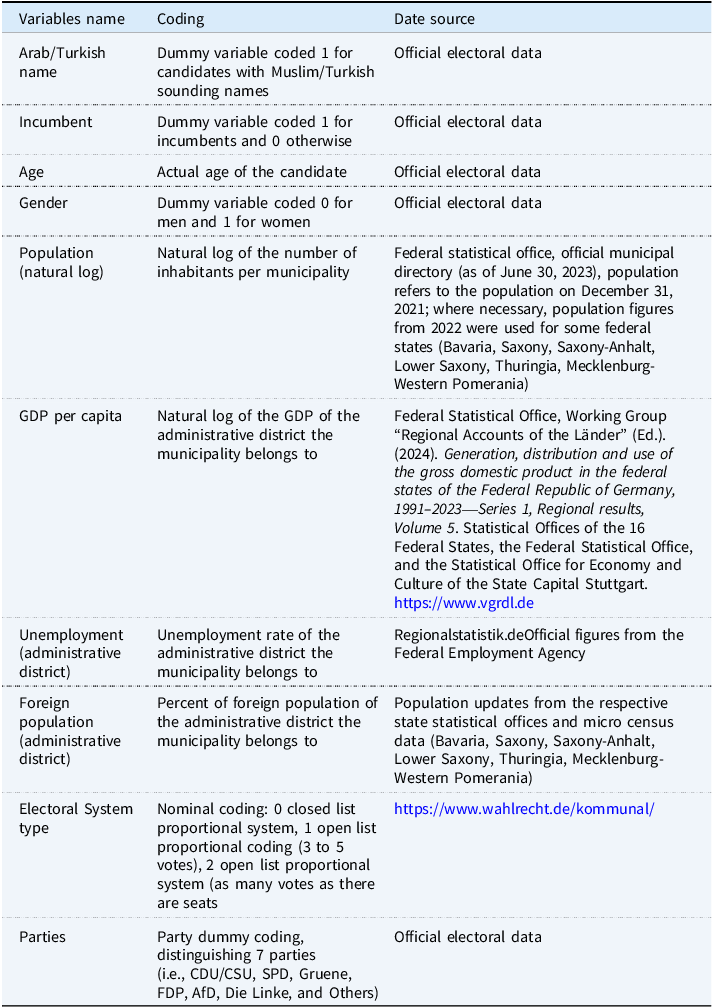
Coding of all independent/control variables

Table A1 Long description
A table with 11 rows and 3 columns. The columns are labeled 'Variables name', 'Coding', and 'Date source'. Row 1: Arab/Turkish name, Dummy variable coded 1 for candidates with Muslim/Turkish sounding names, Official electoral data. Row 2: Incumbent, Dummy variable coded 1 for incumbents and 0 otherwise, Official electoral data. Row 3: Age, Actual age of the candidate, Official electoral data. Row 4: Gender, Dummy variable coded 0 for men and 1 for women, Official electoral data. Row 5: Population (natural log), Natural log of the number of inhabitants per municipality, Federal statistical office, official municipal directory (as of June 30, 2023), population refers to the population on December 31, 2021; where necessary, population figures from 2022 were used for some federal states (Bavaria, Saxony, Saxony-Anhalt, Lower Saxony, Thuringia, Mecklenburg-Western Pomerania). Row 6: GDP per capita, Natural log of the GDP of the administrative district the municipality belongs to, Federal Statistical Office, Working Group Regional Accounts of the Lnder (Ed.). (2024). Generation, distribution and use of the gross domestic product in the federal states of the Federal Republic of Germany, 1991-2023 Series 1, Regional results, Volume 5. Statistical Offices of the 16 Federal States, the Federal Statistical Office, and the Statistical Office for Economy and Culture of the State Capital Stuttgart. https://www.vgrdl.de. Row 7: Unemployment (administrative district), Unemployment rate of the administrative district the municipality belongs to, Regionalstatistik.de Official figures from the Federal Employment Agency. Row 8: Foreign population (administrative district), Percent of foreign population of the administrative district the municipality belongs to, Population updates from the respective state statistical offices and micro census data (Bavaria, Saxony, Saxony-Anhalt, Lower Saxony, Thuringia, Mecklenburg-Western Pomerania). Row 9: Electoral System type, Nominal coding: 0 closed list proportional system, 1 open list proportional coding (3 to 5 votes), 2 open list proportional system (as many votes as there are seats), https://www.wahlrecht.de/kommunal/. Row 10: Parties, Party dummy coding, distinguishing 7 parties (i.e., CDU/CSU, SPD, Gruene, FDP, AfD, Die Linke, and Others), Official electoral data.
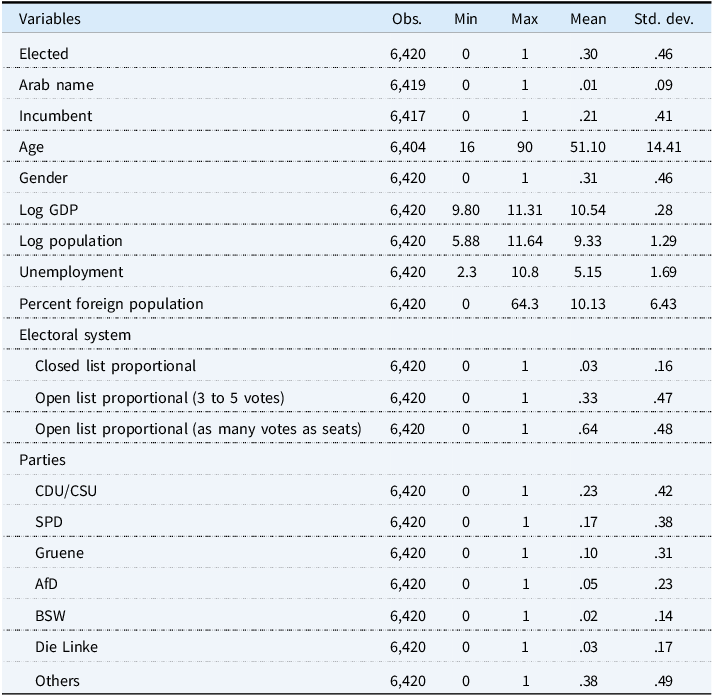
Detailed descriptive statistics of variables included in the study and models

Table A2 Long description
The table presents detailed descriptive statistics of variables included in the study and models. It has 21 rows and 6 columns. The columns are labeled as Variables, Obs., Min, Max, Mean, and Std. dev. The rows are grouped into three categories: general variables, electoral system variables, and party variables. Each row lists a variable name, the number of observations, the minimum value, the maximum value, the mean, and the standard deviation. Notable variables include Elected, Arab name, Incumbent, Age, Gender, Log GDP, Log population, Unemployment, and Percent foreign population. Electoral system variables include Closed list proportional, Open list proportional (3 to 5 votes), and Open list proportional (as many votes as seats). Party variables include CDU/CSU, SPD, Gruene, AfD, BSW, Die Linke, and Others.
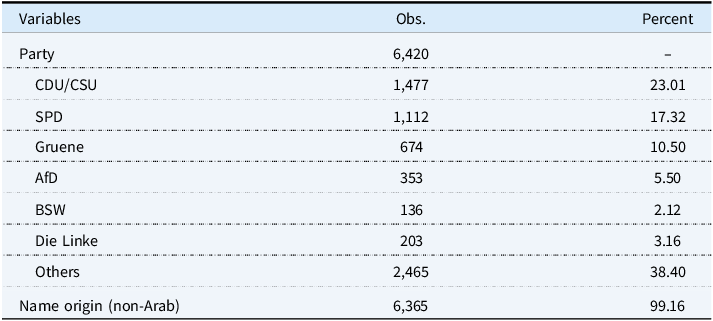
Number of candidates per party

Table A3 Long description
A table with 11 rows and 3 columns. The columns are labeled Variables, Obs., and Percent. The table lists the number of candidates and their percentages for different parties. Row 1: Party, 6,420. Row 2: CDU/CSU, 1,477, 23.01 percent. Row 3: SPD, 1,112, 17.32 percent. Row 4: Gruene, 674, 10.50 percent. Row 5: AfD, 353, 5.50 percent. Row 6: BSW, 136, 2.12 percent. Row 7: Die Linke, 203, 3.16 percent. Row 8: Others, 2,465, 38.40 percent. Row 9: Name origin (non-Arab), 6,365, 99.16 percent.
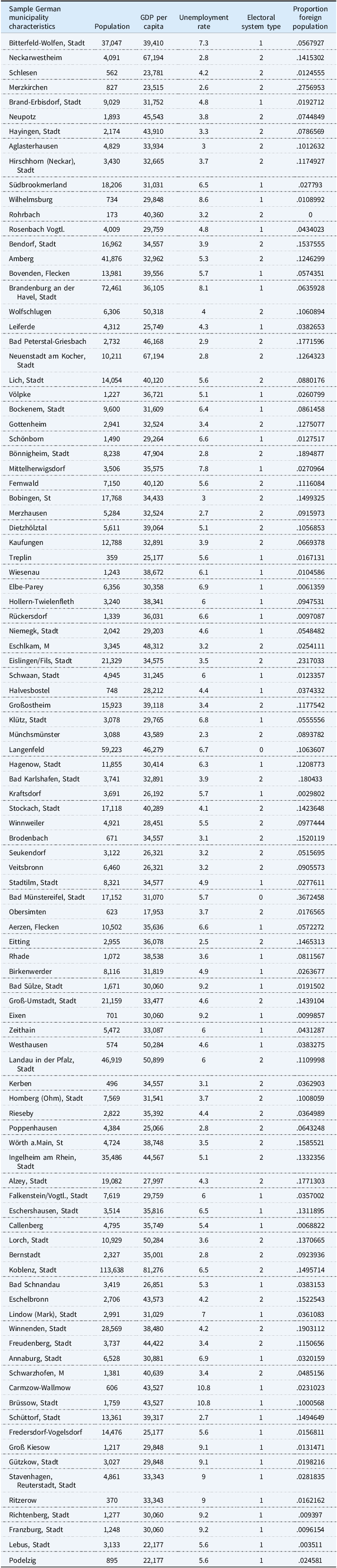
Socioeconomic data on the municipalities included

Table A4 Long description
The table presents socioeconomic data for various German municipalities. It includes columns for municipality name, population, GDP per capita, unemployment rate, electoral system type, and proportion of foreign population. The table has 10 rows and 6 columns. Row 1: Bitterfeld-Wolfen, Stadt, 37,047, 39,410, 7.3, 1, 0.0567927. Row 2: Neckarwestheim, 4,091, 67,194, 2.8, 2, 0.1415302. Row 3: Schlesen, 562, 23,781, 4.2, 2, 0.0124555. Row 4: Merzkirchen, 827, 23,515, 2.6, 2, 0.2756953. Row 5: Brand-Erbisdorf, Stadt, 9,029, 31,752, 4.8, 1, 0.0192712. Row 6: Neupotz, 1,893, 45,543, 3.8, 2, 0.0744849. Row 7: Hayingen, Stadt, 2,174, 43,910, 3.3, 2, 0.0786569. Row 8: Aglasterhausen, 4,829, 33,934, 3, 2, 0.1012632. Row 9: Hirschhorn (Neckar), Stadt, 3,430, 32,665, 3.7, 2, 0.1174927. Row 10: Sdbrookmerland, 18,206, 31,031, 6.5, 1, 0.027793.