Congenital heart disease has been the second most prevalent chronic illness in childhood. Over the past decades, life expectancy of children born with cardiac disease has increased significantly. They can make it to adulthood owing to advances in diagnostic and medical treatment and improvements in cardiac surgical techniques.Reference Drotar 1 – Reference Guitti 3
Cardiac disease can cause harm to the development of children and adolescents and consequently trigger emotional and behavioural problems.Reference DeMaso, Campis, Wypij, Bertram, Lipshitz and Freed 4 – Reference Van Rijen, Utens and Ross-Hesselink 5 There may be limitations to sociability and cause an impact on daily activity, a negative effect on scholastic performance, attention, and overprotection on the part of the parents.Reference Kovacs, Kuhl, Nixon, Sears and Saidi 6 – Reference Shillingford, Glanzman, Ittenbach, Clancy, Gaynor and Wernosvsky 10 Feeling different from one's peers can be disturbing, cause conflicts, and feelings of isolation can compromise social development.Reference Wright, Jarvis, Wannamaker and Cook 11 – Reference Olsson, Boyce, Toumbourou and Sawer 13
Many predictors of behavioural and emotional problems in children who undergo cardiac surgery have been identified. The most prominent ones are circulatory arrest, number of cardiac operations, physical limitation, low self-esteem, increased medical fears, and maternal anxiety.Reference Utens, Verhulst, Duivenvoorden, Meijboom, Erdman and Hess 14 – Reference Fredriksen, Mengshoel, Frydenlund, Sorbye and Thaulow 16 Nonetheless, there is evidence that individuals with cardiac disease may have inner resources in order to face chronic illness in an adaptive manner and allow patients to experience the situation with resilience.Reference De Toni and Cavillo 17
In spite of the increasing interest in the study of behavioural problems in adolescents with congenital and acquired heart disease, research findings have been inconsistent in many aspects, making it difficult to draw firm conclusions. The reasons probably include small sample size, non-standardised assessment procedures, and variation in methods across studies.Reference Utens, Verhulst, Duivenvoorden, Meijboom, Erdman and Hess 14 , Reference Fredriksen, Mengshoel, Frydenlund, Sorbye and Thaulow 16 , Reference Utens, Bieman, Verhulst, Witsenburg, Bogers and Hess 18 – Reference Spijkerboer, Utens, Bogers, Verhulst and Helbing 21
Several researchers used the questionnaires Youth Self-Report, Young Adult Self-Report, Child Behavior Checklist, and Adult Behavior Checklist to study the relationship between children and adolescents with congenital heart disease compared with normal controls or with their parents’ perception of behavioural problems.Reference Utens, Verhulst, Duivenvoorden, Meijboom, Erdman and Hess 14 , Reference Fredriksen, Mengshoel, Frydenlund, Sorbye and Thaulow 16 , Reference Utens, Bieman, Verhulst, Witsenburg, Bogers and Hess 18 , Reference Utens, Verhulst and Meijboom 19
Considering that cardiac disease and its respective procedures can cause emotional and behavioural problems in the long term, the aim of the present study was to assess behavioural problems in adolescents with cardiac disease when compared with adolescents without cardiac disease. Differences between age groups and the parents’ perception of behavioural problems were also assessed.
Material and methods
The patients were recruited for a cross-sectional study at the Pediatric Cardiology outpatient clinic of São Paulo Hospital. The patients’ parents were previously asked by a psychologist from the hospital whether they would participate in the study. They all agreed to sign an informed consent for participation. São Paulo Hospital is a university hospital belonging to a public federal institution, and its patients are mostly of low income. As it is a reference health centre, the patients who seek medical treatment are mostly in a serious condition and come from every corner of the country. Patients from middle and high income prefer to pay for health care, and thus opt for private institutions.
From June, 2006 to April, 2008, 250 adolescents with cardiac disease, in the age group of 11–18 years, were interviewed, but only 134 were eligible for the study. During the research, three patients died and one patient refused to participate. There were 74 boys and 56 girls among the remaining 130 patients, which made up the study group. The average age at the beginning of the study was 13.9 years. Cardiac patients were always accompanied by a parent during medical consultation.
Inclusion criteria for the group with cardiac disease were diagnosis of chronic congenital or acquired heart disease and awareness of diagnoses for at least 3 years to avoid sampling bias. Individuals with genetic syndromes such as Down syndrome or with any mental disorder were excluded from the study. Cardiac patients should also have been attending school.
For the control group, 261 healthy adolescents, in the age group of 11–18 years, were enrolled. Owing to incomplete questionnaires, 16 were excluded. In the remaining 246 students, 128 were girls and 118 were boys, with an average age of 14.3 years. They underwent a clinical and electrocardiographic evaluation with a Paediatric Cardiologist from São Paulo Hospital and were considered to be free of cardiac disease. To collect data from the control group, several schools were contacted. The social and economic profile was similar to the adolescents with cardiac disease. After months of research, a school located in the São Paulo Hospital region allowed the study to be conducted during leisure time. In Brazil, students from public schools are mostly from low-income families.
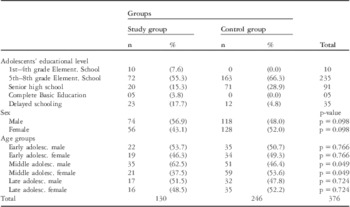
The 376 participants, including patients and healthy controls, were classified into three age groups: early adolescence comprising adolescents between 11 and 12 years of age; middle adolescence comprising adolescents between 13 and 15 years of age; and late adolescence comprising adolescents between 16 and 18 years of age. Most patients and healthy controls were in middle adolescence, and attending elementary school between 5th and 8th grades. There were 35 adolescents delayed in schooling (Table 1).
Demographic characteristics of adolescents with and without cardiac disease.

adolesc. = adolescence; Element. = Elementary
Adolescents with congenital heart disease were patients with a variety of defects: 77 had congenital acyanotic heart disease, 28 had cyanotic heart disease, and 25 had acquired heart disease. There were 16 patients with tetralogy of Fallot, 12 patients with ventricular septal defect, 12 patients with coarctation of the aorta, 11 patients with atrial septal defect, 8 patients with pulmonary stenosis, 8 patients with anomalies of the aortic valve, 6 patients with patent arterial duct, 6 patients with d-transposition of the great arteries, and 39 patients had other types of congenital cardiac malformation. Rheumatic heart disease was the most frequent acquired cardiac problem. In all, 58% of the patients had been submitted to cardiac surgery. According to the patients’ clinical history, medical diagnosis was confirmed between the neonatal period and 3 months of age in 65 cases and in 51 cases diagnosis was made in childhood between 5 and 9 years of age. Only 14 cases were diagnosed after 9 years of age.
The educational level of parents of adolescents with cardiac disease was as follows: 17 were illiterate; 70 fathers and 90 mothers had attended Elementary School; 30 parents had completed Basic Education, and only 12 parents graduated from college.
Approval from São Paulo Hospital – Federal University of São Paulo Ethical Committee for Medical Research in Human Beings was obtained before the study. In both groups, all participants and their parents/guardians signed an informed consent.
Instruments
Two instruments were used in this cross-sectional study: the second part of the Child Behavior Checklist and the second part of the Youth Self-Report (Achenback)Reference Achenback 22 , Reference Achenback 23 validated in Brazil,Reference Bordin, Mari and Caeiro 24 and a semi-structured interview. In the semi-structured interview, the variables age, sex, age at diagnosis, patients' and their parents’ schooling were accessed. The Youth Self-Report questionnaire is similar to the Child Behavior Checklist. In the group of the adolescents with cardiac disease, the Youth Self-Report was administered individually. In the healthy control group, it was administered altogether in the classroom. In both groups, a psychologist read the questionnaire to avoid misunderstanding because the adolescents had difficulties in understanding the questions. All questionnaires were scored using the software Assessment Data Manager. According to the answers obtained from the Youth Self-Report, patients and controls had similar social class profile.
The Child Behavior Checklist for ages 4–18 was used to obtain standardised reports from one of the parents on behavioural problems concerning their adolescents with cardiac disease. The respondents were 93% mothers and 7% fathers. The Youth Self-Report is specific for ages 11–18 and was used to obtain adolescents’ self-reports. Both questionnaires contain 112 items and furnish a behaviour profile based on eight subscales: Withdrawn; Somatic Complaints; Anxiety/Depression; Social Problems; Thought Problems; Attention Problems; Delinquent Behaviour; and Aggressive Behaviour. The sum of the first three subscales corresponds to the Internalising scale and the sum of the last two subscales corresponds to the Externalising scale. The Total Problems score is made up of the sum of all the items on the test. The responses contain data on the previous 6 months and the adolescent and parents choose one of the following for each type of behaviour described: 0 – not true; 1 – sometimes true; or 2 – very or often true. The sum of the scores makes up the overall score, which indicates the presence or absence of deviant behaviour in relation to what is expected for the age group and gender. On the basis of cut-off points for T-scores, the sample was classified as clinical, which means adolescents with more behavioural problems, or non-clinical, adolescents with fewer behavioural problems. A higher score indicates a higher level of problems. The scores derived from the Youth Self-Report and the deviance cut points are similar to the Child Behavior Checklist. Total Scores or T-scores of 60 or higher were considered to be deviant.
Statistics
A databank was generated on an Excel program and statistical analysis was carried out using the Statistical Package for the Social Sciences 13.0. The non-parametric Equality of Two Proportions testReference Conover 25 was applied for the analysis of the results of comparison between adolescents with cardiac disease and adolescents without cardiac disease, and adolescents with cardiac disease according to age groups. It was also used to evaluate differences between the patients and their parents. The confidence interval or p-value had a level of significance of less than 0.05. The significant values were marked with asterisks.
Results
Analysing the demographic data, we found that both patients and the control group had a similar educational level. However, there were significantly more patients with delayed schooling (Table 1).
Comparison between patients and healthy adolescents
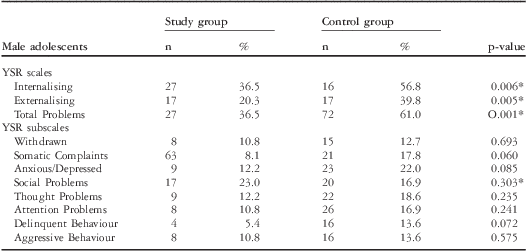
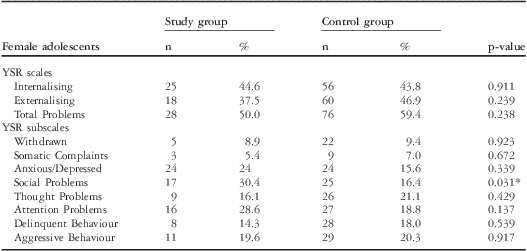
According to the scores obtained from the Youth Self-Report, male healthy controls reported significantly higher scores than did male patients in all three scales: Internalising (p = 0.006), Externalising (p = 0.005), and Total Problems (p < 0.001). There were no significant differences between female controls and patients. When analysing the subscales, male (p = 0.303) and female (p = 0.031) patients scored significantly higher only on the Social Problems subscales (Tables 2 and 3).
Distribution of adolescents with and without cardiac disease classified according to the male gender for the YSR scales and subscales.

YSR = Youth Self-Report
*p < 0. 05
Distribution of adolescents with and without cardiac disease classified according to the female gender for the YSR scales and subscales.

YSR = Youth Self-Report
*p < 0.05
The effect of age
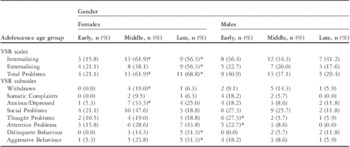
Cardiac patients differed when age groups were compared. Girls in late adolescence scored significantly higher in all three scales – Internalising (p = 0.012), Externalising (p = 0.032), and Total Problems (p = 0.005) – when compared with adolescents in early adolescence. However, no significant difference was found between girls in late and middle adolescence in the three scales. Girls in late adolescence exhibited significantly more problems than did both younger and middle adolescents on the Aggressive (p = 0.042) and Delinquent Behaviour (p = 0.008) subscales. Females in middle adolescence scored significantly higher in the Internalising (p = 0.003) and Total Problems scales (p = 0.009) than did girls in early adolescence, but no difference was found between girls in middle and late adolescence. Girls in middle adolescence scored significantly higher on the Withdrawn (p = 0.045) and Anxiety/Depression subscales (p = 0.027) than did girls in early and late adolescence (Table 4).
Distribution of adolescents with cardiac disease according to age groups classified as clinical in YSR scales and subscales.

YSR = Youth Self-Report
*p < 0.05
On the other hand, boys in early adolescence scored significantly higher in the Thought Problems (p = 0.023) and Attention Problems subscales (p = 0.035) than did boys in middle and late adolescence (Table 4).
Comparison between diagnostic groups
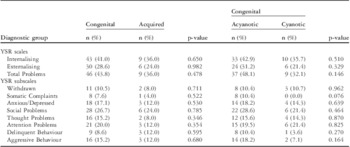
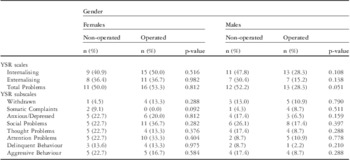
Congenital versus acquired heart disease, and operated versus non-operated patients. There were 105 patients with congenital heart disease and 25 with acquired heart disease. Among the 77 patients with congenital acyanotic heart disease, 46 underwent a corrective surgical procedure. All 28 patients with congenital cyanotic heart disease had a surgical intervention, most of them of the corrective type. Among the 25 patients with acquired heart disease, only three patients underwent a surgical intervention. When analysing behavioural problems among patients, no significant difference was found when congenital and acquired heart disease were compared, nor were there any significant differences between congenital acyanotic and cyanotic heart disease (Table 5). Furthermore, no significant differences were found for boys and girls when operated and non-operated patients were compared (Table 6).
Comparison between adolescents with congenital and acquired heart disease, and congenital acyanotic and cyanotic heart disease, classified as clinical in YSR scales and subscales.

YSR = Youth Self-Report
*p < 0.05
Comparison between operated and non-operated adolescents with cardiac disease classified as clinical in YSR scales and subscales.

YSR = Youth Self-Report
*p < 0.05
Comparison between parents and patients
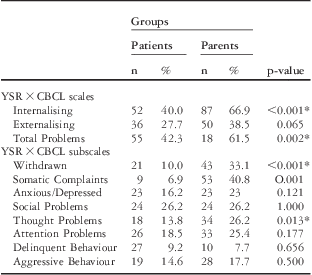
When analysing the results obtained from the Youth Self-Report and the Child Behavior Checklist, patients’ parents reported significantly more behavioural problems in the Internalising (p < 0.001) and Total Problems (p = 0.002) scales, and in the Withdrawn (p < 0.001), Somatic Complaints (p < 0.001), and Thought Problems (p = 0.013) subscales (Table 7).
Distribution of adolescents with cardiac disease compared with parents classified as clinical in YSR and CBCL scales and subscales.

CBCL = Child Behavior Checklist; YSR = Youth Self-Report
*p < 0.05
Discussion
In the present study, male adolescents with cardiac disease reported significantly fewer behavioural problems than did their healthy peers in all three scales: Internalising, Externalising, and Total Problems. No differences were found between patients and controls for the female gender. Patients scored significantly less than did their parents according to the information obtained from the Child Behavior Checklist. These results contradict expectations as patients with chronic cardiac disease are considered to be a population at risk for behavioural problems.Reference Utens, Verhulst, Duivenvoorden, Meijboom, Erdman and Hess 14 , Reference Fredriksen, Mengshoel, Frydenlund, Sorbye and Thaulow 16 , Reference Utens, Verhulst and Meijboom 19 , Reference Gupta, Giuffre, Crawford and Waters 26 Similar to our findings, Fredriksen et alReference Fredriksen, Mengshoel, Frydenlund, Sorbye and Thaulow 16 also reported less behavioural problems in male patients when compared with controls. In the present study, adolescents with cardiac disease reported significantly more behavioural problems only on the Social Problems subscale, which corroborates the findings described in the other studies.Reference Kovacs, Kuhl, Nixon, Sears and Saidi 6 , Reference Wray and Maynard 7 , Reference Utens, Verhulst and Meijboom 19 , Reference Gupta, Giuffre, Crawford and Waters 26
Fredriksen et alReference Fredriksen, Diseth and Thaulow 20 using the Youth Self-Report found significantly more behavioural problems among healthy children in comparison with those with cardiac disease, but only in the female gender, and the scores were also significantly higher in all three scales: Internalising, Externalising, and Total Problems.
Spijkerboer et alReference Spijkerboer, Utens, Bogers, Verhulst and Helbing 21 studied behavioural problems in only four types of congenital heart diseases and found more problems on the Rule-Breaking Behaviour or Delinquent subscale among healthy adolescents. Furthermore, Van der Rijken et alReference Van der Rijken, Maassen, Walk, Daniels and Hulstijn-Dirkmaat 27 using the Youth Self-Report and the Adult Self-Report observed that patients with cardiac disease did not report any significant behavioural problems compared with their healthy peers.
Although most studies show that cardiac disease can cause harm to human psychological development, it is possible that some adolescents with cardiac disease deal with their illness in an adaptive manner by receiving constant support from their families and adopting coping strategies when facing adversity. There is evidence that many adolescents with cardiac disease may develop well when having their basic needs fulfilled, especially their emotional needs. The constant presence of the mother offering care and greater attention makes the adolescent feel safe and protected. It is probably the patient's family that mostly experiences the anguish, disorientation, pain, and anxiety.Reference Gupta, Mitchell, Giuffre and Crawford 15 , Reference Goldbeck and Melches 28 Majnemer et alReference Majnemer, Limperopoulos, Shevell, Rohlicek, Rosenblatt and Tchervenkov 29 reported a high level of psychological stress and anxiety in parents of children with cardiac disease.
With regard to differences between age groups, the present study showed that girls with cardiac disease in middle and late adolescence had significantly more behavioural problems than did girls in early adolescence, emphasising the effect of age. Many factors may have contributed to these results. Both anxiety and depression have important indices in late adolescence, particularly among girls, as the female gender is more vulnerable to psychological diseases. Broberg et alReference Broberg, Ekeroth and Gustafsson 30 studied healthy children and found that older youths exhibited more problems than did the younger ones on the Total Problem scale and suggested that these findings stem from the fact that older adolescents belong to a more turbulent age group. Van Rijen et alReference Van Rijen, Utens and Ross-Hesselink 5 reported that female gender is a predictor for internalising problems among patients probably because of the surgical scar, early hospitalisations with reoperations, and a poor physical condition. These results are probably due to a lack of coping strategies for dealing with frustration. It is also likely that upon approaching adulthood the effects of the disease are no longer so evident and older girls are better able to deal with adversity and feel free to exhibit different types of behaviour, including undesirable ones. According to the literature, there is evidence that chronic illnesses often have an impact on well-being, including symptoms of low self-esteem and impulsiveness.Reference Kellerman, Zeltzer, Ellenberg, Dash and Rigler 31 , Reference Beena and Johnson 32
In the present study, in opposition to the female age group profile, boys in early adolescence scored significantly higher in comparison with boys in middle and late adolescence. Boys in early adolescence had more problems on the Attention and Thought Problems subscales. In studies using the Youth Self-Report, Utens et alReference Utens, Verhulst and Meijboom 19 and Spijkerboer et alReference Spijkerboer, Utens, Bogers, Verhulst and Helbing 21 also encountered more behavioural problems among male patients in early adolescence. On the other hand, Fredriksen et alReference Fredriksen, Diseth and Thaulow 20 studied boys and girls with congenital heart disease and did not find any difference in age groups.
With regard to the diagnostic groups in the present study, no difference was found when congenital heart disease was compared with acquired heart disease. Neither was any difference observed when congenital acyanotic and cyanotic heart disease were compared. These results are similar to the literature, but most of them did not include acquired heart disease. Only the study published by Wray and MaynardReference Wray and Maynard 7 included acquired heart disease in the studied population. Moreover, the congenital diagnostic groups in most studies were individualised and compared, for example atrial septal defect versus tetralogy of Fallot, differently from the present study that compared a group of acyanotic with a group of cyanotic heart disease.Reference Utens, Verhulst, Duivenvoorden, Meijboom, Erdman and Hess 14 , Reference Utens, Verhulst and Meijboom 19 – Reference Spijkerboer, Utens, Bogers, Verhulst and Helbing 21 The only study that compared a group of acyanotic with cyanotic heart disease was undertaken by Gupta et al.Reference Gupta, Giuffre, Crawford and Waters 26 However, most important is what all these studies have in common, that is, no differences between diagnostic groups were found.
Another important information regarding the present study is related to operated and non-operated patients. No significant differences between these two groups were encountered either for males or females. In contrast to the results in the literature, all diagnostic groups had either a surgical or a catheter intervention.Reference Utens, Verhulst, Duivenvoorden, Meijboom, Erdman and Hess 14 , Reference Utens, Verhulst and Meijboom 19 – Reference Spijkerboer, Utens, Bogers, Verhulst and Helbing 21
When comparing the reports of parents with those of the adolescents with cardiac disease, it was observed that parents scored significantly higher. Parents reported more problems on the Internalising and Total Problem scales. These results are similar to those reported by many authors.Reference Miatton, Wolf, François, Thiery and Vingerhoets 9 , Reference Utens, Verhulst, Duivenvoorden, Meijboom, Erdman and Hess 14 – Reference Fredriksen, Mengshoel, Frydenlund, Sorbye and Thaulow 16 Van der Rijken et alReference Van der Rijken, Maassen, Walk, Daniels and Hulstijn-Dirkmaat 27 had similar results for the Withdrawn, Somatic Complaints, and Thought Problems subscales, and Yildiz et alReference Yildiz, Savaser and Tatlioglu 33 only for the Withdrawn subscale. In contrast with the present study, cardiac patients reported more behavioural problems than did their parents in the Fredriksen et alReference Fredriksen, Diseth and Thaulow 20 and Spijkerboer et alReference Spijkerboer, Utens, Bogers, Verhulst and Helbing 21 researches. The reason for the difference between parents’ and patients’ reports of behavioural problems is unclear. Many patients have a mistaken or poor understanding of their disease. Perhaps adolescents who are ill have a tendency to deny their disease; it may also be possible that the parents overestimate it. According to Wray and Maynard,Reference Wray and Maynard 7 irrespective of the severity of the disease, the presence of a cardiac malformation has a negative impact on everyday life for a significant number of children and families. Nonetheless, in a study by Chen et alReference Chen, Chen, Chen, Wang, Su and Wang 34 , no significant difference was found between adolescents with congenital heart disease and those without disease when considering categories such as exercise, social support, stress management, and life appreciation.
A large percentage of adolescents with cardiac disease were behind on their schooling. The National Education Directives and Bases Law in Brazil 35 foresees the possibility of a regular progression of school years in each educational cycle, with no repeats due to grades, only due to absences. As a result of surgery and other medical procedures, adolescents with cardiac disease often miss class, leading to a greater frequency of absences. In the present study, there were more adolescents with cardiac problems displaying a poor scholastic performance in comparison with healthy peers. Van der Rijken et alReference Van der Rijken, Maassen, Walk, Daniels and Hulstijn-Dirkmaat 27 and Miatton et alReference Miatton, Wolf, François, Thiery and Vingerhoets 9 had similar findings.
In conclusion, the data of the present study indicated that male adolescents with cardiac disease had fewer behavioural problems than did healthy controls. The patients’ parents also reported more problems than did the patients. Significant differences were found between patients’ age groups. It is possible that the patients studied have learnt to deal with the limitations brought about by the disease.
The present study has limitations that should be addressed. The sample was small, especially for the analysis of the subgroups, and this was a cross-sectional study. A number of demographic variables were not included: age, number of siblings, schooling, and social and economical level of the parents of healthy adolescents. It is possible that differences in the mode of administration of the Youth Self-Report, individual versus group, influenced the findings. There was no determination of physical capacity, quality of life, or stress level. Another limitation was the use of only one type of instrument for behavioural evaluation of the adolescents and for the family member as an informant. It is also important to bear in mind that culture influences behaviour and may involve forms of acting and reacting that are learnt as natural and unquestionable.
Future research should focus on the strategies adolescents use to solve problems throughout development and determine whether there are other interrelated difficulties that may generate emotional and behavioural problems among adolescents, such as anxiety and depression on the part of the mother, unemployment in the family, and the presence or absence of siblings.
Acknowledgements
We gratefully acknowledge the kind cooperation of all patients who participated in the present study. This study was financially supported by Conselho Nacional de Desenvolvimento Científico e Tecnológico – CNPQ.