Introduction
Being the base for training the ‘ulama, who have traditionally defined what it means to be a true Muslim,Footnote 1 madrasas have been one of the primary sites for the imposition of the project of ‘Islamic modernism’—‘a project of change aiming to re-order Muslims’ lifeworlds and institutional structures in dialogue with those produced under Western modernity’.Footnote 2 The state-led madrasa modernization programmes, which have a complex history across the Muslim world,Footnote 3 have been central in the attempts to make Islam speak with modernity. These state-led modernization attempts have acquired a new potency in South Asia post-September 2011 due to assertions made by western governments and think tanks of close ties between madrasas and Islamic militancy.Footnote 4 Whilst the formal strategy of the war on terror has focused on direct military intervention, or covert operations (most noticeably the use of drone attacks in the north west border areas of Pakistan), the softer side of the war on terror has focused on reforming the Muslim mindset through changing the discourse within the madrasas, where the ‘ulama who most often get to speak on behalf of Islam, are trained.Footnote 5 Universally applicable madrasa reform models are now very much in demand. Amid this clamour for reform, supported by western governments and international development agencies, Bangladesh has been identified as offering a potentially successful reform model due to the steady growth of Aliya (reformed) madrasas.Footnote 6 Taking the case of Bangladesh, this paper addresses two key questions:
(1) Can growth in the number of madrasas willing to accept modern subjects in the curriculum, as in the case of Aliya madrasas in Bangladesh, in itself be interpreted as a sign of success of the project of Islamic modernism?
(2) If not, then what explains the ability of the orthodox madrasas to retain control over the exercising of Islamic authority and the failure of an important state-led project of Islamic modernism?
Drawing on fieldwork with the two established madrasa traditions in Bangladesh, Aliya (reformed) and Qoumi (unreformed/orthodox), this paper argues that looking for a standard model of madrasa reform is just as problematic as developing global labels for Islamic movements, which ignore local peculiarities—introduction of similar financial incentives would not necessarily deliver similar outcomes in different contexts. This paper shows how historically shaped institutional factors—including the older history of Aliya madrasas in Bengal, the marginalized position of Jama’at-i-Islami and the weakened status of Urdu against Bangla in the independent state of Bangladesh—were critical in ensuring the spread of the Aliya madrasa system. Second, I warrant against interpreting the growth of Aliya madrasas as a symbol of the success of the project of Islamic modernism. I argue that, if the aim of the madrasa modernization programme in Bangladesh was to generate a modern or enlightened discourse on Islam, then its measure of success cannot be a growth in the number of Aliya madrasas, instead it has to be asked how effective has the leadership of Aliya madrasas been in displacing the hold of the ‘ulama in Qoumi madrasas over the religious authority.
The fieldwork for this study was conducted during 2008–2009. During my visits to Bangladesh I interviewed officials of the Bangladesh Madrasa Education Board (which regulates the Aliya madrasas), senior ‘ulama who represented the Wafaq ul Madaris Al-Arabia (the Qoumi Madrasa Board), and public intellectuals and scholars in Bangladesh. Fieldwork was carried out in leading Aliya madrasas in Dhaka, and in order to understand the Qoumi madrasa tradition, focus was on its stronghold Chittagong division. I focused on conducting interviews with prominent leaders of Qoumi and highly respected Aliya madrasas because they were best placed to speak on behalf of their respective traditions. Access to the most prestigious Qoumi madrasas in Chittagong was greatly facilitated by the editor of the magazine Probe News Footnote 7 in Dhaka. From the outset of my fieldwork in Bangladesh, he identified two field researchers from the International Islamic University in Chittagong who were former graduates of Qoumi madrasas. In Dhaka, interviews were conducted in Dhaka Aliya Madrasa, Tameer-e-Millat Madrasa, and Jamia Rahmania Arabia. In Chittagong Division, interviews were conducted in four madrasas: Darul Uloom Moinul Islam Hathazari, Al-Jamia Al-Islamia Pattia, Al-Jama’at-ul Islamia Al-Arabia Muzahirul Uloom, and Jamia Darul Ma’arif Al-Islamia.
Based on my fieldwork, this paper shows that the right to speak for Islam in Bangladesh is still exercised primarily by the ‘ulama and graduates of the Qoumi madrasas. This, I suggest, is because the state has attempted to secularize madrasas as opposed to focusing on promoting an enlightened Islamic discourse—which is more accommodative of alternative views and context bound as opposed to being focused on literal interpretations of the Islamic texts as is the practice in orthodox madrasa tradition in South Asia. The result is that, rather than acting as an alternative platform in the exercise of religious authority, madrasas joining the reforms have simply moved out of the religious hierarchy instead of initiating a new discourse, leaving the right to speak for Islam intact in the hands of the ‘ulama of the Qoumi madrasas.Footnote 8
Madrasas and the project of Islamic modernism
Though to many contemporary observers, the need to reform madrasas appears to be a twenty-first century concern, the project of modernizing madrasas has a much older history across Muslim countries, including the states in South Asia.Footnote 9 The madrasa tradition in South Asia started formally in the thirteenth century with the establishment of the Delhi Sultanate and consolidated under the Mughal Empire. Supported by the state as well as individual patrons, madrasas of Mughal India educated the nobility and the elites and officials for the courts whilst also meeting the day to day spiritual needs of the Muslim community in urban as well as rural areas. During this period the madrasa education system witnessed much innovation in learning and placed equal emphasis on the teaching of rationalist and transmitted subjects.Footnote 10 However, from the eighteen century onwards, the system underwent a major transformation with the decline of Muslim political power and the onset of colonial rule.Footnote 11 This period placed both direct and indirect demands on the madrasas to modernize and conform their curriculum to teachings in modern educational institutions established by colonial government.
Indirect pressures for change came from a shift in state policies. The British government not only changed the policy around Madad-i-Ma’ash (revenue free lands), which sustained various institutions of Muslim education and learning,Footnote 12 the changes in administration and the economy, introduced by the English East India Company, made madrasa education lose its worldly utility. Therefore a degree from a college or a university established by the British, instead of an ijaza from a madrasa, helped earn senior positions in the government and the market. In particular, the replacement of the Persian language with English as the official language in 1837 made madrasa education completely irrelevant to the demands of the formal employment market.Footnote 13
The pressure on the madrasas to engage with the British established order, which had reshaped all spheres of economic and political life, was however not entirely subtle and indirect. The British also initiated projects directly designed to modernize madrasa education, the most noticeable of which was the establishment of the Aliya Madrasa in Calcutta in 1782. Governor General Warren Hasting established this madrasa and personally bore its expenses for one and a half years. The Aliya madrasa system aimed to combine Dars-i-Nizami, the madrasa curriculum developed at Farangi Mahal in the eighteenth century, with subjects taught in western colleges and universities. It also aimed to train students in Persian, Arabic and Muslim Law (Fiqh) for eventual appointment to lower posts in government offices and courts, particularly as interpreters of Muslim law. In 1826, English courses were introduced at elementary level and then in 1850 a major reorganization resulted in the establishment of two separate departments within the Madrasa: the Arabic (the Senior Department) and the Anglo-Persian (the Junior Department). State-led attempts to modernize the madrasas during colonial rule continued into the twentieth century, leading to a rise in the number of state-controlled madrasa boards. Bihar Madrasa Board, for instance, was established in 1922, and currently has over 900 madrasas with over 80,000 students.Footnote 14 Implicit in these modernization programmes was an assumption that madrasa education is irrelevant to the modern day realities of society where the state was no longer shaped by Islamic precepts.
Here it is important to recognize that the discourse of madrasa reform has not been confined to colonial government or to the post-colonial secular political elites. As Francis RobinsonFootnote 15 and Qasim ZamanFootnote 16 have established with great mastery, the attempts at reform were not always initiated from outside, nor was madrasa tradition inherently reluctant to change. Rather, internally initiated reforms have a much older history in madrasa tradition than those which have been initiated from outside. The leading madrasas of South Asia actually had a rich tradition of teaching rationalist subjects, which was in fact at its peak at the time of the decline of the Mughal empire.Footnote 17 As MetcalfFootnote 18 has shown, the birth of the Deoband tradition, which today is the most dominant madrasa tradition in South Asia, was itself an attempt at reform triggered by the changed political-economic situation in which the Muslims found themselves during the colonial period. The rise of Nadwa-tul-Ulama was yet another attempt at reform from within the Deoband tradition.
The objectives of the two reforms—the state-led modernization programme and the internally driven reform project—have however been different. As RobinsonFootnote 19 argues, among the western style ‘political elites with immediate concerns to answer the challenges of the West’, the process of renewal ‘has meant attempts to reshape Islamic knowledge and institutions in the light of Western models, a process described as Islamic modernism’. Amongst ‘ulama and Sufis, RobinsonFootnote 20 notes, ‘it has meant “the organization of communities. . .[or] the reform of individual behaviour in the terms of fundamental religious principles”, a development known as reformism’. It is however very important not to view the two as representing binary positions, as both traditions were a product of the same effort: to make Islamic principles relevant to the demands of the changing times. The distinction drawn by Robinson is thus more subtle—it records a difference in the underlying inspiration for change, not in the willingness to change.
The approaches to internal reform have, in addition, not been homogenous. ‘Ulama within madrasas, as well as university educated Islamic intellectuals have adopted different approaches in the treatment of the doctrinal Islamic sources and interpretive methods.Footnote 21 Whilst ‘ulama leading the Deoband tradition favoured more literal interpretations of the orthodox text, and as ZamanFootnote 22 notes, in the process have become more scripture bound, some of their followers and those of other revivalist movements, such as the Jama’at-i-Islami, adopted alternative epistemology and hermeneutics to advance counter arguments drawing on similar sources. The establishment of Nadwa-tul-‘Ulama by graduates of the Deoband, and emergence of reformist scholars such as Javed Ahmad Ghamidi, formerly an active member of Jama’at-i-IslamiFootnote 23 but today is labelled a heretic by orthodox ‘ulama, are examples of plurality in approaches representing Islamic reformism. As Talal AsadFootnote 24 has taught us, generic labels need to be appropriated to a specific context with caution necessitating the need to adjust them to peculiarities of a specific context: ‘The variety of traditional Islamic practices in different times, places, and populations indicates the different Islamic reasonings that different social and historical conditions can or cannot sustain. The idea that traditions are essentially homogenous has a powerful intellectual appeal, but it is mistaken’.Footnote 25
In this paper, Islamic modernism refers to state-led attempts to reform Muslim society which aim to make these societies more open to the influences of western value systems. Islamic reformism on the other hand, refers to similar attempts to reform Muslim society but these are initiated by ‘ulama or Islamic intellectuals rather than the state with the intention of making these societies shape their vision of modernity in the light of Islamic principles and values. These attempts at modernization as well as reform were both triggered in response to the madrasa interface with changing times and the forces of western style modernity. However, the solutions sort by the reformers inside the madrasas and those within the state were different, as were their socio-economic and educational backgrounds. The modernization project, spearheaded by the colonial authorities and post-colonial elites educated in British educational institutions, attempted to search for a more moderate Islam, which allows for context-bound interpretation of the text thereby avoiding rigidity in behaviour. The project of reformism, which was often led by madrasa-trained ulama or modern Islamic intellectuals, sought more pure and original Islam making the reformers go back to the original texts for guidance due to their undisputed authenticity.
These conflicting views of desirable reforms within the madrasa education, which originated during the colonial period and were inherited by the post-colonial states, are equally visible in the post-September 2011 discourse on madrasa reforms in South Asia. The secular elite of both the newly established states of Pakistan and India shared a common vision of the need to make religious institutions, including madrasas, relevant to the demands of modern times. Later the political elite of post-liberation Bangladesh shared similar aspirations. In Pakistan, many state committees were formed in attempting to reform madrasas.Footnote 26 One such committee was the Dars-i-Nizami Jaiza (Review) Commission, which included prominent ‘ulama, educationists and government officials convened to review the syllabus within the madrasas.Footnote 27 The New Education Policy in 1970 also asked for the introduction of modern subjects in the madrasa syllabus to produce graduates capable of meeting the demands of modern science and industry. Reform was viewed as important because madrasas were seen as playing a decisive role in the dissemination of knowledge and as having a considerable moral impact on local culture. The madrasas were viewed as a potential nucleus for Muslim reform, development and mobilization due to the ‘ulama's influence on the public’.Footnote 28
In the independent state of India, government placed similar emphasis on madrasa reforms.Footnote 29 The minority status of the Muslims, and the sensitivities marking the Hindu-Muslim relationship, however, kept pressure on the state to justify any interventions in the madrasa education system as a way to support rather than to reform it. The debates resulted in the launching of a formal national level madrasa modernization programme during the 1980s, in addition to the already functioning state level madrasa boards in a few states. The Bangladeshi state was the most swift to push the madrasa modernization agenda: a national level Bangladesh Madrasa Education Board was established in 1979, which produced an integrated madrasa curriculum in which secular subjects held a prominent position. In 1985, the Dahkil degree was recognized as being equivalent to a senior secondary certificate and, in 1987, Alim, the next level degree of madrasa education, was given the same status as the higher secondary certificate.
The post-September 2011 emphasis on madrasa reforms is thus neither new nor unique. Contemporary discourse on modernizing madrasas has become closely intertwined with anti-militancy discourse, but the solutions proposed are the same: integrate the teaching of secular subjects within the madrasa curriculum. Since September 2011, growing concerns about the rise in religious militancy and madrasas in South Asia, especially in Pakistan and Bangladesh,Footnote 30 has seen many development agencies explore mechanisms to support the Qoumi madrasa reform programme. Whilst the rhetoric of reform is driven by the discourse on militancy, the underlying assumptions of the irrelevance of a madrasa education and incompatibility of orthodox Islamic thinking with modernity and the Western world—assumptions which marked the modernization efforts in colonial and post-colonial period—continue to shape the ongoing debates. Most reports place poverty, madrasa education, and the rigidity of orthodox Islamic teachings at the centre of concerns about militancy and the need for reform.Footnote 31
Current madrasa reform programmes therefore build on old models and provide financial incentives in the form of improved teacher salaries and the provision of material resources such as books and computers, to encourage madrasas to adopt the teaching of modern subjects such as English, Mathematics, and the Sciences in their curriculum. But, do we have in the Aliya madrasa model a standard success strategy of how to modernize madrasas, which can be applied in different contexts irrespective of local complexities and the nature of relationships between the state and the madrasas? Furthermore, can the Aliya madrasa model actually be considered to be a successful project of Islamic modernism? Before answering these two central questions, it is important to explain the existing landscape of these two madrasa traditions in Bangladesh.
The two streams: Aliya and Qoumi madrasas today
The Bangladesh madrasa education market today presents two formal models for securing the teaching of traditional religious education: Aliya (reformed) and Qoumi (unreformed). Within three decades, the number of Aliya madrasas has come to rival those of the Qoumi madrasa, which have grown organically over many centuries. This section presents some basic facts and figures about the two models.
Aliya madrasa system
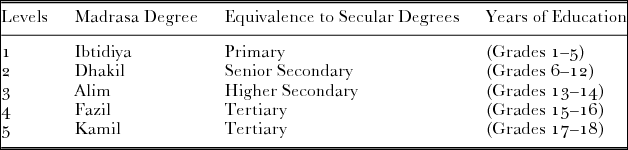
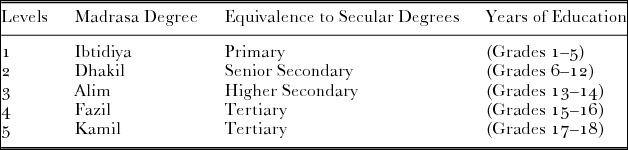
There are 9,000 Aliya madrasas with over 1.77 million students operating across the six divisions of the country.Footnote 32 This amounts to 30 per cent of the total state regulated secondary school population in the country and does not include the children going to Qoumi madrasas. Thus, compared with Pakistan, which is argued to have only 1–3 per cent of students in full time madrasa educationFootnote 33 and 4 per cent in India,Footnote 34 the share of madrasa education in the total education provision in Bangladesh is much larger. Featuring prominently in the Bangladesh Ministry of Education's plans from primary to tertiary level, the Aliya madrasa hierarchy has five distinct levels aligned against the secular schooling system (see Table 1). Till Fazil level, when the students start to specialize in Islamic subjects such as hadith, tafsir, fiqh, and adab, madrasa students are free to choose from various subject options such as humanities, science and business education.Footnote 35
Equivalence of Aliya Madrasa Degrees in Bangladesh
Source: Ministry of Education, Bangladesh, 2006.
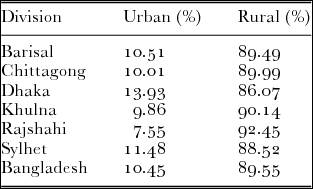
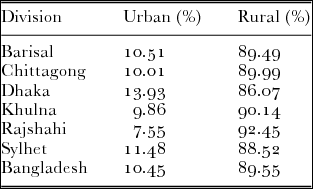
Aliya madrasas are spread across the six divisions of Bangladesh though they are particularly popular in rural areas (see Table 2). The largest concentration of Aliya madrasa students is in Rajshahi with 551,903 students whilst the lowest number is in Sylhet with only 60,496 students.Footnote 36 The student numbers taper off as we go up the madrasa hierarchy. Compared with 1,084,850 students at Dhakil level, only 91,135 students continue up to Kamil level. Thus, though the scale of the Aliya madrasa system at the primary and secondary levels is significant, the number of students actually moving up to the level of specialized Islamic education is small.
Aliya madrasa students in rural and urban areas
Source: Ministry of Education, 2006.
Aliya madrasas are state supported but only three are state owned: one each in Dhaka, Sylhet and Bogra. This community ownership of the Aliya madrasas is in line with government policy, unlike the case in Pakistan and India, to aid private or community owned schools instead of maintaining its own schools. The government bears 90 per cent salary costs of the teachers of both secular and religious subjects in the Aliya madrasa system whilst the communities take care of the school infrastructure costs and are involved in its management. This support amounts to 72.0 per cent of the total cost of the Aliya madrasas. Only 15.2 per cent of the Aliya madrasas’ income comes from student fees, which matches the ratio of income of regular state supported schools at 17.8 per cent. In addition, 2.0 per cent income comes from rents from endowed properties and 4.9 per cent from public donations. The Aliya madrasa system is thus financially dependent on the state for its survival.
Qoumi madrasa system
Against this state-initiated and financed system of Aliya madrasa, rests the organically grown and much older tradition of Qoumi madrasas. Despite lacking the public subsidies available to the Aliya madrasas, the Qoumi madrasas still outnumber the state-supported madrasa system. The Qoumi madrasas rely completely on funding from the Qoum (public). There is no reliable data on Qoumi madrasas but all estimates are higher than those for Aliya madrasas: a total of 15,000 madrasas were reported to be registered with the three umbrella organizations of the Qoumi madrasas during the time of my fieldwork whilst the number of unregistered madrasas has been argued to be as high as 64,000.Footnote 37 Qoumi madrasas constitute a non-formal stream of religious education and are characterized by a hierarchy similar to that of the Aliya madrasa system. At times, they are also referred to as the Kharzia system (a term more common in the West Bengal state of India). Qoumi madrasas follow the Dars-i-Nizami curriculum, although the level of curriculum covered varies according to the teaching capacity of the madrasa.
Whilst the trends within Aliya madrasas can be studied through analyzing the data available with the Bangladesh Madrasa Education Board, studying the Qoumi madrasas requires finding your own way through an informal chain of sources and the data available with the central madrasa boards of the Qoumi madrasas. During the fieldwork, it was very clear that the Qoumi madrasas exercise full control over the traditional platforms of Islamic authority, namely the mosque and madrasa. Interviews within Dhaka made two facts clear very quickly: (1) The stronghold of the Quomi madrasas was Chittagong; (2) the madrasa leading the Qoumi madrasa hierarchy was Darul Uloom Moniul Islam Hathazari followed by Al-Jamia Al-Islamia Pattia.
The Qoumi madrasas take their inspiration from the Darul Uloom Deoband school.Footnote 38 Darul Uloom Moniul Islam Hathazari,Footnote 39 the most prestigious Jamia within the Qoumi madrasas in Bangladesh, was established in 1901 with the combined efforts of many scholars trained at Darul Uloom Deoband. Al-Jamia Al-Islamia Pattia, the next most prominent Qoumi madrasa in Chittagong is also based on the Darul Uloom Deoband school. Jamia Darul Maarif Al-Islamia, another prominent Qoumi madrasa in Chittagong, is inspired by the Nadwat-ul-‘Ulama (another famous madrasa within the Deoband tradition in India) which led a reformist tradition within the Deoband to adapt madrasa education to modern day life. The Jamia was established in May 1975 by Maulana Mohammad Sultan Zoak Nadwai and the current leadership argues that, with changing times, the community also demands change. The religious scholars of the madrasas have therefore made an effort to match the curriculum to modern demands. All the degrees of Maarif Al-Islamia are recognized by Nadwat-ul-‘Ulama. Similarly, Jamia Rahmania Arabia, another of the most prominent Qoumi madrasas in Dhaka, was established in 1986 by Sheikh ul Hadith, a prominent religious political figure in Bangladesh. The madrasa has 12,000 students who all reside within the madrasa. These Qoumi madrasas teach up to Dora-e-Hadith (kamil level) and conduct classes in English and Bengali with some, such as Hathazari, placing emphasis on learning Urdu as one of the working languages— a desirable goal for most bigger madrasas but one which is increasingly difficult to achieve. These madrasas cover secular subjects till the eighth grade, after which they study 27 different Islamic subjects till Dora-e-Hadith.
In response to the state effort to support Aliya madrasa tradition, the Qoumi madrasa leadership has also been strategically organizing itself into collective platforms to protect its position vis-à-vis the state and also to ensure standardization of education within the Qoumi madrasas. In 1978, a Qoumi madrasa board was set up in Bangladesh with the name of Wafaq ul Madaris Al-Arabia, Bangladesh. It was a continuation of the process that had already started in West Pakistan in 1957 with the establishment of Wafaq ul Madaris Al-Arabia, Pakistan. The main purpose of this platform was to develop a standard curriculum for the Qoumi madrasas and to conduct centralized examinations and issue standard degree certificates. It developed a three-tier representative system: an executive body, a middle-level committee comprising the bigger madrasas, and the bottom tier comprising the smaller Qoumi madrasas who form the ordinary members. Membership of the Wafaq is voluntary, but all madrasas wanting their students to have Wafaq-recognized degrees have to register with the Wafaq.
As in the case of the Aliya madrasas, it is thus a pyramid structure with the number of madrasas being the highest at the primary level and shrinking dramatically post-secondary. The madrasas attached to the board follow a standard curriculum. Whereas in the Aliya madrasas specialization in religious subjects starts at Master level, in Qoumi madrasas it starts after the eighth or tenth grade. Ninth class onwards, the focus shifts exclusively to religious education. In addition to this, there are also a few other regional boards of Qoumi madrasas, which often revolve around a specific madrasa. Ittehad-ul-Madaris is another influential Qoumi madrasa board and is mainly under the influence of Al-Jamia Al-Islamiya Pattia in Chittagong. Unlike the Aliya madrasas, whose degrees are recognized by government, the degrees issued by the Qoumi madrasa boards are not recognized by the state. These degrees cannot thus be used for securing positions within government but they are critical for recognition within the Qoumi madrasa hierarchy. They are required by madrasa students seeking teaching positions within the Qoumi madrasas, for religious jobs in the Gulf region, and for placements within mosques. It is therefore legitimate to ask, in the presence of this strong tradition of Qoumi madrasas, what has led to the rise and spread of Aliya madrasas? Is the answer as easy as provision of attractive financial incentives and thus translatable into a universally applicable reform package?
The rise of Aliya madrasas
Current studies on madrasa modernization programmes in Bangladesh emphasize the importance of financial incentives in encouraging Qoumi madrasas to ‘convert’ to Aliya madrasas.Footnote 40 This section, illustrates how financial incentives, though important in creating followers within the Qoumi madrasa system, were not the central ingredient for success. Historically shaped institutional factors, which justified the need to talk of a new discourse on Islam in the post-liberation Bangladesh, and led to a certain level of trust between the state and the madrasa leadership, were critical to the rise of the Aliya madrasa tradition in Bangladesh.
Financial incentives
The fact that the Bangladeshi state, which has managed to implement a madrasa modernization programme on a much larger scale than its neighbouring states of India and Pakistan in a much shorter time, gave higher financial incentives to madrasas to enter the modernization programme than did the other two states apparently makes the arguments noting the power of financial incentives to lead the reform programme appealing. The Bangladesh madrasa reform programme paid the salaries of all the teachers in the madrasa covering secular as well as religious subjects. This was a major incentive for the madrasa leadership, especially for the smaller madrasas struggling to survive on small donations. On the other hand, the incentives provided by the state in India and Pakistan have been far less attractive. The governments in these two countries only offer salaries for the teachers appointed by the state to teach secular subjects. Since the madrasa leadership normally specializes in religious subjects, this means that the reform packages offered in these two countries hold little monetary promise for the core madrasa staff and leadership thus making the programme less appealing. In the case of Bangladesh, apart from the state coverage of the salaries of the entire teaching staff, another incentive programme—the World Bank female stipend scheme introduced post-1993—seems to have played a key role in the rise of the Aliya madrasa. Asadullah and ChaudhuryFootnote 41 show that at the time of the reform only 4.9 per cent of madrasa students were female, today they represent 47 per cent. This increase has mainly occurred in the period 1990 to 2003, which is the period when the female stipend scheme was launched. Under this scheme, tuition fees for girls were waived and they were additionally provided with a stipend. The Aliya madrasa were eligible to take part in this scheme.
State specific factors
My own fieldwork within the madrasas and interviews with officials within the madrasa board, as well as with leading ‘ulama of Qoumi madrasas, show that the most important factor in the rise of the Aliya madrasa tradition has been the role Islam has played in the politics of each country and, more specifically, in Bangladeshi politics since 1971. East and West Pakistan were the result of a demand for a separate homeland for the Muslims of India, where it was argued that Muslims would be able to live by the rules of Islam. The actual politics of this demand were however much more complex with the material interests of various groups embedded in it. This round of politics continued after the creation of Pakistan. The political elite of west Pakistan continued to use Islamic idiom to legitimize themselves and to cover ethnic and regional injustices against the Bengalis. The Pakistani army not only committed many atrocities against the population of East Pakistan but also described the Bengalis as ‘Kafirs’ (infidels).Footnote 42 This meant that in the immediate post-liberation period in Bangladesh, Islam for some time had to take a backseat. The preamble of the 1972 constitution stated secularism as one of the four fundamental principles of the constitution. As Huque and AkhterFootnote 43 note:
Article 12 of the constitution specified that the principle of secularism would be realized by the elimination of: communalism in all its forms; the gathering by the state of political status in favour of any religion; the abuse of religion for political purposes; and any discrimination against, or persecution of, persons practicing a particular religion. Article 38 provided for freedom to form associations, but provided that ‘no person shall have the right to form, or be a member or otherwise take part in the activities of, any communal or other association or union which in the name or on the basis of any religion has for its object, or purposes, a political purpose’.
The constitution prohibited the operation of a number of political parties, which argued for an Islamic state. Article 41 of the constitution stated that every citizen had ‘the right to profess, practice, or propagate any religion’, and that no person ‘attending any educational institution shall be required to receive religious instruction’. At the same time, politico-religious party organizations were abolished, and the ‘formation of such organizations’ was prohibited.
This strict separation of state from religion was, however, artificial in terms of public sentiment which deep down remained Islamic despite the secular undertones of the war of liberation.Footnote 44 This meant that the separation of Islam from politics was never complete, even during Sheikh Mujibur Rahman's (the leader of Awami League) period. The strong appeal of Islam among the masses and the geo-political reality whereby the Bangladeshi leadership also wanted to find a support base within the oil-rich Arab states, made the Islamic identity important for the country even under its secular leadership. The use of Islam in politics became all the more critical in Bangladeshi politics under the military regime that displaced Sheikh Mujibur Rahman within four years of the birth of the country. General Zia who had replaced Sheikh Mujibur Rahman's government needed some ideological platform to justify the military involvement in politics and form a resistance to the Awami League. He chose to play the Islamic card and his party, the Bangladesh Nationalist Party, made a natural alliance with the Islamic forces in the country. General Muhammad Ershad (1982–1990), who took over in 1981 after Zia's assassination, took the same strategy even further.
In 1988, he declared Islam the state religion of Bangladesh. He also changed the weekly holiday from Sunday to Friday and, more significantly, removed the ban on Islamic parties to engage in politics. It was this context of re-Islamization of Bangladeshi politics and the military regimes’ use of Islamic ideology to gain political legitimacy that gave a strong impetus for investment in the Aliya madrasa system and the establishment of the Bangladesh Madrasa Education Board in 1978. The madrasa modernization efforts became part of many other Islamization measures of the Zia regime to convince the public of the government's pro-Islamic credentials. The Board thus had a very different origin than the madrasa reform measures which had been planned in West Pakistan during the 1960s and 1970s and even today:Footnote 45 the birth of the Bangladesh Madrasa Education Board was presented as a genuine effort to support and strengthen the right of Muslim children to gain both secular and religious education. Given the prior history of the Aliya Madrasa in Bengal and the pro-Islamic credentials of the state, the Board was not resisted by the madrasas as strongly as similar efforts were in West Pakistan.
The role of the Bengali Language Movement
Closely intertwined with the war of liberation and the rise of the Aliya madrasas was the issue of the Bengali language movement. In 1948 the Government of Pakistan had declared Urdu as the official language leading to strong resistance in East Pakistan and giving further impetus to the liberation struggle. This resistance against Urdu placed the Qoumi madrasas in an awkward position. Bangla was central to the identity of East Pakistan, however Qoumi madrasas were one platform where Urdu, because of its status as the language of the Indian Muslims, had priority. The Darul Uloom Deoband, on which the Qoumi madrasas are based, is located in Uttar Pradesh, the heartland of the Urdu language. The senior ‘ulama of the top Qoumi madrasas had often studied at top Jamias in Uttar Pradesh, in Deoband or Nadwa. There is dense Islamic literature in Urdu given the contributions of the South Asian ‘ulama to Islamic publications sometimes covering issues not debated even in the Arabic language publications. As explained by many senior ‘ulama interviewed in the Qoumi madrasas, these factors made Urdu the main medium of instruction in the more established Qoumi madrasas after partition. Such a preference however became very taxing post-1971, given the centrality of the Bangla movement in the liberation struggle and the even further diminished economic relevance of Urdu in the newly established state of Bangladesh.
In such a context, when the government Bangladesh Madrasa Education Board proposed madrasa reforms, including support to shift the teaching of Islamic subjects in Bangla, the proposal had its appeal. Even the bigger Qoumi madrasas like Hathazari, which to date place much emphasis on Urdu, now treat it as an additional language and not as the main medium of instruction. For the smaller Qoumi madrasas at times even teaching Urdu as an additional language is not an option given resource constraints. Thus, Urdu has gradually been phased out of madrasa education in Bengal and the government modernization programme helped to make that shift. In the words of a Bangladeshi academic,
Madrasas were financially weak in the 1980s. More importantly, they were giving education in Urdu and they were losing students as they were not getting jobs anywhere and the curriculum was also very biased towards certain kind[s] of jobs. The Islamic elite had [an] affiliation with Arabic but less so with Urdu so it was an affiliation they could consider giving up. This was strategic thinking as it helped [to] access government funds plus meet community requirements.
During the fieldwork, all ‘ulama in the senior Qoumi madrasas were keen to converse in Urdu. This undoubtedly made the fieldwork much more rewarding. It, however, also captured the dilemma faced by the ‘ulama in Bengal, who clearly have strong emotional bonds with Urdu as the language of Indian Muslims, but realize that transmitting this skill to the next generation of Qoumi madrasa students in Bangladesh is an unrealistic aspiration.
History of Jama’at-i-Islami
The support for Aliya madrasas within Jama’at-i-Islami leadership is the third critical factor facilitating the rise of Aliya madrasas. Some authors argue Jama’at-i-Islami has strong links with Qoumi madrasas but without providing convincing evidence.Footnote 46 In fact, during my fieldwork it was very clear that the Jama’at in Bangladesh has supported Aliya madrasas as opposed to the Qoumi madrasas. This issue arose in interviews with the officials of the Bangladesh Madrasah Education Board, senior leadership of the Jama’at, as well as in discussions with journalists, observers of the madrasa system and the Qoumi madrasa leadership. The connection is not formal. As one of the ‘ulama of the Qoumi madrasa explained: ‘It is an ideological support. The teachers of the Aliya madrasa are of the Jama’at-i-Islami mindset’. Another added: ‘Jama’at-i-Islami from the start developed close association within the Aliya madrasas. They have been able to cultivate the links in the madrasas by cultivating links with the teachers of the Aliya madrasas’.
During interviews with officials of Jama’at-i-Islami, the Jama’at's support for Aliya madrasas was also very clear. The senior Jama’at-i-Islami officials I interviewed were critical of the Qoumi madrasas, and one of them noted, ‘Qoumi madrasa education is not total Islam. The student coming out of the madrasa is a misfit in society. He is not a person who can compete in society. The person who comes out of the madrasa should be able to go to Oxford [University]. The question is that Islam does not forbid you from learning English, Mathematics, etc. Islam is a modern religion’.
During the interview, he advised that I should visit an Aliya madrasa in Dhaka as an example of a good madrasa, a visit which he later facilitated. In interviews, ‘ulama of the Qoumi madrasas were also very clear that Jama’at is supportive of the Aliya madrasas. The general perception was that the Qoumi madrasas are supportive of other Islamic parties that are more radical. The support for Aliya madrasas fits well with the underlying philosophy of the Jama’at. The Jama’at does not believe in studying Islam just for the sake of becoming mosque imams and religious teachers. Maududi, the founder of the Jama’at, was keen to attract educated middle class professional Muslims who should take a lead in all professions, most importantly in the shaping of the state, and have a good religious understanding. As ShehabuddinFootnote 47 notes, even today, despite recognizing the importance of reaching out to the large constituency of the illiterate Bangladeshis, especially the illiterate women mobilized by NGOs and development programmes, the majority of Jama’at's official members, both men and women, are middle-class, well-educated, and urban-based. It is thus not surprising that the Aliya madrasas, with their emphasis on combining religious and secular education, found support within a dominant religious force in the country. This gave the government modernization programme greater legitimacy among the madrasas hoping to benefit from it.
Thus, though financial incentives have played a role in the acceptance of the Aliya madrasa system, the political context in which the reforms were undertaken also have an equally important role to play. Unlike Pakistan where the reform programme suffers from a strong distrust of the religious community,Footnote 48 or India, where the state has to deal cautiously with Muslim institutions in order not to be seen as biased, the Aliya madrasa model was rolled out under an apparently pro-Islamic regime in Bangladesh along with many other measures it was taking to Islamize the state. The programme also had the support of an influential religious party within the country, and the switch to the Bengali language suited the socio-economic realities of the madrasa students in the newly created state of Bangladesh. All these factors made this programme look like a genuine opportunity for madrasas rather than appearing as an attempt by the state to control them. To replicate the lessons from Bangladesh to Pakistan and India is thus not just an issue of replicating the financial incentive model developed by the Bangladesh Madrasa Education Board. Such an effort becomes all the more debatable, when it is recognized that introducing secular subjects in the madrasa curriculum does not necessarily lead to a modern discourse on Islam.
Prevalence of Qoumi madrasas
If the objective of the reform was to have the madrasas teach an integrated curriculum which would enable their graduates to find employment outside the religious market then the Aliya madrasa programme has arguably indeed met some of its stated objectives. If the ambition, however, was to lead to a more modern approach to the teaching of Islam, the result is questionable. Interviews with government officials within the Aliya madrasa board as well as with the ‘ulama of the Qoumi madrasas show that it is the Qoumi madrasas that still dominate the religious hierarchy—students from these madrasas still control the mosque networks and provide the spiritual services sought by the community. The modernization programme, might have converted a few madrasas but in general it led to the rise of a new category of madrasas whose establishment was induced by these financial incentives, the state efforts failed to incentivize the prominent Qoumi madrasas, who control the religious hierarchy, to accept the reform. More importantly, the Aliya madrasa system failed to pose a threat to these old elites or displace them from the religious establishment. During the interviews, whether conducted with the Qoumi madrasa leadership, the staff members or senior officials of the Bangladesh Madrasa Education Board, or the secular observers, the base of religious authority was clear: it was quickly associated with the elite madrasas of Chittagong.
Mosques and Islamic teaching
During the interviews, it was repeatedly noted that Aliya madrasas do not play one critical role that has historically been central to the working of madrasas namely, producing graduates who take up formal positions within the mosques. The mosque-madrasa link is integral to the working of the religious authority in Islam. The mosque is where Friday prayer takes place, it is where the children of the community acquire their routine religious training and Quranic instruction. This connection is missing in the case of Aliya madrasas which are rarely linked to a mosque and they are not mandated to provide afternoon Quran classes to community students. This difference is critical in determining religious authority the two types of madrasas enjoy vis-à-vis the Bangladeshi public. The limited links between Aliya madrasas and the mosques leave Qoumi madrasas in control of the mosque network. When there is an opening within the mosque, the students of Qoumi madrasa attached to that mosque have the strongest chance of securing that position. Even the officials of the Bangladesh Madrasah Education Board acknowledge this basic fact, which was summed up by one interviewee as follows: ‘The Aliya madrasa has no connection with the public. In the Qoumi madrasa, children of the community also come to study and there is a link with the community. In the madrasas and masjid, the Imam is from the Qoumi madrasa’. These facts were also emphasized by leaders of the Qoumi madrasas interviewed. In words of one alim: ‘The public knows that there is more religion in these Qoumi madrasas. Even the government officers are convinced that the training here is better’.
Student aspirations
The limited role of the graduates of Aliya madrasas in shaping the religious discourse in Bangladesh is also visible in the aspiration of the students and their parents. One of the biggest critiques of Qoumi madrasas is that they only produce graduates for religious jobs, such as imams and khateebs at local mosques or teaching positions in madrasas. On the other hand, the Aliya madrasa students are by their very orientation encouraged to take up regular jobs, join secular professions and compete with regular school children. The whole philosophy of the Aliya madrasa is that religious studies should not mean religious employment; children from madrasas should be able to enter the regular economy. The number of Aliya madrasa students goes down dramatically at post-secondary level when the emphasis shifts mainly to religious studies. In addition, a high percentage of these Aliya students completing the Fazil degree get absorbed as teachers within the Aliya madrasas.Footnote 49 Thus, there is little evidence that Aliya madrasa students enter the traditional religious hierarchy in Bangladesh and take leadership positions within the mosques spread across the country.
As Maulana Mahfuzul Haque from Jamia Rahmania Arabia stated in the interview: ‘The real purpose of the madrasas is to teach the Quran and Hadith and [to] keep the foundation of Islamic education. The real emphasis is on the Arabic language so that the child can understand the text better. Many people want to get the degree so that they can get a job. If they want this then they will send their children to Aliya madrasas. But, those who only want Islam, they come to Qoumi madrasas’. He further elaborated: ‘The Aliya madrasas have become just like schools. The dressing of the students, their mannerisms and their way of speaking is no different than the school children. If you look at the children from Aliya madrasa you won't be able to differentiate between [the] school and Aliya madrasa students’.
Limited difference in views
At the same time, whilst the Aliya madrasas have failed to displace the authority of Qoumi madrasas, it is interesting to note that the views of the Aliya madrasa students remain quite conservative. Although the Aliya madrasa students seem to have become relatively secular in the eyes of the Qoumi madrasa leadership, they have not become entirely free of religion. Comparing the attitudes of students of Aliya madrasas with those of students from regular schools, Asadullah and ChaudhuryFootnote 50 argue that Aliya madrasa graduates have conservative views compared with the children of regular schools. They are less favourable to higher education for girls, less accepting of working mothers and have a preference for large families, and ask for an Islamic democratic political system. Thus, whilst they are different in their professional orientations from the Qoumi madrasa students, in terms of their outlook towards core issues in life, it is greatly shaped by Islamic precepts similar to those taught in Qoumi madrasas. Seen this way, the Aliya madrasa presents a very different interpretation than that given to it by some. Rather than displacing the Qoumi madrasa establishment, the Aliya madrasa system has created a platform for parents who want to give their children a regular education but with more religious exposure than that provided in secular schools. The Aliya madrasa thus provides competition for the secular schooling system in Bangladesh; it is not competing with the Qoumi madrasas.
This was also explicitly stated by Maulana Mohammad Abdul Jabbar, Secretary General of Wafaq ul Madris Al-Arabia in a media interview. When asked whether there was a possibility of merging the Aliya madrasa system with the Qoumi madrasa system to create a single madrasas education system, Maulana Abdul Jabbar's answer was revealing:
There is a big difference between the views and thoughts of the Aliya Madrasa and the Qoumi Madrasa. Aliya Madrasa wants an education system parallel to the existing general system of education in the country. But, we want higher studies in religious education, specialization in religious matters. So for the moment we can't have a merger. . . . We want all general subjects to be included in the syllabus alongside religious studies up to Class VII. Then up till Class X religious studies will be accompanied by Bengali as a subject. Then in higher studies we want to specialize.
Thus, if the establishment of the Aliya system was part of the modernization project to make the madrasa a base for generating a new discourse on Islam, the claims of success are questionable. The hierarchy of Qoumi madrasas remains intact as reflected in the leadership of the Wafaq-ul-Madaris Al-Arabia and other Qoumi madrasa platforms. These are the madrasas which are also linked with the religious establishments in India and Pakistan. I found some of their students have studied in both Pakistan and India; many senior ‘ulama in the Qoumi madrasa talked very fondly of the bigger Deobandi madrasas in Karachi and identified them as very desirable destinations for their bright students. Thus, even in the international and regional Islamic networks, it is the Qoumi madrasas that continue to dominate the religious establishment of the Bangladeshi madrasas; the Aliya madrasa system has not displaced their authority.
Future studies focusing on the Qoumi madrasas which have converted have therefore to take into count the types of Qoumi madrasas that might have moved to the Aliya system. The converted madrasas appear to be mainly from the lower ranks of the Qoumi madrasas, there is no evidence that mainstream Qoumi madrasas made this shift. Thus, what Bangladesh has been able to achieve is a rise of an alternative madrasa tradition; it has not succeeded in either modernization or displacement of the authority of the traditional Qoumi madrasas. The question then is that why has this major state led project of Islamic modernism succeeded in practice but not in spirit? Why have the Aliya madrasas spread but failed to generate the enlightened Islam sought alike by the colonial and the post-colonial secular elite and the contemporary policy-makers and development agencies? The answer it seems rests in mixing efforts to generate a modern discourse on Islam with attempts at secularizing the society.
Why has the modernization project failed?
Both the Aliya and Qoumi madrasas belong to the Deobandi school of thought, which is the strongest madrasa tradition in South Asia; both follow relatively similar Islamic texts. The same religious textbooks are used in the two madrasa systems, the difference is in the ratio of religious to secular texts taught, the extent to which religious books are covered, and the rigorousness of that training. Whenever I asked the Qoumi madrasa leadership to compare the systems of education in the two types of madrasas, the standard response was that in the Aliya madrasas students are taught only parts of the religious text, which was explained as a ‘school kind of approach’, whilst in the Qoumi madrasas the emphasis is on completing the entire book even if it takes a student additional years. As argued by one senior alim in a Qoumi madrasa, ‘They [students in Aliya madrasas] only read part of the book; we read the whole book from A to Z. In Aliya madrasas there is selection. Those who study in Aliya madrasas cannot teach in a Qoumi madrasa. Our children teach the Islamic subjects in the Aliya madrasa’. Another one added: ‘They study only for the degree; they study for the government job’.
The intensive study of key Islamic texts within the Qoumi madrasas is made possible by the fact that they are mainly residential facilities and the study hours of the students stretch from sunrise till after dinner. In Aliya madrasas, on the other hand, the students follow a standard school timetable (9am–2pm) and, due to the focus on both secular and religious textbooks, can only cover limited chapters within the prescribed textbooks. Thus there is a key difference in the basic outlook of the two madrasas. The state supported Aliya madrasa is mainly focusing on making the students read less Islamic text, it is not attempting to introduce new interpretations of the text or change the teaching methods. The result is that the Qoumi madrasa student is more specialized in religious education and is a more actively sought after figure within the public for seeking religious guidance and continues to control the neighbourhood mosques.
Here it is also important to understand the multiple roles ‘ulama play within the community, which help to establish their authority. For the believer, the imam of the mosque does not only lead Friday prayer, he also becomes the main reference point for clarifying Islamic principles and for seeking guidance for actions which are not explicitly addressed in the Qur’an and Sunnah. These justifications, or fatwas (interpretations of the religious texts in the light of modern day issues), have to be provided in the light of religious texts. For the believer, an alim who is known for his religious specialization is thus more important than the one who has had a divided education. The importance attached to the ‘ulama arises because they have the authority to issue fatwas, which explains the community's support for Qoumi madrasa.
This difference in specialization in religious texts among the two madrasa traditions was also visible during my fieldwork. For example, an important role of Darul Uloom Moniul Islam Hathazari is to provide fatwas to Muslims in the light of the Quran, Sunna, Ijma, and Qias. To perform this function, it maintains a board of learned muftis (‘ulama qualified to give fatwas). It teaches and encourages students to go on Tableeg (preaching Islam to believers and non-believers), live a simple life, and builds up their skills in the art of writing khutbas (Friday prayer sermons). Particular emphasis is placed on teaching the students the art of debate and discussion, so that they can conduct inter-religious debates. Upon completion of their study, the students of the Jamia are expected to teach in religious institutions within the country as well as taking up jobs in the Middle East. The Aliya madrasas do not play these roles. As a prominent Bangladeshi academic observed: ‘The emphasis within Aliya madrasas has been on commercialization of madrasas and not on developing a more enlightened version of Islam. The reformed madrasa curriculum is not teaching Ibn-i-Arabi and the Muslim philosophers who can provide for a more liberal interpretation of Islam. It is just teaching students to get ordinary jobs’.
Conclusion
This paper set out to address two critical questions which help us to understand the impact of state-led efforts at Islamic modernism in Bangladesh and inform contemporary debates on madrasa reform in different contexts. It has shown that the birth and expansion of the Aliya madrasa system cannot be viewed as a successful case of a state-led project of Islamic modernism. Aliya madrasas have failed to displace the hold of Qoumi madrasas over the religious establishment and change the parameters of public discourse on Islam. Rather than creating an alternative platform of religious authority, which could weaken the hold of the orthodox ‘ulama, Aliya madrasas primarily meet the demand of Muslim parents who want their children to secure secular education but with a higher content of religious subjects than is offered in the curriculum in state schools. The growth of Aliya madrasas in Bangladesh is therefore more in line with Nelson’sFootnote 51 documentation of high parental preference for integrated education (that combines religious and secular subjects) in Pakistan, than being proof of the success of state-led efforts to reform Islam or Muslim institutions in line with the demands of western modernity. It is important to acknowledge here that whether or not the state has the right to reform madrasas is in itself a highly contentious debate—many ‘ulama within the madrasas question the very legitimacy of the state-led project of Islamic modernism. This paper therefore did not set out to either approve or denounce state attempts at madrasa reform, but to objectively assess the extent to which the state-led project of Islamic modernism has reached its stated objectives on the ground.
Thus, this paper has attempted to provide evidence of the limited reach of the state-led project of Islamic modernism in Bangladesh as implemented through the Aliya madrasa programme, and also to identify the causes of this failure. However, what we need to know further is whether the profiles of the Muslims following the two different streams of madrasa education differs and, if the answer is ‘yes’, then how do they differ? Is the selection shaped purely by the socio-economic profiles of the parents and poverty levels or is the choice to be in a specific type of madrasa shaped by ideological preferences of the parents? Furthermore, how do the life choices available to the children in the two madrasa traditions differ, if indeed they do? To answer these questions we need ethnographic studies of Qoumi and Aliya madrasas capable of developing a dense narrative of what happens inside these madrasas on a day-to-day level and how student experiences are shaped. My account of an orthodox Deobandi madrasa in PakistanFootnote 52 and Peggy Froerer’sFootnote 53 ethnography of a Saraswati Shishu Mandir Primary School in India provide examples of such a methodological approach. We also need longitudinal studies, which trace the life choices of graduates from the two traditions over a number of years to illuminate the long-term consequences of the choices to be made in a particular madrasa.
Despite the growth in studies on Islamism in Bangladesh, we still have very limited literature on Aliya and Qoumi madrasas. Whilst the recent surveys supported by the World Bank provide interesting insights into attitudes of students in Aliya madrasas, compared with those in secular schools,Footnote 54 there is still hardly any comparative work on students of the Aliya and Qoumi madrasas. Much of the recent literature on the role of Islamic education or Islamic movements in Bangladesh is focused on Jama’at-i-Islami.Footnote 55 Interestingly, though, the issue of Jama’at's support for Aliya madrasas, as documented in this paper, has not been investigated in these publications. Madrasa education and its relationship with modern secular education, an old subject of inquiry in the study of Muslim societies,Footnote 56 thus even today remains an extremely exciting area for new research.