I. Introduction
The term ‘best practice’ has become prominent in the modern lexicon of global governance. International organisations, states, international financial institutions (IFIs), transnational standard-setters, industry associations, and international non-governmental organisations (INGOs) increasingly steer targeted actors – whether governments, firms, or other organisations – towards a multiplicity of objectives through reference to best practices. While efforts to govern through best practices can be found across many contemporary global governance issues, to date, little scholarly research has unpacked what best practices are, how they are constructed, or what consequences they hold for broader efforts to address global problems. This article addresses these questions.
We offer a novel conceptualisation of best practices as a unique mode of global governance that relies on lessons drawn from existing practices for legitimation and political authority. Using diverse empirical examples from a range of global issue areas, we identify four characteristic features of global governance through best practices. First, best practices derive legitimacy from existing practices. Second, they root their legitimacy in the appearance of consensus. Third, they emphasise broad procedures over specific prescriptions. And fourth, they rely on incentives instead of coercion to steer their targets. We also find that best practices in global governance are purposively constructed by political actors with the objective of gaining public authority, an assertion that is at odds with the apolitical ways in which they are often represented. Public authority is obtained through demonstrating fitness with existing social structures – that is, the broader normative environment that sets expectations of appropriate behaviour and practices – and through targeted efforts to make best practices relevant and legitimate to particular communities of practice. We find that these efforts to gain public authority affect the content of best practices, albeit in unpredictable ways. More broadly, we conclude that while best practices offer a pragmatic approach to global governance in a fragmented institutional environment, they also tend to mask underlying power dynamics and limit their prescriptions to actions currently being undertaken while avoiding more radical approaches. We illustrate these conceptual characteristics and consequences of governance through best practices through an in-depth analysis of the ISEAL Alliance, a creator and disseminator of best practices for transnational sustainability standard-setters.
II. Defining global governance through best practices
While references to ‘best practices’ are common in a variety of both domestic and international contexts, our focus is on best practices when employed specifically as a mode of global governance. This scope condition requires a brief discussion of the term’s origins and usage. Best practices first started to gain popularity in governments and international organisations in the 1980s and 1990s as part of the shift away from command-and-control regulation and the growing prominence of new public management (NPM), which sought to transfer the ‘best’ (meaning ‘most efficient’) management practices from the private sector to the public sector.Footnote 1 However, over time the term ‘best’ began to take on new meaning. Taking a cue from NPM, best practices became a popular means within governments to promote reform and, in cases of intergovernmental organisations such as the Organisation for Economic Cooperation and Development (OECD), promote policy transfer. The term ‘best’ was increasingly used to describe those existing policies or practices most likely to achieve a normatively better outcome, although the nature of that outcome depended on the normative preferences of the group(s) creating and disseminating best practices.
Initially, international institutions promoted best practices exclusively through informal mechanisms such as expert group meetings or learning forums. Despite these informal and management-focused origins, over time best practices became increasingly codified and referenced in guidelines, benchmarks, or process standards, creating expectations and sometimes criteria against which targeted entities could be measured.Footnote 2 Best practice promotion became, as André Broome and Leonard Seabrooke note, an ‘indirect form of political power’ used by IFIs such as the World Bank or International Monetary Fund (IMF) to influence national policies by gaining authority for their ideas. They write: ‘framing their policy advice as “world’s best practice” enables the staff of international organisations (IOs) to identify common economic problems across different national economies and to link a diagnosis of the causes of a problem with a generic prescription for policy solutions’.Footnote 3 For example, the OECD does not have a stringent set of accession criteria, but when its Governance Outreach Initiative started in 2000, it included or provided links to a number of documents that laid out ‘governance priorities’ that support ‘OECD Governance Best Practices and Policy Lessons’, in effect providing a set of indicators that contributed expectations around governance practices, later incorporated into initiatives that explicitly targeted prospective members.Footnote 4 It is this contemporary conception of best practices, as an institutionalised mode of global governance that imposes clear expectations on targeted entities, and not just an informal means of knowledge-sharing, that is the focus of our analysis.
Best practices are a unique mode of global governance, or put differently, a distinct means through which ‘governance’ is accomplished. While there are many definitions of governance in the literature, almost all share three core elements when applied to political or public authority. These elements include legitimate authority (an authority recognised by the governed that ought to be obeyed), steering (whether in the form of norms, rules, or practices), and some degree of publicness in reference to the community being governed who grant or legitimate the authority.Footnote 5 John Ruggie’s definition nicely captures these elements: ‘systems of authoritative norms, rules, institutions, and practices by means of which any collectivity, from the local to the global, manages its common affairs’.Footnote 6
Drawing on these core elements of governance, we distinguish global governance through best practices from a more general usage of ‘best practices’ along two lines. First, best practices in global governance are purposively designed to steer someone or something. In practice, this means that a specific organisation, entity, or collectivity is responsible for aggregating and disseminating best practices in support of a defined objective. Second, best practices in global governance possess some degree of publicness in reference to the community they seek to govern. Their governance ambitions are broad, serve public as opposed to strictly private ends, and stretch across political boundaries. They can therefore be distinguished from domestic best practices that often target narrow or private groups of stakeholders in a particular country.
Political authority in governance through best practices, much like other modes of global governance, is contingent upon the legitimacy of the governance effort. However, governance through best practices is unique in how it obtains this legitimacy. It does so specifically through reference to lessons that are ostensibly apolitical and learned through shared experience. Like other modes of global governance, best practices govern in the absence of formal hierarchical arrangements for monitoring and enforcing rules, although they are occasionally incorporated into more formal governance arrangements. We therefore define global governance through best practices as purposive efforts by global political actors to authoritatively steer a defined group towards some goal(s) through reference to lessons that are ostensibly apolitical, replicable, and learned through experience.
Best practices are a means through which global governance is accomplished. While they are increasingly used by states and other actors with well-established political authority, they are particularly common amongst actors that lack an established basis of political authority. These types of actors are the focus of the literatures on private authority,Footnote 7 non-state market-driven initiatives,Footnote 8 soft law,Footnote 9 and transnational standard-setting. Governance through best practices is not a distinct type of global governance in the way that many of these categorisations are, rather it is a mode of governance or a particular strategy that can be used by intergovernmental, private, non-state, or transnational groups to achieve their objectives.
Global governance through best practices possesses four common and empirically identifiable characteristics. First, as noted earlier, it can be distinguished by how governors obtain the legitimate authority to govern. While the arbiters of best practices must demonstrate fitness within existing social structures and be acceptable to specific communities, just like other modes of governance,Footnote 10 their efforts to appeal to specific communities are rooted in a distinct logic. Unlike epistemic communities, religious groups, or advocacy-focused INGOs, the creators and disseminators of best practices do not root their legitimacy in their own scientific objectivityFootnote 11 or claims to moral authority.Footnote 12 Rather, the legitimacy of best practices flows from practical experience. As their name suggests, best practices are often perceived as legitimate because they are already in-practice, implying that they are feasible and providing a clear bridge between abstract principles and material action. Their legitimacy and authority flows from recognition that they are already enacted in some context, blazing a clear trail for other actors to follow.
An example of this unique logic of legitimation can be found in best practices for corporate carbon management. In an effort to improve business action on climate change transnationally, Carbon Disclosure Project (CDP) and IBM released best practice guidelines for measuring, managing, and disclosing business-related carbon emissions. The guidelines profile the existing carbon management policies of 11 ‘carbon leaders’ and use these policies to steer ‘carbon novices’ towards better carbon management.Footnote 13 The legitimacy of the recommendations proposed in the CDP/IBM guidelines is rooted in the fact that they are already practiced by other firms, thereby suggesting to peer businesses that the recommended practices are tried, tested, and demonstrably effective.
Second, governance through best practices roots its legitimacy in the appearance of consensus. Best practices are never based solely on the ideas or opinions of the organisations that disseminate them, rather they are aggregated from the shared experiences of a group of practitioners. This gives them the appearance of being objective and apolitical, even if the members of the community contributing to best practices share a political agenda, exclude dissenting voices, or selectively champion some normatively preferred outcomes over others. While deriving legitimacy from consensus is a common feature of global governance, two aspects of the consensus process stand out in best practices. First, it is the appearance of consensus, rather than an arrival at consensus through participatory and deliberative procedures, that is vital for the legitimacy of best practices. Best practices may claim to be consensus-based, even if they are assembled by in-house experts conducting an ad hoc survey of a particular field of practice.Footnote 14 Second, and relatedly, best practices largely represent a consensus on the best existing practices, not on the types of practices that should or could be in place. As such, they mostly exclude the types of aspirational suggestions that could arise out of deliberative consensus-building procedures. As an example, in 2010, the United Nations Development Group (UNDG) released a publication entitled ‘MDG [Millennium Development Goals] Good Practices’. The publication draws on 197 existing approaches to achieving the various MDGs by local, national, regional, and global bodies with a stated goal of contributing to ‘evidence-based discussions’ on how to achieve the MDGs.Footnote 15 The breadth of the assembled practices suggests a broad research effort, conducted by a core team of UN experts, leading to an objective consensus on what constitutes best practice in lieu of a participatory and deliberative consensus-building process. This consensus, or appearance of consensus, provides legitimacy and political authority for the governance effort.
In this way, the legitimacy requirements for the disseminators of best practices differ from other modes of governance. As Peter Gibbon, Stefano Ponte, and Jakob Verstergaard note: ‘voluntary, formal standards and standard-setters are said to be in constant need to achieve, maintain and manage legitimacy to exert authority, since they need to convince standard users to adopt them and “audiences” to see such adoption as something acceptable’.Footnote 16 Best practices are somewhat less beholden to these legitimacy requirements, since they originate from a pre-established community of practitioners. Thus they have a built-in community that created them and finds them legitimate.
Third, governance through best practices is distinguishable on the basis of content. Whereas laws, treaties, and voluntary standards – even those with broad global scope – can be quite precise and technical, best practices tend to emphasise procedural matters over specific substantive criteria. This feature stems from both their unique logic of legitimation as well as the breadth of their governance efforts. Best practices in global governance at once rely on existing practices for legitimacy and must simultaneously render these practices universal enough to apply in diverse global contexts. For this reason, the groups that disseminate best practices tend to focus on processes that are replicable and versatile enough to apply in multiple contexts.
An example of this characteristic can be found in the International Organization for Standardization’s (ISO) efforts to develop an international framework for best practices in occupational health and safety. The framework eschews specific recommendations in favour of a ‘generic management system approach’ comparable to the ones used in ISO 9001 for quality management or ISO 14001 for environmental management.Footnote 17 The new framework builds on the success of the preceding Occupational Health and Safety Assessment Series (OHSAS) 18001 standard, which aggregated the ‘best’ existing national health and safety standards into a single international standard.Footnote 18 Consistent with OHSAS 18001, the focus of the new ISO framework is on the procedural dimensions of occupational health and safety. For instance, OHSAS suggests that an organisation should prepare, implement, and maintain procedures to identify potential emergency situations and to respond to such emergency situations.Footnote 19 However, neither OHSAS nor the new ISO framework specify what those procedures should entail. This ambiguity and procedural focus is typical of global governance through best practices and reflects the need to generalise recommendations in service of governing a broad audience.
Lastly, best practices share a common means for impelling compliance. Whereas laws, treaties, NGO campaigns, and formal voluntary standards often use coercive sanctions in cases of non-compliance (such as withdrawal of certification, naming-and-shaming, or corrective action requests),Footnote 20 best practices use less coercive and less overt sanctioning mechanisms. Compliance with best practices is seen as desirable but not always necessary. Part of the reason for this is that best practices, unlike voluntary standards, hold no formal legal status. There is no formal certification that accompanies best practice compliance. Moreover, there is little social stigma associated with non-compliance. By contrast, the Technical Barriers to Trade Agreement of the World Trade Organization (WTO) defines a standard (drawing on ISO/IEC Guide 2) as a ‘document approved by a recognized body that provides, for common and repeated use, rules, guidelines or characteristics for products or related processes and production methods, with which compliance is not mandatory’.Footnote 21 While the ISO definition also encompasses ‘mandatory’ standards, many types of standards include the elements of formal adoption by a ‘recognised’ body, codification, and expectations around compliance which gives them a quasi-legal status. Standards may include best practices amongst other criteria, but these criteria are treated less formally than other parts of the standard that generate more specific expectations. For example, ISO 26000, a ‘guideline’ standard on Corporate Social Responsibility, differentiates between ‘minimum steps all organizations should take to be considered socially responsible and additional best practices which organizations may choose or be encouraged to adopt’.Footnote 22
Many arbiters of best practices greet non-compliance with practical guidance and useful tips to help targeted actors attain best practice rather than formal or informal sanctions. While other modes of global governance also use non-coercive incentives, best practices rely almost exclusively on ‘carrots’ to the exclusion of ‘sticks’. For example, in 2013 the European Parliament commissioned a study on best practices for refugee integration to improve resettlement policies amongst EU member states. The best practices suggested therein are not mandatory for EU members. Rather they incentivise compliance by suggesting that effective migration management leads to ‘strengthened economies, greater social cohesion, and cultural diversity’.Footnote 23 The steering mechanism employed by the European Parliament is strictly carrot-based and relies on desirable social and economic incentives to induce compliance.
In sum, we conceive of governance through best practices as possessing a number of characteristics that cumulatively differentiate it from other modes of governance. It derives legitimacy from a distinct practice-oriented logic and the appearance of consensus,Footnote 24 focuses on procedure over substantive content, and employs incentives to induce compliance. All of these characteristics must be present to some degree for an initiative to constitute governance through best practices.
III. The rise of best practices as a mode of global governance
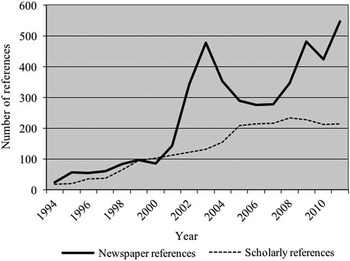
References to ‘best practices’ in global governance are increasingly frequent and transcend issue areas and types of governance arrangements. Prior to 1994, references to best practices in Political Science or International Relations were virtually non-existent. However, over the past twenty years, the term has become entrenched in the discipline’s lexicon. Between 1994 and 2011, occurrences of the term ‘best practice(s)’ in these disciplines’ journals increased nearly twelve-fold. Over the same period, newspaper articles mentioning both ‘best practice’ and ‘governance’ increased twenty-three-fold. The growing usage of the term ‘best practices’ over the last 18 years is illustrated in Figure 1.Footnote 25
References to best practice in newspapers and scholarly journals, 1994–2011.

Explanations for the rise of best practices have garnered some attention in the global governance literature, although scholars modestly disagree on why the shift towards governance through best practices has occurred. Craig Murphy and JoAnne Yates trace the ideas underlying best practices to the growing popularity of ‘process standards’ – particularly quality management standards like ISO 9000 – in the late 1980s. Unlike product standards, which focused on harmonising technical characteristics amongst similar products, quality management standards were supposed to improve ‘all of an organization’s processes so that, over time, all of the features of all of its products will improve’.Footnote 26 The focus on generalisable and replicable processes over particular technical attributes laid the groundwork for subsequent environmental management system (EMS) standards (for example, ISO 14000) or corporate social responsibility standards (for example, SA8000), which promoted general procedures for minimising environmental impacts or improving social performance. Both the broad ambitions and voluntary consensus-based procedures through which such standards are set closely resemble the processes through which best practices are created.Footnote 27 However, standards maintain a more formal legal standing than best practices, requiring formal adoption in their entirety and often third-party verification of conformance. As discussed above, best practices are less formalised and less binding. Nonetheless, the procedural and consensus-based turn in industrial standards undoubtedly helped set the stage for the contemporary rise of best practices in global governance.
More recently, Jacqueline Best has documented best practices as a governing strategy in global development policy, particularly emanating from multilateral economic institutions such as the IMF and the World Bank.Footnote 28 As she explains, the ‘law-like economic rules of the 1980s and early 1990s have been supplemented by and replaced with more flexible standards, often taking the form of best practices and benchmarks’.Footnote 29 Best sees this trend as part of a universalising strategy where the spread of these practices is not dependent on specific IMF or World Bank oversight (although they may engage in oversight in the case of their own lending or policy practices). The new strategy, she argues, provides a way for leaders of the World Bank and IMF to relegitimate their missions and promote the ‘universal value of their institutions’ efforts’.Footnote 30
A focus on best practices accomplishes this in part by allowing IFIs to explicitly move beyond a perceived narrow focus on economic development to include social, environmental, and political practices (such as anti-corruption or judicial independence) in their prescriptions, by ‘recognizing the social and political underpinnings of economic success’.Footnote 31 Combining these softer modes of authority with other practices such as promoting country ownership not only extends the legitimate realm of their authority and prescriptions, it also, Best argues, moves IFIs away from direct liability or responsibility for failure implied by harder forms of rules.
John Ruggie is even more direct in identifying a similar rationale for his decision to use a best practices approach in the development and promotion of the UN Guiding Principles on Business and Human Rights.Footnote 32 He describes his strategy as rooted in the recognition that the ‘old’ form of hierarchical, top-down, rule-making has ‘limited utility in dealing with many of today’s most significant global challenges’ given disagreement on norms among relevant stakeholders and conflicts in national legal norms that militated against hard law solutions.Footnote 33 Instead, he likens the strategy of the Principles to orchestration, working indirectly through intermediary organisations and using soft modes of influence to support and guide their actions.Footnote 34 The Principles are designed to work through international organisations with powers to convene disparate actors (states, private actors, and NGOs) as intermediaries and partners, ‘identifying and disseminating best practices and other forms of collaboration’.Footnote 35
Whereas the studies cited above present different explanations for the rise of best practices (perhaps because they analyse different issue areas), many of the conditions noted in these studies coalesce in transnational environmental and social governance. The increased interest in social and environmental standards by industrial standard-setting bodies (for example, ISO), efforts by IFIs to relegitimate their missions in developing countries, and the limitations of hard law solutions for solving global problems, all precipitated the growing usage of best practices in this field. International organisations, INGOs, states, and industry associations increasingly use best practices as a means of steering governments, firms, and individuals towards sustainability goals.
Efforts to govern climate change offer a good example. At the intergovernmental level, the International Partnership on Mitigation and MRV (Measuring Report and Verification), an initiative launched by the governments of Germany, South Africa, and South Korea after the Petersburg Climate Dialogue in May 2010, leads efforts to improve the uptake of Greenhouse Gas (GHG) mitigation policies in developing countries. The partnership seeks to accomplish these goals by disseminating best practices on the design and effective implementation of Low-Emission Development Strategies (LEDS), Nationally Appropriate Mitigation Actions (NAMAs), and MRV systems, which, like the cases of economic and human rights governance, had to be developed with sensitivity to national circumstances and conflicting national legal norms.Footnote 36
A similar shift towards governing climate change through best practices can be observed amongst non-state actors. Notably, the failure to agree upon an international emission trading system, as called for in the Kyoto Protocol, led to the proliferation of regulated and voluntary carbon offset markets, including those created by the Clean Development Mechanism of the Kyoto Protocol and the nascent UN-REDD+ programme, which promises credit for reduced emissions from deforestation and forest degradation in developing countries. The fragmented proliferation of carbon markets, according to some scholars, created demand for best practices to govern them not only to ensure proper accounting of credits, but also to ensure they embody broader values of social and environmental sustainability.Footnote 37
Best practices for carbon markets are disseminated by both industry and civil society actors. For example, the industry association representing offsetting companies, the International Carbon Reduction and Offset Alliance (ICROA), created a ‘Code of Best Practice for Carbon Management Services’ to respond to credibility concerns.Footnote 38 The Code implores carbon offsetting companies to sell only real, measurable, permanent, and additional carbon credits. Similarly, amongst NGOs, groups like the David Suzuki Foundation (DSF) promote best practices designed to broaden what was previously narrowly cast as single-value carbon accounting. In 2010, DSF released a report describing best practices in GHG management in an effort to steer corporations towards better GHG management, mitigation, and offsetting practices that encompass both social and environmental dimensions.Footnote 39 DSF is but one of a growing series of NGOs that are relying on best practices to steer businesses towards environmental goals, in lieu of more conventional appeals to morality, shared-values, or hard regulation.Footnote 40
In sum, while there are different accounts for the rise of best practices in global governance, there is little debate that best practices are increasingly ubiquitous, transcend issue areas, and cross public-private boundaries.
IV. The construction of best practices
Best practices abound in global governance, yet not all efforts to govern through best practices are successful or constitute ‘governance’ worth its name. We argue that to be authoritative or have the characteristics of governance, best practices must be perceived as legitimate by relevant communities and demonstrate ‘fitness’ with broader social norms regarding the generation of public authority, much the same as other global governance institutions.Footnote 41 The creators and disseminators of best practices in global governance, for the most part, are acutely aware of these legitimacy requirements and thus construct best practices with a specific view to aligning them with broader social norms and appealing to key legitimating communities. Where these legitimacy requirements are not met, we would expect the political authority of best practices to be substantially weakened.
Following Bernstein,Footnote 42 we argue that legitimacy requirements emerge from an interaction of the community of actors affected by governance arrangements (for example, those targeted for governance and concerned stakeholders) with broader institutionalised norms – or social structure – that prevails in the relevant issue area. These interactions create different legitimacy requirements across different issue areas and forms of governance, and define practices of political authority. Practices of political authority create the necessary publicness that separates public authority from strictly private authorities, such as self-regulation, club goods, or technical services for a defined membership such as business associations. The latter are not public since their goal is to provide a rule, good, or service for the sole benefit of members of a private group.
Best practices provide an interesting case since they at once legitimate different kinds of governance institutions and constitute a mode of governance themselves. For example, many standard-setting bodies use best practices in deliberation or stakeholder engagement as part of their legitimation strategy. The act of soliciting diverse experiences from key stakeholders can make a standard-setter appear more representative and accountable, thereby contributing to its legitimacy. However, best practices are also a mode of governance themselves that are deliberately constructed to be self-legitimating by tapping into social structural norms and community practices. It is the latter aspect of best practices, as governance, that is the focus in this section. In the case of governance through best practices, one additional element of their legitimation is important: they appear apolitical in the sense of being generated specifically from existing practices recognised by the relevant community.
IV.i Social structure
The social structure that constrains and enables global governance is composed of global norms and institutions. It serves a constitutive function by defining what appropriate authority is, where it can be located, and on what basis it can be justified. It also serves a regulative function by prescribing and proscribing the boundaries of governance activities.Footnote 43
Social structural norms can be found not only in specific declarations or principles that apply to the sector, problem, or process in question (for example, the International Labor Organization [ILO] conventions in the case of labor), but also in generally accepted or recognised norms of global governance that may intersect with those problems, such as trade rules (especially as embodied WTO agreements) that might constrain or enable other forms of regulation, or evolving norms of sovereignty. Norms may also be found in ‘soft’ declaratory or ‘informal’ international law.Footnote 44
In the case of transnational best practices, two sets of norms are most relevant. First, owing to best practices’ focus on generating authority outside the context of traditional international law-making and formal state consent, are norms specifically concerned with generating public acceptance of the authority of non-traditional or informal forms of global governance. Since the end of the Cold War, these procedural norms reflect a growing normative consensus on the need to ‘democratise’ global governance, though expectations among different sectors and issues may vary significantly. These norms include demands for improved public accountability of international institutions to states and/or broader affected publics and transparency,Footnote 45 as well as ‘stakeholder democracy’ that calls for ‘collaboration’ and truer ‘deliberation’ among states, business, and civil society.Footnote 46 The democratisation of global governance impacts the construction of best practices by all of these parties and means that legitimacy and public authority is increasingly predicated on the degree to which best practices are constructed through an inclusive and consensus-based approach.
With the rise of what some of have called ‘informal international lawmaking’, some international legal scholars have similarly identified a possible emerging set of ‘procedural meta norms related to authority, procedure and substance’.Footnote 47 They particularly emphasise that procedural norms that involve all stakeholders can generate legitimacy through ‘thick stakeholder consensus’ for new forms of cooperation and informal law. Further, such ‘thick consensus’ may even be ‘normatively superior’ in creating criteria for valid authority to ‘thin state consent[,] … the increasingly flimsy [traditional] basis of traditional international law’.Footnote 48 This argument is consistent with research comparing intergovernmental and non-state global governance arrangements that finds the latter requires thicker forms of democratic procedural norms than traditional inter-state governance.Footnote 49 Because best practices are also rooted in existing practices, however, they exhibit greater variability in the actual procedures required to generate the appearance of consensus, as seen in earlier examples where organisations created the appearance of consensus through in-house surveys of existing practices without participatory or deliberative processes. The degree to which best practices fit with emerging meta-norms about consensus-building and deliberation likely reflects the ambition of their governance aspirations. The more the organisations that promote best practices imbue them with claims to political authority, the greater the demand will be for them to engage in processes of consensus building that reflect these meta norms.
Second, norms that define the prevailing consensus on legitimate purposes or goals in a given issue area are relevant to the authority of best practices. For example, best practices that encompass environmental goals are often shaped by broader norms of liberal environmentalism, which predicate environmental protection on the continued promotion of liberal economic policies.Footnote 50 Here, again, best practices are frequently deliberately constructed to reflect more general norms articulated in treaties, declarations, statements of goals, or widely held norms generated by civil society. However, the contestation over this level of norms is often at the heart of developing legitimate governance arrangements that best practices try to navigate. Contestation might arise because of a lack of coherence among existing norms, especially since best practices often emerge in new areas that combine previously isolated or siloed concerns (for example, when carbon markets target forests where indigenous people live as opposed to targeting industrial emissions), or where expert consensus is lacking or unclear (for example, the cases of the IMF and the World Bank discussed earlier).Footnote 51
Social structure contributes to the construction of best practices through its discursive and disciplining role. Thus, when observing the construction of best practices in global governance, one sees deliberate strategies to draw upon already accepted, or emerging, norms in the issue area targeted by best practices. One example of how social structure conditions attempts to govern through best practices can be gleaned from John Ruggie’s strategy for the Guiding Principles (GPs) on Business and Human Rights:
The GPs draw on the different, yet when combined, complementary discourses reflecting the respective social roles that these governance systems play in regulating corporate conduct. Thus, for states the focus is on the legal obligations they have under the international human rights regime to protect human rights abuses by third parties, including business, as well as policy rationales that are consistent with, and supportive of, meeting those obligations. For businesses, beyond compliance with legal obligations that vary across countries in their applicability and enforcement, the GPs focus on the need to manage the risk of involvement in human rights abuses, which requires that companies act with due diligence to avoid infringing on the rights of others and address harm where it does occur. For affected individuals and groups, the GPs stipulate ways for their further empowerment to realize the right to remedy.Footnote 52
As Ruggie makes clear, these roles and obligations stem not from utopian aspirations, but from the existing social structure in the form of public laws and governance, norms arising out of civil society interactions (including advocacy campaigns), and corporate governance which, as he puts it, ‘internalizes values of the other two (unevenly, to be sure)’.Footnote 53 In this way, the Guiding Principles on Business and Human Rights are deliberately constructed to align with extant norms in way that affords them the authority necessary to govern.
IV.ii Community
In addition to demonstrating fitness with existing social structures, best practices must be constructed with a view to gaining legitimacy from relevant communities if they hope to wield public authority. Establishing the boundaries of the relevant communities is an empirical and interpretive endeavour, and unlikely to be without controversy. However, the particular community of practice, that is, those practitioners directly engaged in the activities being targeted, is especially important for the legitimation of best practices.Footnote 54 For example, best practices for refugee resettlement in the EU need to be perceived as legitimate, first and foremost, by the bureaucracies responsible for refugee resettlement in EU member countries. After all, these are the entities that must adapt their policies to conform to best practices. In this sense, best practices are perhaps the most directly derivative mode of governance from ‘communities of practice’, although we are cautious to not embed this argument too deeply in that theoretical literature.Footnote 55 The communities of practitioners for, and from, whom best practices are developed are often less cohesive than those identified in the ‘communities of practice’ literature, and generally include groups who have common as well as competing interests, such as firms and NGOs or developed and developing country government officials. Where that literature is helpful, however, is in highlighting that best practices must be based on at least some subset of practices already engaged in, that members of the community recognise them as feasible when pursuing their interests and desirable values, and that they stem from shared knowledge, and thus can be learned or reinforced through socialisation.
V. The ISEAL Alliance: Setting best practices for sustainability standard-setters
We illustrate the characteristic features of governance through best practices as well as the substantive consequences of the processes through which they gain political authority with reference to an area of global governance where they have been particularly prominent: transnational business governance for sustainability.Footnote 56
Recent years have witnessed a proliferation of transnational sustainability standards, certifications, and labelling schemes that seek to mitigate the social and environmental impacts of business. However, not all of these emergent governance efforts are credible.Footnote 57 Efforts to improve the rigour and credibility of transnational sustainability standards have taken the form of governance through best practices and have been primarily led by the ISEAL Alliance, a UK-based non-profit.Footnote 58 The ISEAL Alliance plays a ‘meta-governance’ role insofar as it seeks to govern the conduct of sustainability standard-setters, the organisations that develop and manage specific standards.Footnote 59 Put differently, ISEAL governs the governors. It does not own or manage any transnational sustainability standards itself, rather it creates and disseminates best practice guidelines to push standard-setting bodies – groups like the Marine Stewardship Council (MSC) and Forest Stewardship Council (FSC) – to better manage their sustainability standards to achieve desirable sustainability outcomes.
From humble origins, ISEAL has become a leading authority in transnational sustainability standard-setting. Its membership comprises the largest and most recognisable sustainability standard-setting bodies in the world, including leaders in the forestry, fisheries, coffee, and sugar sectors. The number of standard-setting bodies following its best practice guidelines, formally or informally, grows every year.Footnote 60 Consistent with the definition of governance provided earlier, ISEAL endeavours to codify best practices in sustainability standard management for the entire global population of standard-setters, not just ISEAL members. Its efforts therefore constitute governance in the sense that they extend beyond providing club goods or technical specifications for a defined membership. Indeed, one of the organisation’s stated goals is to increase the adoption of its best practices throughout the global market.Footnote 61 The fact that ISEAL is widely-regarded as the global authority on best practices in sustainability standard-setting, despite being a small non-profit organisation with no formal basis of political authority, makes it an interesting case study of how best practices gain legitimacy and political authority.
ISEAL grew out of a meeting held in 1999 by the MSC, FSC, International Federation of Organic Agriculture Movements (IFOAM), and Fairtrade International to discuss the possibility of closer collaboration amongst standard-setting organisations.Footnote 62 This meeting, and others like it, led to the creation of ISEAL in 2002 as a freestanding organisation that defines and shares best practices to: ‘strengthen sustainability standards systems for the benefit of people and the environment’.Footnote 63
To date, ISEAL has produced three guidelines for best practices in sustainability standard-setting and management. The first and most widely-referenced is 2004’s standard-setting code, which specifies best practices for sustainability standard-setting.Footnote 64 The second is 2010’s impacts code, which outlines best practices for monitoring and evaluating the impacts of sustainability standards.Footnote 65 The third is 2012’s assurance code, which details best practices for developing assurance models in sustainability standard systems.Footnote 66 Each code targets standard-setting organisations and aligns with ISEAL’s Credibility Principles,Footnote 67 a high-level overview of how sustainability standard owners should conduct themselves on matters like transparency, impartiality, and rigour.
Many of the definitional characteristics we identify as core features of governance through best practices can be observed in the ISEAL Alliance. For example, ISEAL is consistent with our characterisation of how best practice-based governance systems claim legitimacy. The best practices suggested in the ISEAL codes root their claims to legitimacy in the fact that they already exist and are agreed upon by some of the world’s most widely-known sustainability standard-setters, including ISEAL members like the FSC and Fairtrade International. In return, these standard-setters – which form the key part of ISEAL’s legitimating community – lend their support to the organisation thereby further increasing its public authority to set best practices. In this sense, ISEAL demonstrates how governance through best practices roots its legitimacy in the practical experience and appearance of consensus amongst a particular community of practitioners.
ISEAL also serves to illustrate how best practices are largely procedural in content. Owing to the breadth and global ambition of its governance efforts, the organisation has deliberately, and often controversially, refrained from including content-specific prescriptions in its best practice codes.Footnote 68 For example, the ISEAL codes are notably silent on how sustainability standards should address controversial issues like the use of genetically modified organisms (GMOs) in agricultural processes. ISEAL deliberately, and strategically, avoids content-specific recommendations to ensure the universal relevance of its codes while at the same time ensuring their legitimacy amongst a core community of standard-setters. This focus on procedure over content is an identifiable characteristic of governance through best practices.
Lastly, ISEAL usefully illustrates how systems of governance through best practices ensure compliance through non-coercive means. ISEAL governs almost exclusively through ‘carrots’ with little reliance on ‘sticks’. Failure to comply with aspects of the ISEAL codes does not render a standard-setter non-credible or disqualify it from ISEAL membership. Rather, the best practices identified in ISEAL’s codes are separated into baseline, improvement, and aspirational practices, where baseline compliance is the sole requisite for ‘associate’ membership in ISEAL.Footnote 69 Even if a standard-setting body fails to meet baseline criteria, ISEAL places an emphasis on learning and improvement to help prospective members achieve compliance, typical of what one might expect of an organisation socialising members into a community of practice. ISEAL asks independent evaluators to provide detailed guidance on how prospective ISEAL members can improve their practices, instead of simply providing them with a pass/fail grade. In this way, there is little risk of public shaming or reputational damage. Instead, ISEAL incentivises compliance by suggesting that best practices make standard-setters better equipped to offer certification services to governments and major corporations, many of which specify ISEAL membership in their sourcing programmes or policies.Footnote 70
V.i The sources of ISEAL’s public authority
The ISEAL codes demonstrate how best practices in global governance are constructed with a view to gaining public authority and how these efforts to gain public authority affect the content and prescriptions of best practices. ISEAL is a relatively small organisation with fewer than twenty employees and no formal ties to any elected rule-making authority. One may rightfully wonder how it came to wield governing power over sustainability standard-setters that, in some cases, certify billions of dollars of goods and services every year. The answer lies in the description of how best practices are constructed proposed in Section IV.
First, ISEAL gained political authority by ensuring the fitness of its best practice codes with broader social structures. The ISEAL codes reflect contemporary norms of liberal environmentalism, most notably compatibility with international trade law. For example, in wording that closely matches a general WTO norm and the Technical Barriers to Trade agreement specifically, clause 6.1.2 of the standard-setting code states: ‘standards shall be no more trade restrictive than necessary to achieve the legitimate objectives of the standard’.Footnote 71
Additionally, ISEAL seeks to maintain fitness with broader norms about the democratisation of global governance. Indeed, Joost Pauwelyn, Ramses Wessel, and Jan Wouters use ISEAL as a primary example of a new form of cooperation that promotes a normatively ‘thicker’ form of consensus (in this case for the development of standards), even while it sits outside of formal international law.Footnote 72 Its best practices codes are constructed with the input of numerous stakeholders and guided by the goal of broad consensus. For example, the ISEAL Credibility Principles were developed in consultation with more than 400 stakeholders and entailed in-person workshops in Brazil, China, India, the United States, and United Kingdom.Footnote 73 As an unelected organisation with no prior basis for public authority, this level of compliance with norms of stakeholder democracy is vital to ISEAL’s broader legitimation efforts.
Second, ISEAL gained political authority by actively seeking legitimation from relevant communities, in this case, the community of practice that comprises ISEAL’s core membership. This community includes founding members and established standard-setting bodies like the FSC, MSC, and Fairtrade International, whose experience, transnational presence, and continued support are vital to ISEAL’s efforts to establish itself as the credible global authority on sustainability standards.
The need to meet the legitimacy requirements of its members has impacted the content of ISEAL’s best practice codes in a number of distinct ways. First, the codes reflect a particular vision of sustainability shared by ISEAL’s core members, but not necessarily by the broader standard-setting community. Second, the codes tend to reify the existing practices of ISEAL members in a way that precludes forward-thinking approaches. Third, the codes avoid imposing new costs on ISEAL members, thereby limiting the types of actions prescribed. These consequences are specific to the ISEAL Alliance, but they illustrate more generally the numerous ways in which the process through which political authority is obtained can affect the content and direction of governance through best practices.
V.ii Constructing best practices in accordance with a particular vision of sustainability
Core members of ISEAL’s legitimating community like the FSC and MSC share a belief that standard-setters need to capture significant market share in their target sectors in order to have any desirable sustainability impacts. In practice, this means creating sustainability standards that are achievable in the short-to-medium term by a significant portion of a target industry. This strategy for market transformation can be traced back to the pioneering role of the World Wildlife Fund for Nature (WWF) in establishing the FSC and MSC.Footnote 74 As one convener of WWF’s Aquaculture Dialogues (which set the standards for the Aquaculture Stewardship Council) describes it:
industry is a bell-shaped curve with better performers on the left, laggards on the right, and the majority in the middle. The idea was to create a standard that 20% could comply with tomorrow. Because if you shoot for only 1–2%, you’re going to create a niche. And what happens with niches, like organics, is that after 10 years, only 0.8% of global production is organic. Probably less. We didn’t want to create a niche.Footnote 75
ISEAL’s need to legitimate itself to a membership base that shares this particular vision of market transformation played a key role in how it constructed its best practice codes. Namely, it steered best practices away from any attempt to shape the substantive components of sustainability standards in a way that could adversely impact their ability to certify 20 per cent or more of a given market. For example, ISEAL includes no references in its best practice guidelines to avoiding GMO products or managing the size of production facilities. The decision to deliberately avoid content-specific criteria reveals power differentials in ISEAL’s membership base, specifically the power of standard-setters that ascribe to WWF’s vision of market transformation to shape the content of best practices. Yet, not all standard-setters believe best practices should be silent on these issues. Past research suggests that IFOAM, one of ISEAL’s founding members and a highly regarded standard setter in the organics movement, left the ISEAL Alliance because it did not share this vision of universally-accessible sustainability.Footnote 76 Organisations outside ISEAL’s immediate governance network have also been reluctant to acknowledge this vision of sustainability. Organic standards in particular have been adamant about upholding organic principles, even when doing so may result in diminished market share.Footnote 77 Hence, an important outcome of ISEAL’s efforts to legitimate its best practices to a core community – specifically influential WWF-founded standard-setters like FSC and MSC – is the omission of any recommendations that could adversely affect a standard’s ability to gain market share.
V.iii Constructing best practices in accordance with existing practices
ISEAL also seeks legitimacy from key stakeholders in its membership community by constructing best practices in a way that reifies their existing practices. For example, in recent revisions to ISEAL’s standard-setting code, ISEAL proposed a new clause targeting performance that mandates that ‘requirements in the standard go beyond regulatory compliance’.Footnote 78 In comments on the draft standard, ISEAL received pushback from Goodweave, a current full member. Goodweave argued that its standard could still be impactful by mandating regulatory compliance in countries where enforcement of regulations is lax.Footnote 79 Goodweave’s position is understandable, given that its standard is largely based on certifying companies that are in compliance with existing child labour laws. However, a reviewer from WWF took the opposing view, stating: ‘we would opt to go further: since a standard brings not much added value if it is only meeting national law’.Footnote 80 The subsequent draft of the standard supports Goodweave’s position, and in doing so, establishes the power of the organisation over the content of the ISEAL Codes. ISEAL altered the language around regulatory compliance in this clause, changing the wording to: ‘standards shall meet or exceed existing regulatory requirements’ and inserted a caveat stating:
where compliance with regulatory requirements would result in significant positive sustainability impacts (e.g., where regulations would not otherwise be enforced), or where regulations are consistent with international good practice, then standards’ requirements that meet these regulations are sufficient.Footnote 81
Goodweave, accordingly, remains a full member in good standing of ISEAL. As this example demonstrates, the need to appeal to a legitimating community can impact on the content of best practices. In this case, a consequence of the legitimation process is that best practices reflect the minimum threshold of what is already being done.
V.iv Constructing best practices in accordance with minimising costs of compliance
Another way that ISEAL ensures its legitimacy amongst key stakeholders is by avoiding best practices that impose burdensome costs on members and prospective members. Evidence of how best practices are constructed with this aim in mind can be gleaned from a recent public consultation on revisions to the ISEAL standard-setting code.Footnote 82 In comments on an early draft of the revised code, a representative of the MSC summarised the sentiment amongst ISEAL members, writing: ‘to appeal to and be achievable for a wide range of standard-setters the resources needed to meet and demonstrate compliance with the code should not increase’.Footnote 83 This objection to any additional costs associated with best practice compliance echoed across specific criteria in the revised standard-setting code, with similar objections being voiced around requirements for balanced stakeholder participation and documenting interaction with other standard-setting organisations.Footnote 84
In one example, ISEAL introduced a best practice criteria suggesting that standard-setters conduct ‘field tests’ before introducing new requirements to their standards. WWF praised this clause, noting, ‘we regard this as a very important new criterion and would opt to classify it as baseline’.Footnote 85 However, key members of the ISEAL community were far less keen on the practice, owing to the added costs it would impose on them. A commenter from the FSC noted that fields tests are not always needed and ‘should remain on a voluntarily basis or be limited to standard-setting/substantial revision’.Footnote 86 Fairtrade concurred and suggested that the practice remain an optional ‘improvement’ clause.Footnote 87 In the subsequent draft, ISEAL acceded to these objections and repositioned the field testing requirement as an ‘aspirational’ criteria for best practice compliance.Footnote 88 Here again, the legitimacy requirements imposed by ISEAL’s key stakeholder community affect the final content of best practices. In this case, they preclude adding any best practice criteria that existing ISEAL members deemed too costly.
VI. Discussion and conclusions
Best practices are an increasingly common mode of global governance characterised by their reliance on existing practices and the appearance of consensus amongst key stakeholders for legitimation. In line with the breadth of their governance efforts, they attempt to steer targeted actors towards defined goals by suggesting broadly generalisable procedures and by using material and non-material incentives to induce compliance. Much like other modes of governance, their political authority is contingent upon perceptions of legitimacy in relevant stakeholder communities and demonstrating resonance with the broader social structure or norms that define appropriate processes and governance goals or values. The need to obtain political authority through these processes has consequences for the content of best practices. While the exact nature of these consequences varies from case to case, a broader finding of this article is that best practices in global governance are neither as apolitical nor as universally accepted as their benign terminology and public representation suggests. This is not to suggest that they cannot play a vital role in global governance, it simply suggests that the term ‘best practice’ should not be taken at face value. As the ISEAL case illustrates, best practices in global governance often exclude content that does not resonate with existing norms or risks alienating core members of a legitimating community. This observation raises additional questions about the substantive consequences of governance through best practices that we briefly address below, while recognising the need for further research and longer term assessment.
While our analysis foregrounds the political nature of best practices, evaluations of their impacts remain challenging and may be premature because of their relatively recent emergence in global governance, the diversity of contexts in which they are used, and because evaluations of ends depends on one’s prior normative commitments. Regardless, the political nature of best practices suggests a need for greater attention to at least three possible consequences: their propensity to reproduce power differentials among members of the political communities from which they emerge; their problem-solving capacity compared to other forms of governance; and the institutional requirements needed to help produce desired governance effects.
Governance through best practices presents both advantages and disadvantages along these dimensions. On one hand, governance through best practices accords disproportionate power to first-movers in a given issue area. Best practices root their legitimacy in existing practices, thereby affording first-movers in a given field considerable power to ‘set the bar’ for best practice for those that follow them.Footnote 89 For example, the FSC and MSC were amongst the first transnational sustainability standards to gain broad market presence. They are also founding members of the ISEAL Alliance and key participants in its legitimating community. Accordingly, they exert tremendous sway over the content of best practices for sustainability standard-setters. Indeed, many of the recommendations in the ISEAL codes mirror the existing practices of the FSC, MSC, and other first-movers.
The consequences of these power differentials for an initiative’s potential to achieve governance outcomes are unclear and likely case-dependent. If first-movers in a given field set a significantly high bar for achievement, then best practices can raise the level of achievement across an entire governance area. By contrast, if first-movers in a given field set a low bar for achievement, then their power may actively diminish the capacity of an entire field to achieve governance outcomes. In either case, a key consequence is that governance through best practices is highly susceptible to path dependence/lock-in and may reinforce the legitimacy and authority of those actors best positioned to draw lessons from existing experience when best practices are first created.
These power dynamics are often masked by the benign terminology of best practices. The very act of labelling a set of principles ‘best practices’ connotes widespread agreement, as if all existing practices have been evaluated against some objective criteria and a particular subset has emerged as superior. Indeed, the OECD’s experience as a pioneer of the use of best practices as a mode of global governance is telling since around 2005, in response to criticisms that it promoted a ‘one size fits all’ set of policy prescriptions, it began to emphasise that what works ‘best’ may vary by context, although it still supports comparisons of practices across countries with similar systems and longer term policy convergence.Footnote 90
Similarly, as the ISEAL case reveals, there is considerable and ongoing contestation over what constitutes best practice in many areas, including in the context of environmental and social regulation. One source of contestation concerns different interpretations of whether practices do, or should, faithfully reproduce democratic or deliberative practices in transnational spaces, or if, as critics maintain, the inability to adequately engage with the proper communities of legitimation means that they are transforming and legitimising a proxy set of practices that cannot escape from market rationality. For example, best practices in social and environmental regulation might – intentionally or not – elevate the private interests of market actors as legitimate public concerns. While the incorporation of collective goals of economic prosperity would not entail a transformation of public practices, the empowering of individual corporate actors to place their interests on par with individuals or groups in society could have this effect, transforming understandings of public authority in the process.
On the other hand, the universalising tendency of best practices creates normative pressures for broader public legitimation, which in theory ought to hold the tendency to elevate private interests in check. Best practices hold the potential to transform actors previously defined as private by defining them as actors with public responsibilities in an explicit way that subjects them collectively to new forms of regulation, though this transformation through best practices is likely to be far from complete.
Best practices, in sum, are often created as an explicit middle ground, focused on legitimating themselves through reflecting the ‘best’ existing practices of relevant communities while acknowledging the limits of consensus and traditional legitimate governance arrangements to enforce rules. It follows that policymakers, the public, and the targets of governance through best practices should treat the term ‘best practices’ critically with the understanding that the term represents a purposive effort to gain public authority through engaging in legitimating practices. Best practices should not be construed as a final statement of consensus, but rather as a dominant set of beliefs and practices amidst ongoing contention. Even after codification, they remain subject to contestation from opposing parties with different ideas of what constitutes ‘best practice’.
In terms of problem-solving capacity, we find balanced evidence of effectiveness. On one hand, the process through which best practices are constructed can occasionally lead to compromised and weak regulatory outcomes. As the ISEAL case shows, the need to root recommendations in existing practices can limit their prescriptions to actions currently being undertaken while avoiding more forward-looking approaches. In this sense, governance through best practices might be seen as marginalising more disruptive approaches and reinforcing a problem-solving mentality instead of a system-transforming one. In the worst cases, best practices might be accused of stifling innovation and creativity while promoting the status quo.
On the other hand, best practices also hold a number of advantages for achieving global governance outcomes. First, the incentive-based compliance mechanisms common in best practices schemes are less prone to creating rigid insider/outsider dichotomies. This softer, less prescriptive approach may prove valuable in efforts to harmonise disparate governance practices in an increasingly fragmented global governance landscape, and can also provide useful common benchmarks for progress. As both Ruggie and Best acknowledge, governing through best practices responds to pragmatic limits on global governance given conditions of fragmentation and polycentricity.Footnote 91 The shifting and uncertain structure of the international system has made universal rule-making increasingly difficult, and perhaps even inappropriate. Given that the targets of global governance are as frequently non-state actors as states, it may be that best practices, with all their limitations, offer a viable if second-best mode of pursuing legitimate goals.
In this sense, best practices may be especially relevant in an environment that continues to elevate the importance of goal-based governance in lieu of rule-based governance. The Millennium Development Goals and now the Sustainable Development Goals (SDGs) are prominent examples of this trend.Footnote 92 Best practices can provide a pragmatic and incremental roadmap towards achieving these goals. However, to do so, they must be paired with monitoring and accountability mechanisms to overcome inherent limits in their broad and universal articulation and incentive-based design.Footnote 93
Two avenues for future research follow. First, further research is needed into why global actors choose to govern through best practices. Best, Ruggie, and Murphy and Yates offer clues into the rise of governance through best practices generally, however further inquiry into why best practices appear in specific cases could yield insights into the motives that underlie their usage. Second, ongoing research is needed into the appropriate design of monitoring and review mechanisms given the unique governance logic of best practices. While their logic suggests the importance of being incentive-based and providing opportunities for learning, it remains unclear whether they could be more successful in achieving governance outcomes if they were explicitly used as the beginning of a pathway towards mandatory compliance and/or required direct links to institutions that can provide sufficient resources for capacity building or technical assistance to support implementation.
Acknowledgements
We wish to thank Leslie Pal, Ian Clark, the editors, and the three anonymous reviewers for their helpful comments and suggestions. Hamish van der Ven thanks the Social Science and Humanities Research Council of Canada and The MacMillan Center at Yale University for financial support during the preparation of this article.