INTRODUCTION
The longtail stingray Dasyatis longa (Garman, 1880) is distributed in the eastern Pacific Ocean from the southern Gulf of California to Colombia, including the Galapagos Islands (Allen & Robertson, Reference Allen and Robertson1994). This ray inhabits sand-mud bottoms to a depth of at least 25 m and is common in estuaries (Allen & Robertson, Reference Allen and Robertson1994). In Mexico, D. longa has commercial importance as a food resource. It is taken by small-scale regional fisheries along the Pacific coast and the meat is marketed as fresh or dried and salted.
Reported morphological abnormalities for elasmobranchs in the eastern Pacific Ocean are restricted to occurrences of bicephalia and albinism (Talent, Reference Talent1973; Castro-Aguirre & Torres-Villegas, Reference Castro-Aguirre and Torres-Villegas1979; Jesus-Roldan, Reference de Jesus-Roldan1990; Lamilla et al., Reference Lamilla, Pequeño and Kong1995; Sandoval-Castillo et al., Reference Sandoval-Castillo, Mariano-Meléndez and Villavicencio-Garayzar2006). For rays, Jesus-Roldan (Reference de Jesus-Roldan1990) reported one case of albinism in Myliobatis californica caught off the western coast of Baja California, Mexico. This report of morphological abnormalities in the head and pectoral fins of D. longa is the first such report for an elasmobranch occurring in the Gulf of California.
MATERIALS AND METHODS
The specimen was caught in a gill-net (10-cm mesh size) in October 2004 by artisanal fishermen at El Pardito (24°51′42″N 110°35′22″W) in the southern Gulf of California. The ray was frozen and, after examination, preserved in 10% formalin. It was deposited in the fish collection of the Laboratory of Fish Ecology at Centro Interdisciplinario de Ciencias Marinas-IPN in La Paz, Baja California Sur, Mexico (Catalogue LEPCICIMAR 05-2004).
Species identification was based on characteristics described by Compagno (Reference Compagno1984), who distinguished Dasyatis longa from other species on the basis of having a tail length that is more than twice the length of the disc. Other distinct taxonomic characteristics of this species are a dorsal keel and a ventral tail-fin fold. Morphometric measurements were taken to the nearest 0.1 mm according to Compagno (Reference Compagno1984).
RESULTS
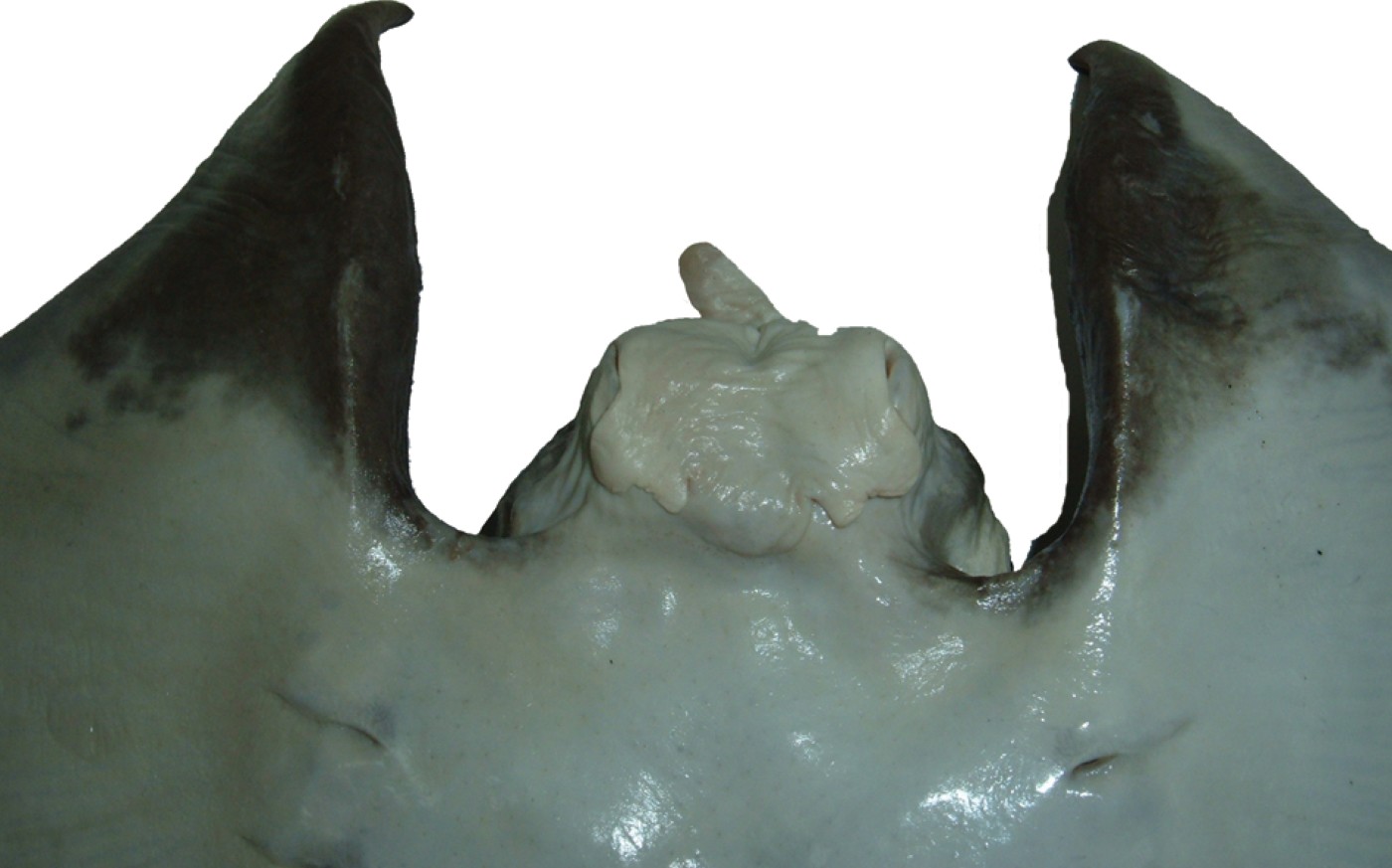
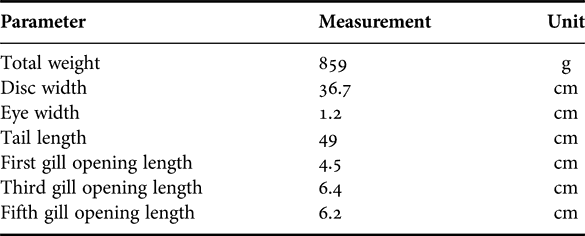
The specimen is female with a disc width of 36.7 cm and weight of 859 g. It is grey without distinctive marks on the body and the skin (Figure 1). The dorsal surface is smooth. The mouth is deformed, incomplete, and lacks a normal opening (Figure 2). The eyes and spiracles are situated on the lateral part of the head, instead of on the dorsal surface. The eyes are covered with skin. At the head tip, there is a vestigial snout measuring 1.5 cm in length. The anterior margins of the pectoral fins are separated from the head; therefore the disc is incomplete. Table 1 presents morphological measurements. The total length was not recorded because of the atypical taxonomic characteristics.
Abnormal female of the longtail stingray, Dasyatis longa.

Abnormal mouth of Dasyatis longa.

Morphometric measurements of Dasyatis longa.

DISCUSSION
This malformed longtailed stingray was alive at the time of capture. However, based on the degree of its deformity, we conclude that it would not be able to feed successfully and would not have survived to adulthood.
Morphological abnormalities similar to these documented for Dasyatis longa have been reported for other species of rays including D. brevis, Raja brachyuran, R. radiata, Amblyraja radiata and Potamotrygon motura (Templeman, 1965; Lamilla et al., Reference Lamilla, Pequeño and Kong1995; Rosa et al., Reference Rosa, Gomes and Gadig1996). According to Rosa et al. (Reference Rosa, Gomes and Gadig1996) the principal morphological abnormality reported in rays are the pectoral fins not being fused to the head.
The cause of morphological deformities of the kind shown for D. longa remains uncertain. Conditions such as parasitic infection, arthritis, injury, tumours, bad nutrition, or a congenital abnormality have all been suggested as causal factors (Heupel et al., Reference Heupel, Simpfendorfer and Bennet1999). Unfavourable environmental conditions during embryonic development may also be a factor (Mancini et al., Reference Mancini, Casas and Amorim2006). While various authors have suggested pollution as a cause of abnormal fish development (Haaker, Reference Haaker1977; Rodríguez-Romero et al., Reference Rodríguez-Romero, Ramírez-Sevilla and Núñez-Márquez1990) this seems a remote possibility in this case for D. longa because the strong water circulation in the lower Gulf of California and the absence of industrial discharges in El Pardito area (Galván et al., Reference Galván, Nienhuis and Klimley1989).
ACKNOWLEDGEMENTS
We thank fishermen of the fishing camp El Pardito, who donated the specimen. F.G.M. thanks the Instituto Politecnico Nacional (COFAA AND EDI) for their support in projects on sharks and rays in Baja California Sur. Thanks to Dr Ellis Glazier for editing this English-language text.