1. Introduction
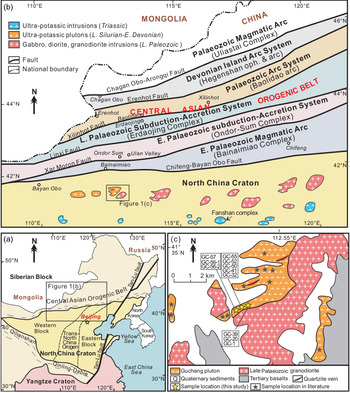
The northern part of the North China Craton experienced repeated episodes of alkaline magmatism during the Palaeozoic and Mesozoic that were also associated with significant mineralization and ore-forming processes (Yan et al. Reference Yan, Mu, Xu, He, Tan, Zhao, He, Zhang and Qiao1999; Niu et al. Reference Niu, Chen, Liu, Suzuki and Ma2012, Reference Niu, Yang, Liu, Zhang and Yang2016, Reference Niu, Chen, Feng, Liu and Yang2017; Yang et al. Reference Yang, Sun, Zhang, Wu and Wilde2012; Zhang et al., Reference Zhang, Zhao, Ye, Hou and Li2012; Chen et al. Reference Chen, Niu, Wang, Gao and Wang2013). Ultrapotassic plutonic rocks in orogenic belts display high contents of K2O, high K2O/Na2O ratios and other incompatible elements (Foley et al. Reference Foley, Venturelli, Green and Toscani1987; Dilek & Altunkaynak Reference Dilek and Altunkaynak2010), and commonly represent partial melting products of a subcontinental lithospheric mantle (e.g. Feldstein & Lange, Reference Feldstein and Lange1999; Miller et al. Reference Miller, Schuster, Klötzli, Frank and Purtscheller1999; Williams et al. Reference Williams, Turner, Pearce, Kelley and Harris2004; Avanzinelli et al. Reference Avanzinelli, Lustrino, Mattei, Melluso and Conticelli2009; Zhao et al. Reference Zhao, Mo, Dilek, Niu, DePaolo, Robinson, Zhu, Sun, Dong, Zhou, Luo and Hou2009), which was previously metasomatized and enriched by slab-derived components (e.g. Conticelli & Peccerillo, Reference Conticelli and Peccerillo1992; Conticelli et al. Reference Conticelli, Carlson, Widom, Serri, Beccaluva, Bianchini and Wilson2007, Reference Conticelli, Avanzinelli, Ammannati and Casalini2015; Prelević et al. Reference Prelević, Foley, Romer and Conticelli2008; Jamali et al., Reference Jamali, Dilek, Daliran, Yaghubpur and Mehrabi2010; Tommasini et al. Reference Tommasini, Avanzinelli and Conticelli2011; Altunkaynak et al. Reference Altunkaynak, Sunal, Aldanmaz, Genç, Dilek, Furnes, Foland, Yang and Yildiz2012; Liu et al. Reference Liu, Zhao, Zhu, Niu, Widom, Teng, DePaolo, Ke, Xu, Wang and Mo2015; Wang et al. Reference Wang, Foley and Prelević2017). In the northern part of the North China Craton, the earliest phase of alkaline magmatism occurred in discrete pulses in the Early and Middle Devonian (Zhang et al. Reference Zhang, Zhang, Jiang, Zhai and Zhang2010; Huang & Hou Reference Huang and Hou2017; this study) whereas the next episode of alkaline magmatism took place in the early Mesozoic (mainly in the Late Triassic; Yan et al. Reference Yan, Mu, Xu, He, Tan, Zhao, He, Zhang and Qiao1999; Niu et al. Reference Niu, Chen, Liu, Suzuki and Ma2012, Reference Niu, Yang, Liu, Zhang and Yang2016, Reference Niu, Chen, Feng, Liu and Yang2017; Yang et al. Reference Yang, Sun, Zhang, Wu and Wilde2012; Chen et al. Reference Chen, Niu, Wang, Gao and Wang2013). Widespread alkaline intrusive complexes constitute an E–W-trending alkaline magmatic belt that is more than 1500 km long along the northern North China Craton (Fig. 1).
(a) Simplified tectonic map of the North China Craton. (b) Simplified tectonics of the SE Central Asian Orogenic Belt (modified from Xiao et al. Reference Xiao, Windley, Hao and Zhai2003). (c) Geological map of the Gucheng pluton.

These discrete episodes of alkaline magmatism and the temporally associated extensional deformation in the North China Craton are widely interpreted as being a result of post-collisional tectonics, which might have involved aesthenospheric melt input due to slab break-off or lithospheric delamination. Slab break-off or lithospheric delamination processes are invoked in the existing models for the required heat source to cause partial melting of the metasomatized subcontinental lithospheric mantle. However, in many cases, the regional geological and geophysical evidence for such slab break-off or delamination events is absent, and the geological record indicates continued subduction of the Palaeo-Asian oceanic plate beneath the North China Craton throughout the middle to late Palaeozoic.
In this paper we address the mode and causes of alkaline magmatism in the northern part of the North China Craton through a case study of an Early Devonian ultrapotassic syenitic pluton (Gucheng pluton), and discuss its petrogenesis within the framework of the regional geology and tectonics. We first present new zircon U–Pb dating results and detailed mineral, whole-rock chemistry, and Sr–Nd and zircon in situ oxygen isotope data from this pluton. We then evaluate the nature of its parental magmas, and its melt evolution and the characteristics of its mantle source through a new chemical geodynamics model. Our proposed tectonomagmatic model differs from the existing ones in regard to the potential causes and mechanisms of the enrichment and partial melting of the subcontinental lithospheric mantle beneath the North China Craton.
2. Regional geology of the North China Craton
The North China Craton represents one of the oldest and largest cratons on Earth with a nearly complete record of Precambrian history (Jahn et al. Reference Jahn, Auvray, Cornichet, Bai, Shen and Liu1987; Liu et al. Reference Liu, Nutman, Compston, Wu and Shen1992). The Proterozoic–Palaeozoic Central Asian Orogenic Belt (also known as the Altaids) to the north is a major accretionary-type orogen (Fig. 1a). The Qilianshan, Qinling–Dabie orogenic belts and the Tan–Lu fault delimit the North China Craton to the west, south and east, respectively. The North China Craton itself is divided into the Western and Eastern Blocks by the 100- to 300-km-wide, NNE–SSW-trending Trans-North China Orogen (Fig. 1a; Zhao Reference Zhao2001).
The Eastern Block consists of early to late Archaean tonalite–trondhjemite–granodiorite and granitic gneiss terranes that are tectonically integrated with felsic to ultramafic greenstones (meta-volcanic and meta-sedimentary rocks) (Zhao & Zhai, Reference Zhao and Zhai2013; Wei et al. Reference Wei, Qian and Zhou2014). These Archaean basement units are overlain by Proterozoic rift basin strata and variously metamorphosed sedimentary and volcanic rock sequences. The Eastern Block underwent successive episodes of rifting, magmatism and strike-slip faulting in the upper plate of the Palaeo-Pacific subduction zone, dipping obliquely beneath East Asia during the Late Triassic through the Jurassic–Cretaceous (Wang et al. Reference Wang, Zhou, Liu, Li and Yang2018). These Mesozoic events resulted in significant thinning and destabilization of the North China Craton in the east (Wu et al. Reference Wu, Lin, Wilde, Zhang and Yang2005; Zhu et al. Reference Zhu, Yang and Wu2012).
The Western Block consists mainly of a Neoarchaean (2.6–2.5 Ga) basement composed of tonalite–trondhjemite–granodiorite and meta-mafic and meta-sedimentary rocks. Palaeoproterozoic meta-pelitic rocks overlie these Archaean basement lithologies and are in turn overlain by undeformed Phanerozoic sedimentary sequences.
The Central Asian Orogenic Belt to the north of the North China Craton developed through successive episodes of subduction–accretion events, punctuated by the collapse of fringing island arc systems, which evolved within the Palaeo-Asian Ocean (Windley et al. Reference Windley, Alexelev, Xiao, Kröner and Badarch2007). The Ordovician – Early Devonian Bainaimiao plutonic–volcanic complexes in the northern North China Craton represent an Andean-type magmatic arc system, developed above a Palaeo-Asian Ocean slab dipping southwards beneath the North China Craton (Xiao et al. Reference Xiao, Windley, Hao and Zhai2003; Song et al. Reference Song, Wang, Xu, Wang, Niu, Allen and Su2015, and references therein). This magmatic arc complex includes calc-alkaline plutons composed of granite, granodiorite, tonalite, quartz diorite and hornblende gabbro, and volcanic sequences composed of tholeiitic basalt, alkaline basalt, andesite, rhyolite, agglomerate and tuffaceous rocks that are intercalated with chert, sandstone and conglomerate; high initial Sr isotope ratios (0.7146) and ϵ Nd values (+2.4 ± 1.7) obtained from granitic and granodioritic rocks of the Bainaimiao arc complex suggest the involvement of Proterozoic and older crustal basement rocks in the melt evolution of arc magmas (Zhang et al. Reference Zhang, Zhao, Ye, Liu and Hu2014, and references therein). All these plutonic, volcanic and sedimentary rocks of the Bainaimiao arc are affected by N-directed thrust faults, consistent with the geometry of the S-dipping Palaeo-Asian Ocean slab. Zircon U–Pb ages available from the Bainaimiao plutonic and dyke rocks range from 472 Ma to 411 ± 8 Ma, and the volcanic rocks from 474 ± 5 Ma to 436 ± 9 Ma (Zhang et al. Reference Zhang, Zhao, Ye, Liu and Hu2014). These ages indicate that the Bainaimiao ensialic arc magmatism occurred during the Early–Middle Ordovician through Early Devonian.
An Early Ordovician (490–470 Ma) subduction–accretion complex and ophiolitic rock sequences with mid-ocean ridge basalt (MORB), island arc tholeiitic and boninitic geochemical affinities that are characteristic of fore-arc oceanic crust (Dilek & Furnes, Reference Dilek and Furnes2011, Reference Dilek and Furnes2014) occur north of the Bainaimiao magmatic arc (Xiao et al. Reference Xiao, Windley, Hao and Zhai2003; Wilhem et al. Reference Wilhem, Windley and Stampfli2012). These ophiolitic and accretionary prism rocks are emplaced southwards onto the North China Craton and are interpreted to represent an Early Ordovician island arc complex (Ulan island arc of Xiao et al. Reference Xiao, Windley, Hao and Zhai2003), which was developed above a N-dipping subduction zone within the Palaeo-Asian Ocean. The collision of the northern passive margin of the North China Craton with this island arc system took place in the early Ordovician and resulted in the accretion of the Ulan island arc to the North China Craton prior to 470 Ma (Xiao et al. Reference Xiao, Windley, Hao and Zhai2003; Wilhem et al. Reference Wilhem, Windley and Stampfli2012).
This arc–continent collision was followed by the initiation of a new subduction zone dipping southwards that resulted in the establishment of a long-lived Andean-type active continental margin along the northern edge of the North China Craton. The Ondor–Sum accretionary complex, with blueschist rocks ranging in age from 446 to 426 Ma (Xiao et al. Reference Xiao, Windley, Hao and Zhai2003), and the Middle Ordovician – Early Devonian Bainaimiao ensialic arc formed at this active margin; steepening slab geometry keeping pace with the slab rollback at this S-dipping subduction zone caused the Bainaimiao arc magmatism to migrate northwards through time (Wilhem et al. Reference Wilhem, Windley and Stampfli2012; Song et al. Reference Song, Wang, Xu, Wang, Niu, Allen and Su2015). Both the Bainaimiao magmatic arc rocks and the Ondor–Sum accretionary complex are unconformably overlain by Early–Middle Devonian shallow marine clastic rocks, suggesting that the Andean-type continental margin magmatism was no longer active by 400 Ma (Wilhem et al. Reference Wilhem, Windley and Stampfli2012, and references therein).
A renewed episode of large-scale intracontinental magmatism in the northern part of the North China Craton started nearly 40 million years later, c. 360 Ma, and lasted until 258 Ma, mainly represented by calc-alkaline, high-K calc-alkaline plutons to the south of the Bainaimiao continental arc (Zhang et al. Reference Zhang, Zhao, Ye, Hou and Li2012; Song et al. Reference Song, Wang, Xu, Wang, Niu, Allen and Su2015).
The timing of the complete amalgamation of the Siberian Block and the North China Craton has been constrained to a period from c. 270 to 250 Ma (Chen et al. Reference Chen, Jahn and Tian2009; Zhang et al. Reference Zhang, Zhao, Kröner, Liu, Xie and Chen2009). During the Late Triassic, this continental collision zone and the northern margin of the North China Craton experienced extensive ultrapotassic, alkaline magmatism in an ~E–W-trending, orogen-parallel belt (represented by the Fanshan ultramafic–syenitic complex; Fig. 1b) (Yan et al. Reference Yan, Mu, Xu, He, Tan, Zhao, He, Zhang and Qiao1999; Niu et al. Reference Niu, Chen, Liu, Suzuki and Ma2012, Reference Niu, Yang, Liu, Zhang and Yang2016, Reference Niu, Chen, Feng, Liu and Yang2017; Yang et al. Reference Yang, Sun, Zhang, Wu and Wilde2012; Chen et al. Reference Chen, Niu, Wang, Gao and Wang2013; Hou et al. Reference Hou, Zhang, Keiding and Veksler2015). These ultrapotassic and alkaline igneous complexes share some common features in their whole-rock and mineral compositions: (i) they are dominantly composed of clinopyroxene/biotite-bearing syenite, alkali-feldspar syenite and/or ultramafic rocks (clinopyroxenite, glimmerite, biotite-bearing clinopyroxenites, K-feldspar-bearing clinopyroxenite); and (ii) clinopyroxene, K-feldspar, biotite, and/or melanite, and/or nepheline, are the main constituent minerals; these intrusive rocks are free in olivine.
3. Field occurrence and mineralogy of the Gucheng pluton
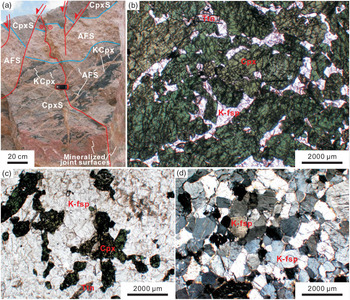
The Gucheng pluton is part of a series of ~E–W-trending small intrusive bodies near the Chifeng–Bayan Obo fault zone along the northern edge of the North China Craton (Fig. 1a, b). It crops out in a ~20 km2 sub-circular exposure, intruded in the east and the south by a Carboniferous granitoid pluton and pegmatites, and covered on all sides by Cenozoic flood basalts and Quaternary alluvial sediments (Fig. 1c). Also known as the Sandaogou intrusive complex (XH Zhang et al. Reference Zhang, Zhang, Jiang, Zhai and Zhang2010; QQ Zhang et al. Reference Zhang, Zhang, Zhao and Liu2018), the Gucheng pluton consists of magmatic bands of K-feldspar-bearing clinopyroxenite, clinopyroxene-bearing syenite and alkali-feldspar syenite (Fig. 2a). The K-feldspar-bearing clinopyroxenite and the clinopyroxene-bearing syenite have gradational contacts and form well-developed layers marked by clinopyroxene and K-feldspar-rich bands (Fig. 2a). These two lithologies are cross-cut by veins and dikelets of alkali-feldspar syenite whose orientations and geometries are controlled by brittle fracture networks (Fig. 2a). These outcrop features suggest that the injection of alkali-feldspar melt into the Gucheng pluton took place after the cooling and solidification of the other two magma types. All three alkaline rock types are cut and displaced by high-angle normal faults as a result of N–S extension (Fig. 2a).
(a) Outcrop image of the Gucheng pluton, showing the contact relationships between the main lithologies and the extensional normal fault patterns. (b–d) Photomicrographs of K-feldspar-bearing clinopyroxenite (plain-polarized light), clinopyroxene-bearing syenite (plain-polarized light) and alkali-feldspar syenite (crossed polars), respectively. AFS = alkali-feldspar syenite; CpxS = clinopyroxene-bearing syenite; KCpx = K-feldspar-bearing clinopyroxenite; K-fsp, K-feldspar; Cpx, clinopyroxene; Ttn, titanite.

The K-feldspar-bearing clinopyroxenite is composed of coarse-grained, accumulate euhedral clinopyroxene (>80 %), interstitial sanidine (5–15 %), euhedral titanite (2–8 %) and minor garnet (1–5 %) (Fig. 2b). The clinopyroxene-bearing syenite consists mainly of varying proportions of subhedral to euhedral clinopyroxene (5–20 %), coarse-grained K-feldspar (60–80 %) and accessory titanite (2–8 %) (Fig. 2c). The alkali-feldspar syenite comprises coarse-grained K-feldspar (>95 %) and minor garnet (<3 %) (Fig. 2d).
4. Sample selection
Previous studies have mainly focused on the clinopyroxene-bearing syenite unit sampled in the central and northern parts of the pluton (Fig. 1c; XH Zhang et al. Reference Zhang, Zhang, Jiang, Zhai and Zhang2010; QQ Zhang et al. Reference Zhang, Zhang, Zhao and Liu2018). In this study, we have identified a large outcrop in an abandoned quarry within the southern part of the pluton, where K-feldspar-bearing clinopyroxenite, clinopyroxene-bearing syenite, and alkali-feldspar syenite occur together. We sampled these three lithological units for our investigations. See Figure 1c for the location of the samples, and Supplementary File 1 in the online Supplementary Material at https://doi.org/10.1017/S0016756819000797 for their GPS geographical coordinates.
K-feldspar-bearing clinopyroxenite rocks (samples GC-57, GC-56-1 and GC-56-2) occur as discrete layers and lenses in the outcrop. They are composed of coarse-grained, accumulate euhedral clinopyroxene (>80 %), interstitial sanidine (5–15 %), euhedral titanite (2–8 %) and minor garnet (1–5 %) (Fig. 2b). This K-feldspar-bearing clinopyroxenite unit has never been reported from the Gucheng pluton in previous studies.
Clinopyroxene-bearing syenite rocks (samples GC-55, GC-52, GC-50, GC-41 and GC-32) are the most common lithological unit in the Gucheng pluton. They consist mainly of varying proportions of subhedral to euhedral clinopyroxene (5–20 %), coarse-grained K-feldspar (60–80 %), and accessory titanite (2–8 %) (Fig. 2c).
Alkali-feldspar syenite rocks (samples GC-39, GC-20 and GC-1) comprise coarse-grained K-feldspar (>95 %) and minor garnet (<3 %) (Fig. 2d).
Previous studies reported the elemental compositions of clinopyroxene-bearing syenites and their U–Pb zircon ages (XH Zhang et al. Reference Zhang, Zhang, Jiang, Zhai and Zhang2010; QQ Zhang et al. Reference Zhang, Zhang, Zhao and Liu2018). In this study, we analysed the elemental (major, trace and Sr–Nd isotopes) compositions of the newly discovered K-feldspar-bearing clinopyroxenite and alkali-feldspar syenite units within the pluton. In addition, we chose an alkali-feldspar syenite sample (GC-1) for zircon U–Pb dating and oxygen isotope analysis, for it was difficult to separate zircons from clinopyroxenites. We also analysed the elemental compositions of our clinopyroxene-bearing syenite samples for comparison with the published data.
5. Analytical methods
5.a. Whole-rock major and trace element analyses
Whole-rock major and trace element measurements were performed at National Research Center of Geoanalysis, Beijing, China. Major elements were determined by X-ray fluorescence, using fused glass discs with analytical uncertainty <1 %. Trace elements were measured using inductively coupled plasma mass spectrometry (ICP-MS) . Analytical uncertainties are 10 % for elements with abundances <10 ppm and c. 5 % for those >10 ppm. The standard sample GBW07109 was prepared and analysed with the same analytical procedure as the samples (repetition n = 1). The measured and recommended values of major and trace element composition of the standard sample GBW07109 are listed in Supplementary File 2 (online Supplementary Material at https://doi.org/10.1017/S0016756819000797).
5.b. Mineral chemistry analyses
Major elements of clinopyroxene, feldspar, titanite and garnet were measured on a JXA-8100 electron microprobe at the Key Laboratory of Deep-Earth Dynamics of Ministry of Land and Resources in the Institute of Geology at the Chinese Academy of Geological Sciences, Beijing (China), using an accelerating voltage of 15 kV, beam current of 10 nA and spot diameter of 1 μm. We used the PRZ method for corrections. We utilized standard samples (53 kinds of minerals produced by US SPI Company) throughout the analytical work. Our reported precision was better than 1 %.
5.c. SHRIMP U–Pb zircon dating and zircon in situ oxygen isotope analysis
Zircon grains were extracted by heavy-liquid and magnetic methods, and were further purified by hand-picking under a binocular microscope. Zircons were mounted onto an epoxy resin disc together with several grains of standard zircon TEMORA, and were then polished to examine their interiors. Photomicrographs and cathodoluminescence images were taken to examine their internal structures and to select the optimum positions for analysis.
Zircon U–Th–Pb analyses were performed using the SHRIMP II (sensitive high-resolution ion microprobe) instrument at Beijing SHRIMP Center in the Institute of Geology at the Chinese Academy of Geological Sciences in Beijing (China). Spot diameter was 30 μm. Detailed analytical procedures of Williams (Reference Williams, McKibben, Shanks and Ridley1998) were followed. Data were processed and assessed using the SQUID1.0 and ISOPLOT software of Ludwig (Reference Ludwig2001, Reference Ludwig2003). Measured 204Pb was used to for common Pb correction. The separated zircon grains were polished and cleaned thoroughly in order to eliminate any possible contamination prior to the in situ oxygen isotope analyses. Zircon in situ oxygen isotope analyses were also performed on the SHRIMP II instrument at Beijing SHRIMP Center, following the analytical procedures of Ickert et al. (Reference Ickert, Hiess, Williams, Holden, Ireland, Lanc, Schram, Foster and Clement2008). We report the oxygen isotopic data here by δ18O values with reference to the Vienna Standard Mean Ocean Water (V-SMOW) standard.
5.d. Whole-rock Sr–Nd isotope analyses
Separation and purification of Sr and Nd were done through conventional cation exchange procedures at the Key Laboratory of Orogenic Belts and Crustal Evolution in Peking University of Beijing (China). Sr and Nd isotopic compositions were measured in a negative ion detection mode on a Thermo-Finnigan TRITON® mass spectrometer at Tianjin Institute of Geology and Mineral Resources, Tianjin (China). Detailed analytical procedures and experimental conditions are given in Niu et al. (Reference Niu, Chen, Feng, Liu and Yang2017). During the period of data acquisition, Jndi-1 Nd standard yielded 143Nd/144Nd = 0.512104 ± 0.000003 (2σ) (repetition n = 1), and Sr standard NBS-987 gave 87Sr/86Sr = 0.710264 ± 0.000004 (2σ) (repetition n = 1). The BCR-2 standard, prepared with the same analysis procedure as the samples, yielded 143Nd/144Nd = 0.512626 ± 0.000006 (2σ), and 87Sr/86Sr = 0.705075 ± 0.000008 (2σ) (repetition n = 1).
6. Results
6.a. Whole-rock major and trace element compositions
We present the major and trace element contents of the analysed rocks from the Gucheng pluton in Table 1.
Major and trace element compositions of Gucheng pluton

δ = (K2O + Na2O)2/(SiO2-43) (units in wt. %); CN stands for chondrite-normalized; normalizing values are from Boynton (Reference Boynton and Henderson1984).
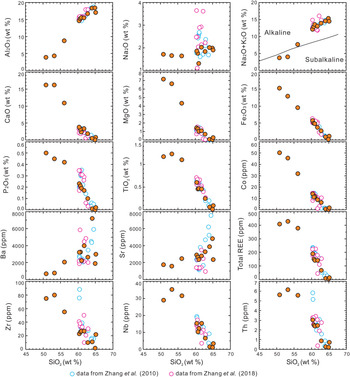
The analysed rocks show variable major element compositions, with SiO2 = 50.89–65.11 wt %, Al2O3 = 3.87–18.39 wt %, Fe2O3 total = 0.23–15.26 wt %, MgO = 0.05–7.18 wt %, CaO = 0.08–16.2 wt %, Na2O= 1.31–2.02 wt % and K2O = 2.03–13.38 wt %. As seen in the plots of major element variations against SiO2 (Fig. 3), with increasing SiO2 values, the Al2O3, K2O and Na2O + K2O contents increase, whereas CaO, MgO, Fe2O3, P2O5 and TiO2 decrease significantly. These compositional variations are mainly due to the varying proportions of clinopyroxene, K-feldspar, titanite and garnet in the analysed rocks. The Na2O contents remain nearly constant between 1.7 and 2.1 wt % with increasing SiO2.
Plots of major and representative trace element vs SiO2 contents for the Gucheng pluton.

Although the overall rare earth element (REE) abundance of the Gucheng pluton syenites varies significantly (total REE = 5.20–428.98 ppm), their light REE (LREE)-enriched chondrite-normalized REE patterns display nearly parallel trends (Fig. 4a), with (La/Yb)CN = 2.81–22.47 (La/Gd)CN = 1.41–6.67 and (Gd/Yb)CN = 1.98–3.37. They show light Eu negative anomalies with δEu values between 0.58 and 0.89 (with one sample having a value of 0.26). In the primitive mantle-normalized multi-element diagrams (Fig. 4b), the analysed Gucheng pluton rocks exhibit coherent, parallel patterns, characterized by enrichment in large ion lithophile elements (LILE; e.g. Rb, Ba, Sr and K) and LREE, and depletion in high field strength elements (HFSE; e.g. Nb, Ta and Ti).
Chondrite-normalized REE patterns (a) and primitive mantle-normalized multi-element diagrams (b) for the Gucheng pluton. Chondrite values are from Boynton (Reference Boynton and Henderson1984), and the primitive mantle values are from Sun & McDonough (Reference Sun, McDonough, Saunders and Norry1989).

6.b. Mineral chemistry
We present the mineral chemistry of clinopyroxene, feldspar, titanite and garnet from the Gucheng pluton in Supplementary Files 3–6, respectively (online Supplementary Material at https://doi.org/10.1017/S0016756819000797).
Clinopyroxene grains in the Gucheng pluton belong to the Ca–Mg–Fe series, and span a compositional range from diopside to hedenbergite and augite (Wo43–48En19–35Fs18–38; Fig. 5a), with SiO2 = 49.18–52.99 wt %, Al2O3 = 0.47–2.01 wt %, CaO = 18.69–23.30 wt %, Na2O = 0.77–2.72 wt %, TFeO = 10.09–20.56 wt %, and MgO = 5.71–11.90 wt %.
Classification diagrams of clinopyroxene (a) and feldspar (b) from the Gucheng pluton.

The Gucheng pluton feldspars form two groups (Fig. 5b): K-feldspar (sanidine; An0Ab3–11Or89–97; SiO2 = 64.44–65.96 wt %, K2O = 14.54–16.23 wt %, Na2O = 0.37–1.13 wt %) and Na-feldspar (albite; An0–3Ab97–99Or0–1; SiO2 = 66.58–69.79 wt %, K2O = 0.07–0.18 wt %, Na2O = 10.07–11.39 wt %).
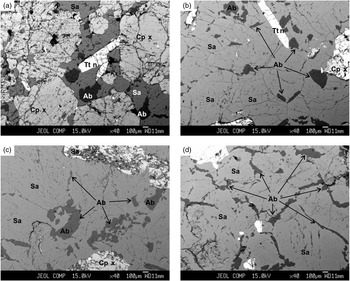
As shown in the backscattered electron images (Fig. 6), K-feldspar grains in K-feldspar-bearing clinopyroxenites are commonly anhedral and interstitial in between relatively euhedral clinopyroxene crystals; parts of some K-feldspar grains are made of Na-feldspar (Fig. 6a). In clinopyroxene-bearing syenites (Fig. 6b, c) and alkali-feldspar syenites (Fig. 6d), K-feldspar grains constitute the cumulate phases, with Na-feldspar grains occurring as an interstitial phase or surrounding K-feldspar grains. These textural and mineralogical observations indicate that Na-feldspars were crystallized at a relatively late stage, when the Na2O contents of the evolving magmas in a magma chamber were increased.
Backscattered electron (BSE) images of the K-feldspar-bearing clinopyroxenite and clinopyroxene-bearing syenites of the Gucheng pluton. Sa – sanidine; Ab – albite; Cpx – clinopyroxene; Ttn – titanite.

Euhedral titanite is a common mineral in the K-feldspar-bearing clinopyroxenite and clinopyroxene-bearing syenite of the Gucheng pluton. Its composition is made of CaO = 27.44–29.37 wt %, Ti = 35.56–38.41 wt %, SiO2 = 29.88–31.67 wt %, FeO = 1.43–2.44 wt % and Al2O3 = 0.34–1.45 wt %, and its calculated formula is Ca0.988–1.037Ti0.902–0.957[Si1–1.043O4]O.
Garnet locally occurs in K-feldspar-bearing clinopyroxenite and alkali-feldspar syenite rocks. Compositionally, it is made of andradite with SiO2 = 34.08–35.93 wt %, TiO2 = 0.43–1.67 wt %, Al2O3 =1.93–3.10 wt %, FeO = 24.62–26.2 wt % and CaO = 31.08–31.96. Its calculated formula is (Ca2.785–2.908Fe2+ 0.017–0.139Mn0.051–0.111) (Fe3+ 1.618–1.838Al0.165–0.306)[Si2.898–3.009Ti0–0.102O12].
6.c. Zircon U–Pb dating and in situ zircon oxygen isotopes
We chose an alkali-feldspar syenite sample (GC-1) for U–Pb zircon dating and in situ oxygen isotope analysis, because: (i) K-feldspar-bearing clinopyroxenite rocks are composed mainly of clinopyroxene and sanidine, and they have low SiO2 contents (50.89–56.1 wt %); it is hard to separate a sufficient quantity of zircons from such rocks for dating; (ii) XH Zhang et al. (Reference Zhang, Zhang, Jiang, Zhai and Zhang2010) and QQ Zhang et al. (Reference Zhang, Zhang, Zhao and Liu2018) already dated the zircons from the clinopyroxene-bearing syenite samples, which gave weighted mean 206Pb/238U ages of 408 ± 4 Ma and 401 ± 2 Ma, respectively. Therefore, we chose the newly discovered, undated alkali-feldspar syenite samples for zircon dating and oxygen isotope analysis. Since the three alkali-feldspar syenite samples have similar elemental compositions and mineralogy, we only chose sample GC-1 for U–Pb zircon dating and in situ oxygen isotope analysis.
Zircon grains separated from the alkali-feldspar syenite sample (GC-1) show oscillatory zoning with no inherited cores (Supplementary File 7 in online Supplementary Material at https://doi.org/10.1017/S0016756819000797), indicating their magmatic origin. We picked zircons for SHRIMP U–Pb isotope analysis that are transparent and free of visible inclusions. The analytical data are presented in Table 2 and graphically shown in a concordia diagram (Fig. 7). The analysed grains have yielded 204Pb-corrected 206Pb/238U ages, ranging from 404.0 ± 8.0 Ma to 424.0 ± 8.4 Ma, with a weighted mean 206Pb/238U age of 415.5 ± 4.5 Ma (14 analyses, MSWD = 0.47). Combined with the zircon U–Pb ages obtained from the clinopyroxene-bearing syenite samples (XH Zhang et al. Reference Zhang, Zhang, Jiang, Zhai and Zhang2010; QQ Zhang et al. Reference Zhang, Zhang, Zhao and Liu2018), we thus interpret the emplacement age of the Gucheng pluton as Early Devonian.
Zircon SHRIMP U–Th–Pb isotopic data for Gucheng syenite

Errors are 1-sigma; Pb* indicate the radiogenic portions. Common Pb corrected using measured 204Pb.
Concordia diagram showing the zircon age data. Inset shows the weighted mean 206Pb/238U age.

Oxygen isotopic compositions of the analysed zircons are listed in Table 3. The Gucheng pluton zircons have δ18O values in the range 5.2 to 6.7 (see Supplementary File 7 in online Supplementary Material at https://doi.org/10.1017/S0016756819000797) for analytical spots in the representative zircon grains).
Zircon in situ oxygen isotope compositions for the Gucheng syenite

δ18OV-SMOW = [(18O/16O)sample/(18O/16O)V-SMOW – 1] × 1000; (18O/16O)V-SMOW = 0.0020052, Vienna Standard Mean Ocean Water (V-SMOW) standard.
6.d. Whole-rock Sr and Nd isotopic compositions
Sr and Nd isotopic compositions of the Gucheng plutonic rocks are listed in Table 4. The initial isotopic compositions are calculated at 415 Ma based on the U–Pb zircon age we have obtained in this study. The samples display relatively homogeneous Sr isotopic compositions with initial 87Sr/86Sr values between 0.7054 and 0.7063, but variable Nd isotopic compositions with ϵ Nd(t) ranging from −23.4 to −10.1 (Fig. 8).
Rb–Sr and Sm–Nd isotopic data of Gucheng pluton

ϵ Nd = [(143Nd/144Nd)S/(143Nd/144Nd)CHUR – 1] × 10 000, f Sm/Nd = (147Sm/144Nd)S/(147Sm/144Nd)CHUR – 1, where (143Nd/144Nd)S and (147Sm/144Nd)S are the measured values of samples (143Nd/144Nd)CHUR = 0.512638 and (147Sm/144Nd)CHUR = 0.1967.
Plot of ϵ Nd(t) vs initial 87Sr/86Sr ratios for the Gucheng pluton. Nd–Sr isotopic modelling based on a two-component mixing model (Langmuir et al. Reference Langmuir, Vocke, Hanson and Hart1978). Also displayed on this plot are the Sr–Nd isotopic compositions of a depleted mantle source (DM; Rudnick et al. Reference Rudnick, Gao, Ling, Liu and McDonough2004), Palaeozoic lithospheric mantle beneath the North China Craton (SCLM; Zheng & Lu, Reference Zheng and Lu1999), mafic lower crust of the North China Craton (Zhang et al. Reference Zhang, Zhou, Sun, Chen and Feng1998; Zhou et al. Reference Zhou, Sun, Zhang and Chen2002; Liu et al. Reference Liu, Gao, Yuan, Zhou, Liu, Wang, Hu and Wang2004), tonalite–trondhjemite–granodiorite gneisses (TTG gneisses; Jahn et al. Reference Jahn, Auvray, Cornichet, Bai, Shen and Liu1987; Zhang et al. Reference Zhang, Wu and Ye1991), and global subducting sediment (GLOSS; Plank & Langmuir, Reference Plank and Langmuir1998) for comparison. Ticks on the lines represent 10 % interval.

7. Petrogenesis, melt evolution and mantle source of the Gucheng pluton
The Gucheng pluton consists of K-feldspar-bearing clinopyroxenite, clinopyroxene-bearing syenite and alkali-feldspar syenite. These rock-types form cyclic intercalations in the outcrop (Fig. 2a), and the boundaries between them are abrupt due to their different mineral assemblages: K-feldspar-bearing clinopyroxenite is composed dominantly of clinopyroxene (>80 %) and minor interstitial K-feldspar, whereas the alkali-feldspar syenite consists predominantly of coarse-grained K-feldspar (>95 %). Three rock-types can be identified in the field and in thin-section based on different proportions of clinopyroxene and K-feldspar in them.
K-feldspar-bearing clinopyroxenite shows typical cumulate textures, characterized by accumulation of coarse-grained, euhedral clinopyroxene with interstitial, anhedral K-feldspar grains. The alkali-feldspar syenite, which is composed of nearly pure K-feldspar, likely formed by the accumulation of K-feldspar, or by the crystallization of residual melt after significant fractionation of clinopyroxene. We interpret the formation of clinopyroxene-bearing syenites as a result of accumulation of clinopyroxene and K-feldspar out of the magma, or as a mixture of cumulus clinopyroxene and residual magma in a magma chamber.
The major and trace elements of the Gucheng pluton rocks vary significantly and regularly (Fig. 3), which is a typical character of cumulate rocks. The LILE (Rb, Ba, Sr, K and Cs) and HFSE (Zr, Hf, Th, U, Nb, Ta and REE) are all incompatible elements, but they behave differently during magma chamber evolution. LILE abundances increase with increasing SiO2 contents, whereas HFSE abundances decrease significantly (Fig. 3). This phenomenon may be related to different partition coefficients of certain elements between specific minerals (clinopyroxene, K-feldspar, titanite or garnet) and the melt. However, this is a topic of further investigation and is outside the scope of the current study.
7. a. Nature of parental magmas
Although the Gucheng syenitic rocks are of cumulate origin, geochemically they still have relatively high K2O + Na2O contents (3.74–15.36 wt %), high K2O/Na2O ratios (1.19–9.36) and high (K2O + Na2O)2/(SiO2-43) ratios (1.60–10.78), suggesting their alkaline, ultrapotassic affinity. The occurrence of normative quartz also indicates that they are SiO2-saturated. Their mineral assemblages and mineral chemistry provide important information on the geochemical features of their parental magmas. The Gucheng pluton rocks are composed mainly of diopside–hedenbergite–augite (Wo43–48En19–35Fs18–38; Fig. 5a), K-feldspar (sanidine; An0Ab3–11Or89–97; Fig. 5b), subordinate titanite, minor garnet, and Na-feldspar (albite; An0–3Ab97–99Or0–1), suggesting a SiO2–Al2O3–TiO2–CaO–FeO–MgO–K2O (less Na2O) chemical system.
These geochemical features and the mineralogy are comparable with those of the Late Triassic ultrapotassic rocks emplaced in the northern margin of the North China Craton. A good example is the Fanshan ultramafic–syenitic complex (Niu et al. Reference Niu, Chen, Liu, Suzuki and Ma2012), which is a typical Late Triassic ultrapotassic intrusion emplaced into the Archaean basement of the North China Craton to the SE of the Gucheng pluton. It consists of ultramafic rocks (clinopyroxenite, glimmerite), garnet–clinopyroxene syenite and alkali-feldspar syenite that formed by fractional crystallization and accumulation of SiO2-undersaturated, ultrapotassic alkaline–peralkaline magmas. The Fanshan parental magmas had high contents of CaO, Fe2O3, K2O, fluid compositions of P2O5, F, CO2, H2O, and had high-temperature, high-oxygen fugacity values. Diopside, melanite (andradite with high TiO2 contents), biotite, K-feldspar, titanomagnetite, calcite and apatite were the major mineral phases that crystallized out of these magmas (Niu et al. Reference Niu, Chen, Liu, Suzuki and Ma2012).
There are some similarities between the Early Devonian Gucheng pluton and the Late Triassic Fanshan intrusion: (i) clinopyroxenite, clinopyroxene syenite and alkali-feldspar syenite are the dominant rock-types in both; (ii) diopside and K-feldspar are the dominant mineral phases in both; and (iii) fractional crystallization and crystal accumulation were the main processes in the evolution of their magmas. However, there are still some major differences between these two ultrapotassic plutons: biotite, melanite, calcite and titanomagnetite are abundant in the Fanshan intrusion, whereas they are absent in the Gucheng pluton. Parental magmas of the Gucheng pluton were ultrapotassic, alkaline and had high contents of CaO, FeO, K2O and TiO2 and low contents of Na2O. However, when compared with the Late Triassic Fanshan intrusion, the parental magmas of the Gucheng pluton were SiO2-saturated, less alkaline and had low contents of fluid compositions (H2O, CO2), low oxygen fugacities and low temperatures, resulting in the absence of minerals such as biotite, melanite and calcite in the Gucheng plutonic rocks.
7.b. Metasomatized, enriched mantle source of the Gucheng pluton magmas
The K-feldspar-bearing clinopyroxenite, clinopyroxene-bearing syenite and alkali-feldspar syenite of the Gucheng pluton show continental crust-like trace element patterns and Sr–Nd isotopic signatures. The Gucheng pluton rocks have high Th/Yb ratios above the MORB–ocean island basalt (MORB-OIB array; Fig. 9), and have radiogenic Sr isotopic compositions (initial 87Sr/86Sr = 0.7054–0.7063) and negative ϵ Nd(t) values (−23.4 to −10.1). Such trace element and Sr–Nd characteristics may result from partial melting of a lithospheric mantle, which was previously enriched by subduction-related metasomatism, or from contamination of depleted mantle-derived magmas by crustal components during their ascent to the crustal levels.
Plot of Th/Yb vs Nb/Yb for the Gucheng pluton. The compositions of different end members are after McDonough (Reference McDonough1990) and Pearce & Peate (Reference Pearce and Peate1995).

However, our calculations based on a simple two-component mixing model (Langmuir et al. Reference Langmuir, Vocke, Hanson and Hart1978) demonstrate that mixing between parental magmas, derived from a depleted mantle source (Sr = 150 ppm, 87Sr/86Sr = 0.704, Nd = 6 ppm, ϵ Nd = 10; Rudnick et al. Reference Rudnick, Gao, Ling, Liu and McDonough2004), with an Archaean crustal component (representative tonalite–trondhjemite–granodiorite gneisses in the North China Craton have most radiogenic Sr isotopic ratios and lowest ϵ Nd values; Sr = 320 ppm, 87Sr/86Sr = 0.716, Nd = 27 ppm, ϵNd = –35; Jahn et al. Reference Jahn, Auvray, Cornichet, Bai, Shen and Liu1987; Zhang et al. Reference Zhang, Wu and Ye1991), cannot explain the observed Sr–Nd isotope compositions of the analysed samples (Fig. 8). Therefore, the Gucheng pluton syenites were unlikely to have originated from a depleted MORB-type mantle source. Instead, the Gucheng pluton magmas were derived from partial melting of an enriched subcontinental lithospheric mantle. This inference is consistent with the occurrence of an isotopically enriched subcontinental lithospheric mantle beneath the North China Craton in the Palaeozoic, as revealed by the studies of upper mantle xenoliths recovered from the Ordovician kimberlites (Zheng & Lu, Reference Zheng and Lu1999).
The Sr isotopic compositions of the Gucheng pluton rocks should resemble those of their mantle source. Although magma-fractionation process could result in the increase of Sr contents (Fig. 3), for the Gucheng rocks, the sample (GC-57, K-feldspar-bearing clinopyroxenite) with the lowest SiO2 content (50.89 wt %) still has higher Sr content (1757 ppm) than those of crustal rocks (average 320 ppm; Rudnick & Gao, Reference Rudnick, Gao, Holland and Turekian2003). Having high Sr contents is a typical character of ultrapotassic rocks (e.g. Niu et al. Reference Niu, Chen, Liu, Suzuki and Ma2012, Reference Niu, Chen, Feng, Liu and Yang2017; Conticelli et al. Reference Conticelli, Avanzinelli, Ammannati and Casalini2015), which should be related to their mantle source mineralogy and partial melting degrees. The high Sr contents of the Gucheng pluton make their Sr isotopic compositions immune to possible crustal contamination effects. This inference is consistent with the relatively homogeneous Sr isotopic ratios of the Gucheng pluton rocks.
The radiogenic Sr isotopic compositions of the Gucheng pluton rocks can be attributed to recycling of subducted sediments into their mantle source, causing subduction metasomatism and enrichment (Plank & Langmuir, Reference Plank and Langmuir1998). A simple calculation based on a two-component mixing model (Langmuir et al. Reference Langmuir, Vocke, Hanson and Hart1978) indicates that incorporation of c. 9–25 % sediments (represented by global subducting sediment with Sr = 380 ppm, 87Sr/86Sr =0.718; Plank & Langmuir, Reference Plank and Langmuir1998) to the subcontinental lithospheric mantle beneath the North China Craton (represented by kimberlite-hosted xenoliths with Sr = 600 ppm, 87Sr/86Sr = 0.7045; Zheng & Lu, Reference Zheng and Lu1999) can successfully achieve the Sr isotopic compositions of the Gucheng pluton magmas, and thus their mantle melt source (Fig. 8).
Studies of the petrogenesis of many other ultrapotassic plutonic and volcanic rocks worldwide have shown that sediment recycling into the mantle source may have indeed played an important role in the formation of their magmas (e.g. Conticelli & Peccerillo, Reference Conticelli and Peccerillo1992; Nelson, Reference Nelson1992; Conticelli et al. Reference Conticelli, Carlson, Widom, Serri, Beccaluva, Bianchini and Wilson2007, Reference Conticelli, Avanzinelli, Ammannati and Casalini2015; Avanzinelli et al. Reference Avanzinelli, Lustrino, Mattei, Melluso and Conticelli2009; Dilek & Altunkaynak Reference Dilek and Altunkaynak2010; Tommasini et al. Reference Tommasini, Avanzinelli and Conticelli2011; Prelević et al. Reference Prelević, Foley, Cvetković, Beccaluva, Bianchini and Wilson2012; Mallik et al. Reference Mallik, Nelson and Dasgupta2015). Fluids or melts derived from subducted sediments on downgoing oceanic plates percolate through the peridotites in the mantle wedge and react with olivine during their ascent, producing K-amphibole, phlogopite, orthopyroxene and clinopyroxene containing, enriched silicate melt (e.g. Sekine & Wyllie, Reference Sekine and Wyllie1983; Bianchini et al. Reference Bianchini, Beccaluva, Nowell, Pearson and Siena2011). Precipitation of this melt in extensive vein networks within the mantle wedge then creates highly metasomatized peridotites (Foley Reference Foley1992). Partial melting of such metasomatized veins could produce ultrapotassic magmas (e.g. Brey & Green Reference Brey and Green1977; Brey et al. Reference Brey, Bulatov, Girnis and Lahaye2008; Foley et al. Reference Foley, Yaxley, Rosenthal, Buhre, Kiseeva, Rapp and Jacob2009; Conticelli et al. Reference Conticelli, Avanzinelli, Ammannati and Casalini2015). The Gucheng pluton rock samples have low Th/Nb ratios, which might be indicative of recycled sediments within their mantle source mainly as aqueous fluids rather than melts. This inference is supported by the presence of Th-hosted minerals (allanite and/or monazite) in the residue of recycled sediments, which underwent partial melting at the interface between the subducting slab and the overlying mantle wedge (e.g. Klimm et al. Reference Klimm, Blundy and Green2008; Skora & Blundy Reference Skora and Blundy2010; Martindale et al. Reference Martindale, Skora, Pickles, Elliott, Blundy and Avanzinelli2013).
Rocks of the Gucheng pluton show, however, significantly negative, varied Nd isotopic compositions with their ϵ Nd(t) values ranging from −23.4 to −10.1; these numbers are much lower than the calculated ϵ Nd(t) values based on a model of mixing of subcontinental lithospheric mantle derived melts with melts from global subducting sediments (Fig. 8). This phenomenon may be attributed to crustal contamination of parental magmas during their ascent through and emplacement in the continental crust.
Crustal contamination of the Gucheng pluton magmas is evidenced by the in situ oxygen isotopic compositions of zircons. Sample GC-1 zircons display δ18O values of 5.2 to 6.7 (Table 3), which are higher than the δ18O values of mantle zircons (5.3 ± 0.3); however, these values are close to the oxygen isotope values of zircons in continental crustal rocks (δ18O = 6.5–7.5; Valley et al. Reference Valley, Lackey, Cavosie, Clechenko, Spicuzza, Basei, Bindeman, Ferreira, Sial, King, Peck, Sinha and Wei2005). This observation indicates crustal contamination of the parental magmas of the Gucheng pluton during their transport through the lower and upper crust of the North China Craton.
Possible crustal contaminants for the Gucheng pluton magmas were the Precambrian mafic granulites and amphibolites or tonalite–trondhjemite–granodiorite gneisses that collectively constitute the crystalline basement of the North China Craton (Jahn et al. Reference Jahn, Auvray, Cornichet, Bai, Shen and Liu1987). The mafic lower crust of the North China Craton has Nd isotopic compositions (ϵ Nd = −12 to −24; Zhang et al. Reference Zhang, Zhou, Sun, Chen and Feng1998; Zhou et al. Reference Zhou, Sun, Zhang and Chen2002; Liu et al. Reference Liu, Gao, Yuan, Zhou, Liu, Wang, Hu and Wang2004) roughly similar to those of the Gucheng pluton, indicating that the mafic lower crustal rocks were unlikely to be the main contaminant, because this would require an addition of unreasonably high proportions of mafic granulites and amphibolites that would have significantly modified the compositions of the Gucheng pluton parental magmas. On the contrary, the tonalite–trondhjemite–granodiorite gneisses have dramatically lower ϵ Nd values (ϵNd = −25 to −40; Jahn et al. Reference Jahn, Auvray, Cornichet, Bai, Shen and Liu1987; Zhang et al. Reference Zhang, Wu and Ye1991) than those of the Gucheng pluton, suggesting that the tonalite–trondhjemite–granodiorite gneisses could be the potential contaminants for the Gucheng pluton parental magmas.
8. Tectonomagmatic evolution of the Gucheng pluton: a new model
The existing models for the formation of the Early Devonian alkaline plutons in the northern North China Craton suggest as a driving mechanism post-collisional magmatism (Huang & Hou, Reference Huang and Hou2017) or slab break-off associated with the subduction of the Palaeo-Asian Ocean lithosphere beneath the North China Craton (Zhang et al. Reference Zhang, Zhang, Jiang, Zhai and Zhang2010). However, neither of these models is compatible with the regional geology. The post-collisional magmatism idea envisions the onset of alkaline magmatism nearly 60 million years after the collisional accretion of the Ulan island arc into the North China Craton continental margin, but this is an unreasonably long period of time for collision-driven lithospheric foundering (Pysklywec et al. Reference Pysklywec, Beaumont and Fullsack2002; Dilek & Altunkaynak Reference Dilek and Altunkaynak2007; Shaffer et al. Reference Shaffer, Hacker, Ratschbacher and Kylander-Clark2017). The slab break-off model envisages the detachment of the downgoing Palaeo-Asian Ocean slab and suggests that slab break-off-induced asthenospheric upwelling might have caused the necessary partial melting of the subcontinental lithospheric mantle (Zhang et al. Reference Zhang, Zhang, Jiang, Zhai and Zhang2010). However, these authors provide no explanation for the cause of the inferred slab break-off, and the regional geology does not provide any evidence or a reason (i.e. attempted subduction of a microcontinent or an oceanic plateau in the downgoing Palaeo-Asian slab) that could have led to the detachment and sinking of the negatively buoyant oceanic slab. Many well-developed slab break-off induced magmatic events in different orogenic belts show unequivocal geological and geophysical evidence for attempted and partial subduction of positively buoyant continental blocks/plates or large seamounts in downgoing oceanic plates (Davies & Blanckenburg, Reference Davies and Blanckenburg1995; Hildebrand & Bowring, Reference Hildebrand and Bowring1999; Dilek & Whitney Reference Dilek, Whitney, Panayides, Xenophontos and Malpas2000; Dilek Reference Dilek, Dilek and Robinson2003; Cloos et al. Reference Cloos, Sapiie, Van Ufford, Weiland, Warren and McMahon2005; Dilek & Altunkaynak, Reference Dilek and Altunkaynak2007; Dilek & Sandvol, Reference Dilek and Sandvol2009; Dilek et al. Reference Dilek, Imamverdiyev and Altinkaynak2010).
We present a new tectonomagmatic model for the Early Devonian alkaline magmatism in the northern part of the North China Craton that is compatible with the extant geological data and the geochemical and geochronological constraints as documented in our study here. Following the Early Ordovician collision of the Ulan intraoceanic arc system with the passive margin of the North China Craton (Fig. 10A, B), subduction jump and polarity flip resulted in the beginning of an Andean-type active continental margin tectonics as the Palaeo-Asian Ocean lithosphere started subducting southwards beneath the North China Craton (Fig. 10B). We posit that initially this subduction zone had a shallow dip angle because of the very large width of the downgoing Palaeo-Asian Ocean slab (Schellart et al. Reference Schellart, Stegman, Farrington, Freeman and Moresi2010; Dilek & Tang, Reference Dilek and Tang2019). This inferred shallow subduction resulted in the development of the early Bainaimiao continental arc (~470 Ma) farther inboard from the trench. Pelitic and volcaniclastic sediments, which were deposited earlier in a back-arc environment of the Ulan island arc system, became subducted and underwent partial melting at the interface of the shallow slab, producing K- and silica-rich metasomatic fluids with residual garnet, rutile, allanite and/or monazite. These metasomatic fluids infiltrated into and reacted with the overlying subcontinental lithospheric mantle beneath the North China Craton, forming phlogopite-, K-amphibole- and orthopyroxene-rich vein networks (Fig. 10B1).
Interpretive chemical geodynamics model, depicting a time-progressive development of the Middle Palaeozoic evolution of the northern continental margin of the North China Craton and its magmatism. Notice the geodynamic switch from a collisional to accretionary continental margin tectonics between 490 Ma and 470 Ma. A – Intraoceanic development of the Ulan island arc complex in the Palaeo-Asian Ocean, with fore-arc oceanic lithosphere formation and deposition of pelitic and volcaniclastic sediments in a back-arc tectonic setting. B – Inception of the shallow subduction of a Palaeo-Asian Ocean slab, following the collisional accretion of the Ulan island arc complex into the continental margin of the North China Craton. U–Pb zircon ages of 466 Ma from a granodiorite pluton in the Bainaimiao continental arc mark the earliest stages of subduction zone magmatism far inland from the trench and nearly time-equivalent Ondor–Sum accretionary complex farther north. B1 – Emplacement of metasomatic veins derived from partial melting of subducted metapelites at the shallow slab interface into the subcontinental lithospheric mantle peridotites of the North China Craton. C – Slab rollback and the associated slab steepening cause the continental arc magmatism represented by the Bainaimiao arc to migrate northwards in the upper plate. Slab-rollback-induced asthenospheric flow results in heat and melt flux into the subcontinental lithospheric mantle that in turn leads into partial melting of metasomatic veins in the subcontinental lithospheric mantle peridotites and hence production of ultra-alkaline magmas, forming the Gucheng pluton. C1 – Nb/La vs La/Yb diagram displaying the mantle source (aesthenospheric vs lithospheric) of the Gucheng pluton magmas. C2 – (Tb/Yb)PM vs (La/Sm)PM diagram, showing the garnet vs spinel stability field of the source mantle, and the relative degrees of source enrichment and degree of melting. PM = Primitive mantle. C3 – Inferred magma chamber model for the development of the Gucheng pluton magmas through melt migration, replenishment and fractional crystallization processes. AFS = alkali-feldspar syenite; CpxS = clinopyroxene-bearing syenite; KCpx = K-feldspar-bearing clinopyroxenite; MLC = mafic lower crust; TTG = tonalite–trondhjemite–granodiorite. In the plot of Nb/La vs La/Yb, the black lines separating fields of lithospheric, aesthenospheric and mixed lithospheric–aesthenospheric mantle are from Abdel-Rahman (Reference Abdel-Rahman2002); the area of Fanshan (FS) complex is from Niu et al. (Reference Niu, Chen, Liu, Suzuki and Ma2012). In the plot of (Tb/Yb)PM vs (La/Sm)PM, the boundary between melting products of garnet- and spinel-bearing peridotites is from Wang et al. (Reference Wang, Plank, Walker and Smith2002).

Subsequent slab rollback and steepening of the subduction zone induced asthenospheric flow and heat flux, causing partial melting of these metasomatic veins in the subcontinental lithospheric mantle that produced the ultra-alkaline magmas of the Gucheng pluton around 415–405 Ma (Fig. 1c). With increased asthenospheric heat flux and slab-derived fluids the host peridotites of metasomatic veins also experienced partial melting, contributing subduction-influenced melts into the melt regime of the Gucheng pluton. Flux melting of the mantle wedge peridotites above the more steeply dipping Palaeo-Ocean slab contributed to calc-alkaline melt/magma evolution of the northward-migrating magmatism in and across the Bainaimiao magmatic arc (Fig. 1c). The Nb/La vs La/Yb diagram in Figure 10C1 shows that both asthenospheric mantle and mixed asthenospheric–lithospheric mantle melt input was important in the evolution of the Gucheng pluton magmas. High (La/Sm)PM and (Tb/Yb)PM ratios of the Gucheng pluton rocks also indicate low-degree partial melting of a garnet-bearing mantle source at great depths in the subcontinental lithospheric mantle (Fig. 10C2).
Extensive fractional crystallization and clinopyroxene accumulation in a magma chamber in the upper crust led to the formation of K-feldspar-bearing clinopyroxenite, whereas accumulation of K-feldspar, or crystallization of the residual melt, led to the formation of alkali-feldspar syenite (Fig. 10C3). The clinopyroxene-bearing syenites in the Gucheng pluton may have resulted from accumulation of clinopyroxene and K-feldspar, or mixing of cumulus clinopyroxene with the residual melt. Spatial relationships among these three rock types in the field suggest that intrusion of alkali-feldspar syenite took place later than the crystallization of the K-feldspar-bearing clinopyroxenite and clinopyroxene-bearing syenite (Fig. 2a).
Emplacement of the alkaline Gucheng pluton in the Early Devonian represented the early stages of incipient continental back-arc magmatism and accompanying extension in the northern part of the North China Craton. This early-stage continental back-arc magmatism was fully developed by the Late Devonian, producing a nearly continuous, E–W-trending belt of alkaline to calc-alkaline plutons to the south of the Bainaimiao magmatic arc.
9. Conclusions
The syenitic Gucheng pluton in the northern part of the North China Craton represents the earliest phase of alkaline magmatism, which evolved through punctuated episodes in the Middle Palaeozoic, Late Triassic and latest Jurassic – Early Cretaceous. Our SHRIMP U-Pb dating of its syenitic rock has revealed a crystallization age of 415 Ma for the emplacement of this pluton into the Archaean basement of the North China Craton. It consists mainly of K-feldspar-bearing clinopyroxenite, clinopyroxene-bearing syenite and alkali-feldspar syenite that formed through fractional crystallization and accumulation of ultrapotassic, alkaline parental magmas.
The geochemical and isotopic characteristics of the Gucheng pluton rocks indicate enrichment of their magmas in high Th/Yb ratios, high Sr abundances (higher than average crustal rocks), variable Nd compositions, and in situ oxygen δ18O values that are higher than those of mantle zircons. Collectively, these features suggest that the ultrapotassic Gucheng pluton magmas were derived from partial melting of metasomatic vein networks in the subcontinental lithospheric mantle of the North China Craton. Subducted pelitic sediments on the Palaeo-Asian Ocean slab were the main source of hydrous silicate melts, which made up these alkaline veins in the overlying subcontinental lithospheric mantle. Asthenospheric upwelling driven by slab rollback and steepening provided the necessary heat flux to cause partial melting of metasomatic veins and the production of ultrapotassic magmas of the Gucheng pluton. This mechanism rules out slab break-off related asthenospheric upwelling as the cause of partial melting, as proposed in earlier models.
Acknowledgements
We wish to thank Xiaochao Che and Chunyan Dong for their assistance in zircon U–Pb dating and zircon in situ oxygen isotope analyses, and Xiaohong Mao and Mingchun Yang for their assistance in mineral chemistry and Nd–Sr isotope analyses. This research has been financially supported by grants from the Nature Science Foundation of China (Grant Nos. 41672063, 41773029, 41302038 and 41720104009). We acknowledge the critical and helpful reviews by two anonymous referees that helped us improve our interpretations.
Supplementary material
To view supplementary material for this article, please visit https://doi.org/10.1017/S0016756819000797.