Introduction
The mobility of older adults has garnered more and more attention in recent years as a consequence of the ageing of Western societies and the need to anticipate and plan for the needs of the growing elderly population (Paez et al. Reference Paez, Scott, Potoglou, Kanaroglou and Newbold2007). Previous research has found that increasing age associates with reduced spatial activity (Carp Reference Carp, Cantilli and Schmelzer1970; Peace et al. Reference Peace, Wahl, Oswald, Mollenkopf, Bond, Dittmann-Kohli, Peace and Westerhof2007; Wahl and Iwarsson Reference Wahl, Iwarsson and Fernandez-Ballesteros2007). After retiring, people find themselves with fewer time constraints than people in paid work, but at the same time their needs differ from those of younger people, so older adults must adapt their spatial activity to meet both their physical and emotional needs and to accommodate any personal limitations in mobility. Out-of-home mobility is critical to numerous aspects of elderly people's quality of life (Mollenkopf et al. Reference Mollenkopf, Baas, Marcellini, Oswald, Ruoppila, Széman, Tacken, Wahl, Mollenkopf, Marcellini, Ruoppila, Széman and Tacken2005; Wahl et al. Reference Wahl, Mollenkopf, Oswald, Claus, Mollenkopf and Walker2007), and a prerequisite for participation in social, commercial and cultural activities – the topic has been extensively covered in the social transport literature (seeAlsnih and Hensher Reference Alsnih and Hensher2003; Cobb and Coughlin Reference Cobb and Coughlin2000; Golob and Hensher Reference Golob and Hensher2007; Hunter-Zaworski Reference Hunter-Zaworski2007; Rosenbloom Reference Rosenbloom2001; Spinney, Scott and Newbold Reference Spinney, Scott and Newbold2009). Various studies have found that people who are unable to move about freely as a result of physical limitations, and those who cannot move freely due to limitations imposed by their surroundings, have a lower quality of life (Breeze et al. Reference Breeze, Jones, Wilkinson, Bulpitt, Grundy, Latif and Fletcher2005; Gabriel and Bowling Reference Gabriel and Bowling2004; Golant Reference Golant1979).
Person–environment interaction models contend that the processes and implications of ageing are strongly dependent on the physical characteristics of the environment (Lawton Reference Lawton, Friedman and Wachs1999; Wahl and Gitlin Reference Wahl, Gitlin and Birren2007). Subjective criteria, such as place attachment and cognitive-emotional bonding, as well as the adoption of mobility behaviour routines over time, have also been found to influence person–environment transactions in old age (Oswald and Wahl Reference Oswald, Wahl, Rowles and Chaudhury2005; Rowles, Oswald and Hunter Reference Rowles, Oswald, Hunter, Wahl, Scheidt and Windley2004). In the theoretical section of this article, we discuss the relevance of those models for our investigation in detail. At the same time, cognitive impairment and dementia are among the major threats to maintaining out-of-home functional capacity and preferred mobility patterns (Blackman et al. Reference Blackman, Mitchell, Burton, Jenks, Parsons, Raman and Williams2003; Mitchell et al. Reference Mitchell, Burton, Raman, Blackman, Jenks and Williams2003). In the extreme, cognitive impairment is strongly associated with wandering behaviour, which threatens the health and wellbeing of both patients and their family members, and often leads to the restriction of the elder to his or her own home or the transfer of an individual to a closed facility (Silverstein, Flaherty and Tobin Reference Silverstein, Flaherty and Tobin2002).
Until recently, the most common method for gathering information on human time–space patterns was the ‘time–space diary’, which compiles a systematic record of the ways in which individuals occupy their time in space over a limited period, be it a few hours, a day, or a week (Anderson Reference Anderson1971). While time–space diaries have been used to great effect (e.g. Goodchild and Janelle Reference Goodchild and Janelle1984; Janelle, Goodchild and Klinkenberg Reference Janelle, Goodchild and Klinkenberg1988), they have several disadvantages, notably that they require the subjects' active involvement in detailed recording of their activities throughout the entire experiment (Thornton, Williams and Shaw Reference Thornton, Williams and Shaw1997). Since participants often fail to record their actions faithfully, the accuracy and comprehensiveness of the data are often questioned (Murakami and Wagner Reference Murakami and Wagner1999; Szalai Reference Szalai1972). There have been attempts to develop better approaches using computer-based and internet-based diaries (Doherty and Miller Reference Doherty and Miller2000). In general, time–space diaries have been used to collect data for up to one week, although there are exceptional examples of longer collection periods (seeAxhausen et al. Reference Axhausen, Zimmermann, Schönfelder, Rindsfüser and Haupt2002; Hanson Reference Hanson1977). The weaknesses of travel diaries include the fact that data on walking pace, number of stops, and the exact locations of stops and places of activity are not recorded, but such data are crucial for a full understanding of personal mobility, perhaps particularly for those who have physical limitations.
The study of the outdoor mobility of cognitively-impaired people faces an even greater methodological challenge, because many are unable to comprehend, communicate or record their location. For this reason, studies of impaired elderly people usually rely on the reports of family and formal carers, using observational approaches, activity monitoring or behavioural checklists. As a result, not much data on community-dwelling elders' out-of-home mobility has been collected, and the majority of the research has been in institutional settings (Miskelly Reference Miskelly2004). Global positioning system (GPS) devices offer researchers the unprecedented opportunity to collect continuous and intensive high-resolution data collection in time (seconds) and space (metres) for long periods. GPS and other tracking technologies are now used in many and diverse fields including environmental health (Elgethun et al. Reference Elgethun, Fenske, Yost and Palcisko2003; Phillips et al. Reference Phillips, Hall, Esmen, Lynch and Johnson2001), clinical research, as in the treatment and support of people with Alzheimer's disease (Miskelly Reference Miskelly2004, Reference Miskelly2005; Shoval et al. Reference Shoval, Auslander, Freytag, Landau, Oswald, Seidl, Wahl, Werner and Heinik2008), physiology (Terrier and Schutz Reference Terrier and Schutz2005), and cardiology (Le Faucheur et al. Reference Le Faucheur, Abraham, Jaquinandi, Bouyé, Saumet and Noury- Desvaux2008); and as a tool to assist in navigation for visually-impaired or blind pedestrians (Golledge et al. Reference Golledge, Loomis, Klatzky, Flury and Yang1991, Reference Golledge, Klatzky, Loomis, Speigle and Tietz1998). To date, however, most research using these advanced technologies for data collection has been in transport studies, mainly for tracking motor vehicles (e.g. Bohte and Maat Reference Bohte and Maat2009; Quiroga and Bullock Reference Quiroga and Bullock1998; Wolf, Guensler and Bachman Reference Wolf, Guensler and Bachman2001; Zito, D'Este and Taylor Reference Zito, D'Este and Taylor1995), while tracking pedestrians has been less common. Gathering data by these means is more complicated for pedestrians than for motor vehicles. In a car, truck or bus, the advanced tracking system is easily installed and does not affect the vehicle's performance, but in the case of pedestrians, the tracking system must be small and ‘passive’ to ensure that it does not disrupt or affect the subject's normal behaviour.
Theoretical background
This article draws its theoretical background from ‘time geography’, which focuses on the constraints and trade-offs that occur when people find themselves having to divide limited time among various activities in space, and created one of the earliest analytical perspectives for analysing patterns of human activity (Miller Reference Miller2005a: 17). Time geography was the brainchild of the Swedish geographer Torsten Hägerstrand, who during the 1960s, 1970s and early 1980s, together with his associates at the University of Lund, developed time geography's basic tenets (Gregory Reference Gregory, Gregory, Johnston, Gereldine, Watts and Whatmore2000: 830). Beyond Sweden, researchers such as Allan Pred, Nigel Thrift and Anthony Giddens helped to diffuse time-geographic thought. In particular, with his structuration theory and thoughts on space-time, Giddens made time geography known to a wider circle of researchers (Lenntorp Reference Lenntorp1999: 157). As a result, the analysis of human activities in space-time burgeoned, amongst both geographers and transport researchers (Kwan Reference Kwan2004). During the 1990s, however, interest in the field faded among geographers but flourished in transport studies (e.g. Kitamura, Nishii and Goulias Reference Kitamura, Nishii, Goulias and Jones1990; Kondo and Kitamura Reference Kondo and Kitamura1987).
Over time, attitudes towards time geography have become more ambivalent in among geographical researchers. It has been praised for its representational capabilities and for offering a conceptual and methodological basis for empirical research, but has also been strongly criticised for being too ‘physicalistic’, ‘reductionistic’, ‘objectivistic’ and ‘masculinistic’ (Gren Reference Gren, May and Thrift2001: 209).Footnote 1 The past decade has seen a resurgence of time-geographic studies. The spread of increasingly sophisticated geographical information systems (GIS), capable of providing detailed computational representations and more precise measurements of basic time-geographic entities – including space–time paths and prisms – has persuaded a growing number of researchers to return to its concepts and techniques (Kwan Reference Kwan1998, Reference Kwan1999, Reference Kwan2000; Kwan and Lee Reference Kwan, Lee, Goodchild and Janelle2004; Miller Reference Miller1991, Reference Miller2005a; Miller and Bridwell Reference Miller and Bridwell2009; Schwanen and Kwan Reference Schwanen and Kwan2008; Timmermans, Arentze and Joh Reference Timmermans, Arentze and Joh2002). The development of new digital information technologies, such as cellular phones, wireless Personal Digital Assistants (PDAs), Location-based Services (LBS), GPS receivers, and radio-location methods, has increased the volume and improved the spatial-temporal resolutions of the empirical data to a previously unimaginable degree (Shoval and Isaacson Reference Shoval and Isaacson2006).
As time geography has it, human activities occur in specific locations and for limited times. Thus transport systems, by enabling people to travel from one place (activity) to another, allow them to make more efficient use of their space–time restrictions by trading time for space. According to Hägerstrand (Reference Hägerstrand1970), an individual's ability to move from one location (activity) to another depends on the combined effect of three types of constraints. These are, first, capability constraints, which include such things as the need for a minimum amount of sleep, which of course limits the amount of time available for travelling and the kind of transport used – bicycle, car, or train – and marks the boundaries of the territory within which people pursue their daily life paths. Second, there are coupling constraints, the need to meet and team up with other individuals or groups at particular locations and for set time periods, which naturally limits an individual's ability to participate in activities taking place in other locations. Third, there are authority constraints, the rights and abilities of various public or private authorities to limit or regulate access to various locations at different points in time. The authority constraints are manifestly structural, and their influence on older people's mobility has recently been examined in detail by Mercado and Páez (Reference Mercado and Páez2009), but they do not explain fully divergences in time-space activities. Variations derive from differences among individuals, in both their social attributes and locations and their personalities (Kang and Scott Reference Kang and Scott2008; Miller Reference Miller2005b; Neutens et al. Reference Neutens, Van de Weghe, Witlox and De Maeyer2008).
The agent-based approach to understanding human behaviour assumes a self-motivated individual. It examines the individual and his or her perceptions, internal motivations and drive, rather than the external structural influences. An early example of this approach was Chapin's (Reference Chapin, Carlstein, Parkes and Thrift1978) study of human activity in the city. Although the two approaches seem contradictory, they can also be conceived as complementary, especially if the opening pages are read of Hägerstrand's celebrated 1970 paper, ‘What about people in regional science?’ We believe that the two approaches are complementary, and that both should be deployed when trying to understand the human spatial-temporal behaviour. In this paper, we propose that the cognitive constraint is added to Hägerstrand's structural constraints, since the cognitive state of a person is both a constraint and a personal attribute. It could also be argued that we are simply enriching the original capability constraints with an additional dimension. In any case, adding the cognitive state to Hägerstrand's approach serves to enrich its understanding of the time–space activities of individuals.
A parallel elaboration can be traced in the literature on the ecology of ageing (seeWahl and Oswald Reference Wahl, Oswald, Dannefer and Phillipson2010). For decades this has tended to represent the ageing individual as strongly influenced by the environment and the difficulties of overcoming distance and space, encapsulated in concepts such as ‘environmental press’ or ‘person–environment reactivity’ (Lawton and Nahemow Reference Lawton, Nahemow, Eisdorfer and Lawton1973). Recently, however, older people have come to be seen more as proactive (Lawton Reference Lawton, Friedman and Wachs1999) and their circumstances as conditioned by processes of person–environment agency (Wahl and Lang Reference Wahl, Lang and Conn2006). In this revised conceptualisation, older people are seen as capable of selecting their environments and spaces according to their needs and preferences; that is, to take an active role in the dynamic interplay between personal characteristics and both environmental press and environmental affordances. Applying the newly-developed understandings in time geography and the ecology of ageing to this paper's concerns, it becomes apparent that cognitive impairment is likely seriously to compromise person–environment agency. As people age, this effect and its consequences may be detectable in their changing relationship with out-of-home spaces. Going further, electronic tracking devices may become increasingly important as a tool to support the older individual's person–environment agency, even when key physical, psychological and cognitive competencies show significant decline.
Research questions and hypotheses
This article addresses the research question, ‘does the timing and distance of out-of-home mobility vary with the level of cognitive impairment?’ There are two specific hypotheses. The first is that we expect to find that the out-of-home mobility of people with cognitive impairment will be characterised by short distances, and for the aggregate distance to be inversely related to the severity of the dementia, i.e. that people with mild dementia will have a more restricted spatial range of out-of-home activities than those with mild cognitive impairment (MCI).Footnote 2 The difference should also remain after controlling for age, gender, car ownership, living arrangement (alone/not alone) and other factors. The second hypothesis is that the daily activity pattern of those participants with cognitive impairments will be less varied and modulated in comparison with those without impairments. Also, due to the expected wider range of activities conducted out of the home in the control group of healthy participants, more fluctuation in the timing of out-of-home activities is expected in this group.
The participants were classified into three groups: mild dementia, MCI and no impairment. Note that there is some disagreement in the literature of the definition of MCI, but a generally accepted consensus has been emerging in recent years (Petersen et al. Reference Petersen, Doody, Kurz, Mohs, Morris, Rabins, Ritchie, Rossor, Thal and Winblad2001; Winblad et al. Reference Winblad, Palmer, Kivipelto, Jelie, Fratiglioni, Wahlund, Nordberg, Bäckman, Albert, Almkvist, Arai, Basun, Blennow, De Leon, Decarli, Erkinjuntti, Giacobini, Graff, Hardy, Jack, Jorm, Ritchie, Van duijn, Visser and Petersen2004). The criteria for assignment to the three sample groups are based on widely used tests [Mini-Mental State Examination (MMSE), Clinical Dementia Rating (CDR) and Geriatric Depression Scale (GDS)], applied as follows:
1. No impairment: MMSE=30; CDR=0; if necessary GDS⩾5.
2. MCI: MMSE=26–30; CDR=0–0.5.
3. Mild dementia: MMSE=21–29; CDR=0.5–1.
The overlap in these criteria reflects current diagnostic guidelines, and their application requires examination by a skilled clinical diagnostician (Perneczky et al. Reference Perneczky, Pohl, Sorg, Hartmann, Tosic, Grimmer, Heitele and Kurz2006).
Methods
Research design and sample
The reported research developed from the SenTra, a multi-disciplinary Israeli–German project that studied the mobility of people with Alzheimer's disease and other related cognitive disorders using GPS and Radio Frequency Identification (RFID) technology combining researchers that specialise in: geography, social work, gerontology, psychology and medicine. The aim is to use GPS data to learn about the out-of-home mobility of cognitively impaired as well as unimpaired older adults. The participants were recruited from outpatient referrals to a psycho-geriatric clinic at the Tel-Aviv Sourasky Medical Center, Israel. All were given a full explanation of the study, its purpose, and how they could contribute.Footnote 3 They were also asked to identify a study partner, generally a family member, who currently cared for them or do so later if necessary. One-half of the study partners were spouses, and all others but one were adult children of the participants. All the spouses resided with the participants, while only one of the other relatives did so. Living alone did not associate significantly with cognitive impairment, for 41 per cent of the healthy participants lived alone, compared to 53 per cent of patients with MCI and 50 per cent of those with mild dementia. However, it did in regards to gender, nine of the females lived alone, compared to three males.
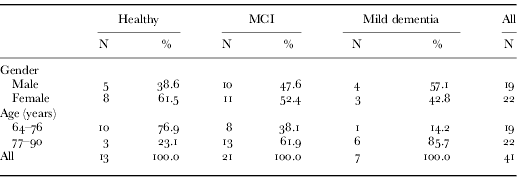
The participants with cognitive impairment were older than healthy controls. The group of participants with dementia had an average age of 81.9 (standard deviation (SD)=5.4) as opposed to 78.3 (SD=4.36) in the MCI group and 72.9 (SD=5.79) in the healthy group; however, there was no significant difference by gender (see Table 1). The participants underwent an in-depth, multi-disciplinary diagnostic screening to determine their level of cognitive impairment (for a detailed description seeShoval et al. Reference Shoval, Auslander, Freytag, Landau, Oswald, Seidl, Wahl, Werner and Heinik2008). Following the meeting at the psycho-geriatric clinic, a second interview with the participant and his or her study partner was scheduled at the participant's home. Interviewers were licensed social workers trained for the task. The participant interview included background information on the participant, information on basic housing conditions, functional health, social network, social support, emotional wellbeing, perceived functional independence, and indoor–outdoor motivation. Furthermore, the participant was presented with an extensive list of activities and services and asked to indicate which he or she took part in or used. The study partner completed similar instruments and was asked whether the participant tended to go out alone or someone else usually accompanied him or her. Following four weeks of GPS tracking, both the participant and the study partner were interviewed again using similar instruments.
The participants by cognitive ability, gender and age group
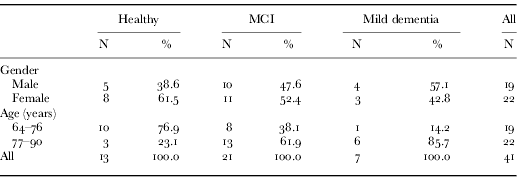
Note: MCI: mild cognitive impairment (for specification, see text).
The assessment of out-of-home mobility
The GPS tracking kit had three main elements: (a) a portable unit weighing 400 grams that incorporated a GPS receiver, a Global System for Mobile communications (GSM) modem, and a radio frequency (RF) receiver; (b) a water-resistant wristwatch with a RF transmitter and additional sensors, including one that detects whether the watch is being worn on a person's body; and (c) a stationary home unit that repeats the RF signal and allows the participant to walk freely around the house.Footnote 4 The wristwatch RF transmitter informed the researchers whether a participant was carrying the GPS device at any given moment and was following the participation guidelines. If the strap was open or the RF transmitter not in contact with the body, the system issues a notification. If the watch is worn on the hand, but out-of-home is further than 10 metres from the GPS receiver or at home further than 70 metres (the longer distance enabled by the home monitoring unit), then a notification is issued. These notifications allowed the researchers to determine whether the participant was complying with the instructions. In fact compliance data were compiled and used to calibrate an overall measure of the quality (or validity) of the data over the extended tracking period (Oswald et al. Reference Oswald, Wahl, Voss, Schilling, Freytag, Auslander, Shoval, Heinik and Landau2010).
This enabled us to assess the degree to which the collected data could really be interpreted as a representation of the participants' spatial behaviour. The GPS receiver was programmed to fix locations every 10 seconds, and functioned for approximately 12 hours without recharging. This was an essential feature because some participants were away from their homes for long periods. The data were transferred by a General Packet Radio Service to the computer server at the Hebrew University of Jerusalem. This enabled the researchers to check that the tracking kits were functioning and had sufficient battery power, and that the subjects were following the study's guidelines. Using the recorded locations, the geodetic (aerial or crow's flight) distance to the participant's was calculated using a GIS. Tables were compiled of all the measured distances for each participant, and the medians established for each hour of each day of observations – medians were used to avoid the influence of outliers. The last step was to calculate the means of the medians.
Results
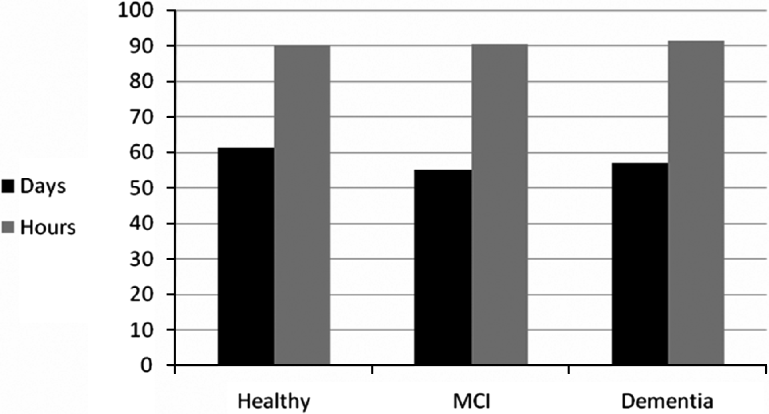
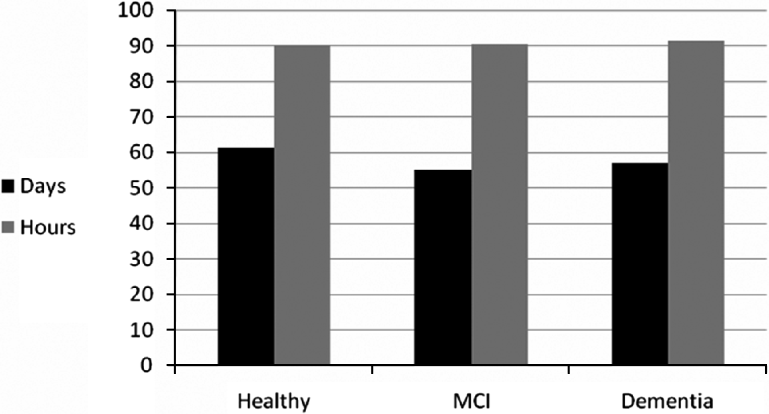
In this article we present data that were collected from 41 participants in the SenTra project. Each participant was tracked for 28 days using the equipment that was described previously. The participants had an average of 88.4 per cent of hours in which they actively participated in the research (wore the RF wristwatch and carried the portable unit that contains the GPS receiver when leaving home, and an average of 15.1 24-hour days with complete observations (no hourly median missing). All participants had similar percentages of complete observations of hours, but those with no cognitive impairments had slightly higher rates of complete observations of days (Figure 1). The overall complete observation of days for all the participants hardly changed over the 28 days of observations. This is rather surprising that there is hardly any ‘fatigue effect’ amongst the participants, though we would have expected such an effect as a natural result of the burden of participation. However, the findings are in line with results of previous long-term data collection research designs (Axhausen et al. Reference Axhausen, Zimmermann, Schönfelder, Rindsfüser and Haupt2002; Hanson Reference Hanson1977).
Average percentage of days and hours of active participation in the research.
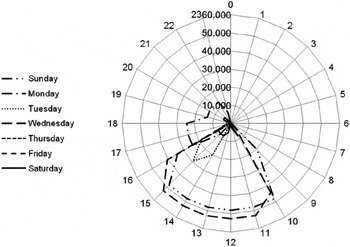
In this article we present descriptive statistics using ‘spider-web diagrams’. These are round diagrams that are divided using radial lines into 24 equal sections. Each section presents one hour of the day arranged from the top and going clockwise around the whole circle. A line representing the distances from home for each of the 24 hours of a day is plotted on the circle (the distance from the centre of the circle represents the distance from home). This circular presentation is intended to capture the cycle aspect of time. For illustrative purposes, Figure 2 shows the distances from home of only one randomly selected participant during one week presented in a circular ‘spider-web’ graph. The figure demonstrates a similar pattern of mobility on two days, on which the participant left the home at 9:00 am, spent the day at a distance of five kilometres from the home, and then returned. Friday and Saturday, Israel's weekend, were spent close to home or at home. Most evenings were spent at home, but on Monday the participant left his home at around 3:00 pm, returning only after 10:00 pm.
Distances from home of one participant during one week.

Graphs of this nature consider only one dimension of space, while disregarding the direction in which the person moved. Thus it is possible that the person was located in different physical locations, though these points appear the same on the graph due to the fact that they are located at the same distance from the home. The graphs represent the full 24 hours of the day presenting the full daily cycle, and giving equal expression to time spent at home and out of home. The advantage of using graphs of this nature is that they allow researchers to compare only one aspect of the mobility of different people living in different locations with a variety of specific spatial characteristics. Another advantage of the visualisation provided by the ‘spider-web’ graphs is that they allow researchers to begin to see patterns of routine behaviour. Daily routines, such as going to work or performing other daily activities, can be revealed. These diagrams are highly focused on time, leading to one of the main limitations in their presentation of a routine: any variation in the time at which the person travels makes it difficult to recognise a routine.
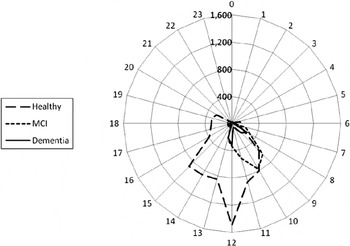
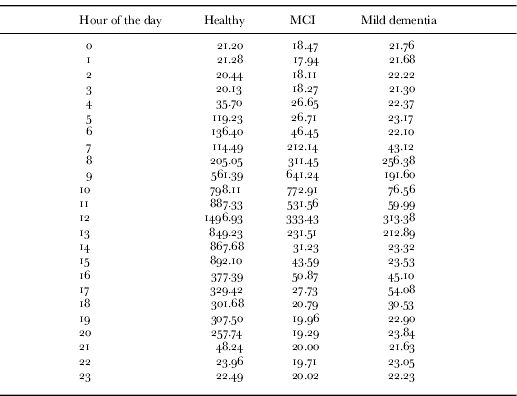
Table 2 presents the averages of the median distances from home for people in each of the three research groups. The average of the median distances was used so that the result would reflect the activity of the whole group, not including any outliers. Figure 3 illustrates the data presented in Table 2 graphically, it could be seen clearly in the figure that the healthy participants display great variability in the patterns and locations of their out-of-home mobility and many of them have more than one episode of out-of-home activity throughout the day. The participants that are categorised as MCI are active out of their homes mostly in the morning hours and in general have less out-of-home activity than the healthy participants. The participants with mild dementia (PWD) generally remain in close proximity to their homes and do not venture out of their familiar surroundings. Although the people diagnosed with dementia do not venture far from their homes, they do conduct out-of-home activity at routine times. There is great variance within this group, some of the participants classified in the group remain very close to home while others venture out to greater distances. These findings are consistent with the existing understanding of the general decline in activity that accompanies cognitive decline (Blackman et al. Reference Blackman, Mitchell, Burton, Jenks, Parsons, Raman and Williams2003).
Average of median distance from home for three cognitive groups.

The participants' distance from home by hour of the day and cognitive ability
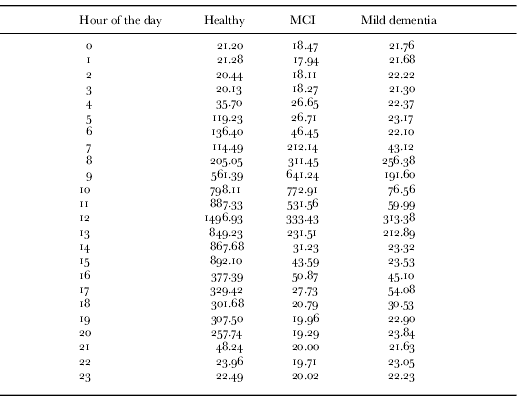
Note: MCI: mild cognitive impairment.
Role of gender
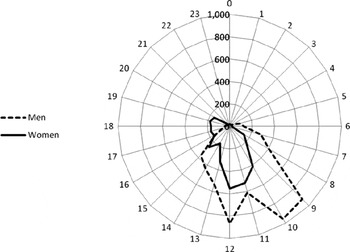
Men and women have different patterns of out-of-home mobility. Figure 4 presents the plot of the average distance throughout the day for both men and women. It seems that men are active out of their homes on an average for more hours a day and at greater distances from home than are women but women spend time out of their homes at later hours than do men. This likely reflects the different social roles of men and women and the nature of their activities. For future analysis on larger samples, there will be a need to adjust for composition effects, such as higher mean age of women in general, however this was not the case in this particular sample.
Average of median distance from home by gender.

Role of age
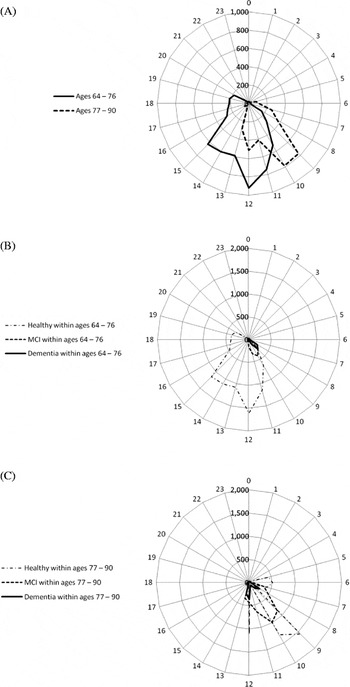
Figure 5A shows the average median distance from home for two different groups divided by age, 64–76 years old (N=19, mean 74.2) and 77–90 years old (N=22, mean 81.36). The figure presents a clear difference in the pattern of time and distance spent out of home within these two age groups, however this difference is not very significant as Mercado and Páez (Reference Mercado and Páez2009) found regarding mode and distance of travel of young-old and the old-old. In general, older people spend most of their time closer to home. People in the older group tend to use the morning hours for their out-of-home activity, returning home by the early afternoon, while people in the younger group have a more widely distributed pattern of time spent out of home. The younger group remains at a distance from their home until the evening. Six participants from the younger group still work. This may serve as part of the reason for their pattern of activity out of home. While age explains some of the differences between the cognitive groups, since there is a correlation between the cognitive health and age (see Table 1) they do not fully explain the close proximity to home of those with dementia, neither the interesting finding that people aged 77–90 years with MCI appear to spend time further away from the home compared to the younger group (aged 64–76) with MCI (Figure 5B, C). It will be interesting to follow up on this when larger samples will be available in order to see if this pattern repeats itself and is not a bias as a result of the small sample at this stage.
Average of median distance from home (A) by age group; (B) of the younger group (age 64–76); (C) of the older group (age 77–90).

Discussion
The main aim of this article was to present the usefulness of high-resolution data collection and the method for presentation the distance from home as a function of the time of day with the spider-web diagrams. Therefore it is not possible to determine if the differences that were detected between various groups are the result of bias or real trends. This will only be validated in the future when more participants will be analysed.
Despite this limitation, by using descriptive visualisations of the data collected, it is evident that the results that were presented are in line with the article's two research hypotheses: (a) The article presented the differences between the three study groups in the distance from home over a cycle of 24 hours. We did find significantly smaller distances in the out-of-home activities of those with cognitive impairment as compared to the healthy control group. Participants with mild dementia did indeed show a smaller spatial range in out-of-home activity as compared to participants who have only MCI. The difference remained visible for different age groups and for women versus men. (b) We did find that that the daily time pattern of those participants with cognitive impairments was less varied and less modulated in comparison with those with higher cognitive function. This was even more pronounced in those with dementia. Also, due to the expected wider range of activities conducted out of the home in the control group of healthy participants, more fluctuation in the timing of out-of-home activities was found.
Comparing the people diagnosed with MCI to the healthy control group shows that the latter were active at greater distances from their homes and until later at night. These findings present a pattern in the decline of the spatial activity of people with cognitive impairment that is part of the general decline in out-of-home mobility. The findings also reveal that the decline in out-of-home activity does not only present itself as less time spent out of home but as a change in the location of the activities as well. So far, due to the limited numbers of participants and the emphasis on descriptive presentations, the role of social dimensions of out-of-home mobility as well as subjective aspects of perceived outdoor place attachment and biographically developed routines and habits could not be considered. In the future, when a larger sample is available as planned in the SenTra project, we will be able to see if the trends presented here are upheld when using statistical models.
These findings have implications for the planning of services and facilities that serve people with cognitive impairment. Just as measures are taken to make services accessible to people with physical limitations, as the population in the developed world ages more consideration needs to be given to the location of services that are essential for the ageing population in general and specifically for the ageing population with cognitive impairment. The cognitive constraints on people's spatial activity must be recognised. For example, the closing of basic services such as food shops and doctors offices within a neighbourhood and the shifting of these services to adjacent locations can create considerable burdens on the population of elderly people with cognitive impairment. These findings highlight the need to keep as many essential functions as possible local in order to enable these populations to live within the community. In addition, age and gender were introduced as possible important factors in the differences in distances and timing of out-of-home activity. However, a larger sample and a thorough statistical analysis are needed for us to fully understand the independent impact that each of these factors has on the timing and location of out-of-home activity in elderly people in general and specifically in regards to people with cognitive impairment.
Acknowledgement
Support for this project provided by the German Federal Ministry of Education and Research (BMBF) within the framework of German–Israeli Project Cooperation (DIP) is gratefully acknowledged.