Implications
The study conducted in parallel on two species (weaned piglets and broilers) allow a better understanding in the use of dietary zinc originating from native or supplemented sources. To optimize feed formulations on Zn, this study confirms that both Zn sources were equivalent in their efficacy to provide available Zn. This, as supplemental Zn would not react with native phytate molecules. This study also illustrates, especially in pigs, the efficacy of phytase to improve the availability of dietary native Zn. The known antagonism between dietary phytate and Zn should therefore be considered only for native Zn.
Introduction
Zinc is an essential trace mineral for swine and poultry, but also a toxic metal for the soil and environment when supplied in excess. Natural Zn concentrations in feedstuffs are generally lower than the daily Zn requirement for weaning piglets or broilers leading to the necessity of dietary Zn supplementation. Because of the high variation in dietary, Zn and Zn antagonists (calcium, phytate, fibers and so on), Zn supplementation is generally supplied with high safety margins for Zn; even when not supplied for pharmacological purposes in piglets. High safety margins in Zn lead to unbalanced manure composition relative to nitrogen (Mohanna and Nys, Reference Mohanna and Nys1998) and to environmental concerns in areas with concentrated livestock production (Dourmad and Jondreville, Reference Dourmad and Jondreville2008; Römkens et al., Reference Römkens, Moolenaar, Groenenberg, Bonten and de Vries2008). Along with new legal limitations on dietary Zn supply (e.g. European Community, 2003), there is a need for new approaches to maximize the efficiency of Zn use to optimize productivity and minimize environmental Zn load.
Zinc is supplemented either in inorganic (oxides, sulfates and so on) or organic forms (non-ionic chemical bond between the Zn atom and the ligand, generally an amino acid). Inorganic salts are ionized in liquid environments and are suspected to react with other feed components. Zn in particularly, forms insoluble complexes with phytate in the digestive tract leading to reduced Zn availability for monogastrics (O’Dell and Savage, Reference O’Dell and Savage1960; Davies and Nightingale, Reference Davies and Nightingale1975; Windisch and Kirchgessner, Reference Windisch and Kirchgessner1999). Calcium reinforces this reduced Zn availability by stabilizing phytates (Oberleas et al., Reference Oberleas, Muhrer and O’Dell1966). According to Dintzis et al. (Reference Dintzis, Laszlo, Nelsen, Baker and Calvert1995) and Susaki et al. (Reference Susaki, Matsui, Ashida, Fujita, Nakajima and Yano1999), these antagonists alter Zn availability by depressing its solubility in the digestive tract. Demonstrations of increased Zn availability when feeding organic Zn sources compared to Zn sulfate in the presence of phytate were reported by Power et al. (Reference Power, Flynn and Cashman1994) and Schlegel and Windisch (Reference Schlegel and Windisch2006) in rats. According to these authors, organic Zn sources have a reduced reaction to dietary Zn antagonists, such as phytate, and present a solubility in the digestive tract favorable for an improved Zn absorbability. Increased Zn availability in broilers using organic Zn sources has also been reported by Wedekind et al. (Reference Wedekind, Hortin and Baker1992) but remains unconfirmed in piglets by the same research group (Wedekind et al., Reference Wedekind, Lewis, Giesemann and Miller1994). Referring to these studies, the authors suggested that the higher Ca content in the broiler diets, a potential Zn antagonist, may explain the increased availability of the organic source in broilers compared with piglets (Wedekind et al., Reference Wedekind, Lewis, Giesemann and Miller1994). However, physicochemical conditions and transit time in the digestive tract of both species may also contribute to different Zn solubility in the digestive tract, and, in turn, to different Zn availability in piglets and broilers.
The aim of this study was to investigate the digestive zinc solubility and zinc availability in piglets and broilers fed diets varying in their phytate contents, phytase activity and zinc source supplementation. The experimental diets were identical for piglets and broilers to allow direct species comparison. The nine experimental diets were therefore formulated to meet the nutrient requirements, except Zn, of the most demanding species.
Material and methods
Experimental diets
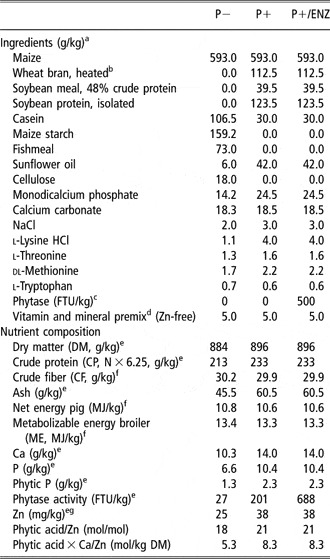
Three iso-energetic, iso-nitrogenous and iso-Ca/P maize–soybean meal basal diets (P−; P+; P+/ENZ) were formulated to be differentiated in their phytic P concentration and phytase activity and to meet or exceed all nutrient requirements of weaned piglets and broiler starters, except for Zn (Institut National de la Recherche Agronomique, 1989; Institut National de la Recherche Agronomique-Association Française de Zootechnie, 2004). Nutrients, except Zn, were therefore adjusted to meet requirements of the most demanding specie. To achieve two different concentrations of phytic P, plant feedstuffs (soybean meal, heated wheat bran and isolated soybean protein) present in the basal diet high in phytic P (P+) were replaced with fish meal, casein, corn starch and cellulose in the basal diet low in phytic P (P−). The third basal diet (P+/ENZ) was made by incorporating 500 units (FTU) of microbial phytase per kg (phytase produced by Aspergillus niger, 6970 FTU/g; Natuphos®, BASF, Ludwigshafen, Germany) into basal diet P+. Wheat bran was heated (twice 2 min at 900 W in microwave oven) to eliminate any intrinsic phytase activity. Frapin (Reference Frapin1996) indicated that this heating treatment denatures plant phytase to a major extent. No basal diet was supplemented with Zn and their premix was Zn-free. The ingredient and chemical composition of the three basal diets P−, P+ and P+/ENZ are presented in Table 1. Nine experimental diets were formulated: each basal diet was supplemented with 0 or 15 mg Zn/kg issued from zinc sulfate heptahydrate (ZnSulf, 326 g Zn/kg feed grade) or 15 mg Zn/kg from zinc glycine chelate (ZnGly, 214 g Zn/kg; B-TRAXIM®, Pancosma, Geneva, Switzerland) according to the defined terms in EU legislation (European Community, 2006). All experimental diets were pelleted (maximum 62°C, 2.5 mm). Piglets and broilers were fed the same experimental diets with the exception of anticoccidiostats (500 mg/kg), which were incorporated before pelletting into the experimental diets fed to broilers.
Composition of basal diets P− and P+ and P+/ENZ (as fed basis)

aDiets for broilers contained 0.5 g coccidiostats/kg.
bHeated twice for 2 min at 900 W in a microwave oven.
cMicrobial phytase produced by Aspergillus niger (6970 FTU/g; Natuphos®, BASF, Ludwigshafen, Germany).
dVitamins supplied per kg of diet: 15 000 IU vitamin A, 3000 IU vitamin D3, 40 IU vitamin E (dl α-tocopherolacetate), 2 mg vitamin K3 (menadion), 2 mg vitamin B1 (thiamine), 10 mg vitamin B2 (riboflavin), 30 mg vitamin B3 (PP, niacin), 15 mg vitamin B5 (panthotenic acid), 10 mg vitamin B6 (pyridoxine), 0.2 mg vitamin B8 (biotin, H), 2 mg vitamin B9 (folic acid), 0.05 mg vitamin B12 (cyanocobalamin), 100 mg vitamin C (ascorbic acid), 800 mg cholin, 30 mg Fe (FeSO4), 20 mg Cu (CuSO4), 40 mg Mn (MnO), 2 mg Co (CoSO4), 1 mg I (Ca(IO3)2), 0.3 mg Se (Na2SeO3).
eAnalyzed as described under the section Material and Methods.
fCalculated using Institut National de la Recherche Agronomique – Association Française de Zootechnie (2004).
gAnalyzed Zn concentration in P−, P+ and P+/ENZ supplemented with Zn as sulfate was 41, 54 and 54 mg/kg, respectively; analyzed Zn concentration in P−, P+ and P+/ENZ supplemented with Zn as glycinate was 42, 52 and 53 mg/kg, respectively.
Animals and experimental procedures
Piglet experiment
One hundred and eight piglets (Pietrain × (Landrace × Large White); female : castrate 1 : 1) were weaned and placed by pairs into plastic/inox pens and fed, ad libitum, the unsupplemented experimental diet P+ for a 6-day adaptation period. Following the adaptation period, 54 piglets were allocated to six blocks on the basis of gender (three blocks of female and three of castrates), BW and litter. The 54 selected piglets were 27 ± 1-day old and weighed 8.8 ± 1.1 kg at weaning. The nine piglets from each block were placed in individual plastic/inox pens and randomly allocated to one of the nine experimental diets for 20 days. Diets were fed restrictively (3.5% of BW) divided in three daily and equal meals. Water was available ad libitum. Before the first and the last experimental days, a night of fasting was introduced. On the last experimental day (day 21), piglets were fed two-thirds of their previous daily consumption until 2 h before anesthesia (electric shock), which was followed by bleeding. The two climatically controlled rooms were set at a constant temperature (25°C ± 1°C).
Broiler experiment
Two hundred and twenty, 1-day-old broilers (Ross) were placed in 96 plastified cages, each containing a plastified feeder and a plastic water nipple. Broilers were fed a standard commercially available starter diet during the first 2 days following hatching. On the second day, 180 broilers having the nearest BW to the mean were selected and allocated by BW to 10 blocks of nine cages. Each cage contained two animals, and one from each block was randomly allocated to one of the nine experimental diets for 20 days. Feed and water was available ad libitum. To stimulate intake before the end of the experience, all experimental diets were removed for 5.5 h and reintroduced for the last 2.5 h before lethal injection of pentobarbital. Broilers were housed in one climatically controlled room. The temperature was progressively decreased from 33°C to 26°C. The light was permanently on during the first 2 days following hatching, then on for 23 h per day.
Data and sample collection and analysis
A sample from each treatment diet was taken and frozen (−20°C). A sample of 10 ml of drinking water was taken (daily in the piglet unit and weekly in the broiler unit) and analyzed for Zn content. Feed intake (FI) was recorded for the individual pig on a daily basis and for each broilers cage on a weekly basis. Piglets and broilers were individually weighed at the start and end of the experimental period. Blood samples were collected from each piglet at the jugular vein with heparinized 10-ml tubes on weighing days. Blood samples from each broiler were collected with heparinized 7.5-ml tubes from the alary vein before lethal injection. Blood samples were centrifuged (3000 × g, 10 min, 4°C) and plasma was frozen (−20°C). At slaughter, the right metacarpal IV from the piglets and the right tibia from the broilers were collected, autoclaved at 120°C for 20 min, cleaned from any soft tissues and were frozen (−20°C). Within 30 min following piglet slaughter, stomacal and intestinal (length of 70 cm from the pylori) contents were collected separately, lyophilized and frozen (−20°C) after their pH was measured. Within 10 min after broiler slaughter, the same process was conducted for the gizzard and the complete small intestine.
Basal diets P− and P+ were analyzed for crude protein (CP; N × 6.25), phytic P, P and Ca contents. Basal diets P−, P+ and P+/ENZ were analyzed for phytase activity. Zn was analyzed in all experimental diets, water samples, bones, plasma and digesta. Soluble Zn was analyzed in digesta. Alkaline phosphatase (AP) activity was measured in plasma. All analyses were performed in duplicate. Dry matter (DM) was measured by drying at 103°C until constant weight. Nitrogen was determined by the Kjeldahl method according to the French standard AFNOR (NFV 18-100) using a Kjelfoss apparatus (A/S N Foss Electric, Denmark). Phytic P was determined by ion-pair HPLC (Column C18, Hypersyl C 18-5 μm 200 × 2 mm, Interchim, Montluçon, France) after acidic extraction and anionic exchange purification according to the method developed by Sandberg and Adherinne (Reference Sandberg and Adherinne1986) and modified by Lehrfeld (Reference Lehrfeld1989). Phytase activity was measured colorimetrically after incubation in a sodium phytate solution (Engelen et al., Reference Engelen, van der Heeft, Randsdorp and Smit1994). One phytase activity unit (FTU) is the amount of enzyme that liberates 1 μmol of inorganic P from 5.1 mmol/l solution of sodium phytate per minute at pH 5.5 and 37°C. Plasmatic AP activity was determined using the procedure from Biomérieux (Biomérieux 63609, Marcy l’Etoile, France) on Cobas Mira apparatus (Hoffman-La Roche, Nutley, NJ, USA).
Samples were treated as follows before mineral analyses: 1.0 ml of plasma, mixed with 0.5 ml HCl 3N and 0.5 ml of 40% trichloroacetic acid, was centrifuged at 3000 × g for 15 min. The supernatant was collected and diluted in 3 ml of deionized water. Each bone was sectioned longitudinally, dried overnight at 103°C, weighed and then ashed at 550°C for 12 h in a muffle furnace. Ash was weighed and ground. Samples of diets and lyophilized digesta were ashed at 550°C for 8 h in a muffle furnace. Bone, feed and digesta ashes were solubilized using nitric acid 16 N and hydrogen peroxide 30% on a digestion block until dry and nitric acid 0.4 N for dilution before analysis. To determine the soluble Zn content in the digesta, samples were rehydrated (0.3 g lyophilized digesta for 10 ml deionized water) and stirred constantly at 38°C during 2 h. Supernatants were clarified by ultracentrifugation (18000 × g, 1 h, 20°C) and separated by filtration (45 μm). The filtrated supernatant was acidified with one drop of HNO3 16 N before mineral analysis. Calcium and Zn were analyzed by flame atomic absorption spectrophotometry (SpectrAA 220 FS; Varian, Springvale, Australia). Phosphorus was analyzed by the Vanadate colorimetric method on a Cobas Mira apparatus (Hoffman-La Roche).
Statistical analysis
Data were submitted to an ANOVA followed by a comparison of means (NCSS, 2001). The individual pig and the cage of two birds were considered as experimental units. Data were analyzed as a 3 × 3 factorial design. The model included block, basal diet (P−, P+, P+/ENZ), supplemental Zn (0, ZnSulf, ZnGly) and basal diet × supplemental Zn. The values obtained before feeding the experimental diets to piglets were used as covariates for final plasma Zn and AP activity values. The feed consumed during the 2 h before slaughter was used as covariate for piglet digestive tract data analysis. Differences were considered significant when P < 0.05 and trends were noted at P < 0.1.
Results
Diets
The analyzed and calculated nutrient values of the three basal diets were consistent with the expected values (Table 1). The analyzed Zn and phytic P contents were higher in basal diet P+ and P+/ENZ than in basal diet P−. The analyzed phytase activity in basal diet P+ reached 200 FTU/kg, probably due to an incomplete denaturation of plant phytase by heat treatment of wheat bran. The increased phytase activity (487 FTU) in basal diet P+/ENZ, compared to basal diet P+ was consistent with the expected phytase inclusion. Analyzed Zn concentration in Zn supplemented experimental diets were according to theoretical values. Zn concentration in drinking water did not exceed values of 0.03 and 0.46 mg/l in piglet and broiler units, respectively.
Animal performance
Three non-zinc supplemented piglets (two from P− and one from P+ diets) had to be removed from the study due to low FI. Broilers fed P− diets performed in reduced intake (−44% compared to P+ and P+/ENZ) and increased cases of morbidity, particularly leg weakness (30% v. 5% in P+ and P+/ENZ). Such low feed intake associated with depressed growth and increased morbidity was not representative of expected broiler performance fed. This situation was most probably due to the hardness of the P-pellets, which is not related to the experimental variable. Broiler data from P-treatments were therefore removed.
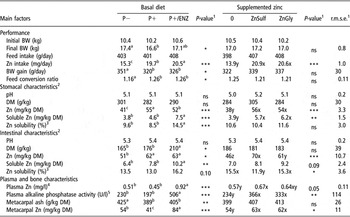
Results relative to piglets are presented in Table 2. Piglet performance was affected by the basal diet (P < 0.05), but not by supplemental Zn (P > 0.1). The restricted FI was 404 ± 16 g/day, irrespective of the experimental treatment, but body weight gain (BWG) and feed conversion ratio (FCR) were improved by 8.7% (P < 0.05) and 7.9% (P < 0.05), respectively, when P− diets were fed compared to P+ or P+/ENZ diets. No interaction was measured between basal diet and supplemental Zn (P > 0.1).
Effect of basal diet and zinc supplementation on growth performance, digesta, plasma and bone characteristics in piglets (main factors)

DM = dry matter.
1r.m.s.e. = root mean square error; ***P < 0.001; **P < 0.01; *P < 0.05; ns (non-significant) P > 0.10; two-way interaction was never significant (P > 0.10) except for stomacal Zn solubility (P = 0.07), and therefore, only main effects are presented. For each main factor, values in the same row not followed by the same letter (a, b, c for basal diet effect; x, y, z for supplemented zinc effect) differ significantly.
2Adjusted means for feed intake on last experimental day of 325 g.
3Calculated as the ratio of total to soluble Zn concentration.
4Adjusted means for initial plasma Zn of 0.83 mg/l.
5Adjusted means for initial plasma alkaline phosphatase activity of 619 U/l.
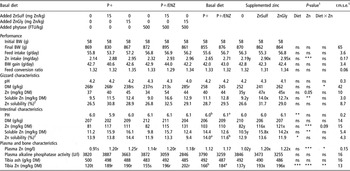
Results relative to broilers are presented in Table 3. Mean broiler performance was 56 ± 4 g/day FI, 43 ± 3 g/day BWG and 1.32 ± 0.06 FCR and was neither affected by the basal diet, supplemental Zn nor by their interaction (P > 0.1).
Effect of basal diet and zinc supplementation on growth performance, digesta, plasma and bone characteristics in broilers

DM = dry matter.
1r.m.s.e. = root mean square error; ***P < 0.001; **P < 0.01; *P < 0.05; ns (non-significant) P > 0.10. For each factor, values in a same row not followed by the same letter (a, b, c for basal diet effect; x, y, z for supplemented zinc effect; r, s, t for interaction effect) differ significantly.
2Calculated as the ratio of total to soluble Zn concentration.
Zinc status: plasma and bone characteristics
In piglets, plasma Zn concentrations and AP activity remained similar, while bone Zn level was reduced (P < 0.001) by 24% when feeding P+ diets compared to P− diets. Supply of phytase to P+ diets increased plasma Zn, AP activity and bone Zn (P < 0.001) by 104%, 157% and 105%, respectively. Dietary Zn supplementation (15 mg/kg) increased plasma AP activity by 49% (P < 0.01) and bone Zn by 17% (P < 0.05), irrespective of Zn source. Plasma Zn was increased by 15% (P < 0.05) with ZnSulf and by 12% (P > 0.05) with ZnGly.
In broilers, dietary Zn supplementation increased (P < 0.001) plasma Zn by 19%, irrespective of Zn source. The use of phytase increased plasma Zn (+25%) only in the experimental diet without supplemental Zn. The dietary addition of ZnSulf or ZnGly increased plasma Zn by 32% and 37%, respectively, when no phytase was fed (interaction basal diet × Zn, P < 0.05). Plasma AP activity was not influenced by dietary treatments (P > 0.1). Dietary Zn supplementation increased (P < 0.001) bone Zn by 42%, irrespective of Zn source and phytase increased it by 11% (P < 0.001). Bone Zn was increased by 29% when adding phytase to non-Zn supplemented diets or by 58% when adding Zn to P+ diet or by 27% (ZnSulf) and 30% (ZnGly) when adding Zn to P+/ENZ diet (interaction basal diet × Zn, P < 0.01).
Digestive pH, Zn and soluble Zn contents
In piglets, mean pH values of the stomacal and intestinal contents were 5.1 ± 0.2 and 5.4 ± 0.2, respectively, and were independent of basal diet and supplemental Zn (P > 0.1). Zn concentration in the stomach closely reflected Zn concentration in diets. P+ and P+/ENZ diets, containing 13 mg/kg more Zn than P− diet also led to there being 11 to 14 mg/kg DM more Zn in the stomach (P < 0.001). Dietary Zn supplementation of 15 mg/kg increased stomacal Zn concentration accordingly by 17 mg/kg DM (P < 0.001), irrespective of Zn source. Stomacal soluble Zn concentration was similar in piglets fed P− and P+ diets (P > 0.05), but increased (P < 0.05) by 63% when phytase was added to P+ diets. Supplemental Zn also increased (P < 0.01) stomacal soluble Zn by 46 (ZnSulf) and 59% (ZnGly). Stomacal Zn solubility (percentage of soluble Zn to total Zn concentration) was increased by P+/ENZ diet (P < 0.001) and by supplemental Zn in P+ and P+/ENZ diets (interaction basal diet × Zn, P = 0.07). Intestinal Zn concentration in piglets was increased by 12 mg/kg DM with P+ and P+/ENZ diets compared to P− diet (P < 0.05) and by 24 (ZnSulf) and 15 mg/kg (ZnGly) DM with Zn supplementation (P < 0.001). As in the stomach, intestinal soluble Zn was not dependent on the dietary phytate content (P > 0.05), but on the addition of phytase into P+ diets (+31%, P < 0.01). Intestinal soluble Zn increased by 16% when ZnSulf was supplied and by 31% when ZnGly was supplied (P = 0.09). Intestinal Zn solubility was higher in piglets fed Zn as ZnGly compared to those fed ZnSulf (P < 0.05). Zn solubility was the highest in the intestine of piglets fed P+/ENZ, ZnGly experimental diet (18.4%).
In broilers, mean pH values of the gizzard and intestinal contents were 4.2 ± 0.3 and 6.0 ± 0.2, respectively. Intestinal pH was slightly increased in birds fed P+/ENZ diets (+0.1 unit, P < 0.01). As observed in the piglet stomach, Zn concentration in the broiler gizzard was close to dietary Zn content. In the gizzard, soluble Zn was not raised by the addition of phytase to P+ diets (P > 0.10) as it was the case in the piglet stomach, but was increased by supplemental Zn (P < 0.01) by 52% (ZnSulf) and 38% (ZnGly). Compared to the Zn concentration in piglet stomach and intestine and to the gizzard, Zn concentration in the broiler intestine was twice as high (82 ± 4 mg Zn/kg for unsupplemented Zn). Intestinal total and soluble Zn concentrations were similar (P > 0.1) in chickens fed P+ and P+/ENZ diets, but increased with Zn supplementation by 45 (P < 0.001) and by 43% (P < 0.01), respectively, irrespective of Zn source. Intestinal Zn solubility was not influenced (P > 0.05) by Zn supplementation, but was reduced in the presence of phytase (P < 0.05). Zn solubility was highest in the intestine of broilers fed P+, ZnGly experimental diet (14.4%).
Discussion
Animal performance and zinc status
In piglets, the increased growth and feed efficiency for the P− diet compared to P+ and P+/ENZ diets was not directly related to Zn use, as plasma and bone Zn concentrations of piglets fed P− diet were lower than those fed P+/ENZ diet. The energy value of ingredients such as casein, maize starch and fish meal in the P− diet may have been underestimated while formulating this diet and may have directly influenced the piglet growth performance. Neither supplemental Zn nor supplemental phytase had any effect on piglet growth performance. Since one of the first signs of Zn deficiency is depressed FI, animal performance may be considered as an adequate indicator for supplemental Zn availability under the condition that animals are fed ad libitum low Zn diets (Jongbloed et al., Reference Jongbloed, Kemme, De Groote, Lippens and Meschy2002). In this study, piglets could not express any potential effect on growth performance because their feeding was restricted.
Similarly, broiler growth performance was neither affected by Zn supplementation nor supply of microbial phytase. In accordance, no improvement in growth performance of broiler starters up to 21 days of age was observed by adding zinc (Mohanna and Nys, Reference Mohanna and Nys1999a; Burrell et al., Reference Burrell, Dozier, Davis, Compton, Freeman, Vendrell and Ward2004; Jondreville et al., Reference Jondreville, Lescoat, Magnin, Feuerstein, Gruenberg and Nys2007) or microbial phytase (Mohanna and Nys, Reference Mohanna and Nys1999b; Jondreville et al., Reference Jondreville, Lescoat, Magnin, Feuerstein, Gruenberg and Nys2007) to maize–soybean meal diets containing more than 30 mg of Zn/kg. Dietary Zn contents slightly below 40 mg Zn/kg may therefore be sufficient for optimal growth over a limited time period of 21 days. In contrary, Ao et al. (Reference Ao, Pierce, Pescatore, Cantor, Dawson, Ford and Shafer2007) observed improved growth performance when supplementing to broilers a maize–soybean meal diet with 500 FTU/kg phytase and/or 2 to 12 mg/kg Zn. However, it must be noted that the unsupplemented broilers had lower growth rates (29 g/day) than in this study.
The present values in piglet and broiler Zn status based on plasma Zn, AP activity and bone Zn are consistent with previous findings conducted on similar protocols within INRA laboratories (e.g. Mohanna and Nys, Reference Mohanna and Nys1999a; Revy et al., Reference Revy, Jondreville, Dourmad and Nys2004) as well as other institutes (Ao et al., Reference Ao, Pierce, Pescatore, Cantor, Dawson, Ford and Shafer2007). The experimental diets were formulated to provide minimal native Zn and maximal supplemental Zn while keeping animals below homeostatic Zn regulation capacity. Consequently, the dietary treatments are expected to influence animal Zn status and present results indicate that this was clearly the case: piglets fed the P− diets had a better Zn status than the ones fed the P+ diets, despite the lower Zn concentration in the P− diets. As suggested by Fordyce et al. (Reference Fordyce, Forbes, Robbins and Erdman1987), the (phytate × Ca)/Zn molar ratio is an accurate Zn availability indicator due to the presence of insoluble Zn–Ca–phytate complexes in the digestive tract. The relative lower Ca and phytate contents to Zn contents in the P− diet (phytate × Ca/Zn of 5.3 mol/kg DM) than P+ diet (phytate × Ca/Zn of 8.3 mol/kg DM) may therefore explain the better Zn status of animals fed P− diet. This study clearly demonstrated an improved Zn status when supplying phytase to the unsupplemented P+ diet. The supply of 500 FTU/kg phytase elicited a far greater response than 15 mg supplemental Zn in piglets, whereas in broilers, 15 mg supplemental Zn was more efficient than 500 FTU/kg phytase. This confirms the previously reported higher efficacy of microbial phytase for improved Zn availability in piglets (e.g. Pallauf et al., Reference Pallauf, Hohler and Rimbach1992; Jondreville et al., Reference Jondreville, Hayler and Feuerstein2005; Revy et al., Reference Revy, Jondreville, Dourmad and Nys2006) than in broilers (e.g. Yi et al., Reference Yi, Kornegay and Denbow1996; Mohanna and Nys, Reference Mohanna and Nys1999b; Jondreville et al., Reference Jondreville, Lescoat, Magnin, Feuerstein, Gruenberg and Nys2007). Recently, the minimal supplementation of 500 FTU/kg phytase in maize–soybean meal diets were evaluated to an equivalent of 30 mg dietary Zn as ZnSO4 in piglets (Jondreville et al., Reference Jondreville, Hayler and Feuerstein2005) and below 15 mg dietary Zn as ZnSO4 in broilers (Biehl et al., Reference Biehl, Baker and DeLuca1995; Mohanna and Nys, Reference Mohanna and Nys1999b; Jondreville et al., Reference Jondreville, Lescoat, Magnin, Feuerstein, Gruenberg and Nys2007).
In broilers, supplemental Zn led to a greater plasma and bone Zn response when added to P+ diet than P+/ENZ diet. These results are consistent with Ao et al. (Reference Ao, Pierce, Pescatore, Cantor, Dawson, Ford and Shafer2007). According to Jondreville et al. (Reference Jondreville, Lescoat, Magnin, Feuerstein, Gruenberg and Nys2007), the respective dietary content of 50 and 59 mg Zn/kg (maize–soybean meal-based diet; 33 mg/kg Zn as native Zn) maximized broiler plasma and bone Zn concentration. Thus, supplementation of P+/ENZ diet (38 mg/kg Zn) with 15 mg Zn could not improve plasma Zn and only slightly improve bone Zn as supply was already close to the requirement. The present findings also suggest that Zn requirements for optimal growth are lower than for maximized metabolic Zn use (plasma AP activity, plasma Zn) and bone mineralization.
In both species, regardless of the basal diet, both supplemented Zn sources (ZnSulf and ZnGly) resulted in similar Zn status improvements indicating a similar availability. Only numerical improvements using ZnGly compared with ZnSulf were observed, such as +9% and +4% in plasma and bone Zn, respectively, for piglets fed P+ diet, +4% in plasma Zn for broilers fed P+ diet and +3% in tibia Zn for broilers fed P+/ENZ diet. These findings are compatible with broiler data (Swiatkiewicz et al., Reference Swiatkiewicz, Koreleski and Zhong2001) in which a Zn amino-acid complex numerically increased bone Zn by 3% and piglet data (Revy et al., Reference Revy, Jondreville, Dourmad and Nys2004) in which a Zn methionine even led to a small but non-significant reduction in plasma Zn and bone Zn when compared to ZnSulf. These findings are in contrast to previous research comparing the identical ZnGly source with ZnSO4 resulted in improved plasma, liver and bone Zn on growing rats (Schlegel and Windisch, Reference Schlegel and Windisch2006) and plasma and liver Zn on growing steers (Spears et al., Reference Spears, Schlegel, Seal and Lloyd2004). Therefore, this study did tnot confirm the hypothesis of improved Zn availability using organic Zn sources relative to ZnSO4 with increased dietary phytate concentration or reduced dietary phytase activity. In addition, this study did not confirm previous findings by Wedekind et al. (Reference Wedekind, Hortin and Baker1992 and Reference Wedekind, Lewis, Giesemann and Miller1994) which showed advantages of using organic Zn sources in piglets relative to broilers due to low dietary Ca contents.
Zinc in digesta and relation to zinc availability
Measurements of pH, total Zn concentrations and soluble Zn in the digestive tract (digesta) were used to evaluate their importance in relation to Zn availability. Previous research suggested that Zn availability depends on Zn solubility in the digesta (Susaki et al., Reference Susaki, Matsui, Ashida, Fujita, Nakajima and Yano1999), whereas Zn solubility may depend on various factors including digesta pH (Cao et al., Reference Cao, Henry, Guo, Holwerda, Toth, Littell, Miles and Ammerman2000; Jongbloed et al., Reference Jongbloed, Kemme, De Groote, Lippens and Meschy2002), dietary Zn concentration (Dintzis et al., Reference Dintzis, Laszlo, Nelsen, Baker and Calvert1995; Susaki et al., Reference Susaki, Matsui, Ashida, Fujita, Nakajima and Yano1999), supplemented Zn source (Cao et al., Reference Cao, Henry, Guo, Holwerda, Toth, Littell, Miles and Ammerman2000) and interactions between dietary Zn and diet composition (Ammerman et al., Reference Ammerman, Baker and Lewis1995; Jongbloed et al., Reference Jongbloed, Kemme, De Groote, Lippens and Meschy2002).
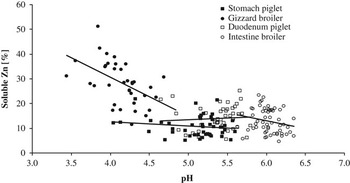
In this study, the gastrointestinal pH increased only slightly from the piglet stomach to its intestine. This increase was more evident from the broiler gizzard to its intestine. The feeding technique before slaughter and the use of limestone as Ca source, which displays a high acid-binding capacity may have favored high pH values in the stomach and gizzard (Lawlor et al., Reference Lawlor, Lynch, Caffrey, O’Reilly and O’Connel2005). Zinc concentrations in digesta reflected dietary Zn concentration, except for the broiler intestine, which may originate from the sampling technique employed and the partial dietary DM absorption and/or endogenous Zn secretions occurring in the intestine even under drastically limited Zn supply (Windisch, Reference Windisch2003; Schlegel and Windisch, Reference Schlegel and Windisch2006). The percentage of Zn present in a soluble form (Zn solubility) may be related to digesta pH (Figure 1) (7% to 16%, respectively) and 10% to 18% of Zn were soluble in piglet stomach and intestine, while these percentages were 26% to 32% and 9% to 14% in the broiler gizzard and intestine, respectively. Furthermore, Zn solubility was also found to be higher as a consequence of lower pH in vitro (Cao et al., Reference Cao, Henry, Guo, Holwerda, Toth, Littell, Miles and Ammerman2000). The stomacal Zn solubility was low (54% to 84% on 100 kg BW pigs) compared to measures observed by Dintzis et al. (Reference Dintzis, Laszlo, Nelsen, Baker and Calvert1995) even though pH was 4.5 and extraction methods for measuring soluble Zn were similar. The intestinal Zn solubility in piglets was, however, comparable with those of Dintzis et al. (Reference Dintzis, Laszlo, Nelsen, Baker and Calvert1995) who reported values of 21% in the jejunum when feeding 24 mg/kg Zn, Susaki et al. (Reference Susaki, Matsui, Ashida, Fujita, Nakajima and Yano1999) with values of 11% in ileum when supplementing the diet with 25 mg/kg Zn, and those observed by Ashida et al. (Reference Ashida, Matsui, Itoh, Yano and Nakajima2000) also showed values of 29% in small intestine when feeding 65 mg/kg Zn.
Effect of digesta pH on Zn solubility.

The importance of the digestive soluble Zn and Zn solubility on animal Zn status remains uncertain since several factors may have limited potential findings in this study: First, in broilers, the supply of soluble Zn near the absorption sites were not the limiting factor for plasma and bone Zn due to the fact that nutritional requirements were fulfilled. Second, the methodology implemented did not differentiate soluble Zn according to the size of the compounds to which it is associated, while Zn is more readily absorbed when associated with small compounds (Shafey et al., Reference Shafey, McDonald and Dingle1991). Third, the collected broiler intestinal contents may not be representative enough of digesta located close to the Zn absorption sites, probably located at the upper part of the small intestine. Nevertheless, the results from this study do present novel findings in both piglets and broilers that Zn supplementation increased the concentration of digestive Zn and soluble Zn, independently of source, resulting in increased Zn status. The absence of interaction between the basal diet and supplemental Zn on digestive soluble Zn suggests that, supplemental Zn, irrespective of its source or target specie, did not react with the dietary antagonists. This is in agreement with the response of Zn status indicators in pigs, as discussed previously. The effect of phytase on piglet Zn status was well illustrated by the positive response on the soluble Zn in stomach and intestine, proving the efficacy of phytase to hydrolyze phytic acid and to release Zn. In broilers, on the other hand, the low pH in the gizzard, the high soluble Zn contents and the absence of phytase efficiency to increase soluble Zn all indicate that phytate and Zn were already dissociated to a major extent in P+. According to Ellis et al. (Reference Ellis, Morris and Hill1982), zinc–phytate complexes dissociate as soon as pH is decreased down to 4. Thus, these results suggest that the low pH in gizzard allows zinc–phytate complexes to dissociate even in the absence of phytase, whereas in the piglet stomach with higher pH, phytates must first be hydrolyzed by phytase before Zn can be released. This phenomenon would result in a physiologically higher availability of zinc in poultry than in swine, explaining the lower dietary requirements in broilers than in piglets for this trace element (40 mg/kg Zn for chickens, (Institut National de la Recherche Agronomique, 1989) and 80/100 mg/kg Zn for piglets, (National Research Council, 1998; Institut National de la Recherche Agronomique, 1989)). This phenomenon would also explain the differential efficacy of phytase for improved Zn availability in poultry and in swine.
Conclusions
The results of this study demonstrate that dietary zinc was used more efficiently by broilers than by piglets, most probably due to the lower gizzard pH and its related higher zinc solubility. The results of this study demonstrate that zinc supplementation, irrespective of zinc source, are successful in improving zinc status in both piglets and broilers, and suggest that supplemented Zn availability was independent from the diet formulation. Finally, the present data confirm that phytase was efficient in increasing digestive soluble Zn and improving zinc status in piglets. This was of a lower magnitude in broilers probably due to the naturally higher Zn availability in poultry comparedwith swine.
Acknowledgements
The authors are grateful to the financial support of Pancosma S. A. and to Sandrine Hillion and Anne-Marie Chagneau for their technical assistance. They also acknowledge Maryse Mills, Kléber Gérard, Jean-Marc Meslier, Frédéric Mercerand, Michel Derouet and Thierry Bordeau of the URA 83 Poultry Unit (INRA) in Nouzilly and Georges Guillemois, Raymond Vilboux and Christelle Homo of the UMR Systèmes d’élevage Nutrition animale et humaine at INRA in Saint-Gilles.