The story of the Rich Man and Lazarus from Luke's Gospel is the source of some of the earliest elaborate sectional musical works in seventeenth-century Germany. With their high degree of textual troping and musical variety, these settings often surpass musical treatments of other Gospel stories in length and complexity. In at least two cases, these long, sectional works seem to defy classification with the label Actus Musicus, the precise features of which are elusive, given the paucity of extant pieces bearing this designation.Footnote 1 Apart from the Passion, no other biblical story seems to have captured seventeenth-century imaginations as strongly as that of the Rich Man and Lazarus. Indeed, with one notable exception, theatrical – that is, sectional, first-person, dramatised – accounts of the Rich Man and Lazarus story seem even to have been encouraged by local clergy.Footnote 2
A long and varied exegetical tradition intersects with this unusual body of musical works. The story of the Rich Man and Lazarus was well known to Lutherans since it served as the Gospel lesson for the First Sunday after Trinity, falling between 24 May and 26 June.Footnote 3 Sermons on the text, collected in cycles for the year or published independently, expose the most common interpretations as well as a few idiosyncratic views. Since most musical settings were intended for liturgical use, reinforcing rather than replacing the reading of the Gospel text, we might expect to find them strengthening the exegetical traditions out of which they emerged.
INTERPRETATIVE THEMES: SERMONS AND PLAYS
The story of the Rich Man and Lazarus is a theologically important one. The Silesian theologian Valerius Herberger (1562–1627), whose sermons are noted for their rhetorical flourishes and accessible if sentimental style, begins his explication of the story by calling it a wonder: ‘I dare say that this is the most beautiful Gospel of the year. It appears to me like a beautiful, pleasant meadow full of scented flowers and herbs. If here is described the world, heaven, and hell, where would one hear the like so close to one another?’Footnote 4 Lutheran theologians and writers agree on a number of interpretative points throughout the late sixteenth and seventeenth century, with the most radical departures in interpretation appearing in the late eighteenth century.
The last shall be first
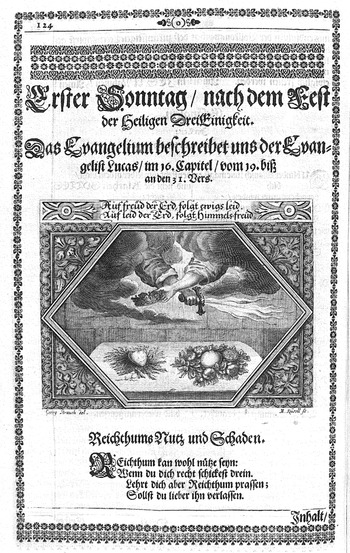
At its most superficial, the story of the Rich Man and Lazarus seems to reiterate the lesson of Matthew 20: 16: ‘So the last will be first, and the first last. For many are called, but few chosen.’ The prolific Nuremberg theologian and author of devotional texts Johann Michael Dilherr (1604–69) visually depicts this reversal in an emblem for the first Sunday after Trinity in his Augen- und Herzens-Lust (1661) (see Figure 1). The pictura shows two hearts, one resting on a bed of thorns, the other on rose petals. Above the hearts are two arms emerging out of the clouds, crossing as they reach down to the hearts. A fiery sword points down towards the heart surrounded by roses, while a regal crown is offered to the heart lying in thorns. The inscription accompanying the emblem reads: ‘After joy on earth follows eternal suffering. After suffering on earth follows heavenly joy’ (‘Auf freud der Erd, folgt ewigs leid. Auf leid der Erd, folgt Himmelsfreud’). Dilherr explains: ‘those who here are injured by the thorny cross and suffer great pain shall be rewarded there with the crown of glory. On the other hand, those who live here as if on roses and for all pleasures, must suffer there the fiery flames.’Footnote 5 Dilherr's simple image belies the more complex interpretation that unfolds in the prose application of the Gospel following the emblem. There Dilherr echoes most of the social concerns of his contemporaries described below, including warning against the misuse of wealth while exhorting almsgiving and charity.
Johann Michael Dilherr, Augen- und Herzens-Lust (1661), p. 124. Wolfenbüttel, Herzog August Bibliothek, Th 4° 13

The rich man is damned
Chief among the concordances in prose exegeses of the story is the Rich Man's fate to be counted among the damned. Although this may seem painfully obvious to readers of the biblical story – we are all familiar with the Rich Man's infernal fate – most writers argue that the Rich Man's namelessness is evidence that he cannot be counted among the saved. Sermon writers cite Psalm 16: 4, ‘Their sorrows shall be multiplied who hasten after another god; Their drink offerings of blood I will not offer, Nor take up their names on my lips’, and Psalm 69: 28, ‘Let them be blotted out of the book of the living, And not be written with the righteous.’ Lazarus, by contrast, does have a name, which some regard as evidence of the story's veracity (and thus not merely a parable) and others as evidence of the beggar's sanctity, for, as Johann Arndt (1555–1621) points out, the names of the saved will be recorded for eternity.Footnote 6
Sixteenth-century dramatisations of the story frequently break with theological tradition and invent appropriate names for the Rich Man. Jakob Frey names the Rich Man Antiochus, after Antiochus IV of Syria, the despised ruler described in 1 Maccabees.Footnote 7 In Johann Krüginger's Comoedia from 1543 and Christophorus Hofmann's play from 1579, the Rich Man is named Chrysophilus (lover of gold).Footnote 8 In his well-known drama of 1590, Georg Rollenhagen names the Rich Man Porphyrius, after the third-century antagonist of Christianity.Footnote 9 In many plays he is joined by a host of other characters including his wife and brothers, various knights, angels, Lazarus, Abraham and Death.Footnote 10
Having established that the nameless Rich Man must be counted among the damned, it is left to ascertain the moral lesson of the story. Why exactly is the Rich Man condemned? What was his sin and, by contrast, what was Lazarus's virtue that he should be embraced in the bosom of Abraham?
Do good and show mercy
According to Luther, in one of his earliest sermons, the lesson espoused by the story is that one ought to do good to one's neighbour:
Secondly, there is the parable of the rich reveller in Luke 16[: 19–31]. He was not damned because he robbed or did evil with respect to these goods, for he feasted and clothed himself sumptuously every day with his own goods. He was damned rather because he did not do good to his neighbor, namely, Lazarus. This parable adequately teaches us that it is not sufficient merely not to do evil and not to do harm, but rather that one must be helpful and do good. It is not enough to ‘depart from evil’; one must also ‘do good’ [Ps. 37: 27].Footnote 11
Later, in a sermon for the First Sunday after Trinity, 1522, Luther connects love of one's neighbour with love of God: ‘Then whoever feels God's goodness also feels his neighbour's pains. Whoever does not feel God's goodness, also does not feel his neighbour's pains. Thus just as he does not love God, so too does he not take his neighbour to heart.’Footnote 12
A similar theme is expressed by the poet and emblematist Georg Philipp Harsdörffer (1607–58) in his collection of emblems, poems and prayers on the weekly Gospels, Hertzbewegliche Sonntagsandachte n (Nuremberg, 1649–52):

Dilherr sees it as the duty of the wealthy to care for the poor. His emblem from the Augen- und Hertzens-Lust, mentioned earlier, includes a short sermon that identifies the central lesson of the parable: ‘The wealthy should render love unto the poor Christian: they should be the providers for the poor, the eyes for the blind and feet for the lame, and their faith, through love of their neighbour, shall always be active.’Footnote 13
The rich man is godless
Faith and godlessness are at the heart of most exegetical writings on the story. The Rich Man, most argue, is a godless sinner, condemned for his lack of faith. Among the earliest is a sermon by Willibald Ramsbeck von Weissenburg, Von der Historien des Reichen mans vnd armen Lazari Luce 16. (Wittenberg, 1555) in which the Rich Man is accused of not attending church and stopping his ears as he stepped over the beggar lying at his doorstep. Martin Moller (1547–1606), the Görlitz preacher and author of popular devotional volumes, gives a colourful description of the Rich Man's life filled with singing, dancing and fine clothes. Who would not want such a life, he asks. But since the Rich Man was not a criminal, a murderer, an adulterer or a thief, he must have been damned for the evil that lay in his heart. Moller enumerates the Rich Man's sins; heading the list is the accusation that he is ‘ein Verächter Göttliches Worts’ (a despiser of God's word) whose heart is filled with unbelief and unrepentance, out of which all other sins flow. As a result of his faithlessness, the Rich Man does not pray, does not give thanks to God and puts his trust in wealth.Footnote 14
Misuse of wealth – clothing, eating and drinking
Sixteenth-century plays make much of the Rich Man's wealth by adding scenes that display his feasts and fine clothes. For most playwrights, the character of the Rich Man is an opportunity to criticise social injustice by building him into a caricature of the wealthy glutton. Sermons, too, often make much of the Rich Man's wealth, inventing scenarios and inflating his worth. Martin Mirum (1532–93), in a sermon published in 1592, embellishes the Rich Man's luxurious life, claiming that he ate constantly from one midnight to the next, had expansive land with a large income and sacks of gold coins, and feared death because he did not want to lose the kingdom of riches he had acquired on earth.Footnote 15 Mirum offers a glimpse of daily life by imagining what the Rich Man's luxurious funeral might have looked like, with bells ringing, a long procession of mourners clad in black and burial within the church. Most plays, too, take advantage of the Rich Man's death to indulge in a luxurious funeral scene.Footnote 16 Likewise Martin Moller describes the Rich Man as eating like a swine and dressing beyond his station.Footnote 17
Excessive drink is also a common thread in sermons on the Rich Man and Lazarus story throughout the century. Some claim that he ate and drank constantly, placing emphasis on the word ‘täglich’ (daily) in Luther's Bible translation. Every day was a Faßnacht (keg night), never a Fastnacht (fasting night), as Johann Conrad Dannhauer (1603–66) cleverly expresses it.Footnote 18 Excessive drink turns people into wild animals, according to Balthasar Meisner.Footnote 19 Excessive consumption of alcohol was grave enough a concern to warrant its own collection of sermons and tracts against the sin.Footnote 20 As we shall see, depictions of the Rich Man and his drunken brothers appear with some frequency in musical settings of the story, though not without their own risks.
The story of the Rich Man and Lazarus provides playwrights and sermon writers alike with a framework on which to hang their grievances of social behaviour. For Peter Rinovius, preacher in Havelberg, the story is an opportunity for the criticism of a wide range of social ills. In addition to condemning the Rich Man for dressing above his station, Rinovius goes so far as to criticise all men who take too much care in their clothing, naming them ‘weiche vnbehertzte Männer’ (soft, faint-hearted men).Footnote 21 Among other grievances he names excess eating and myriad abuses of music in beer halls.
Despite their detailed evocations of wealth, most writers do not condemn the Rich Man for his riches alone. Dilherr admits that wealth may be a sign of God's favour: ‘Truly wealth, when it is rightly earned, is a matter of godly blessing and can serve a wise man in many ways.’Footnote 22 Likewise Mirum points out that several important figures in the Bible were wealthy, namely Rebecca, Esther and Solomon, but the Rich Man was damned for his godless heart, not his wealth. Moller, too, points to Old Testament figures who despite wealth still enjoyed favour with God. In a sermon from 1675, Matthias Winckelmann points out that the wealthy are in the best position to assist the poor and that they should not be distracted by prideful thoughts, but maintain a devout heart under their fine clothing. He goes so far as to pray for the clothiers themselves that they may be blessed and take care to clothe the poor.Footnote 23 Balthasar Meisner, in a collection of sermons from 1659, also condemns the wealthy for possessing large wardrobes and changing clothing too often. Clothing is a necessity, a reminder of lost innocence, and not a source of pride.Footnote 24 Likewise, Christian Hoburg criticises the wealthy who attend church services dressed in fine clothes, for it is not possible for proud clothes to house a lowly heart turned towards God.Footnote 25
Although some point out that the Rich Man was not condemned to hell because of his wealth, many take the opportunity to warn against putting excessive value on worldly goods or living beyond one's station. It is, however, a small step from a pointed critique of excess and inappropriate wealth to outright rejection of worldly goods – a step, however, that few make. Rollenhagen ends his dramatisation of the story with a stinging parody on the Leichenpredigt, the closing moral of which declares ‘es ist alles Vanitas vanitatum et omnia vanitas’ (‘it is all vanity of vanities, all is vanity’; Ecclesiastes 1: 2). Few other sermon writers or playwrights go so far as to reject the physical world altogether – a key point of departure, as we shall see, for composers.
Lazarus as lesson and model
Lazarus himself is silent in Luke's account. This silence, far from making him a minor figure in early modern literature and lore, projected him as a sort of tabula rasa onto whom models of earthly life and preparation for death could be imposed. For most writers, Lazarus is a model to be emulated; but just as the Rich Man could not be condemned on the basis of his wealth alone, so too Lazarus could not be rewarded on his poverty alone. Luke's Gospel says little about Lazarus except that he was poor and that dogs licked his wounds. In order to justify his ascension to Abraham's bosom, writers of the sixteenth and seventeenth centuries mould Lazarus to fit their interpretation. For most, Lazarus is a model for his forbearance. For a few, Lazarus is model for the dying. Ludwig Dunte (1597–1639), in his general handbook on Christian life, advises those suffering a protracted illness to think of Lazarus, who never doubted that he was a child of God.Footnote 26 Lazarus offers an even more specific model according to Ramsbeck, who lists specific passages from Scripture with which Lazarus consoled himself.Footnote 27 Lazarus was familiar with both the New and Old Testaments and could paraphrase verses from Matthew, Paul's letters, Proverbs and Psalms, among others. Martin Moller takes even greater liberty in his conviction of Lazarus's piety: in his sermon on the Gospel, he enumerates seven ways in which Lazarus pleased God – many of which were echoed in sermons by later authors. Among them are the assertions that Lazarus prayed, served God, had faith and loved his neighbours even when they were cruel to him, concluding that he even prayed for the Rich Man.Footnote 28
Death
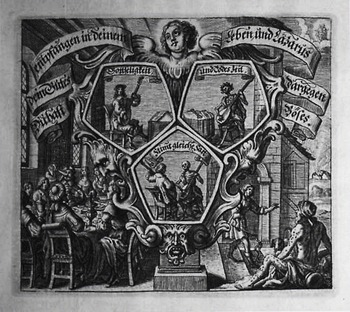
The deaths of the two main figures in the story figure prominently in some exegetical writings. An emblem by Johann Michael Dilherr and Georg Philipp Harsdörffer combines several ideas into a single visual complex including the reminder that death comes at any time (see Figure 2).Footnote 29 It contains a tripartite image, superimposed on a depiction of the Rich Man and Lazarus story. The Rich Man feasts with men and women at a large table while Lazarus, covered in sores and licked by a dog, is threatened by a servant with a large whip. In the background are a figure tormented in hell and two figures on a cloud in heaven representing the fates of the two men after death. The emblem proper contains three panels with the headings ‘Gottseeligkeit’ (Blessedness), ‘und Todes Zeit’ (and the moment of death) and ‘Stimmt gleiche Sait’ (Sound the same string). The images show a young man crowned with thorns and a skeleton crowned with laurels, each playing a lute (theorbo). In the third image they are shown playing together. The explanation points out that the crown of thorns reminds the youth to be aware of the difficult situation that awaits us in death. Death, on the other hand, is crowned with laurels, showing that death brings joy and glory. The two sit together as a reminder that life and death belong together. A good life will be rewarded with a good death while a wicked life will end with eternal death. A subscriptio confirms that the antithesis between a good and a wicked life revolves around piety:Footnote 30

For Dilherr and Harsdörffer, the Rich Man and Lazarus parable offered an opportunity to contemplate the transience of life through the oft-used metaphor of music, and even more specifically the lute. The lute draws attention to the vanitas theme underlying the parable, a theme that will be explored in greater detail below.Footnote 31 Here, the vanitas theme is merely evoked, but not explored as the primary moral foundation of the story.
Johann Michael Dilherr and Georg Philipp Harsdörffer, Drei-ständige Sonn= und Festtag=Emblemata, oder Sinne=bilder (Nuremberg, 1669), p. 161. Wolfenbüttel, Herzog August Bibliothek, TB 158 (1)

MUSICAL INTERPRETATIONS
None of the surviving compositions from the mid-seventeenth to early eighteenth century emphasises mercy, faith or the sin of godlessness, as most sermons do. Instead, Lutheran settings impose virtues and pious activities derived not from Luther's explication of the parable and socialising plays, but from contemporary private devotional practice, specifically preparation for death.
Composers of the first half of the century tended to treat the biblical text with respect, avoiding tropes and additions in favour of a relatively simple pictorial setting of the Gospel's first-person dialogue. Such is true of settings of ‘Vater Abraham’ by Melchior Vulpius, Heinrich Schütz, Johann Rudolph Ahle and Andreas Hammerschmidt.Footnote 32 All these compositions omit the words of the Evangelist and present only the dialogue between Dives in hell and Abraham. With the exception of Schütz's work, all these compositions suit their means of transmission: their relatively small performing forces and brevity made them appropriate for small printed volumes. Since these works were probably intended for liturgical performance, the lack of exegesis would not pose a significant problem: combined with the sermon, the musical depiction of the Gospel's culminating moment after death would serve as an auditory reminder, but not stand on its own in the service. The many extant copies of these volumes attest to their widespread acceptance in central German churches. Other settings with relatively limited texts include Thomas Selle's ‘Es war aber ein reicher Mann’ and Wolfgang Carl Briegel's ‘Vater Abraham’.Footnote 33
Beginning with Andreas Fromm's Actus Musicus de Divite et Lazaro of 1649, a number of lengthy, dramatised accounts of the story appear which employ textual and musical tropes to a relatively high degree. Probably written with very specific performances in mind for a particular location, these compositions survive, with only a few exceptions, in manuscript form.
By the last decades of the seventeenth century, composers of cantata cycles for the liturgical year avoid setting the Gospel text itself in favour of texts with greater poetic variety and freedom. Briegel's setting for the First Sunday after Trinity from his 1680 Musicalische Lebenbrunn, for example, forgoes the dramatic elements of the Rich Man and Lazarus story in favour of poetic reflections on the Gospel's central lesson. By the turn of the eighteenth century, direct references to either the Rich Man or Lazarus in cantata settings are rare.
The call for penitence
Among the simplest settings of the Rich Man and Lazarus story is Wolfgang Carl Briegel's four-voice motet-style composition from the third volume of his Evangelischer Blumengarte n (Gotha, 1667). The first-person sections of the biblical text (Luke 16: 24–5) are followed by a strophic aria, asserting that the sinning Rich Man will go to hell and asking Jesus for help to avoid sin and contemplate eternity:
Typical of Gospel settings in this collection, Briegel imposes a personal, moral element on the story. He extracts the dramatic or theatrical sections of the Gospel, much as his older contemporaries might have done, but adds a first-person prayer to conclude, drawing the penitent listener into direct engagement with the story.
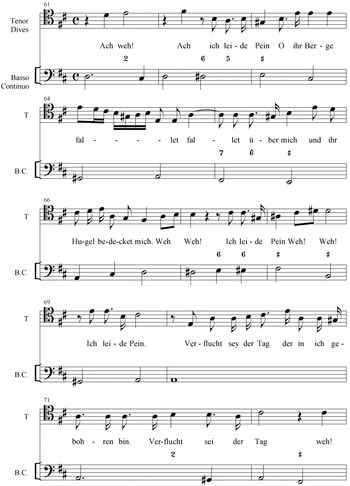
A contemporaneous setting by the North German Kapellmeister Augustin Pfleger (c. 1635–c. 1690) also calls for penitence after presenting the Rich Man's suffering in Hell (see Example 1). Pfleger adds scriptural passages to depict the Rich Man's cries:
Augustin Pfleger, ‘O Todt wie bitter’, bb. 61–72. Uppsala, Universitetsbiblioteket Vmhs 73:15

Pfleger also takes up the theme of death that lies at the heart of the Gospel. The apostrophising opening arioso-like segment seems to suggest that the torments of the Rich Man are a result of his carefree life: ‘O death, how bitter you are, when one who has fine things and abundance, and lives without care thinks of you …’. (‘O todt wie bitter bist du wenn an dich gedencket ein Mensch der gute dinge und gnug hatt und ohne sorge lebt …’). No further mention is made about the Rich Man's life of luxury and his possible sins.
Concluding the work are four stanzas sung by the two canti who throughout the work have offered commentary on the Gospel:
Here, the final stanza is directed at the listening congregation, advising it to ready itself for eternity through penitence. The Rich Man's sins, apart from lack of penitence, figure in neither Briegel's nor Pfleger's setting. Both end with a contemplation on eternity and eternal judgement and not socialising behaviour.
Memento mori and concomitant motifs: vanitas, ubi sunt and contemptus mundi
While some preachers recognised that the Rich Man's wealth was not the primary reason for his eternal punishment, most do warn against putting excessive faith in the pleasures of the physical world. If we consider the audience for printed sermons – literate, at least moderately wealthy – preaching against wealth in and of itself would hardly have been well received. Not surprisingly, most theologians tiptoe about the issue of wealth, calling on biblical figures to justify it, yet cautiously warning against excessive reliance on wealth and living beyond one's proper station. Several musical treatments are decidedly less cautious in their condemnations of wealth. The calls of theologians not to be seduced by wealth and finery and the latent vanitas message of Harsdörffer's emblem are realised explicitly in a number of musical settings. The Rich Man and Lazarus parable becomes a backdrop for memento mori and vanitas-themed treatments.
Kaspar Förster's Latin setting of the story is an entirely pessimistic piece that reminds the listener of the transience of life.Footnote 34 Förster (1616–73) studied with Marco Scacchi in Warsaw and later in Rome with Carissimi and his musical style reflects these Italian influences. Despite the Italianate musical treatment, the moral content of the setting would have been very attractive to German Protestants; Förster served as Kapellmeister to Danzig's Protestant Marienkirche from 1655 to 1657. His setting combines excerpts from the story from the Vulgate with newly written Latin texts and the popular phrase from Ecclesiastes 1: 2, ‘Vanitas vanitatum et omnia vanitas’ (‘vanity of vanities, all is vanity’). Förster begins in medias res with the death of the two characters. Unlike Heinrich Schütz, Andreas Hammerschmidt and Johann Rudolph Ahle, all of whom begin with the cry of the Rich Man from hell (‘Father Abraham’), omitting all narration, Förster introduces the scene with a new Latin text paraphrasing the first four verses of the story.Footnote 35
Lazarus plays absolutely no role in the work and the Rich Man's sins are not explored, in keeping with the biblical text itself. Förster imposes a moral interpretation on the work only in the opening and concluding tutti, in which all three singers admonish the listener: ‘O mortals, in what way are transitory and inane things helpful? Worry will benefit nothing at all. All these things pass away like shadows. Vanity of vanities, all is vanity.’Footnote 36 There is no redeeming call to Jesus for forgiveness, nor is the parable used as a vehicle for social critique. Förster exposes the emptiness of earthly existence, but offers no glimpse at redemption or optimism of eternal life.
Like Förster, Briegel frames another of his settings of the parable with the repeated ‘Vanitas vanitatum’ refrain, but also imposes another memento mori device borrowed from medieval literature: ubi sunt.Footnote 37 The refrain ‘ubi sunt’, literally ‘where are’, explores the transience of life through a series of questions, usually recalling people or things of the past. The rhetorical strength of the conceit lies in the obvious answer – they are all gone. The conceit is a familiar one in poetic memento mor i, appearing in the works of Christian Hofmann von Hofmannswaldau and Martin Moller, among others.Footnote 38 In his setting for the first Sunday after Trinity from his Musicalischer Lebensbrunn (Darmstadt, 1680),Footnote 39 Briegel borrows verses from a hymn attributed to Johann Matthäus Meyfart (1590–1642), which appears in hymn books well into the eighteenth century.Footnote 40 The verses ask not ‘where are’ but ‘what are’ in a line of questioning that exposes the emptiness of worldly glamour:
Meyfart's rhetorical questions echo those in Christian Hofmann von Hofmannswaldau's well-known contemplation of the world's vanity, ‘Die Welt’ (c. 1647–8):
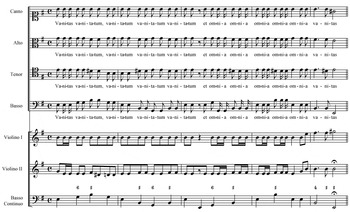
Briegel's setting in the Musicalischer Lebensbrunn is not a theatrical, first-person setting of the parable as was common among his contemporaries. He focuses entirely on the moral lesson. The only reference to the pericopic text comes in the final verses which mention the ‘rich man’. The congregation would certainly have been familiar enough with the Gospel text not to need a full presentation of the story. The strophes cited above, sung by solo voices, alternate with the entire ensemble (CATB), which musically hammers home the phrase ‘vanitas vanitatum et omnia vanitas’ (‘vanity of vanities, all is vanity’) (see Example 2). The setting, homophonic, rhythmically persistent, harmonically stable and lacking any melodic interest whatsoever, eschews even the vanities of music – pleasurable melodies and harmonies, subtle phrasing, intelligent counterpoint, colourful instrumentation – in favour of a stark, almost agitated, motto-like treatment.
Wolfgang Carl Briegel, ‘Vanitas vanitatum’, Musicalischer Lebensbrunn (Darmstadt, 1680), bb. 1–5

Briegel commonly concludes his Gospel settings with a tutti statement of a chorale or a new strophic aria in which a decisive moral statement is made. Here, Meyfart has provided one in the last few strophes of his hymn text with an Abschied:
Briegel's setting is hardly socially conforming and shares little with the sermons that preach the benign nature of wealth. Instead, he condemns wealth for its own sake, expressing a weariness of the physical world and all its trappings of beauty. Curiously, he does not set the final two strophes of Meyfart's text, which form a sort of concluding prayer:
The result is that Briegel's composition remains almost entirely pessimistic and focused on the theme of vanitas in general and contemptus mundi in specific, without the redeeming power of faith in Christ.
Lazarus as a model pious Lutheran – model Sterbekunst
An anonymous setting of the parable from the Dresden State and University Library strikes a tenuous balance between the pessimistic vanitas theme and the positive model of Lazarus as the suffering yet pious Christian.Footnote 41 Right from the outset, the anonymous composer juxtaposes the Rich Man and Lazarus with emphasis on their contrasting attitudes towards life and death. The Rich Man (Bassus) introduces himself with a text derived perhaps from Luke 12: 19 or Wisdom 2:
Lazarus (Tenor II), by contrast, looks forward to death and eternity with the first verse of Christoph Knoll's ‘Herzlich tut mich verlangen’ (1599):
After death, the two characters are further contrasted, with the role of Abraham sung by another bass and the Evangelist sung by another tenor. The Rich Man suffers in hell with words taken directly from the Gospel pericope (Luke 16: 24–31). Lazarus's ascension to heaven is celebrated by two canti, perhaps representing angels, who sing from the apocryphal book of Wisdom: ‘Die gerechten Seelen sind in Gottes Hand und keine Qual rühret sie an’ (‘The souls of the righteous are in the hand of God, and no torment will ever touch them’; Wis. 3: 1).Footnote 42 Lazarus himself, who is silent in the Gospel, also celebrates his expected redemption with the seventh verse from Philipp Nicolai's ‘Wie schön leuchtet der Morgenstern’ (1597):
The Rich Man has spent his days enjoying the pleasures of his earthly life, apparently without consideration for the inevitable end. Lazarus, by contrast, waits for death with expectancy and preparation. Through two popular chorales, Lazarus is established as a model Lutheran, ready for death and placing his faith in Christ the redeemer. The generally positive eschatological tone of the work changes, however, in the final section with a line of questioning that is reminiscent of the ubi sunt:
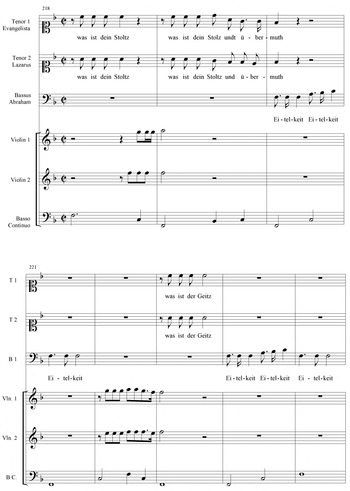
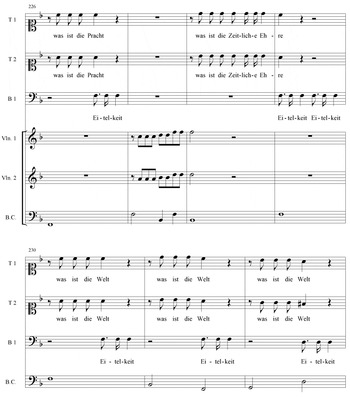
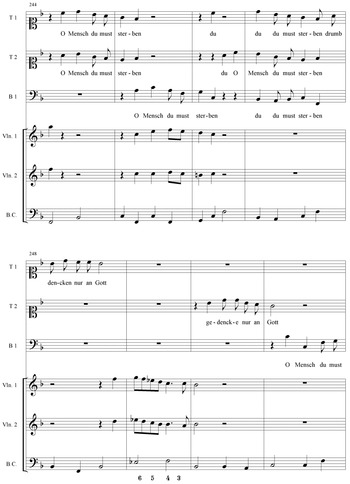
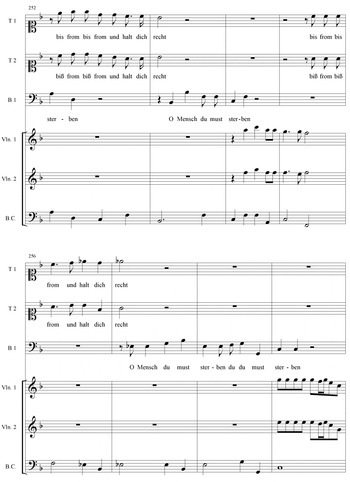
Although the anonymous composer attempts to strike a balance between the optimism of Lazarus's redemption and the pessimism of the vanitas theme, there is no doubt about which prevails at the end of the work. While the two tenors (labelled ‘Evangelista’ and ‘Lazarus’) sing the five rhetorical questions ‘Was ist …’, the first bass (labelled ‘Abraham’) steadfastly answers with the word ‘Eitelkeit’ (Vanity), a total of sixteen times in succession (see Example 3).Footnote 43 Likewise, as the tenors sing the concluding moral, the bass sings ‘O Mensch du musst sterben’ twelve times. The final admonishment to remain pious and upright is underscored by the insistent repetition ‘you must die’ (see Example 4). With its emphasis on the possibility of redemption alongside blatant reminders of the inevitability of death, the anonymous setting offers not just a memento mori, but models the actions and attitudes of the Lutheran Sterbekunst (Art of Dying).
Anonymous, Es war ein reicher Mann, bb. 218–25. Dresden, Sächsische Landes- und Universitätsbibliothek MS 2-E-516


Anonymous, Es war ein reicher Mann, bb. 244–51


STERBEKUNST
The Lutheran Sterbekunst, or art of dying, was very much a lifelong practice devoted to preparing the soul for the final and crucial moment before eternal judgement. Much more than memento mori, the mere reminder of and reflection on the transience of life, the Lutheran ars moriendi required active participation and preparation throughout one's lifetime. Death could come at any time; thorough preparation of the soul throughout life was necessary, lest one be caught unprepared and thus barred from heaven. In fact, a sudden, unexpected death was least desirable. Much more favourable was the death in which the dying, in full control of his or her mental faculties, could assert his or her faith right to the end. This was both a comfort to the dying and to the surviving circle of family and friends, who could be consoled with the knowledge that the departed enjoyed eternal peace with Christ.
The Lutheran understanding of death and salvation revolves around the theology of justification by faith. Luther rejected the idea of free will as a determinant for salvation – good works, Masses, indulgences and the like would not assure salvation. Instead, only true faith in Christ's sacrifice on the cross could bring eternal peace in heaven. Since salvation came not through good works or the intercession of the saints or the living after death, it was incumbent upon the living to ensure the preparedness of their souls through faith in Christ.
Preparation for death began early with the memorisation of scriptural passages, prayers and song verses that offered assurance of salvation through faith. As the moment drew nearer, more specific preparations might be made, including details of the obsequies such as the selection of biblical passages for the funeral sermon, the ordering of a sarcophagus, and for women, the preparation of a burial dress. Such was the case of Ursula of Promnitz, who many years before her death had been given a particularly fine piece of linen which she marked with a cross and at the appropriate time called for it to be cut into her Sterbekittel.Footnote 44 Hymns were selected to be sung at the interment, or new compositions commissioned. We need only think of two cases involving Heinrich Schütz to be reminded of the importance music played in the preparation of funerary rites by the living: the Musicalische Exequien (1636, SWV 279–81) requested by the widow of Heinrich Posthumus Reuss according to the deceased's detailed instructions, and Schütz's own request in 1670 for a motet on Psalm 119 – the scriptural passage he had chosen for his funeral sermon – from his former student Christoph Bernhard, which was performed at his funeral in Dresden in 1672. In at least one case, a full dress rehearsal of the procession and ceremonies was conducted.Footnote 45 Such external preparations were not the primary objective of the Sterbekunst, but merely the outward evidence of the soul's readiness to depart the physical world.
It was, of course, not always possible to be certain that the mind would be in complete control in the body's final moments. In this case it was especially important that hymns, prayers and biblical passages be easily and quickly recalled from memory lest, in the throes of death, the mind wandered and became distracted by fearful images.Footnote 46 The devil lay in wait for a moment of weakness to frighten the dying with images of graves, bodies and decay in order that the dying might, out of horror, turn from God at the last moment. Such was the fear of the preacher Caspar Hanis who, while attending the mortally wounded Caspar von Minckwitz in May 1592, refused at first the dying man's request for a piece of paper out of fear that he might write something inappropriate out of weakness. Instead, the wounded man astonished everyone gathered around him as he wrote the phrase ‘Ich weiß das mein Erlöser lebet’ (I know that my saviour lives), a phrase he had often cited in life.Footnote 47 Luther and other early Reformation writers on the Sterbekunst direct Christians to dwell not on death, sins and hell, but instead on Christ, whose own death made possible the salvation of all Christians.Footnote 48 Through faith alone, salvation is assured. Thus, by the late sixteenth and early seventeenth centuries, Sterbebücher include examples of prayers, hymns and scriptural passages in which the dying may find comfort. On the whole, these passages and verses assert faith in Christ and readiness for death; by reciting them on their deathbeds, or assenting to them being read aloud, Christians reaffirmed their faith and thereby their salvation.
Reports of the final hours of particularly pious Lutherans were collected and published in Sterbebücher and authors of Leichenpredigten took care to demonstrate that the dearly departed ‘fell asleep’ with the correct deportment. Typically, the grievously ill would call their pastor to their side to hear a prayer, confess sins and perhaps take communion. Close family members would be invited into the sickroom for final farewells. The creed might be said and several pious prayers recited and appropriate hymns sung. When the dying became too weak to speak, those present, particularly the pastor, would ask questions confirming the faith to ensure that the deceased's final words were ones of assurance and faith.
Johann Conrad Dannhauer, the Strasburg theologian and defender of music against Calvinist calls for its banishment from churches, points to the consolatory function of Lutheran hymns for the dying:
How many … thousand people have received such strong consolation, in their affliction and distress, particularly when it is recommended at the time of death to their last breaths, from such graceful, merciful song that they were thereby strengthened and departed with peace and joy out of this temporal and into the eternal life. And the spirit could also be perceived in the sweet love-tears. divini amoris rara hora, parva mora. Bernh. Serm. 23 in Cant. (the rare hour of divine love, short delay; Bernhard of Clairvaux, 23rd Sermon on the Song of Songs).Footnote 49
The singing of hymns in the sickroom was advised by many writers of Sterbebücher and a number of Leichenpredigten attest to the importance of music in the final hours. Johannes Olearius (1611–84) instructs those caring for the deathly ill that they should offer comfort through prayer, conversing about the assurance of God's love and ‘mit andächtigen Singen der schönen herzerquickenden Trostlieder’ (with prayerful singing of lovely heart-refreshing consolatory songs).Footnote 50 In his Geistliche Sing-Schule of 1672, Olearius gives the texts for no fewer than 150 songs appropriate for the sick and dying. Most hymn books of the mid- to late seventeenth century include, as Olearius does, a section of Sterbelieder. In one of the most popular books on the art of dying, Martin Moller lists fifteen common hymns as appropriate and particularly comforting for the dying. He writes:
One has the feeling that much sadness and melancholy can be sung away by lovely songs when sung with devotion; on the other hand much consolation can also be sung that makes the heart happy and in good humour; think thereby about the heavenly angels' music which we will assist there and together praise God in eternal joy. One should think of the patient and sing to him what he would like.Footnote 51
Evidence of singing in the sickroom is plentiful in the funeral literature. Leichenpredigten and collections of deathbed accounts in Sterbebücher point to singing as a meaningful, consolatory act and assertion of faith. King Frederick II of Denmark, for example, fell ill shortly before Easter 1585. Wishing to celebrate Easter services, the King made plans to have the service in his room. On Holy Wednesday he took communion, had the Gospel read to him and asked his family to visit with him. On Holy Thursday he heard the service and sang ‘with a rather strong voice’ the last verses of the Our Father and a Psalm. His health took a turn for the worse, however, and later that afternoon ‘took about three breaths and then softly went to sleep in the Lord’.Footnote 52 Christian, Churfürst of Saxony, prayed and wept often on his deathbed, consoling himself with hymns such as ‘Wenn mein Stündlein vorhanden ist’ and ‘Allein zu dir Herr Jesu Christ’ and requested that all around him participate.Footnote 53 Likewise, the 18-year old Duchess Catherine, daughter of the Duke of Braunschsweig-Lüneburg and wife of Duke Heinrich the Younger, Burggraf of Meissen, sang the evening before her death ‘from her heart with strong, firm faith and from true inner spiritual joy’.Footnote 54 As Austra Reinis has pointed out vis-à-vis Reformation Sterbebücher, the primary emotion of the Lutheran Sterbekunst was joy and contentment since salvation could be assured through steadfast faith in Christ.Footnote 55
LAZARUS AS A MODEL FOR THE DYING
In several musical settings of the Rich Man and Lazarus, composers transform Lazarus into a model in preparedness for death. A composition of the Rich Man and Lazarus story by the Danzig organist Thomas Strutz (1621–78), or Strutius, provides such a musical model of the Sterbekunst. In his composition from the second half of the seventeenth century now, sadly, lost, Strutius illustrates Lazarus's piety and preparation for death through several popular and appropriate chorales and biblical verses.Footnote 56 Lazarus first introduces himself in three newly written verses. He then sings at least one verse each from the popular late sixteenth-century hymns ‘Warumb betrübst du dich mein Hertz’, ‘Was mein Gott will, das gescheh allezeit’, ‘Herzlich thut mich verlangen’, ‘Wie schön leutchet der Morgenstern’ and finally ‘Herzlich lieb hab ich dich O Herr’. Far from the silent, sickly beggar of the biblical source, Lazarus here is musical, pious and undoubtedly Lutheran. He has committed appropriate verses to memory and recalls them even as he dies. The hymns that Strutius chooses to depict Lazarus are, not surprisingly, among those recommended by authors of Sterbebücher for the dying, and also among those listed in hymn books as being appropriate for times of sickness and the approach of death.
Alternating with Lazarus is a chorus of the blessed (Chor der Gottseligen), a choir of angels and Jesus himself. Members of the chorus of the blessed remind Lazarus not to dwell on worldly concerns in his final hours: ‘If you concern yourself with things of the flesh, with favour, health and great wealth, you will soon grow cold.’ And later: ‘If the cross is also bitter and heavy, think about how hot Hell could be, into which the world runs.’Footnote 57 In the words of the chorale ‘Was mein Gott will, das g'scheh' allezeit’, Lazarus reminds himself that God is near him in his need:
And God is indeed at hand, for Jesus himself responds: ‘Ah you true servant, dear Lazarus, because by God's love you have been separated from misery, anxiety, nakedness, hunger, sorrow, death, life. Ah you true servant, dear Lazarus, enter into the joy of your Lord.’Footnote 58 With Christ close at hand in his final moments, Lazarus can be assured of salvation through his steadfast faith.
The second part of the composition describes the fate of the Rich Man who, contrariwise, does not sing any familiar chorale tunes, placing him firmly outside the circle of the faithful. Instead of welcoming death with peace and joy as Lazarus does, the Rich Man is fearful and admits his sins in galloping amphibrachs of new poetry:
Although Strutius's music does not survive, the large number of chorales employed in his setting and the metrical variety of the Rich Man's strophes gives us a good impression of the work's overall effect. Strutius juxtaposes the familiar and traditional sacred realm – through hymns – with the new and secular through dance-like metres and new poetry. Lazarus is familiar and the model to be followed, while the Rich Man remains foreign, different and outside the trusted world of the Lutheran faith.
Andreas Fromm's Actus Musicus de divite et Lazaro (Stettin, 1649), a large multi-sectional work with theatrical elements, also uses Lutheran chorales to depict Lazarus's proper preparation for death.Footnote 59 Fromm's engagement of the Sterbekunst goes beyond even preparation in life by employing consolatory techniques encountered in funeral music itself. He opens his work with a Symphonia and the first verses of the biblical pericope sung by a tenor soloist. Lazarus (Alto) enters with the first verse of Christoph Knoll's ‘Herzlich tut mich verlangen’ and then Luther's ‘Mit Fried und Freud ich fahr dahin’
In at least one performance, Lazarus sings this hymn from beneath the altar, accompanied by a viola da gamba.Footnote 60 He is instructed to move up to join the heavenly choir positioned above the congregation in a loft near but not at the organ, for the organ must also accompany the profane choir on the church floor below. The physical placement of the dead or dying Lazarus beneath the altar is a theatrical conceit borrowed from funeral performances. The placement of singers behind the coffin at funerals, projecting the imagined voice of the deceased, offered tangible solace to the bereaved.Footnote 61 Lazarus's singing of a hymn with gamba accompaniment in animated counterpoint is not just a means of ‘Personalizierung’ as Werner Braun describes it,Footnote 62 but places Lazarus within Lutheran funeral traditions, making him a familiar figure all the more able to model pious behaviour through his participation in common rituals.Footnote 63
That death is to be embraced and welcomed with joy is confirmed by Fromm in the concluding chorus, a jubilant choral setting of the penultimate verse of Nicolai's ‘Wie schön leuchtet der Morgenstern’. Lazarus (Alto) introduces the verse alone with a florid accompaniment by the viola da gamba. The six-voice chorus (CCATTB) repeats the last four lines of the verse with a pair of cornetti lending even greater celebratory pomposity to the section.
While Lutheran chorales serve to model pious activity in the pieces cited above, they serve quite a contrary function in the final and latest composition under examination. Petrus Laurentius Wockenfuss's (1675–1721) ‘Dom. 1. p. Trinitat: Actus Musicus de Divite & Lazaro’ survives in an undated manuscript housed in the Brussels Conservatoire.Footnote 64 The piece must have been composed before 1714 since the text was printed in Wockenfuss's Musicalische Fest-Andachten (Kiel, 1714). Although it was probably written in the early years of the eighteenth century, perhaps while Wockenfuss served as Kantor at the Nicolaikirche in Kiel, a position he held from 1708, it looks backward at Andreas Fromm's Actus Musicus from mid-century. Its theatrical textual form, with its combination of biblical, chorale and poetic texts, shares little in common with his contemporaries' reflective, lyrical works for the first Sunday after Trinity – most early eighteenth-century German settings for this Sunday forgo dramatising the story of the Rich Man and Lazarus altogether, opting instead for wholly lyrical works. In its musical forms, however, Wockenfuss does take note of new fashions in recitative and closed aria forms.
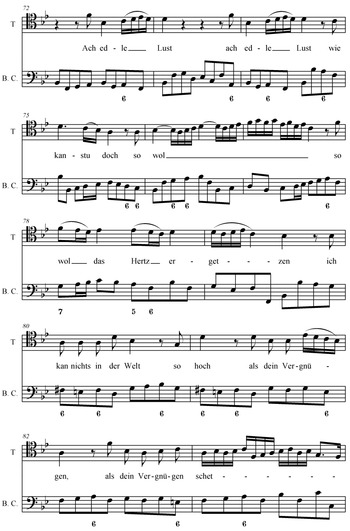
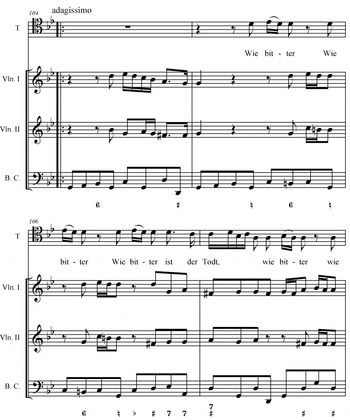
Wockenfuss presents the listener with a more developed picture of the Rich Man than any of the other compositions. We hear at the outset not only the hedonistic choir of the Rich Man and his table of feasting revellers – limited to Wis. 2: 6–9 – but also insight into his mental state before death. Immediately after the drunken choir, the Rich Man sings the praises of earthly pleasure in a short, light-hearted continuo lied. Surface musical pleasures such as rapidly descending hemisemiquaver flourishes and semiquaver turns prove the frivolity of the Rich Man's earthly delights (see Ex. 5). The light-hearted B flat major confection is interrupted by the Bass (God, perhaps), who warns the Rich Man in a verse from Luke 12: 20 of death's immanence in a striking shift to G minor (see Ex. 6). The Rich Man responds in the new key, admitting his fear of death but believing it yet to be far off:
In contrast to most theological explications of the story, the Rich Man here is not presented as a godless, unrepentant, unmerciful heathen. He is a hedonist, one of the sins frequently identified in the story from Luther onward, but he is also ill-prepared for death and admits his fear of the inevitable end.
Wockenfuss, ‘Actus Musicus de Divite et Lazaro’ bb. 72–83. B-Bc, shelf no. 1000

Wockenfuss, ‘Actus Musicus de Divite et Lazaro’, bb. 104–7

The Rich Man's errors find their antithesis in Lazarus's two-strophe aria. Responding to the Rich Man's indulgence in pleasure, Lazarus sings of the mercilessness he endures. Far from earthly amusement and cheer, Lazarus can barely reach the scraps intended for the dogs. In his second strophe, he contrasts the Rich Man's fear of death with his own willing anticipation. ‘Oh, if only I had a coffin / I would in good time / Prepare for my end’ (‘Ach hätt ich einen Sarg / so wolt ich mich bey Zeiten / zu meinen End bereiten’).
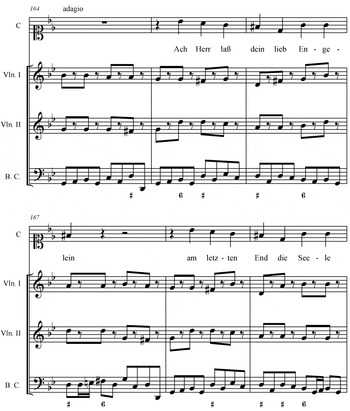
Lazarus's death brings the composition's first chorale, a verse from ‘Herzlich lieb hab ich dich O Herr’. Sung by a solo cantus with two violins, the verse confirms Lazarus's salvation through faith and willing expectancy of death. That the chorale itself is sung by a cantus and not the altus assigned as the role of Lazarus suggests, perhaps, that Lazarus's soul, freed of its physical body, now sings with the angels in a higher range analogous to their heavenly elevation. The notion of resurrection finds a musical analogy in Wockenfuss's setting, with the continuo line elevated up to the alto range at the mid-point of the verse (‘Als den von Todt erwecke mich’) (see Example 7):
Wockenfuss, ‘Actus Musicus de Divite et Lazaro’, bb. 164–9

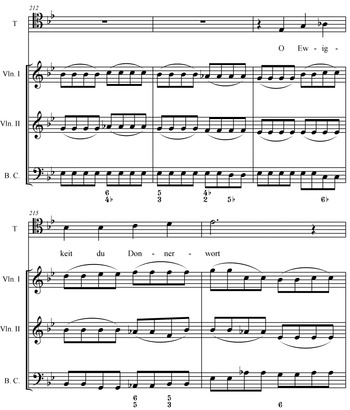
The delicate violin accompaniment lends the chorale a lightness of character that contrasts strikingly with the next chorale, Johann Crüger and Johann Rists's ‘O Ewigkeit du Donnerwort’, sung by the now deceased Rich Man (see Ex. 8). Only one verse appears in Wockenfuss's setting, appropriately, the first which expresses anxiety at the thought of eternity vis-à-vis death. That anxiety transfers to the violin accompaniment in nervous repeated notes beneath the otherwise calm, familiar melody. If Lazarus is painted as a positive model for his acceptance of death and appropriate mental preparation, the Rich Man is developed here into a more fully fleshed-out negative model. And that model is made all the more tangible through familiar chorales. This is not a foreign, heathen, or godless Rich Man, separated from the audience by great misdeeds or caricature. Rather, he is all too familiar. The Rich Man sings the same body of works that the congregation might also have known. He could be heard as a failed member of the community, offering a stern and altogether tangible warning to the congregation that it is not only the godless heathen and gluttonous epicure who will be punished, but even the ill-prepared Christian. As Lucas Osiander (1571–1638) and Dannhauer point out in their sermons, the brotherhood of the Rich Man is not limited to his five brothers, but is vast and includes all who put worldly wealth above all else.Footnote 65 All the streets and alleys are full of such people, according to Dannhauer.Footnote 66
Wockenfuss, ‘Actus Musicus de Divite et Lazaro’, bb. 212–16

The Rich Man admits his guilt in another hymn verse by Johann Franck and again with a melody by Johann Crüger (1649):
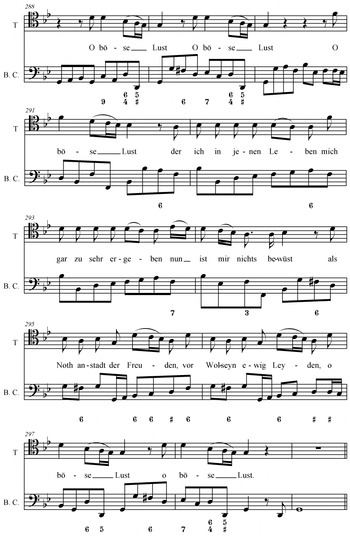
The admission of sin comes too late for the Rich Man. Without proper preparation of his soul in life, he can expect no mercy now in death. He curses the pleasures he had earlier lauded in a brief aria that mirrors some of his earlier melodic material (see Example 9):
Wockenfuss, ‘Actus Musicus de Divite et Lazaro’, bb. 288–99

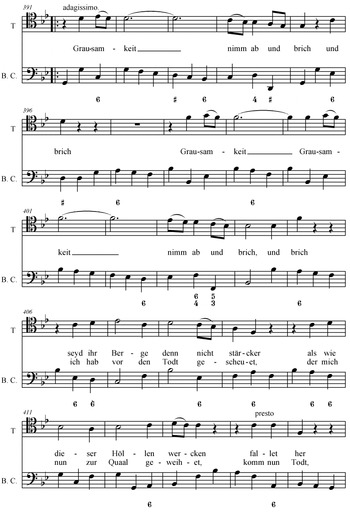
Wockenfuss includes the biblical dialogue between the Rich Man and Abraham, though Abraham sings in rhyming paraphrase while the Rich Man remains true to Luke's Gospel. Finally, the Rich Man sings a last aria asking that death take him away from his torments. It is a curious end, for he has already died. But it confirms what we have seen in musical exegesis of the story, for the Rich Man admits that he feared death but only now, too late, as learned he should have embraced it (see Example 10).
Wockenfuss, ‘Actus Musicus de Divite et Lazaro’, bb. 391–415

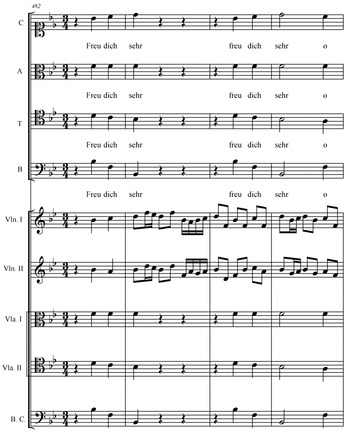
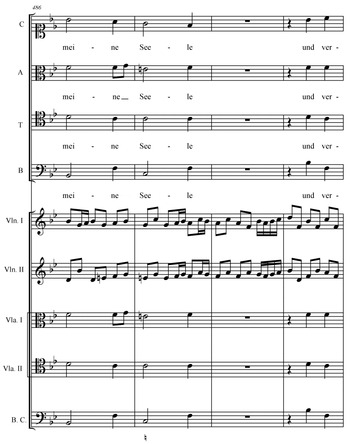
The work ends with Christoph Demantius's chorale ‘Freu dich sehr O meine Seele’ (1620) which calls on the Christian to embrace death when it comes. It is a jubilant four-voice setting with an animated four-part string accompaniment that captures the joyful view of death advanced by Luther and the Reformers (see Example 11).
Wockenfuss, ‘Actus Musicus de Divite et Lazaro’, bb. 482–85


Rather than contemporise the story of the Rich Man and Lazarus by embellishing it with couleur locale as so many writers and playwrights do, describing feasting and drinking, avarice and inappropriate dress in a modern context, composers do so through select chorales and familiar church hymns. The juxtaposition of scriptural text and chorales both lends compositions an immediate familiarity and imbues the chorales themselves with renewed authority. In the mouth of the beloved beggar, chorales are elevated to near-scriptural validity. If Luke failed to record Lazarus's words, chorales offered a sanctioned, poetic version of what he might have said. The silent Lazarus of the story is transformed into a pious Lutheran, the ideal model for the living and dying.
THE NEGATIVE MODEL: THE RICH MAN AND HIS CHOIR OF DRUNKEN BROTHERS
The greatest problem for composers seems to have arisen around negative depictions of the Rich Man. While stage productions from the sixteenth century and sermons throughout the seventeenth century seemed to spare no words in their depictions and descriptions of the sumptuous feast and funeral of Dives, musical compositions, particularly liturgical ones, run a dangerous course towards the inappropriately theatrical. It is perhaps not surprising that the problem of depicting the Rich Man and his brothers in liturgical music persisted through to the eighteenth century. The objection to a performance of Fromm's Actus in Schwarzenberg on 22 July 1672 says only that it was too much like a Jesuit commedia. Town leaders also signed a declaration against the piece and the performance of such secular scenes as drinking and dice playing in order to encourage people to turn to penitence and piety.Footnote 67 Johann Adolph Scheibe's objections to similar music, printed in 1745, could also echo concerns of an earlier period. Scheibe makes specific reference to the Rich Man as a potential pitfall for composers of sacred music:
We must also often set to music such Cantatas whose wicked and coarse disposition nearly compels us to indecorous debauchery. When, for example, a choir of the Rich Man's drunken brothers, a choir of devils, of whores, of blasphemers and the like is presented to us; when we should depict such characters who already in and of themselves contradict goodness but even more so the sanctity and gravity of the place. One should prevent such unwarranted audacity and choose, for the completion of sacred cantatas, only those poets who have reasonable strength in poetry, morality and more than a common understanding of theology, especially in regard to the music, attend thereby the prudent ideas of the composer. In this way church music can be arranged in a decent, sacred and edifying manner.Footnote 68
In all settings of the Rich Man and Lazarus story, the text that depicts the Rich Man or his chorus of drunken brothers is entirely based on verses from the apocryphal book of Wisdom or, in one case, Ecclesiastes. Briegel, in his 1680 setting from Evangelischer Gespräch, Fromm, Strutius and Wockenfuss all assign Wisdom 2: 6–9 ‘Wohl her und lasset uns wol leben weils da ist’ (‘Come, therefore, and let us enjoy the good things that exist’). The anonymous composer of the Dresden manuscript includes a similarly themed text, this time a first-person rendering of Ecclesiastes 9: 7: ‘Wohl an ich will wohl leben und gute tage haben. Ich gehe hin und esse mein Brodt mit freuden’ (‘Now then, I want to live well and enjoy fine days. I go my way and eat my bread with joy’). In none of the pieces is a wholly new text employed. It seems that seventeenth-century composers shared Scheibe's concerns about the inclusion of drunken choirs in sacred music. By quoting Scripture, composers perhaps found an acceptable means of depicting earthly hedonism without resorting to potentially inappropriate secular texts and their overly vivid musical settings.
Wockenfuss perhaps pushes the bounds of liturgical decency. In addition to quoting Scripture, he invents an aria where Scripture lacks first-person speech. Interpolated in the story of the Rich Man and Lazarus is Luke's parable of another rich man who denies death's presence (Luke 12: 16–21). The Rich Man's aria ‘Ach edle Lust’ prompts God's admonition from Luke 12: 20: ‘Du Narr, diese Nacht wird man deine Seele von dir fordern’ (‘Fool! This night your soul will be required of you’), which in turn inspires the Rich Man's fear of death in a second new aria. The Rich Man's arias are fickle and superficially delightful, befitting their texts. But instead of depicting worldly sin and debauchery alone, as Scheibe fears, Wockenfuss depicts frivolity as the absence of true consideration of death, in keeping with earlier musical settings.
CONCLUSION
Seventeenth-century Lutheran composers constructed a specifically musical reading of the story on many levels from the symbolic association of music with transience and vanity, to the direct model of singing as pious behaviour. Moreover, they negotiate a path between the written word and its exegetical traditions on the one hand and the very contemporary Lutheran concern for encouraging pious activity on the other.
The tension between external and internal actions, between a communal and private relationship with God, seems to be very much on display in settings of the Rich Man and Lazarus story and bound up with contemporary concerns over the nature of Christian behaviour in general. Pieces from around mid-century, such as those by Ahle, Hammerschmidt and Schütz, present the story as a theatrical setting in its simplest form. Nothing is added to Scripture and in the interests of theatrical veracity even the role of the Evangelist is removed in order to present the story mimetically, with only those speaking roles in Scripture presented musically. Theirs are objective settings, meant to bring a vivid picture of Scripture to the congregation of passive listeners. Presented in a liturgical context, the works might be explicated by a sermon, but they remain at arm's length and are experienced alike by the community.
By mid-century and later, however, tropes to the story bring a more apparent and directly personal moral message. The character of Lazarus, more fully fleshed out, is no longer a silent figure, but a model built directly on contemporary experience. The characters are brought much closer to contemporary reality, blurring the lines between performer and audience. Moreover, the lesson imparted by the settings seems to use this blurring of theatrical roles to implicate the congregants in the work and force a reading that demands immediate, personal, pious – not merely charitable – behaviour. In this way, troped settings of the story enact what many contemporary theologians hoped to foster through devotional reform – a personal, engagement with Scripture and more pious behaviour in general. Composers certainly played a role in both formal devotional reform vis-à-vis newly written hymns, and also in informally supporting pious activity and the so-called neue Frömmigkeit through the positive, and negative, role models in their works. The Rich Man and Lazarus story seems to have attracted especial attention, perhaps for its easy comparisons with contemporary life, but also for its underlying moral message, one central to Lutheran soteriology, for these musical settings instruct not only how to live, but how to die.