Introduction
Global cancer statistics report approximately 19.3 million new cancer cases and an estimated 10.0 million cancer deaths in 2020 (Sung et al., Reference Sung, Ferlay and Siegel2021). Despite advancement in cancer diagnosis and therapy, most of the patients are still definitely diagnosed at advanced stage (Zhang and Yang, Reference Zhang and Yang2020; Zhu et al., Reference Zhu, Ai and Zhang2021). Advanced cancer is characterized by the poor prognosis and incurability (Luo et al., Reference Luo, Rong and Huang2019), and its incidence and mortality are annually increasing (Wu et al., Reference Wu, Zhang and Wang2020). Studies have shown patients with advanced cancer face huge psychological burden, which affects their quality of life (QOL) (Breitbart et al., Reference Breitbart, Pessin and Rosenfeld2018; Teo et al., Reference Teo, Krishnan and Lee2019; de Mol et al., Reference de Mol, Visser and Aerts2020). Therefore, it is necessary to pay close attention to the psychological status of advanced cancer patients.
Psychotherapy has been increasingly applied to improve the psychological status of cancer patients at advanced stage (Breitbart et al., Reference Breitbart, Pessin and Rosenfeld2018; Rosenfeld et al., Reference Rosenfeld, Cham and Pessin2018; Teo et al., Reference Teo, Krishnan and Lee2019). For advanced cancer patients, psychotherapy is effective to decrease depression, increase existential happiness, and improve QOL (Okuyama et al., Reference Okuyama, Akechi and Mackenzie2017; Teo et al., Reference Teo, Krishnan and Lee2019). However, the relationship between psychotherapy and survival is highly debated (Coyne et al., Reference Coyne, Stefanek and Palmer2007; Kissane, Reference Kissane2007, Reference Kissane2009). Huang et al. found that advanced lung cancer patients receiving psychological intervention presented a higher survival rate than the control group (Huang et al., Reference Huang, Yan and Liu2019). Hou et al. found that advanced cervical cancer patients benefited from the psychotherapy in terms of 2-year survival (Hou et al., Reference Hou, Zhang and Nie2021). However, some studies showed that psychotherapy was not clinically effective on the survival of patients with malignant or advanced cancers (Boesen et al., Reference Boesen, Boesen and Frederiksen2007; Kissane et al., Reference Kissane, Grabsch and Clarke2007). An existing meta-analysis has reported the effect of psychotherapy on the depression, anxiety, distress, and QOL of advanced cancer patients (Okuyama et al., Reference Okuyama, Akechi and Mackenzie2017), while this meta-analysis fails to consider the effect of psychotherapy on survival.
Herein, we performed a meta-analysis based on the currently available studies to comprehensively explore the effect of psychotherapy on the QOL and survival days among advanced cancer patients, which provided evidence for the application of psychotherapy in the clinic.
Methods
This meta-analysis followed the Preferred Reporting Items for Systematic Reviews and Meta-Analyses (PRISMA) guideline (Moher et al., Reference Moher, Liberati and Tetzlaff2009).
Literature search strategy
The literatures were available from Pubmed, Embase, Cochrane Library, and Web of Science, and the deadline for searching literatures was February 20, 2021. Two independent researchers (Y.Q.W. and J.J.P.) searched the literatures, and search strategies included: “Psychotherapy” OR “Psychotherapies” OR “Psychosocial intervention” OR “Intervention, psychosocial” OR “Interventions, psychosocial” OR “Psychosocial interventions” OR “Psychological intervention” OR “Intervention, psychological” OR “Interventions, psychological” OR “Psychological interventions” OR “Spiritual therapies” OR “Therapies, spiritual” OR “Exorcism” OR “Exorcisms” OR “Spiritual healing” OR “Healing, spiritual” OR “Healings, spiritual” OR “Spiritual healings” OR “Psychotherapy, group” OR “Group psychotherapy” OR “Therapy, group” OR “Group therapy” OR “Supportive-expressive group” AND “Neoplasms” OR “Neoplasia” OR “Neoplasias” OR “Neoplasm” OR “Tumors” OR “Tumor” OR “Cancer” OR “Cancers” OR “Malignancy” OR “Malignancies” OR “Malignant neoplasms” OR “Malignant neoplasm” OR “Neoplasm, malignant” OR “Neoplasms, malignant.”
Inclusion and exclusion criteria
Inclusion criteria: (1) patients with advanced cancer; (2) the intervention group receiving psychotherapy, while the control group receiving usual care, massage, or supportive psychotherapy; (3) randomized controlled trials (RCTs) and quasi-experimental studies; and (4) studies published in English.
Advanced cancer was defined that the study used the term “advanced cancer” or reported the patients with metastatic cancer or at III and IV stages.
The psychotherapy included group psychosocial support, cognitive-behavioral therapy, individual meaning-centered psychotherapy, positive affect skill intervention, dignity therapy, forgiveness therapy, mindfulness intervention, and focused narrative intervention.
Exclusion criteria: (1) animal experiments or in vitro experiments; (2) duplicated studies and studies not related to our research topic; (3) studies without full text (or only abstract available) or data not available; and (4) conference reports, case reports, meta-analyses, reviews, editorial materials, letters, protocols, errata, and notes.
Data extraction
The research data were independently screened by two researchers (Y.Q.W. and J.J.P.) in accordance with inclusion and exclusion criteria, and the third researcher (Y.L.) would participate in the data extraction when the conflict existed. The extracted data included the name of the first author, year of publication, country, study design, group, intervention type, intervention/control properties, number of participants in each group, sex, age, cancer type, and outcomes.
Outcome measurements
The primary outcomes were identified a priori as of interest, and the secondary outcomes were identified in the course of screening studies.
Primary outcomes
1. QOL, as measured using McGill Quality of Life Questionnaire (MQOL) (Cohen et al., Reference Cohen, Mount and Strobel1995), Functional Assessment of Cancer Therapy (FACT-G) (Cella et al., Reference Cella, Tulsky and Gray1993), European Organization for Research and Treatment of Cancer Quality of Life-C15-Palliative (EORTC-QLQ-C15-Pal) (Groenvold et al., Reference Groenvold, Petersen and Aaronson2006), EuroQol 5 Dimensions (EQ-5D) (“EuroQol Group”, 1990), and European Organization for Research and Treatment of Cancer Quality of Life Questionnaire-Core 30 (EORTC QLQ-C30) (Aaronson et al., Reference Aaronson, Ahmedzai and Bergman1993).
2. Survival time.
Secondary outcomes
1. Mood, as measured using Hamilton Anxiety Rating Scale (HAM-A) (Hamilton, Reference Hamilton1959), Hospital Anxiety and Depression Scale (HADS) (Zigmond and Snaith, Reference Zigmond and Snaith1983), Beck Depression Inventory-II (BDI-II) (Beck et al., Reference Beck, Ward and Mendelson1961), Center for Epidemiologic Studies Depression Scale (CES-D) (Radloff, Reference Radloff1977), Patient Health Questionnaire 9 (PHQ-9) (Kroenke et al., Reference Kroenke, Spitzer and Williams2001), Functional Assessment of Chronic Illness Therapy-Spiritual Well-Being Scale (FACIT-Sp) (Peterman et al., Reference Peterman, Fitchett and Brady2002), Herth Hope Index (HHI) (Herth, Reference Herth1992), Beck Hopelessness Scale (BHS) (Beck et al., Reference Beck, Weissman and Lester1974), Brief COPE (Carver, Reference Carver1997), and Profile of Mood States (POMS) (Mcnair et al., Reference Mcnair, Lorr and Droppleman1971).
2. Symptom, as measured using Visual Analogue Scale (VAS) (Gift, Reference Gift1989) and Brief Pain Inventory (BPI) (Cleeland and Ryan, Reference Cleeland and Ryan1994).
Methodological quality appraisal
The quality of researches relating RCTs was evaluated using the modified Jadad scale, which increased allocation concealment based on the Jadad scale (Jadad et al., Reference Jadad, Moore and Carroll1996; Chen et al., Reference Chen, Lu and Xu2020). This scale had a total score of 7, with a score of 1–3 for low quality and 4–7 for high quality. For the quality evaluation of researches relating quasi-experimental studies, Methodologic Index for Nonrandomized Studies (MINORS) scale was adopted (Slim et al., Reference Slim, Nini and Forestier2003). This scale was divided into 24 points, and 1–12 was considered as low quality, and 13–24 was considered as high quality.
Statistical analysis
Statistical analysis was performed using the software Stata 15.1 (Stata Corporation, College Station, TX, USA). The power of the analyses was assessed using G*Power 3.1 software (Universität Düsseldorf, Düsseldorf, Germany). The data measurement was calculated using relative risk (RR) or weighted mean difference (WMD) with 95% confidence interval (CI). Every indicator was evaluated by heterogeneity test, and measured by statistics of I-squared (I 2). The random effects model was applied with I 2 ≥ 50%, and the fixed effects model was used with I 2 < 50%. The sensitivity analysis was performed for all results, and publication bias was checked by Egger's test. P < 0.05 was considered statistical significance.
Results
Literature search and study selection
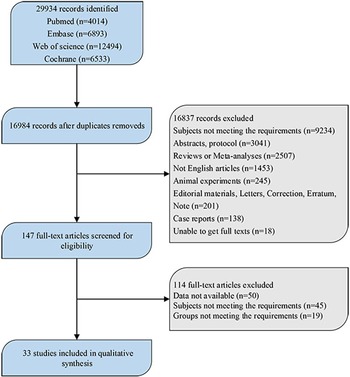
After the search procedure in database, a total of 29,934 studies were searched. After duplicates removal, 16,984 records retained. Among which, 16,837 records that subjects did not meet the requirements (n = 9,234), published as abstracts or protocol (n = 3,041), reviews or meta-analyses (n = 2,507), and not English articles (n = 1,453), included animal experiments (n = 245), were editorial materials, letters, correction, erratum, note (n = 201), case reports (n = 138), or unable to get full texts (n = 18) were excluded to obtain 147 eligible articles. After further exclusion, 33 studies were finally included, with 30 RCTs and 3 quasi-experimental studies (Supplementary File 1). In finally included studies, 17 were assessed as high-quality articles, and 16 were assessed as low-quality articles. The retrieval flowchart is seen in Figure 1. Of the total 4,329 advanced patients, 2,159 were in the psychotherapy group and 2,170 were in the control group. The baseline characteristics are shown in Supplementary Table S1.
Flowchart of the retrieval process.

Effect of psychotherapy on QOL and survival time
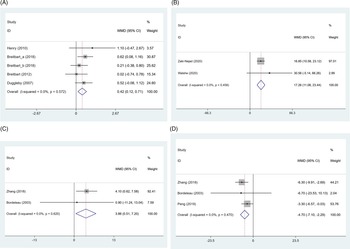
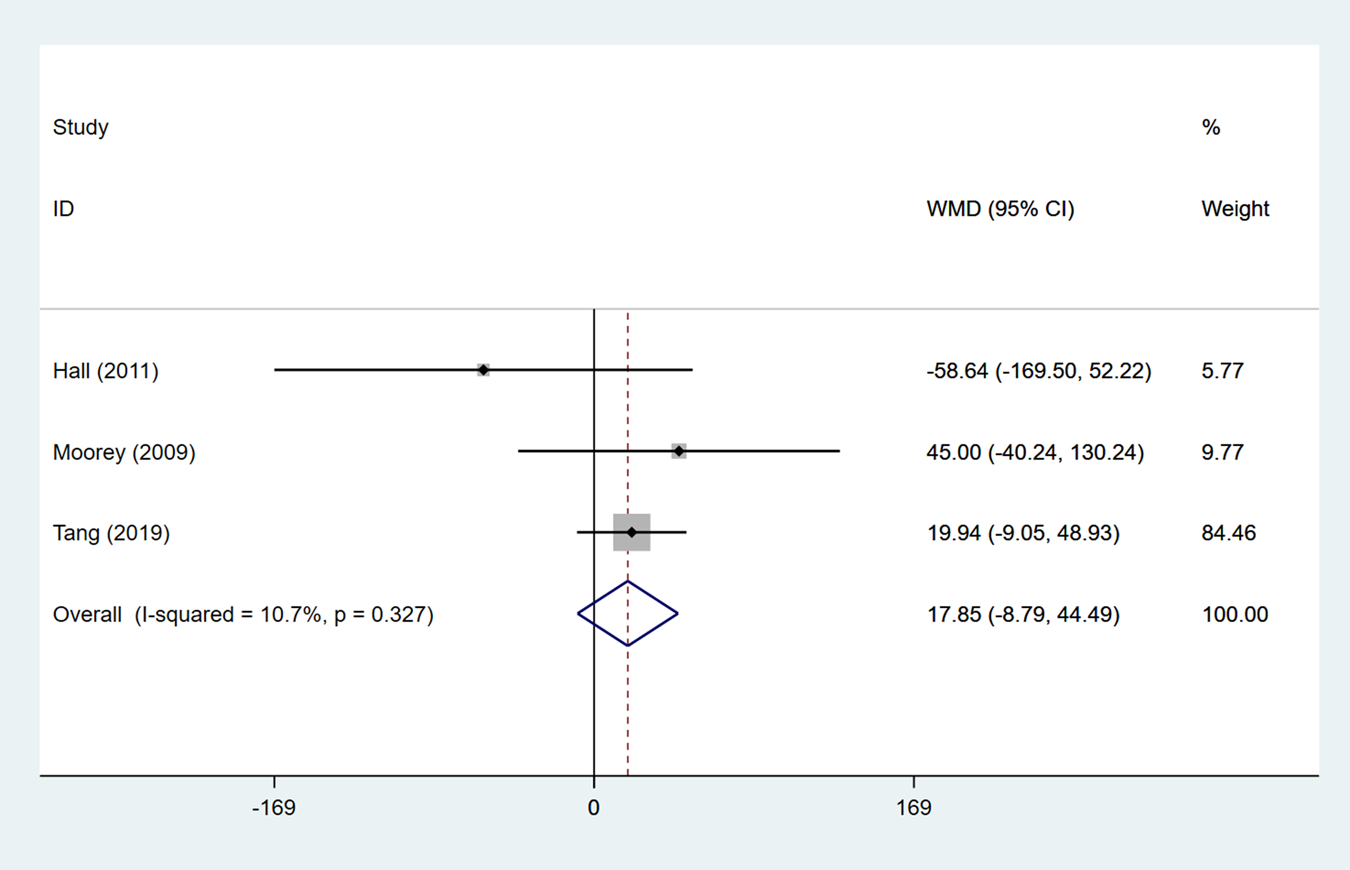
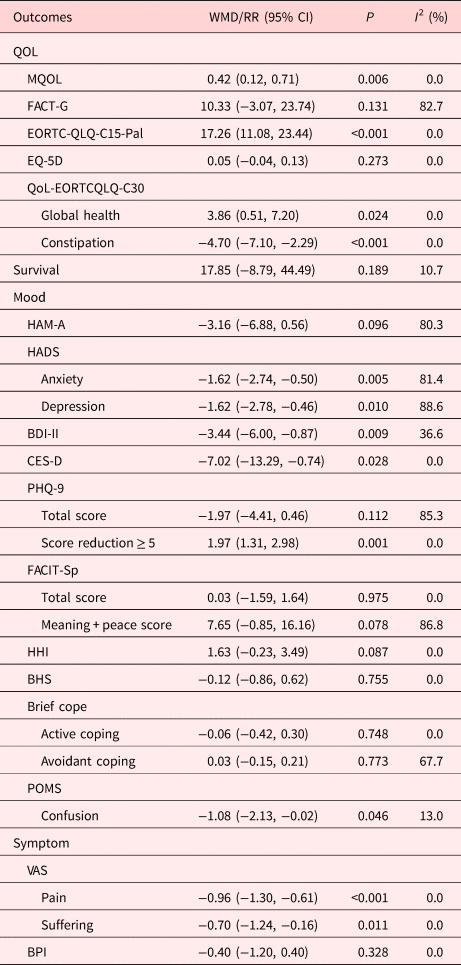
Table 1 presents the summary results of the effect of psychotherapy on QOL and survival days compared to the control group. In MQOL and EORTC-QLQ-C15-Pal, WMD values were 0.42 (95% CI: 0.12–0.71) and 17.26 (95% CI: 11.08–23.44), respectively, revealing that the QOL of the psychotherapy group was higher than that of the control group (Figure 2a,b). EORTC QLQ-C30 manifested that the global health was better (WMD: 3.86, 95% CI: 0.51–7.20, P = 0.024), and the constipation symptom was slighter in the psychotherapy group (WMD: −4.70, 95% CI: −7.10 to −2.29, P < 0.001) than the control group (Figure 2c,d). No significant heterogeneity was observed in above three scales (I 2 = 0.0%). The QOL showed no difference between the two groups according to FACT-G and EQ-5D with P-value of 0.131 and 0.273, respectively. Three studies provided data on survival days, and the pooled result showed that the survival time of the two groups had no statistical significance (WMD: 17.85, 95% CI: −8.79 to 44.49, I 2 = 10.7%, P = 0.189) (Figure 3). The power of the analysis is shown in Supplementary Table S2.
Forest plots for QOL measurement: (a) MQOL, (b) EORTC-QLQ-C15-Pal, (c) global health using EORTC QLQ-C30, and (d) constipation in EORTC QLQ-C30.

Forest plots for survival days.

Overall results of the meta-analysis

WMD, weighted mean difference; RR, relative risk; CI, confidence interval; QOL, quality of life; MQOL, McGill Quality of Life Questionnaire; FACT-G, Functional Assessment of Cancer Therapy; EORTC-QLQ-C15-Pal, European Organization for Research and Treatment of Cancer Quality of Life-C15-Palliative; EQ-5D, EuroQol 5 Dimensions; QoL-EORTCQLQ-C30, European Organization for Research and Treatment of Cancer Quality of Life Questionnaire-Core 30; HAM-A, Hamilton Anxiety Rating Scale; HADS, Hospital Anxiety and Depression Scale; BDI-II, Beck Depression Inventory-II; CES-D, Center for Epidemiologic Studies Depression Scale; PHQ-9, Patient Health Questionnaire 9; FACIT-Sp, Functional Assessment of Chronic Illness Therapy-Spiritual Well-Being Scale; HHI, Herth Hope Index; BHS, Beck Hopelessness Scale; POMS, Profile of Mood States; VAS, Visual Analogue Scale; BPI, Brief Pain Inventory.
Effect of psychotherapy on mood and symptom
Table 1 shows the summary of psychotherapy effect size on mood and symptom compared to the control group. HAM-A demonstrated no significance in the anxiety between the two groups, but HADS indicated the significantly lower anxiety in the psychotherapy group (WMD: −1.62, 95% CI: −2.74 to −0.50, P = 0.005). HADS also displayed that the depression was lower in the psychotherapy group (WMD: −1.62, 95% CI: −2.78 to −0.46, P = 0.010). The similar result was found in BDI-II and CES-D, and the WMD values were −3.44 (95% CI: −6.00 to −0.87, I 2 = 36.6%, P = 0.009) and −7.02 (95% CI: −13.29 to −0.74, I 2 = 0.0%, P = 0.028), respectively. Five points or more reduced in PHQ-9 was defined as clinical significance in response to depression treatment (Lloyd-Williams et al., Reference Lloyd-Williams, Shiels and Ellis2018). Although PHQ-9 revealed no difference in depression between the two groups (P = 0.112), the proportion of patients with a decrease in PHQ-9 scores of five points or more in the psychotherapy group was higher than that in the control group (RR: 1.97, 95% CI: 1.31–2.98, I 2 = 0.0%, P = 0.001). Moreover, psychotherapy greatly improved the confusion (WMD: −1.08, 95% CI: −2.13 to −0.02) according to POMS, and P-value was 0.046. In FACIT-Sp, the total score and score for meaning plus peace dimensions was not statistically significant between the two groups (both P > 0.05), indicating that the spiritual well-being could not be improved by psychotherapy. Moreover, HHI and BHS, respectively, showed hope and hopelessness did not have statistical significance between the two groups with P-value of 0.087 and 0.755. Displayed by Brief COPE, coping strategies were not statistically significant between the two groups with P value for active coping and avoidant coping was 0.748 and 0.773, respectively.
The symptom was measured using VAS and BPI, and no heterogeneity was observed (I 2 = 0.0%). VAS revealed that the pain level was significantly lower in the psychotherapy group (WMD: −0.96, 95% CI: −1.30 to −0.61), with P < 0.001. Moreover, a great improvement of suffering was observed in the psychotherapy group, and WMD was −0.70 (95% CI: −1.24 to −0.16, P = 0.011). Nevertheless, BPI represented no significance in the pain level between the two groups (P = 0.328). The power of the analysis is displayed in Supplementary Table S2.
Publication bias and sensitivity analysis
Publication bias was carried out by Begg’ test. No publication bias was observed in mood evaluation of anxiety (Z = 0.72, P = 0.474) and depression (Z = 0.09, P = 0.929). The sensitivity analysis was used to assess the stability of analysis results, and showed a good stability of all results, prompting that the results were reliable.
Discussion
Thirty-three studies exploring the effect of psychotherapy on the QOL or the survival days were included in this meta-analysis. Overall results manifested that psychotherapy could improve the QOL, but could not affect the survival time of advanced cancer patients. Moreover, psychotherapy lowered the levels of anxiety, depression, confusion, pain, and suffering.
The QOL of advanced cancer patients is a main concern for clinicians. In many countries, the decreased QOL of cancer patients at advanced stage is a common clinical problem (Daly et al., Reference Daly, Dolan and Power2020; Hsieh et al., Reference Hsieh, Lin and Hsu2020). In addition to radiotherapy and drug treatments, psychotherapy has become an important support strategy for advanced cancer patients (Giese-Davis et al., Reference Giese-Davis, Koopman and Butler2002; Akechi et al., Reference Akechi, Okuyama and Onishi2018). The psychological interventions were mainly centered on finding the meaning and goal at the last stages of patients’ lives by strengthening the communication with families and friends to help them decrease the cancer-related distress and pain so as to improve the QOL (Teo et al., Reference Teo, Krishnan and Lee2019). A lot of studies have reported the effective role of psychotherapy in the improvement of QOL. Breitbart et al. (Reference Breitbart, Pessin and Rosenfeld2018) found that psychotherapy had a greater effect on the QOL compared with the control group. Clark et al. (Reference Clark, Rummans and Atherton2013) found that the overall QOL was higher in the psychotherapy group, and recommended psychotherapy as a supplementary strategy to improve QOL among advanced cancer patients. In this meta-analysis, the overall results supported that the psychotherapy group exhibited a higher QOL than the control group.
The survival time for advanced cancer is another main concern for clinicians, patients, and their families (Peng et al., Reference Peng, Wu and Yi2020). Although advanced cancer is incurable, many therapies are attempted to prolong the survival time of the patients (O'Shaughnessy et al., Reference O'Shaughnessy, O'Regan and Isaacs2020). Some studies have reported the impact of psychotherapy in the survival of advanced cancer patients (Coyne et al., Reference Coyne, Stefanek and Palmer2007; Kissane, Reference Kissane2007, Reference Kissane2009). Our results revealed that the survival time was not affected by psychotherapy. Goodwin et al. performed a multicenter randomized controlled trial to explore the effect of psychotherapy on the survival time of patients with advanced cancer, and the result showed psychotherapy did not prolong the survival (Goodwin et al., Reference Goodwin, Leszcz and Ennis2001). The similar result was found in the study of Kissane et al. (Reference Kissane, Grabsch and Clarke2007). However, Steel et al. (Reference Steel, Nadeau and Olek2007) reported that advanced cancer patients accepting the psychotherapy had slightly longer survival days than those not accepting the psychotherapy. Huang et al. (Reference Huang, Yan and Liu2019) and Hou et al. (Reference Hou, Zhang and Nie2021) reported the similar result. Further studies were needed to make clear whether we should expect psychotherapy to impact survival time or not.
The mood and symptom managements are important to maintain the QOL of advanced cancer patients. Approximately 15% of advanced cancer patients suffer from depression, and 10–15% of them suffer from severe anxiety and other psychological symptoms (Hotopf et al., Reference Hotopf, Chidgey and Addington-Hall2002). Existing studies have indicated that psychotherapy could improve the anxiety and depression of patients with advanced cancer (Teo et al., Reference Teo, Vilardaga and Tan2020). Our study also showed the lower degree of anxiety and depression in the psychotherapy group. Pain is the most common and debilitating symptoms related to cancers (Hackett et al., Reference Hackett, Godfrey and Bennett2016). Among the patients with advanced cancer, about 66% of them suffer from the pain (van den Beuken-van Everdingen et al., Reference van den Beuken-van Everdingen, Hochstenbach and Joosten2016). The poorly controlled pain usually impairs patients’ QOL (Marinova et al., Reference Marinova, Feradova and Gonzalez-Carmona2021). Evidence has shown that psychological interventions can effectively improve the pain (Laely et al., Reference Laely, Prasetyo and Ropyanto2018). In our meta-analysis, the greater improvement of pain was found in the psychotherapy group, which was consistent with studies of Kwekkeboom et al. (Reference Kwekkeboom, Zhang and Campbell2018) and Warth et al. (Reference Warth, Zöller and Köhler2020).
Our meta-analysis includes a large number of studies from various databases to comprehensively evaluated the effect of psychotherapy on the QOL and survival time of advanced cancer patients. The publication bias and sensitivity analysis show the good stability of our analysis results, which make our results more reliable. However, some limitations of this study should be concerned. First, the included studies do not support us to stratify the psychotherapy interventional strategies according to the outcomes. Further studies should be performed to explore the types of psychotherapies for particular outcomes. Second, our analysis includes too many scales, and differences are existed in these scales. Therefore, it is unable to determine which scale is more suitable for the advanced cancer patients. Considering the difficulty in the implement and quality evaluation of psychological intervention in clinical experiment, innovative and practical quality evaluation systems for advanced cancer patients are needed to provide reference for the clinicians to adopt more appropriate treatment for them. Third, the power of the analyses is relatively low; thus, our analysis results require further evidence.
The implement of psychotherapy may be limited by some reasons, such as the shortage of financial supports, the shortage of practice experience in the psychotherapy among advanced cancer patients, or the shortage of professional providers. Our study still encourages the clinicians overcome such difficulties to provide evidence-based psychotherapy for the patients with advanced cancer to improve their QOL in the last period of lives.
In conclusion, psychotherapy could improve the QOL of advanced cancer patients although no effect on the survival time. The anxiety, depression, and pain were also greatly improved by psychotherapy. These findings might provide evidence-based direction for clinicians in clinical practice.
Supplementary material
The supplementary material for this article can be found at https://doi.org/10.1017/S1478951522000694.
Conflict of interest
The authors have no conflicts of interest to declare.