Introduction
Like the rupture of an aortic aneurysm, aortic dissection is a severe, life-threatening disease of the aorta. The disease is difficult to detect in the early phase due to a variety of symptoms. It is uncommon at younger ages but increases as age rises above 40 years. The exact incidence is difficult to report due to many incorrect diagnoses and the fact that many patients die prior to hospital admission without autopsy confirmation. However, epidemiological surveys have suggested an incidence of two to four out of 100,000 persons/year.Reference Acosta, Blomstrand and Gottsäter 1 , Reference Tsai, Nienaber and Eagle 2
The mortality among patients with an aortic dissection is high. A Stanford Type A dissection (involving the ascending aorta) carries the highest risk, with a documented mortality of one percent to two percent per hour, early after symptom onset.Reference Tsai, Nienaber and Eagle 2 - Reference Rapezzi, Longhi and Graziosi 4
Among patients who are brought to the hospital alive, the in-hospital mortality has been reported to be as high as 27%.Reference Hagan, Nienaber and Isselbacher 5 The highest mortality was reported in Stanford Type A, particularly if patients were not operated on (58%).Reference Hagan, Nienaber and Isselbacher 5 A Stanford Type B dissection (involving the descending aorta or the arch, without the involvement of the ascending aorta) has been reported to have a lower mortality rate, and these patients do not generally undergo surgery.Reference Dixon 3 , Reference Hagan, Nienaber and Isselbacher 5 - Reference Hoke 8 However, in subjects who develop ischemic complications or a contained rupture, requiring urgent surgical or endovascular repair, 30-day mortality approaches 25%.Reference Tsai, Nienaber and Eagle 2
The classical symptoms are the sudden onset of severe pain in the chest and/or back and/or abdomen, with or without signs of the circulatory system being affected. Other symptoms are the absence of a palpable pulse, diastolic murmur when auscultating the heart, signs of spinal cord dysfunction, focal neurological deficit, reduced level of consciousness, and syncope.Reference Hagan, Nienaber and Isselbacher 5 , Reference Afshin Kasher, El-Bialy and Balingit 9 - Reference Boother, Eagle and Bossone 10 Other symptoms include an observed difference in blood pressure between arms.Reference Boother, Eagle and Bossone 10 , Reference Ramanath, Oh and Sundt TM 11
Due to the variety of symptoms, and the fact that acute myocardial infarction is much more common than aortic dissection, these patients are often misinterpreted as having an acute myocardial infarction.Reference Sherwood and Gill 12 , Reference Forbes and Balderston 13 A misinterpretation of this kind might be detrimental, as anti-thrombotic treatment is not the drug of choice in aortic dissection and might, in fact, modify the progression of the disease in an unfavorable fashion.Reference Dixon 3 - Reference Hagan, Nienaber and Isselbacher 5
In light of this, it is reasonable to assume that the very early phase is critical with regard to early detection and early treatment. The aim of this survey was therefore: (a) to identify the number of patients with a discharge diagnosis of aortic dissection in a defined catchment area and the proportion that used Emergency Medical Services (EMS); (b) to describe the type of symptoms in these patients in relation to the mode of transport; and (c) to determine how often there was a reported suspicion of aortic disease among the EMS clinicians and how the patients were treated in the prehospital setting prior to hospital admission.
Methods
The time of survey was January 1, 2010 through December 31, 2011. The study area was at Sahlgrenska University Hospital in the Municipality of Gothenburg, Sweden. The number of inhabitants in Göteborg is 600,000, while it is 1,600,000 in Western Sweden. The type of study was a retrospective, descriptive study based on patient records.
Inclusion Criteria
All patients who were brought alive to the hospital, and had a discharge diagnosis of aortic dissection (international classification of diseases (ICD) I 71.0), were included.
Exclusion Criteria
Patients aged 18 years and below at the time of admission to the hospital were excluded. If aortic dissection (ICD I 71.0) was not the first diagnosis, these patients were excluded; the first diagnosis is the disease that is the main reason for bringing the patient to the hospital.
Practical Performance
Two nurses, both working at the coronary care unit at Sahlgrenska University Hospital at the time of the survey, abstracted all the cases. The cases were collected via the hospital's computer system, in which, all patients brought to Sahlgrenska University Hospital can be found. Hospital and prehospital data were abstracted from the same computer system, although not the same database.
The nurses first filled in a predesigned case-record form, which had been slightly modified after a pilot study of the first 10 cases. Each case was abstracted by both nurses, one at a time, in order to avoid mistakes. When a discrepancy was found, the case was re-evaluated in order to reach consensus.
The nurses’ work was supervised by a physician and an experienced EMS nurse (both co-authors of the manuscript). When the data abstraction had been completed, the data sheets were computerized and further handled by the responsible statistician (also co-author of the manuscript).
Protocols and Guidelines
There were no specific protocols or guidelines for patients when there was a suspicion of aortic disease.
Suspicion of Aortic Disease
A suspicion of aortic disease was assumed if any of the following words were used: aortic dissection, aortic disease, and aortic aneurysm.
Organization and Competence Level in the Swedish Ambulance Force
The EMS systems in the studied district serve, around the clock with 18 ambulances, approximately 450,000 inhabitants in an area of 445 km2. All ambulance units were staffed with at least one nurse and one ambulance technician. Nurses in the ambulance are a new function in Sweden. The final introduction was made on October 1, 2005 when nurses became the lowest competence level aloud to administrate drugs outside of the hospital. Nursing outside the hospital became a special field demanding specialization beyond general awareness. According to the Swedish welfare, this specialization should lead the nurse to manage care in different and severe conditions. To become a registered nurse in Sweden, three years of higher education, ending up with a bachelor's degree, are required. To become a specialized nurse in ambulance care, one year of nursing experience in somatic care and one year on master studies, in ambulance care, are required.
Ethical Considerations
This study has been conducted within the framework of a master's degree at the University of Borås (Borås, Sweden). According to the Swedish law, SFS 2003:460 The Law of Ethical Considerations in Human Trials, studies conducted by students are not judged by the Swedish Ethical Review Boards. However, Borås University judges all its students’ work according to the Helsinki Declaration. In all analyses, patients remained anonymous and, as a result, patients’ integrity was respected.
Statistical Methods
Fisher's exact test and the Mann-Whitney U test, for dichotomous/categorical and continuous/ordered variables, respectively, were used to test for differences between EMS-transported and non-EMS-transported patients. Two-sided tests were used and P values below.05 were considered statistically significant. All analyses were performed using SAS version 9.3 (SAS Institute Inc.; Cary, North Carolina USA) for Windows 7 (Microsoft Corporation; Redmond, Washington USA).
Results
In all, 125 patients fulfilled the inclusion criteria. However, of them, 33 patients had exclusion criteria (one was below 18 years of age, and in 32 patients, aortic dissection was not the first diagnosis). The remainder of this report will describe the 92 patients fulfilling the inclusion criteria and no exclusion criteria.
Age, Gender, and Previous History
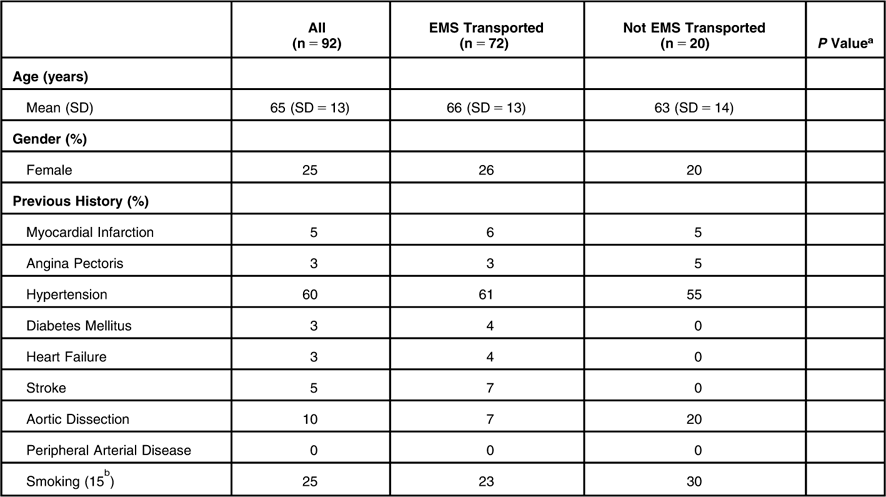
Of the 92 patients, 72 (78%) were transported by the EMS. As seen in Table 1, there was no statistically significant difference between those that did and did not use the EMS with regard to previous history. Among all patients, 60% had a history of hypertension and 10% had a history of a previous aortic dissection.
Age, Gender, and Previous History

Abbreviation: EMS, Emergency Medical Services.
a P value denoted if <.10.
bNumber of patients with missing information.
Symptoms Described by the Patient or First Medical Contact
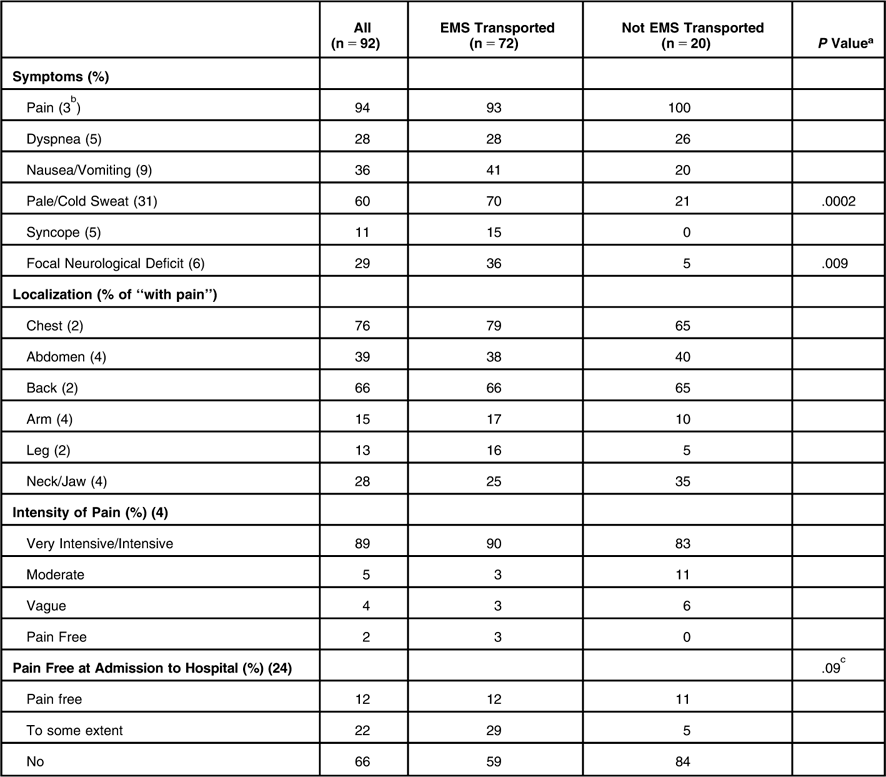
The most common symptom was pain, which was reported in 94% of all patients. Sixty percent displayed signs of cold sweat and/or paleness. Cold sweat/paleness and focal neurological symptoms were significantly more common among patients who used the EMS. As shown in Table 2, among patients with pain, the most frequent localization was the chest (76%), followed in order of frequency by back pain (66%) and abdominal pain (39%). No significant difference was found in relation to the use of the EMS. Pain was intensive or very intensive in 89%, with no significant difference in relation to the use of the EMS.
Symptoms

Abbreviation: EMS, Emergency Medical Services.
a P value denoted if < .10.
bNumber of patients with missing information.
cOrdered scale used in P value calculation.
Time Aspects
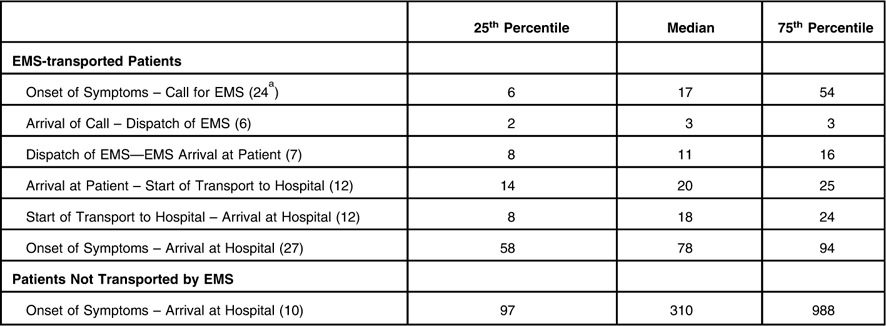
The median delay between onset of symptoms and arrival at the hospital was one hour and 18 minutes among those who used the EMS versus five hours and 10 minutes among those who did not (P = .003). The median delay from symptom onset to calling for the EMS was very short (only 17 minutes; Table 3). The median time from arrival of call to dispatch of an ambulance was three minutes.
Various Aspects of Delay (Minutes)

Abbreviation: EMS, Emergency Medical Services.
aNumber of patients with missing information.
Priority at the Dispatch Centre
The majority of patients (86%) had Priority 1, 14% had Priority 2, and none had Priority 3 assigned by the dispatcher. The corresponding distribution with regard to priority given by EMS clinicians was 58%, 41%, and two percent, respectively.
EMS Arrival and Treatment Prior to Hospital Admission Among EMS-transported Patients
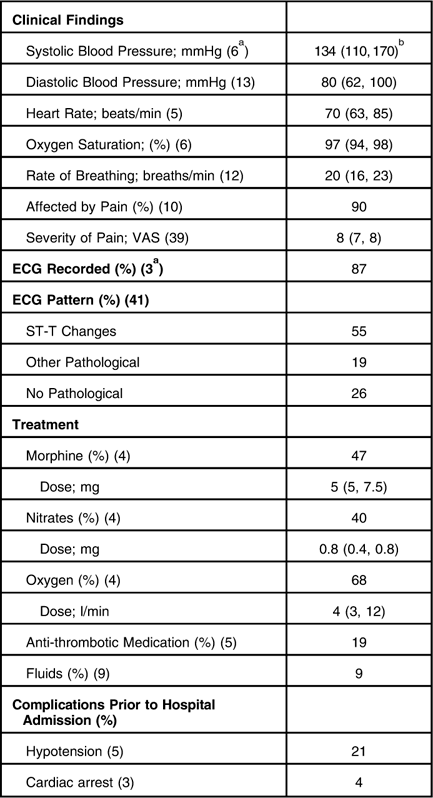
Haemodynamics, in terms of blood pressure, heart rate, and oxygen saturation, appeared normal in the majority of patients, whereas the respiratory rate was elevated (median 20 breaths per minute). However, 25% of the patients had systolic blood pressure of at least 170 mmHg and 25% had a heart rate of at least 85 beats per minute. The systolic blood pressure was lower among patients with a Type A dissection (median; interquartile range 127; 105-155 mmHg) versus patients with a Type B dissection (160; 135-190 mmHg; P = .004). Among those with pain, the median intensity, graded from zero to 10 on the visual analogue scale (VAS), was eight (Table 4).
Clinical Findings on EMS Arrival at Patient and Treatment/Complications Prior to Hospital Admission Among EMS-transported Patients (n = 72)

Abbreviations: ECG; electro cardiogram; EMS, Emergency Medical Services; VAS, visual analogue scale.
aNumber of patients with missing information.
bMedian (25th, 75th percentile), unless otherwise noted.
An electro cardiogram (ECG) was recorded in 87% of patients and reported to be normal in 26%. An ECG was sent to the hospital in 21% of all patients. Among patients for whom an ECG was available for information (n = 14), half the patients with ST deviation had ST elevation and half had ST depression. In terms of medication, narcotic analgesics were given to 47% of the patients. Among patients with VAS ⩾ 8, 71% received opiates. Nineteen percent were given anti-thrombotic medication (Table 4).
Preliminary Diagnosis at Dispatch Centre and by EMS Clinician
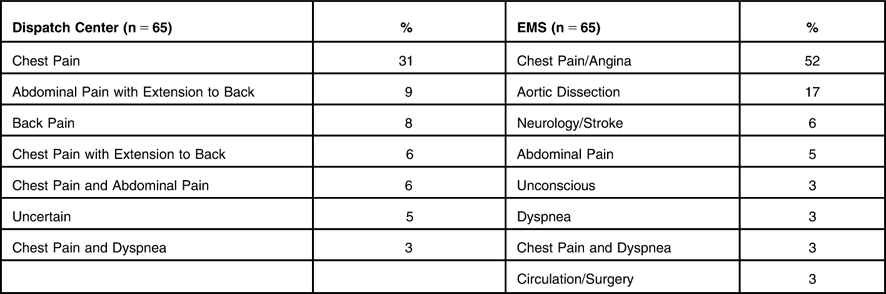
Table 5 shows that the most frequent preliminary diagnosis given both at the dispatch center and by the EMS clinician was chest pain, angina pectoris. In 17% of cases, the EMS clinician reported some suspicion of aortic disease.
The Most Frequent Preliminary Diagnoses at the Dispatch Center and by EMS Crew

Abbreviation: EMS, Emergency Medical Services.
Treatment and Outcome in Hospital
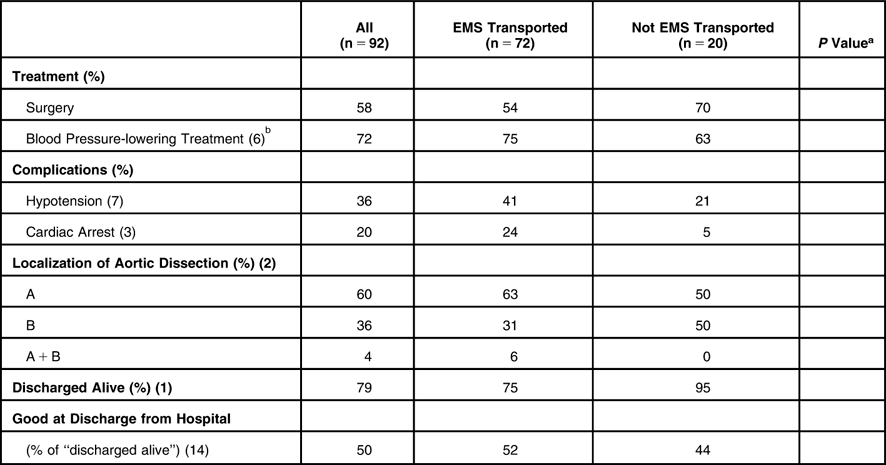
In all, 58% of patients underwent surgery and 72% received medication with the aim of lowering blood pressure (no statistically significant difference between the two patient groups; Table 6). There were statistically non-significant tendencies towards patients using the EMS having complications more frequently, as well as higher hospital mortality, than those not using the EMS.
Treatment, Complications, and Outcome in Hospital

Abbreviation: EMS, Emergency Medical Services.
a P value denoted if < .10.
bNumber of patients with missing information.
Hospital Mortality in Relation to Delay and Initial Suspicion of Aortic Dissection
Half the patients that survived the dissection were discharged in good clinical condition.
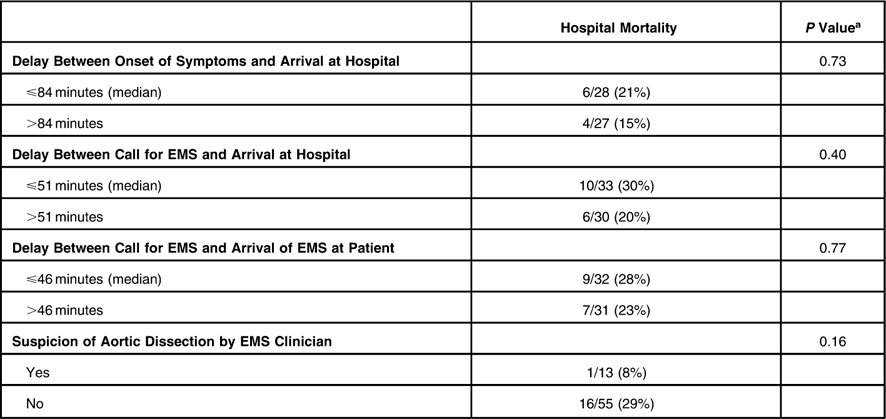
There was no significant difference in the risk of death when patients with a short delay were compared with those with a long delay to hospital admission. Among patients in whom the EMS clinician suspected aortic dissection, the hospital mortality was eight percent versus 29% when there was no suspicion (not significant; Table 7).
Hospital Mortality in Relation to Delay and Initial Suspicion of Aortic Dissection

Abbreviation: EMS, Emergency Medical Services.
a P value is calculated between the median values.
Discussion
This study focused on the prehospital assessment of patients with an aortic dissection in a well-defined catchment area. The main findings were that most patients had severe pain, predominantly in the chest and back, and that pain-relieving pharmacotherapy appeared to be inadequately administered in many patients. In fewer than one-in-five patients was a suspicion of aortic disease reported by the EMS team, a figure similar to that reported by Meszaros et al.Reference Meszaros, Morocz and Szlavi 14
Epidemiology
The finding of 92 cases in a primary catchment population of 600,000 inhabitants is slightly higher than expected.Reference Acosta, Blomstrand and Gottsäter 1 , Reference Meszaros, Morocz and Szlavi 14 The explanation is most probably that some patients from the region of Western Sweden (secondary catchment area) were transported directly to the university hospital. As previously reported, there were more men than womenReference Nienaber, Fattori and Mehta 15 and the mean age was in the mid-sixties.Reference Acosta, Blomstrand and Gottsäter 1 , Reference Meszaros, Morocz and Szlavi 14 More than half had a history of hypertension, which is also in agreement with previous surveys.Reference Hagan, Nienaber and Isselbacher 5 , Reference Hoke 8 , Reference Patel and Arora 16
Use of EMS
It was found that almost 80% used the EMS. The use of the EMS in aortic dissection is not well described in the literature.
Symptoms and Clinical Findings
The majority of patients had severe pain with a localization that has been previously reported in the literature.Reference Hagan, Nienaber and Isselbacher 5 , Reference Meszaros, Morocz and Szlavi 14 In more than half the patients, there were signs of paleness and cold sweat, and this was more frequently found among patients who used the EMS. This finding, in combination with a higher incidence of focal neurological symptoms in this subset, suggests that those patients who chose to call for the EMS were more-severely affected.Reference Herlitz, Hjälte and Karlson 17 , Reference Thuresson, Jarlöv and Lindahl 18
Relatively few patients had signs of elevated blood pressure on admission to the hospital. However, two-thirds had a Type A dissection, which might explain this finding. However, the aggressive reduction of blood pressure with pharmacotherapy is recommended.Reference Li, Eagle and Vaishnava 19
Delay
There was a marked difference in the delay from symptom onset to arrival at the hospital when comparing patients who used the EMS with those who did not, with a much shorter delay in patients who used the EMS. The observation of a median delay from symptom onset to calling for the EMS of 17 minutes and a median delay from symptom onset to arrival at the hospital of one hour and 18 minutes for the EMS users is short compared with that for other patient groups, such as those with acute myocardial infarction or stroke.Reference Herlitz, Hjälte and Karlson 17 This finding suggests that a large proportion had severe symptoms, and therefore, made a rapid decision to seek medical care. The relatively high mortality among patients with a short delay might be explained by a more-severe disease in these patients.
Initial Suspicion of Aortic Dissection
In fewer than one-in-five patients with an aortic dissection was a suspicion of aortic disease reported by the EMS crew. This finding is in agreement with one previous survey.Reference Meszaros, Morocz and Szlavi 14 In many patients, acute coronary disease was recorded and reported as the reason for EMS transfer. This is not surprising, as the symptoms can be very similar in acute coronary syndrome and aortic dissection.Reference Forbes and Balderston 13 In fact, only one-in-four was reported to have a normal ECG. This is in agreement with a previous study which showed that 50% of patients with aortic dissection had ST-T wave changes.Reference Kosuge, Uchida and Imoto 20 This raises concerns about the appropriate education of EMS staff when it comes to recognizing aortic dissection in the prehospital setting. The need for education has also been highlighted by Dixon.Reference Dixon 3
At the emergency department (ED), the sensitivity in terms of diagnosing an aortic dissection has been reported to be as low as 54%.Reference Kung, Ng and Ng 21 In a multivariate analysis, the most obvious predictor when it came to missing the diagnosis of aortic dissection at the ED was “walking mode of admission.”Reference Kurabayashi, Miwa and Ueshima 22
Relatively low mortality was found among patients in whom the EMS clinician suspected aortic dissection. Whether early suspicion of aortic dissection can improve the subsequent outcome needs to be confirmed in a larger study.
Initial Treatment
Another finding of concern was that fewer than half the patients received narcotic analgesics in order to relieve pain.Reference Watt-Watson, Garfinkel and Gallop 23 It is possible to argue about whether this was due to incorrect clinical judgment or whether other mechanisms played a role.Reference Jennings, Cameron and Bernard 24 Could it be that the EMS clinicians were reluctant to give morphine if there was abdominal pain of uncertain origin?
Many patients received nitrates either due to a suspicion of coronary artery disease or due to the desire to lower blood pressure. However, the blood pressure was not very high, so there only appeared to be clear indications for anti-hypertensive treatment in a minority of the patients. Finally, many patients (20%) received anti-thrombotic treatment, which can be detrimental in aortic dissection.Reference Dixon 3 , Reference Hagan, Nienaber and Isselbacher 5 , Reference Davis, Grossman and Kiggins 25
Prognosis
It was found that the mortality rate during hospitalization was 21%. It tended to be higher among patients who used the EMS. As already pointed out, case selection may play a role, indicating that patients with the most-severe disease tended to call for the EMS more frequently. Previous surveys have reported that early mortality varies from 10% to 27%.Reference Tsai, Nienaber and Eagle 2 , Reference Dixon 3 , Reference Hagan, Nienaber and Isselbacher 5
Clinical Implication
A diagnosis of aortic dissection cannot be made in the ambulance. However, it can be suspected. In order to improve the prehospital treatment of suspected aortic dissection, there must be clear guidelines within each EMS system dealing with its recognition and treatment. Correct feedback to the clinicians at the dispatch center, as well as the clinicians in the EMS system, is probably of the utmost importance in order to improve the triage, treatment, and prognosis in aortic dissection.
Limitations
The sample size in this study was relatively small. In the comparison between patients who did and did not use the EMS, the study is underpowered to detect any difference less than major. This was a retrospective study with all the limitations involved in such an approach. For most of the variables, information was missing in a number of cases, while, for some of the variables, it was missing in a substantial proportion. Furthermore, this study is based on what was reported in the EMS case-record forms. This does not necessarily reflect the thoughts of, and actions taken by, the EMS clinicians. Paramedics may have passed on their suspicion of aortic dissection verbally to the ED staff, although it had not been documented on the EMS form.
Also, the evidence of a pulse deficit has been reported to be associated with a high rate of aortic dissection.Reference Chua, Ibrahim, Neo, Sorokin, Shen and Ooi 26 No data are provided on this important symptom. A diagnosis of aortic dissection cannot be made in the ambulance. However, it can be suspected. No education had been given to the EMS clinicians about when to suspect aortic dissection.
Finally, there was no information on the number of patients who died prior to hospital admission because of aortic dissection. Due to a low autopsy rate, this figure is difficult to determine.
Conclusion
Of 92 patients who were hospitalized due to aortic dissection in the Municipality of Gothenburg, 78% used the EMS. Despite severe pain in the majority, fewer than half received narcotic analgesics and only 12% were free from pain on admission to hospital. In fewer than one-in-five cases was a suspicion of aortic dissection reported by the EMS staff.