Nutritional therapy for elderly cancer patients has garnered significant attention, yet a unified, widely applicable and user-friendly tool for diagnosing malnutrition remains elusive. Statistics show that the incidence of malnutrition among hospitalised elderly cancer patients is as high as 67·9 % and even higher in advanced stages(Reference Silva, de Oliveira and Souza1). Accurate identification of malnourished patients is a prerequisite for timely nutritional intervention. Malnutrition is closely associated with various adverse outcomes. Given that a significant proportion of elderly patients with advanced cancer require surgical interventions or treatments such as chemotherapy, radiotherapy and targeted therapy, the accompanying loss of appetite, weight loss and malnutrition often negatively impact clinical outcomes(Reference Zhang, Huang and Tang2). Therefore, early recognition of malnutrition is crucial.
Internationally, the Global Leadership Initiative on Malnutrition (GLIM) has released a diagnostic framework for malnutrition. They encourage medical practitioners to actively validate and refine this consensus-based diagnostic approach, which considers both aetiological and phenotypic criteria(Reference Cederholm, Jensen and Correia3). Unlike other phenotypic criteria (involuntary weight loss and low BMI), the assessment of muscle mass is not standardised. Methods such as CT or dual-energy X-ray absorptiometry for evaluating muscle mass are often limited by equipment availability, radiation exposure and high costs, making them impractical for routine monitoring in all medical institutions. The GLIM guidelines for diagnosing malnutrition suggest that if technical equipment-based assessments of muscle mass are not readily available, anthropometric methods such as calf and upper arm circumference should be used(Reference Barazzoni, Jensen and Correia4). However, there are no reports validating the accuracy of different anthropometric methods under the GLIM criteria for identifying malnourished patients.
This study posits that anthropometric methods can serve as a rapid, simple and objective indicator for the GLIM phenotypic criteria in elderly, advanced-stage cancer patients, especially when technical equipment, economic constraints or patient frailty limit more extensive testing. Grip strength, calf and upper arm circumference have already been validated in oncology as substitutes for reduced muscle mass and anthropometric abnormalities. The geriatric nutritional risk index (GNRI) is a tool specifically designed for the nutritional screening and assessment of the elderly, calculated based on body weight and serum albumin levels, without requiring subjective inquiries from investigators. Previous studies have reported that GNRI is consistent with the GLIM criteria for diagnosing malnutrition(Reference Chen, Lin and Yin5). However, due to the limitations of equipment and materials, there are relatively few related studies on the assessment of muscle mass by different anthropometric indicators in elderly cancer patients, and there are relatively few evaluations of different anthropometric indicators in GLIM and GNRI in elderly patients with advanced malignant tumours. Previous studies mainly focused on the nutritional index and nutritional intervention of elderly cancer patients. Therefore, this study aims to compare the sensitivity, specificity and prognostic assessment capabilities of grip strength, calf and upper arm circumference as different phenotypic criteria within the GNRI and GLIM diagnostic frameworks.
Materials and methods
Participants
This study selected 312 elderly patients with advanced-stage cancer who were hospitalised in the Department of Oncology at Shanghai Tenth People’s Hospital between September 2022 and June 2023. Inclusion criteria were (1) age 60 years and above; (2) pathologically diagnosed as stage III and above malignant tumours; (3) clear consciousness, able to communicate independently and cooperate with physical examination and (4) normal mental state. Exclusion criteria were (1) severe electrolyte disorders, unable to undergo nutritional intervention; (2) alcoholism or drug addiction; (3) unclear or refusal of nutritional risk screening and assessment; (4) absence of limbs or muscle, ligament, bone and joint injuries and other reasons that prevent anthropometric index examination; (5) patients who have received human albumin injection in the past 21 d; (6) having contraindications for enteral nutrition; (7) accompanied by intestinal obstruction, short bowel syndrome, unable to undergo diet and enteral nutrition and (8) lack of admission clinical biochemical data or patients who have been included in this study and are readmitted.
Methods
This study was conducted by the ward nutritionist within 48 h of the patient’s admission, involving nutritional screening, assessment and diagnosis. All included patients were evaluated for malnutrition using both GNRI and GLIM criteria. This study was conducted according to the guidelines laid down in the Declaration of Helsinki, and all procedures involving human subjects were approved by the Shanghai Tenth People’s Hospital Ethics Committee (Ethics Approval Number: 2023-B023). As this is a retrospective study with anonymised data, informed consent was not required.
Anthropometric and laboratory examinations
Upon admission, patients underwent routine physical measurements (including height and weight). Measurements were taken in the morning, with patients fasting and dressed in hospital gowns. Height and weight were measured using calibrated scales and weight scales. Upper arm and calf circumferences were measured with a tape measure, repeated twice and the maximum value recorded to the nearest 1 cm. Grip strength was measured using a grip dynamometer for both hands, repeated twice and the maximum value recorded to the nearest 0·1 kg. Laboratory indicators such as serum albumin, prealbumin and C-reactive protein were selected within 48 h of admission, before any clinical treatment (such as surgery, chemotherapy and radiotherapy) began. Professional nursing staff collected venous blood from the study subjects.
Geriatric risk index
The GNRI was used to assess and diagnose patients for nutritional status as a reference standard. GNRI > 98 was considered ‘no malnutrition,’ and GNRI ≤ 98 was considered ‘malnutrition present.’ The specific formula is as follows(Reference Bouillanne, Morineau and Dupont6):
GNRI = 1·489 × albumin (g/l) + 41·7 × [actual body weight (kg)/ideal body weight (kg)]
Ideal body weight [male] (kg) = height (cm) - 100 - [height (cm)-150]/4
Ideal body weight [female] (kg) = height (cm) - 100 - [height (cm)-150]/2·5
Global Leaders Initiated Malnutrition Standards criteria for malnutrition diagnosis
GLIM nutritional assessment: Step 1: Nutritional risk screening: Patients were screened for nutritional risk using the NRS 2002 within 48 h of hospitalisation. Step 2: For patients at nutritional risk, GLIM assessment was conducted. The GLIM criteria consist of three phenotypic standards and two aetiological standards, requiring at least one phenotypic standard and one aetiological standard to diagnose malnutrition(Reference Cederholm, Jensen and Correia3). Phenotypic indicators include (1) involuntary weight loss: weight loss > 5 % within 6 months, or > 10 % over 6 months; (2) low BMI: Asian standard BMI < 18·5 kg/m2 (< 70 years) or < 20 kg/m2 (≥ 70 years) or < 22 kg/m2 (≥ 80 years) and (3) reduced muscle mass: reduced muscle mass does not have an accurate ‘cut-off point’ in China based on clinical research. According to the GLIM guidelines for diagnosing malnutrition, calf circumference < 33 cm for males and < 32 cm for females(Reference Barazzoni, Jensen and Correia4) and upper arm circumference based on Esteves et al.’s research, the diagnostic cut-off for sarcopenia is 27 cm(Reference Esteves, Ohara and Matos7). Grip strength according to the 2019 Asian Strategy for Diagnosing Sarcopenia is male grip strength < 28 kg, female < 18 kg(Reference Chen, Woo and Assantachai8). Aetiological indicators include (1) reduced food intake or absorption: intake of ≤ 50 % of energy needs (> 1 week) or any reduction in energy intake (> 2 weeks) or presence of chronic gastrointestinal symptoms affecting digestion and absorption and (2) disease burden/inflammation: acute illness or trauma and chronic disease-related inflammation. This study defined chronic inflammation as C-reactive protein ≥ 8·2 mg/l or IL-6 > 5·3 pg/ml. The measurement method of upper arm circumference: The patient takes a sitting position. At the midpoint of the line connecting the acromion to the olecranon of the ulna in a relaxed state, the upper arm is circled once and measured three times. The average value is taken. The measurement method of calf circumference: The patient takes a sitting position, with feet separated shoulder-width apart. The patient is instructed to relax. The thickest part of the calf is measured three times. The average value is taken.
Clinical outcome indicators
Complications included infections that occurred during hospitalisation. Considering that elderly tumour patients are prone to malnutrition complications such as weight loss, hypoproteinaemia and intestinal dysfunction due to factors such as tumour consumption, loss of appetite, reduced food intake, insufficient protein and energy intake, reduced activity and lack of dietary fibre, the complications of concern in the study include weight loss (weight loss of more than 5 % in the past 3 months), hypoproteinaemia (low protein content in the blood, total plasma protein pus is lower than 60 g/l or albumin is lower than 35 g/l) and intestinal dysfunction (patients have constipation and diarrhoea). Total hospital stay was defined as the total number of days from admission to discharge. Total medical expenses included all treatment-related costs during hospitalisation.
Statistical analysis
SPSS 25·0 software was used for statistical analysis. Descriptive statistics were used to describe the basic characteristics of the study subjects. Continuous variables that followed a normal distribution were expressed as (mean (standard deviation)), and comparisons between groups were made using ANOVA variance tests. Variables that did not follow a normal distribution or had unequal variances were analysed using Wilcoxon rank-sum tests. Categorical variables were described using counts and percentages, and comparisons between groups were made using χ 2 tests. Using GNRI as the diagnostic standard, the sensitivity, specificity, positive predictive value, negative predictive value and correct index of GLIM nutritional diagnosis using calf circumference, grip strength and upper arm circumference as different indicators of muscle reduction were calculated. Cohen’s Kappa was used to analyse the consistency of the three tools with the GLIM standard, and the area under the receiver operating characteristic curve was calculated to assess the diagnostic value of the three tools, with AUC values closer to 1 indicating better diagnostic performance. AUC values between 0·5 and 0·7 indicated low accuracy, while AUC values between 0·7 and 0·9 indicated moderate accuracy. Differences were considered statistically significant at P< 0·05.
Results
General characteristics
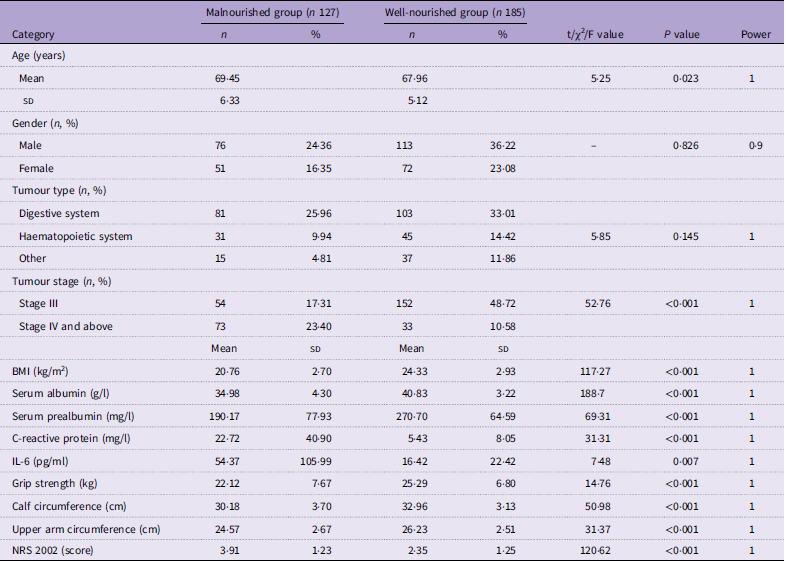
A total of 312 elderly patients with mid-to-late stage tumours were ultimately included in this study. The median age was 68 years, with a mean age of (68·57 (sd 5·58)) years. There were 189 males (60·58 %) and 123 females (39·42 %). Tumour locations included 184 cases of digestive system tumours (gastric, colorectal, liver and pancreatic tumours), seventy-six cases of haematological tumours and fifty-two cases of other tumours (prostate, bladder, kidney, breast, ovarian and cervical tumours). Under the GNRI assessment, 127 patients (40·71 %) were considered malnourished, while the remaining 185 (59·29 %) were well nourished. Differences in age, stage, BMI, serum albumin, serum prealbumin, C-reactive protein, IL-6, grip strength, calf circumference, upper arm circumference and NRS 2002 between the two groups were statistically significant (P< 0·05), as shown in Table 1.
Comparison of clinical data in two groups

Nutritional malnutrition and clinical outcomes under different diagnostic methods
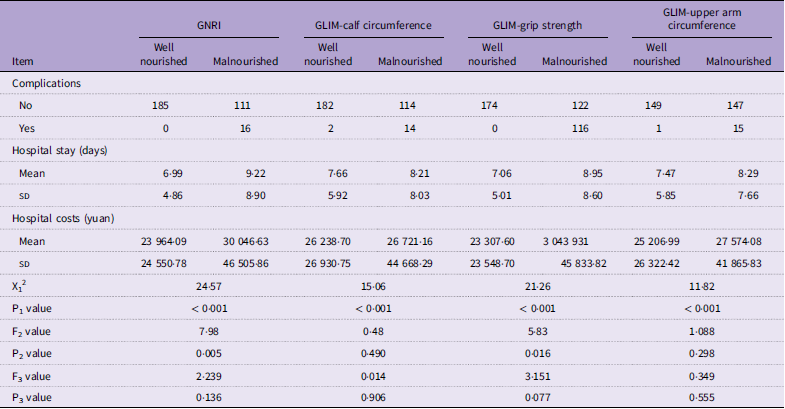
Sixteen patients experienced complications. The malnutrition diagnosed by GNRI and various muscle depletion assessment indicators under the GLIM standard (calf circumference, grip strength and upper arm circumference) was closely related to the overall complication rate in elderly patients with mid-to-late stage malignant tumours. The total hospital stay for the malnourished group diagnosed by GNRI and GLIM-grip strength standard was significantly longer than that of the non-malnourished group, with statistical significance (P< 0·05), as shown in Table 2. Although there were differences in hospitalisation costs between the two groups, they were not statistically significant.
Comparison of clinical outcomes among various nutrition diagnosis groups

The X1 2 value, P1 value, F2 value, P2 value, F3 value and P3 value were, respectively, obtained from the comparison of clinical outcomes under different nutritional diagnostic methods.
Consistency between geriatric risk index and Global Leaders Initiated Malnutrition Standards under different muscle indicators
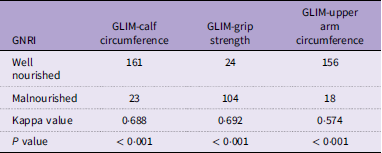
When using GLIM-CF for nutritional diagnosis, 128 (41·03 %) elderly tumour patients were malnourished. GLIM-grip strength identified 138 (44·23 %) malnourished patients, and GLIM-upper arm circumference found 162 (51·92 %) malnourished patients. The consistency test results showed that GLIM standard using calf circumference as the muscle indicator had the best consistency with the GNRI, as summarised in Table 3.
Agreement analysis of GLIM using calf circumference, grip strength or upper arm circumference as indicators of muscle loss with GNRI

GLIM, Global Leaders Initiated Malnutrition Standards; GNRI, geriatric risk index.
Application evaluation of Global Leaders Initiated Malnutrition Standards under different muscle depletion assessments
The correlation between GNRI and the three muscle depletion assessment GLIM standard diagnostic methods was evaluated using the area under the receiver operating characteristic curve. GLIM-calf circumference and GLIM-grip strength had a strong correlation with GNRI, with AUC of 0·845 and 0·851, respectively. The AUC for GLIM-upper arm circumference was lower than the other two at 0·799, as shown in Figure 1. Using GNRI as a reference, the sensitivity of GLIM-upper arm circumference (87·4 %) was the highest, but its specificity was low (72·4 %). The highest specificity was for GLIM-calf circumference (87 %), followed by GLIM-grip strength (84·3 %), with both having an accuracy of 84·9 %, indicating good diagnostic value, as shown in Table 4.
The association of three muscle loss indicators under the GLIM with GNRI. GLIM, Global Leaders Initiated Malnutrition Standards; GNRI, geriatric risk index.

Statistical evaluation of three muscle loss indicators under the GLIM

GLIM, Global Leaders Initiated Malnutrition.
Discussion
With the rapid increase in the ageing population in China, the prevalence of malignant tumours in the elderly is also increasing. Elderly patients over 65 years old account for 60 % of the total patient population and 70 % of the death toll(Reference Chow and Kuza9). Elderly patients dominate the malignant tumour patient population, and in addition to the impact of mid-to-late stage tumours themselves, they are more prone to malnutrition due to metabolic and functional decline with age. Therefore, nutritional screening and assessment of elderly patients with mid-to-late stage malignant tumours are crucial, as this is the basis for nutritional treatment. Selecting a method with high diagnostic value that is convenient and practical can enhance the diagnostic efficacy of malnutrition in tumour patients. This study verified that the GLIM-grip strength standard has good sensitivity, specificity, and accuracy, meaning it can serve as an alternative indicator for diagnosing malnutrition in elderly patients with mid-to-late stage tumours when technical equipment is limited. The results indicate that using GNRI and GLIM standards with grip strength or calf circumference as the malnutrition phenotype standard has high diagnostic consistency in elderly patients with mid-to-late stage tumours. Additionally, both GNRI and GLIM-grip strength are associated with poor prognosis, with the malnourished group having a significantly higher incidence of complications and longer hospital stays than the well-nourished group.
Malnutrition in tumour patients, especially those in mid-to-late stages, exacerbates the occurrence of complications, increases financial burdens and even accelerates death. Therefore, nutritional assessment and diagnosis for this group are essential. The currently published GLIM diagnostic framework aims to establish a global consensus for clinical diagnosis of malnutrition. This standard has been partially validated in tumour patients(Reference Santos, Fonseca and Ferreira10), and compared with weight loss and low BMI, assessing muscle mass is more challenging. Guidelines suggest prioritising imaging methods such as dual-energy X-ray absorptiometry, bioelectrical impedance analysis or CT, and when these are not feasible, GLIM recommends using anthropometric indicators and physical examinations. In patients with stage III digestive system tumours, as the tumour grows, the problems of difficult eating, digestion and absorption in patients intensify. Patients will become emaciated, anaemic and their physical functions will decline, which will reduce the tolerance of subsequent treatments and thus affect the clinical outcome. While patients with stage IV digestive system tumours may completely block the digestive tract or have various complications due to metastasis. Severe malnutrition will lead to extreme physical weakness in patients, unable to tolerate active treatment measures and the clinical outcome is poor, such as death due to multiple organ failure. In patients with stage III haematological system tumours, as the disease progresses, the proliferation of tumour cells accelerates, metabolic abnormalities and haematopoietic dysfunction aggravate and patients will have severely reduced appetite and rapidly deteriorating nutritional status. This will make the patient’s body less tolerant to treatments such as chemotherapy, increase the difficulty of treatment and the clinical outcome is not optimistic, such as an increased risk of serious complications during the treatment process. In patients with stage IV haematological system tumours, in the advanced stage of the disease, haematological system tumours will cause severe complications throughout the body, extremely poor nutritional status and failure of functions of various organs in the body. The clinical outcome is very poor, and the survival time is significantly shortened.
According to the ‘International Consensus on the Definition and Classification of Cancer Cachexia’ in 2010, muscle mass assessment (such as through CT or MRI) has become an important part of the diagnosis of cachexia(Reference Basset, Collin and Vielh11). Decreased calf circumference, upper arm circumference and grip strength can be used as early indicators of malnutrition and disease progression. Even if there is no significant weight loss, it may suggest the presence of nutritional problems(Reference Chun, Kim and Lee12). Decreased muscle content is an independent factor for poor prognosis in elderly tumour patients. The guidelines recommend judging the survival period and treatment effect based on this and setting specific goals for calf circumference, upper arm circumference and grip strength to maintain muscle mass(Reference da Silva, Wiegert and Oliveira13). In view of the negative impact of muscle loss on prognosis, the guidelines emphasise the importance of early nutritional intervention and rehabilitation training to delay the process of muscle loss(Reference Kanemura, Takeoka and Sugase14). Comprehensive management measures should include nutritional support, appropriate exercise training (such as resistance exercise), mental health attention, etc., to improve compliance and quality of life(Reference Cereda, Tancredi and Klersy15). The precise nutritional supplementation strategy recommends increasing the intake of high-quality protein rich in branched-chain amino acids such as leucine and supplementing vitamin D and ω-3 fatty acids to improve muscle function(Reference Polański, Świątoniowska-Lonc and Kołaczyńska16). Combining dietary adjustments with personalised exercise programmes (aerobic and resistance exercises) can enhance muscle strength and endurance(Reference Rick, Dauelsberg and Kalusche-Bontemps17). Regular monitoring of muscle content and related indicators provides a basis for adjusting treatment strategies.
Grip strength can be used as an indicator reflecting the muscle strength of patients, indirectly indicating the nutritional status of patients. Elderly tumour patients are prone to malnutrition due to factors such as tumour consumption and loss of appetite, resulting in decreased muscle strength and grip strength. Lower grip strength may mean poor physical function and weak tolerance in coping with tumour treatments (such as surgery, chemotherapy and radiotherapy), which may lead to treatment interruption or more complications. At the same time, in the long term, this is also related to shortened survival(Reference Hadzibegovic, Porthun and Lena18). (2) The upper arm circumference is an important indicator for measuring the upper limb muscle mass and subcutaneous fat. It can reflect whether the patient has protein-energy malnutrition. If the upper arm circumference of elderly tumour patients continues to decrease, it indicates that the body is in a state of consumption, with insufficient nutritional intake or poor absorption. Patients with a smaller upper arm circumference have an increased risk of infection. Malnutrition can lead to a decline in immunity, and infection is one of the important factors affecting the prognosis of tumour patients. In addition, a small upper arm circumference is also related to a decline in quality of life. For example, patients may have difficulties in daily life activities (such as dressing and washing)(Reference Guo, Yu and Li19,Reference Won, Hiratsuka and Suh20) . (3) The calf circumference mainly reflects the situation of the lower limb muscles and fat. Calf muscle atrophy (decreased circumference) may indicate limited mobility of the patient, which is very common in elderly tumour patients. Because as the tumour progresses malnutrition occurs, the body will decompose muscles to provide energy and the calf muscles will also be affected. Patients with a small calf circumference have an increased risk of falls, which may lead to serious consequences such as fractures, especially in the elderly whose bones are relatively osteoporotic. Once accidents such as fractures occur, it will greatly affect the patient’s treatment plan, such as being unable to undergo tumour treatment on time, and will prolong the hospital stay and increase the mortality rate. At the same time, the decrease in calf circumference is also closely related to the quality of life of patients. Patients may reduce activities due to lower limb weakness, thereby further deteriorating physical function(Reference Zhuang, Zhang and Xu21).
Few studies have reported on the effectiveness and consistency of GLIM combined with easily obtainable anthropometric indicators such as grip strength, calf circumference and upper arm circumference for assessing muscle mass. This study used GNRI as a reference standard. In addition to its consistency with GLIM standards being validated in other studies, its advantage lies in the absence of subjective inquiries, with height, weight and albumin levels being objective indicators. All examinations in this study were completed within 48 h of admission and excluded patients who had received albumin injections within the last 21 d, thus ensuring a high accuracy of GNRI in diagnosing malnutrition. In this study, anthropometric indicators, nutritional indicators, inflammatory indicators and clinical outcomes in the well-nourished/malnourished groups diagnosed by GNRI showed significant differences. Regarding diagnostic consistency, the results of this study indicate that GLIM-grip strength standard has the best consistency with GNRI (K value = 0·692), followed by GLIM-calf circumference (K value = 0·688), and GLIM-upper arm circumference is the worst (K value = 0·574).
Previous studies often used calf circumference as evidence for assessing muscle depletion in elderly patients. However, the sensitivity of GLIM-calf circumference (81·9 %) in this study was lower than the other two, possibly because elderly patients with mid-to-late stage tumours often have comorbid chronic diseases such as lower limb oedema, varicose veins and osteoarthritis, which may affect the accuracy of calf circumference measurements and thus the diagnosis of malnutrition. The 2018 ‘Clinical Multicenter Report on Geriatric Diseases in China’ showed that the comorbidity rate among elderly inpatients in China is particularly high, with an average of 4·68 diseases per person and a comorbidity rate of 91·36 %. Therefore, it is not suitable for elderly patients with multiple comorbidities, and the European Working Group on Sarcopenia in Older People does not recommend using calf circumference for muscle screening(Reference Cruz-Jentoft, Bahat and Bauer22). Although upper arm circumference has high sensitivity, its specificity is the lowest (72·4 %), indicating that using upper arm circumference as one of the GLIM phenotype indicators would increase the proportion of false positives and expand the proportion of malnourished patients diagnosed by GLIM in the target population. The main reason might be the cut-off value setting for upper arm circumference. Currently, neither the European Working Group on Sarcopenia in Older People, the Asian Sarcopenia Consensus nor the GLIM guidelines for assessing muscle mass phenotype standards mention any reference cut-off values for upper arm circumference in any population. This study only used the diagnostic cut-off values for Sarcopenia assessment in people over 60 years old from similar studies, which also hinders the effective clinical application of the upper arm circumference indicator.
This study’s GLIM-grip strength standard can accurately identify malnourished elderly patients with mid-to-late stage tumours, with a sensitivity of 85·8 %, specificity of 84·3 % and accuracy of 84·9 %. Compared with other anthropometric indicators, GLIM-grip strength has the highest AUC and Kappa value. Zhou et al. also reported similar findings, suggesting that grip strength is an effective alternative tool for assessing muscle mass in GLIM diagnosis of gastrointestinal tumour patients(Reference Zhou, Yu and Ma23). Grip strength assessment of muscle strength is closely related to nutritional status in various pathological conditions, such as tumour diseases(Reference Tostes, da Cunha Antunes Saraiva and Martucci24). Xie et al. found that grip strength significantly decreased in hospitalised elderly patients diagnosed with malnutrition by GLIM standards, and after adjusting for BMI, grip strength remained an independent predictor of malnutrition(Reference Xie, Jiang and Fu25). Although grip strength measurement can be affected by disease status, motor ability and patient consciousness, it is not suitable to completely replace CT and other equipment for assessing muscle mass. However, for mid-to-late stage tumour patients, this method is simple, non-invasive and only requires a grip strength device, making it more economical than CT and dual-energy X-ray absorptiometry examinations. In cases where patients are averse to excessive examinations, have limited economic conditions or where medical institutions lack necessary equipment, this method still has certain value for evaluating and diagnosing malnutrition in elderly patients with mid-to-late stage malignant tumours. In clinical practice, using simple and practical methods to closely monitor the development of malnutrition and adjust nutritional status in a timely manner is crucial to improving treatment outcomes. Additionally, other studies have also validated the ability to screen for malnutrition by measuring grip strength, and its level changes are more closely related to early improvements in exercise and nutritional therapy compared with muscle mass(Reference Hsu, Liao and Tsai26). Regarding clinical prognostic ability, this study suggests that only the hospital stay and complication rate of the malnourished/well-nourished groups diagnosed by GNRI and GLIM-grip strength showed significant differences, but since this study only tracked short-term in-hospital outcomes, long-term mortality and quality of life require further validation in larger cohorts. It is worth noting that the nutritional intervention in this study was not completely uniform but was adjusted to a certain extent personalised according to the specific situation of each patient. This may introduce additional variability, affecting the consistency between the GLIM and GNRI evaluations, and may also affect the comparison results among different anthropometric indicators (grip strength, calf circumference and upper arm circumference). However, by strictly controlling other variables, we believe that the impact of these non-uniformities on the main findings is limited. Future studies should be dedicated to developing more standardised nutritional intervention programmes to further improve the consistency and accuracy of diagnostic tools and better understand the actual impact of nutritional intervention on the clinical outcomes of elderly cancer patients.
Limitation
This study has the following several shortcomings: In terms of the selection of research subjects, this study only included elderly patients with advanced malignant tumours treated in our hospital. The regional limitations of the sample may lead to the research results not being fully applicable to elderly tumour groups in other regions or medical environments. Factors such as dietary habits, medical resource allocation and social and cultural backgrounds in different regions may all have an impact on the implementation and effect of nutritional intervention, but this study failed to fully cover these diversities. Second, there may be certain deviations in the implementation of the nutritional intervention programme adopted in the study. Due to the difficulty in completely controlling the compliance of patients in actual operation, some patients may not strictly follow the predetermined nutritional intervention plan, which may interfere with the accuracy of the final research data, making the intervention effect we observed may not fully reflect the true efficacy of this nutritional intervention measure under the ideal state.
To conclude, the high proportion of malnutrition in elderly patients with mid-to-late stage malignant tumours necessitates attention and implementation of nutritional screening, assessment, and intervention. Using grip strength as one of the phenotype standards for assessing muscle loss in GLIM is simple, economical, and suitable for diagnosing malnutrition in elderly patients with mid-to-late stage malignant tumours, with good consistency with GNRI diagnosis results and is expected to be promoted in various levels of medical institutions.
Acknowledgements
We would like to thank Jingwei Wang for her contributions to this work. Her support and insights were invaluable in the completion of this research.
There is no funding for this study.
D. K. contributed to the conception and design of the study, data collection and statistical analysis. N. D. assisted in the study design, participant recruitment and clinical assessments. H. W. and J. W. played a pivotal role in the study’s overall supervision, analysis and interpretation of the data, as well as drafting and revising the manuscript. All authors read and approved the final manuscript, ensuring the integrity and accuracy of the work presented.
The authors declare that there are no conflicts of interest regarding the publication of this paper.