Studies of comedy can seem trivial and in poor taste amidst ongoing political tensions, cultural loss, and economic marginalization in China's Tibet. But comedy can do important work within a society: it can bring pleasure, mask pain, bolster hegemony, or speak truth to power. Sometimes it does all these at the same time. Laughter is also the story of the everyday that all too often gets erased from historical narratives of modernity and progress, of drama, and of trauma (Rea Reference Rea2015, 7). This polysemic and quotidian nature of humor—and particularly satire—makes it an excellent lens through which to examine localized responses to social change at moments of incipient modernity.
Western scholarship on secular cultural production in China's Tibet focused initially on the development of modern Tibetan literature in the post-Mao period (see, for example, Hartley and Schiaffini-Vedani Reference Hartley and Schiaffini-Vedani2007) and art (Harris Reference Harris1999). More recently, as scholars have also examined music (including Adams Reference Adams1996; Morcom Reference Morcom2008; Yangdon Dhondup Reference Dhondup, Barnett and Schwartz2008), television (see Barnett Reference Barnett2008–9), and film (see, for example, Frangville Reference Frangville2016; Robin Reference Robin2008–9). And yet, much of the literature went unread by a Tibetan population suffering high illiteracy rates well into the twenty-first century.Footnote 1 Additionally, few Tibetan-produced films have been shown on Tibetan television or featured in regional cinemas, while mass television ownership is only a recent phenomenon.
In recognition of this, Shakya (Reference Shakya, Barnett and Akiner1994, 159) notes that “[t]he Chinese … realised very early on that the effectiveness of the printed media was limited by the extent of illiteracy in Tibet. Therefore, from the very beginning, the Chinese used radio broadcasts as a method of disseminating information and propaganda.” One popular method for accomplishing this was through A mdo Tibetan kha shags,Footnote 2 scripted comedic dialogues based on the Han Chinese tradition of xiangsheng “crosstalk” and brought to the Tibetan plateau primarily for the purpose of spreading Communist Party propaganda.Footnote 3 Beginning in the 1980s, Tibetan stage performers coopted these comedies to champion a host of social issues, including the promotion of science over religion, Tibetan language use, secular education, and free-choice marriage. Performed on state stages, broadcast on state-sponsored radio airwaves, sold as cassettes and VCDs, and most recently also circulated via social media, Tibetan comedies remain popular today and are quoted liberally in daily conversations by A mdo Tibetans from all walks of life.Footnote 4 These comedies refocus scholarly attention on the role of popular forms in influencing Tibetan engagements with and conceptions of modernity in reform era China.
This article examines a series of four such kha shags. Centered on a fictional locale called “Careful Village” (T. sems chung sde ba), these wildly popular comedic dialogues from the 1990s satirize a wide range of people—including nomads, religious practitioners, and even (obliquely) government officials—and practices—including, but not limited to, arranged marriage, the importance of secular education, and the dangers of religious belief—related to life in post-Mao Tibet. In these performances, Tibetan comedians Sman bla skyabs (b. 1963) and Phag mo bkra shis (b. 1964) reappropriate the modernist ideologies upon which Chinese state-sponsored modernity is based—centered on Putonghua (literally “common speech”)—through promoting modern Tibetan discursive practices.
Comedic dialogues deserve attention partly because of the wider scope they have been permitted for social satire in comparison with other media in China (Link Reference Link and MacDougall1984, 84). This scope, which leaves comedy uniquely positioned to articulate social critique in otherwise restricted mass media, also holds for ethnic minority comedy relative to other minority-produced media. In this article, I first propose a framework for analyzing the discursive work of Tibetan comedies based in attention to interactions between different characters and the social backgrounds they index. Next, I introduce the intellectual scene in 1990s A mdo to place these modernist comedies and their creators within the larger historical and cultural contexts of their performance. The remainder of the article focuses on the Careful Village performances and their attempt to articulate a uniquely Tibetan modernity. Although this modernity seems superficially similar to Chinese state-sponsored modernity, comedy's promotion of the Tibetan language undermines this resemblance. This has important implications for our understandings of language's role in constructing multiple modernities (Eisenstadt Reference Eisenstadt2000) in China and across Asia. Nevertheless, it should be noted at the outset that this article does not purport to analyze why these satirical comedies are funny. Instead, it examines popular comedy's role in creating modernist discursive practices defining Tibetan modernity within a Chinese state always wary of subversive critique. This, in turn, is a reminder of the importance of humor as a resource for marginalized populations in constrained cultural spheres.
Sman bla skyabs's Careful Village
Sman bla skyabs, the author and star of the Careful Village series, hails from a pastoral community of Guinan (T. Mang ra) County in China's Qinghai Province. Growing up in the turbulent years of the Cultural Revolution, he attended primary school in a tent, before beginning a career as a performer in the post-Mao reform era. He began writing and performing comedic dialogues in 1985, before studying acting for two years at the Shanghai Theatre Academy from 1990 to 1992. Though also a poet and essayist, Sman bla skyabs is most famous for his comedies. For two decades after returning from Shanghai, he was A mdo's premier comedian. Now in semi-retirement in Lhasa, he writes lyrics for children's songs.
I first met Sman bla skyabs in a Xining City teahouse in 2013. He sat across from me calmly sipping Pu'er tea, chain-smoking cigarettes, and discussing the history of Tibetan comedy and his experiences as a performer. He also spoke about growing up in a Tibetan pastoral area during the Cultural Revolution (1966–76)—providing a wealth of knowledge that informs his comedic endeavors—and frequently diverted our conversation to the importance of education—an issue central to Tibetan modernists.
If Sman bla skyabs's upbringing in a traditional pastoral community provided both the background for and a target of his satire, then his modernist ideals supplied the impetus for the Careful Village performances. Each dialogue, performed entirely in Tibetan, lasts between eleven and eighteen minutes, and satirizes a variety of problems related to modern Tibetan life. Indeed, when I asked him about the series’ four performances, Sman bla skyabs confided that his overarching goal was to satirize the religious establishment, which often possessed the cultural authority to solve issues on the grassland, but had—to his mind—only infrequently done so. The inspiration, he said, came from imagining how he might solve some of the problems facing Tibetan society if he were a bla ma (pronounced lama, a religious leader or spiritual teacher).
The performances were recorded before a studio audience in 1996 after Sman bla skyabs wrote them between 1990 and 1992 while studying in Shanghai. They were disseminated via cassette tapes, broadcast on state radio, and performed on stages across the Tibetan plateau. Today, Tibetans continue to listen to these favorite comedies online and on CDs.
In the first performance, Sman bla skyabs tells Phag mo bkra shis of his recent trip to (the fictitious) Careful Village,Footnote 5 where he was misrecognized as a bla ma, despite vociferous protests to the contrary. The villagers then beseeched him to settle a grassland dispute with a neighboring village that had turned deadly (see Thurston Reference Thurston2013). He ultimately uses the villagers’ misplaced faith to trick them into resolving the conflict (see Thurston Reference Thurston2015).
In the second performance, he returns from another trip to Careful Village depressed. When Phag mo bkra shis presses him, he reveals that Careful Village has left him bothered because a young villager named Za le rgyal is determined to marry a foreign woman. The village is in an uproar. Again the villagers turn to their trusted “bla ma” to resolve this unprecedented situation.
In the third performance, he orates a modernized wedding speech he had previously given at Careful Village, and describes the village's reaction.
In the fourth and final performance, Sman bla skyabs critiques blind faith in religion (as if the village's belief in him being a bla ma was not enough) when the people of Careful Village beseech him to help fight off a rash of thievery. They had previously asked another bla ma for aid. That bla ma’s advice—building a reliquary (mchod rten) at the mouth of the valley where the thieves had lived—had not only failed to deter the thieves, but also proved expensive. The other bla ma also took monetary offerings from the community. In the end, it is revealed that the bla ma had himself been arrested for theft.
For over two decades, these four performances, disseminated first on stages and cassette tapes, and more recently via social media applications like WeChat, have ingrained themselves into the popular Tibetan consciousness in A mdo and beyond, and have fundamentally altered the Tibetan linguistic habitus. As but a single example, when speaking of a Tibetan man who chases after foreign women, the man's peers might derisively call him “Za le rgyal,” after the famous character in Careful Village who desires to marry an American woman. Like many artists, however, Sman bla skyabs has not rested on his laurels. Over time his work has evolved in response to the continuously developing sociopolitical contexts of life on the Tibetan plateau. Careful Village, however, remains steeped in the context of A mdo Tibet and Western China in the 1990s, and in the experiences of the policies and the decades that preceded it.
Modernism, Language, and Society
Modernist metadiscurisve regimes—discourses that “seek to shape, constrain or appropriate other discourses” (Briggs Reference Briggs and Briggs1996, 19) for the purpose of emphasizing “rational human agency” and articulating “temporal rupture with the past” (Roche and Wen Reference Roche and Xiangcheng2013, 88)—have been crucial to constructions of modernity both in Asia more generally, and China more specifically.Footnote 6 In China, where “[t]he narrative of emancipatory modernity … has its power because it has elicited the commitment of both the Chinese state and the modern intelligentsia” (Duara Reference Duara1995, 226), many Qing dynasty and May Fourth Movement intellectuals advanced vernacularization and other linguistic practices to separate the premodern and modern in China (see Duara Reference Duara1995; Lee Reference Lee2005; Tong Reference Tong2010).
These movements influenced the Communist Party's post-1949 attempts to modernize the Chinese nation through language, including promotion of Putonghua (Gunn Reference Gunn2005, 7; Li Reference Li2004, 103; Liu Reference Liu2008, 1), the Pinyin system of Romanization (DeFrancis Reference DeFrancis1984, 265), and simplified characters (Chen Reference Chen2004, 154–56).Footnote 7 By positing Putonghua as the only language of Chinese modernity, it becomes the basis of a “monoglot language ideology” (Dong Reference Dong2009, 118–19), in relation to which all other languages and dialects are backward. This, in turn, justifies a state-sponsored “literizing project” (Harrell Reference Harrell2001, 28) in which cultural superiority or modernity rests on mastery of the appropriate texts (and linguistic forms) of the Han.
Language has also featured in other Asian modernisms. For example, Billé (Reference Billé2010) shows how interventions in written language were central to Soviet Mongolia's modernist attempts to create discursive ruptures with its premodern past. Closer to the goals of this article, Heinrich's (Reference Heinrich2012, 148) study of Japanese language ideologies pointed out that Japan's monolingual modernity “was created to empower the Japanese in their attempt to join the modern world.” In each case, language is the site for promoting engagements with modernity.
But these studies all represent state- or majority-centered modernist interventions in language practice. When minority groups are subjected to these majority linguistic interventions, there is often considerable anxiety over perceived language loss (Bulag Reference Bulag2003). These anxieties lead many minority elites—who are not passive recipients of majority policies—to engage actively with majority language programs. What happens when these ethnic minority intellectuals appropriate majority discourses in the service of alternative modernities? Due to their visibility and popularity on the one hand, and their scripted nature on the other, Tibetan comedic dialogues are useful for recognizing some of the ways in which minority intellectuals engage with majority metadiscursive regimes.
Careful Village accesses and appropriates majority discourses through juxtaposing the conversation between two comedians in the performance's present with the story of a past experience one comedian tells the other. The comedian then uses reported speech to model a variety of social voices linked to the character or type of character being voiced (Bakhtin Reference Bakhtin, Holquist and Emerson1981; Volosinov Reference Volosinov1973). Comedians may alter pitch and nasality, name the person they are voicing, or describe their appearance. In doing so, they mobilize audience perceptions of the social and educational backgrounds the characters index. Such heteroglossic reported speech has been recognized as “a powerful linguistic apparatus to conquer alterity and thus to consolidate the modern self” (Inoue Reference Inoue2006, 50). In scripted comedic performance, reported speech renders language use visible, opens it to audience evaluation, and becomes central to recognizing the artistic processes by which the state's modernist critiques are articulated, as well as language's role in this modernism. In the ensuing discussion, I analyze Careful Village with special attention to the dynamics created by reported speech. But before we can approach these comedies themselves, it is necessary to contextualize them in the historical moment of their creation.
Comedy and Tibetan Modernism in the People's Republic of China
In the 1990s, China's Tibetan regions remained overwhelmingly rural (Fischer Reference Fischer2008, 640–41), and among the poorest in the PRC (Horlemann Reference Horlemann and Huber2002, 244). Tibetan society was also riven by social problems: divisive land disputes plagued Tibetan pastoral areas (see, for example, Pirie Reference Pirie and Buffetrille2012, Reference Pirie2013; Yeh Reference Yeh2003); schools lacked qualified teachers, and parents saw no benefit in putting their child through school; and if literacy was low among Tibetans in A mdo (Fischer Reference Fischer2009, 15–16), technological literacy was almost certainly lower. Technologies like telephones, televisions, and even automobiles were known, but not necessarily a part of many A mdo Tibetans’ daily lives. For young Tibetan intellectuals, the perceived inability to compete with other ethnic groups economically, educationally, and technologically was a source of considerable concern (see Hartley Reference Hartley1999). By the 1990s, a controversial “new culture” movement (Hartley Reference Hartley and Huber2002; Wu Reference Wu2013) was growing among some Tibetan intellectuals, with a group of self-styled bsam blo gsar pa “New Thinkers”—centered around the author Zhogs dung “Morning Conch” (Hartley Reference Hartley and Huber2002; Yü Reference Yü2013)—advocating for radical cultural reforms similar to those promoted by (primarily) Han Chinese intellectuals during the Chinese May Fourth Movement.
Contemporaneous to this, new opportunities for literary and popular cultural production were opening to Tibetans. In the years after Hu Yaobang's 1980 visit to Tibet (see Yao Reference Yao, Barnett and Akiner1994), popular music was on the rise (Morcom Reference Morcom2008; Yangdon Dhondup Reference Dhondup, Barnett and Schwartz2008) and many authors were pioneering a new, modern literature (Hartley and Schiaffini-Vedani Reference Hartley and Schiaffini-Vedani2007). In this same context, A mdo Tibetan kha shags “comedic dialogues” developed into a wildly popular art form, arguably reaching its peak in the form of a series of four performances about a fictional locale with the intriguing name of “Careful Village” (sems chung sde ba).
Recorded by Sman bla skyabs and his partner Phag mo bkra shis before a live studio audience in Qinghai Province's capital city of Xining, these four comedies quickly became the outstanding works of the genre. Sman bla skyabs and Phag mo bkra shis are both popularly considered linked to Tibet's “New Thinkers” movement, and much of their comedic work is informed by this incipient Tibetan modernism and its creation of traditional/modern dialectics like “the separation of religious education and modern secular education” (Hartley Reference Hartley and Huber2002, 1; see also Kolås Reference Kolås2003). Simultaneously, Careful Village’s rapid-fire delivery, clever combination of traditional verbal art and modern social issues, and dissemination in modern media ensure the performances’ continued popularity among Tibetan audiences more than two decades later. These carefully curated comedies, disseminated on state-controlled stages and airwaves, are a valuable conduit for transmitting these modernist ideas and a useful lens through which to examine language and culture in Tibetan society at a moment of incipient modernity.
Although these New Thinkers do not represent the only vision for Tibetan modernity, and have sometimes faced criticism for their opinions, their views are highly visible, having been published in literature and newspaper editorials, in addition to comedic stages. Zhogs dung, for example, allegedly received death threats for his controversial opinions, while I have heard anecdotally of one comedian being run out of a town by local monks. Lobsang Yongdan—who blogs under the pseudonym “Donkey Herder” Bongdzi—is perhaps the most prominent critic of the New Thinkers today. In posts, Lobsang Yongdan explicitly links New Thinkers to support for the Cultural Revolution's “Four Olds” (T. rnying bzhi), while in academic writing, he posits alternative threads for Tibetan modernity in works like The Detailed Description of the World (T.‘Dzam gling rgyas bshad) (Lobsang Yongdan Reference Yongdan and Tuttle2011). Critiques of the New Thinkers often emphasize the importance of (religious) tradition and religious education, and suggest that the New Thinkers, in rejecting religion, are parroting the Chinese communist state.Footnote 8
The Art of Careful Village
The performances are conversations between two men in the performance's present in which one tells the other about a trip to the countryside in some undefined but presumably recent past.Footnote 9 In the performance's present, the comedians speak as themselves. One may imagine the two educated, young men sitting in one of Xining City's teahouses chatting about a recent, particularly colorful trip to the countryside. One of the two—and in these performances, it is always the star, Sman bla skyabs—begins to speak about his most recent trip to Careful Village by reenacting conversations between Sman bla skyabs and Careful Village's residents (whose speech Sman bla skyabs also voices).
But Careful Village is not a real place. The term sems chung, literally “mind small” implies timidity. The name is a pointed critique of problems that many Tibetan intellectuals felt their culture faced at the end of the twentieth century: an insular and uneducated population, fettered by religious belief, fighting amongst themselves, afraid of the outside world, fearful of thieves, and reluctant to engage with the modern world. In describing the village's shortcomings and the difficulties the villagers face in handling modern situations, the performers expose existing problems, lampoon existing attitudes, and provide models for the resolution of such challenges. Not all of the solutions are elegant or practical, but all provide resolutions.
If there is any sense that these performances limit their social critique to A mdo, certain phrases immediately dispel such notions, by metonymically linking the village to the entire ethnic group, as when Sman bla skyabs and his characters discursively scale up from the village to the ethnic group through reference to primordial myths, and particularly the Tibetan creation myth in which Tibetans are the progeny of a Bodhisattva reincarnate, as an ape, and a rock demoness. In Careful Village's Grassland Dispute, for example, when Phag mo bkra shis realizes that Sman bla skyabs has resolved the dispute by telling the villagers that they may only fight their own relatives (which they cannot do), Sman bla skyabs responds by saying, “Didn't they all arise from the Bodhisattva monkey and the rock ogress?” (tshang ma spre'u dang byang chub sems dpa’ ra brag srin mo nas chad ni red mo) (Sman bla skyabs and Phag mo bkra shis Reference Sman bla skyabs and Phag mo bkra shis1996a; Thurston Reference Thurston2013, 180), suggesting that they are all relatives. Sman bla skyabs turns to the creation myth again in Careful Village's Wedding when he says, “Praise the monkey bodhisattva, praise the human-creating rock goddess” (spre'u byang chub sems dpa’ bstod, mi gcig brag gi lha mo bstod) (Sman bla skyabs and Phag mo bkra shis Reference Sman bla skyabs and Phag mo bkra shis1996c). In this way, Sman bla skyabs links Careful Village to the mythic progenitors of the Tibetan race, scaling his performance up from the village to the ethnic in a single sentence.
These scaling comments are not lost on Tibetan audiences. Several interview respondents linked Careful Village allegorically to the entire Tibetan plateau. For example, one college-educated consultant from a pastoral community stated: “What's called Careful Village, all of Tibet, the name of the whole of Tibet is Careful Village, Careful Village is the name of the entire Tibetan area” (sems chung sde ba zer go no, bod tshang ma, bod tshang ma gi mying nga da sems chung sde ba, bod yul tshang ma gi mying sems chung sde ba zer).Footnote 10 These performances, then, portray issues Tibetan intellectuals perceive to be afflicting the entire Tibetan plateau at the end of the twentieth century. The following section introduces some of the key modernist themes Sman bla skyabs engages in Careful Village.
Modernist Themes in Careful Village
The Careful Village performances introduce several key themes related to modern life in post-Mao A mdo. For brevity's sake, I limit my discussion to three such themes, through which Careful Village creates a set of binaries to define a modernity predicated upon education, gender (in)equality and free-choice marriage, and issues related to religious practitioners.
One of the most prominent modernist themes in Careful Village is that of education. It features in the first Careful Village performance and continues throughout Sman bla skyabs's larger corpus as well. In Careful Village's Grassland Dispute, Sman bla skyabs tells the villagers to build a school, and then emphasizes to a child the importance of education. Indeed, he appears to view the kind of resolutions that bla mas—real or fake—affect as only stopgap solutions that might be able to forestall grassland disputes and other violent conflicts for a short time, but do not change peoples’ underlying attitudes. In the end, the village leader suggests that since there is peace between them, the two villages can collaborate against other villages (Thurston Reference Thurston2013, 181). Only a modern-style education can solve these sorts of problems.
Education appears again in Careful Village's Wedding, where, in the course of his wedding speech, Sman bla skyabs exhorts people to respect teachers, bemoans poor school environments, and avers that there are few children who speak Tibetan. In Careful Village's Thief, meanwhile, education is discussed less explicitly when the village leader suggests that he does not know anything other than Tibetan, and therefore cannot search for the thieves plundering Careful Village. Ultimately, Sman bla skyabs advances modern, secular education as the only way to make lasting changes to Tibet's myriad social issues. At the same time, he suggests that the educational conditions on the Tibetan plateau also need improving to realize this goal.
Buddhism also comes under Sman bla skyabs's satirical lens. At the beginning of the wedding speech, when discussing how his wedding speech is uniquely modern, Sman bla skyabs suggests that the traditional Tibetan wedding speech is too complicated and convoluted to be comprehensible to the average listener. Taking a break from his speech, he tells Phag mo bkra shis: “The form of my wedding speech is fresh so as to be in tune with a new era, and its meaning is easy to understand because it's close to material existence” (T. nga'i ston bshad rnam pa so ma yin nas dus rabs gsar ba mthun ni red/ nang don go ba blangs na dngos yod ‘tsho ba nye ni red/; Sman bla skyabs and Phag mo bkra shis Reference Sman bla skyabs and Phag mo bkra shis1996c). The implication is clear: traditional language—and particularly heavily metaphorical wedding speeches—is distanced from material reality and not up to the task of communicating modern ideas. Instead, a more straightforward oratory, shorn of traditional metaphor, is necessary. Sman bla skyabs's wedding speech simultaneously implies that Tibetan modernity requires a language form that is intelligible to a broad portion of the population, and that the religiously redolent traditional idiom is lacking. This justifies the intellectual's intervention in, and simplification and modernization of, the wedding speech. Sman bla skyabs accomplishes this partly by removing religious content from the speech.
A comparison between traditional Tibetan wedding speeches and Sman bla skyabs's comedic dialogue quickly shows the lengths to which Sman bla skyabs has gone to eliminate Buddhist references from the version he gave in Careful Village. The following two examples from Careful Village help to illustrate the point:
and
Now compare these examples with the following selection of an actual A mdo Tibetan wedding speech. Taken from an orator's notebook in Khri ka (Ch. Guide) County in 2003 and published in Tshe dbang rdo rje, Anton-Luca, and Stuart (Reference Tshe dbang rdo rje, Anton-Luca and Stuart2009), the speech begins by praising Tibetan deities:
Though structurally similar and employing many of the same poetic features as a traditional Tibetan wedding speech, the language is devoid of overt religious reference. By comparing these two examples, we see that Sman bla skyabs's wedding speech does away with the mchod “worship” and replaces it with stod “praise.” He substitutes bkur “respect” with the less-religious brjod “to expound upon.” Finally, he replaces the seed syllables oM, a, and hUM—which immediately raise the ensuing speech to a more sacred level (see Ekvall [1960] Reference Ekvall1964, 116; Thurston Reference Thurston2012, 53)—with e ma ho—an expression of wonder that, though phonetically similar, lacks the sacred overtones of the seed mantras. In the traditional wedding speech, religious imagery helps create the wedding's auspicious circumstances. Sman bla skyabs has no such concerns, partly because he is not actually performing at a wedding. Instead he is more concerned with articulating modernist ideals, so he replaces references to religion and deities with modern technologies and secular concepts. Erasing religious imagery effectively excludes religion from the dual criteria of understandability and closeness to material reality he advances earlier in the speech, and questions religion's place in Tibetan modernity.
Sman bla skyabs cannot, however, openly criticize Tibetan religion without also risking censure from his audience. Instead, his wedding speech targets religious practitioners who fail to comport themselves with the dignity appropriate to their position. In the wedding speech, Sman bla skyabs speaks repeatedly about impious religious practitioners. At one point, Sman bla skyabs orates: “it should be said that there are few monasteries that maintain pure religious doctrine” (chos khrims gtsang can gi dgon pa nyung nis zer gi) and “it should be said there are few upright bla ma” (da rig ma yag ma med nis bla ma nyung nis zer gi). Later, he says, “it should be said that it's bad if monks with shawls play billiards” (grwa ba gzan gos can gyis the cig brgyab na mi mdza’ zer gi).Footnote 11 Finally, he remarks, in a stanza on the three useless things, “it should be said that it's useless if a ritual drum [T. Ta ru] is placed in the hand of a dharma-less monk” (ban chos med lag ga Ta ru bzhag na hang nis zer gi). In each case, Sman bla skyabs implies that these religious practitioners are unworthy of high social standing.Footnote 12
This is, however, only the beginning of Careful Village’s critique of religion. The Careful Village series hinges upon the village's misrecognition of Sman bla skyabs as a bla ma who can help them resolve the problems their village faces. Sman bla skyabs's role as a fake bla ma is significant: he hoodwinks people into living in peace with one another, using their faith against them to humorous effect. But Sman bla skyabs's fake bla ma is not a scoundrel. In Careful Village's Grassland Dispute, he initially takes monetary offerings from villagers, then gives it all back at the end to construct a school, prompting a disbelieving Phag mo bkra shis to state that this would be difficult for even a real bla ma to accomplish. He also deploys the bla ma’s social capital to solve the village's other problems, ranging from a sudden proliferation of thieves to a dispute that has arisen over a foreign woman trying to marry a local man (as described earlier).
In a 2013 interview, one well-known performer of Tibetan comedies, speculating about the role of the fake bla ma in the four Careful Village performances, argued that this was an attempt to satirize religious clerics who do not use their extensive social capital for the public good in A mdo (while also suggesting that the Chinese government is powerless to control at least some aspects of Tibetan life):
So primarily, at that time … these Tibetan problems couldn't be solved by China's laws. Tibet's own, uh, people alone can't solve them … especially for grassland disputes and the like, many of the folk problems like this can be solved by the A lags Footnote 13 [TT. right], but they don't do it.…
da gtso bo skabs de … bod gi gnad don ‘di rgya gi khrims gi ra thag gis mi chod, bod rang gi, a, dmangs khrod rkyang rkyang gis thag gis mi chod, … nang sgos su rtswa sa rtsod gleng la sogs pa ‘di mo yin rgyu na dmangs khrod gi don dag mang nga gzig a lags gzo gis thag chod thub gi ze [TT. ‘o le] yin na yang khi cha'os las gi med gi.Footnote 14
But this performance is not alone. Instead, it is part of a larger trend in late twentieth-century Tibetan cultural production of narratives supporting secular rationalism through portraying corrupt and fake religious practitioners (Kapstein Reference Kapstein and Huber2002). In doing so, Careful Village connects with contemporary debates about religion in modern Tibetan society and immediately suggests where Sman bla skyabs and his partner stand on the issue.
Sman bla skyabs again critiques religious practitioners in Careful Village's Thief, in which, as described above, a bla ma (or a thief posing as a bla ma) takes money from Careful Village in exchange for religious services meant to ward off the area's thieves. At the end of the performance, Sman bla skyabs reveals that the bla ma has been arrested for thievery himself. This last detail is significant in suggesting that the state is (finally) able to protect people against such false religious practitioners better than the people themselves.
A third theme in the Careful Village performances is that of free-choice marriage. A corollary to nascent views on gender equality in the 1990s,Footnote 15 free marriage is a key part of Tibetan modernist intellectual movements, just as it had become a rallying cry for (primarily Han) Chinese May Fourth Movement intellectuals several decades previously. In Careful Village's Bride, when discussing why the young villager Za le rgyal wants to marry a foreign woman, Phag mo bkra shis interjects, saying: “Well, if Za le rgyal loves her, then that's what counts. It's none of Careful Village's business” (T. Da Za le rgyal gis blor bab btang na ‘di red mo/ sems chung sde bar ma babs ni gzig red/) (Sman bla skyabs and Phag mo bkra shis Reference Sman bla skyabs and Phag mo bkra shis1996b). Sman bla skyabs then quickly concurs before continuing his tale. Commenting in this fashion in the performance's present, the urban speakers suggest that modernity requires accepting romantic love and free-choice marriage.
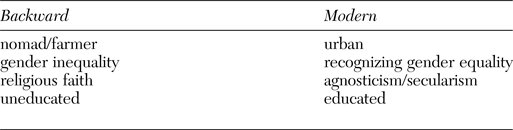
Through voicing Careful Village's residents, meanwhile, Sman bla skyabs indexes their social and geographic backgrounds. These villagers, juxtaposed with Sman bla skyabs and his partner speaking as themselves in the present, suggest two basic perspectives: backward and modern respectively. The key themes of the comedies map onto this backward-modern binary, becoming tools for articulating modernist ideologies—like the importance of secular education, rational agnosticism, and gender equality—that parallel the modernism of the Chinese state. Modern ideas are linked with urbanites like Sman bla and his speaking partner, and backward ideas are linked with the villagers, which may be visualized as shown in table 1. Due to space constraints, the list is representative rather than exhaustive. Other social issues in Careful Village include alcohol, tobacco, thieves, grassland disputes, and contact with foreigners.
Backward and modern themes in Careful Village.

In isolation, no one of these binaries would suggest that Tibetan comedians might be parroting the Chinese state's modernist discourse. Take, for instance, the critique of religious practitioners and religious faith. Tibet has a long history of satirizing clerics and persons in power, from Skal ldan rgya mtsho (1607–77), a bla ma from A mdo who composed songs chastising clerics for their impure ways (Sujata Reference Sujata2005), to Tibetan tricksters, like the famous Uncle Ston pa (a khu ston pa) who often targeted religious leaders.Footnote 16 Despite their sometimes-ribald content, the PRC government supported collecting and publishing Tibetan trickster tales because they seemed to portray a latent revolutionary spirit. Nevertheless, this institutional support did not extend to the trickster's lewd exploits. As the introduction to one highly sanitized 1980 collection of Uncle Tonpa stories states, Tibetan trickster narratives “reflect the pitiful Tibetan people thirsting to smash their fetters, [and] liberate themselves, [as well as] their irrepressible aspiration for a better life. The loves and hates of their class are quite clear…” (Sichuan Sheng 1980, 3).
In a similar fashion to how Uncle Tonpa's inclusion in Chinese state modernity requires first excising the trickster's off-color exploits, there is also no place in Tibetan comedic dialogues for off-color humor. The anti-clerical and anti-religious attitudes in these performances manifest instead only through the sort of sanitized encounters that the Chinese state allowed (and encouraged) on its stages. Combined with the other binaries, this anti-religious stance is not so much an extension of Tibetan traditions as an essential component of Tibetan modernism in the 1990s, and so in dialogue with Chinese state-sponsored modernism.
Tibetan Linguistic Modernity
Thus far, I have traced how juxtaposing characters of different backgrounds lends value to Sman bla skyabs's social critique. Beyond merely using language to index specific modernist principles, however, Careful Village also places language use at the center of Tibetan modernity. This is possible because the comedies put language on display for audiences. Indeed, the language that characters use also links specific discursive forms to social groups and their (stereotypical) values. In some cases, Sman bla skyabs deftly shifts his pitch, nasality, lexicon, and speech styles to imitate people with different social and educational backgrounds.Footnote 17 In others, he changes pitch to voice female characters. In still other instances, his partner Phag mo bkra shis, speaking as himself in the present, comments on a person, on what that person says, or on how they say it. These shifts are immediately recognizable to local audiences and are redolent with meaning. Three discursive forms in particular stand out for their ability to differentiate between characters with nomadic backgrounds and those with urban, educated backgrounds: the separation between spoken Tibetan and literary Tibetan, oaths, and metaphor and verse.
First, Tibetans in A mdo distinguish between terms that are considered yig skad (literary language) and kha skad (colloquial). In each of the Careful Village performances, Sman bla skyabs uses literary terms like ched du “in order to,” gang ltar “whatever,” ‘grel bshad “to explain,” and tha mag “cigarettes” when speaking as himself. This last term is not the colloquial word in A mdo, though it is in Lha sa dialect. (The commonly used term in A mdo is du ba.) Literary Tibetan appears again in Careful Village's Bride when Sman bla skyabs uses ha ma go “to not understand.” Terms associated with literary language or the (sometimes) higher-prestige Lhasa dialect, meanwhile, are absent from Sman bla skyabs's villagers. Audiences immediately recognize the use of literary language and that it suggests a speaker's education relative to A mdo's largely illiterate population.Footnote 18 When the speaker is not a cleric, literary language suggests, moreover, a modern, secular education. Oaths, the topic to which I turn next, also index particular social backgrounds for the characters represented in Careful Village.
Before beginning, let me emphasize that Tibetans distinguish oaths (mna’) from curses (dmod tshig). I am concerned here only with the former. Tibetan oaths (mna’) take a variety of forms. Some are regionally popular, while others are spoken across A mdo. For example, “by Rong bo Monastery” (Rong bo dgon) is an oath unique to inhabitants of the Reb gong region of which Rong bo is the primary monastery, whereas bka’ ‘gyur and bstan ‘gyur (the names of two sets of religious scriptures of special importance to Tibetans) are more typically associated with people from pastoral areas. In Careful Village's Thief, a number of different oaths are sworn as villagers emphasize the severity of the rash of thievery plaguing their pastoral community. These oaths include zha yis cho'i khrag “by my children's blood,” pha ma gnyis ka'i sha “by the flesh of both my parents,” and a rgya'i sha “by my father's flesh” (Sman bla skyabs and Phag mo bkra shis Reference Sman bla skyabs and Phag mo bkra shis1996d).
Significantly, each oath in this performance is linked to a character from Careful Village. “By my children's blood” (zha yis cho'i khrag) is placed in the mouth of an unnamed bald elder. Another unnamed character, described as having “two front teeth covered with iron,” uses “by both my parents’ flesh” (pha ma gnyis ka'i sha) on two occasions. A younger man, when forced to admit having stolen things in the past, is so embarrassed that he says “by my father's flesh” (a rgya'i sha) several times before finally confessing his sin. In swearing oaths, then, Sman bla skyabs speaks not as himself, but as a rural villager.
By contrast, characters from urban backgrounds and educated people rarely swear oaths. Indeed, in the entire Careful Village corpus, Sman bla skyabs only swears once as himself. At the beginning of Careful Village's Grassland Dispute when Careful Village's leader is pressing him to admit that he is a doctor, he swears “Picasso!” (Thurston Reference Thurston2013, 170). It is significant that the only oath he swears is a novel one that indexes a modern, educated experience characterized by knowledge of a Western painter.
A final way in which language use indexes specific social backgrounds lies in the use of metaphoric language and verse. Sman bla skyabs's characters also are notable for their consistent use of metaphoric language and of poetic genres like gtam dpe “proverbs.” But such figurative language leaves Phag mo bkra shis and the audience at a loss on several occasions. This requires Sman bla skyabs—who frequently admits that he too did not initially understand what had been meant by these phrases—to clarify with his after-the-fact knowledge. One such humorous misunderstanding occurs prominently in Careful Village's Thief, when villagers consistently refer to the thieves as khyi rkun “thieving dogs.” Phag mo bkra shis initially believes that the villagers seem to have a problem with the number of stray dogs living in their area. It is only later that he realizes the term “thieving dogs” is the local way of denigrating the thieves:
63A: [as the village leader] These so-called thieving dogs are human thieves. While they are “human thieves” they are also “thieving dogs.” Excepting that some have tails and some don't, they're all still thieves. Now if they're not thieving dogs, then what are they? Do you understand now?
64B: [with a voice of sudden realization] Oooh, now I understand. Those so-called thieving dogs are human thieves. The so-called human thieves are thieving dogs. Actually, they are both thieves.
Ka: khyi rkun zer no myi rkun red/ myi rkun zer rung khyi rkun red/ rnga ma yod med gzig gi khyad par min nas tshang ma rkun ma red/ da khir kun ma ra chi gzig red/ da e go thal/
Kha: O da go thal/ khyi rkun zer no myi rkun red/ myi rkun zer no khyi rkun red/ ngo ma bshad na rkun ma red la/ (Sman bla skyabs and Phag mo bkra shis Reference Sman bla skyabs and Phag mo bkra shis1996d)
Misunderstanding arises, then, when villagers use metaphorical language, thereby excluding outsiders from following the conversation.
In another example, from Careful Village's Grassland Dispute, as villagers describe their conflict with the opposing village, Phag mo bkra shis is confused when the village leader describes the dispute's origins and speaks of slaughtering. Phag mo bkra shis thinks that he was talking about slaughtering people, when in fact they are speaking of slaughtering the other village's livestock.
Here, the villagers use the parallel verse-like phrase du zin na du bsha’ ni red// ma zin na shor ‘gro ni red// “We slaughtered as many as we could catch, if we couldn't catch them, then they got away.” These parallel phrases might traditionally be considered kha bde no “eloquent,” but the use of such highly economical verse confuses the audience, and the urbane Phag mo bkra shis, because they lack the villagers’ inside knowledge of the situation.
Simultaneously, Sman bla skyabs speaks in verse extensively while performing the wedding speech. This is due to the genre he is appropriating: it is impossible to perform a wedding speech without this poetic register. Nonetheless, it remains significant that his figurative language relates to the modern world, and when he breaks out of the speech frame to converse with his partner, he speaks of the need to simplify the wedding speech with more direct and less artistic speech. Thus, in addition to language, the wedding speech genre itself is inadequate without the intervention of the secular intellectual who provides the Tibetan language with this intelligible, useful form. This allows him to retain his modern and educated persona, safely distancing him from troublesome tradition, while at the same time performing this tradition.
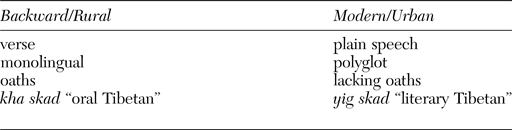
The same voicing of characters that lends ideological weight to Careful Village’s key themes (discussed above) is equally important to understanding the metadiscursive element of Sman bla skyabs's modernist critique. These linguistic practices provide additional criteria for A mdo Tibetan modernity, through creating a second set of backward-modern binaries (see table 2).
Backward and modern language practices in Careful Village.

Despite similarities to the Chinese state's modernity, by advocating for the continued place of the Tibetan language in a multilingual modernity, Tibetan comedians and public intellectuals construct a Tibetan modernity differing significantly from the Chinese state's: Tibetans can be modern and speak Tibetan so long as their Tibetan is literary, plain, and rational. Although this modernity still excludes Tibetans who, like Careful Village's uneducated nomads, fail to produce modernity's linguistic codes, Tibetan entry into modern life is no longer assimilationist, but is instead predicated on mastery of the requisite Tibetan linguistic competences.
Conclusion
In this article, I have suggested that comedy reveals language's oft-overlooked importance to Tibetan modernism. On the surface, the modernity promoted in Tibetan comedy, based in rationalism and modern secular education, appears similar to that promoted by the modernist Chinese state. Through linking discursive practices with characters and their social backgrounds, I argue that comedians aligned Tibetan engagement with modernity also in terms of appropriate discursive practices: polyglot, lacking in oaths, using plain speech rather than a preponderance of imprecise verse phrases, and literary (and therefore also educated). This second set of binaries allows the Tibetan language an important place in this modernity. In doing so, it complicates suggestions that these performers parrot state-articulated modernity.
The Tibetan modernity discussed here is specific to the historical moment in which these comedies were produced at the end of the twentieth century. In response to new cultural and political trends on the Tibetan plateau, Sman bla skyabs's later works take a more ambivalent attitude towards pastoralists and other rural peoples. Some satirize urbanites, others pastoralists. He advocates the preservation of Tibetan traditions, instead of satirizing traditional populations as backward. Always, however, language is at the center of his cultural critique.
Language continues to be an important part of Tibetan modernity. Tibetans in A mdo regularly organize meetings to promote pha skad gtsang ma “pure Tibetan.” Some self-immolators have even explicitly referenced language preservation in their last testaments (see Barnett Reference Barnett2012). Their concerns may be seen partly as a response to state education policies, but also, in part, because they have grown up in a cultural world inundated with reminders that the Tibetan language is crucial to Tibetan modernity. The government has shut down many such meetings, but others pop up to replace them.
Describing language in European modernity, Bauman and Briggs (Reference Bauman and Briggs2003, 310) argue that “rendering language invisible … has played a key role in imagining and naturalizing new schemes of social inequality.” I have suggested that Tibetan comedic dialogues—partly through reported speech—render language visible. In doing so they create a Tibetan modernity that combats the schemes of social inequality naturalized by China's monoglot modernity. However, minority intellectual concern with language in local modernities is not limited to China's Tibet. As communities around Asia and across the globe increasingly emphasize language's importance, attention to interactional practices in modern media and their ability to render language visible provides an important analytical tool for understanding both hegemonic and local modernities.
Acknowledgments
I am grateful to Dr. Gerald Roche and Professors Mark Bender, Dorothy Noyes, Kirk Denton, and Eric Mortensen for their invaluable comments on earlier versions of this paper; to Sman bla skyabs and others who shared their thoughts about the Careful Village comedies; and to the Department of Education for the generous Fulbright-Hays DDRA fellowship, which made much of this research possible. Writing and further research were made possible by a postdoctoral fellowship from the Smithsonian Institution, Center for Folklife and Cultural Heritage. Thanks also go to the reviewers and editorial team whose comments and critiques have improved the paper. Any remaining errors or oversights remain entirely my own.