

1. INTRODUCTION
1.1 Tonal cues to grammar
Many languages use tonal cues (intonation) to facilitate rapid processing of grammatical structures at the sentence level (Cutler, Dahan & van Donselaar Reference Cutler, Dahan and van Donselaar1997, Roll, Horne & Lindgren Reference Roll, Horne and Lindgren2011). Tonal cues for grammatical targets have also been found to operate within words, even from one syllable to the next (Roll, Horne & Lindgren Reference Roll, Horne and Lindgren2010). This is possible in Swedish due to ‘word accents’, where an association between tones on word stems and following suffixes (Rischel Reference Rischel1963, Bruce Reference Bruce1977, Riad Reference Riad1998) helps listeners activate the suffix already when hearing the stem (Söderström, Horne & Roll Reference Söderström, Horne and Roll2015, Roll et al. in press). For example, in the word fisk-en ‘the fish’, the stem fisk- has an accent 1 tone due to the singular definite suffix -en, whereas the same stem has an accent 2 tone when followed by the plural suffix -ar in fisk-ar ‘fishes’. Previous research on Central Swedish has revealed that accent 1 tones activate frontotemporal left-lateralized brain areas more than accent 2. The activated areas are thought to support tone–grammar interaction (Roll et al. in press). We have hypothesized that the reason that accent 1 increases activation is that it is a better suffix predictor than accent 2. Whereas accent 1 is only associated with a well-defined class of suffixes, accent 2 is associated not only with a set of suffixes but also with all compounds, e.g. fisk-soppa ‘fish soup’. However, differing brain responses to distinctive word accent tones could also be simply a result of the acoustic difference between the word tones. To see whether the differing brain response to accent 1 and accent 2 tones is due to activation of possible suffixes rather than just an acoustic difference in processing a low or a high tone, it is necessary to examine a dialect where word accent tones are realized differently than in the previously tested Central Swedish. The present study investigated the electrical brain response (brain potentials)Footnote 1 to word accents in South Swedish, a dialect where the tonal distinction between word accents is virtually the opposite of Central Swedish. Thus, in South Swedish, the stressed syllable begins with a higher tone in accent 1 than is the case for accent 2 (see Figures 1 and 2 in Section 2.2 below). In Central Swedish, the opposite pattern prevails: the accent 2 tone is higher than that for accent 1 (Bruce Reference Bruce1976). A further unexplored question is how the brain responds to word accents in word classes other than nouns. The present study tested nouns, but also went further and studied the effects of word accents in verb processing.
1.2 Word accent processing: Preactivation negativity
Previous brain potential studies have found negative electrical potentialsFootnote 2 at 136–280 ms following accent 1 (Roll et al. Reference Roll, Horne and Lindgren2010, Roll, Söderström & Horne Reference Roll, Söderström and Horne2013, Roll et al. in press), with greatest effect at electrodes located at frontocentral parts of the head. When a task focusing on the suffix was involved in the experiment, the negativity had a left-lateralized distribution across the scalp (Söderström et al. Reference Söderström, Horne and Roll2015, Roll et al. in press). In a study involving both brain potentials and functional Magnetic Resonance Imaging (fMRI), the negativity was found to correlate with increased activity in areas of the left superior temporal and inferior frontal cortex known to be involved in phonological and morphological processing (Roll et al. in press). The negativity has therefore been hypothesized to reflect a greater degree of preactivation of the suffix in the brain upon hearing the accent 1 stem tone, due to its usefulness as a predictor. The reason that accent 1 is a stronger suffix predictor is that it is associated with a limited set of suffixes, whereas accent 2, in addition to being associated with a set of suffixes, occurs in all compound words. Accent 1 stems can therefore provide a more confident prediction about the continuation than accent 2 stems. In support of this hypothesis, native speakers have been found to process accent 1 words with correct tone–suffix combination faster than accent 2 words with correct tone–suffix combination (Söderström, Roll & Horne Reference Söderström, Roll and Horne2012).Footnote 3 Listeners have also been observed to recover 88% of accent 1-associated suffixes which have been masked with a cough, as compared to 72% of masked accent 2 suffixes. (Söderström et al. Reference Söderström, Horne and Roll2015). The suffix recovery advantage correlates with the increased negative brain potential for accent 1. These results indicate that accent 1 activates its associated suffixes more strongly than accent 2.
Although ample support is gathering for the hypothesis that the brain potential effect for accent 1 is a ‘preactivation negativity’ indexing suffix activation, it still cannot be excluded that the difference in brain response to accents 1 and 2 is simply due to the perception of the acoustic difference between a low and a high tone. Roll et al. (Reference Roll, Söderström and Horne2013) addressed this question by testing ‘delexicalized’ word accents, which sound like humming with no lexical content. In that experiment, the brain potentials looked quite different from the effect of word accents in real words. Instead of an effect of accent 1, the high tone of de-lexicalized Central Swedish accent 2 produced an increase in the N1 component of the brain potentials, known to reflect detection of unexpected changes in the auditory environment. However, in order to obtain firm support for the hypothesis that the preactivation negativity for accent 1 does not simply reflect differential low-level acoustic processing, it is also necessary to test different tonal realizations of accents 1 and 2 in real words. This can be done in South Swedish, where accent 1 is realized as a high rather than a low tone at the onset of the stressed vowel, and accent 2 is a low rather than a high tone at the onset (Figures 1 and 2).
1.3 Cued suffixes
Suffixes that are validly cued by their associated word accent tone are processed faster than invalidly cued suffixes (Söderström et al. Reference Söderström, Roll and Horne2012). Invalidly cued suffixes in nouns have been seen to produce a Left Anterior Negativity (LAN) in the brain potentials (Söderström et al. Reference Söderström, Horne and Roll2015), possibly showing detection of an unexpected morpheme, followed by a posterior positivity (P600), indicating reprocessing of the incorrect word form (Roll et al. Reference Roll, Horne and Lindgren2010, Roll et al. Reference Roll, Söderström and Horne2013, Roll et al. in press). A LAN has so far been reported only in a study using pseudowords with real suffixes in a task focusing on the suffix (Söderström et al. Reference Söderström, Horne and Roll2015). It is currently unknown which brain potential effects word accents have on verb inflections.
1.4 The present study
In South Swedish, the tonal realization of word accents at the beginning of the stressed syllable is in effect the opposite of that in Central Swedish. This makes it possible to test whether previously found differences in the processing of accents 1 and 2 are likely to be due to acoustic differences between the realization of the two accents. This being the case, results in South Swedish would be expected to be very different from those of Central Swedish. If, however, the differential effects that have been observed are instead due to differences in the strength of the predictive value of the word accents, results for South Swedish should be similar to those of Central Swedish to the extent that the word accents have a similar cueing effect across dialects. The present study investigated the brain potentials produced when native speakers listened to South Swedish word accents and their associated suffixes in nouns and verbs. Both matching and mismatching word accent–suffix pairs were presented. The response time effects of judging word meaning based on the suffix (singular/plural, present/past) were also investigated. For sentences where critical words were nouns (see example (1) and Figure 1 below), the task was to judge as quickly as possible whether the test sentence was to be interpreted as meaning that the person (subject) got one or many things. For sentences with verbs as critical words (example (2) and Figure 2 below), the task was to judge whether the sentence was in the present (nutid ‘now-time’) or past (dåtid ‘then-time’) tense.
2. METHOD
2.1 Participants
Twenty right-handed native speakers of South Swedish, mean age 23.7 years, SD = 5.3, 13 women, participated in the study. All were undergraduate students at Lund University.
2.2 Procedure and stimuli
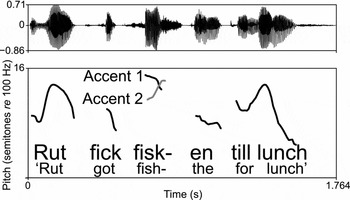
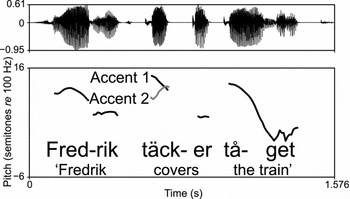
Participants sat in front of a computer screen listening to stimuli via loudspeakers. Thirty sentences per condition, 240 in total, were presented in four blocks in pseudorandomized order with SOA (stimulus onset asynchrony) jittered between 4 s and 8 s using Optseq2 (Dale Reference Dale1999). All sentences had the same syllable structure as in (1), for nouns (see Figure 1), and (2), for verbs (see Figure 2); target words are underlined.
Example stimulus sentence, showing accents 1 and 2 spliced together with the accent 1-associated suffix -en ‘definite singular’ in the target noun fisken ‘the fish’, thus creating matching (accent 1) and mismatching (accent 2) word accent–suffix combinations.

Example stimulus sentence, showing accents 1 and 2 spliced together with the accent 1-associated suffix -er ‘present tense’ in the target verb täcker ‘covers’, thus creating matching (accent 1) and mismatching (accent 2) word accent–suffix combinations.

(1)

(2)


Focus was on the target word (fisken/fiskar ‘the fish/fishes’ in (1) and täcker/täckte ‘covers/covered’ in (2)) in order to obtain maximal difference between word accents (Bruce Reference Bruce1976). Stimulus nouns containing two syllables and with voiceless stops at the boundary between stem and suffix (definite singular or plural for nouns, e.g. fisken/fiskar ‘the fish/fishes’, and present or past for verbs, e.g. täcker/täckte ‘covers/covered’) were chosen for ease of splicing. The critical noun was also always separated from the surrounding sentence material by a voiceless stop (fick ‘got’ and till ‘for’ in example (1) above, and Fredrik and tåget ‘the train’ in (2). A male South Swedish speaker recorded the sentences in an anechoic chamber. The critical words were extracted from the carrier sentence and were cut between stem and suffix in order to create combinations for cross-splicing stems with validly and invalidly cued suffixes. The intensity was normalized over stems and suffixes separately, and the stem/suffix fragments were spliced together to make valid and invalid combinations, which were then spliced back into the carrier sentences. The first part of the carrier sentences (Rut fick . . . ‘Rut got . . .’/Fredrik . . .) measured 553/463 ms in duration, SD = 53/72 ms. Stems (fisk- ‘fish-’/täck- ‘cover-’) had an average duration of 335/332 ms for accent 1, SD = 54/54 ms, and 345/339 ms for accent 2, SD = 45/55, t(29) = 1.11/2.75, p = .275/.010. Accent 1 suffixes (-en ‘definite singular’/-er ‘present tense’) had a duration of 215/142 ms, SD = 28/31 ms, and the duration of accent 2 suffixes (-ar ‘plural’/-te ‘past tense’) was 243/233 ms, SD = 53/49 ms. The mean duration of the phrase (e.g. till lunch ‘for lunch’/tåget ‘the train’) following the test word was 544 ms, SD = 53 ms. The parts preceding and following the critical noun were identical across conditions, and were in half of the cases taken from the singular/present tense recording, and in the other half, from the plural/past tense recording. The high accent 1 tone was on average 13.54/13.45 semitones (st) at vowel onset, SD = 0.68/0.66, and fell to M = 9.33/10.75 st, SD = 0.47/0.29, during M = 95/72 ms, SD = 34/17. The corresponding low accent 2 tone was 8.19/7.89 st, SD = 1.10/1.70 st at vowel onset, rising to 12.98/12.73 st, SD = 0.59/0.61, with a duration of 121/100 ms from vowel onset to offset, SD = 46/35 s.
2.3 Time points for measuring brain response and response times
The time-locking point for the electrical brain potential analysis of the word accent comparison was stem-vowel onset in the stressed syllable of test words, e.g. i in fisken ‘the fish’ (Figure 1) and ä in täcker ‘covers’ (Figure 2). This was the point where fundamental frequency started to differ between conditions. For the suffix comparison, brain potentials and response times were time-locked to the onset of the syllable containing the suffix, i.e. the burst of [k] in fisken/fiskar ‘the fish/fishes’ or täcker/täckte ‘covers/covered’. It is possible to distinguish plural from singular and present from past suffixes at this point due to co-articulation between the consonant (here [k]) and the suffix vowel ([e] or [a] in -en, -ar, and -er).
2.4 Recordings of electrical brain potentials
To obtain a measure of brain response to word accents and suffixes, electroencephalography (EEG) recordings were made and analyzed with the event-related potential (ERP) technique (Roll Reference Roll, Horne, Lindgren, Nilsson, Roll, Shtyrov, Ståhlberg and Topgaard2015). EEG uses electrodes attached to a cap to measure electric potential (voltage) fluctuations over the head of participants. The EEG equipment was a 27-channel EasyCap setup (19 active EEG electrodes) and a Synamps 2 amplifier. Impedances in the contact between electrodes and scalp were kept below 5 kΩ. The EEG data was filtered online (during recording) and offline (after recording). The lower edge of the online band-pass filter (cutoff frequency 0.05 Hz) was used to avoid slow large potentials due to e.g. sweating. The higher edge of the filter was set to 70 Hz to avoid ‘aliasing’, i.e. distortions due to activity at half the frequencies of signals exceeding the sampling frequency (250 Hz). A 30 Hz low-pass filter was applied offline to attenuate smaller muscular artifacts (Nilsson, Panizza & Hallett Reference Nilsson, Panizza and Hallett1993).
Some of the electric potential variation registered by the electrodes stems from changes in neural activity in the brain. The ERP technique aims at isolating potentials related to specific events, such as hearing different word accents. Pieces of EEG called event-related potentials (ERPs) are time-locked to a specific event type, cut out, and averaged over several trials per participant to increase signal-to-noise ratio. In this study, ERPs starting at 100 ms before the word accent and suffix points and ending 1000 ms thereafter were extracted. Figures 4 and 5 (in Section 3 below) show only the relevant parts of the brain potentials. The 100 ms pre-stimulus interval was used for ‘baseline correction’, meaning that the average potentials of that interval were subtracted from each data sample of the following 1000 ms. This is done to center the potentials around the horizontal axis. The ERPs were averaged over M = 28.5 trials per participant and condition, SD = 2.2. Originally, there were 30 trials per condition, but all trials with potentials exceeding ±100 μV were discarded, since such high values are likely to be due to e.g. movement artifacts. Before this procedure, blink- and eye- movement-related artifacts were compensated for using independent component analysis (Jung et al. Reference Jung, Makeig, Humphries, Lee, McKeown, Iragui and Sejnowski2000). Finally, the consistency of effects was estimated across all 20 participants using analysis of variance (ANOVA). The resulting statistically evaluated average of each condition and over all participants is referred to in this study as ‘brain potentials’.
As mentioned in note 2, there is no intrinsic meaning of brain potentials being negative or positive. The polarity depends to some extent on the reference electrodes, from which the signal of the active electrodes is subtracted. However, having equivalent reference channels, polarity can be used to recognize compontents with certain characteristics in the potentials across studies. Thus, for example, a negative peak at around 100 ms after the onset of auditory stimuli is called N100 or N1, and is known from many experiments to increase for unexpected sounds (Näätänen Reference Näätänen1992, Roll & Horne Reference Roll and Horne2011, Roll et al. Reference Roll, Söderström and Horne2013). In this study, a centroparietal electrode was used as online reference, and data were re-referenced offline to average mastoid reference (electrodes behind the ears) through a mathematical transformation. Ground reference was a centrofrontal electrode. This electrode is what the potentials of the active and reference electrodes are measured against. The placement of the ground reference is to a certain extent arbitrary, since the signal from the reference electrodes is subtracted from all potentials measured between the ground reference and active electrodes, which removes most placement effects of the ground reference on the brain potentials.
2.5 Statistical analyses
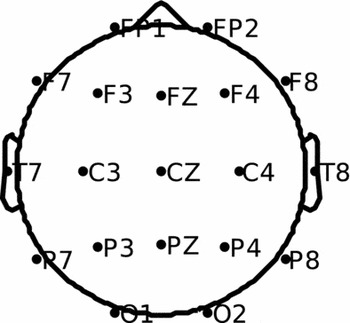
Within-subjects ANOVA of average brain potentials was performed with the experimental factors word class (noun, verb) and word accent (1, 2), as well as the topographical factors anterior–posterior (anterior, central, posterior) and hemisphere (left, right) corresponding to regions left anterior (F7, F3), right anterior (F4, F8), left central (T7, C3), right central (C4, T8), left posterior (P7, P3), and right posterior (P4, P8) (see Figure 3). At suffix onset, the factor validity (valid, invalid word accent suffix pairing) was added. Averages over conditions and effect time windows were used as raw scores. Time windows were determined on the basis of visual inspection and previous research. Behavioral results were analyzed with a suffix factor (accent 1-associated, accent 2-associated) instead of the word accent factor. The main reason for not using the suffix factor in the brain potential analysis of the suffix time point was that it would involve comparing the same suffix paired with different word accents. This would mean that the difference between word accents would affect the baseline of the suffix brain potentials, which would create artifactual effects. Greenhouse–Geisser correction was used when applicable. All and only significant effects are reported.
Locations of the 19 active electrodes on a head seen from above. A position slightly outside the head means that the electrode is lower than the visible surface.

3. RESULTS
3.1 Behavior
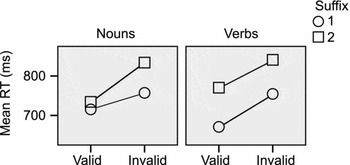
Response times are presented in Figure 4. Participants responded on average 74 ms faster to suffixes that were validly cued by the right word accent, M = 723 ms, SD = 275, than to invalidly cued suffixes, M = 797 ms, SD = 272, F(1,19) = 54.00, p < .001. There was also an effect of suffix, where accent 1-associated suffixes were responded to on average 70 ms faster than accent 2-associated, F(1,19) = 37.32, p < .001. Further, there was a difference between word classes, so that validity of word accent influenced accent 2-associated suffixes proportionally more than accent 1-associated suffixes in nouns. This was seen in a word class × validity × suffix interaction, F(1,19) = 7.65, p = .012, and a validity × suffix interaction for nouns, F(1,19) = 5.80, p = .026. Validity had a larger effect size for accent 2-associated suffixes, F(1,19) = 32.0, p < .001, ηp2 = 0.63, than for accent 1-associated suffixes, F(1,19) = 5.14, p = .035, ηp2 = 0.21. Accuracy was overall high, M = 97%, but a word class × validity interaction, F(1,19) = 4.95, p = .038, showed that invalid word accent–suffix combinations significantly decreased accuracy from 98.5% to 97.4% only in nouns, F(1,19) = 5.07, p = .036.
Response times (RTs) for nouns and verbs. Suffixes that were validly cued by the right word accent were processed faster than invalidly cued suffixes. Word accent affected accent 2-associated suffixes more than accent 1-associated suffixes in nouns.

3.2 Brain potentials
3.2.1 Word accent onset
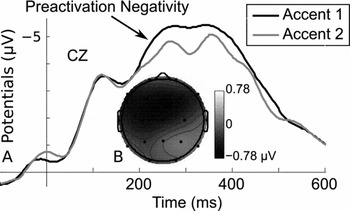
At 220–280 ms following f0 onset, a deflection for accent 1 with a central-to-left anterior distribution produced a main effect for word accent in both nouns and verbs (Figure 5), F(1,19) = 4.67, p = .044.
Electrical brain potentials for South Swedish word accents. (A) Potentials at central electrode CZ time-locked to f0 onset. A preactivation negativity is seen for accent 1. (B) Topographical distribution of the negativity (accent 1 – accent 2 subtraction) 220 ms – 280 ms following f0 onset.

3.2.2 Suffix onset
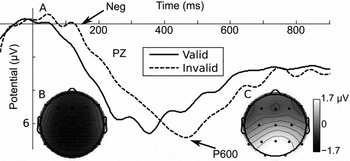
There was a broadly distributed negativity for invalid suffixes at 110–240 ms following suffix onset, producing a main effect of validity (Figure 6), F(1,19) = 23.76, p < .001. At 400–600 ms, there was a posterior positive deflection for invalidly cued suffixes (Figure 6), giving rise to a validity × anterior-posterior interaction, F(1,19) = 12.60, p < .001, and an effect of validity at posterior leads, F(1,19) = 12.09, p = .003.
Electrical brain potentials for suffixes that were either validly cued by the right word accent tone or invalidly cued by the wrong word accent tone. (A) Potentials at parietal electrode PZ time-locked to suffix onset. Invalidly cued suffixes produced a negativity (Neg) followed by a positivity (P600). The negativity (invalid – valid subtraction) had a broad topographical distribution (B) and the positivity was posterior (C).

4. DISCUSSION
The present study investigated response times and electrical brain potentials in the processing of South Swedish nouns and verbs with accents 1 and 2, as well as with valid and invalid word accent–suffix combinations. Suffixes that were validly cued by their associated word accent were seen to be processed faster than invalidly cued suffixes. This is similar to Central Swedish, and indicates that test participants used the word accent tones to preactivate the associated suffixes. In nouns, the response time advantage for validly cued suffixes was greater for accent 2-associated suffixes than for accent 1-associated suffixes. This result also partly replicates findings from Central Swedish, and could be interpreted as a consequence of accent 2-associated suffixes depending more on being cued by their lexically marked tone (Roll et al. Reference Roll, Horne and Lindgren2010, Riad Reference Riad2014). However, the result could also stem from an augmented blocking effect of accent 1 as compared to accent 2. Thus, whereas accent 1 is only associated with a well-defined set of suffixes, accent 2 is associated with suffixes and also with all compound words in Central Swedish. Accent 2 is more common in compound words than accent 1 in South Swedish as well (Bruce Reference Bruce1973, Frid Reference Frid2000). In other words, upon hearing an accent 1 stem, a more limited number of continuations are accessible to the listener, whereas accent 2 stems open possibility of an in principle infinite set of compounds in addition to a set of suffixes. Therefore, accent 1 can be thought to more strongly preactivate its associated set of suffixes and inhibit other possible continuations, and hence to have more detrimental effects on the processing of uncued suffixes than accent 2. A possible explanation for the difference between nouns and verbs is that verb stems might be less likely to appear in compound words in the sentence position used in the experiment. Therefore, the accent 2 tone might in this specific context be almost as constraining as the accent 1 tone in these verbs. Further, it might be that word accents influence suffixes of the word classes differently due to the modification of the task, i.e. judging number vs. tense.
In previous studies on brain potentials of word accents, a ‘preactivation negativity’ appearing shortly after the accent 1 tone has been hypothesized to index increased preactivation of accent 1-associated suffixes. A central-to-left anterior preactivation negativity was also seen in the present study, but it was not as extensive as that found in Central Swedish, being significant only between 220 ms and 280 ms following f0 onset. This supports the hypothesis, since it indicates that the preactivation negativity is not the result of perceiving the acoustic difference between word accents. An effect of the acoustic difference would be thought to give the opposite results in South Swedish, where word accents are practically the mirror image of those in Central Swedish. In other words, a negative potential would be expected for accent 2 instead of accent 1 in South Swedish if it were the case that the negativity was due to acoustic differences between the word accent tones. A possible explanation for the less pronounced effect in South Swedish than in Central Swedish is that preactivation of accent 1-associated suffixes might be slightly weaker in South Swedish than in Central Swedish, since some compound words have accent 1 in South Swedish although accent 2 is more common (Bruce Reference Bruce1973, Frid Reference Frid2000).
Suffixes that were invalidly cued by the wrong word accent produced a broadly distributed negativity. The time window of the negativity was similar to the left anterior negativity (LAN) previously found for invalidly cued suffixes in pseudowords (Söderström et al. Reference Söderström, Horne and Roll2015). This LAN has previously been observed to have a more left anterior distribution, similar to the preactivation negativity of the present study. The preactivation negativity has been seen to correlate with activity in Brodmann area (BA) 47 in the inferior frontal gyrus, an area related to increased morphological processing (Tyler, Marslen-Wilson & Stamatakis Reference Tyler, Marslen-Wilson and Stamatakis2005, Koester & Schiller Reference Koester and Schiller2011). A hypothesis is that the preactivation negativity and the LAN for invalid suffixes both reflect activity in BA47 due to increased morphological processing, in one case, related to activating associated suffixes, and in the other case, related to difficulty in processing a non-preactivated suffix (Söderström et al. Reference Söderström, Horne and Roll2015, Roll et al. in press). The difference in distribution of the negativity for invalid suffixes in the present study might be due to the increased amount of semantic information that was processed in the existing words, whereas the absence of lexical information in pseudowords in the previous experiment forced concentration on morphological features. The negativity for invalidly cued suffixes was followed by a positivity, as has been previously found. This positivity is interpreted as a P600 effect, showing reprocessing of the incorrect word accent–suffix combination, most likely perhaps in terms of the meaning of the suffix (Roll et al. in press).
In conclusion, the present results support the hypothesis that Swedish word accent tones rapidly activate suffix representations engaging mainly the language-dominant hemisphere. Importantly, the study shows that the preactivation negativity previously found in brain potentials for Central Swedish word accents is unlikely to result from processing of low-level acoustic features, since a similar effect was obtained for South Swedish word accents, which are acoustically radically different from the Central Swedish realizations. In addition, word accent–suffix mismatch in South Swedish produced effects that were very similar to those obtained for Central Swedish. The present study also extended previous findings of word accent–suffix processing in nouns, showing that word accent tones activate suffixes in verbs in a manner similar to that observed in nouns.
ACKNOWLEDGEMENTS
This work was supported by the Swedish Research Council (grant number 2011–2284), Knut and Alice Wallenberg Foundation (grant number 2014.0139), and Marcus and Amalia Wallenberg Foundation (grant number 2014.0039). I thank Otto Ewald for recording the stimuli and collecting the data. The comments of two anonymous reviewers helped improve and clarify the manuscript.