Central-line–associated bloodstream infections (CLABSIs) and catheter-associated urinary tract infections (CAUTIs) are associated with adverse clinical outcomes. CLABSIs are associated with greater lengths of hospital stay and mortality rates.Reference Rello, Ochagavia and Roque1,Reference Siempos, Kopterides, Tsangaris, Dimopoulou and Armaganidis2 Similar adverse outcomes have been associated with CAUTIs in critically ill patients.Reference Chant, Smith, Marshall and Friedrich3 These hospital-associated catheter infections also pose a financial burden, with estimated additional hospital costs of $48,000 and $14,000 for CLABSIs and CAUTIs, respectively, and hospitals may not be reimbursed for these costs.4 These infections are also factored into value-based purchasing policies, further financially penalizing medical centers with higher rates.
More than a decade ago, interventions were developed to reduce CLABSIs and CAUTIs. These interventions largely emphasized reducing unnecessary catheter use and improving catheter care. Initial reports documented impressive declines in both CLABSIsReference Edgeworth, Batra, Wulff and Harrison5–Reference Burton, Edwards and Horan8 and CAUTIsReference Saint, Greene and Krein9,Reference Magill, O’Leary and Janelle10 following the institution of catheter “bundles.” The Centers for Disease Control and Prevention published multicomponent 2-tiered approaches for reducing CLABSIs and CAUTIs.Reference Patel, Olmsted and Hung11,Reference Meddings, Manojlovich and Fowler12 For each, the initial tier includes emphasis on decreasing catheter utilization and promoting specific insertion and maintenance techniques. If rates remain elevated despite first-tier implementation, second-tier recommendations can be attempted. The second-tier components include catheter rounds, feedback, observed competencies, and focused reviews. More recent studies have suggested that these tiered measures may not always be successful or reach a leveling off point,Reference Edgeworth, Batra, Wulff and Harrison5,Reference Patel, Greene and Jones13,Reference Meddings, Manojlovich and Ameling14 which suggests that additional infection control measures will be needed for further reductions.
In this report, we describe trends regarding CLABSIs and CAUTIs in 11 acute-care medical centers under the New York City Health + Hospitals system.
Methods
The New York City Health + Hospitals system includes 11 acute-care medical centers in the boroughs of Brooklyn, Bronx, Manhattan, and Queens. These public facilities all have major academic affiliations, and they predominantly serve persons residing in neighborhoods of low socio-economic status.
Information regarding hospital-specific reportable infections were obtained from the National Healthcare Safety Network (NHSN) database and retrospectively reviewed. Line listings for each reportable infection were obtained for each hospital for the period of January 1, 2016, through December 31, 2019. CLABSIs and CAUTIs were identified according to Centers for Disease Control and Prevention NHSN definitions. Patients were excluded if the diagnosis of mucosal barrier injury laboratory-confirmed bloodstream infection or asymptomatic bacterial urinary tract infection was entered. For each medical center, the annual standardized infection ratios (SIRs), number of catheter days, and number of patient days were also gathered. The 2019 Medicare case-mix index (CMI) and average length of stay (LOS) for each hospital were obtained from the American Hospital Directory (AHD.com).
Statistical analysis
The Student t test and Fisher exact test were used to compare continuous and categorical values, respectively. Multiple linear regression analysis was used to determine any correlation between SIRs with CMI and LOS. A P ≤ .05 was considered significant.
Results
CLABSIs
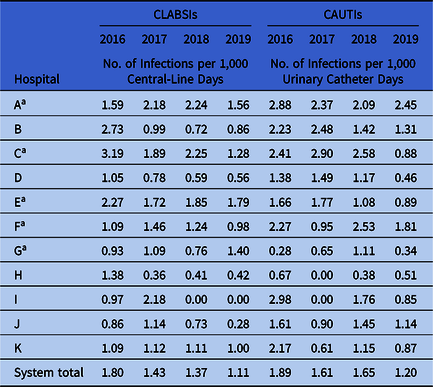
From 2016 to 2019, the number of CLABSIs reported for the entire 11-hospital system progressively declined: 159 in 2016, 124 in 2017, 111 in 2018, and 85 in 2019. The average age of the patients with CLABSIs remained constant over the 4 years: 55.4 ± 23.2 years in 2016, 51.2 ± 25.5 years in 2017, 54.8 ± 23.2 years in 2018, and 50.4 ± 26.0 years in 2019. The number of central-line days across the system decreased: 88,105 days in 2016, 86,905 days in 2017, 80,781 days in 2018, and 76,444 days in 2019. The number of infections per 1,000 central-line days also progressively declined across the system (Table 1). The number of patient days across the system remained stable: 819,449 in 2016, 828,982 in 2017, 809,482 in 2018, and 794,174 in 2019). The device utilization ratios (ie, central-line days per hospital patient days) decreased: 0.1075 in 2016, 0.1048 in 2017, 0.0998 in 2018, and 0.0963 in 2019. Dialysis-related infections were frequent, accounting for 33 of 159 CLABSIs (21%) in 2016, 11 of 124 (9%) in 2017, 24 of 111 (22%) in 2018, and 34 of 85 (40%) in 2019. Notably, documentation of the presence of a dialysis catheter became a mandatory reporting item in 2019, likely accounting for the increase for that year. The median time from admission to infection decreased over the 4-year period: 24 days in 2016, 24.5 days in 2017, 20 days in 2018, and 18 days in 2019. The average annual SIRs for the 11 hospital system also progressively decreased: 1.40 in 2016, 1.09 in 2017, 1.04 in 2018, and 0.82 in 2019. Multiple linear regression analysis revealed a direct relationship between SIRs and CMI (P <.01) but not with LOS. The SIRs were higher in the 7 hospitals with CMI ≥1.5 compared to the 4 hospitals with CMI <1.5: 1.13 ± 0.24 vs 0.29 ± 0.21; P < .001).
Trends in the Numbers of CLABSIs and CAUTIs per 1,000 Device Days for the 11 Acute-Care Hospitals, 2016–2019

a Level 1 trauma center.
Of the 11 hospitals, 5 (ie, A, C, E, F, G) were level 1 trauma centers. For the 4-year period, these 5 hospitals accounted for 2,014,645 of 3,252,087 total patient days (62%) and 208,923 of 332,235 central-line days (63%), and 354 of 479 of all CLABSIs (74%). Compared with the 6 hospitals that were not trauma centers, both the annual number of infections per 1,000 central-line days and the SIRs were significantly higher in the 5 trauma-center hospitals: 1.64 ± 0.60 versus 0.89 ± 0.61 infections per 1,000 central-line days (P < .001) and 1.43 ± 0.56 versus 0.80 ± 0.50, (P < .001). Of the 354 CLABSIs from the trauma centers, 57 originated from patients in NHSN-defined surgical intensive care units versus 8 of the 125 CLABSIs from surgical intensive care units in the nontrauma centers (P = .006).
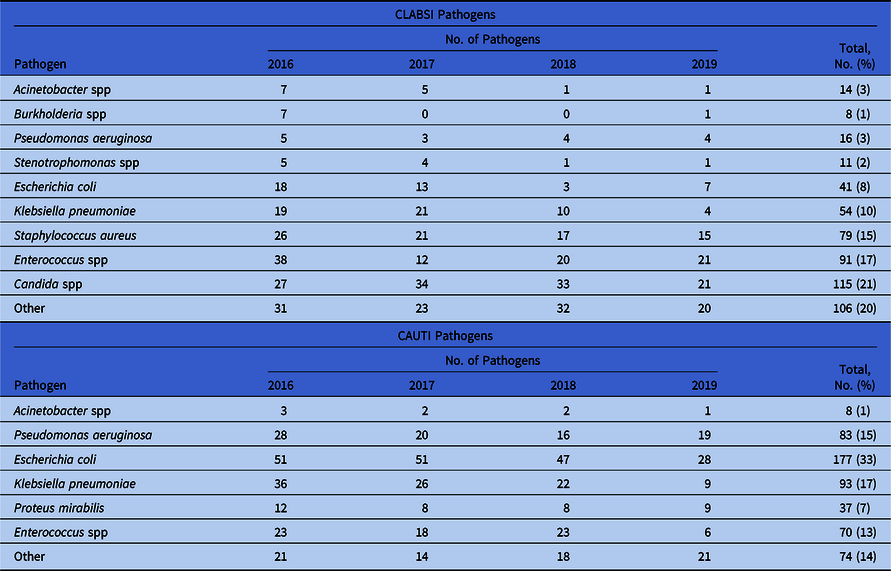
Over the 4-year period, 535 pathogens were involved in the 479 CLABSIs (Table 2). The number of infections due to nonfermenting bacteria (Acinetobacter spp, Burkholderia spp, Pseudomonas aeruginosa, and Stenotrophomonas spp), well-recognized catheter-related pathogens, were infrequent. Over the 4-year period, there were impressive declines in the number of infections attributed to Enterobacteraceae (Escherichia coli and Klebsiella pneumoniae). However, Enterococcus spp and Candida spp remained problematic pathogens, accounting for nearly 40% of all infections. For the infections occurring in the adult intensive care units, Candida spp were especially challenging, accounting for 66 of 239 infections (28%); however, none of the Candida isolates were identified as Candida auris.
Pathogens Involved in CLABSIs and CAUTIs Reported by the 11 Hospitals, 2016–2019

CAUTIs
From 2016 to 2019, there was a decline in the number of CAUTIs reported for the hospital system. The numbers of reported CAUTIs for the 11 hospitals were 157 in 2016, 133 in 2017, 123 in 2018, and 87 in 2019. The percentage of patients with CAUTIs that were female remained constant over the 4-year study period: 73 of 157 (46%) in 2016, 68 of 133 (51%) in 2017, 63 of 123 (51%) in 2018, and 44 of 87 (51%) in 2019. Similarly, average age of the patients with CAUTIs remained constant over the 4 years: 62.8 ± 17.3 years in 2016, 66.2 ± 15.3 years in 2017, 65.4 ± 15.6 in 2018, and 66.1 ± 15.9 in 2019. The number of infections per 1,000 device days progressively declined across the 11-hospital system (Table 1). The device utilization ratios also decreased: 0.101 in 2016, 0.0998 in 2017, 0.0924 in 2018, and 0.0915 in 2019. The median time from admission to infection was unchanged over the 4-year period: 14 days in 2016, 16 days in 2017, 14 days in 2018, and 18 days in 2019. The average annual SIRs trended downward for the system: 1.42 in 2016, 0.93 in 2017, 1.18 in 2018, and 0.78 in 2019. We detected no correlation between SIRs with CMI or LOS.
As previously noted, the 5 level 1 trauma centers accounted for 62% of all patient days. These 5 hospitals accounted for 189,161 of 313,148 urinary device days (60%) but 328 of 500 CAUTIs (66%). Compared with the 6 hospitals that were not trauma centers, the annual rate of infections per 1,000 device days were higher in the 5 trauma center hospitals: 1.69 ± 0.86 versus 1.21 ± 0.75 infections per 1,000 device days (P = .05). However, the SIRs were similar between the 2 groups: 1.16 ± 0.60 versus 1.02 ± 0.74 for the trauma and nontrauma centers, respectively (P nonsignificant). Of the 328 CAUTIs from the trauma centers, 62 originated from patients in a defined surgical intensive care unit versus 6 of the 172 CAUTIs from the nontrauma centers (P < .001).
Over the 4-year period, 542 pathogens were involved in the 500 CAUTIs (Table 2). During this period, there were notable declines in the number of infections attributed to Enterobacteraceae (eg, Escherichia coli, Klebsiella pneumoniae, and Proteus mirabilis) and Enterococcus spp. However, infections with Pseudomonas aeruginosa were frequent and persistent, accounting for 15% of all positive cultures. Of the 500 CAUTIs, 195 (39%) involved patients residing in intensive care areas. Of the 210 pathogens identified from patients from intensive care units, 80 were Escherichia coli, compared with 90 of the 332 cultures from outside intensive care areas (P = .008). The remaining pathogens were distributed proportionately between intensive care and nonintensive care areas.
Discussion
Because of the clinical and financial burden, the prevention of hospital-associated-device–related infections has become an important priority for medical centers. A decade ago, many of these infections were felt to be preventable.Reference Umsheid, Mitchell, Doshi, Agarwal, Williams and Brennan15 Prevention of CLABSIs has the greatest clinical and economic impact, even though CAUTIs have been considered the most preventable infection.Reference Siempos, Kopterides, Tsangaris, Dimopoulou and Armaganidis2,Reference Umsheid, Mitchell, Doshi, Agarwal, Williams and Brennan15 Following multicomponent interventions that stressed reducing device utilization and improving maintenance care, impressive initial declines in CLABSIs and CAUTIs can be achieved.Reference Edgeworth, Batra, Wulff and Harrison5–Reference Magill, O’Leary and Janelle10,Reference Xiong and Chen16 However, it appears with time the reductions reach a plateau,Reference Edgeworth, Batra, Wulff and Harrison5,Reference Patel, Greene and Jones13,Reference Meddings, Manojlovich and Ameling14 and additional measures may be needed.
In this study, we assessed continued reductions in the number of CLABSIs and CAUTIs across a system that encompasses 11 acute-care public hospitals. Several lines of evidence suggest that the items of emphasis regarding the Centers for Disease Control and Prevention’s tiered approach remain important.Reference Patel, Olmsted and Hung11,Reference Meddings, Manojlovich and Fowler12 First, the device utilization ratios for both central lines and urinary catheters declined over the 4-year period, suggesting that implementation of programs to emphasize removal and/or alternatives are effective. During the 4-year study period, a system-wide policy regarding midline catheters (introduced in 2017) was enacted, likely contributing to reduced central line utilization. Similarly, external urinary catheter systems for females were introduced during the study period, possibly contributing to the decline of urinary catheter utilization. Additionally, intermittent straight catherization protocols were encouraged during this period. However, the percentage of CAUTIs involving female patients did not change, which suggests that other factors were involved.
Second, over the 4-year period, the number of infections per 1,000 device days declined for both central lines and urinary catheters. Improvements in both insertion techniques and catheter maintenance may have contributed to these declines. Compliance with components of catheter “bundles” has been shown to correlate with reductions in infectionsReference Yoko, Dick, Herzig, Pogorzelska-Maziar, Larson and Stone17 and may explain some of the system reductions and interhospital variability observed in this study. It is likely that attitudes and protocols regarding culturing febrile patients evolved over the 4-year period and may also account for the interhospital variability. Finally, administrative effects may have contributed to the declines; for example, more diligent efforts to identify secondary sources of bacteremia could have led to fewer reported CLABSIs.
During the study period, reductions in CLABSIs and CAUTIs were included in the New York State Department of Health Value Based Purchasing Quality Improvement Program as quality indicators. As a result, efforts to decrease the infections were a priority of the hospital system. These efforts included dedicated quality improvement nurses trained to educate healthcare workers and to implement the system-wide quality program, including overseeing compliance with bundles. Notably, the New York State Department of Health audits medical centers regarding the reporting of CLABSIs, ensuring the validity of those reports. However, CAUTIs are not audited, and rates may be affected by the diligence in identifying catheter-related infections.
Patient-specific variables have been identified that will increase the likelihood of a CLABSI to occur.Reference Pepin, Thom and Sorkin18,Reference Kritchevsky, Braun and Kusek19 Patients on hemodialysis represent an important at-risk population, and in our report patients on dialysis accounted for ~40% of all CLABSIs in 2019. In addition, unit-specific risk factors may affect risk of CLABSIs.Reference Kritchevsky, Braun and Kusek19 In our study, level 1 trauma centers had significantly higher infection rates (and corresponding SIRs) than nontrauma centers. The trauma centers also had significantly higher CMIs, confirming the greater complexity of patients in these centers. In addition, a disproportionate number of CLABSIs originated from surgical intensive care units from these trauma centers. Given the frequent complications and multisystem organ involvement of patients following serious trauma, novel strategies may be needed to reduce CLABSIs in level 1 trauma centers. For example, at one of the trauma centers in this report, fluconazole prophylaxis for patients on prolonged parenteral nutrition in a surgical intensive care unit was associated with a significant reduction of catheter-related candidemias (data not shown). Risk adjustment in the calculation of SIRs should be considered for trauma centers.
Although overall trends showed reduced numbers of CLABSIs and CAUTIs, several pathogens were identified that remain problematic. For CLABSIs, Enterococcus spp and Candida spp together accounted for 40% of all CLABSIs. The intrinsic resistance of these 2 pathogens to broad-spectrum antibiotics, including fluoroquinolones and cephalosporins, likely contributes to this finding. The preponderance of Enterococcus and Candida is also likely the result of the NHSN surveillance definition of pneumonia, which is frequently used to attribute a bloodstream infection as a secondary source. Both Enterococcus and Candida bloodstream infection can only rarely be attributed to bacterial pneumonia (ie, PNU2). For CLABSIs occurring in the intensive care areas, 28% involved candidemia, likely a reflection of the number of patients on total parenteral nutrition and with intra-abdominal complications in these areas. Pseudomonas aeruginosa continues to be a frequent pathogen involved in CAUTIs, a concern because of the propensity for this pathogen to become resistant to multiple classes of antimicrobial agents.
Acknowledgments
We thank the infection preventionists in the NYC Health + Hospitals system for their dedication and efforts.
Financial support
No financial support was provided relevant to this article.
Conflicts of interest
All authors report no conflicts of interest relevant to this article.