INTRODUCTION
Party ideology has long been recognized as an important variable in explaining the political representation of women across the globe. Leftist parties, because of an emphasis on egalitarianism, would be more inclusive of women whereas parties of the Right, because of their more conservative ideas about women's public and private roles, would be less likely to place women on their party lists (Caul Reference Caul1999; Craske Reference Craske1999; Duverger Reference Duverger1955; Matland and Studlar Reference Matland and Studlar1996; Rule Reference Rule1987). Political parties of the Right like the Unión Demócrata Independiente (UDI) party in Chile, therefore, would be expected to lag behind parties of the Left in support of female candidates. But the UDI leads among Chilean parties in placing women into local positions of power. Of the 42 women mayors elected in 2000, 17 were UDI party members. The party has nominated the greatest proportion of women to municipal councils. More than a third of all female mayoral candidates for the 2004 elections were members of this party, as were a significant percentage of independents aligned with the party. How has the most conservative party in Chile placed the most women in local politics?
The exceptionalism of the UDI cannot easily be explained. Ideological explanations do not unravel this puzzle. By focusing on parties within a single national context, we are able to control for many of the factors regularly cited to explain the dearth of women in politics, such as electoral systems, district magnitude, cultural explanations, and modernization levels. Currently, much academic work has focused on the role of gender quotas (either national or party level) to explain variation, but those explanations are also inadequate. The UDI has managed to outperform all three of the major center-left parties that use gender quotas.
This project contributes to the literature on female representation that has focused on explaining differences across parties (e.g. Caul Kittilson Reference Caul Kittilson2006; Lovenduski and Hills Reference Lovenduski and Hills1981; Norris and Lovenduski Reference Norris and Lovenduski1995). I demonstrate that the success enjoyed by women of the UDI at the local level can be attributed to the party's candidate selection processes, a factor that has received more limited academic attention. Understanding how the UDI has nominated and elected more women to local office than the Chilean parties that actively seek to increase female participation is important for two reasons: First, it allows us to understand how a party that does not prioritize increasing women's political participation has nonetheless done so; and secondly, it sheds light on the causal mechanisms of candidate selection processes and their effects on female representation.
The importance of studying the role of parties in explaining women's political underrepresentation cannot be overemphasized: Parties are “the missing variable” in research on women's participation in politics (Baer Reference Baer1993). Studies have concluded that discrimination by political party elites, that is, failing to recruit female candidates, nominating women to unwinnable seats, and refusing to support female candidacies, has declined (Burrell Reference Burrell, Thomas and Wilcox1998; Carroll Reference Carroll2001; Darcy, Welch, and Clark Reference Darcy, Welch and Clark1994), but academic research nonetheless continues to indicate that party elites seek qualities in candidates that are more likely to belong to men than to women (Norris and Lovenduski Reference Norris and Lovenduski1995; Tremblay and Pelletier Reference Tremblay and Pelletier2001).
Researchers have also found that the lack of female officeholders is a consequence of a lack of female candidates (Burrell Reference Burrell1992; Darcy, Welch, and Clark Reference Darcy, Welch and Clark1994; Hinojosa Reference Hinojosa2005; Sanbonmatsu Reference Sanbonmatsu2006a; Seltzer, Newman, and Leighton Reference Seltzer, Newman and Leighton1997). Pioneered by Pippa Norris and Joni Lovenduski's (Reference Norris and Lovenduski1995) study of political recruitment in Great Britain, scholarly attention has turned to the importance of candidate recruitment and selection in explaining the scarcity of female candidates in a number of countries (Caul Reference Caul2001; Caul Kittilson Reference Caul Kittilson2006; Fox and Lawless Reference Fox and Lawless2004; Fox and Oxley Reference Fox and Oxley2003; Lawless Reference Lawless2003; Niven Reference Niven1998, Reference Niven2006; Tremblay and Pelletier Reference Tremblay and Pelletier2001). Research on the impact of political recruitment on women's representation has largely focused on national-level office—the exception would be Kira Sanbonmatsu's (Reference Sanbonmatsu, Carroll and Fox2006b) work on the United States.
Few studies, however, have analyzed the effects of candidate selection processes outside of the advanced industrialized countries. Moreover, while important work has focused on candidate recruitment and selection in Latin America (Camp Reference Camp1995; Crisp Reference Crisp2001; De Luca, Jones, and Tula Reference De Luca, Jones and Tula2001; Martz Reference Martz2000; Navia Reference Navia2004; Smith Reference Smith1979; Taylor-Robinson Reference Taylor-Robinson2001), only a handful of scholars have analyzed the effects of these candidate selection processes on women's political representation in the region (Baldez Reference Baldez2004; Escobar-Lemmon and Taylor-Robinson 2004; Heath, Schwindt-Bayer, and Taylor-Robinson Reference Heath, Schwindt-Bayer and Taylor-Robinson2005; Hinojosa Reference Hinojosa2005). The malleability of candidate recruitment and selection processes makes this an especially promising avenue for scholarly research. For example, in recent years, changing party rules and national legislation have led to a significant increase in the use of primaries across Latin America (Carey and Polga-Hecimovich Reference Carey and Polga-Hecimovich2004; Poiré Reference Poiré2002). Understanding the consequences that candidate selection processes have on women's representation is crucial.
This study examines the effects of candidate selection procedures on municipal elections in Chile. Local-level elections in Chile are ideal for academic analysis since they are less responsive to the distortions introduced by the binomial system for national legislative elections;Footnote 1 it is only at the local level where we can really see voters' party preferences. As Alfredo Joignant and Patricio Navia note: “The municipal elections have become the most realistic and trustworthy sample of the national importance of each party” (Reference Joignant and Navia2003, 143). The importance of local politics in Chile continues to grow; some mayors are now considered “national leaders” within their parties (Mardones Z. Reference Mardones Z.2006, 14). Municipal elections are also significant because of the small size of the country, the few elected positions available at all levels of government, and the ability to use a position in local politics as a jumping-off point for higher-level office.Footnote 2
Analyzing women's representation at the local level is particularly important because local office can serve as a stepping stone to more important political positions. Because these seats are “often less competitive, require less costly campaigns, and are less likely to require relocation away from familial demands” they should also be most accessible to women (Vengroff, Nyiri, and Fugiero Reference Vengroff, Nyiri and Fugiero2003, 163).Footnote 3 The access of women to local office may even today be eased by traditional ideas of their proper roles, which allow them to enter politics as “as an extension of their family role to the arena of public affairs” (Chaney Reference Chaney1979, 20). Chilean women's initial foray into politics was at the local level. In 1934, women received the right to vote and run for municipal office. But it was not until 1949 that women were given these rights for national office.Footnote 4 It is also important to study women's representation at the local level because a lack of female officeholders at this level could decrease women's political interest, activism, and sense of political efficacy (see, for example, Atkeson Reference Atkeson2003; Brill Reference Brill1995; High-Pippert and Comer Reference High-Pippert and Comer1998).Footnote 5 Women's descriptive representation likely translates into substantive representation: Studies of female legislators in Latin America have demonstrated that women in office promote women's interests (Jones Reference Jones1997; Schwindt-Bayer 2006; Taylor-Robinson and Heath Reference Taylor-Robinson and Heath2003).
As Norris and Lovenduski note, “Many studies have focused on the formal recruitment process as set out in legal regulations, constitutional conventions and formal party rules. These studies often assume that the formal processes determine the outcome. The obvious weakness of this approach is that formal rules may have little bearing on informal practices” (Reference Norris and Lovenduski1995, 9). In contrast, this study draws heavily on more than eight months of fieldwork undertaken in Chile during 2002, 2004, and 2006. More than 50 interviews were carried out with local- and national-level politicians and political elites.Footnote 6 The case of the UDI underscores the need to analyze patterns of women's representation in politics. I propose that by examining a party's candidate selection procedures, we can further our understanding of women's political representation and underrepresentation.
This article explains that candidate selection procedures are key to the success enjoyed by women from the UDI in municipal politics. First, I provide background on the Chilean political system and women's political representation. Next, I propose a framework for analyzing candidate selection and posit hypotheses concerning women's abilities to become candidates in different types of selection settings. I then turn to data about the UDI to demonstrate how the party's selection procedures have proven beneficial to women. Finally, the article presents some general conclusions and directions for future research on women's representation in politics.
THE CHILEAN PARTY SYSTEM
Although the Chilean electorate has been divided into three thirds throughout its modern history, reflecting the political Right, the center, and the Left, the institution of the binomial electoral system has forced the existence of two coalitions, composed of six major parties.Footnote 7 The Concertación is an amalgamation of political parties of the center and Left: the Partido Por la Democracia (PPD, Party for Democracy), the Partido Radical Social Demócrata (PRSD, Radical Social Democratic Party), the Partido Socialista (PS, Socialist Party), and the Partido Demócrata Cristiano (PDC, Christian Democratic Party). The coalition of the Right is formed by the Renovación Nacional (RN, National Renovation Party) and the UDI (known in English as the Independent Democratic Union). Despite little chance of electing candidates even to local-level office, minor parties such as the Communist Party and the Humanist Party nonetheless regularly field candidates.Footnote 8
The dynamics of the party system are strongly tied to the events of the Chilean dictatorship (1973–90), which banned most parties. The Socialist Party and Communist Party reemerged with the return to democracy. Unsure of whether Augusto Pinochet would allow them to register legally, moderate socialists created the Party for Democracy as an instrumental party. In the middle of the political spectrum, the Christian Democratic Party regrouped after the dictatorship and chose to join some of its former enemies in the Concertación. A former centrist party became the Radical Social Democratic Party, now the smallest member of the coalition. The former party of the Right, known as the National Party, chose oblivion when it “willingly accepted the military junta's suspension of party activities,” but the National Renovation Party emerged in its place prior to the end of the dictatorship. The UDI was spawned from the newly formed National Renovation Party (Navia Reference Navia2004; Valenzuela and Scully Reference Valenzuela and Scully1997).
WOMEN'S POLITICAL REPRESENTATION IN CHILE
A recent study found that the majority of Chileans believe that “female participation in public life is lower than it should be,” and 66% of those polled believed that women should play a larger role in public life (Palacios and Martínez Reference Palacios and Martínez2006, 15). Nonetheless, women's participation in Chilean politics has been low. Despite a well-publicized boost for female politicians afforded by the election of Michelle Bachelet to the presidency, women remain severely underrepresented.
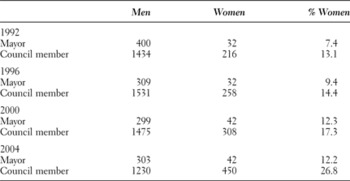
Women's presence in national-level politics has been increasing sluggishly. Following the 1989 congressional elections, only 5.8% of deputies and 6.4% of senators were women. The 1997 elections saw the percentage of female deputies increase to 10.8% but that of female senators drop to 4.2%. While women's representation in the Chamber of Deputies has continued to increase, it has stagnated in the Senate. Women now make up 15.0% of deputies but only 5.3% of senators. The representation of women has increased dramatically, however, in ministerial positions, predominantly because of concerted efforts by the Lagos and Bachelet administrations. President Ricardo Lagos doubled the proportion of female ministers and Bachelet brought full gender parity to her cabinet.Footnote 9 At the local level, women's representation in Chilean politics has similarly been growing slowly since the return to democracy, as Table 1 demonstrates. Women's representation in mayoral positions had been increasing at a slow rate (women were 7.4% of mayors in 1992, 9.4% in 1996, and 12.3% in 2000), but a noticeable plateau occurred after the 2004 elections. Female council members have also become more common. In 1992, 13.1% of council members were female; that percentage increased to 14.4% in 1996 and to 17.3% in 2000, jumping to 26.8% in 2004 (Interior Ministry 2007; SERNAM 2001).Footnote 10 The percentage of female candidates to local level office has increased equally gradually (for example, the increase in the percentage of women running for local office increased from 16.5% in 1992 to 18.0% eight years later) indicating in part that women's share of candidacies directly results in their share of elected positions.
Women in municipal politics

Source: SERNAM 2001; author's data set
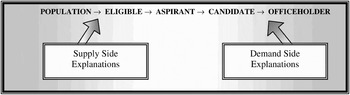
I argue that an essential element of understanding the variation that exists across parties in levels of female representation can be found by examining candidate selection. Women's underrepresentation in elective politics is a result of bottlenecks at particular points in the process of becoming an officeholder. As Figure 1 demonstrates, there are four steps in this process. The first stage marks the transition from being a member of the general population to being legally allowed to run for office. The second stage encompasses the move from being merely eligible to run to having an interest in pursuing public office. The third stage signals that an aspirant has entered the race and become a candidate.Footnote 11 The final stage indicates that the candidate has won election and become an officeholder. Magda Hinojosa (Reference Hinojosa2005) finds that inequitable levels of female representation in Chile are not the result of bottlenecks at the first or the last stage. It is the processes of candidate selection that transform eligibles into aspirants and aspirants into candidates. To understand women's underrepresentation in politics, we must, therefore, focus on political recruitment.
The process of becoming an officeholder. (Source: The relationship expressed here is borrowed from Norris and Lovenduski Reference Norris and Lovenduski1995. For a more thorough diagrammatic articulation of the recruitment process, see Norris and Lovenduski Reference Norris and Lovenduski1995, 84.)

CANDIDATE SELECTION PROCESSES: OBSTACLES AND OPPORTUNITIES FOR WOMEN'S REPRESENTATION
The lack of female officeholders is symptomatic of the underrepresentation of women on candidate lists. While the more commonly held belief is that women's underrepresentation in politics is a result of either a lack of qualified women for public office or voter bias against female candidates, neither of these explanations holds up to scrutiny. Neither the “supply problem” nor the “demand problem” can adequately explain women's underrepresentation.
Chilean women have made tremendous gains that affect their ability to move into the workforce more generally, and into politics specifically. The average age of marriage rose from 23.8 in 1980 to 26.7 in 1999; women are also both postponing childbearing and having fewer children (fecundity levels dropped from 3.6 in the early 1970s to 2.7 by the 1990s, and are continuing to drop). If educational qualifications alone sufficed for political officeholding, we would expect that half of Chilean politicians would be female. Girls are actually more likely than boys to attend and complete their secondary education. By 1980, women were 42% of university students, and by 1998, 44% of law degrees went to women. Women are, however, still less likely to be part of the workforce than men; while 72.9% of Chilean men participate in the labor force, only 35.0% of women do, but these numbers are changing rapidly.Footnote 12 Women's wages are not yet on par with men's; in 1998, women earned 68.2 cents for every dollar earned by a man. Nonetheless, even while taking into account women's decreased participation in the workforce and their lesser earnings, we cannot explain women's absence from politics. Furthermore, voters demonstrate minimal prejudice toward female candidates. Polling data indicate that there is little bias.Footnote 13 Electoral data seem to confirm those findings. When controlling for both political party and incumbency status, an analysis of all municipal elections in 1996 and 2000 reveals that the difference in ability to win elections for men and women candidates is 53.5% to 49.0% (Hinojosa Reference Hinojosa2005). Marcela Ríos and Andrés Villar (Reference Ríos and Villar2006) analyzed the 2005 national elections and found that women actually had a slight advantage: 51.3% of women won office compared to 49.5% of men. If there is voter bias, it is much too slight to explain why women lag so far behind men in gaining political office.
Women's underrepresentation in Chilean politics is the direct result of their underrepresentation as candidates (Duerst-Lahti Reference Duerst-Lahti, Thomas and Wilcox1998 argues that the same is true of the United States). I argue that the primary obstacles to women's political candidacies in local government are self-nomination and local power monopolies. These problems emerge in the process of transforming female political aspirants into candidates. I explain each of these two problems before turning to a categorization of candidate selection. Candidate selection processes systematically structure the effects of these two obstacles to women's candidacies. By categorizing candidate selection procedures, we can see the variation that candidate selection can produce in female candidacies.
Reticent to Throw Their Hats into the Ring: The Problem of Self-Nomination
The first obstacle to female candidacies is self-nomination. Self-nomination refers to the proposal of one's own candidacy and can be contrasted to external nomination. External nomination occurs when party elites, formal or informal groups, or party members recruit an individual to run for office. Either form of nomination is necessary to transform a political eligible into an aspirant and an aspirant into a candidate.Footnote 14 The importance of external encouragement to run for office cannot be understated. External nomination has been shown to be quite significant in creating candidates (Fox and Lawless Reference Fox and Lawless2004; Lawless and Fox Reference Lawless and Fox2005; Mueller Reference Mueller2002; Verba, Schlozman, and Brady Reference Verba, Schlozman and Brady1995). Richard L. Fox and Jennifer L. Lawless (Reference Lawless and Fox2005) found that while neither men nor women were likely to forge a candidacy without some form of external impetus, if encouraged to run, the majority of both men and women would consider doing so.Footnote 15
Candidate selection procedures that require self-nomination can prove disadvantageous to women's representation in politics, since women are less likely to promote their own candidacies. Studies in the United States indicate that women are reticent to propose themselves as candidates and are more likely than men to consider themselves “unqualified and incapable” of running for office (Duerst-Lahti Reference Duerst-Lahti, Thomas and Wilcox1998, 25).Footnote 16 Fox and Lawless found that in the United States, men were more likely than women to have considered entering politics (59% to 43%) despite the fact that women were more interested in politics than men. In their study, they find two critical problems (the first is an issue of external nomination, the second of self-nomination):
First, women are significantly less likely than men to receive a political source's encouragement to run for office. This difference is very important, since potential candidates are twice as likely to think about running for office when a party leader, elected official, or political activist attempts to recruit them as candidates. Second, women are significantly less likely than men to deem themselves qualified to run for office, yet more likely to rely on their self-perceived qualifications when considering whether to enter the electoral arena (Fox and Lawless Reference Fox and Lawless2004, 275).
Keeping Outsiders Out: The Problem of Local Power Monopolies
The second impediment to women's candidacies is the existence of local power monopolies. These power monopolies are small, informal groups of people connected by kinship,Footnote 17 social, or business associations, which concentrate local power and represent the local establishment.Footnote 18 Entrance to these local power monopolies is tightly guarded and is likely to require sponsorship.Footnote 19 Women are likely to be disadvantaged when local power monopolies have influence over candidate selection processes.
Due to women's historic roles in the private rather than the public sphere, they are less likely to belong to these local power monopolies.Footnote 20 These monopolies prove disadvantageous to women for two reasons: First, women are less likely to be offered up as candidates by these local power monopolies since these groups usually concentrate power and rotate political positions among themselves; second, they are less likely to benefit from the political mobilization and financial support that these groups can provide.Footnote 21
The effects that these two problems have on women's emergence as candidates are largely structured by the types of candidate selection procedures used by a political party. Candidate selection varies across two dimensions: the exclusive versus inclusive continuum and the centralized versus decentralized continuum.Footnote 22 The first dimension measures the exclusivity of the process of candidate selection by gauging the size of the selectorate—“party members involved at some stage in the nomination, shortlisting and selecting of prospective candidates” (Burrell Reference Burrell1997, 291). For example, candidate selection would be considered exclusive when decision making is the domain of a single party leader, but would be characterized as inclusive when decision making is undertaken by hundreds or thousands of party members, as could happen with a primary. The second dimension evaluates the centralization of power in selection decisions. In a party using centralized candidate selection, decisions would be made by national elites, such as party board members. If instead a party relies on decentralized candidate selection, power stays at the local level; decision making would then be done by local party leaders and members or even by a sample of the general population. These two dimensions each operate on a continuum: Candidate selection would be considered inclusive regardless of whether an open or closed primary was being used; likewise, decision making would be deemed decentralized in a situation where decisions were being made at the municipal or submunicipal level.Footnote 23
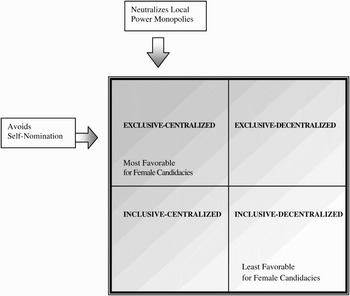
The exclusivity versus inclusivity of candidate selection affects self-nomination, which is key to transforming political eligibles into aspirants and aspirants into candidates. The levels of centralization in the process of candidate selection will determine the influence that local power monopolies will have in turning eligibles into aspirants and aspirants into candidates. As Figure 2 demonstrates, my argument is that processes that are exclusive avoid the need for self-nomination, whereas those procedures that are more inclusive will require that candidates propose their own candidacies—by making it known that they aspire to office, encouraging other party members to participate in the decision-making process, and lobbying those same party members for their support. Centralized candidate selection dilutes the importance of local power monopolies, while those methods for selecting candidates that take place at the local level will increase the influence of these monopolies on decision making.
A typology of candidate selection.

Types of Candidate Selection
Classifying the exclusivity and centralization dimensions as high or low yields four ideal types. For example, if a party uses candidate selection processes that are high on exclusivity and high on centralization, it is classified as having exclusive-centralized candidate selection. Inclusive-centralized candidate selection procedures involve a potentially large number of selectors, and decision making takes place outside of the local level, at either the regional or national level. Candidate decisions that are made by a large group and at the local level are considered inclusive-decentralized. The most well known form of inclusive-decentralized selection is the primary. Exclusive-decentralized candidate selection involves a very small number of decision makers operating at the local level.
Exclusive-centralized selection procedures are characterized by decision making involving a small number of selectors, possibly only a single person, and decision making outside of the local level. Various types of parties have employed these kinds of procedures, including the Peronist Party in Argentina during the 1950s and the Institutional Revolutionary Party in Mexico during much of the twentieth century.
The use of exclusive-centralized candidate selection for local-level office can be complicated due to issues of distance and familiarity with local politics. Those parties that employ centralized selection processes (either inclusive or exclusive) avoid these complications by using a number of strategies, such as fielding central representatives or relying on polling or other scientific means. A typical scenario for choosing candidates in an exclusive-centralized system might look like this: First, the national party office will instruct party senators to identify possible leaders in the geographic regions that they represent. Second, the senator from a region will notice the work of an individual in a given municipality. If the senator and the mayor are of the same party, the third step might be for the senator to discuss this individual with the mayor, and for the two of them to visit the individual in his/her home and ask that he/she participate as a candidate in the upcoming elections. Finally, the new candidate will be introduced by the mayor at a meeting of the local party membership and his/her candidacy will be officially approved.
While women can be advantaged by this type of process because of the absence of two significant obstacles for female candidacies, the effects of this type of selection procedure can be lessened in certain instances—for example, if the selectorate is actively biased against women or if the party is not electorally driven. Even if the selectorate exhibits passive bias—by expressing concerns that the voters will be unprepared to vote for women or manifesting a desire to seek candidates that have (male) qualities—women can still benefit from exclusive-centralized selection. That is because this passive bias is likely to be present across all parties; by eliminating just two important obstacles, parties using exclusive-centralized selection can increase women's representation. Moreover, removing the need for self-nomination and avoiding local power monopolies from influencing selection will prove beneficial to women even if parties are not attempting to increase female presence in politics.
I argue then that when candidate selection is both exclusive and centralized, women can be advantaged. Exclusive selection forces the use of external nomination and circumvents self-nomination. The centralization of the process neutralizes the influence of local monopolies, and this disconnection from these groups allows selectors greater liberty in making their decisions based solely on expected electoral outcomes. Candidates will be chosen because of their name recognition, their personal charisma, their work in their own localities, and their general appeal to voters. When decisions are made exclusively, but at the local level, we are more likely to see the influence of these local power monopolies, since it is likely that a local selector will be influenced by those groups that concentrate local power. By moving decision making away from the local level, the importance of monopolies is further decreased. The use of exclusive-centralized candidate selection procedures can lead to an increase in women's candidacies, but, more generally, it can result in a rise in the candidacies of political outsiders. Since candidate selection is at the discretion of one person or of a small group whose interests are not representative of local power monopolies, outsiders such as women and those removed from typical political circles are more likely to make their way onto party tickets.
In the following section, I use the case of the UDI to test whether a party whose selection procedures avoid the obstacles posed by self-nomination and local power monopolies can produce a greater proportion of female candidates. I first provide evidence that the UDI does not seek to increase the representation of women and then show that the UDI has had more success than other parties in nominating women to local office. Using qualitative data, I demonstrate the effects of, first, exclusive candidate selection and, second, centralized selection.
EVIDENCE FROM THE UNIÓN DEMÓCRATA INDEPENDIENTE
The UDI occupies the position farthest to the right among the major Chilean political parties, and has been described as “a blend of neoliberalism and strongly conservative Catholicism” (Scully and Valenzuela Reference Scully and Valenzuela1993, 7). From its beginnings, the party identified itself strongly with the government and positions of the Pinochet regime and maintained support for the authoritarian enclaves created during the dictatorship (Garretón Reference Garretón2000). One of the party's founding fathers has described the UDI as a party guided by three principles: First, it is a party committed to free market economic politics; second, it is a “popular” party aligned with the poor; and third, it is a party defined by Christian values (Longueira Montes Reference Longueira Montes2003, 28).
The UDI is the fastest growing party in the country, though the recent failure of its candidate Joaquin Lavín to enter the second round of the presidential election was an important setback. Despite this, the UDI continues to be defined as a “successful” party: It increased its percentage of votes for parliamentary elections from 9.8% to 25.2% in only 12 years, and consequently, its representation in the Chamber of Deputies and the Senate has grown dramatically since the return to democracy (Joignant and Navia Reference Joignant and Navia2003, 129). The UDI is the best-represented party in the Chamber by an impressive margin. In the Senate, the party holds 29% of seats, second only to the PDC, which comprises 32% of senators.Footnote 24 The party's impressive growth has not been limited to national-level elections. Because of its striking electoral growth at the local level, the UDI has increased its bargaining power within the coalition of the Right, allowing it to field even more candidates. The strength of the UDI can be attributed to “the existence of a defined project, an iron discipline and a cohesive team” (Joignant and Navia Reference Joignant and Navia2003, 148).
Women's membership is higher in the UDI than in the other major parties. From a historic context, this is hardly surprising. It was the parties of the Right that first pushed for women's enfranchisement (Baldez Reference Baldez2002; Chaney Reference Chaney1979; Franceschet Reference Franceschet2005; Power Reference Power2002) and understood that women's support of the Catholic Church could translate into political support for conservative parties. More recently, UDI presidential candidate Lavín sought to project himself as someone whom “heterosexual women would appreciate” by including images in his campaign that represented his role as a devoted husband and father of seven (Power Reference Power2002, 262).
Despite the greater presence of women among the UDI rank and file, the party makes no discernible effort to increase women's political representation within its organization (few women can be found in its national directorate, compared to its competitors) or as candidates to outside positions. Unlike the majority of other parties in the country, it has no gender quotas for either internal party positions or external nominations.Footnote 25 The party makes no ideological commitment to increasing women's representation, nor does it believe that women's historic underrepresentation in politics is a problem. As UDI leader Julio Dittborn stated, “If there effectively were very few women participating in politics, that in and of itself would not seem problematic. It's not a matter of incorporating women just so that the statistics will indicate a greater number of parliamentarians or ministers” (quoted in Macaulay Reference Macaulay1993). The influential UDI mayor of an important municipality within the Santiago metropolitan area explained that the party's high proportion of women in municipal office was not a party strategy and did not reflect party goals; rather, he said, the party was focused on “choosing the best person [for each position], regardless of gender” (Interview, August 27, 2002).
While the party constitution does speak explicitly to issues of discrimination, the party seems most concerned with allowing women to continue in their historic roles as wives and mothers, as the following statement from its founding principles conveys:
Unión Demócrata Independiente recognizes the importance of women in society, for the role that they have played throughout the long history of our country. Unión Demócrata Independiente will energetically uphold the principle of equal rights for women in all of their activities, in employment or otherwise, in which they serve alongside men; the party will work to open opportunities to women, and will oppose all form of economic or social discrimination that women may face. Likewise, Unión Demócrata Independiente especially values the virtues and proper functions of women as carriers of life, nuclei of the family, and the principle transmitters of values, morals, and traditions. Consequently, Unión Demócrata Independiente will work so that women's work in society can be compatible with their proper functions, especially those related to maternity, child-rearing, and caring for their families (UDI 2007).
The UDI views the lack of women in politics as a reflection of the absence of qualified women for political office (Interview, July 29, 2002). The ability of female UDI members to succeed in local politics was repeatedly explained—by party representatives—as a reflection of women's traditional roles. Echoing Elsa Chaney's supermadre theory, which linked women's political participation with their roles within the family unit, an important UDI politician who was then serving as a regional party president explained that serving as mayor is a natural fit for women since it is the “administration of the biggest house” (Interview, November 21, 2002).Footnote 26 This explanation, however, fails to address why these traditional roles have benefitted UDI women in particular, and not women from other political parties.
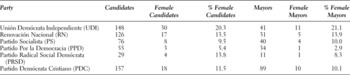
It is not the case that the UDI seeks to increase women's representation in politics. The party has not done so outside of the local level. For example, only three of its 35 deputies and one of its five senators are women (prior to its recent defeat in the polls, only one of its 11 senators was a woman). Among the major parties, the UDI has one of the lowest percentages of women in its directorate (Hinojosa Reference Hinojosa2005). While other parties in the Chilean system face pressure from their own (predominantly female) members to address gender inequalities, the UDI does not have to address such concerns.Footnote 27 And yet, nearly one of every two female mayors in 2003 was a member of the UDI. In 2007, more than one of every three women occupying mayoral positions was a party member. The success that the UDI has had in electing female mayors cannot be explained by examining voter behavior; in other words, it is not the case that parties are nominating equal numbers of women and voters simply prefer the UDI's female candidates.Footnote 28Table 2 reveals that women make up approximately the same proportion of mayors as they did candidates. For example, 11.5% of the PDC candidates were female and 10.1% of the party's mayors are women. The UDI has more women in local-level politics because it has more female candidates for local-level political office.
Female mayoral candidates and elected mayors in the 2004 municipal elections

Source: Author's data set.
The UDI nominated a greater proportion of female candidates for municipal positions in 2000 than did any of the other major parties; 23.9% of its candidates were female. By way of comparison, the Christian Democratic Party nominated the greatest number of female candidates, but a considerably smaller proportion of its candidates were woman (16.6%).Footnote 29 For the 2004 elections, the UDI once again nominated more female candidates than did any other party; 21.81% of the UDI candidates for council member positions were female. Of the additional 139 candidates who ran as independents aligned with the UDI, 28.78% were women. As Table 2 demonstrates, more than 20% of the party's candidates for mayoral positions were women.
Candidate Selection within the UDI
What kind of process does the UDI use to select such a relatively large proportion of female candidates? Although the official party statutes explain a vigorous process for selecting municipal candidates that involves search committees and the local-level party office composing a list of possible candidates based on strict criteria, the actual selection mechanism is considerably less formal and indeed analogous to the infamous dedazo.Footnote 30 Individual selection processes do vary, but typically, as a first step, a UDI representative from a particular region (deputy or senator) chooses an ideal candidate. Those candidates' vitas are sent to Santiago. The final decision is then made by this representative in consultation with the party's district or regional president.Footnote 31 The party's candidate selection procedures clearly fall into the exclusive-centralized category outlined earlier.
In the following, I show how the use of exclusive-centralized candidate selection by the UDI in local elections allows for the circumvention of both self-nomination and local power monopolies. The case of the UDI demonstrates that avoiding self-nomination and decreasing the influence of power monopolies can work in women's favor.
The selection of candidates is clearly an exclusive process, leading a UDI council member to remark of the process: “It looks less democratic, but it's more effective” (Interview, September 12, 2002).Footnote 32 The exclusivity of the process eliminates self-nomination, as one council member then in his second term succinctly stated: “They decide. They assess our work” (Interview, September 12, 2002). From data obtained through interviews with party women, it became clear that self-nomination would have proven problematic since UDI women were extremely reluctant to even describe themselves as politically ambitious. When asked whether they would continue in politics and perhaps seek higher-level office, UDI women were reticent to express interest, though many offered that they would be willing to do “whatever the party asks of me” (Interview, December 16, 2002). A young councillor only two years into her term on the council of a sizable Santiago suburb described her dedication to her previous line of work in social services. I asked her whether she would return to her previous position or continue in politics. Clearly torn due to her dedication to the party, she finally answered that she would do “what they [UDI] demand of me” (Interview, July 29, 2002). UDI men, however, were unapologetically forthcoming about their interest in running for higher-level office (Interviews with author). The lack of an institution for self-nomination in the process means that the UDI must actively recruit its candidates. The female mayor of a medium-sized city near Santiago, who had been on the council since 1992, explained her entrance into politics by saying, “I didn't get involved; they got me involved” (Interview, December 16, 2002). While women were unwilling to nominate themselves, the exclusivity of the candidate selection process allowed the UDI to identify female candidates and request that they run for office.
The UDI also uses centralized candidate selection procedures. The centralization of candidate selection led to an evident lack of influence by local power monopolies: The UDI was more likely than any other party to choose candidates from outside the party (Interview, June 14, 2004). A UDI councillor pointed out that the characteristics of the selection process meant that “candidates didn't even have to be party members” (Interview, September 12, 2002); the exclusivity of candidate selection spoke to the selectorate's decreased accountability to the local party membership. Despite the assertion by one high-ranking party leader that the party “searches for people who have been leaders within the party for many years,” in actuality, the party regularly chose outsiders (Interview, June 14, 2004). A UDI councillor disclosed that the party chose an outsider to be their privileged candidate over him, despite the fact that he had been an active member and held internal party positions for many years, because the privileged candidate was known to be a “person of the people” and was more likely to win the mayoral seat (Interview, September 17, 2002). In an effort to gain electoral strength, the UDI has chosen not only people from outside the party but also people who could be classified as ideologically at odds with the party. As one of the members of the 10-person National Directorate explained, “the party chooses candidates without regard for party membership,” and “we choose people from all parts” (Interview, October 2, 2002). The use of exclusive-centralized selection has allowed the party to choose candidates who self-identify as leftists, who were tortured during the dictatorship, or who disregarded their political convictions because they found “it was easier to be a candidate of the right” (Interviews, September 12, 2002, and October 2, 2002).
One unsuccessful candidate to the council in a large city known as a tourist hub observed that candidate selection is “decided over there in Santiago” (Interview, December 4, 2002). She had been asked to run by one of the country's best-known and most important politicians, whom she considered an acquaintance. Because of the centralization of the process, the party oftentimes chose outsiders, and this ultimately proved beneficial to women, who were less likely to belong to local monopolies.Footnote 33 This exclusive selection mechanism was also visible in candidacies for councillors, which are decided by the party's designated mayoral candidate.Footnote 34 When party tickets are composed in this manner, mayoral candidates can increase women's representation since they are making decisions in an extremely exclusive manner.
Exclusive-centralized candidate selection has allowed the UDI to nominate a greater proportion of women to municipal office than has any other Chilean party; this selection process is the mechanism that permits the party to nominate women if it so chooses. The UDI's decision to do so, however, is ultimately one that is driven by electoral concerns. The competitive electoral environment of municipal races in Chile has led the UDI to be ruthless in its search for winning candidates—leading the party to disregard, as previously noted, party loyalty, ideology, and potential gender bias. The UDI's exclusive-centralized selection processes have allowed it to make nomination decisions based on projected electoral results (a party motivated by nonelectoral concerns would likely see different results).Footnote 35 The next section of this article demonstrates how other selection processes can prove prohibitive for increasing female representation.
CANDIDATE SELECTION IN OTHER POLITICAL PARTIES
No other Chilean political party employs candidate selection procedures that are both exclusive and centralized and none matches the UDI's record of female nominations. The Renovación Nacional, the UDI's traditional coalition partner, has the most similar processes, while the parties of the Concertación all choose candidates in inclusive and decentralized ways.
The RN uses an exclusive-decentralized process for choosing its municipal candidates. An RN councillor from a city about an hour from Santiago described how he was approached to run for the council: “They went to my house to talk to me about running for the Renovación Nacional. The woman who went to talk to me was the secretary of a mayor [of a nearby town]. She's a councillor now, too. She remembered me” (Interview, September 27, 2002). Decisions were made by one or two local RN leaders and were then rubber-stamped by the national office. Whereas in the UDI decisions were made by national elites, in the RN local party elites were the selectorate. Candidate selection was biased in favor of RN members, indicating the influence of local monopolies in selection decisions; although the exclusivity of the process eliminated the need for self-nomination, candidates were routinely chosen from the party's membership. Becoming an RN candidate depends heavily on party loyalty and being a part of the local elite. An RN local party vice president said, “If you don't have the money, you won't be running,” and one woman with a long history of social activism stated that she would not run because “I have to support my family” (Interviews, September 30, 2002, and December 2, 2002).
The four parties of the Concertación each use some form of inclusive-decentralized candidate selection. The Partido Socialista and the Partido Por la Democracia each hold internal elections to decide on candidacies; only party members are allowed to attend and vote. Although these parties made commitments to increasing female representation and have set affirmative action goals, both not only have failed to meet their own quotas for municipal candidates but have also nominated fewer women than the UDI. The smallest coalition member, the Partido Radical Social Demócrata, routinely exhibits difficulty in convening enough members for candidate selection. In municipalities with more than 15 members, the party holds an internal election, known as an assembly, but where there is insufficient membership for an assembly, local party officers make the candidate decision. The Regional Tribunal approves candidacies after a background check, and the national level is only involved in extraordinary instances. The PDC also employs inclusive-decentralized selection, but has experimented with using primaries and other methods. In municipalities that did not hold primaries, decisions were made by regional councils based on local selection. The party does require that its candidates be members, collect signatures from 10 other members, and undergo a background check.
The candidate selection practices of the parties of the Concertación have had deleterious effects on women's abilities to gain nomination. The inclusivity of the processes of candidate selection has increased the importance of self-nomination, which proves problematic considering women's reluctance to propose their own candidacies. The decentralized nature of the process has augmented the importance of local power monopolies; all five major parties that use decentralized methods of candidate selection were less likely than the UDI to choose candidates who were nonparty members, and they were more likely to nominate members of local monopolies. Women's historic absence from these monopolies of power means that decentralized procedures disadvantage them during the process of candidate selection.
CONCLUSION
The research presented here on the Chilean case is an attempt to fill the gap that exists on the institutional effects of candidate selection and to provide evidence that the creation of these institutions needs to take into account possible effects on women. Candidate selection is dynamic. Parties can adopt more inclusive procedures, decentralize their selection processes, or simultaneously use a variety of selection methods. The malleability of candidate selection procedures provides a rich opportunity 1) to study the effects of processes and 2) to design institutions that systematically address obstacles to the full incorporation of women.
This work provides a couple of directions for future research by scholars interested in women's political representation. First, future research could examine the effects of these processes across different levels of government. While Jaime Guzmán was alive, he handpicked UDI leaders; his death transformed candidate selection within the UDI. Choosing candidates for national office now parallels the exclusive-decentralized type that I described earlier. The homogenous UDI elite, using less centralized and less exclusive selection methods, have kept outsiders at bay and rewarded their own grupo de amigos (“group of friends”). Can this explain why the UDI has placed so many women into local office, but so few into national office? Second, other scholars could explore unintended consequences of institutional choices. This work has noted that these choices may have unforeseen effects. Parties like the PPD may want to increase female participation but will be unable to do so because of their choice of candidate selection procedures; meanwhile a party with no desire to nominate more women to office may inadvertently adopt processes that will lead it to do just that. A political party's intentions will be subverted by the effects of poor institutional choices. Do gender quotas or term limits come with their own unintended consequences for women?
This work is not intended to justify the use of exclusive-centralized candidate selection procedures over other forms of selection. Rather, I would argue that it is important to study the effects of all such institutional designs. This work is meant to add to general understanding about the effects that candidate selection procedures have on female candidacies and to argue for an examination of the ways in which institutions structure obstacles to women's full incorporation into politics. The case of the UDI in Chile highlights the need for political scientists to combine institutional analysis with in-depth fieldwork in order to further our understanding of women's representation in politics.