INTRODUCTION
Comprehension of text arises from both memory-based and strategic processes (van den Broek, Rapp, & Kendeou, Reference van den Broek, Rapp and Kendeou2005). Memory-based processes refer to the passive activation and retrieval of information from semantic memory (word and world knowledge) and from the reader’s evolving representation of the text. Effortful strategic processes, sometimes referred to as metacognitive aspects of comprehension, are used to adjust how a text is read depending on the purpose or goal of reading and, thereby, to monitor and repair comprehension. Individuals with poor text comprehension often have difficulties with both memory-based and strategic processing.
Some models of reading comprehension (e.g., van den Broek et al., Reference van den Broek, Rapp and Kendeou2005) propose that skilled comprehenders possess “standards of coherence” that allow them to flexibly allocate resources to generate appropriate strategies in accord with specific reading goals, such as reading to learn new information, or reading for entertainment (van den Broek, Lorch, Linderholm, & Gustafson, Reference van den Broek, Lorch, Linderholm and Gustafson2001). Sensitivity to reading goals is highly related to the type of text representation formed by the reader. In college students, reading for study purposes involves more integration attempts, rereading, memory processes, text evaluation, inference generation, and decreased reading rate than reading for entertainment (Lorch, Lorch, & Klusewitz, Reference Lorch, Lorch and Klusewitz1993; Narvaez, van den Broek, & Ruiz, Reference Narvaez, van den Broek and Ruiz1999; van den Broek et al., Reference van den Broek, Lorch, Linderholm and Gustafson2001).
Younger and less skilled readers often fail to modulate how they read text in relation to reading goals. They tend to not change their approach to reading with different reading goals (Baker, Reference Baker1984), even when they have age appropriate single word reading skills (Cain, Reference Cain1999). Failure to monitor and adjust reading may arise for several reasons, including failure to prioritize text understanding over word decoding (Pazzaglia, De Beni, & Cornoldi, Reference Pazzaglia, De Beni and Cornoldi1995), deficient awareness of a range of reading strategies, and impaired control over reading processes (Cain, Reference Cain1999). Cognitive control processes are important for reading in adult populations, in whom higher working memory capacity is associated with more demanding strategies and better recall when reading for study rather than for entertainment (Linderholm & van den Broek, Reference Linderholm and van den Broek2002).
While text comprehension and metacognitive aspects of comprehension are related, the nature of the relation, and the reason for the association, are less apparent. In one view, good metacognition (effective strategy use and goal-related allocation of cognitive resources) causes better comprehension (see Oakhill & Cain, Reference Oakhill, Cain, Cain and Oakhill2007 for a review). In an alternative view, enhanced metacognition is a product of skilled comprehension (e.g., constructing a high quality text representation enables enhanced ability to reflect on the text and monitor failures of coherence; Vosniadou, Pearson, & Rogers, Reference Vosniadou, Pearson and Rogers1988).
Metacognition and comprehension are linked in the course of normal development and throughout a normal reading history. Groups in whom metacognition and comprehension are less tightly linked might clarify hypotheses about the relation of metacognition and text comprehension. The neurodevelopmental disorder, spina bifida meningomyelocele (SBM), provides a forum for an analysis of the metacognition-comprehension relationship.
SBM is a birth defect that occurs in 0.3–0.5 per 1000 live births (Williams, Rasmussen, Flores, Kirby, & Edmonds, Reference Williams, Rasmussen, Flores, Kirby and Edmonds2005) and that affects brain and spinal development. Cognitive development in SBM is uneven, with a characteristic pattern of cognitive strengths and weaknesses (Dennis, Landry, Barnes, & Fletcher, Reference Dennis, Landry, Barnes and Fletcher2006). Reading is atypical in children with SBM, who have good single word reading but deficient discourse and text comprehension (Barnes & Dennis, Reference Barnes and Dennis1992). Barnes, Huber, Johnston, and Dennis (Reference Barnes, Huber, Johnston and Dennis2007) proposed a model of comprehension in which meaning is dynamically constructed as the text unfolds through a variety of processes that serve to revise and update the reader’s representation of the text. These processes include activation of meaning, suppression of contextually irrelevant meanings, and integration between and among ideas within the text itself, the situation it describes, and real world knowledge. The comprehension model explains why children with SBM can derive meaning from syntax, quickly access word meanings, understand common idioms, and form simple situation models from individual sentences (Barnes & Dennis, Reference Barnes and Dennis1998; Barnes, Faulkner, Wilkinson, & Dennis, Reference Barnes, Faulkner, Wilkinson and Dennis2004; Barnes et al., Reference Barnes, Huber, Johnston and Dennis2007), but exhibit difficulty with information integration involved in making text-based and knowledge-based inferences, forming situation models that integrate across sentences, and suppressing context-irrelevant meanings.
Metacognition has not been fully studied in SBM. Perhaps surprisingly, these children have relatively intact top-down, strategic attentional control; for example, they can direct their attention according to internally generated cues (Dennis et al., Reference Dennis, Edelstein, Copeland, Frederick, Francis and Hetherington2005). In addition, children with hydrocephalus, most with SBM, performed well on metacognitive aspects of sentence comprehension involving the ability to detect lexical, semantic, and syntactic errors in spoken sentences (Dennis, Hendrick, Hoffman, & Humphreys, 1987). The metacognition data suggest that children with SBM might have better metacognitive abilities than would be expected on the basis of their well-studied comprehension deficits. However, this has yet to be confirmed. Because the Barnes et al. (Reference Barnes, Huber, Johnston and Dennis2007) comprehension model deals primarily with memory-based comprehension processes, not how sensitivity to reading goals might dictate strategic allocation of working memory, understanding the relation of reading goals to comprehension in the SBM population would be of both practical and theoretical interest.
This study investigated how comprehension is related to one metacognitive aspect of reading, the ability to adjust how a text is read in relation to the goal for reading that text. We had two specific aims.
The first aim was to compare the ability of children and adolescents with SBM and age peers to adjust how they read texts according to reading goals. Whether readers are sensitive to the goals of reading is assessed by changes in reading speed and comprehension to suit the cognitive demands inherent in different goal conditions. We predicted that typically developing children and adolescents would modify their approach to reading based on their perception of the goal of reading for a particular story; that is, they would show longer reading times and increased text comprehension for goals requiring more cognitive effort (e.g., when instructed to study the text or to generate a title) compared with goals requiring less cognitive effort (e.g., when instructed to read for fun or to skim). To the extent that children and adolescents with SBM are similar to other groups with difficulties in comprehension, they will fail to adjust their reading in relation to reading goals. If comprehension and metacognition are not related in children with SBM, on the other hand, they will adjust how they read in response to different reading goals.
The second specific aim was to investigate whether reading goals moderate the relation between working memory and comprehension. In typically developing children and adolescents, we predicted that variability in working memory would be related to comprehension in reading situations hypothesized to require greater cognitive effort. To the extent that children and adolescents with SBM are insensitive to the goals of reading, variability in working memory might not be differentially related to comprehension in the different goal conditions for this group.
METHOD
Participants
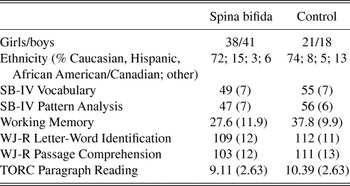
Children and adolescents from Ontario and Texas were recruited to participate in a research study examining learning outcomes in children and adolescents with SBM. The 79 children and adolescents with SBM recruited from clinics in Houston and Toronto had a mean age of 12.5 years (SD = 2.7 years), ranging from 9 to 19 years. All participants spoke English as their primary language. Participants were included only if they had a standard score of 35 or higher on either the Stanford-Binet Intelligence Test-IV Vocabulary subtest or the Pattern Analysis subtest (SB-IV; Thorndike, Hagan, & Sattler, Reference Thorndike, Hagan and Sattler1986), a score which is within 2 SD of the population mean for this test (see Table 1). In addition, participants had to be at least average readers, measured by word reading skill at or above the 25th percentile on the Letter-Word Identification subtest of the Woodcock-Johnson Psycho-Educational Battery-Revised (WJR; Woodcock & Johnson, Reference Woodcock and Johnson1989). This exclusion criterion ensured that no child in the sample had a word reading disability (Fletcher et al., Reference Fletcher, Lyon, Barnes, Stuebing, Francis, Olson, Bradley, Danielson and Hallahan2002). Twenty-eight percent of the sample had upper spinal level lesions (thoracic and above), and 64% had undergone 2 or fewer shunt revisions.
Participant characteristics

Note
The scores for the Stanford-Binet Tests of Intelligence-IV reflect Standard Age Scores (SD), which have a mean of 50 and a standard deviation of 8 on each subtest. Working memory scores represent participants’ mean (SD) accuracy scores on the N-back experimental task. WJ-R = Woodcock-Johnson-Revised Tests of Achievement. Scores on the WJ-R are reported as standard scores (SD), with a mean of 100 and a standard deviation of 15. TORC = Test of Reading Comprehension. Scores on the TORC are reported as scaled scores (SD), with a mean of 10 and a standard deviation of 3.
The control group consisted of 39 typically developing children and adolescents with a mean age of 12.3 years (SD = 2.8 years), ranging from 8 to 17 years who had responded to study announcements in Texas and Ontario. Exclusion criteria included: learning, behavior, or central nervous system disorders. The cognitive and reading criteria implemented with the group with SBM were also applied to the control group. Informed consent and/or assent to participate in the study were obtained from all participants and/or their guardians, in compliance with the research ethics boards in Toronto and Houston.
Participant characteristics are in Table 1. The groups did not differ in age. As expected, the control group demonstrated significantly higher scores than the group with SBM on SB-IV Vocabulary (t(113) = 4.74; p < .001) and Pattern Analysis (t(113) = 6.20; p < .001). However, the scores of the group with SBM are clearly close to the middle of the average range. The analyses do not covary for these scores (although vocabulary is used in the regression analyses given its status in models of reading comprehension) because IQ does not meet the requirements for a covariate when applied to neurodevelopmental disorders in which IQ differences between groups are part of the disorder rather than due to problems in sampling (Dennis et al., 2009). The control group also scored significantly higher than the group with SBM on the Passage Comprehension subtest of the WJ-R (t(113) = 3.39; p = .001), and on the Test of Reading Comprehension – Third Edition (TORC-3; Brown, Hammill, & Wiederholt, Reference Brown, Hammill and Wiederholt1995) (t(113) = 2.41; p = .017), but did not differ from the group with SBM on the Letter-Word Identification subtest of the WJ-R. Reading comprehension scores on these standardized tests were within the average range. Consistent with findings in other cohorts of children with SBM (Barnes & Dennis, Reference Barnes and Dennis1992; Barnes, Faulkner, & Dennis, Reference Barnes, Faulkner and Dennis2001), this group scored significantly higher on the WJ-R Letter Word identification subtest than on the WJ-R Passage Comprehension subtest (t(113) = 4.18; p < .01); there was no significant difference between word decoding and comprehension for controls.
Materials
Reading goals task
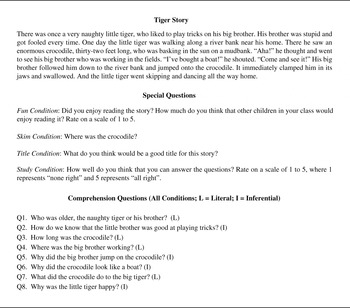
A modified version of Cain’s (Reference Cain1999) paradigm was used to assess how readers adapt reading strategies to reading goals. Four short stories were presented to each participant, accompanied by eight comprehension questions and a condition-specific question described below. The condition-specific question was asked after the story was read, but before the comprehension questions were administered. The stories were narrative tales depicting people and animals in various situations. For example, one story depicted a younger tiger that fools his older brother (see Figure 1). Half of the comprehension questions concerned literal story content (e.g., Where was the big brother working?); half required inferential comprehension (e.g., Why did the big brother jump on the crocodile?). There were four instruction conditions: Study, Title, Skim and Fun. In the Study condition, participants were told that the important thing was how well they could answer the questions after the story, but that their reading time was unimportant. The condition-specific question was “How well do you think that you can answer the questions?” The children rated their ability to answer the questions on a scale of 1 to 5 (from “you do not think that you will get any of the questions right” to “you think you will get of the questions right”). In the Title condition, participants were told that they needed to think up a good title for the story, and that their answers to the questions at the end of the story and reading time were unimportant. The condition-specific question was “What do you think would be a good title for this story?” In the Fun condition, participants were told that their answers to the questions at the end of the story and reading time were unimportant, but that they would need to decide whether other children in their class would enjoy reading the story. The condition-specific question was “How much do you think that other children in your class would enjoy reading the story?”, which they rated on a scale of 1 to 5 (from “a very good story that other children would enjoy”, to “not a very good story and other children would not enjoy reading it”). In the Skim condition, participants were instructed to find the answer to a particular question while reading, and that their answers to the questions at the end of the story were unimportant, but that they should finish reading the story as quickly as possible. For the story in Figure 1, the condition-specific question was, “Where was the crocodile?”
Example of Story Episode and Accompanying Questions

Working memory N-back task
The N-back task assessed working memory in various memory load conditions (0-back, 1-back, 2-back, 3-back). In each condition, letters appeared on a computer screen for 2 s, for a total of 40 trials. The trials consisted of 20 targets and 20 distracters. Participants proceeded to the next condition if they obtained 50% or more correct trials. The 0-back condition required them to press a designated key (Yes button) when a particular target letter (e.g., N) appeared on the screen. Participants were instructed to press another key (No button) for any other letter. In the 1-back condition, they were instructed to press Yes if they observed two identical letters in a row (e.g., N, N) and No for every other letter. In the 2-back condition, they were given the following instructions: “Press the Yes button when there is only one letter between the first time you see the letter and the second time you see that same letter (e.g., N, A, N) and press No every other time.” Finally, in the 3-back condition, participants were instructed to press Yes when two different letters appeared between the first and second presentations of a particular letter (e.g., N, A, P, N). Because the 0-Back condition does not involve memory, the score used in the analyses was total number correct from N-Backs 1, 2, and 3. The group with SBM had a lower working memory score than the controls (t(88) = 4.81; p < .001). These findings are in Table 1.
Procedures
Participants were tested in two sessions. The tests from the SB-IV and WJ-R achievement measures were given in session 1. The remaining tasks were presented in the second session. For the reading goals tasks, they were presented with four short stories on different topics and instructions that corresponded to the four goal conditions. Participants were asked to repeat the instructions and to say what was important before reading each story to ensure they remembered the goal instructions. They read the stories silently and were timed from when the passage was placed in front of them until they said they were finished reading. Each child received the conditions in the following order: Fun, Title, Skim, and Study. To control for story-specific content, knowledge, and interest level, the four story topics were counterbalanced according to a predetermined schedule. After reading each story, participants answered a set of comprehension questions with literal and inferential questions presented in a set, but random order for each story. Participant responses to the comprehension questions were double scored according to a scoring manual to ensure consistency. Discrepancies that arose for answers not in the manual were resolved by consulting the story and discussion between the scorer and one of the authors (M.A.B.) who was blind to group membership.
RESULTS
Effects of Goals on Comprehension Scores
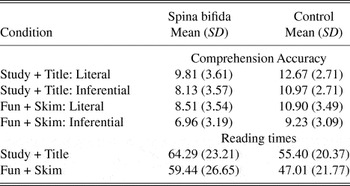
Although the groups are similar in age, the stratification of ages in the two groups is not identical. Because the primary measures of interest are not normed for age and reading rate in all conditions and comprehension in two conditions are correlated with age, age was added as a covariate to the analyses (correlations of age and reading rate are small to moderate between .29 and .46; correlations of age and comprehension are small between .01 and .26). In other studies using this and similar paradigms (e.g., Cain, Reference Cain1999; Linderholm & van den Broek, Reference Linderholm and van den Broek2002), distinctions are made between conditions that require more (Study and Title) and less cognitive effort (Fun and Skim) when readers are sensitive to the goals of reading. In the current study, correlations between Study and Title comprehension and between Fun and Skim comprehension were moderate to high (r = .66 and .42, respectively). For purposes of analysis Study and Title were combined to yield a condition requiring greater cognitive effort during reading and Fun and Skim were combined to yield a condition requiring less cognitive effort during reading. A repeated measures analysis of covariance (ANCOVA) with 2 groups (SBM vs. Control), two goal conditions (Study+Title vs. Fun+Skim), and two types of comprehension questions (literal vs. inferential) revealed a main effect of group (F(1,115) = 31.94; p < .001, partial η2 = .22), such that the group with SBM answered fewer comprehension questions correctly than the control group. There was trend for the effect of goal (F(1,115) = 3.48; p = .065; partial η2 = .03), such that participants answered more comprehension questions correctly in the Study+Title condition than in the Fun+Skim condition. There was a main effect of question type (F(1,115) = 8.94; p < .01; partial η2 = .07), with literal comprehension better than inferential comprehension. None of the interactions were significant. These results are in Table 2.
Mean correct on comprehension questions and mean reading times for children with SBM and Controls

Note
Maximum comprehension score = 16 (each answer scored out of 2); Reading times are in seconds. SBM = spina bifida meningomyelocele.
Effects of Goals on Reading Speed
Table 2 presents means and standard deviations by group and condition. A repeated-measures ANCOVA with 2 groups (SBM vs. Control) and two goal conditions (Study+Title vs. Fun+Skim) revealed a main effect of group, F(1,114) = 7.77; p < .01; partial η2 = .06. The group with SBM took longer to read the passages than the control group, across goal conditions. There was also a main effect of reading goal, F(1,114) = 5.47; p < .05; partial η2 = .05, such that participants read more slowly in the Study+Title than in the Fun+Skim condition (Table 2). The interaction was not significant.
Relation of Working Memory to Comprehension When Reading for Different Purposes
To test whether working memory is differentially related to comprehension in the two reading goal conditions and as a function of group, we added working memory scores to the model above testing the effects of group and goal condition on comprehension scores. There was a goal condition by working memory interaction, F(1,218) = 17.19; p < .0001, signifying a significant relation between working memory and comprehension only for Study+Title. The three-way interaction with group was not significant.
As a supplementary analysis, multiple regression analyses were used to evaluate whether working memory predicted reading comprehension (for literal and inferential comprehension combined) in the reading goal conditions (Study+Title and Fun+Skim), when age, word reading accuracy, vocabulary, and group were in the model. Because abilities to read words and to understand word meanings are highly related to reading comprehension, they are included in these regressions. Results indicated that the assumptions of multicollinearity, independent errors, homoscedasticity, and linearity were met for all models. The model evaluated for the Study+Title condition was significant, F(5,105) = 19.62; p < .001, and accounted for 48% of the variance in reading comprehension. The significant predictors were vocabulary, t(103) = 3.77; p < .001, and working memory, t(103) = 2.67; p < .001. The effect of group did not achieve the level of alpha adopted for this study (p < .05), t = −1.85; p = .068. The model evaluated for the Fun+Skim condition was significant, F(5,105) = 7.26; p < .001, and accounted for 22% of the variability in comprehension. The only predictor of reading comprehension in this model was vocabulary, t(103) = 3.68; p < .001. The effect of group did not reach significance, t(103) = −1.86; p = .065.
Correlations between working memory and comprehension in each reading goal condition for the groups separately support the regressions, showing significant relations between working memory and comprehension for Study+Title for both the group with SBM (r = .52; p < .001) and controls (r = .50; p < .001). Correlations between working memory and comprehension in the Fun+Skim condition were not significant for either group (r = .11 for group with SBM and r = .22 for control group). These findings support those from the general linear model above.
Answers to Condition-Specific Questions
The groups differed significantly in the Skim condition in answering the question about a specific detail from the story (F(1,88) = 16.36; p < .001) with the group with SBM less accurate than the control group. The groups did not differ on their ratings of how much their classmates might enjoy reading the story in the Fun condition. As in Cain’s (Reference Cain1999) study, most participants produced titles with the main characters in the Title condition and so the evaluation of title quality was not further analyzed. The group with SBM rated their ability to answer the comprehension questions in the Study condition lower than that of the self-ratings of the control group (F(1,88) = 18.58; p = .001).
DISCUSSION
In children with SBM, metacognitive performance and metacognitive awareness are both well developed. Despite comparatively deficient comprehension skills, these children exhibited metacognitive knowledge about reading (they adapted their reading strategies to match prescribed reading goals so that, when reading for fun or to find a specific piece of information, their reading was faster than when they read to answer comprehension questions or to generate a title for the story), and metacognitive awareness of themselves as readers (their ratings of their own understanding were lower than that of their peers with higher levels of comprehension).
Although inferential comprehension was more difficult than literal comprehension for both groups in the current study, there were no interactions of literal versus inferential comprehension with either reading goals or group. These findings suggest that whatever strategies were brought to bear in relation to reading goals affected both literal and inferential comprehension similarly in the two groups.
A strict standard of coherence enhances comprehension but increases effort; alternatively, a more relaxed standard of coherence reduces both effort and comprehension (van den Broek et al., Reference van den Broek, Lorch, Linderholm and Gustafson2001). Children and adolescents with SBM appeared to be capable of modulating the strictness and depth of their standards of coherence as seen in changes in reading rate (and in the trend for differences in answering comprehension questions) in reading goal conditions requiring more and less cognitive effort. Furthermore, in the group with SBM (as for their typically developing peers), working memory resources were related to comprehension in conditions requiring more effortful processing. Thus, children and adolescents with SBM appeared able to construct meaning using strategic processes that involve the allocation of cognitive resources and these effortful strategies resulted in better comprehension.
Children and adolescents with SBM were able, not only to make adjustments of reading goals, but also to reflect accurately on their own comprehension performance. Unlike typically developing children with poor comprehension who rate themselves as being as able as their better comprehending peers to answer the comprehension questions (Cain, Reference Cain1999), children and adolescents with SBM rated themselves as being less able to answer the comprehension questions than their age peers when asked to read for a study purpose.
Despite relatively intact metacognitive reading skills, reading comprehension in children and adolescents with SBM was poorer than that of their age peers. They answered fewer comprehension questions correctly, and the application of strategies did not entirely compensate for their comprehension difficulties (in absolute terms, the best comprehension performance of children and adolescents with SBM was similar to that of the lowest performance of the typically developing individuals).
Why was the comprehension of children and adolescents with SBM deficient even when more cognitive effort was expended? These individuals demonstrate particular problems when context-irrelevant information must be suppressed or when more resources are required for cross-textual or text-knowledge integration (Barnes et al., Reference Barnes, Huber, Johnston and Dennis2007). The inclusion of contextually irrelevant information in working memory likely hinders subsequent attempts to integrate this information with preceding processing cycles and results in a representation of the text that is not entirely well-integrated and specific to the context (Barnes et al., Reference Barnes, Huber, Johnston and Dennis2007). Although children and adolescents with SBM are able to use strategies to help them in their search after meaning (van den Broek et al., Reference van den Broek, Rapp and Kendeou2005), such strategic processes can neither change the way in which some of the basic processes above operate, nor compensate for basic deficits in text processing. In this respect, we note that although the group with SBM recruited working memory resources in conditions requiring greater cognitive effort, their working memory abilities were less developed than those of their peers.
In some situations, and with effort, children and adolescents with SBM can use strategies to maintain coherence and compensate for deficient lower-level processes. For example, they are as accurate as typically developing children at making text-based inferences that maintain coherence across several sentences in a text, while being slower and less efficient at making these inferences (Barnes et al., Reference Barnes, Faulkner, Wilkinson and Dennis2004, Reference Barnes, Huber, Johnston and Dennis2007), suggesting that in other situations they might fail to expend sufficient cognitive effort to maintain text coherence. Even when the effort is made, slow revision and integration processes may lead to processing bottlenecks at the level of text or discourse (Long, Oppy, & Seely, Reference Long, Oppy and Seely1997), further disrupting the construction of text representations.
Strategic processing of text typically results in slower reading with better encoding of the text in memory. In a seeming paradox, the consistently longer reading times for the group with SBM across conditions did not translate into better comprehension. Although skilled comprehenders modulate their reading speed to match the task requirements, generalized slow reading of text is frequently linked to poorer comprehension (Perfetti, Reference Perfetti1985, but see Baker & Anderson, Reference Baker and Anderson1982; Harris, Kruithof, Meerum Terwogt, & Visser, Reference Harris, Kruithof, Meerum Terwogt and Visser1981; Yuill & Oakhill, Reference Yuill and Oakhill1991). Slow word reading is thought to divert resources away from integral processes like text integration (LaBerge & Samuels, Reference LaBerge and Samuels1974; Perfetti, Reference Perfetti1985). The relation of text reading fluency to comprehension is likely more complex and less transparent than these resource-based explanations afford. Readers are said to attain fluency when their representation of the text is context-dependent and organized around a situation model (Raney, Reference Raney2003; review in Collins & Levy, Reference Collins and Levy2008). Although slowing reading may have resulted in better comprehension for children and adolescents with SBM (or faster reading resulted in poorer comprehension), overall slower reading in the group with SBM may be a further reflection of their difficulty in constructing well-integrated context-dependent text representations around a situation model. Children with hydrocephalus, many with SBM, were not slower than controls at naming words and nonwords (Barnes et al., Reference Barnes, Faulkner and Dennis2001), suggesting that longer reading times in SBM may not represent lack of fluency at the lexical level, but, rather, difficulties at the semantic level involving the construction of an integrated situation model.
Typically, metacognition and comprehension performance are highly related; that is, less skilled comprehenders often fail to adjust their reading in relation to reading goals and they tend to overestimate their own comprehension abilities (Cain, Reference Cain1999; review in Baker, Reference Baker, Block and Parris2008). However, our data suggest that metacognition and comprehension need not be so tightly linked; that is, poor comprehension is not inevitably accompanied by poor metacognitive comprehension skills. The theoretical implication of this metacognition-comprehension dissociation is that the relation between the two need not be direct or causal. This proposal is consistent with longitudinal studies showing that inference-making ability, comprehension monitoring and sensitivity to story structure all predict growth in reading (Muter et al., Reference Muter, Hulme, Snowling and Stevenson2004; Oakhill, Cain, & Bryant, Reference Oakhill, Cain and Bryant2003), and with cognitive profiling studies of children with poor comprehension reporting difficulties in these same domains, but not in all domains for all children (Cornoldi, DeBeni, & Pazzaglia, Reference Cornoldi, DeBeni, Pazzaglia, Cornoldi and Oakhill1996). Missing from comprehension models is an explanation of how metacognitive aspects of reading might interact with memory-based comprehension processes for readers of different ages and skill levels in the course of reading different types of text (but see van den Broek et al., Reference van den Broek, Rapp and Kendeou2005).
Metacognitive abilities may moderate reading comprehension to the extent that cognitive resources can be strategically allocated to partially compensate for deficits in other processes that are used to construct representations of the text base and the situation the text describes. In this respect, our model of comprehension in SBM (Barnes et al., Reference Barnes, Huber, Johnston and Dennis2007) would benefit from the addition of metacognitive knowledge as a moderator of meaning construction with the potential to affect some of the processes involved in the construction of the representation of the text-base and the situation model. With respect to comprehension models more generally, metacognitive abilities may also play a moderating role in comprehension performance. Deficient metacognitive comprehension skills in poor comprehenders might simply exacerbate already existing comprehension impairments that arise from other sources by restricting the compensatory advantages of being able to read strategically.
This study leaves several unanswered questions about metacognitive aspects of reading in SBM. First, we have not studied the ability of children with SBM to engage in strategic reading when presented with more complex passages, when reading expository texts and when strategic reading must be sustained over longer periods of time, all conditions known to affect the use of metacognitive comprehension skills (Cataldo & Cornoldi, Reference Cataldo and Cornoldi1998). Second, although we know that children and adolescents with SBM engaged in strategic reading, we do not know much about the quality and effectiveness of their strategies. For example, adults with low working memory capacity often rely primarily on strategies like text repetition, to the exclusion of more beneficial metacognitive approaches. Their limited cognitive resources may result in the use of less demanding strategies to comprehend text (Linderholm & van den Broek, 2002) given that more demanding metacognitive strategies require the simultaneous activation of understanding and reflection capacities.
Further investigations are required to identify the types of cognitive strategies used by children and adolescents with SBM during purposeful reading, their effectiveness, and the cognitive resources needed to engage these strategies during reading. Such information will be important in designing comprehension interventions for children and adolescents with SBM.
ACKNOWLEDGMENTS
The research was supported by grants from the National Institute of Child Health and Development, P01 HD35946, Spina Bifida: Cognitive and Neurobiological Variability and R01HD046609, Longitudinal Effects of Spina Bifida on Learning. We thank Margaret Wilkinson and Amy Walker for their assistance. In addition, we thank Kate Cain for sharing her materials.