Introduction
The importance of weight and shape has been described as the ‘core psychopathology’ of eating disorders (Cooper & Fairburn, Reference Cooper and Fairburn1993) and is included in the current diagnostic definitions for eating disorders as ‘undue influence of body shape or weight on self-evaluation’ (APA, 1994). Clinically significant (or threshold) importance of shape and weight has been operationalized as a mean item score of ⩾4 on the Shape Concern and Weight Concern scales of the Eating Disorder Examination 12th edition (EDE; Fairburn & Cooper, Reference Fairburn, Cooper, Fairburn and Wilson1993). Robust prospective evidence now exists for the importance of shape and weight in the development and maintenance of eating disorders (Goldfein et al. Reference Goldfein, Walsh and Midlarsky2000; Gowers & Shore, Reference Gowers and Shore2001; Jacobi et al. Reference Jacobi, Hayward, de Zwaan, Kraemer and Agras2004) and in the cognitive model of eating disorders this construct is postulated to lead to the development of extreme and rigid dietary behaviour that can lead to the development of disordered eating (Fairburn et al. Reference Fairburn, Cooper and Shafran2003).
Whilst this variable represents an important target of both eating disorder prevention and treatment, predictors of this phenotype have received surprisingly little empirical attention. A useful framework for investigating such predictors is a candidate endophenotype approach, where endophenotypes are seen to be expressions of biological markers for a phenotype that meet the following criteria (Gershon & Goldin, Reference Gershon and Goldin1986): (i) associated with illness in the general population; (ii) a stable, state-independent characteristic (i.e. observable regardless of whether illness is active); (iii) found in non-affected family members at a higher rate than in the general population, and; (iv) heritable. The importance of weight and shape in adults has been previously found to be mainly affected by the environment (Wade & Bulik, Reference Wade and Bulik2007), with only 25% of the variance accounted for by additive genetic action, with 95% confidence intervals (CI) of 14–36%. Identifying endophenotypes that are more influenced by genetic action and that share genetic risk factors with the importance of weight and shape may allow for identification of plausible biological mechanisms along the pathway to development of this phenotype.
Another important potential of a candidate endophenotype approach in psychiatry research is a shift from unitary conceptualizations of psychopathology to a more homogeneous view of common features across diagnostic categories (Berrettini, Reference Berrettini2005) that will permit refinement of diagnostic criteria (Bulik et al. Reference Bulik, Hebebrand, Keski-Rahkonen, Klump, Reichborn-Kjennerud, Mazzeo and Wade2007). For example, Hollander et al. (Reference Hollander, Kim, Khanna and Pallanti2007) have suggested that eating disorders, obsessive–compulsive disorder and autistic spectrum disorders be a joint diagnostic category due to shared personality traits caused by underlying biological and/or environmental triggers, while the Maudsley group is investigating similar representations of cognitive inflexibility in the development of eating disorders (e.g. Treasure et al. Reference Treasure, Lopez and Roberts2007). It is important that investigations of potential endophenotypes include temperament as this is likely to provide markers more genetically influenced than importance of shape and weight and may provide the greatest value in informing aetiological processes (Lilenfeld et al. Reference Lilenfeld, Kaye, Greeno, Merikangas, Plotnicov, Pollice, Rao, Strober, Bulik and Nagy1997).
Thus the current study was designed to investigate potential temperament endophenotypes for clinically significant importance of shape and weight. Temperament variables selected to be investigated were those that have received previous empirical support for playing a causal role in the development of disordered eating and are theorized to be premorbid to the development of importance of weight and shape, are likely to be more genetically influenced than importance of shape and weight, and are likely to be relatively stable in the absence of a targeted intervention. Variables meeting these criteria included thin-ideal internalization, ineffectiveness, body dissatisfaction, concern over mistakes, sensitivity to punishment/reward and obsessionality.
Thin-ideal internalization and body dissatisfaction both feature in Stice's dual pathway model of bulimic pathology (Stice, Reference Stice2001) and prospectively predict growth of bulimic pathology through both negative affect and dieting. Both body dissatisfaction and drive for thinness (seen to be allied to thin-ideal internalization) have been found to be affected significantly by heritability of 59% (95% CI 53–65%) and 51% (95% CI 44–58%) respectively (Keski-Rahkonnen et al. Reference Keski-Rahkonnen, Bulik, Neale, Rose, Rissanen and Kaprio2005). Ineffectiveness has been identified as a risk factor for disordered eating (Jacobi et al. Reference Jacobi, Hayward, de Zwaan, Kraemer and Agras2004), and it could be argued that ineffectiveness is allied with ‘core low self-esteem’ in the transdiagnostic model of eating disorders (Fairburn et al. Reference Fairburn, Cooper and Shafran2003), hypothesized to contribute to the onset of clinically significant importance of shape and weight. The heritability of self-esteem has been found to be 0.40 (95% CI 0.26–0.54) in 14-year-old girls (Raevuori et al. Reference Raevuori, Dick, Keski-Rahkonnen, Pulkkinen, Rose, Rissanen, Kaprio, Viken and Silventoinen2007). Perfectionism related to concern over mistakes has been uniquely associated with eating disorders compared with other psychiatric disorders (Bulik et al. Reference Bulik, Tozzi, Anderson, Mazzeo, Aggen and Sullivan2003), and linked prospectively (Tyrka et al. Reference Tyrka, Waldron, Graber and Brooks-Gunn2002) and experimentally (Shafran et al. Reference Shafran, Lee and Fairburn2004) with the development of eating disorder symptoms. Previous examination of this construct in adults has estimated the heritability of this perfectionism construct to be 0.39 (95% CI 0.27–0.49; Wade & Bulik, Reference Wade and Bulik2007). Based on Gray's model of personality (Gray, Reference Gray and Eysenck1981), sensitivity to punishment has been proposed as an indicator of anxiety, while sensitivity to reward has been suggested as an indicator of impulsivity. Jacobi et al. (Reference Jacobi, Hayward, de Zwaan, Kraemer and Agras2004) described anxiety as a non-specific risk factor for eating disorders and patients with eating disorders characterized by bingeing and purging have been consistently found to score higher on novelty-seeking measures, indicating higher levels of impulsivity and excitability (Cassin & von Ranson, Reference Cassin and von Ranson2005). Impulsivity has also been linked to impaired serotonergic responsiveness, which is associated with greater bulimic symptom severity (Jimerson et al. Reference Jimerson, Lesem, Kaye and Brewerton1992; Steiger et al. Reference Steiger, Gauvin, Israel, Koerner, Ng Ying, Paris and Young2001). Both temperaments have been found to be influenced significantly by heritability in young adults (Larsson et al. Reference Larsson, Lichtenstein and Larsson2006; Nes et al. Reference Nes, Roysamb, Reichborn-Kjennerud, Harris and Tambs2007). Finally, premorbid obsessive–compulsive personality disorder has been found to be significantly higher among non-eating-disordered relatives of eating-disorder probands than among relatives of comparison subjects (Lilenfeld et al. Reference Lilenfeld, Kaye, Greeno, Merikangas, Plotnicov, Pollice, Rao, Strober, Bulik and Nagy1998; Bellodi et al. Reference Bellodi, Cavallini, Bertelli, Chiapparino, Riboldi and Smeraldi2001), with the suggestion that eating disorders should be considered as part of the obsessive–compulsive spectrum of disorders. Previous research has indicated that just under half the variation in obessionality is due to genetic influences (Clifford et al. Reference Clifford, Murray and Fulker1984).
Thus the current study sought to examine if any of the risk factors described above met criteria for endophenotypes for one of the diagnostic criteria for eating disorders, namely clinically significant importance of shape and weight. We examined adolescents who were, on the whole, asymptomatic for disordered eating as they were too young for risk to be expressed (Wade et al. Reference Wade, Byrne and Bryant-Waugh2008), but of whom 7.9% reported clinical levels of importance of shape and weight. In particular, we examined three of the criteria for endophenotypes, namely association with illness in the general population, levels in non-affected family members, and heritability along with shared genetic risk factors with importance of weight and shape. It was not possible to investigate the second criterion (i.e. stable, state-independent characteristic), given that the current paper describes only the first wave of data of a prospective research project.
Method
Participants
Female–female twins who were registered with the Australian Twin Registry (ATR) and were aged between 12 and 15 years of age and their parents were approached to participate in the present study by the ATR. Of the 719 families approached by the ATR, 411 (57.2%) agreed to participate, 237 (32.9%) said no, and 71 (9.9%) did not reply. Families were then approached by the researchers with self-report questionnaires sent to both parents, including those families where the parents did not live together. At this stage 595 parents returned questionnaires, representing 351 families. When questionnaires were returned from the parents, an adapted version of the EDE was conducted over the telephone with the twins, at separate times and with a different interviewer for each child in the family. Interviews were completed with 699 children, where 349 Twin 1 children participated, 350 Twin 2 children participated, and two Twin 1 children and one Twin 2 child did not participate (two children had cerebral palsy and had difficulties talking and one withdrew), thus representing 348 complete pairs and three incomplete pairs. Parents reported their child's zygosity as follows: 184 monozygotic (MZ) pairs, 158 dizygotic (DZ) pairs, and eight where zygosity was not reported. This sample represents 48.8% of those families who were approached by the ATR. The mean age of the girls at the time of the data collection was 13.96 years (s.d.=0.80 years), ranging from 12.70 to 16.28 years (two pairs of twins had turned 16 years between the approach and data collection). The total protocol consisted of a self-report questionnaire for the parents and a telephone interview for the twins. Zygosity assignment was based on parental responses to standard questions about physical similarity and confusion of twins by parents, teachers and strangers, methods that give better than 95% agreement with genotyping (Eaves et al. Reference Eaves, Eysenck, Martin, Jardine, Heath, Feingold, Young and Kendler1989). The Flinders University Clinical Research Ethics Committee approved the data collection process and written informed consent from parents and written assent from the twins was obtained after the procedures had been fully explained.
Measures
Eating interview
This protocol has been previously described (Wade et al. Reference Wade, Byrne and Bryant-Waugh2008). The telephone interview consisted of two parts. The first part utilized the EDE (Fairburn & Cooper, Reference Fairburn, Cooper, Fairburn and Wilson1993) and the second part consisted of questions from various self-report questionnaires. The EDE included questions relating to behavioural features of eating disorders as well as dietary restraint, and eating, shape and weight concern over the last 28 days. In addition, all diagnostic questions addressed a 3-month time-frame. The EDE was slightly modified in line with previous recommendations for use with children (Bryant-Waugh et al. Reference Bryant-Waugh, Cooper, Taylor and Lask1996) and according to current training protocols for use with children. In order to allow for the assessment of lifetime disorders using DSM-IV diagnostic criteria, the EDE was also revised with insertion of lifetime questions, including the age range during which the behaviour occurred in order to assess the co-occurrence of features, as used previously with an adult sample of twins (Wade et al. Reference Wade, Crosby and Martin2006). Three of these revisions are of relevance to the current study. First, as the EDE does not currently assess fasting (apart from those who have experienced concurrent binge episodes), a 3-month and lifetime version of the ‘avoidance of eating’ question was included. The threshold criterion was met if the person had gone for ⩾8 or waking hours without eating anything in order to influence shape or weight on more than half the days each week for a 3-month period. Second, lifetime occurrence of objective binge eating was assessed with an additional question about whether the behaviour met threshold criteria (at least twice per week for a 3-month period with breaks of no more than 2 weeks). Third, lifetime questions assessing use of self-induced vomiting, laxatives, diuretics and excessive exercise were included, along with questions about threshold frequency. The threshold was defined the same as for objective binge eating with the exception of excessive exercise, which was defined as driven or compulsive exercise that had occurred for at least 1 h 5 days per week for a 3-month period with no breaks of more than 2 weeks. Questions were asked separately for competitive sport and other forms of exercise, where only exercise for weight or shape reasons was included and exercise for fitness or recreation was excluded. Abstinence from these weight-control behaviours for ⩾2 weeks was assessed by a follow-up question, as was co-occurrence with any binge eating behaviour.
Given the difficulty of assessing lifetime importance of weight and shape, these diagnostic items were assessed for the previous 3 months and then during any lifetime objective binge eating behaviour or anorexia nervosa symptoms.
Weight and height of the twins were reported by both the mother and father separately. These reports were highly correlated and so the mother's report was used in the current report or the father's report if the mother's was missing. The percentage weight for height ratio was used in the current study as it is considered to be more accurate for children than body mass index. As suggested by Cole et al. (Reference Cole, Flegal, Nicholls and Jackson2007), underweight was considered to be ⩽80% weight for height, while overweight was considered to be ⩾120% weight for height.
Temperament
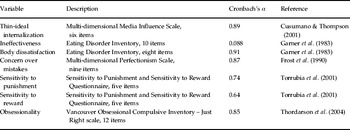
The self-report questionnaires were also asked in the interview and are described in Table 1. The internal consistency for each scale was generally adequate; however, the five-item Sensitivity to Reward scale (Torrubia et al. Reference Torrubia, Avila, Molto and Caseras2001) was not highly reliable (α=0.64). It should be noted that the Sensitivity to Punishment and Sensitivity to Reward Questionnaire was abbreviated from its original 48-item version to a 10-item version in order to reduce the burden of measure completion. The selected items were those that have been previously found to load most strongly on the sensitivity to punishment (five items) and sensitivity to reward (five items) factors (Torrubia et al. Reference Torrubia, Avila, Molto and Caseras2001).
Summary and description of the self-report measures used in the analyses

The only deviation from prescribed scoring procedures of any measure was for the Eating Disorder Inventory scales (Ineffectiveness and Body Dissatisfaction) where a system of 1 (always) to 6 (never) was used. The original scoring for eating disorder populations was not used (0, 0, 0, 1, 2, 3) as this was neither expected to be a sensitive enough measure of change in a population expected to be less extreme with respect to eating disorder behaviour and psychopathology nor to have acceptable internal consistency (Schoemaker et al. Reference Schoemaker, van Strien and van der Staak1994; van Strien & Ouwens, Reference van Strien and Ouwens2003).
Interviewers
All interviewers were postgraduate clinical psychology trainees (n=16) who had been trained in use of the EDE. Each of the interviews was taped and corrective feedback was provided until the interviewer had acquired the skills required to complete the interview independently. Throughout the interviewing process monthly group meetings were held to discuss the interview process in order to ensure interview fidelity. Independent ratings by the second author (T.D.W.) of a subsample of 20 randomly chosen interviews (five from each of the four age groups, i.e. 12, 13, 14 and 15–16 years) yielded inter-rater reliability statistics (intra-class correlation coefficients) of the four subscales (last 4 weeks) as follows: 1.00 (dietary restraint); 0.96 (eating concern); 0.98 (weight concern); 0.99 (shape concern).
Statistical analyses
Descriptive data
All analyses were conducted using SPSS (version 15; SPSS Inc., Chicago, IL, USA). Associations between threshold shape and weight importance, eating disorder behaviours and weight status were investigated using generalized estimating equations (GEE), where results are presented as odds ratios (OR) with 95% CIs. Given that Twin 1 and Twin 2 are correlated observations, GEE corrects for within-family shared variance that is inherent in family research.
Endophenotype criteria
To investigate whether the measured temperament variables were candidate endophenotypes for threshold importance of shape and weight, three different analyses were conducted in order to assess the three endophenotype criteria. First, GEE were used to investigate if the within-twin temperament variables were associated with threshold importance of shape and weight, where results are presented as OR with 95% CIs. Second, logistic regression was used to investigate whether Twin 2 scores for temperament variables were associated with threshold importance of shape and weight in Twin 1, where results are presented as OR with 95% CIs. For this and subsequent investigations, where discordant threshold importance of shape and weight was present across Twin 1 and Twin 2, the data were reorganized such that all twins who had high importance of shape or weight were assigned as Twin 1. The second investigation was repeated but this time with the addition of controlling for Twin 1 scores on the respective temperament variables, in order to identify the most robust predictors.
Heritability was investigated by a comparison of correlations between Twin 1 and Twin 2 of each MZ and each DZ pair, derived using Maximum Likelihood Estimations in Mx (Neale, Reference Neale1997). In addition, univariate twin models were tested for each construct, reporting only the full model that included additive genetic influences (A), shared environment (C) and non-shared environment (E), as we did not have the power to distinguish between the full and sub-models. Additionally, a multivariate Cholesky decomposition analysis was used as a means of calculating the genetic correlations between the five variables. These genetic correlations represent the extent to which the same genes contribute to the observed phenotypic correlation between the variables.
Results
Descriptives
Of the 696 twins for which importance of shape and weight data were available, a total of 55 twins (7.9%) recorded threshold importance of shape and weight. Of these, 43 were discordant for threshold importance of shape and weight (i.e. only one twin from the pair had a mean item score ⩾4 for the previous 3 months, while the other twin reported low importance of shape and weight), six twin pairs were concordant for high importance of shape and weight, and 299 twin pairs were concordant for low importance of weight and shape. All of the concordant pairs were MZ, while of the discordant pairs, 19 were MZ, 23 were DZ and one did not have zygosity reported.
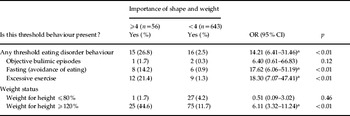
GEE was used to investigate the association between threshold importance of shape and weight and lifetime disordered eating behaviours (see Table 2). No lifetime diagnostic threshold use of laxatives or diuretics was reported, while only one participant with threshold importance of shape and weight reported threshold levels of self-induced vomiting. Generally, the frequency of disordered eating behaviours was higher in those with threshold importance of shape and these associations were significant for fasting and excessive exercise. The proportion of females with any threshold lifetime eating disorder behaviour was considerably more common in the threshold importance of shape and weight group (26.8%) than in the non-threshold group (2.5%). Almost half (44.6%) of the females with threshold importance of shape and weight met our criteria for being overweight, compared with 11.7% in the non-threshold group, while this pattern of findings was reversed for the underweight criterion.
Frequency of lifetime disordered eating behaviours, weight status and their association with clinically significant importance of shape and weight in twins

OR, Odds ratio; CI, confidence interval.
a Significant predictors of threshold importance of shape and weight.
Within-twin associations between temperament variables and threshold importance of shape and weight
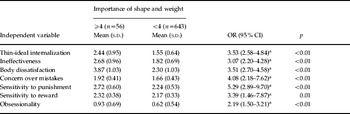
When examining the first endophenotype criterion (i.e. whether an association exists between candidate variables and threshold importance of shape and weight concern), GEE analyses revealed that all seven temperament variables were significantly positively associated with threshold importance of shape and weight. That is, higher levels of each of the temperament variables were associated with increased likelihood of threshold shape and weight concern. Results are summarized in Table 3.
Temperament associations with clinically significant importance of shape and weight in twins

s.d., Standard deviation; OR, odds ratio; CI, confidence interval.
a Significant predictors of threshold importance of shape and weight.
Cross-twin associations between Twin 2 temperament variables and threshold importance of shape and weight
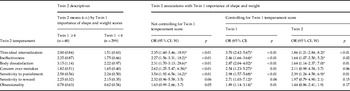
When examining the second endophenotype criterion using Twin 2 temperament scores as predictors, logistic regressions revealed five of the seven temperament variables were significantly positively associated with threshold importance of shape and weight in Twin 1. These findings are presented in Table 4, where it can be seen that sensitivity to reward and obsessionality approached significance (respective p values of 0.06 and 0.05). When Twin 1 scores were entered as a covariate and then Twin 2 temperament scores were entered, thin-ideal internalization, ineffectiveness, body dissatisfaction and sensitivity to punishment remained significant predictors of threshold importance of shape and weight in Twin 1 (see Table 4).
Twin 2 temperament associations with clinically significant importance of shape and weight in Twin 1, both with and without controlling for Twin 1 scores

s.d., Standard deviation; OR, odds ratio; CI, confidence interval; W, Wald statistic.
a Significant predictors of threshold importance of shape and weight.
Heritability
In order to examine heritability, the MZ and DZ twin pair correlations, along with 95% CI, were examined for importance of weight and shape and the four variables identified in Table 4. In addition, the full ACE univariate models were examined and are reported in Table 5. It can be seen that heritability only accounted for a small amount of variance of the importance of weight and shape whilst the other four variables had two to five times as much variance accounted for by heritability. The correlation matrix for the additive genetic risk factors showed that all four temperament variables had genetic correlations with importance of weight and shape, ranging from 0.48 (ineffectiveness) to 0.95 (thin-ideal internalization).
Candidate endophenotype twin pair correlations for MZ and DZ twins

MZ, Monozygotic; DZ, dizygotic; CI, confidence interval; A, additive genetic variance; E, non-shared environmental variance; C, shared environmental variance.
a Given lack of power to discriminate between the full model and the sub-models, only the parameter estimates for the full model are presented for each variable.
b Continuous measure.
Discussion
This study sought to investigate if any of the seven measured temperament risk factors for disordered eating met criteria for being an endophenotype for clinically significant importance of shape and weight. This was done by examining three of the criteria for endophenotypes (Gershon & Goldin, Reference Gershon and Goldin1986), namely: association with illness in the general population; elevated levels in non-affected family members compared with the general population; and heritability. Whilst family studies have been used previously to investigate the importance of shape and weight (e.g. Reichborn-Kjennerud et al. Reference Reichborn-Kjennerud, Bulik, Kendler, Roysamb, Tambs, Torgersen and Harris2004), these studies have been with adults rather than adolescents and thus the current study provides useful information about importance of shape and weight closer to the time at which it starts to emerge.
Threshold importance of shape and weight was chosen for examination as it is considered to be an important predictor of the development of later disordered eating behaviours. Whilst the cross-sectional design of our study could not address causality, we did find, consistent with previous research, a positive relationship between the presence of clinically significant importance of shape and weight and disordered eating behaviours (Gowers & Shore, Reference Gowers and Shore2001). Indeed, 26.8% of the 56 participants with threshold importance of shape and weight met threshold criteria for at least one lifetime disordered eating behaviour, compared with just 2.5% of participants who did not meet threshold importance of shape and weight. Investigations of the weight status of those with threshold importance of shape and weight revealed almost half (44.6%) met our criteria for being overweight, which is consistent with other findings that a history of being overweight in childhood (Micali et al. Reference Micali, Holliday, Karwautz, Haidvogl, Wagner, Fernandez-Aranda, Badia, Gimenez, Solano, Brecelj-Anderluh, Mohan, Collier and Treasure2007) is a risk factor for later disordered eating, in particular of a bulimic phenotype. Conversely, there was a non-significant trend for a higher proportion of the non-threshold importance of shape and weight group meeting criteria for being underweight (4.2%) compared with those in the threshold group (1.7%). In sum, descriptive analyses in the current study provide further support for importance of shape and weight as having a strong association with disordered eating behaviours (Cooper & Goodyer, Reference Cooper and Goodyer1997; Goldfein et al. Reference Goldfein, Walsh and Midlarsky2000).
The first endophenotype criterion we investigated was whether the temperament variables were associated with illness; in this case, presence of threshold importance of shape and weight. Findings indicated each of the candidate endophenotypes measured was significantly associated with threshold importance of shape and weight in the current study. The second criterion assessed was whether the temperament variables were found at an elevated level in non-affected family members (i.e. twins without threshold importance of shape and weight) compared with the general population. Our most rigorous test of non-affected family members showed four significant predictors of threshold importance of shape and weight in the affected twin – namely, thin-ideal internalization, ineffectiveness, body dissatisfaction and sensitivity to punishment. These Twin 2 variables predicted variance in Twin 1 importance of shape and weight, even when controlling for Twin 1 scores on these variables, suggesting that these variables are found at a significantly elevated level in non-affected family members compared with the general population. These findings provide support for conceptualizations of the development and maintenance of disordered eating that include one or more of these variables (e.g. Stice, Reference Stice2001). They suggest that prevention and early intervention efforts that target one or more of these variables are likely to be of value and indeed some such prevention programmes, particularly those targeting thin-ideal internalization, have had success at reducing eating disorder risk (e.g. Wade et al. Reference Wade, Davidson and O'Dea2003). On a clinical level, these findings are also a reminder of the potentially important role of anxiety (represented by sensitivity to punishment) as a worthwhile target in the treatment of eating disorders. The third endophenotype criterion evaluated was that of heritability. The amount of variance explained by genetic influences ranged from 28% (ineffectiveness) to 71% (sensitivity to punishment). A far lower proportion of variance was explained by genetic influences for importance of shape and weight (15%), suggesting this construct is more environmentally influenced, consistent with previous findings (Wade & Bulik, Reference Wade and Bulik2007). The heritability findings of the current study provide support for differentiation of the importance of shape and weight construct from the temperament variables investigated. It should be noted that one of the limitations with evaluating temperament candidate endophenotypes is that temperaments are genetically complex constructs where influences are difficult to simplify. However, the endophenotype criteria do provide a useful indication of the essential building blocks on the pathway to the development of clinically significant importance of shape and weight.
In summary, of the four endophenotypes identified, two related to general temperament relating to ineffectiveness and anxiety, and the other two related to body-specific temperament. This conceptualization is consistent with the model proposed by Peter Slade (Slade, Reference Slade1982) where premorbid personal ineffectiveness and its associated anxiety, when allied with weight sensitivity triggered by adolescence, can result in coping strategies that focus on the importance of controlling weight, shape and eating in order to manufacture some sense of personal success.
Limitations
The results of the current study should be interpreted in the context of four limitations. First, the use of an abbreviated Sensitivity to Punishment and Sensitivity to Reward Questionnaire (Torrubia et al. Reference Torrubia, Avila, Molto and Caseras2001) may not be as psychometrically robust as the full scales and thus findings related to these scales should be interpreted with some caution. Second, only one dimension of perfectionism, concern over mistakes, was measured in the current study. Given that this candidate endophenotype did approach significance in our most robust test, it would have been of interest to have measured other perfectionism constructs such as personal standards, which has been found to be associated with disturbed eating behaviour (Shafran et al. Reference Shafran, Lee, Payne and Fairburn2006). Third, due to the cross-sectional nature of the current study, we were unable to investigate all of the previously stated criteria for an endophenotype (Gershon & Goldin, Reference Gershon and Goldin1986) and thus future investigations will need to establish if the temperament endophenotypes identified in the current study meet the criterion of being a stable, state-independent characteristic. A further limitation is our moderate response rate (48.8%), which is commensurate with other large Australian twin studies (Wade et al. Reference Wade, Crosby and Martin2006). A previous study of Australian twins using interviews focused only on eating indicated that response was not biased by previous eating problems (Wade et al. Reference Wade, Tiggemann, Martin and Heath1997).
Future direction and final comments
The identification of endophenotypes for the development of clinically significant importance of shape and weight, previously described as the ‘core psychopathology’ of eating disorders (Cooper & Fairburn, Reference Cooper and Fairburn1993), is a valuable endeavour given that endophenotypes are particularly useful in deconstructing complex disorders (Bulik et al. Reference Bulik, Hebebrand, Keski-Rahkonen, Klump, Reichborn-Kjennerud, Mazzeo and Wade2007) and that importance of shape and weight is considered to be an important diagnostic criterion across different eating disorders. The issue of complexity goes to the heart of the eating disorder field, where up to 30 variables have been reported in the literature as possible risk factors (Jacobi et al. Reference Jacobi, Hayward, de Zwaan, Kraemer and Agras2004), and increased success in developing parsimonious formulations and models that indicate more helpful therapeutic directions are urgently required (Fairburn & Cooper, Reference Fairburn and Cooper2007).
To this end, the current study has identified four temperament endophenotypes for the development of clinically significant importance of shape and weight, namely, thin-ideal internalization, ineffectiveness, body dissatisfaction and sensitivity to punishment (anxiety). Future research should evaluate the utility of these endophenotypes for predicting significant growth in importance of shape and weight, and also whether different endophenotypes emerge when the importance of weight and shape reaches its peak in adolescents, around the age of 15–16 years (Cooper & Goodyer, Reference Cooper and Goodyer1997).
Acknowledgements
This work was supported by Grant 324715 from the National Health and Medical Research Council (NHMRC). The authors thank the twins and their families for their participation in this research, and Ms. Judith Slater for coordinating the data collection. Administrative support for data collection was received from the Australian Twin Registry which is supported by an Enabling Grant (ID 310667) from the NHMRC administered by the University of Melbourne.
Declaration of Interest
None.