Introduction
Opiate-dependent patients who enter methadone maintenance treatment (MMT) had by definition experienced at least 1 year of compulsive drug-seeking behavior and drug self-administration of opiates as well as other substances. Most of them had experienced many more years of that behavior as well as several self- and at times institutional-imposed abstinence failures. Opiate addiction onset among MMT patients has been found to occur during childhood or adolescence and is often combined with other substances, such as cannabis.Reference Navaratnam and Foong1 Many of the MMT patients experienced unpleasant childhood as well as multiple traumas, including sexual abuse, emotional abuse, and exposure to or involvement in crimes. Most of them had limited education, and, in addition to their opiate addiction, at least half of them suffered from physical and psychiatric comorbidities.Reference Assanangkornchai and Edwards2 Studies on cognitive function of MMT patients usually describe them as suffering from cognitive impairment as reflected by their poor performance on diverse cognitive tasks.Reference Bracken, Trksak and Penetar3–Reference Marvel, Faulkner and Strain5 Although some investigators have suggested that methadone itself might relate to their impairment, others also reported possible improvement in their cognitive abilities during MMT.Reference Soyka, Zingg and Koller6, Reference Gruber, Tzilos and Silveri7
The neuro-developmental disorder attention deficit hyperactivity disorder (ADHD) was found to be associated with substance dependence comorbidity,Reference Kollins8, Reference Schubiner9 and it has been suggested that children with ADHD are more vulnerable to develop substance dependence.Reference Wilens10 Neurobiological research on patients with ADHD has shown a lack of connectivity in key brain regions, inhibitory control deficits, delayed brain maturation, and noradrenergic and dopaminergic dysfunction in multiple brain regions.Reference Dopheide and Pliszka11 ADHD is associated with impaired academic, occupational, and social functioning; increased rates of substance dependence; traffic accidentsReference Barkley and Cox12; persistent neuropsychological impairments; and increased associated costs to society.Reference Minkoff13
Several recent studies have found that MMT patients had impaired cognitive function in measures of selective attention on the Stroop task.Reference Prosser, Cohen and Steinfeld14, Reference Mintzer and Stitzer15 Naming the color of an incongruent color word requires suppression or inhibition of the currently irrelevant word dimension. Thus, the magnitude of the Stroop interference effect is considered to be a measure of the inhibitory processes involved in selective attention. The Stroop task reflects attention selection that is mediated by the dorsolateral prefrontal cortex and anterior cingulate cortex.Reference Perret16, Reference Peterson, Skudlarski and Gatenby17 In the study by Mintzer and Stitzer,Reference Mintzer and Stitzer15 MMT patients were compared by gender, race, age, years of education, current employment status, current reading level, and estimated IQ score to matched healthy control subjects. The Stroop interference effect was higher among MMT patients (together with impairment in psychomotor speed on the digit symbol substitution and trail-making tests), working memory (2-back task), decision making (gambling task), and memory (confidence ratings on a recognition memory test). MMT patients did not exhibit impairment in time estimation, conceptual flexibility, or long-term memory. They also were not diagnosed as fulfilling the criteria for other axis I psychiatric comorbidity or substance abuse. The MMT patients were a selective subgroup in that study, and they were not evaluated for ADHD.
As several psychiatric comorbidities are frequently found among MMT patients, including obsessive-compulsive disorder and/or pathological gambling, our aim in the current study was to study the impact of ADHD on cognitive performance among MMT patients, focusing on selective attention to words related to conditions such as obsessive-compulsive disorder (OCD) and pathological gambling (PG), which are prevalent among MMT patients. Clinical OCD diagnosis was previously found by us among 40% of our patients,Reference Peles, Adelson and Schreiber18, Reference Peles, Schreiber and Adelson19 and lifetime PG among 29% of our MMT patients.Reference Peles, Schreiber and Adelson19, Reference Peles, Schreiber and Adelson20 Inconsistent findings on the Stroop task for both OCDReference Hartston and Swerdlow21–Reference Abramovitch, Dar and Schweiger25 and PGReference Kertzman, Lowengrub and Aizer26, Reference Potenza, Leung and Blumberg27 have already been reported.
Specifically, we studied selective attention by using the classical standard Stroop color task and the modified Stroop task by using condition-related words (OCD, PG, addiction). The study was done among MMT patients with respect to OCD and PG diagnosis, while controlling for drug abuse, age, sex, cognitive state, and ADHD. The ADHD condition was in particular important, as it was already found to be prevalent (33%) among our patients.Reference Peles, Schreiber and Sutzman28 We also studied subjects without a history of drug abuse who served as a control group.
With respect to the condition-related words, we hypothesized that patients will be affected by words that are related to their clinical conditions, namely that MMT patients would be slower to respond to addiction-related words, while MMT patients with gambling problems would be slower to respond to gambling words and MMT patients with OCD would be slower to respond to obsessive-compulsive words. Condition-related words are expected to delay color naming on the modified Stroop task. Such slow responses were already found by various conditions and patient groups (see Weinstein and CoxReference Weinstein and Cox29). We also used the patients’ general reaction times (RTs) to obtain a general measure of the patients’ neurocognitive performance.
The importance of the current study is that findings may explain in part the inconsistency of previous studies with relation to poor cognitive performance among MMT patients as a whole. The results would contribute to enabling us to differentiate MMT patients into those who are characterized as having diverse levels of cognitive state or impairment due to other specific comorbidities such as OCD and ADHD. Any new understanding that there are specific subgroups with different impairment among MMT patients and that not all MMT patients suffer from a poor cognitive state would be important to lessen the stigma about MMT patients and the methadone maintenance itself. By characterizing the specific cognitive impairments and their possible causes, a better understanding of patients’ abilities, and goals in treatment will be available; this would lead to improvement of treatment directions and quality.
Methods
Study patients
The Tel Aviv Sourasky Medical Center Ethics (Helsinki) Committee approved this study (IRB number 0120-09), and all participants signed an informed consent. The Adelson Clinic in Tel Aviv treats about 330 patients who meet criteria similar to those of the U.S. Federal Regulations for entering methadone treatment [ie, Diagnostic and Statistical Manual for Mental Disorders, 4th edition, text revision (DSM-IV-TR) criteria of heroin-dependence with multiple self-administrations of heroin per day for at least 1 year]. Characterization, demography, and effectiveness of the clinic have been reported elsewhere.Reference Peles, Schreiber and Adelson20, Reference Adelson, Hayward and Bodner30 MMT patients who were diagnosed with either PG or OCD, or who had neither PG nor OCD diagnosis, were asked to participate in the Stroop task test. Cognitive status and ADHD diagnosis were tested in all participants. Exclusions were color blindness and non-Hebrew speaking. The staff personnel served as control subjects.
Questionnaires
Each patient underwent an evaluation by a board certified psychiatrist who administered the following questionnaires. The Self-Report Scale (ASRS) symptom checklist was used to define adult ADHD.Reference Kessler, Adler and Ames31, Reference Adler, Spencer and Faraone32 The questionnaire includes an 18-item scale that rates ADHD symptoms using a 5-point Likert severity scale (from 0 = never to 4 = very often). A score of ≥17 is indicative of possible adult ADHD (ie, likely to have ADHD), while a score of ≥24 is indicative of definite ADHD (ie, highly likely to have ADHD). The Wender Utah Rating Scale was used to define childhood ADHD.Reference Ward, Wender and Reimherr33 It includes 61 questions and a 5-point Likert severity scale. A total of ≥46 points is indicative of childhood ADHD. The patients’ current quantitative measure of cognitive status was assessed by the Mini-Mental State Examination (MMSE).Reference Folstein, Folstein and McHugh34 The South Oaks Gambling Screen (SOGS) instrument was used to define PG.Reference Lesieur and Blume35 The SOGS includes 20 items, which are scored by summing the number of items endorsed out of 20. “Potential” (ie, likely to be a problem gambler) is defined by a score of 3–4, and a “probable” PG (PPG) is defined by a score ≥5. The Yale-Brown Obsessive Compulsive Scale (YOCS) questionnaireReference Goodman, Price and Rasmussen36 was used to define clinical OCD. The scale is a clinician-rated, 10-item scale, with each item rated from 0 (no symptoms) to 4 (extreme symptoms), yielding a total range between 0 to 40, with separate subtotals for severity of obsessions and compulsions. Clinical OCD was defined if the score was moderate to extreme (≥16). Finally, the Modified Addiction Severity Index (ASI) was used to assess the addiction indices history.Reference McLellan, Luborsky and O'Brien37
Urine toxicology
Patients in MMT programs routinely undergo repeated observed urine tests throughout the entire duration of their treatment. In addition, for the current study, a urine test was done on the morning of the Stroop task. The drugs that were checked by enzyme immunoassay systems (DRI® and CEDIA®, Thermo Scientific, CA, USA)Reference Hawks38 for abuse on the day prior to Stroop task included opiates, cocaine metabolite (benzoylecgonine), benzodiazepines (BDZ), amphetamines, cannabinoids (THC), and methadone metabolite.
Stroop task
Participants used a response box with 4 colored buttons (red, blue, yellow, and green). They were asked to immediately push the button with the same color that was shown on the computer screen and to ignore the printed written words on the screen. In the classical Stroop task, the printed words were either congruent (the printed word was the name of the observed color) or incongruent (the printed word was other than the name of the observed color). The subjects were seated close to the screen (usually 50–60 cm).
In the modified Stroop task, printed words that were related to OCD (ie, clean, contaminations, lock, dirt), gambling (ie, casino, cards, dice), addiction (ie, high, euphoria), color (ie, blue, red), and neutral (ie, building, window, chair, closet, coat) were displayed randomly in the colors red, blue, yellow, and green, and the subjects were instructed to push the corresponding color button. The related words were selected and validated by therapists and psychiatric experts. The task included a random mixture of 48 words, with the background color presented for 50 ms and the word with no time limit. As a control condition, the background color was presented for 500 ms together with a few words, but there were no differences in response times.
Patients were informally checked to rule out color blindness, and were asked to read the list of words on the Stroop task to exclude those who were unable to read. Two were excluded for color blindness and 5 for reading disabilities. Then, the classical and the modified Stroop tasks were administered one after the other, with a short practice session (about 1 minute) before each task.
Statistical analyses
The SPSS 19 version was used to analyze the results. Chi-square or Fisher's Exact test were used to compare categorical variables, and the one-way analysis of variance (ANOVA) was used to compare continuous variables [the means ± standard deviation (SD) are presented]. The Pearson correlation coefficient was used for linear correlation.
The mean RTs for correct responses to each condition-related word group were calculated. Interference was defined as the difference in RTs between congruent and incongruent colors in the classical Stroop task, and as the difference in RTs between each condition word groups (OCD, PG, addiction) to RTs to the neutral words in the modified Stroop task. The percentages of errors of all conditions for all participants were also compared.
Sample size of 35 patients for a subgroup can find a significance of p = 0.05 with a power of 80% based on 10-ms differences in the interference between 2 groups (ie, 40 ms vs 50 ms) with a standard deviation of 15 ms.
Repeated-measure multivariate analyses were used to evaluate differences between congruent and incongruent responses (time effect) and RT differences (group difference). The Stroop interference effect was defined as interaction of time by group. We used this analysis, as did Lusher etal,Reference Lusher, Chandler and Ball39 as it also takes into account the congruent and incongruent absolute values, in addition to the difference change between them, which is calculated by the classical Stroop method. For multivariate analyses, we used repeated measures and analyzed 2 models: 1 model that included all variables that differed (p < 0.1) in RT and 1 model that included variables that differed (p < 0.1) in interference.
Results
A total of 86 MMT patients participated in the study; their ages ranged between 25 and 73 years. The mean age was 46.3 ± 9.5 years, and 43 (50%) were older than 45 years. There were 47 males and 39 females, with a mean number of pre-opiate years of 14.5 ± 8.6 and 10.1 ± 2.2 years of education. The 15 control subjects were younger than the MMT patients [mean age 38.8 ± 13.3 years F(d.f = 1)6.7, p = 0.01], with no gender differences [5 males and 10 females (p = 0.2)]; they were more educated [had 16.2 ± 3.3 years of education F(d.f = 1)84, p < 0.0005]; and had no history of drug use.
Thirty-eight of the 86 MMT patients (44.2%) abused drugs at the time of the study (positive urine test on the day of the Stroop study): 32 tested positive to BDZ (11 of them to other drugs as well), 9 tested positive to opiates (6 to other drugs as well), 8 to cocaine (7 to other drugs as well), and 3 to cannabis (2 to other drugs as well).
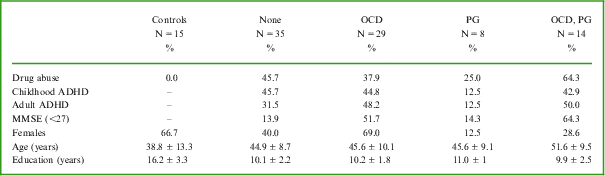
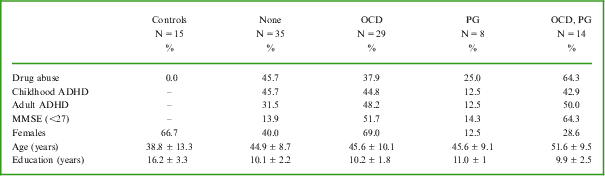
The patients’ methadone therapeutic dose ranged between 13 to 235 mg/day, with a mean of 130.4 ± 42 mg/day. One-third of the patients (29 of 86, 33.7%) were treated with doses >150 mg/day, and the remaining 57 were treated with doses <150 mg/day (66.3%). Table 1 presents characteristics of each MMT subgroup.
Stroop task
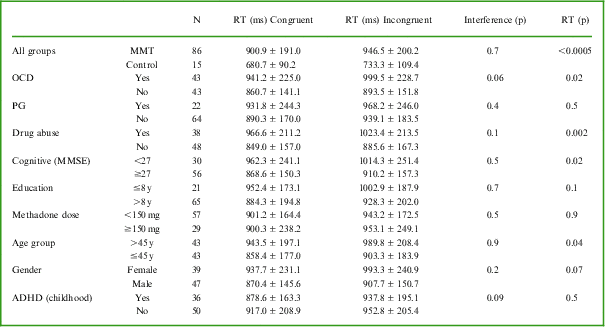
The results of the classic Stroop study showed that RTs to congruent words were significantly shorter than incongruent words in both groups, as expected. The RTs for the MMT patients were 900.9 ± 191.0 ms to congruent and 946.5 ± 200.2 to incongruent words, and the RTs for the control subjects were 680.7 ± 90.2 and 733.3 ± 109.4 for the congruent and incongruent words, respectively [repeated measures: time F(df = 1)34.2, p < 0.0005]. The Stroop interference did not differ between groups (F = 0.2, p = 0.7); however, the RTs were significantly shorter for the control subjects [repeated measures: group F(df = 2)17.9, p < 0.0005].
Stroop task and drug abuse
The drug abuser group had significantly longer congruent and incongruent RTs compared with the non-drug abusers [repeated measures: time F(df = 1)49.0, p < 0.0005, Group F(df = 1)10.3, p = 0.002] with no difference in Stroop interference [F(df = 1)2.3, p = 0.1] (Table 2). When each of the drugs was compared separately, only BDZ abusers differed in congruent and incongruent RTs compared to non-BDZ abusers, with no other drugs showing any differences in Stroop effects.
Reaction time (RT) in milliseconds of classical color Stroop by variables

Stroop task and methadone dose
The 2 methadone dose groups (>150 mg/day and <150 mg/day) did not differ in congruent and incongruent RTs [repeated measures: time F(df = 1)44.6, p < 0.0005, Group F(df = 1)0.01, p = 0.9] or Stroop interference [F(df = 1)0.6, p = 0.4] (Table 2).
Stroop task and age and gender
The 43 (50%) patients who were older than 45 years of age had significantly longer congruent and incongruent RTs compared with the group of patients who were younger than 45 years of age. Repeated measure analysis showed a time effect [F(df = 1)45.9, p < 0.0005] and a group effect [F(df = 1)4.4, p = 0.04], but no time by group interaction, which is the Stroop interference effect [F(df = 1)0.01, p = 0.9] (Table 2).
Females showed a trend to have longer congruent and incongruent RTs. Repeated measure analysis showed a time effect (F = 48.3, p < 0.0005) and a Group effect [F(d.f = 1)3.4, p = 0.07] with no time by group interaction, which is the Stroop interference effect (F = 1.9, p = 0.2) (Table 2). The females were significantly younger than the males (42.9 ± 9 vs. 49.2 ± 9 years, respectively; F = 10.5, p = 0.002). Repeated measure analysis by aged group and gender found the congruent and incongruent RTs to differ significantly by age (F = 9.4, p = 0.003) and by gender (F = 8, p = 0.006), but with no significant interaction between them (F = 2.1, p = 0.1) and no differences in Stroop interference (data not shown).
ADHD
Thirty-six (41.9%) of the MMT patients were diagnosed as having had childhood ADHD. This ADHD group did not differ in Stroop congruent and incongruent RTs from any of the other groups. Repeated measure analysis showed a time effect [F(df = 1)50.3, p < 0.0005], no group effect [F(df = 1)0.4, p = 0.5], and a trend of time by group interaction, which is the Stroop interference effect [F(df = 1)3.0, p = 0.09] (Table 2).
Adult ADHD was defined as “possible” ADHD among 16 patients and “definite” among 17 MMT patients. Repeated measure analysis showed a time effect [F(df = 1)43.5, p < 0.0005], no Group effect (F = 1.1, p = 0.3), and no time by group interaction, which is the Stroop interference effect (F = 1.0, p = 0.4) (Table 2).
Cognitive status
Thirty of the MMT patients (34.9%) had low MMSE scores (<27). That group had longer mean congruent and incongruent RTs compared with the normal (≥27) cognitive group. Repeated measure analysis showed a time effect [F(df = 1)44.8, p < 0.0005], a group effect [F(df = 1)5.4, p = 0.02], with no time by group interference, which is the Stroop interference effect [F(df = 1)0.5, p = 0.5] (Table 2).
Education
The MMT patients had a mean of 10.1 ± 2.2 years of education (range 3–15 years, median 11). The 65 patients (75.6%) in the more educated group (>8 years) had a trend of having shorter mean congruent and incongruent RTs compared with the 21 patients in the less educated group (≤8 years). Repeated measure analysis showed a time effect [F(df = 1)36.5, p < 0.0005] and no group effect [F(df = 1)2.2, p = 0.1], with no time by group interaction, which is the Stroop interference effect [F(df = 1)0.2, p = 0.7] (Table 2).
Obsessive-compulsive disorder (OCD)
Forty-three (50%) MMT patients were clinically diagnosed as having OCD. The OCD-diagnosed group had significantly longer congruent and incongruent RTs compared with the non-OCD group. Repeated measures analysis showed a time effect [F(df = 1)48.0, p < 0.0005], a group effect [F(df = 1)5.3, p = 0.02], and a trend of significant time by group interaction, which is the Stroop interference effect [F(df = 1)3.8, p = 0.06] (Table 2).
Pathological gambling (PG)
Twenty-two MMT patients (25.6%) had PG. The PG-diagnosed group did not differ from the non-PG group in congruent and incongruent RTs. Repeated measures analysis showed a time effect [F(df = 1)30.7, p < 0.0005], no group effect [F(df = 1)0.5, p = 0.5], and no time by group interaction or the Stroop interference effect [F(df = 1)0.7, p = 0.4] (Table 2).
PG and OCD
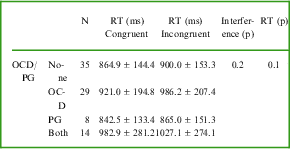
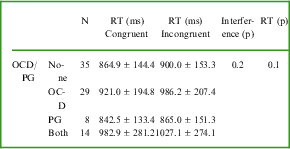
Comparisons of patients with PG or OCD, or both, revealed that those with the 2 comorbidities were the oldest patients, more of them had positive urine tests (to any drug abuse), and they had fewer years of education (Table 1). The 4 groups (PG, OCD, both, and none) did not differ significantly between the congruent and incongruent RTs [F(df = 1)2.0, p = 0.1], as well as the time by group interaction, which is the Stroop interference effect [F(df = 1)1.7, p = 0.2) (Table 3). The mean RTs of the patients with PG alone were very similar to those of the MMT patients with no comorbidities, while the patients with both PG and OCD had the longest RTs (ie, longer than the OCD-only group).
Comparison between OCD and PG group characteristics
Reaction time (RT) in milliseconds of classical color Stroop by OCD and PG groups
Multivariate analyses
We studied 2 models: one that included all variables that differed (p < 0.1) in RTs (OCD, drug abuse, age, gender, cognitive state), and another that included variables that differed (p < 0.1) in interference (OCD, ADHD). The first model, the “RT model,” found RTs to be significantly influenced by the cognitive state (as measured by MMSE) (F = 4.3, p = 0.04), and OCD diagnosis and drug abuse interaction (F = 6.3, p = 0.02), all of which characterize longer RTs. Any drug abuse interaction with cognitive state (F = 6.6, p = 0.01), with OCD (F = 4.7, p = 0.04), and with gender and cognitive state (F = 7, p = 0.01) also significantly related to longer interference. The second model, the “interference model,” also found RTs to be significantly influenced by OCD diagnosis (F = 5.0, p = 0.03), while interference was significantly related to OCD diagnosis (F = 5.3, p = 0.02) and to interaction between OCD and ADHD diagnosis (F = 4.4, p = 0.04). Specifically, interference in patients with ADHD diagnosis was higher among those with OCD diagnosis compared to those without OCD diagnosis, but interference did not relate to OCD diagnosis among subjects without ADHD.
Correlations
RTs (both congruent and incongruent) linearly correlated with age (R = 0.37, p < 0.0005, n = 101) and OCD severity (as measured by Y-BOCS score; R = 0.29, p = 0.008, n = 86) (Figure 1), and inversely correlated with the cognitive state (as measured by MMSE score) (R = −0.43, p < 0.0005, n = 86), but not with the childhood ADHD severity score (R = 0.07, p = 0.6). Stroop interference correlated significantly with the OCD score (Y-BOCS) (R = 0.22, p = 0.04) and showed a trend to correlate with childhood ADHD score (R = 0.2, p = 0.06), in particular among the clinical OCD group of patients (Figure 2). Stroop interference did not correlate with the cognitive score (MMSE) (R = −0.1, p = 0.3, n = 86) or with age (R = 0.06, p = 0.7, n = 86).
Correlation between incongruent RT to color and Y-BOCS score.
Correlation between color interference and ADHD-childhood score by OCD group.
Errors
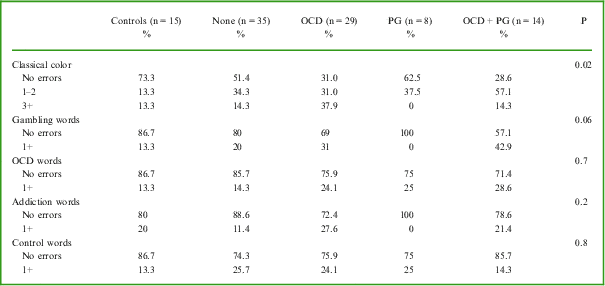
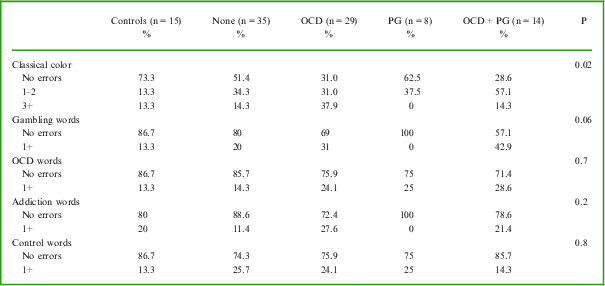
Percentage of errors also differed by comorbidity groups [χ2 (df = 4)17.9, p = 0.02]. Performance on the classical Stroop color words had the highest percentage of errors (53.5%) compared with all the modified Stroop conditions (PG 23.8%, OCD 19.8%, addiction 17.8%, neutral 21.8%, color 30.7%). The subjects with both OCD and PG had the highest percentage of errors in the classical Stroop color task (57.1% had 1–2 errors and 14% had ≥3 errors) (Table 4). There were no significant differences in number of errors generated by use of condition-related words, although there was a trend toward significant interference by the gambling words condition [χ2 (df = 4)8.9, p = 0.06). As was observed in other Stroop tasks, the PG and OCD comorbidity group presented the higher percentage of errors (Table 4).
Errors by comorbidity groups
Discussion
The aim of this study was to evaluate the Stroop interference effect and general performance (reaction times) among MMT patients with OCD or PG, or both OCD and PG, and childhood- or adult-onset ADHD. Former opiate-dependent patients who were current MMT patients showed a general slow response (longer RTs) on the Stroop task compared with healthy control subjects. Even a small selected group of MMT patients (10 patients with normal cognitive status who had not abused any drugs recently, and have had no ADHD, OCD, or PG diagnosis) had overall longer RTs on the Stroop task than the control subjects. Longer RTs were found to be related to older age, to drug abuse, and to low cognitive status. The MMT patients, however, did not show any difference on the Stroop interference effect, which is a measure of selective attention, compared with the controls.
Being diagnosed with PG was not related to the performance of the Stroop task, while having OCD diagnosis significantly did affect performance, and presented generally longer RTs as well as a higher Stroop interference effect. There was a difference between subjects who had both PG and OCD diagnosis and those with PG diagnosis only: They differed substantially in their overall performance as well as in other variables, such as age, drug abuse, and cognitive status, each of which was related to Stroop performance. The subjects with both PG and OCD diagnosis were older and had a higher percentage of drug abusers and of patients with lower cognitive status. Their performance showed the longest RTs and the highest percentage of errors. In contrast, subjects with PG diagnosis alone were younger, and had a low rate of drug abuse and a high rate of normal cognitive status. Their performance, as expected, was better, and they had no errors at all. Thus, OCD, but not PG diagnosis, was characterized by poor Stroop performance. The patients with OCD but without PG diagnosis also presented longer RTs and the severity score of OCD (Y-BOCS) linearly correlated with RTs. In other words, the more severe the OCD symptoms were, the slower the RTs were. The association was even stronger among drug abusers. This is not surprising, since heroin-dependent patients with OCD diagnosis often abuse benzodiazepines.Reference Peles, Adelson and Schreiber18 Several studies reported that patients with OCD diagnosis perform less accurately on the Stroop task,Reference Galderisi, Mucci and Catapano22, Reference Purcell, Maruff and Kyrios23 while other studies found no attention bias (ie, Moritz etal Reference Moritz, Fischer and Hottenrott40). Schlösser etal,Reference Schlösser, Wagner and Schachtzabel24 who used a Stroop task in functional magnetic resonance imaging studies, found significant interference among OCD patients, as did Abramovitch etal.Reference Abramovitch, Dar and Schweiger25
ADHD condition, which is highly prevalent among our MMT patients,Reference Peles, Schreiber and Sutzman28 as well as our patients with OCD diagnosis,Reference Peles, Adelson and Schreiber18, Reference Peles, Schreiber and Adelson19, Reference Peles, Schreiber and Linzy41 has also shown mostly higher Stroop effect. BarkleyReference Barkley42 suggested that behavioral disinhibition is the primary deficit in ADHD (predominantly in the hyperactive-impulsive and combined types) and distinguished between 3 interrelated forms of behavioral inhibition. The third one is interference control, which is defined as protecting the period of delay and self-directed responses that occur within it from disruption by competing events and responses. In computerized Stroop tests, congruent color words, neutral non-color words, as well as incongruent color words are presented one at a time, and the reaction time for each item can be recorded. A meta-analysis of 19 studies revealed more interference for patients with ADHD diagnosis relative to the control groups.Reference Lansbergen, Kenemans and van Engeland43
We found no difference between the childhood ADHD and non-childhood ADHD MMT patients in RTs, but we did find a trend for Stroop interference. Moreover, the Stroop interference effect linearly correlated with ADHD severity (the score of childhood ADHD symptoms). In the final multivariate model, the patients with ADHD who also had OCD diagnosis presented a higher Stroop interference effect than those who did not have OCD diagnosis. This was not observed among the subjects with OCD who did not have ADHD.
The results of a study that compared gender, race, age, years of education, current employment status, current reading level, and estimated IQ score between MMT patients and matched healthy controls revealed that the Stroop interference effect was higher among MMT patients (together with impairment in psychomotor speed, digit symbol substitution, and trail-making tests), working memory (2-back task), decision making (gambling task), and memory (confidence ratings on a recognition memory test).Reference Mintzer and Stitzer15 The MMT patients did not exhibit impairment in time estimation, conceptual flexibility, or long-term memory, nor did they fulfill the criterion of axis I psychiatric comorbidity or substance abuse. Their RTs were longer (M = 1033 ms for incongruent, 849 ms for neutral) relative to the controls (M = 974 ms for incongruent, 828 ms for neutral).Reference Mintzer and Stitzer15 These MMT patients were a selective subgroup, and, although ADHD status was not evaluated, it was most likely present among some of them.
As a whole, our MMT patients did not differ from the control subjects in the Stroop interference effect; however, subgroups within the MMT patients did: In the ADHD group, those with OCD diagnosis presented higher interference effect, and those who did not have OCD (independent of their PG status) did not.
One study that compared a group of MMT patients to a group of protracted abstinence, former MMT patients, and a group of healthy control subjects demonstrated an impaired Stroop performance among the former (currently abstinent) MMT patients compared to the controls, but no difference between the former and current MMT patients.Reference Prosser, Cohen and Steinfeld14 Another study that compared Stroop performance among subjects who were abstinent from opiates for 15 days to current MMT patients found no difference between the groups in Stroop performance, but reported that the performances of both of those groups were below the normative mean values.Reference Verdejo, Toribio and Orozco44 Using the modified addiction Stroop task, Fadardi and ZiaeeReference Fadardi and Ziaee45 observed an attention bias to addiction-related words among MMT drug abusers compared to healthy controls. We did not find any differences between our MMT patients and healthy controls either in response to addiction-related words on the modified Stroop or to other condition-related categories of OCD and PG. We used shorter exposure times (50 ms) than Fadardi and Ziaee,Reference Fadardi and Ziaee45 and the fact that we made our subjects process the words subliminally (below the threshold of awareness) may have affected the results. We therefore performed an additional control trial using 500 ms among 28 MMT patients, and it did not change the Stroop interference reaction times significantly (data not shown).
Specka etal Reference Specka, Finkbeiner and Lodemann46 compared several measures of psychomotor performance and attention relevant to driving fitness between MMP patients and that of controls matched for age, gender, and years of education. The MMP patients were more impaired than the control subjects on measures of attention perception. On a choice RT task, the MMP patients were faster but produced more errors. Our findings showed longer RTs among the MMT patients, with a trend of higher error percentage than the controls. Actually, both findings reflect the same situation: the MMT patients needed longer time to respond, and, if they responded quickly (as in Specka etal Reference Specka, Finkbeiner and Lodemann46), there were higher error rates. The rate of errors among our MMT patients with ADHD diagnosis did not differ significantly from those of our MMT patients with no ADHD diagnosis (data not shown). This may indicate a “bottom-effect” reached by the MMT patients, either due to years of street drugs abuse that preceded the admission to the MMT or by the chronic MMT.
Cognitive impairment induced by acute doses of BDZ and alcohol is well-documented (for a review, see CurranReference Curran47). Indeed, 85% of our drug abusers who were slow to perform on the Stroop task had abused BDZ. This may have also been observed for other drugs; however, their numbers were too few to identify any effect.
Our patients are receiving a wide range of methadone doses (from 12.5 to 235 mg, mean 130.4 mg). Still, there was no relationship between performance and methadone dose, neither when we compared low with high dose, nor by correlation. Similarly, Specka etal Reference Specka, Finkbeiner and Lodemann46 showed that neuropsychological test scores were independent of methadone dose.
The study has several limitations. One of them is that drug abuse was not evaluated among our control subjects whom we assumed were not taking drugs. We also assumed that none of them had been diagnosed (and not reported) as having ADHD. Also, diagnosis was based on self-report questionnaires rather than on an interview by a psychiatrist using Structured Clinical Interview for DSM-IV Psychiatric diagnosis (SCID). Thus future study should be on a large sample, and should use a thorough psychiatric evaluation of both patients and controls, in order to support our pilot finding.
MMT patients had generally longer RTs that were related to clinical OCD, drug abuse, poor cognitive state and older age. Clinical OCD with ADHD had a higher Stroop interference effect, which is a reflection of an attention deficit. The severity of OCD and ADHD symptoms were associated with the extent of Stroop interference effect.
Conclusions
MMT patients are usually assumed to have a poorer cognitive status than the general population. It must be remembered, however, that they are invariably characterized as having other comorbid conditions, which must be taken into consideration when evaluating cognitive status. OCD is highly prevalent among MMT patients, but it is rarely part of evaluations in cognitive studies. We present the effect of OCD on MMT patients and propose that it may influence the results in other studies as well. ADHD is also highly prevalent among MMT patients, and it, too, is not routinely assessed in cognitive evaluations of the MMT population. In the current study, we emphasize the effect of these 2 variables on the patient's performance in a cognitive task that specifically measures Stroop interference and overall performance (reaction times). We recommend that the influence of both OCD and ADHD be considered in future studies on Stroop effect. We also recommend evaluating OCD and ADHD among MMT patients, as it may lead to a better clinical approach and treatment plan.
Disclosures
The authors do not have anything to disclose.