Starting in the 1970s and continuing to sanctions against Iran in the present day, US policy-makers have long considered sanctions central to US efforts to halt nuclear proliferation and have employed them regularly. Many scholars of nonproliferation are similarly optimistic about the role of sanctions, arguing they are an important component of the nonproliferation policy toolkit.Footnote 1 Despite their centrality to US nonproliferation policy, the efficacy of these efforts—which include financial and trade restrictions, economic and military aid cutoffs, termination of peaceful nuclear cooperation, as well as threats to weaken military alliance relationships—remains hotly debated. This disagreement is reflected in policy debates over sanctions on Iran,Footnote 2 recent scholarly work on sanctions and nuclear proliferation,Footnote 3 and an extensive literature that argues imposed sanctions are generally ineffective.Footnote 4
As in other policy realms, selection effects pose an obstacle to assessing the efficacy of sanctions in nonproliferation.Footnote 5 As the editor of a recent volume on the topic observes, “selection effects entail the plausibility that sanctions are only applied in instances where targets estimate (correctly or incorrectly) that sanctions will not work in their own particular case.”Footnote 6 In other words, if states expect that sanctions are likely and too costly to endure, they may abstain from nuclear proliferation in the first place, which may mean that sanctions succeed before they are even implemented—biasing downward our estimates of sanctions' efficacy. However, much like early work on economic sanctions that focused on cases where sanctions were imposed rather than threatened,Footnote 7 the literature on nonproliferation has focused almost entirely on cases where sanctions were imposed.Footnote 8 Although this is an important topic of inquiry, on its own it cannot settle the issue of sanctions' efficacy as an overall policy.
Building on the rationalist literature on sanctions, this article incorporates the selection effects issue into the theoretical argument and systematically tests its observational implications. I argue that economic and political sanctions are indeed a successful nonproliferation tool, but that selection effects have rendered this success largely hidden. I provide evidence that since the late 1970s—when the United States made clear through congressional legislation that positive economic and security relations with the country were contingent on nonproliferation and began regularly employing sanctions against proliferating states—sanctions have been ineffective in halting ongoing nuclear weapons programs, but have succeeded in deterring states from starting nuclear weapons programs in the first place and have thus contributed to a decline in the rate of nuclear pursuit.Footnote 9 The logic is simple: rational leaders assess the risk of sanctions before initiating a nuclear weapons program, which produces a selection effect whereby states highly vulnerable to sanctions are deterred from starting nuclear weapons programs in the first place, so long as the threat is credible. Vulnerability is a function of a state's level of economic and security dependence on the United States—states with greater dependence have more to lose from US sanctions and are more likely to be sensitive to US-sponsored norms. The end result of this selection effect is that since the United States made the threat of sanctions credible in the late 1970s, only insulated, inward-looking regimes with few ties to the United States have pursued nuclear weapons and become the target of imposed sanctions, rendering the observed success rate of nonproliferation sanctions low.Footnote 10
To evaluate this argument, I test three key observable implications: (1) controlling for other predictors of proliferation, states dependent on the United States economically and militarily should be significantly less likely to pursue nuclear weapons, but only since the threat of sanctions became credible in the late 1970s; (2) the observed success rate of sanctions threatened or imposed against ongoing nuclear programs should be low; and (3) the rare cases of observed sanctions success should be largely confined to instances where states dependent on the United States underestimated the risk of sanctions when initiating their nuclear pursuit. Utilizing quantitative analysis on a global sample of countries from 1950 to 2000, an original data set of US nonproliferation sanctions episodes, and historical analysis of South Korean and Taiwanese nuclear programs drawing on US archival documents, this article finds strong support for the theoretical argument.
Existing Literature on Sanctions and Nuclear Proliferation
A large body of literature examines the efficacy of economic sanctions, and although some scholars are relatively optimistic about the efficacy of imposing sanctions,Footnote 11 the majority view is that sanctions are usually ineffective in securing the desired behavioral changes from the target state.Footnote 12 The arguments for why imposed sanctions are unsuccessful fall into three different camps, and suggest different policy implications. First are those who argue that nationalism and the possibility of substitution allow states to weather economic disruption.Footnote 13 Second are those arguing that domestic political incentives or international conflict expectations lead sanctions to be poorly designed and targeted—thus, it is not that sanctions are inherently ineffective but rather that policy-makers implement them in imperfect ways.Footnote 14 Finally, and most relevant to this article's argument, a third group of scholars focuses on the rational calculations of leaders and the incentives for reaching a bargain before the imposition of sanctions. Their intuition is that rational states consider the future costs of sanctions when weighing their options—the result is that those who are particularly vulnerable to the sanctions will concede at the mere threat rather than defying the sender and enduring the costs.Footnote 15
Turning to the literature on nuclear proliferation, extant work has identified three classes of motivations for proliferation: security, domestic politics, and norms.Footnote 16 More precisely, states pursue nuclear weapons to (1) ensure their security against nuclear or overwhelming conventional threats,Footnote 17 (2) serve domestic bureaucratic or political interests,Footnote 18 or (3) build international prestige or fulfill conceptions of national identity.Footnote 19 Consequently, states may renounce nuclear weapons programs when they promise to harm rather than help their security, threaten domestic political or bureaucratic interests, or when nuclear proliferation is believed to violate an important international norm or contradict a state's national identity. Apart from motivations for proliferation, recent work has examined how peaceful nuclear cooperation and sensitive nuclear assistance provide a supply-side impetus for the pursuit and acquisition of nuclear weapons.Footnote 20 However, no extant work systematically examines how dependence on the United States deters nuclear pursuit by the threat of sanctions; indeed, the role of US nonproliferation policy and strategic interaction between potential proliferators and opponents of proliferation is largely absent from the literature.
Argument and Methods
Building on the rationalist work on economic sanctions, I argue that the key to understanding the dynamics of sanctions in nonproliferation is that rational leaders consider the risk of sanctions before initiating a nuclear weapons program. If the probability and cost of sanctions are sufficiently high for a given state—in particular, if the state is highly dependent on the United States and the threat of sanctions is credible—it will not pursue nuclear weapons at all and no explicit threat of sanctions will be needed. In other words, the selection effect is one step further removed than the rationalist work on economic sanctions suggests: states can be deterred even before an explicitly targeted threat. As Drezner notes, “It is quite likely that potential targets try to comply with US demands before the articulation of a threat … There may … be instances in which a target refrains from acting against the sender's preferences because of the anticipation of sanctions.”Footnote 21
The threat of sanctions can help deter proliferation by states dependent on the United States through each of the three pathways of proliferation identified in the literature: security, domestic politics, and norms. First, in terms of security, states dependent on US troops or military aid are likely to think twice about proliferating if it threatens to jeopardize these important relations with the United States. Thus, although states may desire nuclear weapons to ensure security against nuclear or conventional threats, they may be unwilling to accept the window of vulnerability that would occur if they started a nuclear weapons program and lost American troop commitments and military aid shortly thereafter—the average time to complete a nuclear weapons program (among those who succeeded in building the bomb) is not short: about ten years.Footnote 22
Second, in terms of domestic politics, recent work by Solingen has highlighted how regimes whose political coalitions depend on the international economy are less likely to pursue nuclear weapons because such a pursuit poses risks to the states' internationalist agenda.Footnote 23 The threat of sanctions is clearly relevant here: ruling coalitions relying on trade or foreign aid from the United States are likely to oppose a nuclear program to avoid costly trade embargos or aid cutoffs that may threaten their political survival. Alternately, domestic nuclear scientists and bureaucrats whose work is advanced through international nuclear cooperation may oppose the initiation of a nuclear weapons program because it jeopardizes international assistance.Footnote 24
Finally, in terms of norms, sanctions ought to be equally critical. Although much of the international relations literature has focused on the moral, ideational, and sociological sources of norms,Footnote 25 there is an extensive literature in international relations and other disciplines that argues norms derive much of their power from sanctions that serve as enforcement mechanisms.Footnote 26 Finnemore and Sikkink note that socialization is the primary mechanism of a norm cascade, and that “in the context of international politics, socialization involves diplomatic praise or censure, either bilateral or multilateral, which is reinforced by material sanctions and incentives.”Footnote 27 Goertz and Diehl observe that even if norms become internalized, the fact remains that “in virtually all cases of functioning norms, there seem to be some sanctions.”Footnote 28 Drawing on this research, scholars should expect that the credibility of and vulnerability to sanctions should strengthen norms against proliferation, helping to deter nuclear pursuit.
This argument suggests that a serious selection effect is at play. As Fearon explains, “selection effects occur when factors that influence the choices that produce cases also influence the outcome or dependent variable for each case.”Footnote 29 Thus, when the threat of sanctions is credible, dependence on the United States is likely to influence both (1) whether a state starts a nuclear weapons program (and thus becomes a possible observed case of nonproliferation sanctions) and (2) whether that state concedes in the face of sanctions that are ultimately threatened or imposed.Footnote 30 The result of this selection effect is that states vulnerable to sanctions are likely to be deterred from initiating nuclear weapons programs; meanwhile, those that choose to initiate them are likely to be precisely those states that are least vulnerable to sanctions (and therefore unlikely to make major concessions). A natural question arises: Why does the United States continue to impose sanctions in cases where it is likely to fail? The answer, simply, is that a reputation for imposing sanctions is necessary for the policy to successfully deter.Footnote 31
To test this argument, I explore multiple observable implications using a variety of sources and methods. Despite their disagreements, both quantitative and qualitative methodologists agree that rigorous theory testing should explore as many observable implications of a theory as feasible.Footnote 32 Although no test is expected to be fully convincing on its own, in combination the tests shed considerable light on the theory's validity. Specifically, one should observe that states that are more vulnerable to US sanctions (that is, more dependent on the United States economically and militarily) should be less likely to pursue nuclear weapons, even controlling for other predictors of proliferation, but only after the threat of sanctions became credible in the late 1970s. Second, one should find that the observed success rate of sanctions threatened or imposed against proliferating states is low. Third, sanctions should be most likely to succeed at halting existing nuclear weapons programs when targeted at states that had reasons to miscalculate the probability of sanctions when initiating their nuclear pursuit, particularly those with high economic and security dependence on the United States.
The Deterrent Effect of Nonproliferation Sanctions
The argument I have elaborated suggests that dependence on the United States should be associated with nuclear forbearance, but only when the threat of sanctions is credible. As a proxy for the credibility of the threat of American sanctions, I exploit the shift in US nonproliferation policy that occurred between 1975 and 1978. Before 1975, when the United States imposed sanctions on South Africa, the United States had never imposed sanctions in the context of nonproliferation. This policy was strengthened and formalized between 1976 and 1977, when Congress passed the Symington and Glenn amendments to the Foreign Assistance Act of 1961. These amendments, codified in the Arms Export Control Act of 1976, banned all US economic assistance, military aid, and export credits to states that export or import plutonium reprocessing technology or unsafeguarded, nonmultilaterally managed uranium enrichment technology after 4 August 1977—significantly, these are the only two methods for producing the material needed to build a nuclear bomb—as well as to states that test a nuclear bomb. Only a presidential waiver, submitted to Congress, could exempt a country from these sanctions.Footnote 33 This policy was bolstered by the passage of the Nuclear Non-Proliferation Act (NNPA) in 1978, which mandated a cutoff in nuclear cooperation (absent a presidential exemption) with nonnuclear weapons states that did not conform to a set of strict nonproliferation criteria, including full-scope International Atomic Energy Agency (IAEA) safeguards on all their nuclear facilities, a commitment not to explode a nuclear device and not to enrich or reprocess US-supplied nuclear materials without prior approval.Footnote 34 Between 1975 and 1978, the United States also spearheaded the establishment of the Nuclear Suppliers Group (NSG), an international cartel of nuclear suppliers devoted to preventing the export of sensitive nuclear materials to states without IAEA safeguards.Footnote 35 Importantly, however, since the NSG included the Soviet Union as well as Japan and European suppliers, its effect would not account for the decline in proliferation among only countries dependent on the United States that the theoretical argument predicts (and the evidence supports).
Although the United States sponsored the Nuclear Non-Proliferation Treaty (NPT), which entered into force in 1970 and prohibited nonnuclear weapons states that ratified the treaty from developing nuclear weapons, the treaty did not include an explicit sanctioning mechanism. Moreover, while US policy stood in opposition to further proliferation, President Richard Nixon himself was not strongly opposed, at least among friendly states. Although he went through with ratification of the NPT after taking office in 1969, Nixon insisted, “There should be no efforts by the US Government to pressure other nations, in particular the Federal Republic of Germany, to follow suit.”Footnote 36 Nixon considered the NPT an unwelcome product of the Johnson Administration—as he told National Security Advisor Henry Kissinger in a meeting in June 1972, “I supported nonproliferation because we had to.” Instead, he believed that “Each nation should handle this problem in the light of its own circumstances.”Footnote 37 Overall, nonproliferation “remained on the periphery of the Nixon administration's foreign policy agenda in light of other, more pressing Cold War concerns.”Footnote 38 When India exploded a nuclear device in May 1974, the United States initially responded calmly, increasing economic assistance in the short term and continuing nuclear fuel shipments, policies that continued into the Ford administration.Footnote 39
In the long run, however, the Indian nuclear test, along with the revelation of commercial deals that promised to transfer reprocessing and enrichment technology from European suppliers to Brazil, South Korea, and Pakistan, convinced many US policy-makers that (1) nonproliferation needed to be a higher priority, and (2) the NPT was insufficient to halt proliferation.Footnote 40 In other words, it was precisely the limitations of the NPT—its inability to influence states that chose to remain outside the treaty and lack of controls on the spread of sensitive nuclear technology that could be used to build weapons as well as for peaceful purposes—that led to the firmer US sanctions policies emerging between 1976 and 1978.Footnote 41
The threat of sanctions developed between 1976 and 1978 meets the primary criteria for threat credibility identified in the deterrence literature: (1) the United States had both the interest and capability to carry out the threat,Footnote 42 (2) communicated the threat clearly to the world,Footnote 43 and (3) signaled its commitment by adopting hand-tying mechanisms that generate domestic audience costs.Footnote 44 First, in terms of capability, it is clear that the United States had the power to employ sanctions against proliferating states if it desired. The United States also had an interest in doing so: as one of the few states with nuclear weapons, and the only state with truly global power projection capabilities, any additional nuclear state reduced American relative power and limited the American military's influence and freedom of action.Footnote 45 As a pivotal 1965 US government report concluded, additional nuclear proliferation “will add complexity and instability to the deterrent balance between the US and the Soviet Union, aggravate suspicions and hostility among states neighboring new nuclear powers … impede the vital tasks of controlling and reducing weapons around the world, and eventually constitute direct military threats to the US.”Footnote 46
Although it took about a decade until the United States developed enforcement mechanisms, this blanket policy of opposition to nuclear proliferation was ultimately applied to allies and enemies alike, and was largely driven by the belief in a nuclear domino theory—once one state got nuclear weapons, others would inevitably follow, further constraining US power.Footnote 47 In fact, since the Symington and Glenn amendments cut off military and economic aid to offending states, and the NNPA cut off US nuclear energy cooperation, one might conclude that the policy was targeted especially at allies, since US adversaries would not be receiving US aid or nuclear cooperation in the first place.
The second criterion for credible threats, clear communication, is also met by the US sanctions policy, which was publicly codified in US law, reported on in the media,Footnote 48 and privately communicated to states that seemed in danger of violating it.Footnote 49 Finally, if American interests in nuclear nonproliferation were not clear enough, the US sanctions legislation tied the president's hands, automatically cutting off aid to proliferating states without a presidential waiver. By granting a waiver the president would incur audience costs, a nontrivial matter given the importance of nonproliferation as an American political issue starting with the 1976 presidential campaign.Footnote 50 In fact, the one case between 1976 and 2000 where the president did waive the Symington amendment (sanctions against Pakistan were lifted after the Soviet invasion of Afghanistan convinced President Ronald Reagan that Pakistani support was crucial) was accompanied by significant congressional and public criticism and efforts by Congress to restrict the presidential waiver, namely the Pressler and Solarz amendments.Footnote 51 Although Israel is often mentioned as a case where US nonproliferation law was sidestepped, Israel has in fact never triggered sanctions because “(1) it has not been documented to have received any un-safeguarded nuclear fuel since the enactment of the Symington Amendment and the NNPA, (2) it does not receive any US nuclear assistance, and (3) it has never overtly tested a nuclear device.”Footnote 52
To test the hypothesized deterrent effect of US sanctions, I analyze a country-year data set from 1950 to 2000, adapted from Singh and Way and incorporating data from Fuhrmann on nuclear cooperation agreements.Footnote 53 Measuring the key causal variable, dependence on the United States, requires the recognition that dependence is a multidimensional concept. Empirically, the United States maintains a variety of economic and security relationships with other states in the international system. As an economical way of capturing these relationships, each of which may contribute to a state's dependence on the United States, and each of which could be endangered by US sanctions, for every country-year I code a dependence score that sums together four binary indicators: (1) whether the state received economic aid from the United States, (2) whether the state received military aid from the United States,Footnote 54 (3) whether the state stationed any US troops,Footnote 55 and (4) whether the United States was a major trade partner for the state (more than the median in the full sample, or 1.67 percent of the state's gross domestic product (GDP) involved in imports from or exports to the United States).Footnote 56 This five-point dependence score thus measures the extent to which a state relies on the United States economically and militarily, with economic aid and trade measuring economic dependence and troop presence and military aid measuring security dependence.Footnote 57 I expect that in the post-1976 period, greater dependence on the United States should reduce the likelihood that a state initiates a nuclear weapons program—the greater the number of pathways through which a state is dependent on the United States, the more likely it will be deterred by the threat of sanctions. In the pre-1976 period, meanwhile, dependence on the United States should have no effect on the probability of pursuing nuclear weapons.
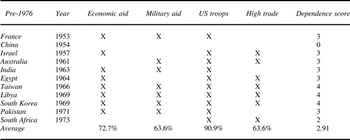
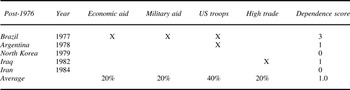
As an initial, informal way of exploring this hypothesis, Tables 1 and 2 display each of the four dimensions of dependence for all states that have pursued nuclear weapons post-1950, divided by time period. I draw on Singh and Way's coding of nuclear pursuit, which requires that a state “do more than simply explore the possibility of a weapons program. They have to take additional further steps aimed at acquiring nuclear weapons, such as a political decision by cabinet-level officials, movement toward weaponization, or development of single-use, dedicated technology.”Footnote 58 I utilize Way's Reference Way2011 codings of nuclear program dates.Footnote 59 Although proliferation is a fluid phenomenon, with many states hedging or exploring the nuclear option without formally authorizing a program,Footnote 60 for my purposes the explicit political decision to pursue nuclear weapons is most theoretically relevant, since at this pursuit stage it is most accurate to code deterrence as having failed.Footnote 61 To mitigate reverse causality issues, the data displayed are from the year before the onset of a nuclear weapons program. As the tables illustrate, the average state that pursued nuclear weapons in the pre-1976 time period was significantly more dependent on the United States than in the post-1976 era.
Pre-sanctions nuclear aspirants

Post-sanctions nuclear aspirants

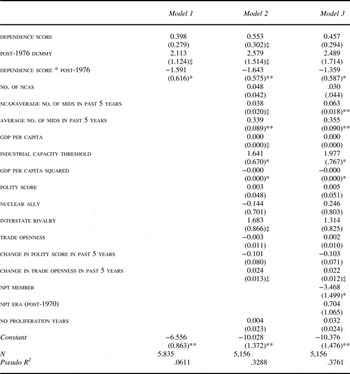
Of course, these data select on the dependent variable and do not control for alternate reasons that states may or may not pursue nuclear weapons so they are at best suggestive. To test the argument more systematically, I turn to a multivariate logit analysis on a global sample of countries from 1950 to 2000.Footnote 62 Following recent work by Singh and Way and Fuhrmann, the binary dependent variable measures whether a state decides to pursue nuclear weapons in a given year (states exit the data set while nuclear programs are ongoing).Footnote 63 To test the theoretical argument, I include the dependence score for each country-year, a dummy variable for the post-1976 period, and create an interaction between these two variables (since dependence on the United States is expected to have an effect only after 1976).Footnote 64 Whereas the dependence score proxies the costs of sanctions for a given state, the dummy variable for time period proxies the expected probability of sanctions. Before 1976, when the United States lacked a sanctions policy, the expected probability was close to zero; after 1976, as a result of US legislation, the expected probability was at least in theory close to 100 percent (because the sanctions were intended to be automatic). The interaction term can therefore be interpreted as the expected value of the cost of sanctions. I estimate three primary models: one that includes only the theoretical variables, one that includes all control variables employed in Fuhrmann,Footnote 65 excluding NPT variables out of concerns for posttreatment bias,Footnote 66 and one that includes the NPT variables as well. I use a leading dependent variable to mitigate reverse causality concerns and cluster standard errors by country.
Table 3 displays the results of the primary models and shows that regardless of whether controls are included or excluded, and whether variables measuring the NPT era and NPT membership are included, significance and signs on the variables of interest remain largely stable. Because the coefficient and statistical significance of the interaction term cannot be interpreted directly,Footnote 67 and because logit coefficients do not represent the marginal effects that are of substantive interest, I use Clarify to estimate first differences based on Model 2.Footnote 68 These first differences illustrate how much the yearly probability of pursuing nuclear weapons changes in the pre- and post-1976 era as dependence on the United States increases, holding all control variables at their median.
Logistic regression results

Notes: Clustered standard errors are in parentheses. MIDS = militarized interstate disputes. NCA = nuclear cooperation agreements. NPT = Nuclear Non-Proliferation Treaty. ‡p < .10 *p < .05; **p < .01 (two-tailed tests).
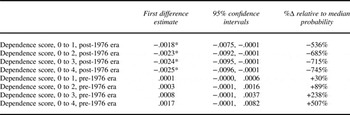
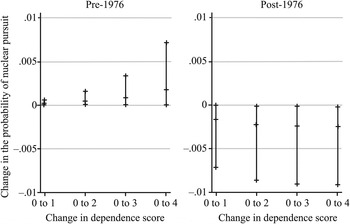
Table 4 displays the estimates. Supporting the theoretical argument, the results suggest that increases in dependence score significantly reduce the probability of proliferation, but only in the post-1976 era. In the pre-1976 era, dependence score has an insignificant, positive effect. Specifically, the first differences suggest that an increase in the dependence score from 0 to 1 reduces the yearly probability of proliferation in the post-1976 era by .0018, with this difference significant at the 95 percent level. Although this sounds small, proliferation is a rare outcome, and this first difference represents an approximately 536 percent decrease from the median yearly predicted probability of proliferation generated by the model. An increase to 2, 3, or 4 in dependence score reduces the probability of proliferation by .0023 to .0025—between a 685 percent to 745 percent reduction from the median; all of these first differences are significant at the 95 percent level.
First differences

Note: * Significant at the 95% confidence level.
Figure 1 displays these first differences graphically. The figure shows that in the pre-sanctions era, there is an insignificant, positive effect of changes in dependence score (the 95 percent confidence interval always includes zero). In the postsanctions era, however, the first differences are always negative and significant (never crossing zero), as theoretically expected, with the biggest change in simply moving from 0 to 1 in the dependence score. While the first differences of moving from 1 to 2, 2 to 3, and 3 to 4 in the dependence score are still negative and statistically significant, they are much smaller in magnitude, suggesting that moving from 0 to 1 is most important. Although it is hard to tell from the figures, the 95 percent confidence intervals for first differences in the two eras never overlap. This means that one can infer with 95 percent confidence that the effect of dependence on the United States was different in the two eras.
Effects of changes in dependence on the United States, by era

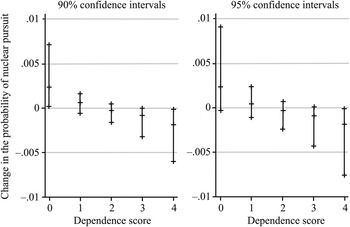
Figure 2 shows the first differences of moving from the pre- to postsanctions era at different levels of dependence score. This treats dependence as the conditioning variable in the interaction term rather than era (as in Figure 1).Footnote 69 The results suggest that for states with relatively low dependence on the United States (scores of 0 or 1), moving to the postsanctions era is associated with an insignificant increase in the probability of pursuing nuclear weapons. For those with high dependence (scores of 3 or 4), moving to the postsanctions era is associated with a significant decrease in the probability of pursuing nuclear weapons, as theoretically expected.Footnote 70 Taken together, these results suggest that in the postsanctions era, the biggest dampening effect is moving from no dependence to some dependence. However, moving from the pre- to postsanctions era has the biggest negative effect on states with the highest levels of dependence.
Effect of changing from pre-1976 to post-1976 era, by dependence score

Finally, although the effect of dependence is insignificant in the pre-1976 era, the fact that it is positive in sign suggests a shift not just in magnitude but in direction: before the US sanctions policy, states dependent on the United States were actually marginally more likely to pursue nuclear weapons, ceteris paribus, perhaps because of greater access to nuclear technology and know-how before the United States tightened its nonproliferation policy. This cuts against an important counterargument—that states dependent on the United States do not pursue nuclear weapons simply because they feel more secure—since before 1976 and the US sanctions regime, states dependent on the United States were actually somewhat more likely to proliferate.
The Inefficacy of Observed Sanctions
The argument suggests that starting in the late 1970s, states dependent on the United States have been deterred from proliferation, an assertion supported by the empirical evidence. This causes a selection effect: because only states with low dependence on the United States are likely to pursue nuclear weapons in this time period, the observed success rate for sanctions should be low—the United States will not have the leverage necessary to succeed.
To test this prediction, I built a data set of all nonproliferation sanctions episodes involving the United States from 1975 to the present.Footnote 71 The data build on previous data sets on economic sanctions collected by Hufbauer, Schott, Elliott, and Oegg,Footnote 72 the Threat and Imposition of Sanctions Dataset compiled by Morgan, Krustev, and Bapat,Footnote 73 and are supplemented by my research. To qualify for the data set, the United States must have threatened or imposed some cutoff in its economic or security relationship (trade, economic or military aid, nuclear energy cooperation, US troop commitments) with a state exploring or pursuing nuclear weapons, and the resumption of normal relations must have been linked to some form of nuclear restraint on the part of the target state. A case is coded as successful if the target state halted its development of nuclear weapons shortly following the threat or during the imposition of sanctions. Cases where existing sanctions are tightened or expanded are not counted as separate observations; including them would make the success rate lower.Footnote 74
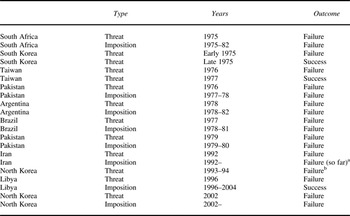
The cases are presented in Table 5, and the evidence strongly confirms the theoretical prediction—that the overall success rate of sanctions should be low. Only one of eight cases of sanctions imposition has succeeded (Libya 2004), for a success rate of 12.5 percent. Similarly, threats of sanctions have succeeded in only two of thirteen tries (South Korea and Taiwan), for a success rate of 15.4 percent.Footnote 75 Overall, there are three cases of success out of twenty-one observations, a 14.3 percent rate of success. This is lower than the 34 percent success rate Hufbauer, Schott, and Elliot identified in their analysis of 115 cases of economic sanctions, although higher than the 4.34 percent success rate Pape found after reanalyzing their data.Footnote 76
US nonproliferation sanctions episodes

aAt the time of publication, Iran was engaged in negotiations with the United States and other world powers to limit its nuclear program in exchange for sanctions relief. If this effort is ultimately successful at halting Iran's nuclear weapons program, this case could be coded as a success.
bWhile a case could be made that the threat of sanctions succeeded because it was followed by the 1994 Agreed Framework that froze the North Korean plutonium program, North Korea did not actually end its nuclear weapons program, simply switching to the uranium enrichment route. Others have argued that by 1994, North Korea already possessed a virtual nuclear capability through plutonium reprocessing. See Richelson Reference Richelson2007; and Niksch Reference Niksch2006. For a dissenting view, see Hymans Reference Hymans, Potter and Mukhatzhanova2010.
Of course, the prediction that the success rate of imposed sanctions should be low is not unique—it could also be explained by the inherent inefficacy of sanctions or poor design and implementation. To provide greater confidence in my argument, I test theoretical predictions about the rare cases of observed sanction success, predictions unique to this article's argument.
Miscalculation and the Rare Cases of Observed Sanctions Success
The argument that states consider the risk of sanctions before pursuing nuclear weapons, and that this deters vulnerable states from starting nuclear weapons programs, holds only for states that are able to accurately assess the likelihood and costs of sanctions. To the extent that states underestimate the risk, there is room for vulnerable states to slip through and for explicitly targeted threats of sanctions to have an impact. This logic suggests two observable implications: states with identifiable reasons for underestimating the risk of sanctions when initiating nuclear weapons programs should (1) be surprised at the threat of sanctions, and (2) those vulnerable states that underestimated the risk of sanctions should be likely to concede to subsequent threats of sanctions, once they are made credible, for fear of jeopardizing relations with the United States.
As a measure of whether states had reason to underestimate the risk of sanctions when they initiated their nuclear programs, I again turn to the shift one would expect to see when the United States began imposing sanctions as nonproliferation policy after 1976. Countries that started nuclear weapons programs before 1976 would undoubtedly underestimate the future probability of sanctions from the outset. After 1976 and the new emphasis on sanctions in US nonproliferation policy, one would expect precisely those states that started nuclear programs before 1976 but had not yet completed them to be most likely to fold in the face of sanctions, in particular those states with high dependence on the United States.
The two countries that fit these criteria are South Korea and Taiwan. These represent two out of three successful cases of sanctions; there are no successes for sanctions against states that started programs post-1976 (and thus were more likely to accurately assess the risk of sanctions). Although Libya likely underestimated the probability of sanctions (having started its nuclear weapons program in 1970) and ultimately conceded to US-led sanctions, the mechanism in this case is different. By the time Muammar Qaddafi initiated a nuclear weapons program in 1970, Libya was no longer highly dependent on the United States; moreover, the literature suggests that a combination of military threats and/or a change in Qaddafi's general preferences about international engagement were most relevant.Footnote 77
Drawing on secondary sources and US archival documents, I seek to confirm the theory's relevant observable implications in the South Korea and Taiwan cases: (1) that these states were surprised by the threat of sanctions and (2) that they subsequently ended their nuclear weapons programs because of the threat of sanctions, once the threat was made credible, because of their high dependence on the United States.
Taiwan
Taiwan was undoubtedly surprised when the United States began threatening sanctions in 1976 and 1977. Although US officials had opposed Taiwanese proliferation since they judged Taiwan was pursuing nuclear weapons in 1972,Footnote 78 sanctions were not clearly threatened until the introduction of the Symington amendment in 1976. Instead, the United States initially focused on supply-side measures. In early 1973, for example, the United States successfully pressured Germany to reject the Taiwanese purchase of reprocessing equipment.Footnote 79 The first direct verbal warnings to Taiwan were vague and did not threaten sanctions. In October 1973, for example, a US study team warned Taiwanese officials, “Should we have reason to believe that the ROC has moved from consideration of a nuclear weapons program to actual implementation, we would be forced to react. That reaction would be based upon the circumstances at the time.”Footnote 80
Despite the Taiwanese foreign minister's promise to drop efforts to acquire a reprocessing facility,Footnote 81 the vague US threats were insufficient to halt the Taiwanese nuclear weapons program. In 1975, Chiang Ching-kuo came to power following his father's death, and by early 1976, “the IAEA suspected that Taiwan's nuclear ambitions might stretch beyond power production.”Footnote 82 Reacting to growing concerns about the Taiwanese nuclear program, in September the US State Department instructed the ambassador in Taipei to clearly threaten sanctions, namely an end to nuclear cooperation and
legislative efforts by the US congress, such as the Symington Amendment, to deny US military and economic assistance to any country that acquires a national reprocessing capability. This reflects the growing sensitivity of congressional and public opinion on the issue of nuclear proliferation and the implications seem clear to my government—should the ROC [Republic of China] or any other government seek national reprocessing facilities, this would risk jeopardizing additional highly important relationships with the US.Footnote 83
Superficially, these threats appeared to be successful, as Chiang Ching-kuo reiterated that Taiwan's policy was “not to manufacture nuclear weapons” and that “all nuclear research on Taiwan would be directed toward peaceful uses.”Footnote 84 He pledged that Taiwan would cease all reprocessing activity and end attempts to purchase reprocessing technology abroad.Footnote 85 Nonetheless, by December the ambassador was forced to admit, “we have rather compelling evidence that in spite of solemn and public assurances given by the GROC [Government of the Republic of China] and personally by Premier Chiang, the Chinese may not yet have given up their intentions of acquiring a capability for reprocessing nuclear fuels.”Footnote 86
A major problem was that the new US nonproliferation policy was still inchoate. Although the Symington amendment had been passed in Congress as of June 1976, it would not go into effect until August 1977 and it was still unclear to outside observers exactly how far the US government would go to enforce congressional dictates. Thus, in January 1977 the Taiwanese Vice Foreign Minister Chien Fu complained that he had “seen a press report that US would acquiesce in West German and French sales of reprocessing facilities to Brazil and Pakistan respectively” and “asked whether the US was applying a ‘double standard’ with regard to its policy of opposing acquisition of reprocessing facilities.”Footnote 87 Even after being informed that the new American policy was “global, and that the US would be ‘unstinting’ in its efforts to prevent proliferation of sensitive technology to Brazil and Pakistan,” the Taiwanese vice foreign minister still felt the US policy was sufficiently vague that he asked, “out of ‘curiosity,’ what the penalties would be in the event a nation did not follow US non-proliferation guidelines.”Footnote 88 The response was clear and to the point: “the sanctions would not be confined to nuclear matters but would also affect a wide range of relations, including military cooperation … Levin [the US official] dwelt on the adverse consequences that questionable ROC nuclear activities would have on weapons supply and cited the Symington Amendment as an example of the increasingly restrictive US attitude toward proliferation risks.”Footnote 89 In March, the United States continued to pressure Taiwan, directing the American ambassador to emphasize to Taiwanese officials, “President Carter's determination to do everything in his power to prevent nuclear proliferation … Our non-proliferation policy is global in scope and must be based on long-term considerations.”Footnote 90
With the Symington amendment and Glenn amendment approaching entry into force, increasing the credibility of American threats, Taiwan complied with the tough American conditions, which went far beyond Taiwan's obligations under the NPT.Footnote 91 Both security and domestic political considerations deriving from the importance of the United States to the Taiwanese economy played a role in this decision. After all, “The US was not only Taiwan's main market, source of foreign investment, and provider of weapons and security guarantees, but also its principal supplier of low-enriched uranium for power reactors.”Footnote 92 As Solingen concludes, “The KMT and its successors' military, political, and economic dependence on the US are central to understanding Taiwan's nuclear history. Nuclear decisions were embedded in a model of regime survival emphasizing economic growth, prosperity, stability, and the defeat of internal subversion, which explains widespread receptivity to US demands and inducements.”Footnote 93 Evidence from US government documents supports this conclusion. For example, in January 1977, a cable from the US embassy in Taipei noted that high-ranking Taiwanese officials “gave the impression that they believe it would be folly for ROC to endanger its nuclear power program by conducting nuclear activities of questionable nature. We were particularly struck by Chien's question about penalties that would result from defiance of US nuclear policies. It seemed as if he might have been seeking ammunition—which we supplied—to use within ROC policy counsels.”Footnote 94
Although evidence of small-scale uranium enrichment and plutonium reprocessing emerged again in 1978 and 1987–88, respectively, there is no indication that Taiwan ever made the political decision to pursue nuclear weapons again post-1977. Moreover, in both instances, the threat of US sanctions succeeded in bringing the Taiwanese program under control.Footnote 95
South Korea
When South Korea initiated its nuclear weapons program in 1970, the United States was five years from its first application of sanctions in nonproliferation policy. Predictably, then, South Korea was not expecting sanctions and was surprised when confronted with threats of American sanctions in 1975. This fact was explicitly noted by a 1978 CIA report:
What patchwork attempts were made to assess the political implications of the nuclear weapons program in 1974–75 led [Park Chung-Hee] and some of his senior advisers to conclude that Washington would tolerate this work. Blue House staffers at that time drew an analogy between the cases of South Korea and Israel. The US, they reasoned, provided Israel with billions of dollars in defense assistance, including the most modern weapons in its inventory, even while Washington suspected Tel Aviv of developing a nuclear weapons program. The Koreans went on from there to conclude that the US—while opposing short-term weapons work in Korea—would eventually recognize and tolerate Korea's need to have an independent nuclear capability.Footnote 96
The account of US diplomacy vis-à-vis the South Korean nuclear program starts in early 1975, when US officials ramped up nuclear intelligence gathering efforts following the 1974 Indian nuclear test and obtained evidence of the South Korean nuclear weapons efforts.Footnote 97 This evidence included a South Korean deal to purchase a nuclear reprocessing facility from a French firm—although this did not violate South Korea's commitments under the NPT, the United States worried the facility could be used to extract weapons grade plutonium.Footnote 98 Despite their serious concern over the matter, US officials initially decided to tread lightly to avoid another public crisis in Asia following the fall of Saigon and America's ongoing diplomatic focus on improving relations with China.Footnote 99 Rather than explicitly confronting South Korea about ending its nuclear weapons program and canceling the reprocessing deal, the United States “first focused on South Korea's NPT membership.”Footnote 100 As part of this effort, in March 1975 Congress delayed US. Export-Import Bank loans totaling $236 million to South Korea's nuclear energy industry; the United States informed South Korea that the loan was under review because of the Indian nuclear test and that “Korea's very timely ratification of the NPT will be an important factor in Ex-Im eventually gaining congressional agreement to finance Kori-2.”Footnote 101 This veiled threat was shortly followed by South Korea ratifying the NPT in March,Footnote 102 but it did not end the South Korean nuclear program.
In summer 1975, the United States finally confronted South Korea about the reprocessing deal. Nonetheless, “despite possessing significant evidence that the South was indeed pursuing a weapons program, the Americans refrained from any direct accusation. Nor did they reveal the extent of their intelligence. Instead, the US vigorously objected to the reprocessing deal on the grounds of “‘the appearances of things’ and the ‘difficulties it would cause.’”Footnote 103 Starting in August 1975, however, “The Americans' threats became progressively costlier and increasingly explicit.”Footnote 104 The United States reportedly threatened to cut off $275 million in annual military assistance.Footnote 105 Even more broadly, according to the US ambassador in Seoul, South Korean leaders were asked, “whether Korea (is) prepared (to) jeopardize availability of best technology and largest financing capability which only US could offer, as well as vital partnership with US, not only in nuclear and scientific areas but in broad political and security areas.”Footnote 106 By the end of the year, “the US had threatened to cease civilian nuclear cooperation, including the training of scientists, and to withdraw US security guarantees, including the nuclear umbrella.”Footnote 107 In January 1976, South Korea canceled the reprocessing deal under the mounting pressure, and by December 1976 the broader nuclear weapons program was canceled, a decision “based both on US threats and the failure of the program to make any significant technical progress.”Footnote 108
Although the Symington amendment had not yet entered into force, these threats were credible because of a variety of signals the US government had sent in recent years, including the US rapprochement with China and withdrawal from Vietnam, both of which communicated to South Korea that anticommunism was no longer sufficient to merit unwavering military and political support from the United States.Footnote 109 Bringing matters closer to home, in 1973 the United States withdrew 24,000 of the 70,000 American troops from Korea and was subsequently late in delivering a promised $1.5 billion military aid package.Footnote 110 In 1974, Congress reduced the level of military aid to South Korea because of human rights concerns.Footnote 111 Taken together, these signals made clear to South Korea that the United States was willing and able to withdraw its military and economic support.
Once President Jimmy Carter entered office in 1977, however, the nuclear weapons issue surfaced once again. Echoing a pledge he had made while campaigning, in March Carter announced his intent to withdraw almost all US troops from Korea, asserting that US air and naval forces could provide adequate security for South Korea.Footnote 112 Moreover, Carter announced plans to remove approximately one thousand tactical nuclear weapons from the peninsula.Footnote 113 South Korean officials declared in May that they would have to develop their own nuclear weapons if the United States went through with their plans and in August claimed they would build their own indigenous reprocessing plant.Footnote 114 Importantly, however, South Korea did not fully revive its nuclear weapons program, instead focusing on “keeping the option open” by developing dual-use missile, explosive, and heavy water reactor technology.Footnote 115 As Pollack and Reiss put it, “American officials never found convincing evidence of a revived covert program.”Footnote 116 Indeed, the aforementioned 1978 CIA report found “No evidence that any nuclear weapons design work is under way at present … No evidence that the South Koreans are trying to acquire a uranium enrichment capability … No evidence of any current activity related to the acquisition of a reprocessing capability … No evidence of stockpiling of fissile material … [and] No evidence of work on weapons fabrication.”Footnote 117
After President Park was assassinated in 1979, successor Chun Doohwan ended these nuclear hedging efforts.Footnote 118 This occurred after Carter had scrapped the troop withdrawal plan and was reinforced by the incoming Reagan administration's promise to increase the American economic and security commitment to South Korea, coupled with the threat of removing these benefits if South Korean nuclear weapons activities continued.Footnote 119 However, these reassurances occurred after South Korea had canceled its nuclear weapons program, suggesting that it was the threat of sanctions rather than the reassurance that played the key causal role. Drezner reaches the same conclusions about the primacy of threats over assurances in his analysis of the 1975–76 period.Footnote 120 Thus, although the reassurance may have been important for ending the nuclear hedging, the evidence suggests the sanctions threats were sufficient to halt the active nuclear weapons effort.
Like Taiwan, South Korea conceded to US threats only because of its high dependence on the United States. Both security and economic considerations played a role in the success of the sanctions threats. The United States was South Korea's largest trading partner,Footnote 121 purchasing 26 percent of South Korean exports at the time, and the United States held much of South Korea's $20 billion foreign debt.Footnote 122 Drezner observes that, “the threat to suspend all trade in nuclear materials would have completely devastated ROK [Republic of Korea] plans for energy autonomy,”Footnote 123 while Solingen notes, “without US equipment and fuel supplies for South Korea's first nuclear plant, still under construction in 1975, the economy might have stalled at an already critical period following the oil crisis.”Footnote 124 Meyer similarly observes that “The United States government took advantage of South Korea's political, military, and economic dependence to compel the South Korean government to cancel its nuclear weapons project … the threat of an economic cutoff was particularly potent.”Footnote 125
In terms of security, as Reiss notes, South Korea was simply unwilling to take the risk of placing itself “in a position where it had neither nuclear arms nor the American commitment,”Footnote 126 an eventuality that would have been realized—at least for several years—had the United States acted on its threats. In other words, even though part of South Korea's motivation for pursuing nuclear weapons was uncertainty about the long-term American security commitment,Footnote 127 the short-term loss of American support was simply too costly, both in economic and security terms. Overall, then, the South Korean case is in line with theoretical expectations. South Korea conceded to US threats after miscalculating, but only because of its high dependence on the United States politically, economically, and militarily.
Conclusion
The argument and evidence presented in this article suggest that US sanctions have indeed been an effective tool of nonproliferation policy, but that selection effects have rendered this success largely hidden. Because states consider the probability and cost of sanctions before initiating nuclear weapons programs, those that are highly vulnerable to US sanctions are likely to be deterred from starting nuclear weapons programs in the first place, so long as the threat of sanctions is credible. Meanwhile, those that choose to pursue nuclear weapons are likely to be highly insulated and able to weather the threat and imposition of sanctions. Thus, while observed sanctions campaigns are unlikely to succeed in halting ongoing nuclear programs, they do deter less insulated states that might otherwise have pursued nuclear weapons.
On the causes of proliferation, the findings suggest one should move beyond focusing on the incentives and capacity to build nuclear weapons and pay more attention to disincentives. Although important theoretical works have emphasized the disincentives in terms of negative economic and security externalities,Footnote 128 sanctions have been largely ignored and systematic empirical testing has been rare. Moreover, the findings help resolve a puzzle in the nuclear proliferation literature: namely the disconnect between theoretical and qualitative empirical works that emphasize the role of allied security commitments and international trade openness in reducing motivations for nuclear proliferationFootnote 129 and quantitative studies that find these variables to be insignificant or mixed in their effect.Footnote 130 The findings suggest that international integration and security commitments may inhibit proliferation only to the extent that their continuation is contingent on nuclear abstinence, a condition that arguably did not exist until the advent of US sanctions policies in the late 1970s. The key point is that many states quite rationally may prefer an independent nuclear arsenal, a nuclear ally, and an internationally integrated economy. Only when well-established sanctions policies make states choose between a nuclear arsenal and the latter two luxuries should international integration and allied security commitments significantly inhibit proliferation. More broadly, the results suggest the importance of historicizing the study of nuclear proliferation; for example, the disincentives to pursue nuclear weapons have not been constant over time and nuclear cascades may have failed to materialize partially because of determined efforts to prevent their occurrence by the United States.Footnote 131
In terms of theoretical implications for the study of sanctions, the findings suggest that sanctions can be effective even in the realm of national security, contrary to popular realist arguments. Thus, while the field has known since Drezner that selection effects understate the true efficacy of sanctions with regard to trade and environmental issues,Footnote 132 scholars can now extend this argument to cases where security is more directly at stake.
In terms of policy implications, three in particular stand out. First, nonproliferation sanctions should continue to be employed by the United States, even though they are unlikely to halt active nuclear weapons programs. After all, the threat of sanctions is credible only to the extent that the United States actually employs them. The importance of credible signals also suggests that recent US decisions to waive sanctions against India and Pakistan in 2001 and sign a major civilian nuclear deal with India in 2006 may reduce the efficacy of sanctions in the future—it should be harder to deter states to the extent that the actual imposition of sanctions is less automatic. On the other hand, both India and Pakistan suffered under years of sanctions before reaching this point, and most states cannot count on an exception being made for them. Depending on the importance of relations with the United States, even a relatively small chance of sanctions may be enough to dissuade the potential proliferator. Moreover, although I have focused on the United States because it has the most extensive nonproliferation sanctions track record, the findings should be generalizable to other important bilateral relations. For example, if China and Russia had credible sanctions policies in the early 1980s, Iran may not have pursued nuclear weapons in the first place.
Second, US international engagement provides critical leverage in the realm of nonproliferation—sanctions deter only states that are dependent on the United States economically and/or militarily. In other words, to the extent that the United States reduces its global economic and security commitments, a position that has become more attractive in recent years because of its budget crisis and recent experiences in Afghanistan and Iraq, it should expect a corresponding lack of nonproliferation leverage. This would be particularly problematic given recent research that suggests nuclear weapons may not be a reliable or consistent deterrent to conflict.Footnote 133
Third and finally, gauging the success of sanctions solely by studying cases where they were imposed against states like Iran and North Korea is theoretically misguided; success should not be expected in such cases. In these adversary cases where the United States had little relationship with the proliferating state to begin with, multilateral sanctions involving important partners of the proliferating state or inducements (whether in the form of economic assistance or security assurances) are likely to be more effective since the United States has little to threaten in the way of sanctions on its own.Footnote 134
Supplementary material
Replication data are available at <http://dx.doi.org/10.1017/S0020818314000216>.