Introduction
This study aims to characterise the empirical research on worker-related ageism by undertaking a systematic review of the literature and deepening the conceptual approach of the concept. Furthermore, we aim to identify the existing gaps in the research carried out so far and state new conceptual propositions and new lines of research. We offer new inputs to those who intend to design and implement interventions to combat worker-related ageism.
The study of ageism in the scientific literature started in 1969 when Butler (Reference Butler1969: 243) coined it for the first time as ‘age discrimination or ageism, prejudice by one age group toward other age groups’. Despite this definition, Butler's article related to the elderly population and the early studies were focused only on the ageism against older people (Butler, Reference Butler1980; Palmore, Reference Palmore2001, Reference Palmore2004; North and Fiske, Reference North and Fiske2013). Furthermore, the first empirical research article on worker-related ageism appeared only in 1983 and the second one ten years later.
The main components of ageism are discrimination due to age, or the prejudice of one age group against other age groups, based on systematic stereotyping (Butler, Reference Butler1969; Palmore, Reference Palmore1999), which according to the definition of Jost and Hamilton (Reference Jost, Hamilton, Dovidio, Glick and Rudman2005) is: fixed ideas, beliefs, which attribute psychological characteristics to others, and which justify the acceptance or rejection of a group. In its complexity it includes cognitive (perceptions and images of others based on age), affective (prejudice) and behavioural (discrimination) components, is expressed positively and negatively, can be implicit and explicit, and is present at the micro (intrapersonal), meso (social networks) and macro (institutional/organisational) levels. It can be conscious and include exploiting the vulnerabilities of the older people or the young, or be unconscious and inadvertent (International Longevity Center USA, 2005).
The unprecedented demographic changes as a result of increased longevity and the extremely low birth and death rates, especially in Europe and North America, led to the ageing of the global population (European Commission, 2015b; Rouzet et al., Reference Rouzet, Sánchez, Renault and Roehn2019; United Nations (UN), 2019a, 2019b). The proportion between the active population and people aged 65 and over has been steadily declining for several decades. This context profoundly challenges the sustainability and management of organisations that promote and generate paid work, health care, social security and retirement (Lagacé et al., Reference Lagacé, Nahon-Serfaty and Laplante2015; Gahan et al., Reference Gahan, Harbridge, Healy and Williams2017; Rouzet et al., Reference Rouzet, Sánchez, Renault and Roehn2019). Older workers tend to prolong their working lives. Often they find in ageism an obstacle to their wellbeing, to productive employment, to training and qualification opportunities (Unson and Richardson, Reference Unson and Richardson2013; Cebola, Reference Cebola2016; Garcia et al., Reference Garcia, Fontainha and Passos2017), and job satisfaction, commitment and involvement (Macdonald and Levy, Reference Macdonald and Levy2016).
Ageism is a transversal phenomenon. It is observed in the work context in different countries, expressed in many ways. For example, in discrimination regarding selection and access to job vacancies (Drydakis et al., Reference Drydakis, MacDonald, Chiotis and Somers2017; Garcia et al., Reference Garcia, Fontainha and Passos2017; Jones et al., Reference Jones, Sabat, King, Ahmad, McCausland and Chen2017), pressure to retire (Thorsen et al., Reference Thorsen, Rugulies, Løngaard, Borg, Thielen and Bjorner2012), negative stereotypical images, devaluation of older workers (McMullin and Marshall, Reference McMullin and Marshall2001), relational discomfort (Dixon, Reference Dixon2012), and the stress that arises from the imposition of the youth of the image of women, particularly on television (Spedale et al., Reference Spedale, Coupland and Tempest2014). Regarding younger workers, ageism can be expressed in the lack of confidence in their age/experience (Loretto et al., Reference Loretto, Duncan and White2000), in not being taken too seriously (Jyrkinen and McKie, Reference Jyrkinen and McKie2012) or in barriers to promotion (Duncan and Loretto, Reference Duncan and Loretto2004). Ageism can be expressed in legally prohibited behaviours (hard ageism) or in behaviours that, not being prohibited, affect their targets negatively (soft ageism), often in the interpersonal sphere (Stypinska and Turek, Reference Stypinska and Turek2017). The concept evolved and is no longer described or studied only concerning elderly people (Palmore, Reference Palmore2001, Reference Palmore2004; Hooyman, Reference Hooyman2003; Butler, Reference Butler2005; Levy and Macdonald, Reference Levy and Macdonald2016) but also concerning the younger (European Social Survey, 2012; Raymer et al., Reference Raymer, Reed, Spiegel and Purvanova2017). Ageism can also have a positive characteristic that seems empathetic but is paternalistic and discriminatory instead, leading to negative ageism (Iversen et al., Reference Iversen, Larsen and Solem2009; Lagacé et al., Reference Lagacé, Nahon-Serfaty and Laplante2015; Chonody, Reference Chonody2016).
Ageism being depreciation and non-inclusion that affects workers results in a decent work deficit (International Labour Office, 2001). Therefore, its importance, combat and concern are expressed in the Declaration on Fundamental Principles and Rights at Work (International Labour Office, 1998) and in the Decent Work Agenda (Ferraro et al., Reference Ferraro, Pais, Santos and Moreira2018; International Labour Organization, nd). The Sustainable Development Goals of the 2030 Agenda (UN, 2015) also express this concern, namely in Goals 3, 4 and 8, focusing on social inclusion and decent work.
The psychological and sociological approach to ageism, at the individual level, can be made by the theory of terror management: from death – to which ageing leads – in a response of avoidance and detachment; from the threat of deterioration of the physical body and physical appearance that reminds us of our mortal nature (which opposes the current apology for physical health and youth); and from insignificance, through the loss of skills and resources that conditions positive self-esteem. This approach is complemented by two other theories, the stereotype embodiment theory – age stereotypes and negative attitudes internalised and incorporated throughout life; and the social identity theory – the identification related to interpersonal and inter-group behaviours (Lev et al., Reference Lev, Wurm, Ayalon, Ayalon and Tesch-Römer2019).
The psychological approach explains ageism in the intrapsychic reasons for simplifying reality (uncertainty reduction) and valuing the ingroup (those of the same age) compared to the outgroup (those of other ages, the oldest, the youngest, etc.). The sociological approach highlights the importance of the context in the following ways: (a) different places where it occurs (workplace, family, society); and (b) cultural and cross-cultural perspective (local, regional, national and/or international).
Ageism can hit all age groups, although there is a great deal of agreement that older people are more significant victims of this scourge with the ageing of the population. However, reverse ageism – ageism directed at young people – is also an important issue. Some authors even claim that younger people have related more perceived age discrimination than older ones (Bratt et al., Reference Bratt, Abrams, Swift, Vauclair and Marques2018).
Given the ageism-related problems for individuals, organisations and society, its combat requires a comprehensive study that describes, maps, explains, and prevents or remedies it. Empirical research undertaken so far is enough for deserving a literature review, and it is of great use to public policy and intervention. It is helpful to take stock of the empirical research and propose new avenues for future developments. Jones et al. (Reference Jones, Sabat, King, Ahmad, McCausland and Chen2017) conducted a meta-analysis in which they sought to understand the relationship between prejudice and discrimination in the workplace concerning gender, age and race. However, their target was not workers. Additionally, more than double were students, and the rest were undifferentiated. Their meta-analysis is essential to understanding the prejudice–discrimination relationship in the workplace. However, it does not address the main findings and purposes of the empirical research conducted on worker-related ageism.
Method
Literature search and inclusion criteria
This systematic review follows the guidelines by the Centre for Reviews and Dissemination (CRD) at the University of York (CRD, 2009) and the Preferred Reporting Items for Systematic Reviews and Meta-Analyses (PRISMA) (Moher et al., Reference Moher, Liberati, Tetzlaff and Altman2009). This review includes only empirical research reported in English, focused on worker-related ageism (workers/labour market/workplace/workforce) published in peer-reviewed journals.
Procedure
We searched the electronic academic databases EBSCOhost (Academic Search Complete, Business Source Complete, Directory of Open Access Journals, ERIC and Science Direct) and Web of Science (Core Collection) until March 2020.
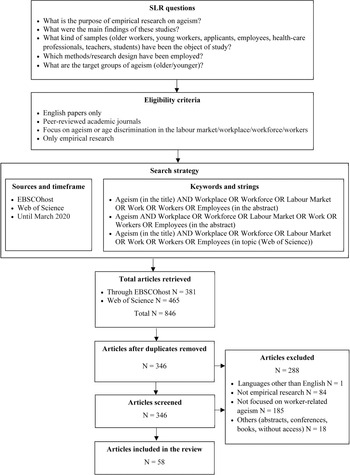
Figure 1 shows the different combinations of keywords applied. We retrieved 381 articles after duplicates were removed. After all rounds and eliminating the articles that did not meet the eligibility criteria, we retained 58 articles for analysis. Figure 1 describes the process.
Flow diagram of article selection.
Note: SLR: systematic literature review.

Results
Study characteristics
Research on ageism in the labour market is relatively recent. Most studies analysed were published post-2000, with only 15 articles before 2010 and just three before 2000. Most of the studies were from the United States of Americe (USA) (12) and the United Kingdom (UK) (nine). The others were from the following countries: Australia, Canada (four), Belgium, New Zealand, Norway, Sweden (three), Finland (two), Brazil, Czech Republic, Denmark, France, India, Japan, The Netherlands, Poland, Spain, Finland and UK, The Netherlands and Germany, UK and Hong Kong, Portugal and Brazil, the USA and Canada, and the USA and New Zealand (one), as shown in the online supplementary material.
The sample sizes are highly diverse, ranging from one to 4,852, and are composed of applicants, job searchers, workers, recruitment texts, government web pages and even a text of a final judgement of an employment tribunal court case. Ten articles had research with samples aged explicitly over 45. Just two had ages specifically less than 50, one article had a sample above 18 years old, and three studies had students’ samples (workers or with work experience). In addition, 35 per cent of samples are under 100, 32 per cent from 100 to 500, 15 per cent from 501 to 1,000 and 18 per cent above 1,000.
Most studies adopted a quantitative approach (33), followed by those using a qualitative approach (21). In their article Iweins et al. (Reference Iweins, Desmette and Yzerbyt2012) have two studies, one used a quantitative approach and the other adopted an experimental approach. Two studies followed a mixed research design and three reported instrument development.
Research objectives and main findings
Considering the objectives and the main findings of the studies, the following seven main categories emerged.
Category 1
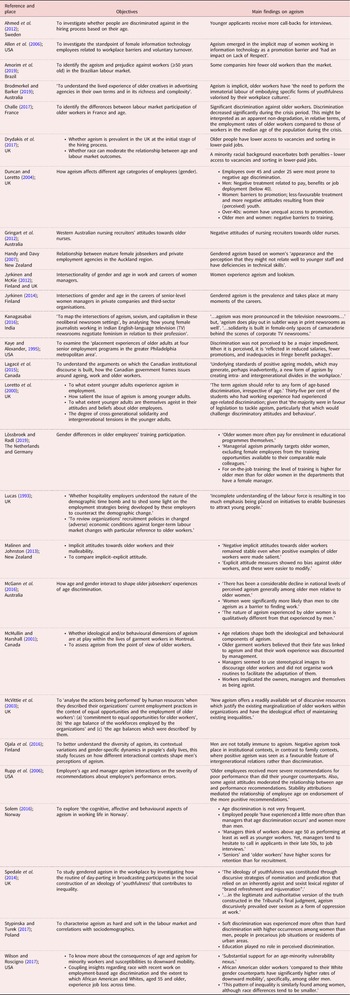
The most represented category is diagnosis studies. Twenty-seven articles report research aiming to identify and describe the prevalence of ageism (Table 1). All studies found some ageism in the corresponding samples, going from the hiring process and employability, the severity with which the performance of older workers is evaluated, to retirement, making salient that the psychological process behind ageism crosses all the working lifespan.
Diagnosis studies on ageism

Notes: UK: United Kingdom. USA: United States of America.
Some of the studies relate sociodemographic variables to ageism, showing that gender and race can potentiate ageism. The type of ageism identified is implicit and explicit, and the studies suggest that it is a cross-phenomenon present in multiple cultures. The older worker is the main target of ageism, followed by the younger. Cortina et al. (Reference Cortina, Kabat-Farr, Leskinen, Huerta and Magley2013), Kaye and Alexander (Reference Kaye and Alexander1995) and Solem (Reference Solem2016) found not frequent or even no evidence of perceived discrimination at work. Moreover, there is no evidence of age-based selective incivility – which could be, in the first case, the result of relatively young samples. Furthermore, McGann et al. (Reference McGann, Ong, Bowman, Duncan, Kimberley and Biggs2016: 375) found ‘a considerable decline in national levels of perceived ageism generally among older men relative to older women’.
Category 2
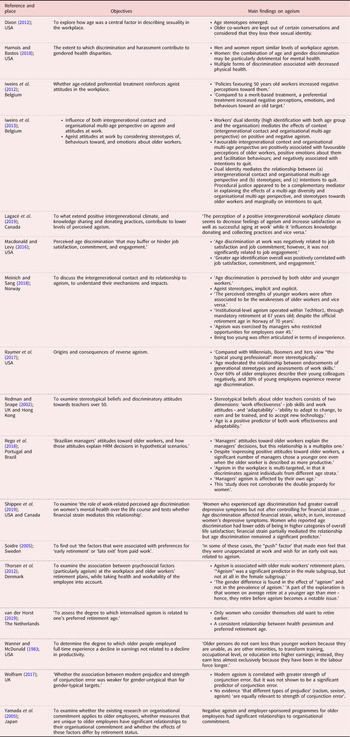
Seventeen articles are focused on expanding the nomological network of ageism (Table 2). The variables studied can be framed within five types: (a) demographics (e.g. gender); (b) psychological characteristics or states (e.g. dual identity); (c) organisational procedures, processes and policy (e.g. organisational multi-age perspective); (d) interaction practices (e.g. intergenerational contact); and (e) context (e.g. labour market characteristics).
Studies on the nomological network of ageism

Notes: UK: United Kingdom. USA: United States of America. HRM: human resources management.
The main findings suggest that age (and gender-based) discrimination at work may be particularly detrimental for mental health (Harnois and Bastos, Reference Harnois and Bastos2018; Shippee et al., Reference Shippee, Wilkinson, Schafer and Shippee2019). However, policies favouring older workers, or preferential treatment, increased negative perceptions towards them, provoking ageism (Iweins et al., Reference Iweins, Desmette and Yzerbyt2012). Younger workers also can suffer ageism (Raymer et al., Reference Raymer, Reed, Spiegel and Purvanova2017; Meinich and Sang, Reference Meinich and Sang2018), despite the fewer empirical studies retrieved. Ageism affects workers, yet it is also a challenge for organisations whose workers affected by it are more prone to voluntary turnover, negative job satisfaction and job commitment (Soidre, Reference Soidre2005; Macdonald and Levy, Reference Macdonald and Levy2016; van der Horst, Reference van der Horst2019). These factors could have profound implications for an excellent working environment and productivity. However, the high identification of workers with different age groups and the perceived procedural justice are critical mediators in ageism (Iweins et al., Reference Iweins, Desmette, Yzerbyt and Stinglhamber2013).
Category 3
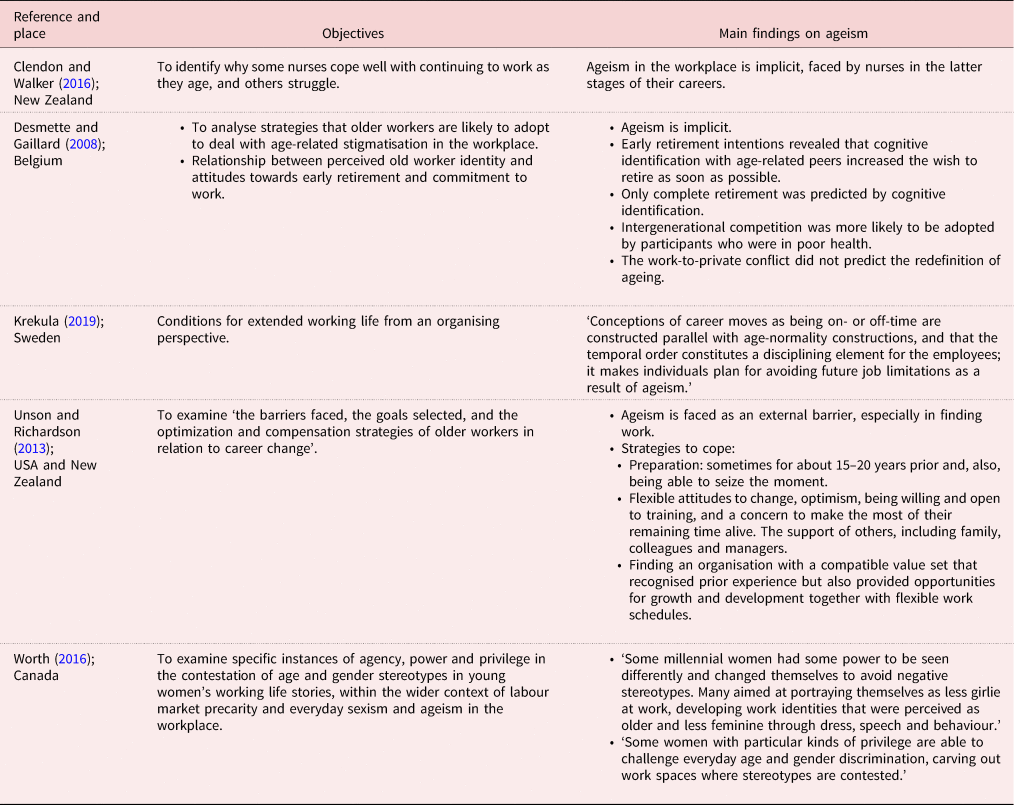
Five articles focus on coping strategies that are used by those who are the ageism target. Those strategies can be: the care and maintenance of health and wellbeing of the body and mind, use of external memory aids, change of working hours or flexible working hours, the transition to less physically demanding tasks, plans to avoid future job limitations, flexible attitudes to change, optimism, being willing and open to training, finding an organisation with a compatible value set that recognises prior experience but also provides growth opportunities, work in family and support environments, or early retirement, and in the case of young women, the adoption of less feminine and young clothing and behaviours (see Table 3). The social construction of the older worker and even the self-categorisation of older workers contribute to discrimination against them and negative attitudes towards work (Desmette and Gaillard, Reference Desmette and Gaillard2008).
Studies on coping with ageism

Note: USA: United States of America.
Category 4
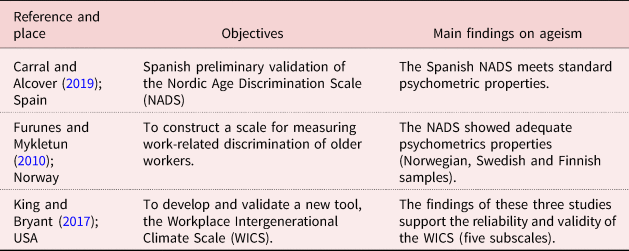
Three articles refer to instrument development (Table 4). Only two different ageism instruments were reported. One is the Nordic Age Discrimination Scale, from Norway, for monitoring age discrimination in the workplace among elderly workers. The other is the Workplace Intergenerational Climate Scale, from the USA, designed to measure employees’ attitudes and perceptions about workers of different ages in the workplace. The third instrument paper is a Spanish validation of the Nordic Age Discrimination Scale.
Instrument development studies

Note: USA: United States of America.
Category 5
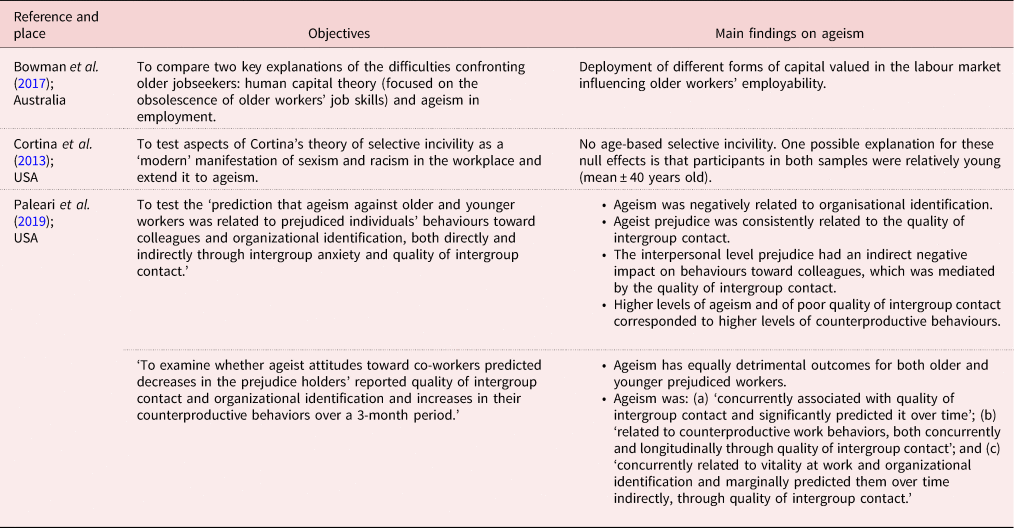
Three articles focus on a theoretical test (Table 5). Only the Cortina et al. (Reference Cortina, Kabat-Farr, Leskinen, Huerta and Magley2013) theory of selective incivility is presented as a theory, while the other two studies test theoretical hypotheses.
Theoretical tests on ageism

Note: USA: United States of America.
Category 6
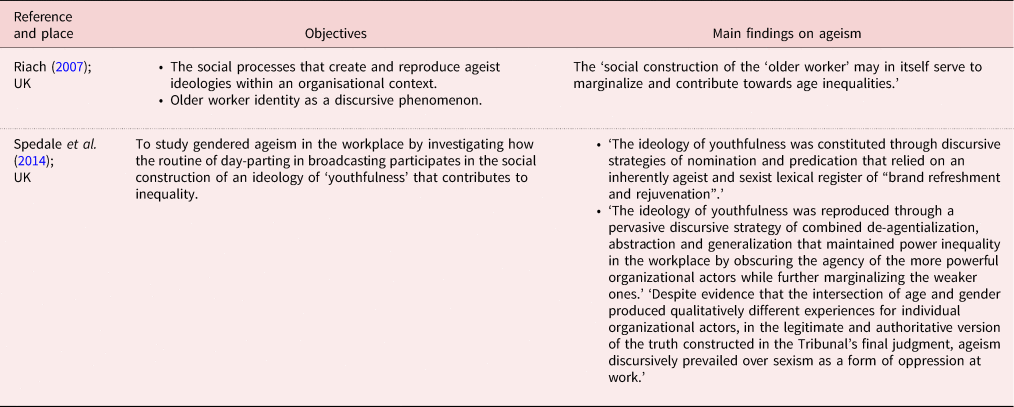
Two articles try to identify determinants of ageism such as the ideology of youthfulness and the social construction of the ‘older worker’, how they are insinuated, reproduced and manipulated (Riach, Reference Riach2007; Spedale et al., Reference Spedale, Coupland and Tempest2014) (Table 6).
Determinants of ageism

Note: UK: United Kingdom.
Category 7
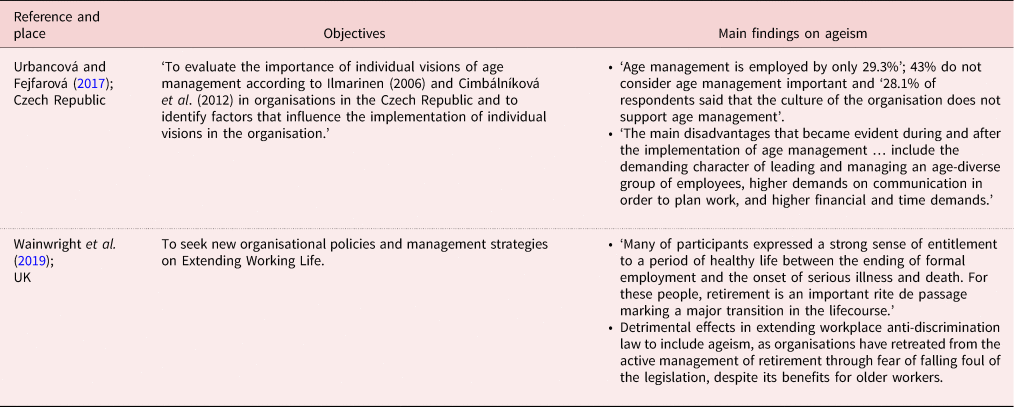
Two articles focus on the managerial strategies to prevent and minimise ageism and its effects (Table 7).
Ageism management studies

Note: UK: United Kingdom.
In the analysed articles, some authors adopt definitions of ageism previously presented by other authors, quoting mainly Butler and Palmore (Lucas, Reference Lucas1993; Loretto et al., Reference Loretto, Duncan and White2000; McMullin and Marshall, Reference McMullin and Marshall2001; Rupp et al., Reference Rupp, Vodanovich and Credé2006; Desmette and Gaillard, Reference Desmette and Gaillard2008; Furunes and Mykletun, Reference Furunes and Mykletun2010; Iweins et al., Reference Iweins, Desmette and Yzerbyt2012, Reference Iweins, Desmette, Yzerbyt and Stinglhamber2013; Cortina et al., Reference Cortina, Kabat-Farr, Leskinen, Huerta and Magley2013; Spedale et al., Reference Spedale, Coupland and Tempest2014; King and Bryant, Reference King and Bryant2017; Stypinska and Turek, Reference Stypinska and Turek2017; Meinich and Sang, Reference Meinich and Sang2018; Carral and Alcover, Reference Carral and Alcover2019). All these authors present this phenomenon in its complexity (e.g. discrimination based on age, stereotypes − positive and negative, stigmatisation, beliefs and attitudes). Although some of these authors (Rupp et al., Reference Rupp, Vodanovich and Credé2006; Desmette and Gaillard, Reference Desmette and Gaillard2008; Iweins et al., Reference Iweins, Desmette and Yzerbyt2012, Reference Iweins, Desmette, Yzerbyt and Stinglhamber2013; Cortina et al., Reference Cortina, Kabat-Farr, Leskinen, Huerta and Magley2013; Stypinska and Turek, Reference Stypinska and Turek2017) analysed several dimensions of ageism, they only applied those dimensions to elderly people. Challe (Reference Challe2017), Harnois and Bastos (Reference Harnois and Bastos2018), Raymer et al. (Reference Raymer, Reed, Spiegel and Purvanova2017) and Thorsen et al. (Reference Thorsen, Rugulies, Løngaard, Borg, Thielen and Bjorner2012) define ageism as workplace mistreatment and attitudes, and discrimination against older adults, without citing other authors (Jyrkinen, Reference Jyrkinen2014; Raymer et al., Reference Raymer, Reed, Spiegel and Purvanova2017; Paleari et al., Reference Paleari, Brambilla and Fincham2019). Despite ageism being mostly felt and studied against older people, it is not exclusive to them and can also emerge against younger people (Jyrkinen, Reference Jyrkinen2014; Raymer et al., Reference Raymer, Reed, Spiegel and Purvanova2017; Paleari et al., Reference Paleari, Brambilla and Fincham2019). The concepts of positive and negative ageism, implicit and explicit, personal and institutional, cognitive, affective and behavioural, already appear in the definition in some of the studies (Allen et al., Reference Allen, Armstrong, Riemenschneider and Reid2006; Rupp et al., Reference Rupp, Vodanovich and Credé2006; Stypinska and Turek, Reference Stypinska and Turek2017).
Discussion
The ageing of the workforce makes ageism a real threat to workers, the economy and society. While a type of discrimination, ageism goes against the decent work concept. Among the seven decent work dimensions, non-discrimination is part of fundamental principles and values at work (Ferraro et al., Reference Ferraro, Pais, Santos and Moreira2018). Therefore, those targeted at ageist treatment suffer a decent work deficit. That is against Goal 8 of the UN 2030 Agenda. Consequently, there is high legitimacy to actions which aim to combat ageism at work.
This review found a lack of reliable and broadly used instruments on worker-related ageism. The construct mainly was measured using a few ad hoc questions or scales whose items were withdrawn and often adapted from other studies/scales, which do not allow a robust comparison between studies. The Nordic Age Discrimination Scale is an essential first step. A Spanish version of the scale is already available. Nevertheless, this scale focuses only on the elderly workers, which entails at least two questions. First, it is not clear what an elderly worker is, i.e. from what age someone is old or elderly in the workplace/labour market. Most studies consider old workers to be aged 55 and over. For the labour market, a worker can be considered old much earlier (e.g. in the recruitment and selection process or information technology (IT) sector), creating deviations in the results. Thus, the age from which one can be considered an old or elderly worker is another difficulty in allowing a robust comparison between studies. Secondly, young workers, and the rest of the age spectrum, are left out of this scale and still do not have an instrument that measures the behaviours of prejudice and discrimination targeting them. Another important measuring instrument found in this review is the Workplace Intergenerational Climate Scale. This instrument, measuring the intergenerational climate of an organisation, covers all ages. That is an essential aid to study ageism, considering the importance of positive intergenerational contact to minimise or even eliminate ageism.
Regarding diagnostic studies, one of the aspects that stood out in this review was that the cluster of sample age was over 50 years old. There are hardly any studies on ageism in young workers or workers who are no longer young but are also not yet old or elderly. Consequently, there is a lack of accurate information for institutions and organisations to develop policies and practices to fight against ageism, considering its particularities in these different age groups.
Researchers from Asia, Europe, America and Oceania studied ageism. Despite the cultural differences between the various geographic regions of the studies, there were no differences in its focus or their main findings. Almost all studies have identified some type of ageism, implicit and explicit. Those studies focus on the full range of working life moments, from employability and the hiring process to retirement. Researchers reported studies in varied sectors of activity – IT, advertising, financial, education, health care, journalism, hospitality, employment tribunal court and human resources (HR) managers. Overall, research shows that ageism crosses all the working lifespan and contexts. Even though ageism can be positive or negative, the studies retrieved are mostly about negative ageism on older workers.
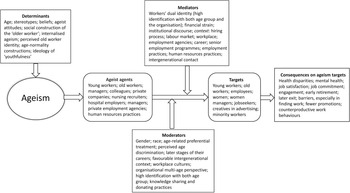
Race and gender are moderators (see Figure 2) which potentiate ageism (Spedale et al., Reference Spedale, Coupland and Tempest2014; Kanagasabai, Reference Kanagasabai2016; McGann et al., Reference McGann, Ong, Bowman, Duncan, Kimberley and Biggs2016; Drydakis et al., Reference Drydakis, MacDonald, Chiotis and Somers2017; Stypinska and Turek, Reference Stypinska and Turek2017), as well as age and image, with the latter, in a society oriented to beauty and youth, having higher incidence among women. Several studies show that older women are not the only ones who have to deal with the stigma of the juxtaposition of age and image (Handy and Davy, Reference Handy and Davy2007; Jyrkinen, Reference Jyrkinen2014; Spedale et al., Reference Spedale, Coupland and Tempest2014). Young women sometimes have to deal with this burden, often seeking to create a professional character, less female and less young, to feel taken seriously (Jyrkinen and McKie, Reference Jyrkinen and McKie2012; Worth, Reference Worth2016).
Nomological networks of ageism.

Until a few years ago, governments and organisations had appealed for the anticipation of retirement, either due to the economic crisis and consequent reduction of jobs or because of the need to make room for the younger ones (Eichhorst et al., Reference Eichhorst, Boeri, De Coen, Galasso, Kendzia and Steiber2014). Nevertheless, now, whether it is for the increase in longevity (physically and cognitively sound), for the sustainability of institutions, or the significant human and intellectual capital of older workers, it is urgent to delay the retirement age and retain workers’ full of knowledge (Gibson et al., Reference Gibson, Jones, Cella, Clark, Epstein and Haselberger2010; Stevens, Reference Stevens2010; International Labour Office, 2011; European Commission, 2015a; Kenny et al., Reference Kenny, Groeller, McGinn and Flouris2016; Nelson, Reference Nelson2016). This need and urgency has led governments and institutions to create and disseminate positive images about ageing and promote policies and programmes that help and favour older workers (Iweins et al., Reference Iweins, Desmette and Yzerbyt2012). However, that can lead to negative ageism or generate positive ageism (Iweins et al., Reference Iweins, Desmette, Yzerbyt and Stinglhamber2013; Lagacé et al., Reference Lagacé, Nahon-Serfaty and Laplante2015), which per se can lead to negative ageism.
For several reasons, older workers tend to extend their working lives (International Labour Office, 2011; Rouzet et al., Reference Rouzet, Sánchez, Renault and Roehn2019), while younger generations enter or try to enter the labour market, becoming more technological and competitive. While older workers are regarded as potential sources of knowledge, experience and talent, they also may be seen as an obstacle to young people entering the labour market. However, despite being considered more agile and better prepared for the new skills required by the labour market, younger workers also suffer from ageism. They are considered inexperienced, being too casual, having communication training needs or even not staying long enough to deserve investment in training (Raymer et al., Reference Raymer, Reed, Spiegel and Purvanova2017; Meinich and Sang, Reference Meinich and Sang2018).
Ageism targets individuals physically and mentally (Harnois and Bastos, Reference Harnois and Bastos2018; Shippee et al., Reference Shippee, Wilkinson, Schafer and Shippee2019) and impacts organisations (United Nations Economic Commission for Europe (UNECE), 2019). It can directly correlate to job satisfaction, job and organisational commitment (Yamada et al., Reference Yamada, Sugisawa, Sugihara and Shibata2005; Levy and Macdonald, Reference Levy and Macdonald2016), and retirement plans (see Figure 2).
Workers’ strategies to cope with ageism are diverse. They range from early preparation for the end of the career, attention to health and physical performance, attitudes to change, training, support from others, change of working hours, and physical and behavioural appearance (Desmette and Gaillard, Reference Desmette and Gaillard2008; Unson and Richardson, Reference Unson and Richardson2013; Clendon and Walker, Reference Clendon and Walker2016; Worth, Reference Worth2016; Krekula, Reference Krekula2019). These are essential contributions of this study for those investigating and preparing policies and strategies to combat this problem.
Furthermore, some companies cope with ageism using age management. However, the percentage of companies that are aware of workforce ageing and the challenge of a multigenerational workforce and try to manage it using age management is still low (Urbancová and Fejfarová, Reference Urbancová and Fejfarová2017).
Besides that, extending workplace anti-discrimination law to include ageism has led to organisations withdrawing from active retirement management for fear of violating legislation, despite its benefits for older workers (Wainwright et al., Reference Wainwright, Crawford, Loretto, Phillipson, Robinson, Shepherd, Vickerstaff and Weyman2019).
The summary of the studies and prominent findings in this review are an asset for researchers and organisations. Those who want to manage workforce ageing and the multiple variables of a multigenerational workforce may find inspiration and evidence to design suitable policies and HR practices. Age management and retirement management can be carried out, with more evident benefits for organisations and workers.
Ageism can be targeted at workers by their colleagues, managers and recruiters. However, ageism is also often created by the worker her- or himself (Desmette and Gaillard, Reference Desmette and Gaillard2008), with the stereotypes and prejudices present in society insinuated over time. We may realise that the social construct of the ‘older worker’ and the ideology of youth are determinants of ageism (Spedale et al., Reference Spedale, Coupland and Tempest2014; Riach and Kelly, Reference Riach and Kelly2015).
Nevertheless, good intergenerational relationships, as we said previously, can help to minimise ageism (Iweins et al., Reference Iweins, Desmette, Yzerbyt and Stinglhamber2013) by leading younger workers to be less prejudiced towards older workers, to accept their knowledge, often tacit, and their professional experience.
Additionally, older workers would be able to learn and take advantage of the skills and characteristics of younger workers (Stevens, Reference Stevens2010). Good labour relations, knowing how to co-exist, learning from each other, taking advantage of each other's assets, and filing individual and group weaknesses make it possible for organisations and society to grow healthily (Di Fabio, Reference Di Fabio2017). If organisations understand the importance, for their success, of an excellent relational climate among workers, they can use this knowledge to improve HR management practices.
In an economic and social context with limited resources and employment, making efforts to improve the employability of older or less-young workers is essential for the survival of institutions, for the physical and mental health of individuals, and the wellbeing of society. However, like the reverse of the medal, this need may decrease the employment of young people, who themselves are often the target of ageism or who, feeling threatened, may have ageist attitudes.
This review constitutes a fundamental support base for studies on age and ageism. Information on worker-related ageism is synthesised, gaps identified and future lines of research are proposed in the next section. It is a base for organisations to access information about the impact of ageism and the ageing of the labour force, allowing them strategically to anticipate scenarios and plan their HR management. It draws a vital input regarding interventions aiming to prevent and mitigate worker-related ageism.
The workplace, while a locus of acculturation, is an essential target of such interventions. Considering the ageism determinants (Table 6), the test of explanatory theories (Table 5), studies on coping with ageism (Table 3) and age management practices (Table 7), those interventions must focus on: (a) designing HR policy and practices meeting non-discrimination standards as proposed by the concept of decent work; (b) creating positive intergenerational interactions integrating the full range of ages, namely intergenerational co-operation; (c) persuading organisations to include in their job advertisements non-age discrimination statements; and (d) helping organisations to design and implement age management practices. By providing such inputs, this study also addresses the concerns of Goal 8 of the 2030 Agenda (UN, 2015) and the UNECE (2019).
Limitations and recommendations for future research
This review has the limitation of being restricted to only two databases (EBSCOhost and Web of Science), and keywords with ageism in the title or abstract, which may exclude studies about age discrimination but without using the word ageism. Furthermore, only articles written in English were included. Additionally, the search strategy did not search other databases and studies not published, which was ineffective in dealing with publication bias.
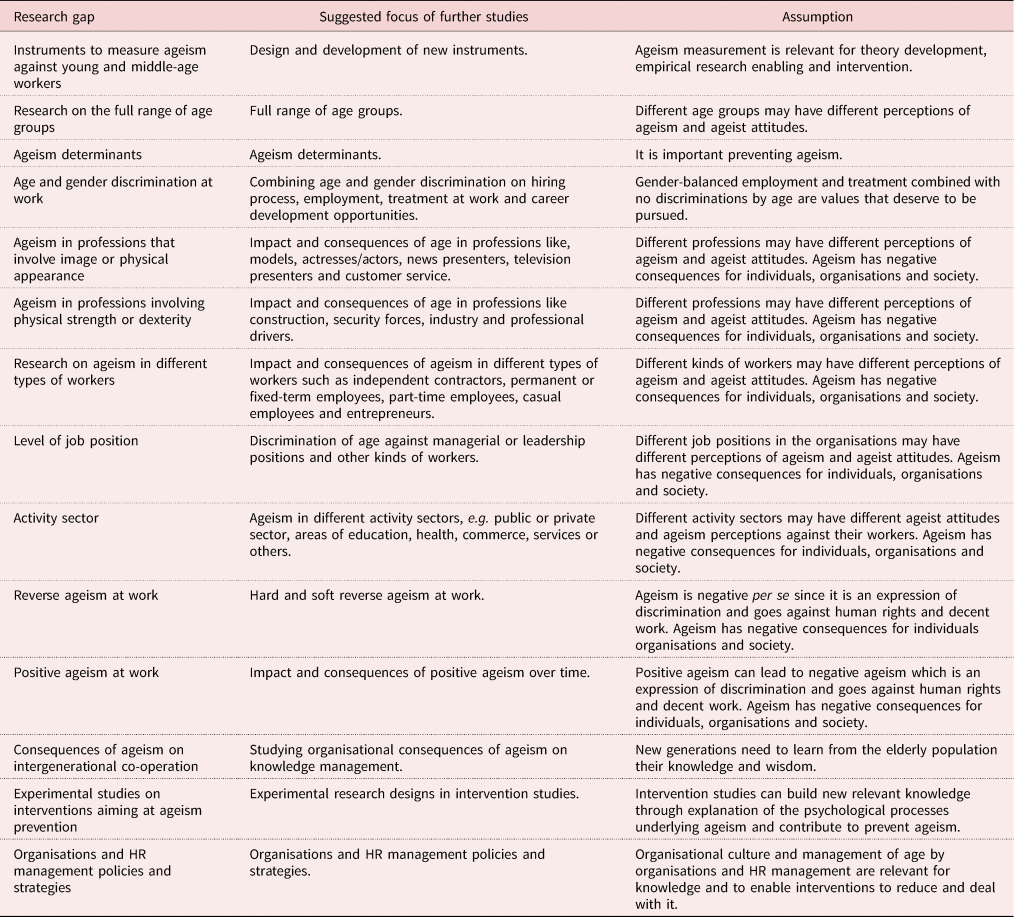
The multi-dimensionality and complexity of ageism at work has ground to be explored. Table 8 synthesises the main gaps found and future studies for filling those gaps, and the assumptions behind the suggestions.
Gaps, suggestions and assumptions

Note: HR: human resources.
Ageism has the potential to become a more relevant topic in research and intervention, also in the field of economics and management. For this to be true, an effort is needed to unite the different research disciplines, carrying out inter-disciplinary research, thus contributing to the understanding of this phenomenon and its impact.
Implications for organisations
Ageism is an issue that, if not tackled now, with the expected growth of ageing in the coming decades, could have a significant negative impact not only on workers and organisations but also on the economy and society. Combating ageism should be a priority for policy makers, those in charge of organisations and people management. For that endeavour, it is imperative to adopt a broad perspective of worker-related ageism – throughout the entire process, from vacancies and job applications to employment, pre-unemployment and pre-retirement – and identify the determinants, actors and moderators at play.
Supplementary material
The supplementary material for this article can be found at https://doi.org/10.1017/S0144686X21001380
Financial support
The authors received no financial support for the research, authorship and/or publication of this article.
Conflict of interest
The authors declare no conflicts of interest.
Ethical standards
This systematic review study used published data in public domains and therefore required no ethical approval.