I. INTRODUCTION
Metallic multilayered laminate composites have become more demanding in automotive, aerospace, medical, and electrical industries due to its unique physical and mechanical properties. Reference Wadsworth and Lesuer1 These composites are generally fabricated by coating techniques or by bonding techniques such as diffusion and adhesive. The deformation bonding can be utilized as an alternative approach for producing metallic multilayered composite with ultrafine grains (UFGs). Reference Shingu, Ishihara, Otsuki and Daigo2
Severe plastic deformation (SPD) is considered as an effective grain refinement technique to produce high strength in metallic materials. Reference Azushima, Kopp, Korhonen, Yang, Micari and Lahoti3,Reference Toth and Gu4 Various SPD techniques are high pressure torsion, Reference Al-Zubaydi, Zhilyaev, Wang and Reed5 equal-channel angular pressing (ECAP), Reference Muralidhar, Narendranath and Shivananda Nayaka6,Reference Valiev and Langdon7 accumulative roll bonding process (ARB), Reference Tsuji and Kamikawa8–Reference Xin, Hong, Feng, Yu, Wu and Liu11 multiaxial forging (MAF), Reference Tayyebi and Eghbali12 and repetitive corrugation and straightening (RCS). Reference Lee and Kim13 ARB technique is found to be the most suitable process for the production of bulk materials with UFG and develop to multilayered composites. In ARB processing, the function of the rolling step is to achieve simultaneous deformation and bonding of the adjacent metallic layers being rolled. Major advantages of ARB technique are the development of multilayered composites at low cost, high productivity, and defects-free microstructure. In this regard, multilayered sheets, composed of alternative layers of Al and Mg alloys, have received a great deal of attention because of their outstanding combination of corrosion resistance from the Al alloy and high specific strength and extraordinary light weight from the Mg alloy. Reference Liu, Zhang and Zhang14,Reference Matsumoto, Watanabe and Hanada15 Recently the ARB process has been successfully adapted to fabricate various UFG multilayered composites including Al/Cu, Reference Eizadjou, Talachi, Manesh, Shahabi and Janghorban16 Al/Mg, Reference Chang, Zheng, Gan, Xu and Brokmeier17,Reference Chen, Hsieh and Wu18 Ti/Ni, Reference Inoue, Ishio, Takasugi, Inoue, Ishio and Takasugi19,Reference Ding, Lee, Lee, Kang and Nam20 Al/Ti, Reference Yang, Cizek, Hodgson and Wen21 and Cu/Ni. Reference Tayyebi and Eghbali12 However, very meager information is available in the literature about the combination of anodization treatment and ARB of Mg–Zn/Al multilayered composites. Generally, most metal matrix composites are developed using stir casting, spray forming, and powder metallurgy. Some major drawbacks of these techniques are agglomeration, nonuniform distribution, and poor wettability of reinforcement particle which lead to poor mechanical properties. Reference Lee and Kim13 Normally, metal matrix composites are developed by squeeze casting, spray forming, and powder metallurgy methods. The limited application of these techniques in engineering industries is due to the occurrence of defects such as agglomeration and nonuniform distribution of reinforcement particles and also higher manufacturing cost due to costly equipment and complex processing routes. Reference Yu and Lee22 To overcome these problems, Jamaati et al. (2010) Reference Jamaati, Toroghinejad and Najafizadeh23 reported the combination of anodizing and ARB processes as a novel approach to produce high strength multilayered composites. Anodization process is to develop an alumina layer on the material followed by uniform dispersing alumina particle into the bulk of the material through rolling process which is the novel method of obtaining dispersion strengthening in the composite.
In the present work, efforts have been made to develop Mg–6% Zn/Al and Mg–6% Zn/anodized Al multilayered composites through the ARB process, thereby combining advantageous properties of both Mg–6% Zn alloy and Al and Al2O3. The roll of grain refinement and anodization treatment in improving mechanical properties has been discussed through microstructure evaluation.
II. MATERIALS AND METHOD
Cast ingot of Mg–6% Zn and Al was homogenized at ∼400 °C for 24 h in a tubular furnace. Rolling was carried out in a laboratory rolling mill of diameter 110 mm with intermediate heating at 300 °C for 10 min with 0.25% reduction per pass to get a final thickness of about 1 mm. Mg–6% Zn alloy and Al were degreased with acetone, wire-brushed, and then stacked alternatively and held for 10 min at 300 °C in a furnace before being roll-bonded with 50% reduction to get a Mg–6% Zn/Al multilayered composite.
In the second system of material, anodization was carried out on a pure Al sheet before it is roll-bonded with Mg–6% Zn. Anodization of the Al sheet was carried out in 15% H2SO4 solution with an operating potential of 16 V at 3.5 A for 60 min at 18 °C adopted for forced circulation for the period of one hour, to obtain a uniform aluminum oxide film. Reference Toroghinejad, Jamaati, Nooryan and Edris24 The thickness of the alumina layer was measured by using scanning electron microscopy (SEM). A Mg–2% Zn sheet was degreased with acetone and wire-brushed, after surface preparation the Mg–6% Zn was stacked alternatively with anodized Al. The stacked composite was preheated for 10 min at 300 °C in a furnace, and then roll-bonded using A 2Hi rolling mill (Buhler Ltd., Braunschweig, Germany) at 20 rpm with 50% reduction to get a Mg–6% Zn/anodized Al multilayered composite.
The microstructure characterization of multilayered composites was done by using scanning electron microscopy (SEM; JEOL JSM-6380LA, JEOL USA Ltd., Peabody, Massachusetts), electron backscattered diffraction (EBSD; JEOL JSM-7100F, JEOL USA Ltd.), and transmission electron microscopy (TEM; JEOL JEM-2100, JEOL USA Ltd.). Composite samples were sectioned along the normal direction (ND)–rolling direction (RD) plane and polished sequentially up to 2000 grit SiC paper using diamond paste. Etching was done using an acetic-picral solution. Phase analysis was done on RD–transverse direction (TD) plane using the X-ray diffraction (XRD) analysis. For the EBSD analysis, the RD–ND plane of the samples was electro-polished in Struers’ AC2 electrolyte at 16 V for 60 s at −25 °C. The EBSD results were analyzed using HKL Channel 5 software.
The Vickers microhardness test was performed in Omni-tech microhardness tester (Omni-tech, Maharashtra, India) on the TD plane using a load of 10 g with the dwell time of 11 s. The tensile test was carried out according to ASTM E8 M standard using Tinius Olsen Tensometer (Noida, India) at a constant cross head speed with an initial strain rate of 5 × 10⁻³ s−1. Following the standard, gage length, radius of fillet, length, and width of the specimens were equal to 20 mm, 7 mm, 64 mm, and 10 mm respectively.
III. RESULTS AND DISCUSSION
A. Microstructural investigations
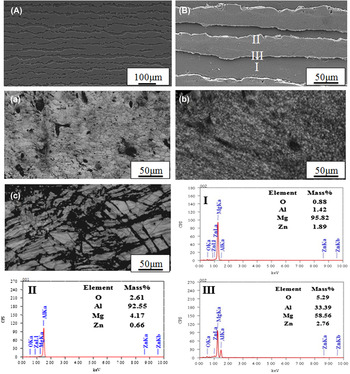
SEM micrographs of the 5-pass ARB processed Mg–6% Zn/anodized Al multilayered composite show 32 alternative layers of Mg–6% Zn and anodized Al depicted in Fig. 1. There were no cracks or de-lamination along the interfaces of the multilayer composite which indicates good bonding between Mg–6% Zn alloy and anodized Al but a slight waviness layer structure was observed. The thickness of the multilayered composite decreases with an increase in the number of ARB passes and finally, 5-pass ARB processed composite layer thickness was found to be in the range of 40–50 μm. The UFGs are depicted in the ARB processed Al layer [Fig. 1(a)], anodized Al layer [Fig. 1(b)], Mg–6% Zn layer [Fig. 1(c)] in the Mg–6% Zn/Al, and Mg–6% Zn/anodized Al multilayered composites. Energy dispersive spectroscopy data show alternate layers of Al (region I) and Mg–6% Zn (region II) at the interface of Mg–6% Zn and Al (region III). Grain refinement during ARB is due (i) the subdivision of the initial grains and the formation of the subgrain structure with low angle grain boundaries (LAGBs) by multidirectional slip, (ii) misorientation increase and gradual transformation of low angle boundaries (LABs) to high angle grain boundaries (HAGBs) by dislocation accumulation, and (iii) migration of new HAGBs and formation of a well-defined UFG structure. Reference Xing, Kang and Kim25 A fraction of recrystallized grains increased with an increase in strain due to the higher rate of nucleation of new grains during recrystallization, which resulted in a relatively uniform microstructure with UFGs. The dynamic recovery and recrystallization are the reason for the UFG structure in the SPD processed metals. Reference Jamaati and Toroghinejad26,Reference Humphreys and Hatherly27
SEM micrographs of (A) 5-pass ARB processed Mg–6% Zn/anodized Al multilayered composite, (B) magnified image. (a) Micrographs revealing the grains in Al layer, (b) anodized Al layer, (c) Mg–6% Zn layer; (I) EDS of the Mg–6% Zn layer, (II) anodized Al layer, (III) interphase between Mg–6% Zn/anodized Al layer.

B. EBSD analysis
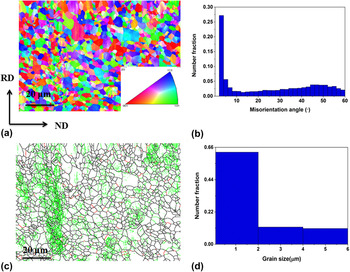
The EBSD based analysis of the Al layer (on the ND–RD plane) in the 5-pass ARB Mg–6% Zn/Al multilayered composites is shown in Fig. 2. Here, Fig. 2(a) shows the inverse pole figure (IPF) map where a standard stereographic triangle corresponds to various crystallographic directions indicated by various colors. The grains are directed in the direction of rolling, which is 〈001〉 orientation. The misorientation angle distribution profile [Fig. 2(b)] revealed some fraction of HAGBs due to a large strain during deformation process [the density of dislocations increases which results in an increase in the fraction of high angle boundaries (HABs)]. Reference Hansen and Jensen28 If the number of ARB passes increases, the density of dislocations increases which results in an increase in the fraction of HABs. At the higher ARB passes, the area of grain boundaries increased due to internal energy in the deformed material. Reference Lee, Saito, Tsuji, Utsunomiya and Sakai29
EBSD based analysis of Al layer in the Mg–6% Zn/Al multilayered composite: (a) IPF map, (b) misorientation angle distribution profile, (c) IPF map and grain boundary map with twins, (d) grain size distribution.

The grain boundary map overlaid with twins is shown in Fig. 2(c). Here, LABs are represented in green lines with misorientations between 2 and 15° and HABs are represented in black lines with misorientations above 15° and twins are marked in red colors. The Al layer in the multilayered composite which consists of fully equiaxed grains oriented in the rolling direction with a fraction of HABs are formed due to dynamic recrystallization during the ARB process. At higher strain, the LAGBs were converted into HAGBs. The percentage of twins has been calculated from the HKL channel 5 software (JEOL USA Ltd.) and found to be 2.39% and occurs along with some shear bands. The average grain size was found to be 1.8 μm as plotted in Fig. 2(d).
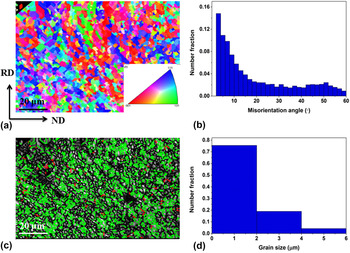
Figure 3 depicts the EBSD based analysis of the anodized Al layer (taken on the ND–RD plane) in the Mg–6% Zn/anodized Al multilayered composite. The IPF map [Fig. 3(a)] revealed that the anodized Al layer grains are directed uniformly in 〈001〉 orientation in the direction of rolling. The misorientation angle distribution profile [Fig. 3(b)] consists of subgrains with a fraction of HABs due of the dynamic recrystallization during ARB process. A grain boundary map overlaid with twins is shown in Fig. 3(c) which consists of equiaxed grains with some fraction of HABs. The percentage of twins was found to be 1.4%. The grain size variation profile [Fig. 3(d)] exhibited average grain size ∼1.6 μm.
EBSD based analysis of anodized Al layer in the Mg–6% Zn/anodized Al multilayered composite: (a) IPF map, (b) misorientation angle distribution profile, (c) IPF map overlaid with grain boundaries and twins, (d) grain size distribution.

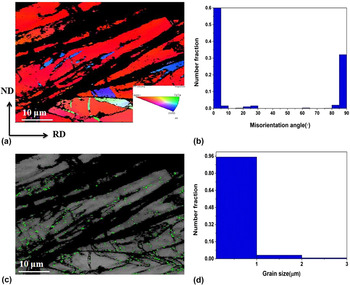
Figure 4 depicts the EBSD based analysis of the Mg–6% Zn layer (ND–RD plan) in the multilayered composites. The IPF map [Fig. 4(a)] revealed that Mg–6% Zn layer grains are directed uniformly in 〈0001〉 orientation in the direction of rolling. The misorientation angle distribution profile [shown in Fig. 4(b)] exhibited both LAGBs and HAGBs in Mg–6% Zn layer in the multilayered composite.
EBSD based analysis of Mg–6% Zn layer in the multilayered composite: (a) IPF map, (b) grain boundary map overlaid with twins, (c) misorientation angle distribution profile, (d) grain size distribution.

Figure 4(c) shows uniform distribution of UFGs and did not show any twin boundary. The grain size variation profile [Fig. 4(d)] exhibited average grain size ∼0.6 μm. The fraction of recrystallized grains increased with an increase in strain due to the higher rate of nucleation of new grains during recrystallization, which resulted in a relatively uniform microstructure with fine grains. Mg–6% Zn layer did not show any twin boundary because when the grain size decreases, the twin nucleation decreases in the Mg alloys. In the fine grained Mg alloys, slips are activated resulting in the suppression of twin generation and reduction in mechanical anisotropy by grain refinement. Reference Chino, Kimura and Mabuchi30 Deformation twins disappear in the Mg alloys, when the average grain size reaches <2 μm.
C. TEM analysis
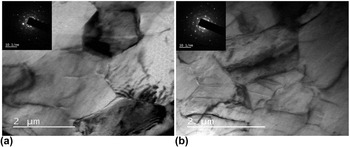
TEM micrographs of the Mg–6% Zn/Al and Mg–6% Zn/anodized Al multilayered composites revealed fine grains with a high degree of misorientation [Figs. 5(a) and 5(b)]. The density of dislocations can be observed inside the grains. During the ARB process, due to high strain, subdivision of grains occurs due to the formation of planar dislocation boundaries and incidental dislocation boundaries. Higher misorientations form across these dislocation boundaries and spacing of boundaries reduces, which helps to create fine grains. The selected area electron diffraction (SAED) patterns revealed the formation of rings, which confirms the fine grain structure in the multilayered composites. Grain refinement is because of dynamic recrystallization as evidenced by the presence of equiaxed grains.
TEM micrographs and SAED patterns of the 5-pass ARB processed (a) Mg–6% Zn/Al and (b) Mg–6% Zn/anodized Al multilayered composites.

D. XRD
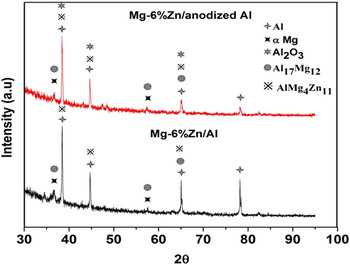
XRD patterns (Fig. 6) of the 5-pass ARB processed multilayered composites revealed peaks indexed to Al, αMg, Al17Mg12, and AlMg4Zn11. Multilayered composite exhibited intermetallic compounds due to inter diffusion between Al, Mg, and Zn because of high strain during ARB at 300 °C. The Mg–6% Zn/anodized Al multilayered composite exhibited Al2O3 peak due to anodization on the Al sheet before the ARB process.
XRD analysis along the cross section of ARB processed multilayered composite.

E. Density
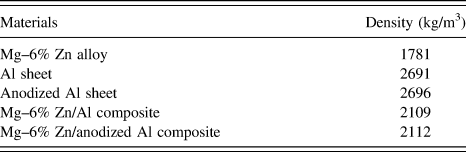
Density test was carried out according to Archimedes principle. The weight of the samples was measured in the presence of air and in water. Density test results are illustrated in Table I.
Density test results.

Developed Mg–6% Zn/Al and Mg–6% Zn/anodized Al multilayered composites were found to be 1.27 times light weight as compared to pure Al.
F. Microhardness
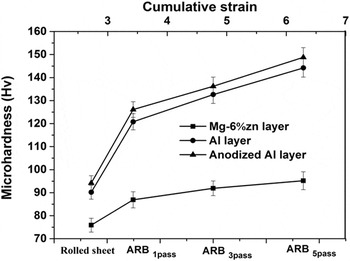
The microhardness variation of layered composite (Fig. 7) depicted that as the number of ARB passes increases, the microhardness of Mg–6% Zn, Al, and anodized Al layers increases. During initial passes of ARB process, the improvement of hardness was attributed to strain hardening (based on the density of dislocations and interactions between them) during the ARB process.
Microhardness variation of composite layers of the Mg–6% Zn, Al, and anodized Al at different ARB passes.

Cumulative strain accumulated in the roll-bonded samples can be given by Eq. (1), Reference Saito, Utsunomiya, Tsuji and Sakai31
 $${\varepsilon _{{\rm{cum}}}} = {\varepsilon _{\rm{i}}} + 2\sqrt 3 \,{\rm{ln}}\left\{ {{1 \over {{2^n}}}} \right\}\quad ,$$
where initial strain
 ${\varepsilon _{\rm{i}}} = {\rm{ln}}\left( {{{{t_{\rm{i}}}} \over {{t_{\rm{o}}}}}} \right)$
, t
i = initial thickness of the sample, t
o = final thickness of the sample, and n = number of passes.
Cumulative strain was found to be 3.2, 4.7, and 6.3 for 1, 3, and 5 pass ARB multilayered composites, respectively. After the first pass, microhardness increased rapidly which is due to the work hardening as a result of increased dislocations density. Improvement of microhardness at higher passes of ARB is due to the combined effect of dislocation density increment and grain refinement. Microhardness of the 5-pass multilayered composite layers reached 95.2 HV (∼1.25 time), 144.2 HV (∼1.59 times), and 148.8 HV (∼1.57 times) in comparison to its counterpart rolled Mg–6% Zn alloy, aluminum, and anodized Al, respectively. The microhardness of the multilayered composites is also affected by the presence of intermetallic (Al17Mg12 and AlMg4Zn11) formed during the ARB process as shown in Fig. 6. In the case of Mg–6% Zn/anodized Al multilayered composites, harder alumina particles are distributed uniformly in the microstructure during the ARB process and act as a barrier to the dislocation movement.
G. Tensile test
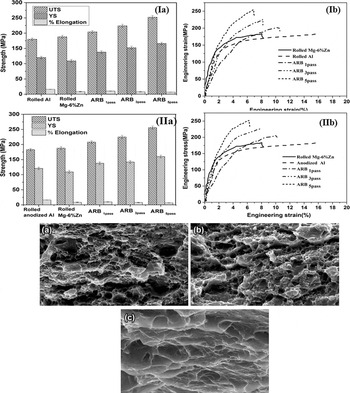
Variation of ultimate tensile strength (UTS), yield strength (YS), and elongation of the Mg–6% Zn/Al and Mg–6% Zn/anodized Al multilayered composites at different ARB passes is shown in Figs. 8(I) and 8(II). As can be seen, the strength of multilayered composite increases with an increase in the number of ARB passes. The YS and UTS of the Mg–6% Zn/Al composite [Fig. 8(I)] improved to 1.52 and 1.34 times and for Mg–6% Zn/anodized Al composite [Fig. 8(II)] improved to 1.46 and 1.36 times than that of rolled Mg–6% Zn alloy, respectively. The improvement of strength in initial passes of ARB is due to strain hardening or dislocation strengthening mechanism. Reference Hansen, Huang, Ueji and Tsuji32 Strength improvement at the higher ARB passes is due to the formation of fine grain structure (Hall–Petch effect), largely misoriented grain boundaries, Reference Terada, Inoue and Tsuji33 and formation of intermetallic phases. Reference Schmidt, Knieke, Maier, Hopple, Peukert and Goken34 At higher ARB passes, work hardening effect gradually decreases, as the number of fine grains with high angle boundaries increases. Total elongation decreases with an increasing number of ARB passes. During the initial passes, the composites exhibited higher elongation because of the presence of highly ductile element Al in the equal quantity with Mg–6% Zn. At the higher passes, the total elongation decreases due to strain hardening and refined grains. The tensile strength of the Mg–6% Zn/anodized Al composite is 1.58% higher as compared to Mg–6% Zn/Al composite due to alumina particle (due to anodization treatment). Alumina particle helps to increase the strength by pinning the dislocations and impeding their motion resulting in enhanced dislocation density and dislocation interactions which increases work hardening and strength. Reference Jamaati, Toroghinejad, Dutkiewicz and Szpunar35 Improved strength of the multilayered composite has been reported that it is not only the stain hardening and grain refinement but also the reinforcement effect in the matrix caused by intermetallics formed during the ARB process. Reference Chang, Zheng, Xu, Fan, Brokmeier and Wu36–Reference Ahmadi, Toroghinejad and Najafizadeh39 According to the Orowan mechanism, a reinforcement particle acts as a barrier to a dislocation movement. With an increase in the number of ARB passes, the density of dislocations increases along with the formation of HABs.
Variation of UTS, YS, and percentage elongation for different passes of ARB processed multilayered composite: (Ia) Mg–6% Zn/Al, (IIa) Mg–6% Zn/anodized Al. (Ib and IIb) Engineering stress–strain curves and fracture surface of the (a) Al, (b) Anodized Al, and (c) Mg–6% Zn layers.

Fracture surface of tensile tested 5-pass ARB processed Al, anodized Al, and Mg–6% Zn layers is shown in Figs. 8(a)–8(c). Al layer and anodized Al layer in the Mg–6% Zn/Al and Mg–6% Zn/anodized Al multilayerd composite depict typical ductile failure illustrated by dimples, as shown in Figs. 8(a) and 8(b), respectively. Ductile fracture begins with the nucleation, growth, and coalescence of microvoids. The presence of shallow and small elongated microvoids affected by shear stress during ARB process confirms the shear ductile fracture. But the Mg–6% Zn layer in the multilayered composite depicts [Fig. 8(c)] bright lines on the fracture surface which are indication for cleavage fracture. Mg–6% Zn layers were fractured in the shear mode and without forming dimples which appear to be transgranular brittle fracture.
IV. CONCLUSIONS
In the present research, ARB was used to develop Mg–6% Zn/Al and Mg–6% Zn/anodized Al multilayered composites at 300 °C up to five passes successfully. Microstructural and mechanical properties of the developed composites were studied. The following conclusions can be summarized based on the obtained results.
-
(1) Developed Mg–6% Zn/Al and Mg–6% Zn/anodized Al multilayered composites exhibited 1.275 times and 1.274 times light weight as compared to pure Al. The formation of Al17Mg12, AlMg4Zn11, and Al2O3 intermetallics was confirmed by the XRD analysis. EBSD and TEM analyses revealed that the 5-pass ARB processed multilayered composite exhibited an average grain size of 1.8, 1.6, and 0.6 μm with high angle misorientation for Al, anodized Al, and Mg–6% Zn layers.
-
(2) Microhardness of the multilayered composite layers was increased with the increase in the number of ARB passes. The 5-passed composite layers exhibited 95.2 HV (∼1.25 time), 144.2 HV (∼1.59 times), and 148.8 HV (∼1.57 times) in comparison to its counterpart rolled Mg–6% Zn alloy, aluminum, and anodized Al respectively.
-
(3) Tensile data indicate a significant increasing in the tensile strength of Mg–6% Zn/Al and Mg–6% Zn/anodized Al multilayered composites in comparison with the rolled Mg–6% Zn alloy due to strain hardening, grain refinement, and intermetallics formed during the ARB process. Mg–6% Zn/anodized Al composite exhibited better mechanical properties as compared to Mg–6% Zn/Al composite due to alumina particle which acts as a barrier to dislocation movement, causing enhancement of strength.
-
(4) Fractured surface of Al layer and anodized Al layer in the multilayered composites exhibited shear ductile failure and Mg–6% Zn layer shows cleavage, which appear to be transgranular brittle fracture.
ACKNOWLEDGMENTS
The authors gratefully appreciate the support of Department of Materials Engineering, Indian Institute of Science Bangalore, India; Advanced Center for Material Science, Indian Institute of Technology Kanpur, India; and Exclusive Magnesium Private limited, Hyderabad, India for providing various testing facilities used in this research work.