Implications
There is an increasing demand for sustainable protein sources for the livestock sector. This manuscript contributes with important knowledge to the field of forage-based protein for monogastrics by demonstrating the possibilities of increasing the nutritional value by extracting protein from grass and legumes. Using rats as model enabled screening for parameters important for large-scale production of plant-based protein feed. Improvements in protein yield and digestibility and nutritional evaluation in poultry and pigs are warranted in order to produce quality protein large-scale. Production is expected to limit surplus protein feeding and hence be of economic and environmental importance.
Introduction
Human population growth and increasing standards of living in developing countries create a rise in the global demand for sustainable animal protein (Boland et al., Reference Boland, Rae, Vereijken, Meuwissen, Fischer, van Boekel, Rutherfurd, Gruppen, Moughan and Hendriks2013). Soya bean-based protein is currently the protein of choice for animal feed because of quality and accessibility (Wang et al., Reference Wang, Hong, Yan, Cho, Lee and Kim2011), but production is associated with environmental and health concerns in the production countries (WWF International, 2014). Temperate green plants such as grass and forage legumes have the potential to become locally grown alternatives to soy because of high protein yield and balanced amino acid composition (Pirie, Reference Pirie1987) thereby constituting a potential protein source for the continuously increasing livestock sector. Young monogastric animals, like growing pigs and broilers, are challenged by the high fibre content in some green plants, therefore a direct use of green plants as protein source is unrealistic in these animals (Pirie, Reference Pirie1966). Furthermore, high water content in the plants complicates handling and increases the transportation costs thereby reducing the competitive position of the protein. By fractionating the plant into a pulp and a juice from which soluble proteins can be isolated, these limitations can be bypassed and a feed more suitable for monogastrics is produced (Pirie, Reference Pirie1987). Quantitative studies of green plant proteins have demonstrated the production of protein-rich concentrates containing 40% to 60% of the original plant protein (Chiesa and Gnansounou, Reference Chiesa and Gnansounou2011). Recently we reported that screw-press processing of white clover followed by acidification of the juice produced a protein concentrate with high protein concentration and an amino acid composition comparable to soya bean protein, and thereby a potential for using white clover as protein source for monogastric animal feed (Stødkilde et al., Reference Stødkilde, Damborg, Jørgensen, Lærke and Jensen2018). Nutritional studies are limited and have mainly focused on lucerne as raw material (Duckworth and Woodham, Reference Duckworth and Woodham1961; Myer et al., Reference Myer, Cheeke and Kennick1975; Cheeke et al., Reference Cheeke, Kinzell, De Fremery and Kohler1977). These earlier studies have been inconclusive, probably because of improper processing and yet no appropriate protocol or preferable plant have been determined. Method improvements for green plant processing and protein extraction have been seen in the recent years, an example being the use of a twin-screw technology for processing (Colas et al., Reference Colas, Doumeng, Pontalier and Rigal2013), and combined with the increasing demand for sustainable protein this justifies new attempts to produce high-quality plant protein for monogastric animal feed. The aim of the present study was to determine nitrogen (N) and amino acid composition of plant, pulp and protein concentrate from white clover, red clover, lucerne and perennial ryegrass produced by processing the plants in a screw-press. In addition, the aim was to determine the faecal digestibility of dry matter (DMD) and the standardised N digestibility of all fractions in a rat model with the purpose of evaluating the four plant species as potential protein sources for monogastric animals.
Material and methods
Plants and processing
White clover (Trifolium repens L.), red clover (Trifolium pratense L.), lucerne (Medicago sativa L.) and perennial ryegrass (Lolium perenne) were grown at the experimental farm at Aarhus University, Foulum and were harvested at a 7 to 10 cm stubble height in June (lucerne, July) 2014 (1st regrowth).The maturity stage was, according to Skinner and Moore (Reference Skinner and Moore2007), index 4/6 for legumes and index E3/R1 for perennial ryegrass. The plants were manually cleaned from bugs, dirt, and other plants and frozen.
The plant material was thawed over-night before processing, which was done in a commercial lab-scale twin-screw press (Angelia 8500S Angel slow-juicer, Angel Co. Ltd, Busan, Korea) resulting in a juice and a fibrous pulp as previously described (Stødkilde et al., Reference Stødkilde, Damborg, Jørgensen, Lærke and Jensen2018). Proteins in the juice were precipitated by lowering pH to 4 with addition of 12 M sulphuric acid. The acidified juice was left overnight at 4°C and subsequently centrifuged for 10 min at 2000×g and 4°C. The leftover liquid (brown juice) was discarded. All samples were freeze-dried and ground (0.5 mm). The processing and extraction resulted in three samples from each plant; plant, pulp and protein concentrate.
Animal experiments
The experiment was conducted at research facilities at Aarhus University, Foulum and complied with the guidelines set by the Danish Ministry of Environment and Food. The experimental procedure with growing rats has been described in detail (Jørgensen et al., Reference Jørgensen, Brandt and Lauridsen2008; Stødkilde et al., Reference Stødkilde, Damborg, Jørgensen, Lærke and Jensen2018) and is frequently used for research in bioavailability of nutrients in foods. Groups of five Wistar rats (Taconic, Laven, Denmark) with initial BW of 80 to 85 g were used in a digestibility trial. The animals were housed individually in metabolic cages with free access to water. After 6 days of acclimatisation on a standard rodent chow, the rats were allocated randomly to each experimental group. During the trial, each rat received 11 g dry matter (DM) daily. All dietary N was provided by fractions from the four plants. Different amounts of the plant fractions were added to each diet to ensure that the N content was equal corresponding to 1.5% of the DM (165 mg N/day) (Stødkilde et al., Reference Stødkilde, Damborg, Jørgensen, Lærke and Jensen2018). An N-free mixture constituted the remaining amount and consisted of 80.7% pregelatinised maize starch (Cargill Nordic, Søborg, Denmark), 8.9% sucrose (Danisco Sugar, Copenhagen, Denmark), 5.2% cellulose (MN grade 100; Macherey-Nagel GmbH, Düren, Germany) and 5.2% rapeseed oil (COOP, Albertslund, Denmark) (Stødkilde et al., Reference Stødkilde, Damborg, Jørgensen, Lærke and Jensen2018). The cages allowed quantitative collection of faeces. Four days were allowed for adaptation, after which faeces were collected quantitatively for 5 days. In calculations of feed intake, feed refusals were taken into account. During the experiment, the rats were kept in a 12 : 12-h artificial light cycle, a temperature of 25°C and a humidity of 60%. After conclusion of the digestibility experiment, the rats were euthanised with carbon dioxide.
Due to limited space, we ran two separate experiments; one with perennial ryegrass and lucerne (trial A) and one with white clover and red clover (trial B).
Chemical analysis
The chemical analyses were performed as previously described (Stødkilde et al., Reference Stødkilde, Damborg, Jørgensen, Lærke and Jensen2018). In short, plants, pulps, diets and faeces were freeze-dried and the DM contents were determined in duplicates by drying the freeze-dried material at 100°C for 2h. Nitrogen was analysed by the Dumas procedure using thermal conductivity after complete combustion at 1300°C in pure oxygen (LECO CNS-2000, Carbon, Nitrogen and Sulphur analyser, St. Joseph, MO, USA) (Hansen, Reference Hansen1989). The CP concentration was determined by multiplying the N concentration with factor 6.25.
Amino acids in the samples were determined using the European Economic Community methods (98/64/EC and 2000/45/EC) (European Commission, 1998). The concentration of all analysed amino acids was summed. Non-protein nitrogen (NPN) was calculated as the difference between the concentration of CP and the sum of analysed amino acids, expressed as g/kg CP.
Calculations
Based on feed intake and faecal excretion, the DM and protein digestibility of the plant fractions were calculated according to Jørgensen et al. (Reference Jørgensen, Brandt and Lauridsen2008) and Stødkilde et al. (Reference Stødkilde, Damborg, Jørgensen, Lærke and Jensen2018). The DM digestibility of the N-free mixture and the faecal excretion of N after ingestion of N-free diet (endogenous N-loss) were estimated previously (Jørgensen et al., Reference Jørgensen, Brandt and Lauridsen2008) and used for calculations of the digestibility of the plant fractions.
The DMD, where only the DM contribution from the plant, pulp or protein concentrate was included, was calculated as:
 $$\eqalignno{ &{\rm {\rm DMD}} {\equals}{{{\displaystyle{{\rm Total \;digested \;DM\,{\minus}\, DM \;intake }\,\left( {{\rm mg}} \right)\;{\rm of \;N\,{\minus}} \atop {\rm free \;mixture}{\times} {\rm dc(N\,{\minus}\,free \;mixture)}} \over{\rm {{\rm DM \;intake }\left( {{\rm mg}} \right){\; \rm of\; plant, pulp \;or\; protein\; concentrate}}}} \cr & \;{\times}{\rm 100}$$
where dc(N-free mixture) is the digestibility of the N-free mixture estimated to be 92.8% based on a large set of rat digestibility trials (unpublished data) and Jørgensen et al. (Reference Jørgensen, Brandt and Lauridsen2008).
For CP, the apparent digestibility (ADP) was calculated as:
 ${\rm ADP{\equals}}{{{\rm N \;intake }\;\left( {{\rm mg}} \right){\rm {\minus}N \;excretion\; in\; faeces\;(mg)}} \over {{\rm N \;intake \;(mg)}}}{\times}100$
The endogenous faecal N-loss (FE) was calculated using a correction of 1.01 mg N/g feed DM as estimated by Jørgensen et al. (Reference Jørgensen, Brandt and Lauridsen2008) in a rat feeding trial with an N-free mixture:
 ${\rm FE \;(mg){\equals}}{{{\rm Feed \;intake\; }\left( {\rm g} \right){\times}{\rm Feed \;DM\,\%\,}} \over {{\rm 100}}}{\times}{\rm 1}{\rm .01 mg \; N}\,/\,{\rm g \;feed \;DM}$
Standardised N digestibility was calculated, where ADP was corrected for FE:
 $\eqalignno{ &{{\rm Standardised \;N \;digestibility}} \cr & \quad{\equals}{{{\rm N \;intake \;(mg){\minus}}\left( {{\rm N \;excretion \;in \;faeces \;(mg){\minus}FE(mg)}} \right)} \over {{\rm N \;intake \;(mg)}}}{\times}100$
Protein digestibility-corrected amino acid score (PDCAAS) was calculated:
 $\eqalignno{ &{\rm PDCAAS{\equals}}{{{\rm mg \;of \;essential \;amino \;acid \;in \;1 \,g \;of \;the \;test \;protein}} \over {{\rm mg \;of \;the \;same \;amino \;acid \;in \;1 \,g \;reference \;protein}}} \cr & \quad{\times}{\rm Standardised \;N \;digestibility }$
The reference protein is the requirement of pigs (20 to 50 kg) (National Research Council, 2012) or the requirements of broilers (2.0 to 2.5 kg live weight) (Aviagen, 2007). For the calculations, individual standardised N digestibility was used resulting in five amino acid scores for a specific diet.
Statistics
Pairwise comparisons were done for samples in trial A and in trial B, respectively. The experimental design did not allow comparisons between the two trials. The standardised N digestibility, DM digestibility, feed intake and amino acid scores of the plant fractions were compared by a one-way ANOVA using the GLM procedure (SAS version 9.4) with Tukey adjustment for multiple comparisons. The linear model used was:
 $\hskip 60ptYij{\equals}{\rm }\mu {\plus}{\rm }\alpha i{\plus}{\rm }{\epsilon}ij$
where  $\mu $ is the overall mean,
 $\alpha $ the effect of diets (i = 1, … , 6) and
 ${\epsilon}$ the residual random error N(0,σ2). The experimental unit is the individual rat within one diet (j = 1, … , n), n = 5, for ryegrass pulp n = 3. Results are presented as mean.
Root mean square error and P-value for the model are given for each calculated variable. A P-value<0.05 was considered significant for multiple comparisons.
Results
Chemical composition of plant fractions
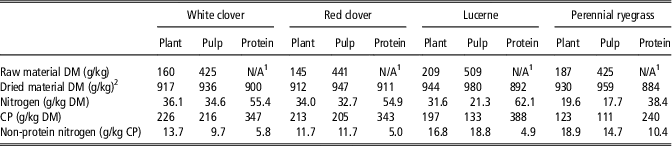
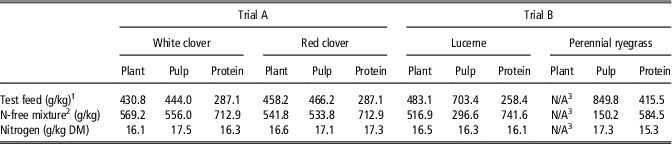
Three legumes; white clover, red clover and lucerne, and one grass; perennial ryegrass, were chosen as raw material in this study. Dry matter concentration in the plants ranged from 145 to 209 g/kg, the highest found in lucerne and the lowest found in red clover (Table 1). The CP concentration ranged from 123 to 226 g/ kg DM, the highest found in white clover, the lowest in perennial ryegrass. After screw-press fractionation, pulps with DM concentrations of 425 to 509 g/kg were produced. Lucerne pulp had the highest concentration, perennial ryegrass pulp had the lowest. Dry matter concentration of the produced protein concentrates before drying were not recorded. The CP concentration in the pulp ranged from 111 g/kg DM for perennial ryegrass to 216 g/kg DM for white clover. For the protein concentrates, CP concentrations were 240, 343, 347 and 388 g/kg DM for perennial ryegrass, red clover, white clover and lucerne, respectively (Table 1). For all four plant species, the NPN concentration in the CP was lower in the protein concentrate than in the plants ranging from 5.8 to 10.4 g/kg CP and 11.7 to 18.9 g/kg CP, for protein concentrate and plant, respectively. Diets where the plant fractions were the only N source were mixed ensuring that the N concentration of all diets were equal corresponding to 1.5% of the total DM (Table 2).
Chemical composition of plant fractions used for rat digestibility trials

1 The dry matter (DM) of the protein concentrate before freezedrying was not determined.
2 Composition in freeze-dried material.
Composition of diets for rat digestibility trials

1 Amount of plant fraction included in the rat diet resulting in equal N content corresponding to 1.5% of the dry matter (DM) (165 mg N/day).
2 Composition of N-free mixture (806.7 g/kg pregelatinised maize starch, 89.3 g/kg sucrose, 52.0 g/kg cellulose powder, 52.0 g/kg rapeseed oil).
3 Due to insufficient supplies, this sample was not included in the animal experiment.
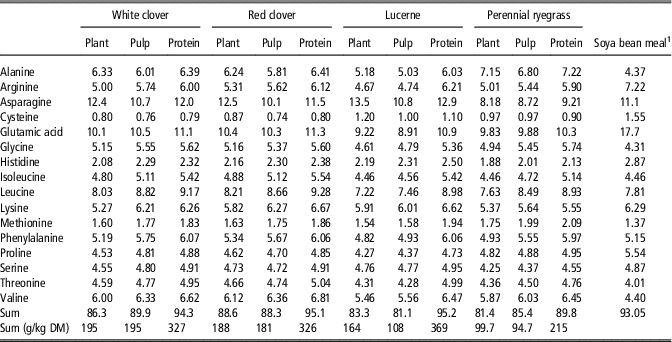
The amino acid compositions of the plant fractions were determined and expressed as g/16 g N corresponding to 100 g CP (Table 3). The concentration of lysine ranged from 5.27 to 6.67 g/16 g N and methionine ranged from 1.54 to 2.09 g/16 g N. The sum of all amino acids ranged from 81.1 g/16 g N in lucerne pulp to 95.2 g/16 g N in lucerne protein concentrate. When reporting the amino acid sum in g/kg DM, the lowest concentration, 94.7 g/kg DM, was found in pulp from perennial ryegrass, whereas lucerne protein concentrate had the highest concentration of 369 g/kg DM. In general, there was a numerically higher concentration of all individual amino acids in the protein concentrate than in the originating plant, except for aspartic acid in all three legumes and for cysteine in all four plant species where the concentrations were higher in the plant compared to the protein concentrate. There were only few distinctive differences between the plant species; methionine, alanine and aspartic acid concentration in perennial ryegrass differed numerically from the three legumes. Among the protein concentrates, lucerne and perennial ryegrass had the highest methionine concentration, whereas red clover protein concentrate was high in lysine. Moreover, the concentration of several of the essential amino acids was comparable to or higher than the literature value for soya bean meal (Table 3).
Amino acid composition of plant fractions (g/16 g nitrogen) used for rats digestibility trials

1 Soya bean meal, Solvent extracted, CP 43.90% (National Research Council, 2012).
Digestibility of dry matter and nitrogen
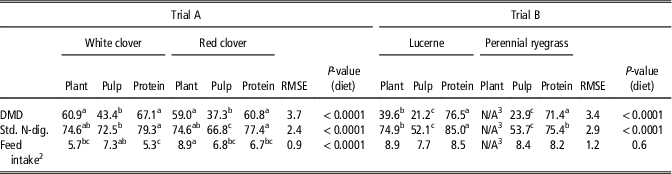
Standardised N digestibility and DMD of plants, pulps and protein concentrates were determined in a rat digestibility trial (Table 4). The rats accepted the diets after a few days but all groups had some leftover feed. In trial A there was a difference in daily DM intake. The amount of perennial ryegrass plant was insufficient for the experiment (due to low protein concentration) and was excluded. Moreover, two rats were euthanised in the perennial ryegrass pulp group during the collection period due to signs of distress.
Digestibility of feed dry matter (DM) and standardised Nitrogen digestibility estimated in a rat model1

DMD = digestibility of DM from plant fractions (g/kg); Std. N-dig = standardised nitrogen digestibility.
a,b,cDifferent superscripts in a row indicate significant difference (P < 0.05).
1 Numbers are mean of n = 5. Ryegrass pulp is mean of n = 3. Model root mean square error (RMSE) is given.
2 Daily feed intake in collection period (g DM/day).
3 Due to insufficient supplies, this sample was not included in the animal experiment.
The protein concentrates had higher DMD than the corresponding pulp, ranging from 60.8% for red clover protein concentrate to 76.5% for lucerne protein concentrate. The DMD of the pulp ranged from 21.2% to 43.4%, the highest found in white clover pulp, the lowest in lucerne pulp. Moreover, DMD of lucerne protein concentrate was higher than that of lucerne plant; this was not the case for the two clovers. Within each trial, the DMD of the protein concentrates did not differ.
The standardised N digestibility of the protein concentrates ranged from 75.4% in perennial ryegrass to 85.0% in lucerne and was higher than the pulp. Pulp standardised N digestibility was lowest for lucerne (52.1%) and highest for white clover (72.5%). Lucerne protein concentrate had a higher standardised N digestibility than lucerne plant, whereas no difference was observed between plant and protein concentrate for red and white clover.
Protein quality
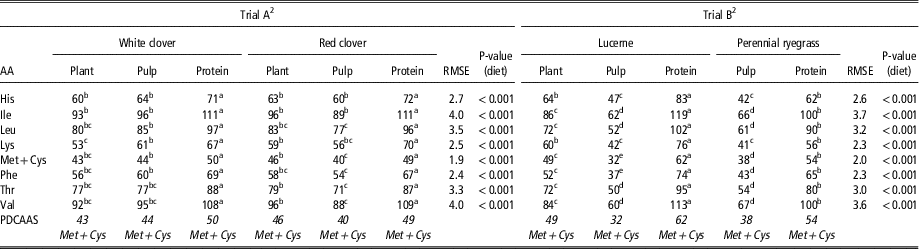
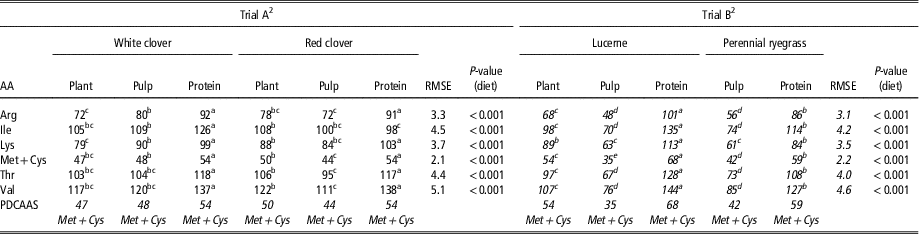
The produced plant fractions were ranked with respect to protein quality for monogastrics using PDCAAS, exemplified with the requirements of pigs (Table 5) and broilers (Table 6). The tables present amino acid scores for a range of amino acids, and the lowest value reflects the particular amino acid that is limiting for protein requirement if the plant, pulp or protein concentrate is the only protein source available. That one is reported as PDCAAS (Joint FAO/WHO Expert Consultation, 1991; Jørgensen et al., Reference Jørgensen, Brandt and Lauridsen2008).
Amino acid (AA) scores and untruncated PDCAAS (%) for plant fractions estimated in a rat model – pig reference1

PDCAAS = protein digestibility-corrected amino acid score; His = Histidine; Ile = Isoleucine; Leu = Leucine; Lys = Lysine; Met+Cys = Methionine+Cysteine; Phe = Phenylalanine; Thr = Threonine; Val = Valine.
The italics highlight the specific amino acid and the corresponding score which is limiting for protein requirement given that the plant fraction is the only protein source available.
a,b,c,d,eWithin a trial, different superscripts in a row indicate significant difference (P < 0.05).
1 Requirements of pigs 20 to 45 kg (National Research Council, 2012).
2 Numbers are mean of n = 5. Ryegrass pulp is mean of n = 3. Model root mean square error (RMSE) is given.
Amino acid (AA) scores and untruncated PDCAAS (%) for plant fractions estimated in a rat model – broiler reference1

PDCAAS = protein digestibility-corrected amino acid score; His = Histidine; Ile = Isoleucine; Leu = Leucine; Lys = Lysine; Met+Cys = Methionine+Cysteine; Phe = Phenylalanine; Thr = Threonine; Val = Valine.
The italics highlight the specific amino acid and the corresponding score which is limiting for protein requirement given that the plant fraction is the only protein source available.
a,b,c,d,eWithin a trial, different superscripts in a row indicate significant difference (P < 0.05).
1 Requirements of broilers (2.0 to 2.5 kg live weight (Aviagen, 2007)).
2 Numbers are mean of n = 5. Ryegrass pulp is mean of n = 3. Model root mean square error (RMSE) is given.
The scores for all amino acids were higher in the protein concentrates than in the corresponding plants and pulp. Moreover, for red clover and lucerne, the scores for plant were higher than the scores for the corresponding pulp, this was not the case in white clover. Regardless of reference group, white clover, red clover, perennial ryegrass and lucerne fractions were all limited in the sulphur-containing amino acids methionine and cysteine with PDCAAS values ranging from 32% to 68%.
Discussion
Effect of plant species and fractionation on protein and dry matter content
Dry matter concentration of the plants used in the study ranged from 145 to 209 g/kg with CP concentrations ranging from 123 to 226 g/kg DM. Both DM and CP concentrations were in accordance with earlier studies, where the CP concentration of the legumes were found to be higher than that of the grass and grass clover mixtures (Santamaría-Fernández et al., Reference Santamaría-Fernández, Molinuevo-Salces, Kiel, Steenfeldt, Uellendahl and Lübeck2017; Damborg et al., Reference Damborg, Stødkilde, Jensen and Weisbjerg2018; Stødkilde et al., Reference Stødkilde, Damborg, Jørgensen, Lærke and Jensen2018). After screw press processing, large amounts of water and solubles were removed into a juice leaving a pulp with a higher DM concentration (425 to 509 g/kg) than the corresponding plant. On DM basis, the CP concentrations of the pulp were similar to the plant material; a high plant CP concentration resulted in a high pulp CP concentration. This indicates that a large amount of protein is still located in the pulp after removal of water and soluble compounds (Byers and Sturrock, Reference Byers and Sturrock1965; Pirie, Reference Pirie1987; Damborg et al., Reference Damborg, Stødkilde, Jensen and Weisbjerg2018). Dry matter and CP of the produced pulps were in accordance with earlier findings (Santamaría-Fernández et al., Reference Santamaría-Fernández, Molinuevo-Salces, Kiel, Steenfeldt, Uellendahl and Lübeck2017; Damborg et al., Reference Damborg, Stødkilde, Jensen and Weisbjerg2018; Stødkilde et al., Reference Stødkilde, Damborg, Jørgensen, Lærke and Jensen2018). A solid protein concentrate was produced by acidification of the produced juice having a CP concentration of 240 to 388 g/kg DM, the highest found in lucerne and the lowest in perennial ryegrass. The values were in accordance with earlier findings where precipitates were produced with CP concentrations ranging as far as 276 to 700 g/kg DM depending on the raw material and method used (Chiesa and Gnansounou, Reference Chiesa and Gnansounou2011). In a recent study, we and co-workers determined the CP extractability using the same plant material as the present study, but where protein was precipitated using a two-step heat treatment of the juice (Damborg et al., Reference Damborg, Stødkilde, Jensen and Adamsen2015). The recovery of plant protein into the two resulting protein fractions were 18%, 22%, 23% and 26% for perennial ryegrass, red clover, white clover and lucerne, respectively, which is in accordance with earlier studies (Santamaría-Fernández et al., Reference Santamaría-Fernández, Molinuevo-Salces, Kiel, Steenfeldt, Uellendahl and Lübeck2017). Based on high CP concentrations seen in the present study and CP recovery found (Damborg et al., Reference Damborg, Stødkilde, Jensen and Adamsen2015) , lucerne shows the greatest potential as raw material for fractionation and as a sustainable protein source.
Amino acid content and composition
The majority of the amino acids had comparable values regardless of plant species corresponding to earlier findings (Eppendorfer, Reference Eppendorfer1977; Damborg et al., Reference Damborg, Stødkilde, Jensen and Weisbjerg2018; Stødkilde et al., Reference Stødkilde, Damborg, Jørgensen, Lærke and Jensen2018). The conserved enzyme rubisco constitutes the majority of protein in plant leaves (Pirie, Reference Pirie1987) resulting in the limited variability in amino acid composition seen between species. Moreover, the similarity in amino acid compositions of the fractions indicates that the processing did not result in a complete separation of soluble and insoluble protein. This is in agreement with recent studies (Damborg et al., Reference Damborg, Stødkilde, Jensen and Weisbjerg2018; Stødkilde et al., Reference Stødkilde, Damborg, Jørgensen, Lærke and Jensen2018) suggesting that the fibre-rich pulp contains a proportion of soluble proteins enclosed in the fibre network. Protein extracted from the three legumes had higher lysine concentration than protein from perennial ryegrass, whereas lucerne and perennial ryegrass had the highest methionine concentration confirming earlier findings (Edmunds et al., Reference Edmunds, Südekum, Bennett, Schröder, Spiekers and Schwarz2013; Damborg et al., Reference Damborg, Stødkilde, Jensen and Weisbjerg2018). Lysine and methionine are important, as they often are the first or second limiting amino acids in feed for pigs and poultry (Kidd et al., Reference Kidd, Kerr, Allard, Rao and Halley2000; National Research Council, 2012). Importantly, the present study demonstrated that protein from all the four plants species had an amino acid composition comparable to the current primary source of animal feed protein, soya bean meal (National Research Council, 2012).
The sum of the analysed amino acids expressed as g/kg DM was higher in the produced protein concentrates than in the plant and pulp explained by the removal of insoluble compounds, soluble carbohydrates and nitrogenous non-protein compounds during plant processing and protein precipitation, all contributing to the DM content. This would naturally lead to higher DM-based amino acid concentration in the concentrate. This is also highlighted by the fact that sum of amino acids (percentage of CP) for the protein concentrates ranged from 89.8% to 95.2%, with low NPN concentrations, suggesting that almost all of CP in the concentrates was protein-bound N. No difference was observed between the total amino acid concentration in g/kg DM in plant and pulp emphasising that after juice removal, the pulp is a side stream with valuable nutrients.
Effect of plant processing and protein extraction on digestibility
The use of rats as model for monogastrics enables screening of parameters important for large-scale production of plant-based protein feed for monogastrics but in lab-scale setup. The rats adjusted to the new diets, but as seen previously (Stødkilde et al., Reference Stødkilde, Damborg, Jørgensen, Lærke and Jensen2018), the palatability and possibly the bulk of the pulp fractions were challenging for the rats.
The standardised N digestibility of the unprocessed plants corresponded to earlier findings (Eggum, Reference Eggum1969). After fractionation, the four protein concentrates had significantly higher digestibility of both DM and N than the corresponding pulp. With a value of 85.0%, lucerne protein concentrate standardised N digestibility was in accordance with values published for other plant-based food products (Joint FAO/WHO Expert Consultation, 1991) and with values found by precipitating lucerne protein either by steam or by freezing the juice (Hove et al., Reference Hove, Lohrey, Urs and Allison1974; Hernández et al., Reference Hernández, Martínez, Hernández and Urbano1997).
During the biorefining process, soluble proteins will be precipitated generating a protein fraction with an expectedly high digestibility for monogastrics, whereas the majority of the plant fibre will distribute into the pulp resulting in a pulp fraction expected to have a low digestibility for monogastrics (Davys and Pirie, Reference Davys and Pirie1965), as confirmed in the present study. In addition to the majority of the plant fibres, fibre-bound protein are also present in the pulp upon processing (Pirie, Reference Pirie1987, Damborg et al., Reference Damborg, Stødkilde, Jensen and Weisbjerg2018). In the present study focus was on N and amino acids and the fibre content of the fractions were not investigated in this study. Recently it was reported that lucerne has a high content of fibre components and that a substantial amount of plant CP is associated and/or bound to these fibre components (Damborg et al., Reference Damborg, Stødkilde, Jensen and Weisbjerg2018). A larger difference in both DMD and standardised N digestibility between plant and protein concentrate is therefore likely to exist in fibrous plants like lucerne (Eppendorfer, Reference Eppendorfer1977) as confirmed by the present results, where a large fractional difference in digestibility in lucerne, with increased DMD and standardised N digestibility in the protein concentrate compared to the plant. The lower digestibility seen for pulp fractions regardless of plant origin combined with the impaired feed intake of these fractions suggest that for growing monogastrics, pulp-based feeds are not likely to be applicable thereby confirming recent results on white clover (Stødkilde et al., Reference Stødkilde, Damborg, Jørgensen, Lærke and Jensen2018).
In general, earlier studies have focussed on determining the nutritive value and effect on growth of lucerne plant juice or protein-rich concentrates fed to broilers, pigs or rats. Overall, the results are inconsistent (Duckworth and Woodham, Reference Duckworth and Woodham1961; Houseman, Reference Houseman1976; Cheeke et al., Reference Cheeke, Kinzell, De Fremery and Kohler1977) presumably caused by improper processing and variations in the methods used (Houseman, Reference Houseman1976; Chiesa and Gnansounou, Reference Chiesa and Gnansounou2011). Moreover, the presence of various anti-nutritional factors in some plant species and plant varieties may add to the inconsistency in earlier studies, like impaired weight gain in broilers fed with protein concentrate extracted from high saponin lucerne but not from low saponin lucerne (Ameenuddin et al., Reference Ameenuddin, Bird, Pringle and Sunde1983a). A deeper understanding of plant specific anti-nutritional factors, the fractional distribution during the biorefining process and the effect on protein digestibility and quality is needed, and will be addressed in future studies.
Assessment of the nutritional quality of protein in the plant fractions
The most recent recommendation for assessment of protein quality for humans suggests DIAAS estimated in humans or pigs (FAO Expert Consultation, 2013), but PDCAAS is still the most suitable method of biological evaluation when limited amounts are available. Therefore, PDCAAS was selected as method of ranking the produced plant fractions with reference to both broilers and pigs. For all fractions regardless of plant origin, the sulphur-containing amino acids; methionine and cysteine, were the limiting amino acids for broilers and pigs. Reference ratios of lysine were the second lowest and did not deviate greatly from the sulphur-containing amino acids. Lysine has been reported being the limiting amino acids in protein fractions from lucerne (Chiesa and Gnansounou, Reference Chiesa and Gnansounou2011), but generally, methionine has been reported as limiting in protein from green plants (Ameenuddin et al., Reference Ameenuddin, Bird, Sunde and Koegel1983b; Stødkilde et al., Reference Stødkilde, Damborg, Jørgensen, Lærke and Jensen2018) confirming the results in the present study.
The amino acids scores were higher in the protein concentrates than in plant and pulp samples and were found to be comparable to other vegetable sources (Joint FAO/WHO Expert Consultation, 1991). For all reference groups, there were amino acid scores below 100 in the protein concentrate, thereby not meeting the requirements of that specific amino acid. Eggum (Reference Eggum1969) concluded that despite a good amino acid composition, the biological value data from rat digestibility trials were lower than expected indicating that one or more amino acids were unavailable either due to structural circumstances or because processing impairs the availability. Lysine is particularly exposed to process-induced modifications (Mehta and Deeth, Reference Mehta and Deeth2016) which is problematic as lysine is the most deficient amino acid in nearly all typical swine diets based on cereal grains (Liao et al., Reference Liao, Wang and Regmi2015). Although lysine modifications are mainly heat-induced (Pirie, Reference Pirie1987), process-optimisation focussing on yield, preservation of protein quality from field to final product, and avoidance of unfavourable amino acid modifications has to be a central point in the future production of sustainable protein from green plants.
In conclusion, this study demonstrates the potential of green plants as protein sources for monogastrics because of high protein content, proper amino acid composition and high digestibility of N. Fractionation of the plants in a screw-press followed by acidification produced protein concentrates with significantly higher standardised N digestibility than the unprocessed plant. Improvements were seen in all four plants, particularly in lucerne, emphasising the potential of this legume. In the majority of the produced fractions, the sulphur-containing amino acids were limiting and low amino acid scores were found for lysine. Preferably, the protein concentrates should be used in a mixture with other protein sources thereby ensuring that the amino acid requirements of the monogastrics are covered.
Acknowledgements
The study was supported by the Biobase Green Protein project funded by Aarhus University and the Danish Ministry of Food, Agriculture, and Fisheries and was furthermore part of BioValue Strategic Platform for Innovation and Research, which is co-funded, by The Danish Council for Strategic Research and The Danish Council for Technology and Innovation. The authors would like to thank the laboratory technical staff at the Department of Animal Science Aarhus University for excellent guidance and for their assistance with the analyses.
Declaration of interest
The authors have no conflicts of interest.
Ethics statement
The animal experiment was conducted according to license obtained from the Danish Animal Experiments Inspectorate, the Danish Veterinary and Food Administration, Ministry of Environment and Food of Denmark.
Software and data repository resources
None of the data were deposited in an official repository