INTRODUCTION
The historical novelty and comparative extremity of the American imprisonment rate are by now so well-known that they barely even need introduction, as are the massive racial, class, and sex disparities in the American imprisonment rate (e.g., Bobo and Thompson, Reference Bobo, Thompson, Markus and Moya2010; Clear Reference Clear2007; Garland Reference Garland2001; Glaze and Herberman, 2013; Gottschalk Reference Gottschalk2006; Pew Center on the States 2008; Wacquant Reference Wacquant2001; Wakefield and Uggen, Reference Wakefield and Uggen2010; Western Reference Western2006; Wildeman and Muller, Reference Wildeman and Muller2012). When combined, these unique features of the American prison system have dramatically transformed the lives of Black men, with imprisonment now a common stage in the life course of many Black men, especially those who did not complete high school (Bonczar 2003; Pettit and Western, Reference Pettit and Western2004).
Although much research on the consequences of the massive uptick in imprisonment continues to focus on imprisonment’s crime-fighting benefits (e.g., Johnson and Raphael, Reference Johnson and Raphael2012; Levitt Reference Levitt1996), an alternate wave of research seeks to consider how imprisonment affects the subsequent life chances of American men who are or have been imprisoned, with implications for various forms of inequality. In this vein, research has considered how imprisonment—and contact with the criminal justice system more broadly—affects the health and mortality (e.g., Binswanger et al., Reference Binswanger, Stern, Deyo, Heagerty, Cheadle, Elmore and Koepsell2007; Massoglia Reference Massoglia2008a, Reference Massoglia2008b; Schnittker et al., Reference Schnittker, Massoglia and Uggen2012; Spaulding et al., Reference Spaulding, Seals, McCallum, Perez, Brzozowski and Steenland2011; Turney et al., Reference Turney, Schnittker and Wildeman2012; Wang et al., Reference Wang, Pletcher, Lin, Vittinghoff, Kertesz, Kiefe and Bibbins-Domingo2009), social and political engagement (e.g., Lerman and Weaver, Reference Lerman and Weaver2014; Manza and Uggen, Reference Manza and Uggen2006; Weaver and Lerman, Reference Weaver and Lerman2010), labor market outcomes (e.g., Kling Reference Kling2006; Western Reference Western2002, Reference Western2006; Western and Beckett, Reference Western and Beckett1999), and union formation and stability of individuals who are either currently imprisoned or have ever been imprisoned (e.g., Lopoo and Western, Reference Lopoo and Western2005; Massoglia et al., Reference Massoglia, Remster and King2011).
If the first wave of research on the consequences of mass imprisonment for social inequality focused almost exclusively on adult men who were imprisoned or had ever been imprisoned, the second wave sought to isolate spillover effects of mass imprisonment on families and communities.Footnote 2 Consistent with research on the consequences of imprisonment for the life course outcomes of men who experience imprisonment, research on these spillover effects on families and communities identifies harms more often than benefits. Research shows, for instance, that even though the incarceration of a male romantic partner negligibly affects women’s positive parenting behaviors (Turney and Wildeman, Reference Turney and Wildeman2013), it increases their risk of resorting to harsh parenting tactics, including, in some instances, physical abuse (Turney Reference Turney2014). In a similar vein, the incarceration of a male romantic partner increases women’s risk of experiencing depression (Wildeman et al., Reference Wildeman, Schnittker and Turney2012). The incarceration of any resident family member has also been tied to a whole host of both negative health behaviors and negative physical and mental health outcomes (Lee et al., Reference Lee, Wildeman, Wang, Matusko and Jackson2014; Lee and Wildeman, Reference Lee and Wildeman2013).Footnote 3
Similar evidence exists regarding the harms resulting from paternal incarceration,Footnote 4 the area of the broader spillover effects of mass imprisonment that has, to date, received the most attention.Footnote 5 The incarceration of a father is implicated not only in sometimes-dramatic increases in children’s behavioral problems (Geller et al., Reference Geller, Cooper, Garfinkel, Schwartz-Soicher and Mincy2012; Haskins Reference Haskins2014; Wakefield and Wildeman, Reference Wakefield and Wildeman2011, Reference Wakefield and Wildeman2014; Wildeman Reference Wildeman2010), but also in numerous negative mental and physical health outcomes, both very early in life and in adolescence (Roettger and Boardman, Reference Roettger and Boardman2012; Wildeman Reference Wildeman2012), as well as in housing instability, including higher risks of homelessness in childhood and adolescence (Foster and Hagan, Reference Foster and Hagan2007; Geller and Franklin, Reference Geller and Franklin2014; Wildeman, Reference Wildeman2014), to name just a few such effects. Because we also have estimates of the extent to which paternal imprisonment is racially unequally distributed, with Black children experiencing far higher cumulative risks of paternal imprisonment than White children (Wildeman Reference Wildeman2009),Footnote 6 we can estimate the extent to which mass imprisonment has increased racial inequality among children, with estimates suggesting that mass imprisonment has done even more to increase racial inequality among American children than it has among adult men.Footnote 7 Indeed, taken together, these lines of research suggest that the massive size and inequity of the American prison system may have set in motion a mechanism that will increase social, behavioral, and health inequalities for generations.
Unfortunately, existing research on the broader implications of mass imprisonment for inequality among adults is limited by the fact that research on Black-White disparities in connectedness to prisoners is relatively sparse. This is not to say, of course, that we know nothing about the connections adults have to prisoners, and two critical studies merit attention before discussing the contribution our research makes to the literature. In their work in Tallahassee, Florida, Dina Rose and Todd Clear (Reference Rose and Clear2004) document that in the neighborhoods with the highest incarceration rates, nearly everyone knew someone who was imprisoned, clearly highlighting how the vast spatial disproportionality in imprisonment (e.g., Clear Reference Clear2007, Reference Clear2008; Roberts Reference Roberts2004; Sampson and Loeffler, Reference Sampson and Loeffler2010) affects social networks—with important implications for the lowest-income African Americans. In another vitally important piece of previous research, Lawrence D. Bobo and Victor Thompson (Reference Bobo, Thompson, Markus and Moya2010) demonstrate that even among the highest-earning and highly-educated Black respondents, having a friend or relative incarcerated was common, with over one-third of highly-educated, high-earning Black respondents reporting that they had a friend or relative incarcerated. Notably, this risk dwarfs the risk (roughly, one in six) of having a friend or family member incarcerated even for White respondents who have less than a high school education and make less than $25,000 per year—which provides a sense of the tremendous size of the Black-White inequalities in connections to prisoners.
In this study, we build on existing research by providing national estimates of the number and percentage of Black and White men and women who have (1) an acquaintance, (2) a family member, (3) a neighbor, or (4) someone they trust in prison. We also estimate what percentage of each individual’s social network is in prison, which provides an alternate way to consider the extent to which imprisonment has transformed individuals’ social environment. The results from our study, while not surprising (in the sense that they show vast racial disparities in connectedness to prisoners and high rates of connectedness to prisoners among Black men and women) suggest that mass imprisonment has important spillover effects for inequality that extend beyond the men for whom imprisonment has become common. Black-White inequality among women is especially stark, as Black women are far more likely to have an acquaintance (35% vs. 15%), family member (44% vs. 12%), neighbor (22% vs. 4%), or someone they trust (17% vs. 5%) in prison than are White women. Because of this, a larger percentage of Black women’s social networks are composed of prisoners, suggesting that these women may carry an especially heavy burden.
DATA AND METHODS
In order to provide these estimates, we rely on data from the 2006 General Social Survey (GSS) (Smith et al., Reference Smith, Marsden, Hout and Kim2006), which is a nationally-representative survey of adults age eighteen and over.Footnote 8 Specifically, we use a series of questions from the 2006 GSS that asks respondents how many people they know in prison, allowing them to select the number of acquaintances, family members, neighbors, and people they trust who are in prison.Footnote 9 By providing information about multiple social contexts using a nationally-representative sample, the GSS data allow us to examine the broad reach of incarceration, providing a more complete picture of the impact of the criminal justice system.
The GSS data also include questions that can be used to estimate one’s total network size (or “degree”), which makes it possible for us to estimate what percentage of a respondent’s social network is currently imprisoned. This is especially vital because Blacks and women have smaller networks, on average, than Whites and men, respectively (Marsden Reference Marsden1987; McPherson et al., Reference McPherson, Smith-Lovin and Brashears2006). Therefore, even if a Black and a White respondent know the same number of prisoners, a larger share of the Black respondent’s network will, on average, be comprised of prisoners. Accounting for differences in respondents’ degrees thus provides insight into the effective reach of incarceration among different groups.
Estimating social network size is a challenging statistical problem, and we provide only the briefest explanation of our approach.Footnote 10 Briefly, we used estimates from the Bayesian model presented in Zheng and colleagues (2006) and then adapted for the categorical responses in the GSS data by DiPrete and colleagues (2011). The method relies on the number of people survey respondents know with a given first name. The number of people in the U.S. population with a given first name is available from the United States Social Security Administration, meaning that we can estimate the fraction of people with a given name the respondent knows. Multiplying this fraction by the total population size gives an estimated number known. For instance, if there are 280 million individuals in the American population, of which 358,000 are named Nicole, and a respondent knows two people named Nicole, then the estimated network size would be:Footnote 11
 $${2 \over {358,000}}*280,000,000 = 1,560$$
In practice, the GSS asked respondents about multiple names (e.g., Nicole, Andrew, Erika, and Joshua), increasing the fraction information available for each respondent and decreasing variance in the final network size estimate.
These methods allow us to provide three key estimates. First, we estimate the fraction of a social network that consists of prisoners across multiple social contexts (i.e., acquaintances, family members, neighbors, and trusted persons) for Black and White men and women. Second, we estimate what proportion of Black and White men and women know at least one prisoner across each context. Third, we estimate how many Black and White men and women in the United States know at least one prisoner across each context. All estimates provided in these analyses are for adults age eighteen or older.
RESULTS
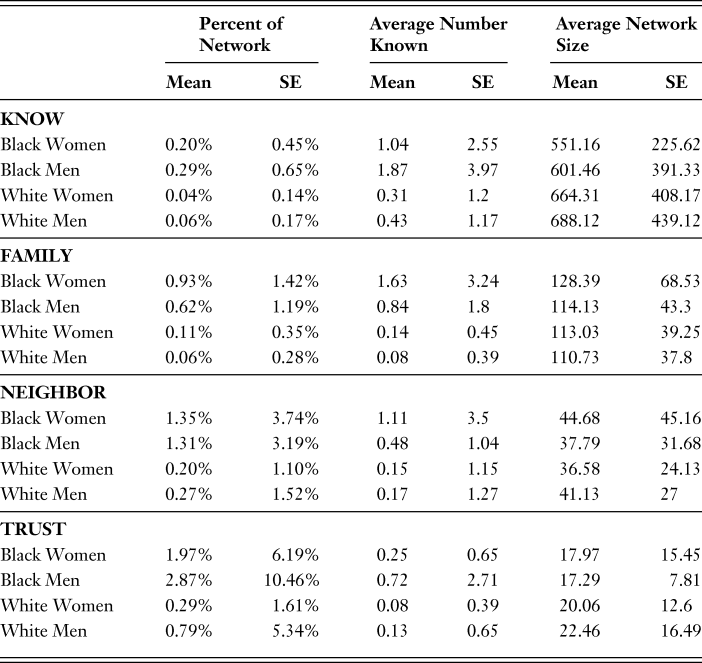
Although the procedures needed to estimate the social networks of Black and White men and women in the era of mass imprisonment are mathematically complex and computationally intensive, the results from our analysis are far easier to interpret. Table 1 presents estimates for Black and White men and women of the percentage of an individual’s network—acquaintances, family members, neighbors, and people they trust—made up of persons who are currently imprisoned.
Average Percent of Network Made Up of Persons Currently in State or Federal Prison by Race, Gender, and Network Context

Notes: The Percent of Network columns contain the average percent of the respondents’ network containing persons in prison by race and sex and across four contexts: people that you are acquainted with (know); people in your family; people that you are acquainted with through your neighborhood (neighbor); and people you can trust. The Average Number Known columns provide the average number of people known in an average network by race and sex and across contexts. The Average Network Size columns provide the average network size by race and sex and across the four contexts. SE stands for standard error. The data source is the 2006 General Social Survey (Smith et al., Reference Smith, Marsden, Hout and Kim2006).
Even for Black men, who have the highest percentage of their acquaintances imprisoned (0.29%, or just under 1 in 300), the share of acquaintances imprisoned is relatively small. However, as the average acquaintance network for Black men is just over 600, this means that a Black man with an average-sized network knows, on average, 1.87 prisoners. For the group with the lowest share of prisoners in their acquaintance network (White women), the risk is far smaller, at 0.04%, or about 1 in 2500. Since the average social network of White women is 664.31, this means that a White woman with an average-sized network knows, on average, far less than one prisoner—about 0.31 prisoners. Thus, even though the absolute percentage of one’s network of acquaintances currently imprisoned is small for all four groups we consider, racial inequality in these connections is nonetheless still quite pronounced.
All four groups we considered had a large proportion of their network of family members, neighbors, and people they trust imprisoned. Black women had a larger share of their network of family members (0.93%) and neighbors (1.35%) imprisoned than any of the other three groups we considered; however, Black men had a larger share of their network of people they could trust imprisoned (2.87%) than did any other group. Racial disparities in connectedness to prisoners are again striking, with Black women, on average, having over eleven times as many of their family members currently imprisoned as White women. Even more provocatively, Black men, on average, have more people they trust in prison (0.72) than White men have imprisoned in their entire network of acquaintances (0.43). To contextualize this difference, consider that the average Black man in the GSS has 17.29 people he can trust, while the average White man has 688.12 acquaintances.
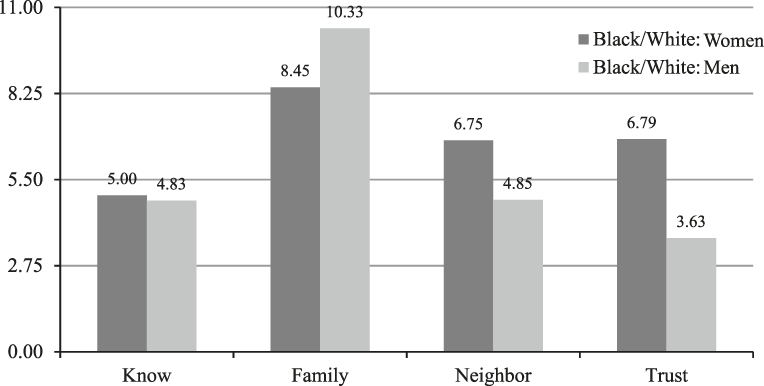
Figure 1 shifts how we think about inequality in connectedness to prisoners from depicting absolute disparity (Black-White) to depicting relative disparity (Black/White). Figure 1 provides the average percent of Black respondents’ network consisting of individuals in prison divided by the average percent of White respondents’ network consisting of individuals in prison for men and women, respectively.Footnote 12 Conceptualizing inequality in this way further demonstrates the racial inequalities in connectedness to prisoners. On average, people in prison made up a portion of Black women’s networks five times larger than White women’s networks for acquaintances, and a fraction up to 8.45 times as large for family. Although the disparity is smaller for men for acquaintances, neighbors, and people they trust, it is markedly larger for family members. The average fraction of Black men’s social networks made up of family members in prison is 10.33 times as large as the fraction for White men, suggesting far greater connectedness to prisoners.
The average percent of Black respondents’ networks consisting of individuals currently in state or federal prison divided by the average percent of White respondents’ networks consisting of individuals currently in state or federal prison for women (dark grey) and men (light grey) across four contexts: people that you are acquainted with (know); people in your family; people that you are acquainted with through your neighborhood; and people you can trust. The data source is the 2006 General Social Survey (Smith et al., Reference Smith, Marsden, Hout and Kim2006).
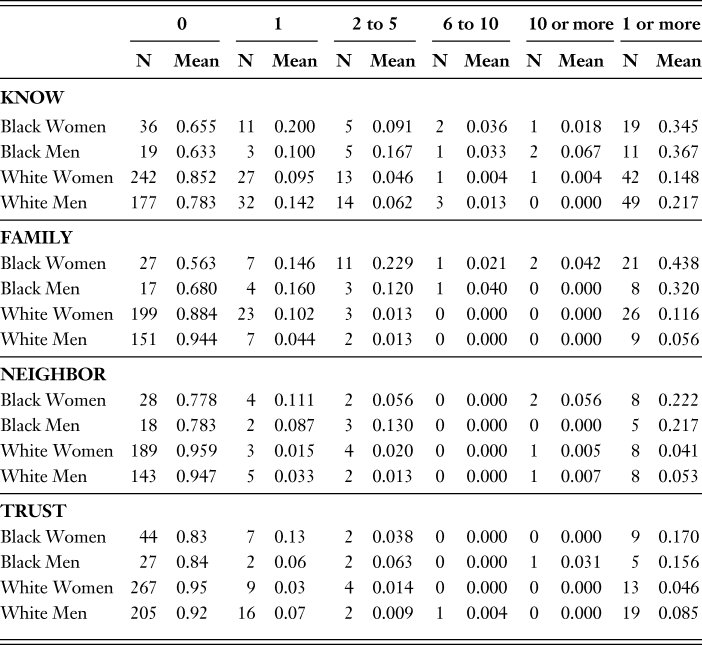
Table 2 provides a different type of portrait of connections to prisoners by showing what proportion of Black and White men and women know 0, 1, 2 to 5, 6 to 10, 10 or more, and 1 or more prisoner(s) (which is expressed as the mean in this table). The findings for family members are especially interesting, as much of the recent empirical research on the consequences of being connected to prisoners focuses on effects on female family members (e.g., Lee et al., Reference Lee, Wildeman, Wang, Matusko and Jackson2014; Wildeman et al., Reference Wildeman, Schnittker and Turney2012). According to our results, 88.4% of White women have no family members in prison, 10.2% have one family member in prison, 1.3% have two to five family members in prison, while no White women report having more than five family members in prison. The story could hardly be more different for Black women, 56.3% of whom have no family members in prison, 14.6% of whom have one family member in prison, 22.9% of whom have two to five family members in prison, 2.1% of whom have six to ten family members in prison, and 4.4% of whom have ten or more family members in prison. In short, Black women are only slightly less likely to have ten or more family members in prison than White women are to have up to five family members in prison, a disparity that could have massive consequences for further inequality. We return to this issue in the conclusion.
Percent and Number of Individuals Who Know Persons Currently in State or Federal Prison by Race, Sex, and Network Context
Notes: People that you are acquainted with (know); people in your family; people that you are acquainted with through your neighborhood (neighbor); and people you can trust. The top row indicates number of people known. The data source is the 2006 General Social Survey (Smith et al., Reference Smith, Marsden, Hout and Kim2006).
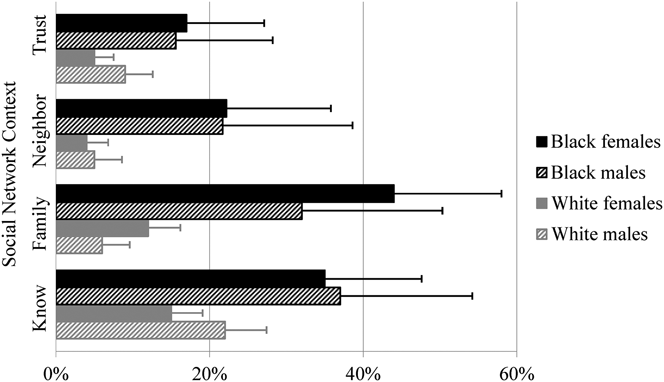
Figure 2 provides a graphical representation of the information presented in Table 2 by showing what percentage of Black and White men and women have any acquaintances, family members, neighbors, or people they trust currently imprisoned. The results are striking: Black women are far more likely to have an acquaintance (35% vs. 15%), family member (44% vs. 12%), neighbor (22% vs. 4%), or someone they trust (17% vs. 5%) in prison than are White women. Black-White inequality is similar for men, although both Black and White men are less likely to report having a family member imprisoned than are women.
The percentage of individuals who know one or more persons currently in state or federal prison by race and sex across four contexts: people that you are acquainted with (know); people in your family; people that you are acquainted with through your neighborhood (neighbor); and people you can trust. The data source is the 2006 General Social Survey (Smith et al., Reference Smith, Marsden, Hout and Kim2006).
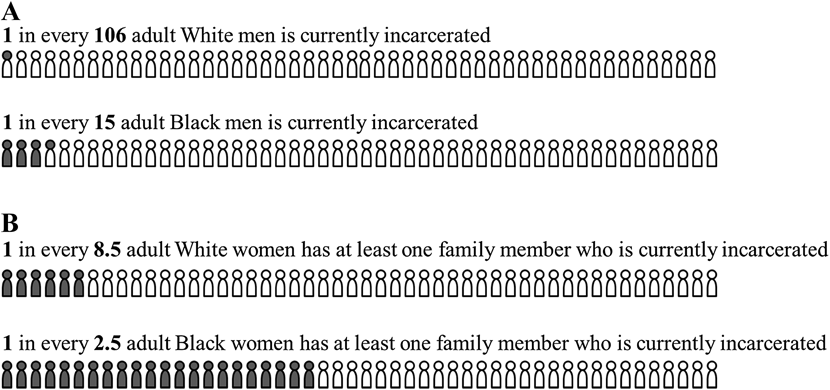
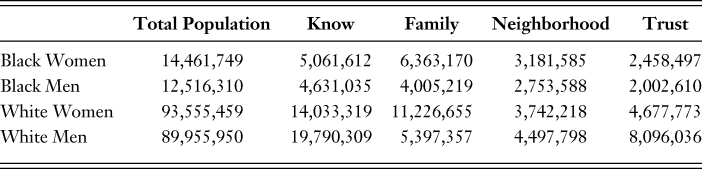
Figure 3 and Table 3 provide another way to think about how imprisonment shapes the daily lives and social networks of Black and White men and women by presenting estimates of the proportion of Black and White men who are incarcerated and the proportion (and number) of Black and White women who have a family member imprisoned. Note that the estimates for men include both prison and jail incarceration, while the estimates for women include only prison incarceration. This is because the data used in previous research combines prison and jail incarceration, while the data we use provides information only on prison incarceration. According to Pew Center on the States (2008) (using data from the Bureau of Justice Statistics), one in every fifteen Black adult men but only one in 106 White adult men is currently incarcerated (Figure 3). According to our estimates (using data from the GSS and the United States Census Bureau), this means that one in every 2.5 Black women (Figure 3), or 6,363,170 Black women age eighteen or older (Table 3) have a family member who is currently incarcerated. On the other hand, one in every 8.5 White women (Figure 3) or, 11,226,655 White women age eighteen years or older (Table 3), have a family member currently incarcerated. This means that about one in four women in the United States currently has a family member in prison (figure not shown).
Black-White comparison of the network reach of incarceration. Panel A shows the incarceration (in jail or prison) rates for adult White and Black men, respectively. Panel B shows the rate of having at least one family member incarcerated (in state or federal prison) for adult White and Black women, respectively.
Data sources: the 2006 General Social Survey (GSS) (Smith et al., Reference Smith, Marsden, Hout and Kim2006) for Panel B estimates and the Bureau of Justice Statistics (BJS) (Sabol and Harrison, 2007) for Panel A estimates. Calculations using the BJS data are from The Pew Center on the States Public Safety Performance Project (2008). Calculations using GSS data are the authors’.
Number of Individuals Who Know One or More Persons Currently in State or Federal Prison in 2006 by Race and Sex and Across Four Contexts
Notes: People that you are acquainted with (know); people in your family; people that you are acquainted with through your neighborhood (neighbor); and people you can trust. The data sources include the 2006 General Social Survey (Smith et al., Reference Smith, Marsden, Hout and Kim2006) and the 2006 U.S. Census (United States Census Bureau 2007a, 2007b). Estimates of the total White alone and Black alone population of adult men and women ages eighteen and older.
CONCLUSION
Although researchers and policymakers continue to test (e.g., Johnson and Raphael, Reference Johnson and Raphael2012) and debate the extent to which incarceration affects crime (e.g., Travis et al., Reference Travis, Western and Redburn2014), it has become clear to scholars of the criminal justice system and inequality that the consequences of the massive uptick in imprisonment for inequality may far outweigh its benefits for crime reduction.
These effects, furthermore, may not be—and, indeed, almost certainly are not—limited to the marginalized men for whom imprisonment has become a common stage in the life course (Pettit and Western, Reference Pettit and Western2004), although it is only very recently that scholars have started to consider (much less test) that possibility. Yet the initial signs suggest that the spillover effects of mass imprisonment on American families and communities may be even larger than the direct effects on adult men. Unfortunately, despite some important exceptions (e.g., Bobo and Thompson, Reference Bobo, Thompson, Markus and Moya2010; Rose and Clear, Reference Rose and Clear2004), researchers have yet to provide estimates of racial disparities in social connections to prisoners in the era of mass incarceration. This lacuna is important because without estimates of racial inequality in these connections, it is difficult to assess just how large the consequences of mass imprisonment for American society are. The goal of this article is to partially bridge that research gap by providing precise estimates of how many Black and White men and women have an acquaintance, a family member, a neighbor, or someone they trust currently in prison using a unique series of questions in the GSS that asked about connectedness to current prisoners.
Our findings suggest that being connected to a prisoner is quite common for Black men and women, with Black women especially likely to have a family member currently imprisoned and Black men especially likely to have someone they trust currently imprisoned. Maybe most importantly, our estimates suggest that 43.8% of Black women—just over one in 2.5—have a family member currently imprisoned, meaning that over 6,000,000 Black women in the United States have a family member currently imprisoned. Indeed, connectedness to prisoners is common for all women in the United States with about one in four women currently having a family member in prison. Our results also suggest, perhaps unsurprisingly, that connectedness to prisoners is far less common for White men and women. Indeed, Black women have anywhere from 5.00 to 8.45 as many prisoners in their social networks as do White women. The Black-White gap for men ranges from 3.63 to 10.33. Because the Black men and women who are connected to a prisoner are also more likely than Whites connected to a prisoner to be connected to multiple prisoners, these connections could place a heavy burden on their social networks, with a host of negative implications for them.
Our results extend previous research on connectedness to prisoners (e.g., Bobo and Thompson, Reference Bobo, Thompson, Markus and Moya2010; Rose and Clear, Reference Rose and Clear2004) to show just how pervasive contact with prisoners is for Black Americans—especially Black women—and, in so doing, to suggest that mass imprisonment may have fundamentally reshaped American inequality not only for the men for whom imprisonment has become so common, or for the children they leave behind, but also for the family members who rally together to support them during and after their imprisonment (e.g., Comfort Reference Comfort2009), their neighborhood friends who are left to support their families made increasingly vulnerable by their absence (e.g., Clear Reference Clear2007), and the confidants who bear the stigma of incarceration along with them (e.g., Braman Reference Braman2004). Because of how common it is for Americans to have a family member, friend, neighbor, or someone they trust imprisoned, and because of the inequality surrounding rates of incarceration, better understanding the spillover effects of mass imprisonment on the political behavior and opinions, health and wellbeing, and criminal activity of those tied to the imprisoned in one way or another is of the utmost importance.
Important as these results are for how we think about contemporary racial inequality, this study nonetheless has some limitations. First, we were unable to provide insight into how connectedness to prisoners varies across neighborhoods because the GSS does not provide detailed information on neighborhoods. Existing accounts of neighborhood-level variation in connectedness to prisoners in one city imply vast variation across neighborhoods in these connections (Rose and Clear, Reference Rose and Clear2004), yet more information is necessary to better understand the unique roles of race and place. Second, we were unable to provide estimates of how much class variation there is within racial groups in terms of connectedness to prisoners. Although this might seem implausible given how large the GSS is, because the series of questions we rely on was asked only of a limited sample of respondents, we routinely had only around fifty Black men or women responding to any one question (Table 2), which would have led to highly unstable estimates of class variation in connectedness to prisoners in these groups. Nonetheless, future research should extend our analyses to also consider class variation. Finally, our estimates apply only to members of the free population, meaning, most importantly, that the roughly 2.3 million Americans currently living in a correctional facility were not included in the analysis. This means that our estimates both of connectedness to prisoners and racial inequality in connectedness to prisoners were highly conservative and suggests the need to field the GSS and other household-based surveys not only in the general population, but also in the institutionalized population, a suggestion that follows logically from much research in this area (Pettit Reference Pettit2012).