Background
Following the initial recognition of coronavirus disease 2019 (COVID-19) in late 2019, the causative agent, severe acute respiratory coronavirus virus 2, was rapidly identified. 1 The COVID-19 pandemic has had major direct (eg, cases, hospitalizations, deaths) and indirect (eg, economic disruptions, K-12 school closings, decreased health maintenance, social inequality) far-reaching effects across all sectors of society including healthcare. Reference Powe, Cole, Arnone and Cook2
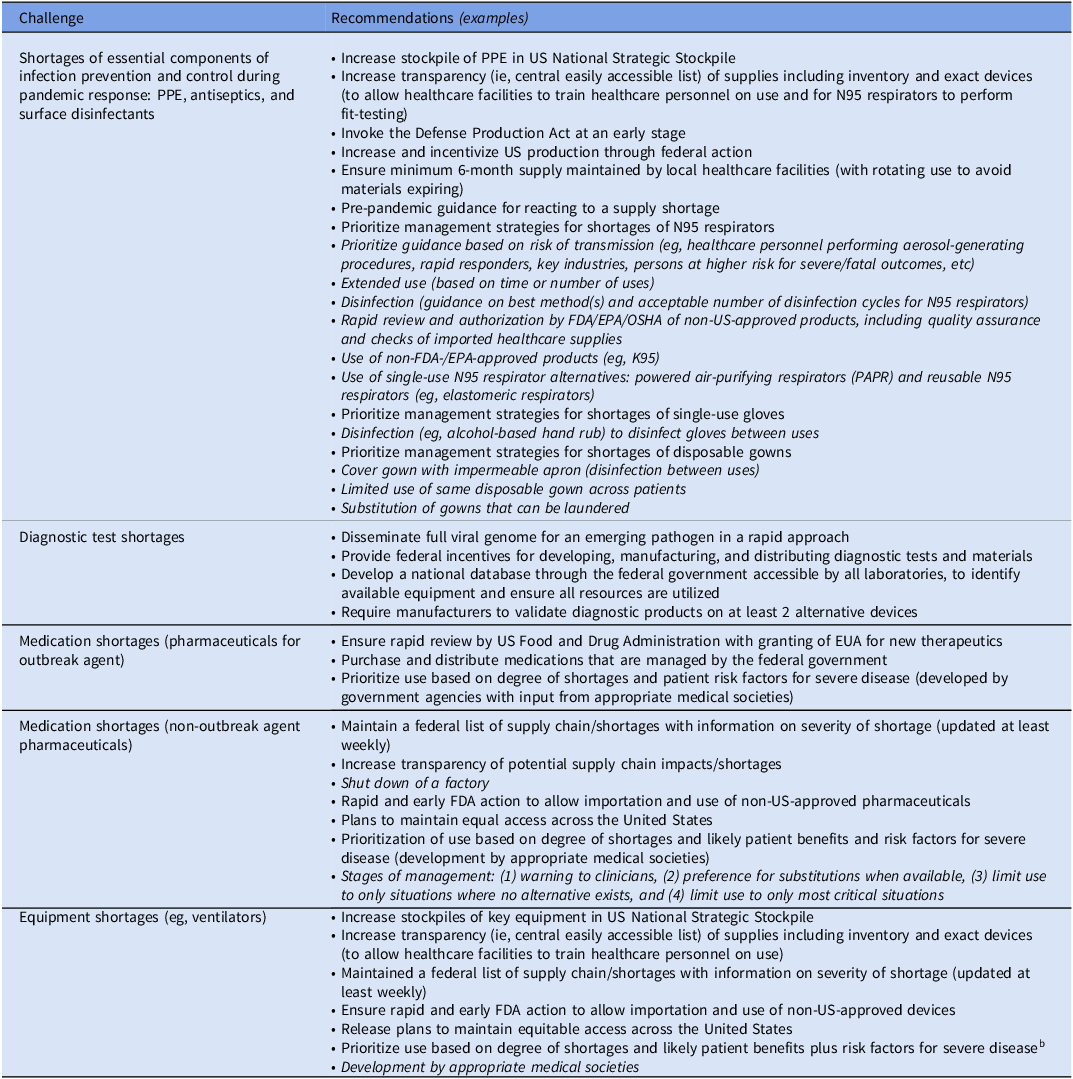
In the early stage of the COVID-19 pandemic, the public health response featured some important successes, such as universal masking and rapid development and deployment of COVID-19 pharmaceuticals and vaccines. However, systemic failures, including decentralized oversight of the pandemic response, slow development and scale-up of diagnostic tests, and inadequate public health infrastructure, overshadowed these gains. 4 Shortages of personal protective equipment (PPE) and other supply chain failures were notable deficiencies in the initial US response. 4 This commentary will describe supply chain failures in PPE, laboratory diagnostics, and pandemic- and non-pandemic-related pharmaceuticals and focus on recommendations for mitigating supply shortages and supply chain failures in healthcare settings in future pandemics. Our recommendations are summarized (Table 1).
Mitigation of supply chain shortages: challenges, recommendations to policymakers, and examples a

Note. EPA, Environmental Protection Agency; FDA, Food and Drug Administration; OSHA, Occupational Safety and Health Administration; PPE, personal protective equipment.
a All strategies must provide equitable distribution and availability.
b Prioritization committees at the national, local, and institution levels must contain experts in diversity and ethics.
Personal protective equipment (PPE)
Background
Keys to preventing transmission of communicable diseases in healthcare settings include prompt recognition and isolation of patients with known or suspected communicable diseases and availability and proper use of personal protective equipment (PPE). Reference Siegel, Rhinehart and Jackson5,6 During the coronavirus disease 2019 (COVID-19) pandemic, enhanced infection prevention strategies were rapidly adopted in healthcare facilities including mask use when in a medical facility; additionally, the use of gloves, gown, eye protection, and an N95 respirator when providing care for all patients with known or suspected COVID-19 was implemented. Reference Weber, Babcock and Hayden7 Rapid isolation of patients and adherence to universal masking have been demonstrated to prevent transmission of severe acute respiratory coronavirus virus 2 in healthcare settings including between healthcare personnel (HCP), from patient-to-HCP, from HCP-to-patients, and from patients-to-HCP. More recently, requiring COVID-19 vaccination as a condition of employment further mitigates the risk of transmission in healthcare and community. Reference Weber, Al-Tawfiq and Babcock8
Impact of coronavirus disease 2019 on personal protective equipment supply
During the COVID-19 response in 2020, severe shortages of PPE occurred in the United States, especially N95 respirators. 4,Reference Ranney, Griffeth and Jha9 To optimize the limited supply of N95 respirators, many healthcare facilities developed strategies and protocols around reuse and extended use. As noted by Cohen and Rogers:
The lack of effective action on the part of the federal government to maintain and distribute domestic inventories, as well as severe disruptions to the PPE global supply chain, amplified the problem. Analysis of trade data shows that the U.S. is the world’s largest importer of face masks, eye protection, and medical gloves, making it highly vulnerable to disruptions in exports of medical supplies. Reference Cohen and Rodgers11
In addition, shortages of antiseptic (eg, alcohol-based hand rubs) and surface disinfectants occurred.
Recommendations for mitigating supply shortages in future pandemics
Key recommendations for mitigating future shortages of PPE in the United States are as follows: (1) incentives for expansion of US domestic productions, (2) increased stockpiles in the Strategic National Stockpile (SNS), and (3) rapid invocation of the Defense Procurement Act to increase supply in future pandemics if there are supply shortages (Table 1). Moreover, increased transparency in the number and type of PPE in the SNS is critically important for healthcare facilities to properly train their HCP on the use of stockpile supplies. This insight is most relevant for N95 respirators to which HCP must be fit-tested prior to use, ventilators for which respiratory therapists must be familiar with maintenance and management, and PPE where doffing sequences can vary depending on the type and institution.
Diagnostic tests
Background
Rapid development of sensitive and specific diagnostic tests, with clinically relevant turnaround times, is crucial to early identification of infected patients to allow proper isolation and use of appropriate PPE by HCP, preserve workforce through return to work of HCP with symptoms suggestive of infection with the pandemic agent, and provide the patient with appropriate therapy.
As noted by Henderson et al:
The slow development and scale-up of rapid, accurate, and widely available testing seriously hampered the US’s ability to detect infections and blinded epidemiologists, public health surveillance systems, hospitals, and municipalities to the clusters of infections that were already occurring in the country. The first test kit deployed from the CDC to state health departments was flawed, and distribution of an effective test was delayed for a month, leaving the country far behind in testing and slowing the public health response. 4
Shortages of diagnostic tests and associated supplies (ie, nasal swabs, viral transport media, polymerase chain reaction reagents) for COVID-19 persisted for months. Reference Barré-Sinoussi, Chermann and Rey16
Recommendations for improving diagnostic testing in future pandemics
We endorse and support the recommendations of the Infectious Disease Society of America (IDSA), which provided recent recommendations for “Building Medical Device Supply Chain Resilience: A Healthcare & Public Health Ecosystem-Wide Collaboration.” The IDSA specifically recommended developing “a federally guided supply chain and distribution plan involving all manufacturers of products relevant to diagnostics and pandemic response” (see Table 1 for additional IDSA recommendation). Reference Behnam, Dey, Gambell and Talwar17
Pandemic-related pharmaceuticals
Background
One of the successes of the COVID-19 response has been the rapid development of pharmaceuticals including therapeutic agents and vaccines for the prevention and treatment of COVID-19. 4 Both the IDSA and the National Institutes of Health (NIH) have developed and routinely updated evidence-based therapeutic guidelines for prevention and treatment of COVID-19. We strongly support continued recommendations from both IDSA and the NIH and encourage development of similar guidelines for future outbreaks (eg, Mpox).
Impact of coronavirus disease 2019 on therapeutic supplies
Limited supplies, due to manufacturing limitations and an inadequate supply chain for necessary constituents, have impaired widespread use of new therapeutics and vaccines. Therefore, as the federal government rolled out vaccines, Centers for Disease Control and Prevention developed a priority scheme for administration. Similarly, the requirement to adhere to the conditions for use in the Food and Drug Administration (FDA) Emergency Use Authorization (EUA) constrained therapeutic use.
Recommendations for mitigating therapeutic supply shortages in future pandemics
Rapid availability of vaccines and therapeutics for future pandemics requires increased funding for development of vaccines for likely pathogens, rapid review by the FDA with granting of an EUA for therapeutics, and US government purchase and distribution of drugs in an equitable manner (Table 1).
Non-pandemic-related pharmaceuticals
Background
Modern medicine is based in large part on the availability of effective and safe medications. Shortages of drugs negatively affect patient care. Mitigating the impact of drug shortages may increase patient risk by eliminating or altering infection prevention/pharmacy standards.
Impact of coronavirus disease 2019 on drug supply
As described by Shukar and colleagues, “the causes of shortage are multifactorial, including supply issues, demand issues, and regulatory issues. Supply issues consist of manufacturing problems, unavailability of raw materials, logistic problems, and business problems. In contrast, demand issues include just-in-time inventory, higher demand for a product, seasonal demand, and unpredictable demand.” Reference Belisle, Anger and Kanaan23 Although drug shortages in the United States have been a long-standing problem, Reference Shukar, Zahoor and Hayat24 the COVID-19 pandemic has substantially increased the frequency and duration of shortages. Reference Belisle, Anger and Kanaan23
Recommendations for mitigating drug shortages in future pandemics
Key recommendations for mitigating drug shortages in future outbreaks and pandemics include the following: (1) US government-maintained list of supplies and shortages with information on severity of any shortages, updated at least weekly, (2) transparency of potential supply chain impacts/shortages (eg, shutdown of a factory), and (3) rapid and early FDA action to allow importation and use of non-US-approved pharmaceuticals (Table 1). Guidance on management of drug shortages has been published previously. Reference Belisle, Anger and Kanaan23,Reference Tu, Miller and Forman28–Reference Piatek, Ning and Touchette31
Ethical distribution of scarce resources
Management of shortages must include ethical values to guide rationing of scarce resources including PPE, therapeutics, and vaccines, both in society and within healthcare facilities. Reference Pulk, Leber and Tran32 Guiding principles include the following: maximizing benefits, treating people equitably, promoting and rewarding instrumental value, and giving priority to persons at highest risk for an adverse outcome. Ethical frameworks for management of drug shortages within) healthcare facilities have been published. Reference Pulk, Leber and Tran32–Reference Berlinger, Wynia and Powell36 At both the national and local levels (including health facilities) experts in ethics and diversity, equity and inclusion must be included in the planning and management of drug shortages.
Summary
Shortages of medications have long been a problem in the United States. The COVID-19 pandemic exacerbated the scale and frequency of medical shortages and led to shortages of PPE for healthcare providers and of devices (eg, ventilators). Recommendations for methods to mitigate shortages during future pandemics are provided.
Acknowledgments
We would like to thank Dr. Benny Joyner for providing references on ethical management of shortages.
Financial support
None.
Competing interests
No author has a conflict of interest.