Implications
Cadmium (Cd) is a potentially toxic heavy metal and its occurrence in feed is a major issue in animal production. In some cases, Cd levels exceed the maximum permitted limits. Two main routes of animal exposure to Cd include the use of feed mineral premixes with high Cd residues and application of animal manure, containing high Cd levels, as an organic fertilizer. In case of feed contaminated with Cd, addition of high levels of the trace element selenium (Se), added as Se-yeast, to animals’ diet can help against the negative effects of Cd toxicity but cannot counteract all of them.
Introduction
Cadmium (Cd) is known for its toxicity, and the International Agency for Research on Cancer (IARC) has classified Cd as a Category I carcinogen (IARC, 1993). Cd is an inescapable side product of the metallurgy of several metals such as Zn (Martelli et al., Reference Martelli, Rousselet, Dycke, Bouron and Moulis2006). To ensure animal and human health, European Union (EU) recommends that Cd concentration in feed should remain below 5 mg per kg of feed (European Commission (EC), 2005). Furthermore, EU specifies that feed materials of vegetable origin should contain <1 mg/kg, feed materials of animal origin <2 mg/kg and additives belonging to the functional group of compounds of trace elements <10 mg/kg, with the exception of copper oxide, manganous oxide, zinc oxide and manganous sulphate monohydrate, which should contain <30 mg/kg. The maximum limit for Cd in water is 5 μg/kg (EC, 1998). International green trade barriers for agricultural products and domestic feed safety issues, combined with public awareness on the impact of Cd pollution, led to a considerable worldwide effort to reduce Cd discharge (Li et al., Reference Li, Xiong, Lin, Zhang, Li and Han2010a). Currently, Cd occurrence in food is a major issue for public health, and the panel on contaminants in the food chain of the European Food Safety Authority (EFSA) issued a statement maintaining the tolerable weekly intake at 2.5 μg per kg of BW (EFSA, 2011). However, several reports indicate that in some cases Cd levels in feed and manure can exceed the maximum permitted limits (Cang et al., Reference Cang, Wang, Zhou and Dong2004; Liu et al., Reference Liu, Li, Wang and Wang2005). The use of mineral premixes with high residues of Cd and application of animal manure, containing high Cd levels, as an organic fertilizer may be two routes of animal exposure (Cang et al., Reference Cang, Wang, Zhou and Dong2004; Liu et al., Reference Liu, Li, Wang and Wang2005). A study conducted in 14 Chinese provinces revealed that the highest Cd concentrations measured in those areas were 27.60, 31.00 and 21.92 mg/kg in pig, dairy cattle and chicken feed, respectively (Li et al., Reference Li, Xiong, Lin, Zhang, Li and Han2010a).
Several studies investigated ways to reduce Cd toxicity by administering other elements as a remedy (Jemai et al., Reference Jemai, Messaoudi, Chaouch and Kerkeni2007; Jihen et al., Reference Jihen, Messaoudi, Fatima and Kerkeni2008), as absorption, accumulation and toxicity of a trace element may be affected by a variety of factors, including the element's level in feed ingredients, its chemical form, ability to form complexes and interactions with other elements (Valko et al., Reference Valko, Morris and Cronin2005; Lopez-Alonso et al., Reference Lopez-Alonso, Miranda, Castillo, Hernandez, Garcia-Vaquero and Benedito2007; Pappas et al., Reference Pappas, Zoidis, Fegeros, Zervas and Surai2010).
Selenium (Se) is a trace element known to play a pivotal role in the antioxidant defence system, protecting the organism from oxidative stress (Pappas et al., Reference Pappas, Zoidis, Surai and Zervas2008; Zoidis et al., Reference Zoidis, Pappas, Georgiou, Komaitis and Fegeros2010). The majority of studies examining ways to reduce Cd toxicity with Se were conducted in mammals using inorganic Se (Jihen et al., Reference Jihen, Messaoudi, Fatima and Kerkeni2008; Messaoudi et al., Reference Messaoudi, Hammouda, El Heni, Baati, Saïd and Kerkeni2010). Inorganic Se orally administered to suckling rats, equimolar to Cd, reduced Cd levels in the liver and kidney of the pups (Lazarus et al., Reference Lazarus, Orct, Jurasoviae and Blanuša2009). Moreover, organic Se is a highly available form of Se for livestock and provides antioxidant protection at a level greater than inorganic Se (Mahan, Reference Mahan1999; Mahmoud and Edens, Reference Mahmoud and Edens2003).
The present study was designed to evaluate the effects of Cd toxicity and whether they can be ameliorated by the presence of organic Se. Therefore, performance, health parameters and accumulation of Se and Cd in liver, kidney, breast and blood tissues of 4- and 6-week-old broilers fed diets with low and high levels of Se and Cd was investigated.
Material and methods
Animals, diets and experimental design
The study was designed considering that (1) the EU limit of Cd in feed is 5 mg/kg (EC, 2005), (2) in some cases levels of Cd in feed can exceed maximum permitted limits (Li et al., Reference Li, Xiong, Lin, Zhang, Li and Han2010a), (3) the addition of elevated levels of essential elements may ameliorate the negative effects of toxic metal contamination (Nolan and Brown, Reference Nolan and Brown2000; Jemai et al., Reference Jemai, Messaoudi, Chaouch and Kerkeni2007; Jihen et al., Reference Jihen, Messaoudi, Fatima and Kerkeni2008) and (4) the maximum allowed Se inclusion level in the United States is 0.3 mg/kg (Payne et al., Reference Payne, Lavergne and Southern2005).
A total of 300, as hatched, 1-day-old, Cobb broilers were used. The broilers were obtained from a commercial hatchery. There were five replicate pens of four dietary treatments, namely, T1, T2, T3 and T4, randomly allocated in the house. Pen was the experimental unit. Each replicate was assigned to a clean concrete floor pen (2 m2) and birds were raised on a wheat straw shavings litter. There were 15 broilers per pen and 75 per treatment. In T1 treatment, broilers were fed a diet with 0.3 mg/kg added Se, as Se-yeast, without added Cd; in T2, broilers were fed a diet with 0.3 mg/kg Se and 10 mg/kg Cd; in T3, broilers were fed a diet with 0.3 mg/kg Se and 100 mg/kg of Cd; and in T4 treatment broilers were fed a diet with 3 mg/kg Se and 100 mg/kg Cd. The Cd added to diets T2, T3 and T4 as CdCl2 (Sigma-Aldrich, St Louis, MO, USA; Table 1). Supplemented Se was obtained from a yeast source, Sel-Plex® (Alltech Inc., Nicholasville, KY, USA).
Composition (g/kg), calculated analysis and determined Se and Cd concentration (μg/kg) of the experimental broiler diets

Se = selenium; Cd = cadmium.
1Premix supplied per kg of diet: 12 000 IU vitamin A (retinyl acetate), 4000 IU vitamin D3 (cholecalciferol), 80 mg vitamin E (dl-α-tocopheryl acetate), 9 mg vitamin K3, 3 mg thiamin, 7 mg riboflavin, 6 mg vitamin B6, 0.025 mg vitamin B12, 50 mg nicotinic acid, 15 mg pantothenic acid, 1.5 mg folic acid, 0.15 mg biotin, 400 mg choline, 1.5 mg iodine, 50 mg iron, 130 mg manganese, 20 mg copper, 0.25 mg cobalt, 100 mg zinc. No Se was provided in the vitamin–mineral premix.
2In T1 treatment, broilers were fed a diet with 0.3 mg/kg added Se, as Se-yeast, without added Cd; in T2, broilers were fed a diet with 0.3 mg/kg Se and 10 mg/kg Cd; in T3, broilers were fed a diet with 0.3 mg/kg Se and 100 mg/kg of Cd; and in T4 treatment broilers were fed a diet with 3 mg/kg Se and 100 mg/kg Cd.
3Se was added in the form of Sel-Plex® (Alltech Inc., Nicholasville, KY, USA).
4The determined Se and Cd contents represent pooled data from all three diets (starter, grower and finisher).
5Cd was added in the form of CdCl2 (Sigma-Aldrich, St Louis, MO, USA).
The duration of the experiment was 42 days, with housing and care of broilers, conforming to the guidelines of the Faculty of Animal Science and Aquaculture of the Agricultural University of Athens. The broilers were raised, according to Cobb's management manual, in a house where light and ventilation were controlled. The lighting programme was 23 h of light and 1 h of dark. Heat was provided with a heating lamp per pen. The broilers were fed a starter diet up to the 10th day of their life, a grower diet up to the 20th day and a finisher diet up to the 42nd day (Table 1). Food and water were provided ad libitum.
At weekly intervals, broilers were weighed, their body mass was recorded and the weekly mean body mass gain was calculated. Furthermore, feed intake was measured weekly, and weekly mean feed consumption and feed to gain ratio (FCR) were calculated. At the end of the 28th and 42nd day, two broilers per pen were killed in order to obtain liver, breast, kidney and blood samples for Se and Cd determination. Broilers were inspected daily, and mortality was recorded on the appropriate data capture form. Total mortality was calculated as the number of broilers that died throughout the study compared with the initial number of broilers placed, corrected for broilers removed for blood collection.
Se and Cd determination
Se and Cd were determined in feed and tissue samples using inductively coupled plasma mass spectrometry, ICP-MS (Perkin Elmer, Elan 9000, Perkin Elmer Life and Analytical Sciences Inc., Waltham, MA, USA; Pappas et al., Reference Pappas, Zoidis, Georgiou, Demiris, Surai and Fegeros2011). The instrumental parameters of the equipment used were: nebulizer flow 0.775 l/min, vacuum pressure 1.5 × 10⁻⁵ Torr, lens voltage 950 W, analogue stage voltage 1900 V, pulse stage voltage 950 V, sweeps/reading 20, readings/replicate 1, number of replicates 3, time per sample 83 s. Feed samples were collected before feeding and milled before analysis through a 1 mm sieve (Cyclotec, 1093 sample mill, Tecator, Höganäs, Sweden). Samples (1 g) of wet tissue or feed were soaked in 10 ml concentrated HNO3 (65% w/v, Suprapur, Merck, Darmstadt, Germany). Before analysis, complete digestion of the samples was performed using a microwave digestion system (CEM, Mars X-Press, NC, USA). The samples were heated in the microwave-accelerated digestion system according to the following programme: the power was ramped during 20 min from 100 to 1200 W and held for 15 min. The temperature reached a maximum of 200°C followed by a cool down cycle for 15 min. Losses of volatile element compounds do not occur as the tubes are sealed during heating. The samples were then filtered with disposable syringe filters (Chromafil, Macherey-Nagel, Duren, Germany) and diluted 50 times with reversed osmosis water (Milli-Q Water Purification Systems, Billerica, MA, USA) before injection in the ICP-MS instrument. Standard solutions used for calibration curves were prepared from high purity standards (Multielement standard solution, Fluka Analytical, Sigma-Aldrich, St Louis, MO, USA). The analytical procedure was validated using a Se recovery procedure (Zoidis et al., Reference Zoidis, Pappas, Georgiou, Komaitis and Fegeros2010) and two standard reference materials (NIST-RM 8414, bovine muscle powder and NIST-RM 1577c, bovine liver powder – LGC Standards; Promochem, Wesel, Germany). The Se recovery procedure was as follows: four samples from the same liver tissue (1 g each) were spiked with 250, 500 and 750 μl of Se standard solution of 4 mg/kg, respectively. The spiked samples were analysed after the aforementioned analytical procedure. The recoveries of the procedure used to validate ICP-MS were in the range of 96% to 111% and the recoveries of the reference materials ranged from 93% to 120%, indicating the accuracy of the method.
Haematological analyses
Standard haematological analyses included determination of haematocrit, blood protein concentration and the leukocyte type (% of lymphocytes, heterophiles, monocytes, eosinophiles and basophiles). Haematocrit and blood protein concentration were determined using an ABX Pentra 400 bench top analyzer (Horiba-ABX, Montpellier, France). Leukocyte type (% of different white blood cells) was determined manually by light microscopy using a Neubauer chamber following a 1 : 20 dilution with the diluting solution (Turk's solution; 2% acetic acid v/v with a few drops of gentian violet; International Council for Standardization in Haematology (ICSH), 2001). The counting was performed by one haematologist who was blinded to the blood probes examined. Lymphocytes, heterophiles, monocytes, eosinophiles and basophiles were counted and expressed as percentage of total white blood cells.
Statistical analysis
The statistical analysis was performed using SAS software (SAS Institute Inc., Cary NC, USA). All performance variates (body mass, feed intake, weekly body mass gain, feed conversion ratio, mortality) were analysed by repeated measures ANOVA using treatment as the main factor and age of broilers as the repeated factor. Percentage data such as mortality were angularly transformed before analysis.
Se and Cd concentration data were log-transformed in order to achieve approximate normality. The vector of the dependent variables consisted of the concentrations of the trace elements, whereas the fixed factors included treatment, age and tissue effects and their potential interactions.
Percentage haematological data were subjected to angular transformation before analysis. The vector of the response variables consisted of the haematological data, whereas the fixed factors included treatment and age effects, as well as their potential interactions. The basophil data appear to deserve special attention. In particular, the occurrence of non-zero measurements was rare and we analysed these data via a Poisson log-linear model. In addition, the presence of a significant number of excess zeros suggested the use of a zero-inflated-Poisson (ZIP) model, which is a mixture model. Specifically, the model assumes that the observation may be zero with probability π, or X with probability 1 − π, where X∼Po( $$\[-->$<>\theta<$>
<!--$$) and Po denotes the Poisson distribution. The best model was chosen by comparing the deviance of the two models and by inspecting the 95% CI of π. The Poisson and ZIP models were fitted using the WinBUGS software (Lunn et al., Reference Lunn, Thomas, Best and Spiegelhalter2000). The statements of significance presented in this study were based on P ⩽ 0.05 unless otherwise stated.
Results
Performance of broilers
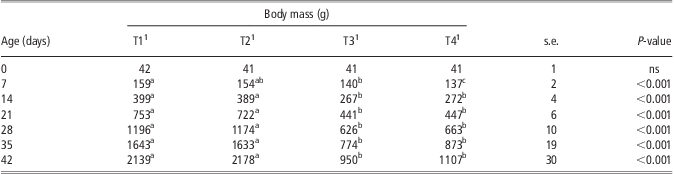
Addition of 10 mg/kg of Cd in the diet (T2) did not cause any significant difference in broilers’ body mass compared with that of broilers fed diets without added Cd (T1), indicating that broilers supplemented with 0.3 mg/kg Se can tolerate low levels of 10 mg/kg Cd present in the diet (Table 2). On the other hand, addition of 100 mg/kg of Cd (T3) significantly reduced (P < 0.001) broilers’ body mass compared with that of broilers fed no added Cd (T1), by 11.95% at day 7 to 55.6% at day 42 (Table 2). The body mass of broilers fed a diet with 100 mg/kg of Cd and 3 mg/kg of Se (T4) did not differ compared with that of broilers fed 100 mg/kg of Cd and 0.3 mg/kg of Se (T3) and was lower compared with that of broilers fed no or low levels of added Cd.
Effect of Se and Cd addition to broilers’ diet on body mass from 0 to 42 days
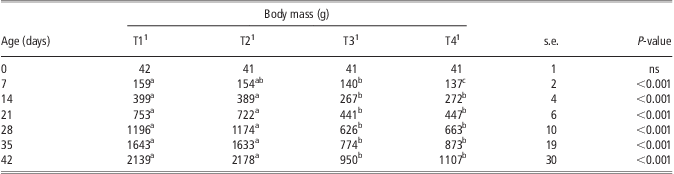
Se = selenium; Cd = cadmium; ns = non-significant.
Values are means of five replicates (n = 5). Means within a row with different superscripts are different at P < 0.05, unless otherwise stated.
1In T1 treatment, broilers were fed a diet with 0.3 mg/kg added Se, as Se-yeast, without added Cd; in T2, broilers were fed a diet with 0.3 mg/kg Se and 10 mg/kg Cd; in T3, broilers were fed a diet with 0.3 mg/kg Se and 100 mg/kg of Cd; and in T4 treatment broilers were fed a diet with 3 mg/kg Se and 100 mg/kg Cd.
For the whole experimental period, the mean feed consumption of broilers fed diets with high levels of added Cd (T3, T4) was significantly lower (P < 0.001) compared with that of broilers fed no or low added Cd (T1, T2). Treatment T1 did not differ from T2, and similarly T3 did not differ from T4 (Table 3). Similarly, the mean body mass gain of broilers fed diets with high added Cd levels (T3 and T4) was significantly lower (P < 0.001) compared with that of broilers fed no or low added Cd (T1 and T2), with no statistically significant difference between treatments T1 and T2 or T3 and T4 (Table 3). Overall, broilers fed no or low added Cd levels had better FCR values (P < 0.001) compared with that of broilers fed high Cd level, irrespective of the level of Se present in the diet (Table 3). Mortality of broilers did not differ (P > 0.05) between the four dietary treatments at any interval point (not shown) or the whole period (Table 3).
Effect of Se and Cd addition to broilers’ diet on growth performance and mortality

Se = selenium; Cd = cadmium; MFC = mean feed consumption; MBG = mean body mass gain; FCR = feed conversion ratio (feed intake : body mass gain); ns = non-significant.
Values are means of five replicates (n = 5) and refer to the 6-week growing period (0 to 42 days). Means within a column with different superscripts are different at P < 0.05, unless otherwise stated. Mortality is presented as angularly transformed values.
1In T1 treatment, broilers were fed a diet with 0.3 mg/kg added Se, as Se-yeast, without added Cd; in T2, broilers were fed a diet with 0.3 mg/kg Se and 10 mg/kg Cd; in T3, broilers were fed a diet with 0.3 mg/kg Se and 100 mg/kg of Cd; and in T4 treatment broilers were fed a diet with 3 mg/kg Se and 100 mg/kg Cd.
Haematological parameters
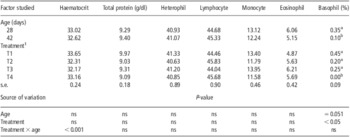
Overall, haematocrit and total blood protein of broilers (data pooled for age effects) did not differ between the four dietary treatments. Similarly, age of broilers did not affect the examined haematological parameters (Table 4). The significant treatment × age interaction (P < 0.001) in haematocrit values revealed that the haematocrit of broilers fed the T1 diet at 28 days was lower compared with that at 42 days and that the haematocrit of broilers fed the T4 diet at 28 days was higher than that at 42 days. No significant differences were noted in leukocyte type, indicating no treatment or age effect except for basophil values. In detail, basophil values (pooled data to exacerbate age effects) were 3.5 times lower (P = 0.051) at 42 compared with 28 days. Similarly, lower basophil percentage (P < 0.05) was noted in broilers fed the T4 diet compared with that of broilers fed other experimental diets. The overall percentage representation of each white cell type was in the following order: lymphocytes > heterophiles > monocytes > eosinophiles > basophiles.
Effects of age and dietary treatments on broilers’ haematocrit, total blood protein concentration and different white blood cell types

ns = non-significant; LSM = least square means.
With the exception of blood protein concentration and basophil white blood cells, which are mean values, all other values are angular transformed LSM. Data are means of five replicates (n = 5). The vector of the response variables consisted of the haematological data, whereas the fixed factors included treatment and age effects as well as their potential interactions. Means within a column, within a main effect comparison, with different superscripts are different at P < 0.05, unless otherwise stated.
1In T1 treatment, broilers were fed a diet with 0.3 mg/kg added Se, as Se-yeast, without added Cd; in T2, broilers were fed a diet with 0.3 mg/kg Se and 10 mg/kg Cd; in T3, broilers were fed a diet with 0.3 mg/kg Se and 100 mg/kg of Cd; and in T4 treatment broilers were fed a diet with 3 mg/kg Se and 100 mg/kg Cd.
Se and Cd concentration in broilers’ tissues
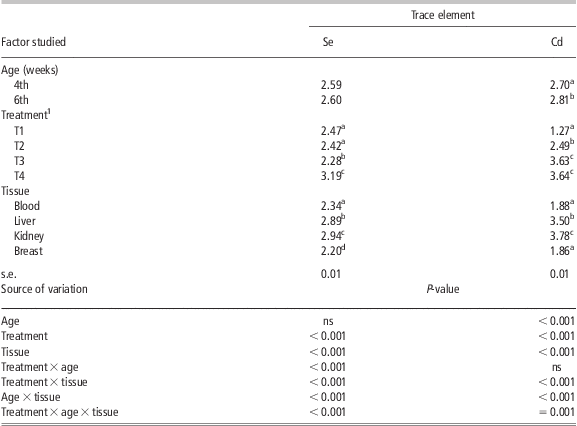
Broilers fed the diet with high Se concentration had increased tissue Se concentration (data pooled for age and tissue effects) compared with that in broilers fed low Se diets (Table 5). Age of broilers did not affect Se concentration (data pooled for treatment and tissue effects). Tissue type significantly affected Se concentration (P < 0.001, data pooled for age and treatment to exacerbate tissue effects). Tissue Se concentration in descending order was kidney > liver > blood > breast muscle, and this pattern was noted for all treatments as indicated by the significant treatment × tissue interactions (P < 0.001).
Effects of age, dietary treatments and broilers’ tissue type on Se and Cd concentrations
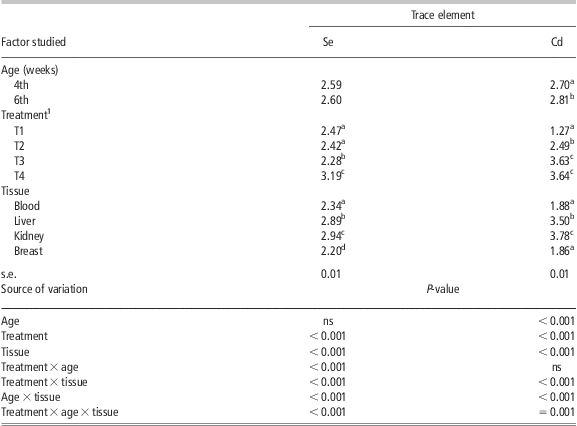
Se = selenium; Cd = cadmium; ns = non-significant; LSM = least square means.
Values are log transformed LSM. Data are means of five replicates (n = 5). The vector of the dependent variables consisted of the concentrations of the trace elements, whereas the fixed factors included treatment, age and tissue effects and their potential interactions. Means within a column, within a main effect comparison, with different superscripts are different at P < 0.05, unless otherwise stated.
1In T1 treatment, broilers were fed a diet with 0.3 mg/kg added Se, as Se-yeast, without added Cd; in T2, broilers were fed a diet with 0.3 mg/kg Se and 10 mg/kg Cd; in T3, broilers were fed a diet with 0.3 mg/kg Se and 100 mg/kg of Cd; and in T4 treatment broilers were fed a diet with 3 mg/kg Se and 100 mg/kg Cd.
The concentration of Cd in 6-week-old broilers was higher (P < 0.001) compared with that in 4-week-old broilers (data pooled for treatment and tissue effects; Table 5). Tissue Cd concentration of broilers fed diets with 100 mg/kg of Cd was higher than that in broilers fed diets with 10 mg/kg Cd. Tissue type significantly affected Cd concentration (P < 0.001; Table 5). Tissue Cd concentration in descending order was kidney > liver > blood = breast muscle, and this pattern was noted for all treatments as indicated by the significant treatment × tissue interactions (P < 0.001).
Discussion
The principal aim of the present work was to examine whether organic Se administered at high doses could protect broilers from Cd toxicity. It was hypothesized that addition of high Se levels, well below toxic ones (Gad and Abd El-Twab, Reference Gad and Abd El-Twab2009), could maintain the antioxidant–pro-oxidant balance and reduce the detrimental effects of Cd. The antioxidant role of Se was affirmed as it partially protected against Cd contamination. Selenomethionine, a major constituent of Se-yeast, is non-specifically incorporated into proteins in place of methionine (Rayman, Reference Rayman2004), and it is believed that stored tissue Se levels can be mobilized and used in circumstances of oxidative stress. In a previous study (Pappas et al., Reference Pappas, Zoidis, Georgiou, Demiris, Surai and Fegeros2011), it was shown that Se-yeast added at several concentrations, from 0.15 up to 3 mg/kg, could reduce the tissue deposition of the low Cd levels (no added Cd, only that present in the diet). It is possible that the discrepancy of the results reported in the present work and the previous study by Pappas et al. (Reference Pappas, Zoidis, Georgiou, Demiris, Surai and Fegeros2011) is related to the ratio of Se/Cd. It is possible that 3 mg/kg of added Se could not ameliorate all the toxic effects of 100 mg/kg of added Cd. When Se is administered as a remedy for heavy metal toxicity, it should form insoluble compounds to be excreted in the faeces. Complexes of heavy metals with organic and inorganic sources of Se exhibit different solubility (Feroci et al., Reference Feroci, Badiello and Fini2005). Direct comparison with inorganic Se cannot be made in the present study as it was not used; however, previous work with inorganic Se showed that 0.1 mg/kg Se, as Na2SeO3, added to diets contained 200 mg/kg of CdCl2 did not induce any significant changes in the levels of Cd accumulation in rats’ kidney, liver (Jihen et al., Reference Jihen, Messaoudi, Fatima and Kerkeni2008) and testis (Messaoudi et al., Reference Messaoudi, Hammouda, El Heni, Baati, Saïd and Kerkeni2010). However, another study showed that inorganic Se supplementation reduced Cd levels in the liver and kidney of rat pups (Lazarus et al., Reference Lazarus, Orct, Jurasoviae and Blanuša2009). It is possible that differences regarding reduction or not of Cd accumulation by Se noted between different studies may be related with the administered doses, the mode of application and the duration of exposure. Previous work with in vitro-produced selenite and sulphide (Na2S) revealed that transition metal ions, like Cd2+, could form a complex, which then bounds to the plasma protein selenoprotein P to form a ternary complex (Sasakura and Suzuki, Reference Sasakura and Suzuki1998), indicating that selenoprotein P may be also involved during formation of complexes with Cd.
Absorption and in turn tissue accumulation of dietary Cd is mainly influenced by dose, age, gender, species and nutritional status, as well as by dietary intake of other elements that may interact with Cd (Klaassen et al., Reference Klaassen, Liu and Choudhuri1999; Andersen et al., Reference Andersen, Nielsen and Nordberg2004). The toxicity of a metal can be severely modulated by the interaction with other toxic or essential metals (Petersson-Grawé et al., Reference Petersson-Grawé, Thierfelder, Jorhem and Oskarsson1997; Lopez-Alonso et al., Reference Lopez-Alonso, Miranda, Castillo, Hernandez, Garcia-Vaquero and Benedito2007). These reasons gave rise to the employment of Se as a remedy against Cd toxicity (Nolan and Brown, Reference Nolan and Brown2000; Jihen et al., Reference Jihen, Messaoudi, Fatima and Kerkeni2008). As mentioned before, Se can be added to the broilers’ diet either as an inorganic salt (sodium selenite or sodium selenate) or as an organo-Se compound more often in the form of Se-yeast (Zoidis et al., Reference Zoidis, Pappas, Georgiou, Komaitis and Fegeros2010). Organic Se is actively transported through intestinal membranes during absorption and excess of it can be accumulated in the tissues while excess of inorganic Se is excreted. Several studies showed that the organic form of Se has higher bioavailability and provides better antioxidant protection than inorganic form (Mahmoud and Edens, Reference Mahmoud and Edens2003; Lacour et al., Reference Lacour, Zunder, Restle and Schwarzer2004).
In the present study, addition of 10 mg/kg Cd to broilers’ diets showed no negative effects on performance and mortality, whereas addition of 100 mg/kg Cd caused significant negative effects on performance such as reduced body mass, decreased feed consumption and increased FCR. Although a direct comparison with inorganic Se cannot be made, previous work with inorganic Se indicated that 0.91 mg/kg of inorganic Se protected the hens against a cumulative dose of 0.54 mg Cd per kg of BW administered intraperitoneally but was ineffective against further Cd exposure (Nolan and Brown, Reference Nolan and Brown2000). The same authors reported that intraperitoneal Cd administration (0.32 to 1.62 mg/kg BW) to hens did not cause negative effects on BW, feed intake and haematocrit but reduced egg production. In another study by Li et al. (Reference Li, Gao, Li, Wang, Tang and Xu2010b), cocks were fed a diet with 10 mg/kg of inorganic Se or 150 mg/kg of Cd or a combination of those levels. The authors reported reduced final BW in the Cd group compared with the other groups. The reduced BW reported in the present study is directly attributed to Cd toxicity.
Several mechanisms have been reported for Cd toxicity. More specifically, Cd induces lipid peroxidation and interferes with some of the organism's enzymatic reactions, substituting Zn or other metals (Ognjanović et al., Reference Ognjanović, Marković, Dordević, Trbojević, Štajn and Saičić2010). Furthermore, it causes renal dysfunctions, hypertension, arteriosclerosis, damages in the nervous system, bone demineralization and endocrine dysfunctions (Lafuente et al., Reference Lafuente, González-Carracedo, Romero, Cano and Esquifino2004; Schrauzer, Reference Schrauzer2009). After oral exposure, Cd preferentially accumulates in the kidneys and liver (Lehman and Klaassen, Reference Lehman and Klaassen1986), a result that was corroborated in the present work. It is known that trace elements are bound to various ligands in cellular membranes, cytoplasm and blood, and are transported and stored via several proteins including but not limited to albumin, ceruloplasmin, transferrin and metallothioneins (Strachan, Reference Strachan2010). In the present study, the concentration of Cd deposited in the tissues was not affected by high Se level. This result is in line with studies with rats where inorganic Se did not affect the deposited Cd level (Jihen et al., Reference Jihen, Messaoudi, Fatima and Kerkeni2008; Ognjanović et al., Reference Ognjanović, Marković, Pavlović, Žikić, Štajn and Saičić2008). This may be due to inadequate formation of certain Se–Cd complexes (Pappas et al., Reference Pappas, Zoidis, Fegeros, Zervas and Surai2010). By examining solely the performance parameters of the current study, excess of Se fed to broilers did not ameliorate the negative effects of Cd. However, Se addition to broilers’ feed did maintain mortality and haematological parameters to levels similar to that of broilers fed no added Cd and within the physiological range for 42 days (Bounous and Stedman, Reference Bounous and Stedman2000). These ameliorating effects of Se against Cd toxicity may be attributed to its antioxidant role. It is known that broiler haematology has several distinctive characteristics such as red blood cells with nucleus and short life span and heterophil function parallels mammalian neutrophil function. In the present study, haematocrit ranged between 28% and 31%, values that are within the physiological values (22% to 35%). The same applied for lymphocytes and heterophiles that accounted for the 80% of all white cells (Bounous and Stedman, Reference Bounous and Stedman2000). Moreover, high Se addition in broilers’ feed reduced basophil levels. Basopenia (a low basophil count) is generally difficult to be demonstrated, as the normal basophil count is usually low. However, basopenia has been reported in association with stress- and drug-induced reactions and autoimmune diseases (Grattan et al., Reference Grattan, Dawn, Gibbs and Francis2003), but further research is indispensable to clarify the results of the present study. Other studies with concurrent Cd and inorganic Se addition in feed or drinking water showed that although Se could not counteract for Cd-induced decreased performance it improved other examined parameters such as tissue structural damages, antioxidant defence and apoptosis (Jihen et al., Reference Jihen, Messaoudi, Fatima and Kerkeni2008; Li et al., Reference Li, Gao, Li, Wang, Tang and Xu2010b).
In conclusion, the present study revealed that Se can help against the negative effects of Cd toxicity mainly because of its antioxidant role and can partially protect against Cd accumulation in the tissues. Future studies will indicate and may establish the appropriate level of Se inclusion or use of Se in conjunction with other elements and antioxidants against Cd contamination and toxicity.
Acknowledgements
A. Al-Waeli is grateful to the Greek State Scholarship Foundation (IKY) for postgraduate funding. We are grateful to NUEVO S.A. (N. Artaki, Euboia, Greece) for providing Sel-Plex®, to DSM Nutritional Products Hellas Ltd (Athens, Greece) for providing the vitamin and mineral premix, to Prof. Stamatis G. for providing ICP-MS standards and to Ms Koutina V. for excellent laboratory assistance.