Sociolegal scholars have offered competing assessments of whether and how courts reshape the possibilities for outsiders to meaningfully advance policy and political change. Many studies have concluded that the judicial enforcement of rights primarily benefits political and economic elites, with some suggesting that rights are constitutionalized and courts empowered for precisely this purpose (Finkel Reference Finkel2008; Ginsburg Reference Ginsburg2003; Hirschl Reference Hirschl2004). By contrast, others report that under certain conditions, previously disadvantaged groups are able to advance their interests via rights mobilization in court, even when other avenues to political power remain closed (Andersen Reference Andersen2005; Epp Reference Epp1998; Keck Reference Keck2009; Reference Keck2014; Langford et al. Reference Langford, Dugard, Madlingozi, Cousins, Langford, Cousins, Dugard and Madlingozi2014; McCann Reference McCann1994). This debate has been particularly acute in the literature on courts and constitutionalism in the Global South, again with some scholars adopting relatively optimistic assessments of courts’ capacities to create new pathways to power (Botero Reference Botero2018; Brinks and Gauri Reference Brinks and Gauri2014; Langford Reference Langford, Langford, Cousins, Dugard and Madlingozi2014; Wilson Reference Wilson2009), and others advancing more critical accounts of the role of courts in preserving the status quo (Gargarella Reference Gargarella, García, Klare and Williams2014; Suresh and Narrain Reference Suresh and Narrain2014).
We engage this long-standing debate by examining how three prominent apex courts have responded to similar free expression claims advanced by a variety of differently situated claimants. In particular, we deploy a medium-N analysis of all constitutional free expression decisions that involved sexually explicit, economic, or religious speech acts and were issued by the Supreme Court of India or the Constitutional Courts of Colombia and South Africa from their inception through calendar year 2016. We find that these three courts use their power and independence to protect both political and economic elites and relatively powerless claimants. The courts rule in favor of elite claimants with some regularity, but the case volume for non-elite claimants is higher, and the win rates are comparable. We also find that judicial protection of free expression varies depending on the content of the speech at issue. In particular, regardless of whether the speech claimants are elite or non-elite actors, these three apex courts regularly rule in favor of free expression for dissenting or unorthodox speech acts.
These findings suggest that the debate about who benefits from judicial empowerment may not be easily captured in terms of zero-sum competition between classes of rights claimants. Instead, even if judicial empowerment is driven by elite calculations, courts may subsequently act in ways that benefit a broader range of interests. With regard to free expression jurisprudence in particular, our findings regarding the judicial protection of dissenting or unorthodox speech acts may reflect the sort of “bounded [judicial] activism” that scholars have noted in other contexts (Moustafa Reference Moustafa2007). That is, judges sometimes demonstrate more assertive and independent behavior on issues that are relatively peripheral to the governing regime’s core interests, but these issues may still be important to the diverse array of claimants who bring them to court.
WHO BENEFITS FROM JUDICIAL EMPOWERMENT?
The global expansion of judicial power during the late twentieth and early twenty-first centuries is now well documented, with courts across a wide variety of jurisdictions playing an ever more consequential role in resolving important policy and political questions (Tate and Vallinder Reference Tate and Vallinder1995; Kapiszewski et al. Reference Kapiszewski, Silverstein and Kagan2013). The political consequences of judicial empowerment, however, remain the subject of significant dispute. On Ran Hirschl’s influential account, judicial empowerment “[i]s often not a reflection of a genuinely progressive revolution in a polity; rather, it is evidence that the rhetoric of rights and judicial review has been appropriated by certain groups to bolster their own position in the polity” (Reference Hirschl and Choudhry2006, 60). In particular, across a wide range of national contexts, political and economic elites have intentionally entrenched rights in written constitutions and empowered courts to enforce them as a hedge against future loss of power. Tom Ginsburg (Reference Ginsburg2003) and Jodi Finkel (Reference Finkel2008) have developed similar arguments, characterizing judicial empowerment as a form of insurance for current power holders who foresee electoral defeat. Even in polities with long-established constitutional courts, some scholars have suggested that judicial empowerment typically results from efforts by existing power holders to entrench their policy agendas or shield themselves from electoral accountability (Gillman Reference Gillman2002; Graber Reference Graber1993; Lovell Reference Lovell2003). In each of these variants, the judicial empowerment literature suggests that judges will generally act in the interests of the political and economic elites with whom they are allied.
By contrast, a long line of scholars working in the legal mobilization tradition have emphasized that under certain conditions, relatively powerless groups of people are able to use legal processes to advance their rights and interests. For example, in a classic work on the politics of rights, Stuart Scheingold (1974) conceded that the dominant tendency of “the myth of rights” was to reinforce the status quo, but he nonetheless emphasized the potential value of legal rights as resources for political mobilization (Reference Scheingold2004, 91–96). In subsequent work, Michael McCann (Reference McCann1994) identified multiple concrete mechanisms by which relatively powerless political actors can sometimes use the politics of rights to leverage policy and political change. McCann’s account of social movement litigation was advanced further by scholars like Ellen Ann Andersen (Reference Andersen2005), who delineated key features of the legal opportunity structure that may enable organized litigation to succeed. Scheingold, McCann, and Andersen each called attention to the potential benefits of legal mobilization even in the absence of consistent support from judges, but Charles Epp (Reference Epp1996) has also shown that, with sufficient support from organized rights advocates, rights claimants with lesser means are sometimes able to persuade judges to rule for their claims. In a related vein, Rachel Cichowski (Reference Cichowski2006) and Terri Peretti (Reference Peretti1999) have argued that one of the chief benefits of independent and empowered courts is that they provide civil society actors with additional avenues for participation, thereby furthering the expansion of democratic governance.
The Track Record of Global South Courts
The debate about whether and how courts preserve existing power relationships in society has been a particularly important theme in the literature on Global South constitutionalism. Here, the debate has proceeded against the backdrop of the 1990s wave of democratization and the dashed hopes for lasting political change in its aftermath. Within this context, reformers have often looked to courts as the only recourse for pursuing political or socioeconomic change in polities where democracy has either not yet taken firm hold or is backsliding. At the same time, across much of Latin America, Africa, and Asia, the independence and authority of judicial institutions remains underdeveloped.
As such, the record of Global South courts in restraining or empowering elites varies substantially across time and space (Gargarella, Domingo, and Roux Reference Gargarella, Domingo and Roux2006; Gloppen et al. Reference Gloppen, Wilson, Gargarella, Skaar and Kinander2010). From this uneven record, some scholars have drawn relatively favorable assessments of the judicial enforcement of rights, either with regard to their potential egalitarian distributive effects or their broader impacts on the development of a stable middle class, the growth of civil society, and the consolidation of democracy (Gloppen and Kanyongolo Reference Gloppen and Kanyongolo2007; Landau Reference Landau2012; Wilson Reference Wilson2009). For example, Varun Gauri and Daniel Brinks (Reference Gauri and Brinks2008) show that a well-developed policy infrastructure, a constituency with legal capacity, and support from politically consequential actors can enable successful legal mobilization by the relatively powerless. Bruce Wilson and Camila Gianella-Malca (Reference Wilson and Gianella-Malca2019, 153) find that “well-organized, deep-pocketed social movements” can position historically marginalized groups such as LGBT persons in Colombia to make successful use of strategic litigation. Sandra Botero (Reference Botero2018) shows that as Latin American courts have extended rights-based activism into new policy areas such as indigenous rights and environmental justice, they have sometimes developed new institutional tools to facilitate implementation and broaden the impact of their holdings.
Sometimes the benefits of litigation are indirectly helpful for marginalized groups, as with the promotion of greater coordination among government bureaucracies, which in turn allows for the participation of more actors in the formulation of public policy (Rodríguez Garavito and Rodríguez-Franco Reference Rodríguez Garavito, Rodríguez and Franco2015). Indeed, even some decisions widely regarded as failing to live up to their progressive promise—such as the South African Constitutional Court’s famous decision in Government of the Republic of South Africa v. Grootboom (2000) on the right to housing—have had important radiating effects that have benefited relatively powerless political actors (Langford Reference Langford, Langford, Cousins, Dugard and Madlingozi2014).
By contrast, others have concluded that Global South courts function to preserve the status quo (Gargarella Reference Gargarella, García, Klare and Williams2014; Suresh and Narrain Reference Suresh and Narrain2014), linking the judicialization of rights with the proliferation of neoliberal policies that further exclude the marginalized. According to Mariela Puga (Reference Puga2012), collective rights-based litigation in Colombia and Argentina is dominated by legalese and controlled exclusively by elite legal actors, leaving out the communities whom the rulings purport to benefit. A variety of scholars have likewise found that judicial responses to public interest litigation (PIL) in India have sometimes benefited the interests of the urban middle class, but have rarely improved the livelihoods of more marginalized members of the community (Baviskar Reference Baviskar, Eckert, Donahoe, Stümpell and Biner2012; Bhuwania Reference Bhuwania2017; Menon Reference Menon, Suresh and Narrain2014).
We focus in this article on apex courts operating in constitutional democracies, but as Tamir Moustafa (Reference Moustafa2007) has shown, even authoritarian regimes sometimes establish independent courts with the authority to decide consequential policy and political questions. Regime actors, in both democratic and authoritarian settings, sometimes find it advantageous to delegate certain issues to judges who are at least partly autonomous from direct political control. They are more likely to do so when they trust those judges to act as faithful agents of regime interests, but once independent courts are up and running, it is an open question whether and to what extent this fidelity will persist (Stone Sweet Reference Stone Sweet2004, 9). Again, Moustafa has shown that this is true even in some authoritarian contexts. The Sadat regime empowered the Egyptian Supreme Constitutional Court principally to provide the secure guarantee of property rights necessary to attract foreign direct investment, but once empowered, the Court created an institutional space for opposition parties and human rights activists to pursue other sorts of claims as well. If this sort of institutional evolution is true in authoritarian Egypt, it seems even more likely to be true of apex courts operating in stable constitutional democracies. After all, when the Egyptian Court pushed too far in its defense of human rights, the government pushed back with a variety of court-curbing measures that would have been more costly to enact in more democratic settings.
Whose Interests Do Judges Serve?
Like Epp’s account of rights-based adjudication in Britain, Canada, India, and the United States, Moustafa’s account of judicial review in Egypt emphasizes the significant role played by legal professional associations, human rights organizations, and other aspects of a civil society “support structure” in enabling robust judicial enforcement of constitutional rights guarantees (Epp Reference Epp1998; Moustafa Reference Moustafa2007). Depending on the institutional configuration of apex courts, however, such support structures do not appear to be a necessary condition for judicial rights protection (Sanchez Urribarri et al. Reference Sanchez Urribarri, Schorpp, Randazzo and Songer2011; Wilson Reference Wilson2009). Where apex courts are designed so as to enable broad citizen access, judges who are inclined to defend key constitutional rights against regime infringement are likely to have a steady supply of cases in which they might do so.
The question remains when and why judges might be so inclined. On Hirschl’s account, judges are best understood as agents of elite interests. If and only if a governing partisan coalition sees its continued control of the state as threatened, it may choose to delegate some important decisions to judges who will remain in office even after the regime has been unseated. This line of argument comes in varied forms—notably, Hirschl’s “hegemonic preservation” thesis and Finkel’s and Ginsburg’s political insurance arguments—but its central through-line is that governing elites will seek to empower courts when they are confident that such courts will rule in the elites’ interests, and they will seek to curb courts when judges begin ruling against those interests.
Much of the evidence for these claims rests on scholarly assessments of landmark constitutional rights holdings. In all regions of the constitutional world, some courts appear increasingly willing to engage with “mega-politics” questions, such as the outcome of national elections, and to issue holdings demanding sweeping and consequential changes on highly salient questions of public policy (Hirschl Reference Hirschl2008). However, these same courts also regularly engage in what we might think of as run-of-the-mill judicial review—assessing constitutional rights claims advanced by ordinary citizens in cases whose political salience and policy significance are less obvious.
In this article, we examine the full universe of constitutional free expression decisions issued by three apex courts across three categories of disputes that feature a diverse array of rights claimants. By doing so, we hope to shed light on the limits of elite-driven accounts of judicial empowerment. Even where constitutional courts are empowered by political or economic elites seeking to advance their own interests, those courts may be in a position to rule in favor of rights claims that emerge from the bottom up. If those rights-protecting decisions steer clear of interfering with core regime interests, the courts may strike a balance that the governing elites can live with, but the decisions may nonetheless be substantively important to the ordinary persons who sought them. Moreover, such decisions may help build the institutional capital necessary to challenge core regime interests on occasion as well.
METHODOLOGY
To assess whether courts engaged in the day-to-day practice of judicial review tend to unsettle or preserve the political status quo, we examine all constitutional free expression decisions that involved sexually explicit, economic, or religious speech acts and were issued by the Supreme Court of India or the Constitutional Courts of Colombia and South Africa from their inception through calendar year 2016. Using original data on the identity of the speech claimants in each case and the expressive content of their speech acts, we assess what types of political actors have directly benefited from the judicial protection of free speech in three prominent apex courts in the Global South. Our research design is best understood as a medium-N strategy for examining a set of cases large enough to identify patterns across cases, while still providing important details about individual judgments (Goertz Reference Goertz2017, 217–43; Kapiszewski Reference Kapiszewski2012; Keck Reference Keck, Langford and Lawforthcoming).
Free Expression as a Window on Judicial Power and the Politics of Rights
The debate about whether judicial empowerment reinforces or challenges existing power relations turns in part on how different types of rights claimants fare in court. Under various conditions, litigation and other forms of legal mobilization may have a broad array of political effects, and their successful deployment does not always require winning in court (Dugard Reference Dugard2010; McCann Reference McCann1994; NeJaime Reference NeJaime2011). Still, if judges rarely or never rule in favor of disadvantaged claimants, then our expectations regarding courts as access points for bottom-up challenges to the status quo would surely be reduced. This assessment seems especially true at the appellate level, where legal pronouncements about constitutional rights often serve as important limits on future action by policymakers. If appellate courts rarely or never rule in favor of relatively powerless claimants, it seems less likely that judicial doctrine will render the state more responsive to the interests of such claimants. Conversely, even if appellate courts regularly ruled in favor of relatively powerless claimants, such evidence alone would not support a conclusion that courts act against the interests of powerful elites. As such, while most existing studies examine how a single set of political actors fare—focusing on either insiders or outsiders, but not both—we think side-by-side comparisons of differently situated actors promise additional analytical leverage. We draw these comparisons from constitutional free expression law.
Free expression cases are substantively important in their own right, but they also provide a valuable window onto these broader debates regarding the beneficiaries of judicial power. As our data will show, free expression claims are regularly advanced by a wide range of political actors, asserting the right to express a wide range of ideas.Footnote 1 These two dimensions of variation—the identity of the speech claimants and the expressive content of their speech acts—provide a rich source of data for assessing who benefits from the judicial protection of rights. In other words, the competing arguments about the influence of courts have different observable implications for cases arrayed along these two dimensions.
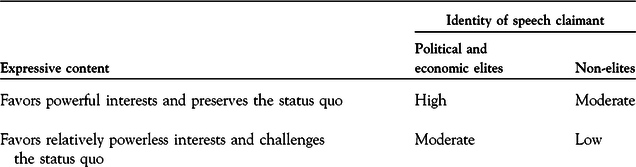
If judicial empowerment tends to preserve status quo power relations, then we would expect judges to be most protective of speech claims advanced by political and economic elites seeking to express orthodox ideas, less protective of speech claims advanced by non-elites or those involving the expression of dissenting ideas, and least protective of speech rights involving both non-elite claimants and dissenting ideas. These observable implications are summarized in Table 1.
Observable Implications of Courts as Defenders of the Status Quo

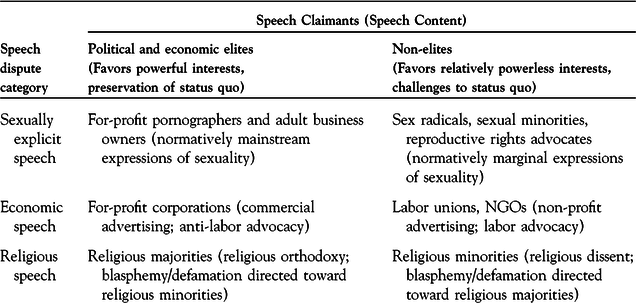
In Table 2, we identify three distinct categories of free speech disputes that are regularly resolved by constitutional courts across multiple jurisdictions. We select these three categories in an effort to examine a diverse array of claimants seeking protection for a wide range of expression. The three categories differ insofar as they implicate a regime’s interest in ways that might render courts more or less reluctant to rule in favor of rights claimants. As many accounts of judicial empowerment note, courts are often useful regime partners in protecting economic interests. We might therefore expect judges to defer to elite interests in free expression cases about economic matters. By contrast, theories of judicial empowerment do not render clear expectations about sexually explicit speech. Although such speech may implicate important social divisions, those disagreements are rarely the subject for constitutional bargains that bind the regime together. Finally, although religion is important in nearly all societies, the political salience of religion varies across our cases. Divisions among Hindus and Muslims feature heavily in Indian politics and have done so since independence to varying degrees. Religious divisions are less salient in the other countries we examine, but all three countries contain smaller or fringe religious groups that could readily benefit from free speech protection. Collectively, these three categories of speech offer fair insight into how judges might rule in a wide range of regularly occurring free expression disputes.
Speech Claimants and Speech Content Across Three Categories of Disputes

As Table 2 indicates, each of these three categories includes cases where the speech claimants are best understood as political or economic elites (i.e., claimants whose regime proximity and/or material resources are such that their interests are often well represented in existing political institutions), as well as cases where the claimants are non-elites (whose interests are typically less well represented). Likewise, each category includes cases where the expressive content of the claimants’ speech acts varies across a wide ideological range.
Applying these distinctions to particular cases sometimes requires significant contextual judgment, but often, the lines will be clear. For example, when courts hear disputes involving sexually explicit expression, free speech claims are sometimes advanced by large, for-profit pornographers and sometimes by solitary performance artists. Likewise, the speech acts sometimes involve normatively mainstream expressions of sexuality and sometimes normatively marginal ones. For cases that are close to the line, we seek to provide a generous test of status quo theories by erring on the side of coding speech claimants as elites. In other words, we code claimants as non-elite only if they are solitary individuals or small groups, opposed to or disconnected from the governing political regime, and lacking robust material resources. The observable implications of existing theories for speech with varying expressive content are less clear. Accordingly, in this dimension, we make our best independent coding judgments and provide sufficient contextual detail for those judgments to be evaluated by others.
Case Selection
The field of comparative constitutional law has focused disproportionately on the experiences of established liberal democracies in the Global North (Hirschl Reference Hirschl2014, 210–23). In this article, we seek to foreground the experiences of three Global South courts, where the debate about the influence of the judiciary in preserving or challenging existing power relationships has been particularly acute. We have selected national apex courts that are both powerful on paper—they can draw on a variety of legal mechanisms to enforce an ample catalogue of rights—and are widely regarded as leading practitioners of rights-based judicial activism across three distinct regions of the developing world (Gloppen et al. Reference Gloppen, Wilson, Gargarella, Skaar and Kinander2010, 4–5; Bonilla Maldonado Reference Maldonado and Maldonado2013, 29). Robust constitutional rights protections and courts with strong judicial review are now more common across the Global South. However, some of these courts lack robust legal mobilization support structures, have conservative docket control, or operate in a political environment that severely restricts judicial independence. If we are to observe evidence anywhere of Global South courts as avenues for challenging the status quo, we should expect to find it in the decisions of the Colombian, Indian, and South African apex courts, three assertive institutions with high “accountability functions”—i.e., courts that have made significant contributions toward the well-functioning of their democratic systems.Footnote 2 If we do not find it here, we can reject the argument that Global South courts may provide such avenues.
Even if the Colombian, Indian, and South African apex courts are not fully representative of Global South courts more broadly, the national contexts in which they operate share certain key features with other countries, and we would thus expect the patterns we identify here to be relevant to understanding judicialization elsewhere. Colombia, India, and South Africa are each post-colonial states with ethnolinguistically pluralistic societies. India is classified as a lower-middle income country, Colombia and South Africa are upper-middle income (World Bank 2020). Each has experienced major democratic advances since colonial independence, though sometimes with significant setbacks, as with India’s state of emergency from 1975–1977. And while today all three countries feature assertive courts, they have each witnessed notable instances of challenges to judicial independence as well.
Supreme Court of India
India’s inherited common law system has been significantly constrained by the adoption of a constitution which contains strong rights protections enforced by a Supreme Court with strong-form judicial review, even against Parliament.Footnote 3 The list of rights includes “the freedom of speech and expression,” guaranteed in Article 19(1)(a), though limited by a number of exceptions specified in Article 19(2).Footnote 4 We have identified 103 cases in which the Supreme Court reached the merits of a constitutional free expression claim from 1950 to 2016, with the Court ruling in the speech claimant’s favor in forty-four of them (42.7 percent).
The Supreme Court of India faces significant and sometimes idiosyncratic constraints, but it has been identified as one of the world’s most powerful courts, particularly in terms of public interest litigation and its expansive approach to locus standi (Bhushan Reference Bhushan, Dua, Singh and Saxena2007; Cunningham Reference Cunningham, Sathe and Narayan2003; Singh Reference Singh, Dua, Singh and Saxena2007). Notably in light of our analysis here, litigants pressing constitutional claims take advantage of rules allowing them to petition the states’ high courts or the Supreme Court directly, all but guaranteeing that free expression and other constitutional rights claims leapfrog more traditional legal matters because the courts do not retain control over their own dockets. These rules allow claimants to avoid the lower courts, where cases often languish because of insufficient personnel (Dhavan Reference Dhavan1986; Moog Reference Moog1992).
Epp (Reference Epp1998) identifies India as an example where a rights revolution did not occur, but subsequent developments—coinciding with the decline of the Indian National Congress—suggest that the Court has used its authority to articulate new and more elaborate understandings of the Constitution and its rights guarantees. In regards to free speech rights, Abhinav Chandrachud (Reference Chandrachud2017) argues that the Indian Supreme Court has failed to realize the Constitution’s transformative potential, instead adopting positions favored by the governing regime that preserved the state’s colonial-era authority to limit expression (see also Bhatia Reference Bhatia and Bhatia2017). And although the decline in Congress’ authority coincided with the increase in judicial power in ways that are consistent with Hirschl’s (Reference Hirschl2004) hegemonic preservation thesis, the substance of those decisions diverged from Congress’ earlier commitments in ways that are not fully explained by elite-driven accounts of judicial empowerment (Stohler Reference Stohler2019). Moreover, in other areas, the Indian judiciary has demonstrated remarkable assertiveness. While commentators have offered competing interpretations of the judiciary’s support for public interest litigation (Baviskar Reference Baviskar, Eckert, Donahoe, Stümpell and Biner2012; Bhuwania Reference Bhuwania2017; Menon Reference Menon, Suresh and Narrain2014), in some instances the Supreme Court has initiated cases against the state suo moto to hold governments accountable (Bhuwania Reference Bhuwania2017; Galanter Reference Galanter2014).
Constitutional Court of South Africa
South Africa’s 1996 Constitution rendered the nation’s Parliament democratically accountable to citizens of all races, but it also constrained this Parliament with an elaborate bill of rights, enforceable by a powerful new Constitutional Court.Footnote 5 Section 16(1) of this bill of rights provides explicit guarantees for a free press and other media, artistic creativity, academic freedom, and more generally, the right to receive or impart information or ideas. This right of free speech is limited by Section 16(2), which specifies exceptions for war propaganda, incitement of imminent violence, and hate speech. We have identified twenty-three cases in which the Constitutional Court reached the merits of a free expression claim from 1994–2016, ruling in the speech claimant’s favor in seventeen of them (73.9 percent).Footnote 6
South Africa was one of Hirschl’s (Reference Hirschl2004) key empirical examples, and its democratic transition provides strong support for his hegemonic preservation theory insofar as the previously dominant National Party (NP) abandoned its commitments to parliamentary democracy and instead insisted on a written constitution containing a judicially enforceable bill of rights. In this regard, South African judicialization would seem consistent with elite-driven accounts. But the judicial opinions we examine here were issued by South Africa’s Constitutional Court, whose staffing was determined predominantly by the emergent African National Congress (ANC), which was itself concerned with greater social and political transformation (Klug Reference Klug2000; Roux Reference Roux2013). As such, we might expect these judges to exercise their authority at the behest of a wider range of domestic constituencies. In other words, “who benefits” from judicial empowerment was not predetermined at the time of democratic transition, but instead remains an open empirical question.
Constitutional Court of Colombia
Colombia’s 1991 Constitution enshrined a generous bill of rights and created a Constitutional Court with ample powers to enforce these rights. Article 20 provides that:
Every person is guaranteed the freedom to express and disseminate their thoughts and opinions, to inform and receive truthful and impartial information and to create mass media. The media are free and have a social responsibility. The right to rectifications in conditions of equality is guaranteed. There shall be no censorship.
Through its jurisprudence, the Colombian Constitutional Court (CCC) has carved out exceptions for speech that incites war, genocide, discrimination, or violence; speech that advocates national, racial, or religious hatred; and child pornography. We have identified 150 constitutional free expression decisions issued by the CCC through 2016, with the Court ruling in favor of the speech claimant in seventy-six of them (50.7 percent).
Since its establishment, the CCC has been recognized as one of the most powerful courts in the region, with a significant track record in terms of rights-enforcing jurisprudence (Brinks and Blass Reference Brinks and Blass2018; Cepeda-Espinosa Reference Cepeda-Espinosa, Sieder, Schjolden and Angell2005; Uprimny Reference Uprimny2003, 46). One key source of the CCC’s power is the writ of tutela, an inexpensive legal device that any person (or a third party on her behalf) can file before any judge when her fundamental constitutional rights have been violated. The first-instance judge has ten days to decide the matter, and all tutela rulings are ultimately forwarded to the CCC, which then has discretionary power to select some for review. Many litigants have used tutelas to press their right to free expression under Article 20, while others have used tutelas to urge restrictions on free expression when it infringes on other constitutional rights, such as Article 15’s provision for “the right to … good reputation.”
JUDICIAL PROTECTION OF FREE EXPRESSION
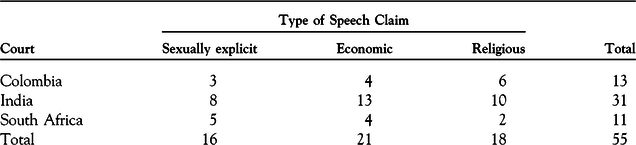
In this section, we survey the constitutional decisions issued by our three apex courts across three categories of free expression disputes. Of the 276 constitutional free expression decisions issued by these courts through 2016, fifty-five fall in one of our three categories of interest, as summarized in Table 3. Broadly speaking, the data demonstrate that judges have regularly come to the defense of regime-aligned or otherwise well-resourced free speech claimants engaged in sexually explicit speech. By contrast, when economic speech is at issue, judges have come to the defense of non-elite claimants more frequently than elites. In religious speech cases, the results are mixed. For each set of cases, we present qualitative case summaries to illustrate the range of political actors who benefit from the judicial protection of free expression. One finding of note is that regardless of the identities of the speech claimants, all three courts appear willing to extend constitutional protection to a broad range of expressive content. In particular, the vast majority of decisions ruling in favor of constitutional free expression claims have come in cases involving dissenting or unorthodox speech acts.
Distribution of Cases, by Courts and Speech Categories

Sexually Explicit Speech
The proper scope of regulation of sexually explicit expression is a question with a range of legitimate answers. On the one hand, unregulated sexually explicit expression may contribute to social harms. On the other, attempts at such regulation will sometimes infringe upon conversations about sex that should be protected by any reasonable conception of free expression. Courts will peg the ideal scope of such expression differently in different jurisdictions, but wherever the line is drawn—assuming that at least some sexually explicit expression is constitutionally protected—we are curious what sort of political actors benefit from this protection.
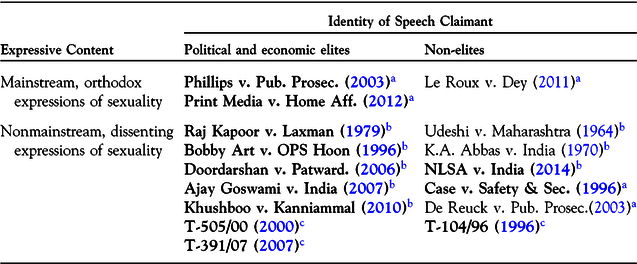
We have identified sixteen cases involving the constitutional protection of sexually explicit speech acts, listed in Table 4. For each case, we have characterized the speech claimants as elites or non-elites, and their speech acts as majoritarian/orthodox or nonmajoritarian/dissenting expressions of sexuality.
Judicial Protection of Sexually Explicit Speech

Note: Boldface indicates speech-protective holdings. Case names have been abbreviated.
a South Africa.
b India.
c Colombia.
Much of the time, it turns out, courts protect sexually explicit speech at the behest of actors who already have substantial resources to make their views heard. In Print Media South Africa v. Minister of Home Affairs (2012), for example, the Court ruled in favor of a speech claim brought by a trade association representing leading newspapers, magazines, and publishers and by a professional association representing editors and senior journalists. The industry associations had challenged provisions of the Films and Publications Act that required government review and classification of publications containing degrading sexual content. Some such publications would then be banned; for others, distribution would be authorized only in businesses with adults-only premises.Footnote 7
Likewise, the Indian Supreme Court sided with major newspapers (and the government) in Ajay Goswami v. India (2007). Mr. Goswami, a private lawyer concerned about minors’ exposure to sexually explicit material in newspapers, filed a petition contending that the freedom of expression “is not keeping balance with the protection of children.” In his view, such content violated the individual right “to their own space and right not to be exposed against their will to other’s expressions of ideas and actions.”Footnote 8 But the Indian Court sided with the newspapers, holding that obscenity should not be interpreted so broadly as to protect society’s most sensitive people.Footnote 9 The speech claimants here are elite media actors, including some of the largest newspapers in India, but the speech act at issue is adult newspaper content inconsistent with traditional notions of sexual morality.Footnote 10 Hence, the case appears in the lower-left cell of Table 4.
Along similar lines, consider S. Khushboo v. Kanniammal (2010). The news magazine India Today had quoted well-known actress S. Khushboo regarding “the increasing incidence of pre-marital sex” and her judgment that it should be socially accepted. These statements led to multiple criminal complaints filed against Kushboo, which she sought to quash on Article 19 grounds. The Court ruled in her favor, noting “the need to tolerate unpopular views in the socio-cultural space.”Footnote 11 Indeed, the Court construed the Constitution as “promot[ing] a culture of open dialogue when it comes to societal attitudes.”Footnote 12
The Indian Supreme Court also ruled in favor of filmmakers seeking constitutional protection for the sexually explicit content of their films. For example, in Raj Kapoor v. Laxman (1979), the Court ruled for the makers and distributors of a film entitled “Satyam, Sivam, Sundaram” (Truth, Godliness, Beauty), who had been sued because “the fascinating title was misleadingly foul and beguiled the guileless into degeneracy.”Footnote 13 The Court relied primarily on the claim that the film’s prior approval from the Board of Censors should immunize it from subsequent obscenity lawsuits, but ended by noting that “freedom of expression is fundamental” and that the state should not “restrain aesthetic expression and progressive art through obsolete norms and grandma inhibitions when the world is wheeling forward to glimpse the beauty of Creation in its myriad manifestations and liberal horizons.”Footnote 14 The Court also sided with filmmakers in Bobby Art International v. Om Pal Singh Hoon (1996) and Director General, Directorate General of Doordarshan v. Anand Patwardhan (2006), holding that the sexually explicit (and otherwise controversial) content of their films was constitutionally protected.Footnote 15
In Colombia, the Constitutional Court ruled in favor of a major TV channel in T-505/00 (2000), holding that the National TV Regulation Board (CNTV) had engaged in prohibited censorship when it pulled a talk show off the air.Footnote 16 Based on viewer complaints, the CNTV had concluded that in some episodes of the talk show, “obscene, grotesque and perverted expressions were used in dealing with topics like the abuse of minors, sexual harassment, extramarital relations and homosexuality.” The Court found that CNTV had violated Caracol TV’s right to due process and free speech. In its ruling, the Court reminded CNTV that the Constitution guarantees freedom for the media, regardless of format, and that the permissible legal limits to media (e.g., national security) must be imposed in a content-neutral fashion.
An important tutela ruling in which the Colombian Constitutional Court tried to balance freedom of expression and special protections for children, while defining the contours of sexually explicit speech, was T-391/07 (2007). In 2007 the RCN radio broadcaster filed a tutela against a ruling by the Council of State (one of three Colombian apex courts). The original case before the Council of State was an acción popular (akin to a class action lawsuit) in which a civil society organization, Fundación Un Sueño por Colombia (FUSPC), was suing the Ministry of Communications and RCN for violating public morality and the physical and psychological integrity of Colombian society in allowing the morning radio show El Mañanero de la Mega to air. According to FUSPC, this show corrupted Colombian youth with its vulgarity. After the CS ruled in favor of FUSCP, the Ministry of Communications fined RCN, ordered the program to modify its content, and created a committee that would oversee the changes. RCN then filed a tutela against the decision made by the CS, seeking permission for the program to go back to being transmitted freely and without controls. The Constitutional Court granted the tutela and reversed, holding that so long as the hosts and journalists of the radio show were not engaged in child pornography, their sexually explicit speech remains constitutionally protected.Footnote 17 The ruling reiterated that state authorities are free to regulate broadcasters, in this case in the interest of protecting minors, but that doing so on the basis of the expressive content amounts to impermissible censorship. As with the Goswami case from India, the free expression claim was advanced by elite media actors, but the claim’s import was to protect sexually explicit expression at odds with traditional sexual morality.
In just three cases did any of our courts rule in favor of a non-elite claimant expressing nonmainstream ideas about sexuality. Consider, first, the Indian Court’s widely noted decision in National Legal Services Authority v. Union of India (2014), which relied in part on Article 19(1)(a) to protect the right to legal recognition of one’s preferred gender identity. In the Court’s view, the freedom of expression “includes one’s right to expression of his self-identified gender. Self-identified gender can be expressed through dress, words, action or behavior or any other form. No restriction can be placed on one’s personal appearance or choice of dressing, subject to the restrictions contained in Article 19(2) of the Constitution.”Footnote 18 This holding makes clear that the judicial protection of free expression may clear space for important acts of self-expression by sexual minorities and other marginalized groups.
On one occasion, the South African Court held in favor of a non-elite claimant whose expressive activity is best understood as nonmainstream. In Case v. Minister of Safety and Security (1996), one of its first post-apartheid free expression decisions, the Court struck down the 1967 Indecent or Obscene Photographic Matter Act’s provisions prohibiting possession of pornography.Footnote 19 The case arose after three defendants were arrested for the possession of 155 pornographic videos. The Court’s majority relied on the right to privacy, but two justices wrote separately to indicate that the law also violated the freedom of expression. Both Justice Mokgoro and Justice Sachs expressed concern that the Act banned even private possession of obscene materials, which it defined in sweeping and discriminatory terms. In particular, the Act prohibited possession of “photographic matter … manifesting … homosexuality [or] Lesbianism [sic].”Footnote 20 The judgment provides little detail about the speech claimants and their speech acts—indicating only that three defendants had been charged with possession of “video cassettes containing sexually explicit matter”—but given the examples provided by Mokgoro and Sachs of sexually explicit materials subject to the Act, we have coded the case as protecting nonmainstream expressions of sexuality.
The CCC has also ruled exactly once in favor of a non-elite claimant engaged in nonmainstream sexually explicit expression. In T-104/96 (1996), the Court ruled for Celso José Castro, who had filed a tutela alleging that the director of a local Culture and Tourism Institute had violated his right to freedom of expression when he ordered that half of the pieces be removed from an exhibition that Castro had inaugurated at the Institute. The photographs in question depicted naked men, some with erect penises, as well as food items with phallic connotations. The Constitutional Court emphasized that individuals choose whether or not to see an art exhibit, and hence that state authorities should not thwart the artist’s right to distribute their work.
On three occasions, these courts declined to protect non-elite claimants engaged in nonmainstream sexually explicit expression. In Ranjit D. Udeshi v. Maharashtra (1964), the Indian Court ruled against the owners of a book stall, street-level merchants whom we code as non-elite, after they were arrested for selling a copy of D.H. Lawrence’s Lady Chatterley’s Lover. The Court denied their arguments about the scope of protections of Article 19(1)(a), finding instead that Article 19(2) created an exception to speech protection for “public order, decency or morality.”Footnote 21 Similarly in K.A. Abbas v. India (1970), the Court ruled against “a journalist, playwright and writer of short stories” who created a sixteen-minute documentary film about wealth and poverty in four Indian cities, with one scene suggesting the existence of prostitution and sex trafficking. The filmmaker received an adverse rating from India’s Board of Film Censors, restricting viewership to adults only. The filmmaker challenged the constitutionality of this prior restraint, but the Supreme Court rejected the filmmaker’s argument, noting the dangers posed by the powerful medium of cinema.Footnote 22 Likewise, the South African Court ruled against a minor film producer in Tasco Luc De Reuck v. Director of Public Prosecutions (Reference Gloppen and Kanyongolo2003). When charged with possession of child pornography, the producer claimed that the materials were necessary to complete a documentary on the topic and challenged the relevant sections of the Films and Publications Act of 1996 as unconstitutional. The Court rejected this claim, finding the law appropriately tailored to allow for expression while simultaneously protecting the dignity of children.Footnote 23
The South African Court likewise declined to protect non-elite speech claimants in Le Roux v. Dey (2011). After a group of Pretoria high-school students created and shared a computer-generated image depicting their school’s principal and deputy principal “sitting in a sexually suggestive posture,” the deputy principal sued for defamation, and the Court held that the students’ speech rights were outweighed by the administrators’ reputational interests and the importance of school discipline.Footnote 24 The students are clearly non-elite claimants, but their speech act can be construed as anti-gay taunting, so we have placed this case in the upper right cell of Table 4.
In sum, nine of the twelve decisions (seventy-five percent) extending constitutional protection to sexually explicit speech acts did so at the behest of elite claimants. Notably, the win rate for these claimants is one hundred percent, compared to just forty-three percent for non-elite claimants. In other words, all nine of the decisions in the left-hand column of table four ruled in favor of the free expression claim, while just three of the seven decisions in the right-hand column did so. Also noteworthy, however, is that ten of the twelve decisions (eighty-three percent) extending constitutional protection to sexually explicit speech did so in defense of nonmainstream expressions of sexuality. The win rate for speech claims in these cases is also quite high (seventy-seven percent). In the context of sexually explicit speech, these apex courts rule only rarely in favor of non-elite claimants—just once each for the Indian, South African, and Colombian courts—but they may nonetheless be serving a counter-majoritarian, rights-protecting function by extending constitutional protection to heterodox acts of expression.
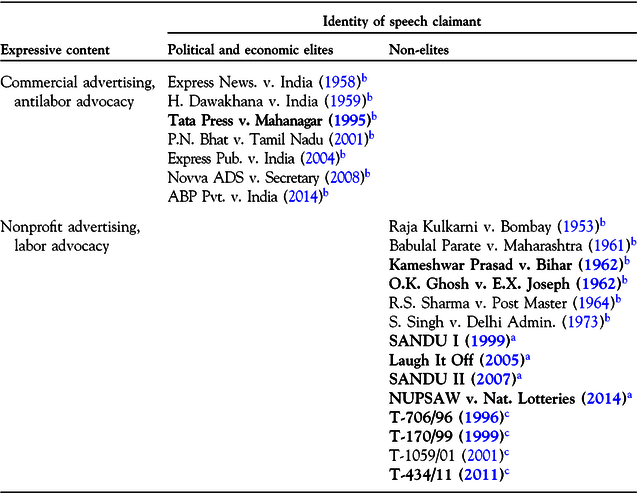
Economic Speech
Constitutional courts have long faced free expression disputes emerging in an economic context, by which we mean disputes regarding paid advertising, either commercial or noncommercial, as well as speech advocating or opposing improved wages, benefits, and working conditions.Footnote 25 As with sexually explicit speech, we investigated how courts have responded to speech claims from differently situated actors, and as Table 5 illustrates, the distribution of cases here appears markedly different. From India, we have identified four cases involving commercial advertising and three involving antilabor positions, listed in the upper-left cell. We also identified six cases involving labor advocacy, listed in the lower-right cell. From Colombia and South Africa, all identified cases involve labor advocacy. As a result, two of the four cells in Table 5 are empty. The upper-right cell would contain any cases involving commercial advertising by businesses best characterized as non-elite actors. Consider, for example, Bigelow v. Virginia (1975), in which the US Supreme Court ruled in favor of a speech claim from a small, “underground newspaper” in Virginia, which had been convicted for printing an advertisement by a New York-based abortion provider.Footnote 26 The lower-left cell would contain any cases involving labor advocacy or noncommercial advertising by elite actors, such as do-gooder corporate employers, majority-party MPs, or regime-aligned unions. Again, we have identified no such cases.
Judicial Protection of Economic Speech

Note: Boldface indicates speech-protective holdings. Case names have been abbreviated.
a South Africa.
b India.
c Colombia.
The Indian Court held early on that commercial advertising is not constitutionally protected. It later reconsidered this holding, but it has not to date protected advertising with any regularity. In a 1959 case brought by an Indian pharmaceutical manufacturer, the Court held that when a speech act “takes the form of a commercial advertisement which has an element of trade or commerce it no longer falls within the concept of freedom of speech for the object is not propagation of ideas.” Citing the US Supreme Court’s decision in Valentine v. Chrestensen (1942), the Indian Court found commercial advertising to be outside the scope of constitutionally protected speech.Footnote 27 Just as the US Court reconsidered this holding in cases like Bigelow, the Indian Court declared in 1995 that commercial speech was constitutionally protected under Article 19 after all.Footnote 28 The free expression claim here was advanced by Tata Press, which sought to print, publish, and circulate a yellow pages directory. Ruling in the company’s favor, the Court invalidated a federal law prohibiting anyone but the phone company from publishing a list of telephone subscribers. Remarking on India’s new commitment to the market system, the Court held that individuals have a right to know and receive such commercial information. In doing so, it noted that the US Court had long since departed from the doctrine of Valentine, citing Bigelow and two other US cases in support.Footnote 29
To date, however, Tata Press does not appear to have sparked robust judicial protection of commercial speech. In P. Narayana Bhat v. State of Tamil Nadu (2001), the Court declined to set aside a municipal regulation prohibiting the display of hoardings (billboards) in areas visible by traffic. Commercial advertisers had challenged the regulation as a violation of their free speech rights, but while the Court modified a lower court order in their favor somewhat, it did not accept their key free expression arguments.Footnote 30
Outside the advertising context, the Indian Court failed to come to the defense of powerful newspaper conglomerates which sought to further their economic interests at labor’s expense by invoking free speech rights. In Express Newspapers v. India (1958), the Court dismissed arguments by a group of newspapers challenging a minimum wage law for journalists.Footnote 31 Similarly, the Court was unpersuaded when newspapers alleged that their required contributions under a pension scheme for journalists had grown so burdensome that they were no longer able to bear the additional costs within an increasingly competitive media environment.Footnote 32 In ABP Pvt. v. India (2014), the Court again refused to extend free speech protections to newspapers challenging the authority of a wage board to dictate journalists’ pay.Footnote 33
Moving from the upper left to the lower right of Table 5, the Indian Court has twice ruled partially in favor of speech claims brought by labor advocates, holding in Kameshwar Prasad v. Bihar (1962) and O.K. Ghosh v. E.X. Joseph (1962) that the Constitution does not protect a constitutional right to strike, but that the state’s blanket ban on demonstrations by government employees violated Article 19(1)(a).Footnote 34 More often, however, the Court declined in its first two decades to extend Article 19 protection to labor advocacy, and since 1974, it has ignored such claims altogether. The four such anti-speech holdings in the lower-right cell of Table 5 include Santokh Singh v. Delhi Administration (1973), in which the Court refused to extend free speech protection to an employee in the Defence Department who made controversial and inflammatory remarks as part of a protest.Footnote 35
In contrast to India, the South African and Colombian apex courts have issued no constitutional free expression holdings protecting economic speech claims advanced by elites, but they have each issued multiple decisions protecting free expression rights for labor advocates. The South African Court, in particular, has protected labor advocacy under Section 16 uniformly and on multiple occasions. In 1999 and again in 2007, the Court ruled in favor of the South African National Defence Union (SANDU), which challenged various provisions of the 1957 Defence Act prohibiting protest actions by military personnel. In the first case, the Court held that the relevant provision “clearly infringes the freedom of expression of those members of the Defence Force who are bound by it. They are, for example, prohibited from attending all meetings which may support or oppose any government policy.”Footnote 36 In the second case, SANDU challenged a provision prohibiting all demonstrations, pickets, and other protest actions by its members concerning their relationship with the Department of Defence, and the Court ruled in their favor again.Footnote 37 Labor unions are integral components of the ANC’s governing regime, but defense unions like SANDU are prohibited by law from affiliating with any of the dominant labor federations, including the Congress of South African Trade Unions (COSATU), which is itself a member of the ANC’s tripartite governing alliance. Given this absence of regime proximity, and given that the union’s legal conflict was with the ANC’s own Minister of Defense, we have coded SANDU as a non-elite claimant.
In a 2014 case, the Court ruled in favor of the National Union of Public Service & Allied Workers (NUPSAW), whose members had been fired by the National Lotteries Board after calling for dismissal of the Board’s CEO. The holding relied primarily on South African labor law, but also noted the importance of the employees’ free expression rights.Footnote 38 Like SANDU, we code the labor union claimant as non-elite because it is not officially aligned with the ANC. The Court has also defended free expression for labor advocacy outside the union organizing context. In Laugh It Off Promotions CC v. South African Breweries International Finance (2005), the Court ruled in favor of speech claimants who had designed a t-shirt that parodied a well-known beer advertisement by adapting it into a defense of African labor against Western imperialism.Footnote 39
The Colombian Court has defended the free speech of labor advocates in two rulings (along with a third case raising related issues), while ruling against a union claimant once. In T-170/99 (1999), the Court ruled in favor of a unionized employee of a nationwide pharmacy chain, who had claimed employer retaliation against him for his union organizing work. The Court emphasized that workers have a right to take issue with company policy and express it without retaliation.Footnote 40 In T-434/11 (2011), the Court again protected the freedom of speech of unionized workers—this time involving organizing at one of Colombia’s biggest dairy producers, PROLECHE, which had required prior authorization for employees to post signs or distribute flyers in the workplace. The Court held that the ability to communicate information was an essential part of the right to organize and that the company could not constitutionally forbid the circulation of printed material.Footnote 41 In T-706/96 (1996), the CCC ruled in favor of members of a small NGO working with political prisoners who had had magazines of two different workers’ unions (along with other printed materials) confiscated when they entered Cali women’s prison for a visit.Footnote 42
The Colombian Court’s only ruling against a labor union speech claimant came in T-1059/01 (2001), filed by a member of a local teachers’ union against the Minister of Education, the Governor of Antioquia, and the Antioquia Secretary of Education. The plaintiff claimed that her rights to association, work, and freedom of expression were violated when her pay was withheld after she participated in a work stoppage. The Court determined that no rights had been violated as the stoppage itself had been illegal.Footnote 43
In sum, and as Table 5 makes clear, our three courts are on the whole much more likely to rule in favor of pro-labor than pro-corporate speech. These courts ruled in favor of non-elite labor speech in nine of the fourteen such cases examined, while ruling in favor of corporate advertising or antilabor positions only once.
Religious Speech
Perhaps the most contested category of free expression disputes globally in recent years has been religious speech. As Michel Rosenfeld (Reference Rosenfeld, Herz and Molnar2012, 276–81) has noted, the crime of blasphemy has long been used to silence dissenting criticism of the dominant church in a given society, but in recent years, has regularly been invoked in an effort to silence offensive criticism of minority religions as well. Many liberal and secularist proponents of free expression have maintained that the dangers of criminalizing religious dissent weigh in favor of robust judicial protection for blasphemous speech, but Rosenfeld emphasizes that our evaluations of legal restrictions on blasphemy might well vary depending on whether the religion targeted by the speech is a majority or minority religion in the given society. Here, we attempt to assess the relative tendencies of three constitutional courts to protect the interests of the dominant religious groups in their societies, to protect the equal rights of members of all religions to proclaim their faith, and to protect the rights of religious adherents and skeptics alike to dissent from prevailing orthodoxies.
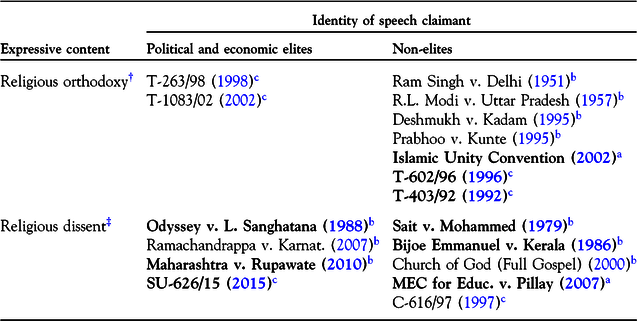
As indicated in Table 6, none of our courts have defended orthodox religious expression advanced by elites. This record likely results in part from the fact that such expression is not typically subject to state repression, but the Colombian Court has had two opportunities, which it has not taken up. The tutela ruling T-263/98 (1998) is particularly notable, as the Court emphasized the relative social power of the parties in seeking to define the limits of permissible religious speech. In this case, a school teacher claimed that a local priest infringed upon his right to a good name by characterizing school activities as diabolical and demonic, blaming the teacher for the state of affairs, and urging the community to remove him.Footnote 44 The priest pleaded freedom of expression and religion in defense, but the CCC concluded that the social power differential between teacher and priest put the teacher in a disadvantaged position and hence justified restrictions on the priest’s defamatory statements.
Judicial Protection of Religious Speech

Note: Boldface indicates speech-protective holdings. Case names have been abbreviated.
† Includes blasphemy or defamation directed toward religious minorities.
‡ Includes minority religious expression, secularism, and blasphemy or defamation directed toward religious majorities.
a South Africa.
b India.
c Colombia.
In the second case from the upper-left hand corner of Table 6, the Court again called attention to the authoritative position that Catholic priests hold in Colombian society when it ordered one to apologize for having referred to a minor with cerebral palsy as “a little animal.”Footnote 45 The tutela was originally filed after the priest refused to give the child communion and allegedly called him an animalito and “thing” during mass. The Court agreed with the appellate tribunal that there were no grounds for a tutela challenge on the matter of the withheld communion; given religious freedom, the church has full autonomy to define guidelines with regard to its rituals. But the Court underscored that the priest’s language was dehumanizing and not subject to the special protections that would otherwise apply to religious speech.
In a third case involving an elite claimant, the Colombian Court ruled in favor of a relatively well-resourced actor dissenting from religious orthodoxy. In SU-626/15 (2015), listed in the lower left cell of Table 6, the Court declined to shut down an allegedly blasphemous art exhibit. A private citizen had filed a tutela against the Ministry of Culture and the Santa Clara Museum, objecting to an exhibit by artist Maria Eugenia Trujillo entitled “Mujeres Ocultas” (Hidden Women). The exhibit included monstrances inlaid with vaginas, which the complainant found disrespectful to sacred symbols of the Catholic faith. Emphasizing the government’s duty to promote cultural activities and the constitutional protections afforded to artistic freedom, the Court ruled that the exhibit did not fall within any of the categories of speech restriction that have constitutional standing in Colombia (namely, war propaganda, apology for national, racial or religious hatred, and invitation to discrimination, hostility, or violence). Allowing the exhibit to take place was not an action by the state to offend or favor a particular religion; instead it was an effort to promote access to artistic expressions.Footnote 46 If the speech claimant here were the artist alone, we might code this case as judicial protection of a non-elite claimant, but the claimants included the Ministry of Culture and a government-run museum, which we have coded as elites.
Likewise, the Indian Court has on two occasions been willing to extend speech protections to well-resourced claimants engaged in religious dissent. In Odyssey Communications v. Lokvidayan Sanghatana (1988), the Supreme Court considered a High Court injunction, issued at the behest of two NGOs, prohibiting broadcast of certain episodes of a television series entitled “Honi-Anhoni.” According to the show’s critics, its continued broadcast was not in the public interest because it “had the effect of confirming blinds faiths [sic], superstitious beliefs in stories of ghosts, rebirth, precognition etc. and of spreading the unscientific way of thinking and blind beliefs.” In response, the show’s producer contended that the series was actually intended to condemn superstition and provide scientific explanations for purportedly supernatural phenomena. Relying on this latter characterization, we have coded the speech content as secularism. The Supreme Court ruled for the producer, vacating the injunction as inconsistent with Article 19.
When an Indian publisher released a paperback version of Shivaji: Hindu King in Islamic India, a book authored by James Laine, professor of religious studies at Macalester College in Minnesota, communal violence erupted and the State of Maharashtra ordered the book confiscated. The book allegedly included “scurrilous and derogatory references to Shri Chhaptrapati Shivaji Maharaj,” a historical figure revered by Hindus. In the Supreme Court’s view, however, “[t]he effect of the words used in the offending material must be judged from the standards of reasonable, strong-minded, firm and courageous men, and not those of weak and vacillating minds, nor of those who scent danger in every hostile point of view. The class of readers for whom the book is primarily meant would also be relevant for judging the probable consequences of the writing.” In Maharashtra v. Sangharaj Damodar Rupawate (2010), the Court sided with Professor Laine and his publisher.
Three years earlier, a case similar in many respects had come out the other way, with the Indian Court declining to protect a 1995 novel entitled Dharmakaarana, which recounted the story of Basaveshwara, a Hindu poet-saint, and his family members. After the novel was designated for a government award, a group of worshipers of Basaveshwara filed a lawsuit to prevent the state from awarding the prize, alleging that passages depicting the sister of the poet-saint having an illegitimate child were “objectionable, inflammatory, hurtful and insulting.”Footnote 47 In Sri Baragur Ramachandrappa v. Karnataka (2007), the Supreme Court ruled against the novelist, noting that the historical record did not warrant the insinuation about the sister, and hence that the passages had been “deliberately designed to be hurtful and to bring the family to shame.”Footnote 48 The Court ordered that all copies of the book be seized.
The Indian Court has also rejected multiple free speech claims advanced by Hindu nationalists, who were politically marginal relative to the country’s governing secular-nationalist party, the Indian National Congress, until the mid 1990s. The speech claimants in Ram Singh v. Delhi (1951) were three named officers of the Hindu Mahasabha of the Delhi State, who had given a series of public speeches that allegedly incited disaffection between Hindus and Muslims. The Court held that preventive detention laws did not target speech explicitly and therefore were not subject to challenge under Article 19(1)(a).Footnote 49 The Indian Court has likewise displayed little patience for religious speech that borders on incitement. Although the facts giving rise to Ramji Lal Modi v. Uttar Pradesh (1957) are not precisely clear, the publisher of a magazine dedicated to cow-protection (a prominent issue for Hindu nationalists early in the country’s democratic history) was arrested for reprinting “an article or a cartoon about a donkey” which had previously provoked an “agitation … by the Muslims of Uttar Pradesh.”Footnote 50 The Court rejected the free speech appeal, holding that prohibitions on religious incitement were reasonable under the Indian Constitution.
The Supreme Court remained largely committed to this position even during the volatile 1980s and 1990s, when Hindu-nationalist appeals grew increasingly prominent in Indian politics. In a pair of 1995 decisions, the Court ruled against candidates from Hindu-nationalist political parties who made statements on the campaign trail that seemingly incited religious and communal tensions. In one case, a candidate for the Hindu-nationalist Bharatiya Janata Party (BJP), distributed a campaign poster urging voters “to teach a lesson to Muslims.”Footnote 51 In the other, two political candidates running on the Shiv Sena ticket delivered a number of speeches containing pro-Hindu and anti-Muslim themes.Footnote 52 In both cases, these candidates were convicted for corrupt practices under Section 123 of the Representation of the People Act, 1951. The Supreme Court recognized that the Act could not be interpreted to prohibit the discussion of religion or even religious nationalism during elections. Nonetheless, in both cases the Court confidently declared that the speech acts at issue constituted corrupt practices beyond the protection of Article 19(1)(a). As such, the Court set aside the Hindu nationalist candidates’ electoral victories. In each of these cases, the Court declined to extend free speech protections to religious nationalists who expressed a particular version of the society’s dominant religion, but who themselves were positioned outside the country’s governing elite.
In Colombia, the Constitutional Court has on occasion ruled for non-elites engaged in orthodox religious expression. In T-602/96 (1996), the CCC safeguarded a priest’s freedom to engage in religious practice in public spaces, particularly in public cemeteries.Footnote 53 Presenting himself as both a Catholic and Anglican priest, Father Arango Marín alleged that the company operating two of Bogotá’s biggest cemeteries had forbidden him from saying mass and worshipping on the premises. The Court held that freedom of worship does not hinge on accreditation, and hence that Arango Marín’s rights had been violated, regardless of whether he was a certified priest. In so holding, the Court highlighted the importance of freedom of expression to the realization of freedom of worship, and it emphasized that the freedom to express one’s religion must be available to all persons without discrimination. Catholic prayer is clearly orthodox religious expression in Colombia, but here the plaintiff was a solitary and possibly self-proclaimed Catholic priest, acting without institutional support from the Church. Hence, we have coded him as a non-elite claimant.
In T-403/92 (1992),Footnote 54 the CCC ruled in favor of an individual’s right to use a loudspeaker, several hours per day, to proclaim his evangelical faith. Neighbors claimed that the individual’s house was not a place of worship and that his use of amplified sound was disrespectful toward others’ religions and their ability to rest, sleep, or watch television. The police forbade Sierra Hernandez from using the speaker without official permission, and his request for a permit was denied by the Mayor’s office. The first-instance court denied the tutela, but the CCC reversed, voiding the prohibition and directing the lower court to determine whether there was a public forum in the Gaitán neighborhood.
One South African case also falls in the upper right cell of Table 6. In Islamic Unity Convention v. Independent Broadcasting Authority (2002), the SACC struck down a provision of the Code of Conduct of the Independent Broadcasting Authority which prohibited broadcasters from conveying material “likely to prejudice relations between sections of the population.” The provision came under attack after the Islamic Unity Convention, owners of a community radio station, aired a program in which a historian suggested that Jews had not been gassed during the Holocaust and questioned Israel’s legitimacy as a state.Footnote 55 While the Court acknowledged that the comments raised countervailing dignity concerns under the Constitution, it held that the regulation itself was inappropriately vague and risked interfering with freedom of expression.Footnote 56 The speech claimant here was an organization representing members of the country’s Muslim minority and operating well outside the standard corridors of power, and we have coded it as non-elite. The speech content is a closer call, as the radio broadcast might be read as minority religious sentiment, but it also represented defamation directed against a religious minority (South Africa’s Jews), and we have coded it as such.
Finally, in three cases, the Indian or South African apex courts have ruled in favor of a non-elite claimant seeking to engage in religious dissent. In MEC for Education Kwazulu Natal v. Pillay (2007), the South African Court came to the defense of an ethnically Indian student who refused to remove a nose stud that she considered a symbol of cultural expression. The Court resolved the case largely in terms of equality rights, but also noted that the ban imposed serious limits on the student’s right to express herself.Footnote 57 In Ebrahim Suleiman Sait v. M.C. Mohammed (1979), the Indian Court proved willing to tolerate campaign speech that implicated the often volatile ethnoreligious divisions in India, on the grounds that such speech was inevitable in a political system which contained communal political parties.Footnote 58 In this case, the Muslim League candidate had successfully contested a seat for the Lok Sabha (India’s lower house). As part of his campaign, he denounced the opposing candidate from the Muslim League (Opposition) Party for his willingness to align with the Janata and Marxist parties, warning that they “not entertain the fat hopes of securing the votes of any Muslim, in whose head the Islam’s blood was flowing.”Footnote 59 The Court interpreted the speech at issue as fair criticism of another political party rather than an attempt to incite religious hatred.Footnote 60 We treat it as minority religious expression on the part of a candidate operating outside India’s governing regime. In Bijoe Emmanuel v. State of Kerala (1986), the Indian Court also ruled in favor of a group of students who refused to sing the National Anthem because it conflicted with their faith as Jehovah’s Witnesses. The children and their elder siblings had for several years made a practice of standing in respectful silence during the mandatory singing of the anthem at school, but once the matter came to the attention of a state legislator who viewed the behavior as unpatriotic, school officials instructed the Head Mistress to expel the students. Looking to case law protecting the rights of Jehovah’s Witnesses in Australia, Canada, and the United States, the Supreme Court held that public-school authorities could not constitutionally expel the students for a sincere and nondisruptive expression of their faith.Footnote 61
The Indian Court had one additional opportunity to protect a non-elite claimant engaged in minority religious speech, but declined to do so in Church of God (Full Gospel) in India v. K.K.R. Majestic Colony Welfare Association (2000). Here, the Court ruled against a Pentecostal church that had violated a noise pollution statute by using musical instruments and microphones during religious services. The Court argued that no religion necessarily required worship with the aid of electronic amplification or loud instruments and therefore the church was subject to the same rules as everyone else.Footnote 62
The Colombian Court also declined to protect free expression for a non-elite religious dissenter who challenged the constitutionality of several statutes that required specified persons to swear under oath. In C-616/97 (1997), the Court argued that while swearing under oath has religious origins, in its pluralist contemporary legal understanding, the religious character has been greatly diminished. Swearing under oath is a way to reaffirm the link between the person and the truth of what is being said, and it is important as a way of establishing proof in the judicial context. As such, the Court found that swearing under oath does not compromise a person’s beliefs, their ideology, or moral judgments.Footnote 63
In sum, the Indian, South African, and Colombian apex courts have never extended the constitutional protection of free speech to orthodox religious expression by political and economic elites. Most of the cases protecting religious expression (six of nine) have involved claimants dissenting from religious orthodoxy (i.e., the boldface cases in the bottom row of Table 6). The other three judgments in favor of free expression claims (those in the upper-right cell) have involved non-elite actors expressing orthodox religious sentiment.
CONCLUSION: JUDICIAL EMPOWERMENT, BEYOND A ZERO-SUM GAME
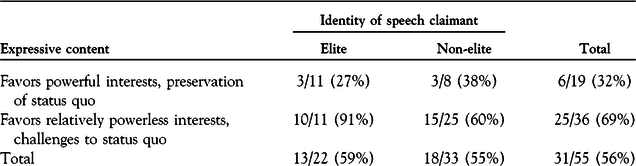
We close by reviewing the aggregate patterns from the cases we have examined. From the Colombian, Indian, and South African apex courts, we have identified a total of fifty-five judgments involving sexually explicit, economic, or religious speech acts. These judgments are summarized in Table 7.
Aggregate Judicial Protection of Sexually Explicit, Economic, and Religious Speech

Two dimensions of this data are worthy of note. First, judicial protection of free expression rights results from claims brought by both elite and non-elite claimants. As indicated in Table 7, we have identified thirteen cases in which courts ruled in favor of free expression claims advanced by political or economic elites. These cases stand as potential evidence for top-down accounts of the effects of judicial empowerment, though it is worth noting that from a civil-libertarian or democracy-enhancing perspective, many of these decisions serve to advance important democratic and constitutional values and establish legal precedent. In Khushboo, for example, the Indian Supreme Court ruled in favor of a speech claim advanced by a well-known film celebrity, but the holding cleared space for all Indians to write and read about sexual practices departing from traditional conservative norms. Likewise for the Print Media South Africa case, in which the SACC ruled in favor of a claim brought by an association of leading national newspapers, magazines, and publishers.
As Table 7 makes clear, judicial protection of free expression rights often results from claims brought by non-elite actors as well. Indeed, the win rate for such claimants is comparable to that for elite claimants, but given the larger denominator, the courts have protected the speech of non-elite claimants more often than that of elites (eighteen as compared to thirteen). Given their distance from governing political regimes and their relative lack of material and legal resources, some of these non-elite claimants seem unlikely candidates to have their interests reflected in any state institutions. For example, in Bijoe Emmanuel, the Indian Court followed in the tradition of West Virginia State Board of Education v. Barnette (1943) by ruling in favor of public-school students for whom mandatory patriotic salutes conflicted with their minority faith tradition. Jehovah’s Witnesses were no more politically powerful in late-twentieth century Kerala than they were in mid-twentieth century West Virginia, but the Court was nonetheless willing to rule in their favor. Likewise, in National Union of Public Service & Allied Workers, the South African Court ruled in favor of a public employee union, several of whose members had been fired for publicly calling for dismissal of the head of the National Lotteries Board.
Second, and most notably, whether brought by elite or non-elite claimants, judicial decisions favoring free expression claims often served to protect persons engaged in dissenting or unorthodox speech. In SU-626/15 (2015), for example, the Colombian Court extended constitutional protection to an artistic exhibit that many Colombians viewed as disrespectful toward sacred symbols of the Catholic faith. A full twenty-five of the thirty-one cases ruling in favor of free expression claims involved labor advocacy, unorthodox religious speech, or nonmainstream expressions of sexuality. Indeed, the difference between the rows in Table 7 is much larger than the difference between the columns, with a win rate in cases involving dissenting speech acts that is thirty-seven percentage points higher than in cases involving orthodox speech. In other words, these activist apex courts appear more protective of dissenting than of orthodox speech, irrespective of the elite or non-elite status of the claimants. If these three constitutional courts are willing to protect the expression of labor advocacy, of religious blasphemy, and of nontraditional sexual norms—even if they sometimes protect more orthodox speech acts as well—then there is good reason to believe that judicial empowerment in these societies has played out in ways not fully controlled by political and economic elites.
This conclusion is conditioned somewhat by our case selection strategy. We used a most-likely case design, arguing that if we did not find evidence of judicial support for individuals who challenged the status quo in these relatively assertive apex courts, then we would not expect to find such behavior anywhere in the Global South. And yet we do. Accordingly, while we cannot conclude that we will observe such judicial behavior in all Global South courts, our findings are consistent with other studies that call attention to the sorts of “bounded activism” that judges exhibit even in authoritarian regimes (Moustafa Reference Moustafa2007). Together, the evidence from Moustafa’s account of the Egyptian Court and our account of the Indian, Colombian, and South African courts suggest that judges regularly rule in favor of non-elite claimants in varied settings. This conclusion is also in line with Brinks and Blass’s (Reference Brinks and Blass2018) work on Latin American courts, which shows that depending on the original institutional design and the subsequent political context, empowered high courts may be relatively inclusive and expansive. Our findings, therefore, suggest one way of reconciling the debate over “who benefits?” Namely, while elite and mass interests may often be in tension with one another, judicial institutions may operate in ways that provide distinct benefits to both. In other words, judicial empowerment need not be a zero-sum game. This fact may help to explain why non-elites often view courts more favorably than electoral institutions, despite their potentially counter-majoritarian nature, because courts frequently provide meaningful benefits to a diverse range of political actors.
In sum, even if they are empowered by political and economic elites, activist courts can develop a practice of rights-protection that benefits a diverse range of less-powerful actors. The question of whether and why such actors are likely to succeed in particular cases likely turns on varying patterns of legal mobilization support structures, judicial preferences, and broader political contexts. The interaction of such factors merits further research. For example, we note that the courts’ rulings in favor of free expression for sexually explicit speech seem in large part to involve cases where the speech acts consist of artistic expression or social commentary, rather than pure pornography or immature mockery. The pro-labor speech holdings in South Africa may reflect the historic ties between organized labor and the governing ANC regime, even where we have coded particular claimants as non-elite actors. The pro-religious speech holdings appear to reflect a genuine judicial commitment to protecting the right to dissent from religious orthodoxy, but we have no illusions that this commitment would extend to all religious dissenters in all contexts, particularly when ostensibly independent courts are captured by governing religious coalitions.
In future work, we plan further comparative investigations of the political beneficiaries of judicial power. Some existing literature suggests that courts may be particularly likely to rule for regime interests on issues of central concern to the regime, but may have more leeway to rule for a wider range of interests on more peripheral issues. Whether characterized as courts exercising “bounded activism” (Moustafa Reference Moustafa2007) or performing a “safety-valve role” (Gloppen and Kanyongolo Reference Gloppen and Kanyongolo2006), the cases we have reviewed here are consistent with this story, and we close by reiterating that issues of only peripheral concern to governing regimes are sometimes quite important to the non-elite claimants who raise them in court.