This paper examines two intertwined processes that helped shape life in Tehran in the 1950s. One was a ravenous demand for electricity, part of a surge in popular expectations for mass consumer goods and higher living standards that began in mid-century; the other the 1958–1961 construction, to meet that demand, of a massive hydro-electrical dam, 180 meters high and 390 meters long, on the Karaj River 60 kilometers north of Tehran.Footnote 1 This double story, and more particularly the crucial role that societal actors played in it, illuminates society-state and domestic-global interactions characteristic of post-colonial, Third World countries during the Cold War.
The mass consumer society that began to emerge in the 1950s in Tehran, and thereafter across Iran, was not a bolt from the blue.Footnote 2 While in the West twentieth-century mass consumerism was rooted in the rise of consumerism of the seventeenth and eighteenth centuries, in Iran its origins are found in the nineteenth century.Footnote 3 That is when Western, Russian, British-Indian, and Ottoman goods began to arrive there in greater quantities than in the disordered eighteenth century, aided by Iran's greater stability under the Qajars (1794–1925) and trade agreements imposed by several European powers. After mid-century, courtiers and wealthy merchants, especially in the growing capital, Tehran, started to display wealth more openly.Footnote 4 The Constitutional Revolution's mass politics (1905–1911) helped popularize some goods like photographs, and at the same time debates intensified about the consumption of certain imported goods such as Western cloth.Footnote 5 In the 1920s and 1930s, Reza Shah Pahlavi's state (1921/25–1941) expanded roads and railways that helped create a national market. An emerging modern middle class joined what had been a small pool of people who could afford consumer goods. In Iran's largest cities new avenues lined by modern shops were central for marketing, selling, and buying such goods, while new leisure spaces like parks and novel “Western-style restaurants serving Western dishes” provided opportunities to display some of them.Footnote 6
Still, this was a far cry from the mass consumerism that grew in the second half of the century.Footnote 7 Post-revolutionary political instability, World War I, the Depression, and World War II each cut into consumerist habits. The autocratic Reza Shah's state cared little for consumption and much for production and construction, typified by its financing of its Trans-Iranian Railway by means of a steep sugar and tea tax.
The social class basis for mass consumerism was not yet given and did not crystallize until the 1950s. During that decade, Tehran's middle classes, in particular, grew more quickly. They enlarged their presence in a city whose population between 1950 and 1960 doubled to two million, and they had more money and time to buy and enjoy goods. Key reasons for this development were a rise—and after 1963, a boom—in state employment, due mainly to the state's growing revenues after Iran's 1954 50-50 profit-sharing agreement with an international oil consortium, and a laissez-faire monetary policy that made loans more readily available.Footnote 8
Make no mistake, the start of a mass consumer society in 1950s Tehran was not seamless. Different modes of retail, marketing, and purchase coexisted and would continue to do so. Most crucially, the majority of Tehranis, including many a provincial immigrant, remained poor and demanded above all cheaper basics—food, cloth, heating. In 1953 and 1954, for instance, a wave of protests against high-priced staples rocked Tehran.Footnote 9 Still, the above-mentioned socio-demographic and politico-economic changes did usher in a mass consumer society of hundreds of thousands of upper- and middle-class people in Tehran and in provincial cities. Electricity demand skyrocketed, advertisements flourished, consumer festivals and other modern marketing techniques boomed, and department stores opened, while tirades against “materialism” grew louder.Footnote 10 Mass consumerism exerted a dream-like attraction on the poor, as well.
I will argue here that this growing mass consumerism was shaped importantly by one domestic and two global processes.Footnote 11 Understanding these processes, together with the socio-demographic and politico-economic changes just sketched, helps explain why we can talk about an emerging mass consumer society in 1950s Tehran, at a time when the material lives of the majority of the city's inhabitants were dominated by scarcity.Footnote 12
At home, material expectations were fueled by a “politics of promise,” which together with severe repression, especially against leftists, and some cooptation, was initiated in 1953 by Mohammad Reza Shah Pahlavi (1941–1979) and his elite politicians and technocrats to help stabilize their shaky government after a CIA-royalist coup d’état toppled popular Prime Minister Mohammad Mosaddeq.Footnote 13 (Before 1963 the shah was a primus inter pares more than the autocrat he then became.) Part of this politics was the aforementioned laissez-faire monetary policy, which between 1955 and 1960 helped quintuple imports,Footnote 14 especially of Western mass consumer goods. These, in turn, encouraged some Iranian producers to adapt modern marketing techniques.
These developments were the domestic side of a coin whose global side was the acceleration in the 1950s of mass consumerism, particularly in the capitalist “First World” but also in the Soviet and eastern European parts of the “Second World.”Footnote 15 Through increased exports, this momentum affected certain places and classes in “Third World” countries.Footnote 16 It was further energized by the Cold War, which brought about a capitalist-versus-communist competition of consumerist models that also played out in the Third World.Footnote 17
Against this background, a first key reason for the Iranian government's construction of the Karaj Dam was to meet a popular consumerist demand for electricity. This demand also had foreign political implications, which constitute a second reason the dam was constructed. The United States was interested in Iran because of its oil and long Soviet border,Footnote 18 and after the 1953 coup became the patron to Iran's client state. Iranian officials transferred the consumerist pressures they felt at home onto Washington, D.C. This tactic helped to maintain U.S. fears about Iran's stability: its administration felt it had to help finance the dam despite technical and fiscal reservations on the part of American technical experts and the U.S. Congress.Footnote 19 A third reason the dam was constructed, linked to the first, was the shah's urge to legitimize himself and Iranian technocrats’ “building big” bias in development.Footnote 20 In sum, while, the Karaj Dam was built by the government and partly financed by the United States, it was not simply a state project;Footnote 21 it was caused and demanded by, and in this sense belonged to, Tehranis as well.
The argument that in post-coup Iran popular material demands, especially those of urban middle classes, influenced state dam and electricity planning and, more broadly, foreign policy and domestic politics (of promise), is relevant beyond Iran.Footnote 22 It helps us to understand interactions between the Cold War and Third World development, and the interplay, in the latter process, between societal and state actors.Footnote 23 Building on and invigorating extant analyses, Odd Arne Westad has shown that the Third World was a central Cold War arena.Footnote 24 Similarly, David Engerman and Corinna Unger have advocated a global history of modernization that studies it “not as an American export but as a global phenomenon that was hotly contested, between blocs but also within them.” In consequence, they have called for “local studies [as] an excellent avenue to … global studies of modernization without losing sight of regional, national, and international circumstances.”Footnote 25 My analysis here builds on these overlapping research agendas, but looks beyond their shared focus on state, NGO, and international-organization elites.Footnote 26
Analyses of development and the Cold War in the Third World need to more seriously factor in ordinary people. Although led by elites, Third World development was also driven by material and often mass consumerist expectations, especially among sizeable—and in many parts of the world bourgeoning—urban middle classes. During the Cold War this meant that American or Soviet or other Western and Eastern patrons were affected by the elites as well as by the society of their client states. In the Third World, “the state” did not always ram development projects down “society's” throat.Footnote 27 The urban middle classes and/or other non-subaltern societal actors often gave these projects their blessings or even pushed for them.Footnote 28 Put differently, elite actors and subaltern actors or victims—the focus of most students of development—were not the only ones involved in or touched by development.
This does not mean that all Third World middle classes were the same; they differed greatly, including politically. The urban middle classes of Iran, from 1953 an increasingly autocratic state, were, like the country's population in general, disenfranchised and in this sense had little in common with, for instance, their Indian counterparts. And yet, across the post-war Third World the ranks of the middle classes swelled, their material expectations grew, and they rode on a mass consumerist wave whose crest was in the capitalist West (but which touched also the communist East).Footnote 29 While the Third World was a minor market for Western companies, in the eye of the Third World, middle-class beholder, the goods on display in shops and advertisements far exceeded those of their pre-war experiences. This situation, together with a more general hunger for higher living standards, had a marked effect both on economic development and on Cold War politics.
*****
In a 1955 letter that “the inhabitants of [Tehran's] Baqirabad Street” sent to the editor of Ittila‘at, Iran's largest daily paper, they complained, “We have been forced to use the Khui Leather Factory … for lighting.… [But] unfortunately, the only thing we have seen of electricity is a wire and [some] tools.… Hence, we request that special [state] investigators … order the company to fulfill its written obligations.”Footnote 30 The Baqirabadis were not alone, and outrage over faulty goods and services abounded in Iran's post-coup press. Tehranis had started to care about electricity a decade earlier, during World War II, when they needed reliable radio reception. This small increase in electricity demand was met because as of 1939 Tehranis were consuming only 8.5 mw of a total of 10.5 mw of power then available to the city. This was a sharp increase from 1.5 mw in 1934, the year the government had entered the capital's electricity market. Into the 1940s, “people did not welcome electricity and were not ready to give up their oil lamps, to the point that the municipality was forced to condition [the issuance of] purchase licenses of shops in Lalezar and Islambul Streets on [subscription to] electricity.” Not by chance, although Iran's 1939 total of 20 mw had by 1948 risen to 90 mw, its non-industrial consumption rate, at 23 percent, remained considerably lower than its neighbors’ rates, and its 12 kwh per capita usage was eclipsed by Turkey's 32 kwh and Lebanon's 64 kwh that same year.Footnote 31
It was about this time that the government began taking electricity expansion seriously. One reason was that it adopted a more integrated vision of development.Footnote 32 In 1946, the government commissioned a U.S. firm, Morrison-Knudsen, to prepare a mixed consumerist-productivist development plan.Footnote 33 Regarding power, the firm reported that hydroelectricity had to wait for urgently needed river flow measurements. For now, they advised, Iran's plentiful oil and gas should be used, in forty-four towns, to power small diesel-driven and larger steam-turbine plants.Footnote 34 In 1949, the new Plan Organization (PO) commissioned a more detailed plan. The plan's authors, the U.S. company Overseas Consultants, retained Morrison-Knudsen's mixed approach: electricity is “essential in industrial production … [and] in raising standards of living.” It also stressed that Iran's many private and hence decentralized, costly, and unreliable grids fell short of present needs, and would soon be wholly inadequate. It recommended the building, through 1956, of oil-driven thermal central power stations totaling 220 mw and “immediate investigation … of water power.” Although more expensive than city-based thermal stations, dams built in mountainous areas produced cheaper electricity, which eventually amortized construction costs.Footnote 35 There were soon improvements; Tehran municipality in 1948 installed an 8 mw U.S. Westinghouse generator; in 1952, the Tehran Power Bungah, founded in 1949, proposed to soon raise the capital's power output to 75 mw. By March 1953 the PO had transferred funds to forty-eight cities to allow them to build power stations totaling 25.3 mw, and by that fall Tehran's capacity had risen to 21 mw. “Conditions have improved since 1948,” a trade report affirmed.Footnote 36
Many advances still existed only on paper,Footnote 37 and the 1949 Seven-Year Plan shored up rather than reorganized defective, privately owned grids. In 1951, many larger schemes were shelved when an international oil boycott, spearheaded by Britain to punish Iran for nationalizing the Anglo-Iranian Oil Company (AIOC), slashed Iran's budget.Footnote 38 Imports of electricity-generating equipment decreased.Footnote 39 To make matters worse, this was at the very time electricity demand mushroomed. In Tehran, families took to installing small generators for themselves and their neighbors.Footnote 40 People demanded better lighting and talk grew about new uses for electricity, especially home appliances. While imports of the latter began in the interwar years, it was only now that development plans pointed out their role in raising living standards and that popular magazines enthused about their part in Western mass consumerism.Footnote 41
In short, by 1953, electricity reform was of public interest and underway, and demand was on the rise, but implementation lagged far behind. Forty thousand Tehrani families were waiting for their subscriptions to be processed. Estimates about future needs grew by leaps and bounds, reflecting also the city's rapid population growth from around one million in 1950 to two million in 1960.Footnote 42 Quick action was required, and improvements indeed were made. Iran's overall spending on imports of electricity-generating equipment, including by private investors, rose from 120.6 million rials in 1953 (via a dip of 94.7 million rials in 1954) to 233.9 in 1955, 289.8 in 1957, 904.5 in 1959, and 888.5 in 1960.Footnote 43 In Tehran, milestones were the installment of three diesel generators totaling 3.9 mw in 1954, a 10 mw Westinghouse power station in 1957, and a 50 mw French Alstom station in 1959, as well as the 1961 inauguration of the 63 mw Karaj Dam.Footnote 44 This 700 percent increase in eight years, from 21 mw in 1953 to about 150 mw in 1961, eclipsed all past advances. Nonetheless, these increases in output were overwhelmed by the pitiless demand for more and more electricity, a situation that beset all of Iran to various degrees.Footnote 45 Tehran's electricity crisis was grave also because substantial growth, though continuously promised since the coup, only began with the Westinghouse station in 1957. Until then and into the 1960s, private suppliers remained important, and they hurried to reap maximum profits with minimum investments. Customers had to live with this situation faute de mieux, but complained about it ever louder as it dragged on.Footnote 46
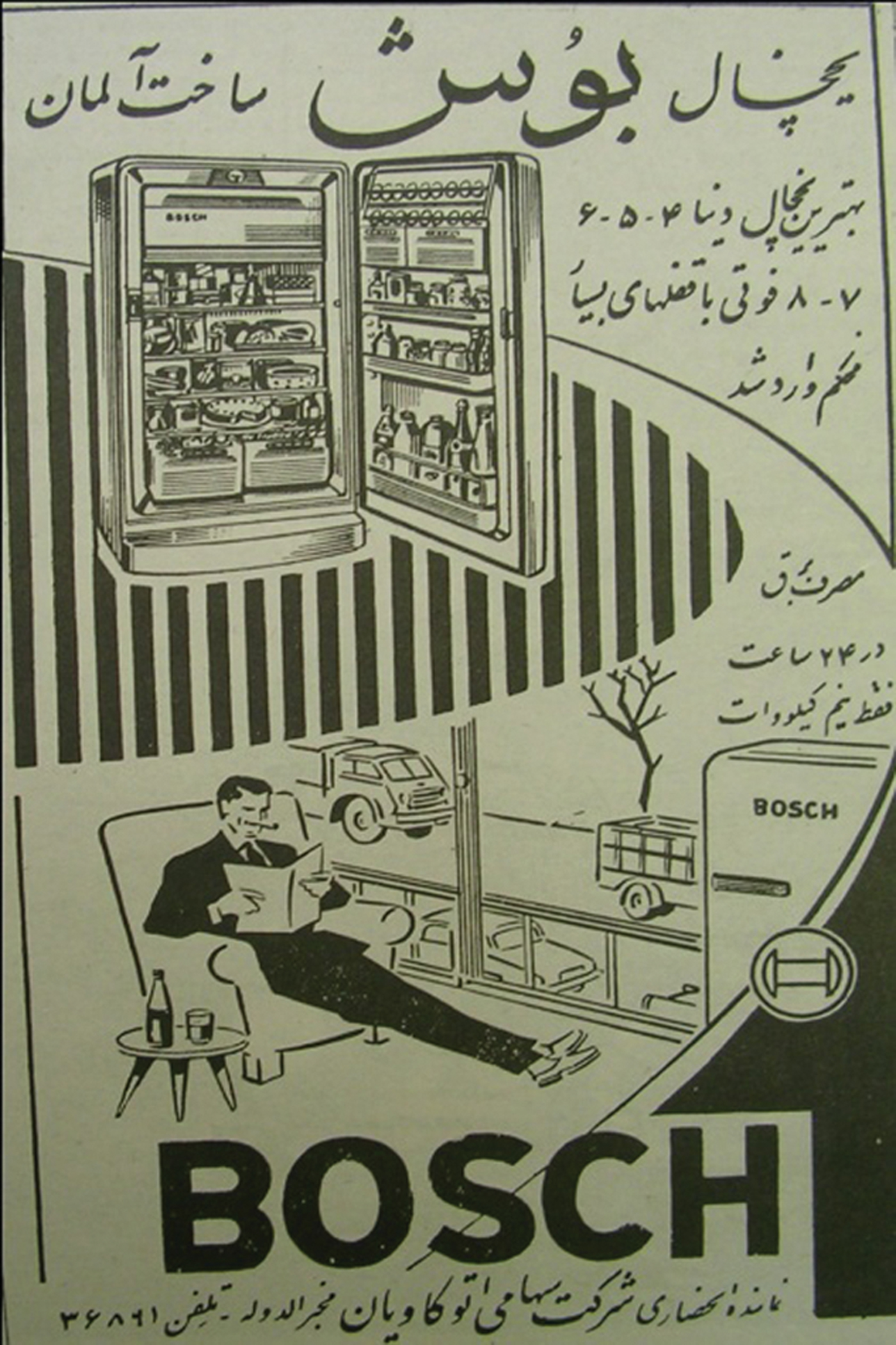
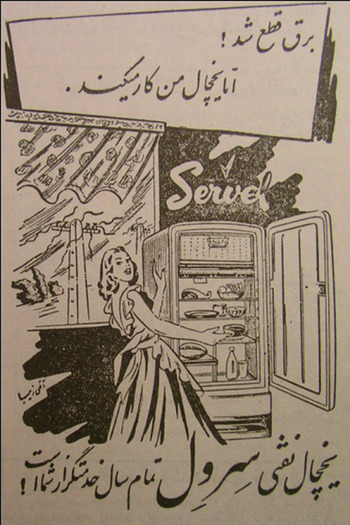
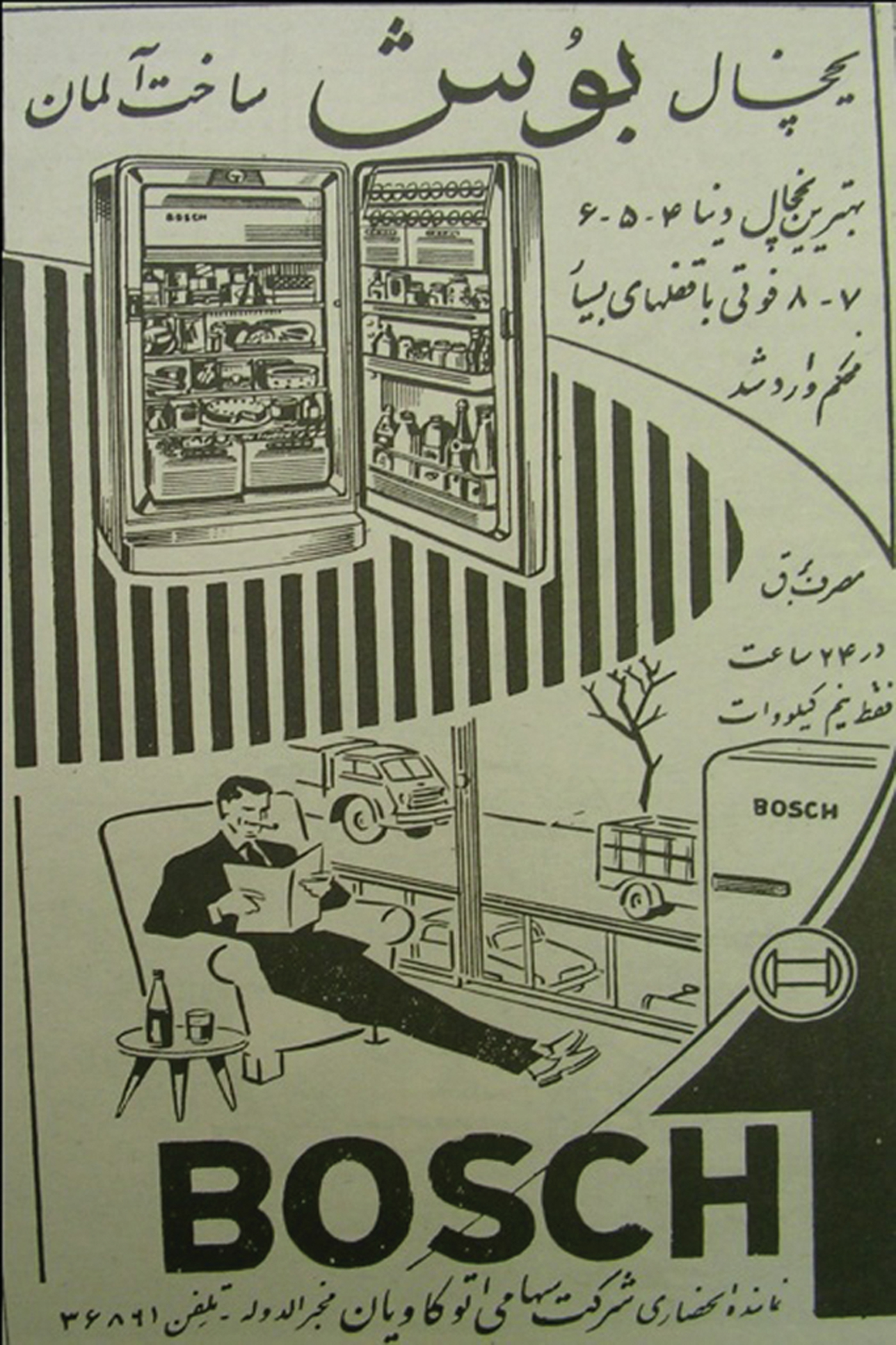
Unsurprisingly, the way people now talked about electricity differed sharply from the past. One Hassan Mir-Husseini was livid during his 1957 trial for having illegally tapped the municipal electricity grid: “In today's world, one should not have to live in the light of an oil lamp!” He claimed that his turn for a subscription had been immanent but—yet again!—delayed. The status quo being unbearable, he had to take matters into his own hands.Footnote 47 It is telling that electricity became a selling point in advertisements for apartments. “A house for rental or sale in Pahlavi Street” in 1958, for instance, had “10 ampère” tension.Footnote 48 Such precise information made sense only because supply trailed demand. But alas, once in a flat with electricity, many people faced the same problems as the Baqirabadis: low voltage, electricity cuts, and network breakdowns. Consumers’ impatience with these problems was noted, reflected upon, and possibly reinforced by foreign suppliers of home appliances.Footnote 49 Some advertisements for refrigerators, amongst the most popular of these new products, praised low consumption and twinkled with promises of the sort of relaxed life enjoyed by the employee shown in image 1.Footnote 50 Other ads, for oil-driven models, harped on electricity's unreliability. “Power is out! But my fridge is working”: the housewife in image 2 is all smiles and laughter.Footnote 51
“Yakhchal-i Bosch,” Ittila'at (18 Mar 1958: 18).
“Servel,” Ittila'at (26 May 1955: 10).

A different, growling sound came from newspaper editorial comments, short notices, reports, and letters to the editors. These were the opposite, complementary side of the dreamland sorts of advertisements—they portrayed electricity as a fundamental, non-negotiable modern need.Footnote 52 Why, asked an Ittila‘at journalist with thinly disguised racism (and some hurt pride?), is Tehran's electricity supply less reliable than that of many Afghan villages, not to mention neighboring capitals like Baghdad or Ankara and Western cities?Footnote 53 Such questions abounded, and Tehranis and residents of provincial towns sent a steady stream of letters to the newspaper complaining about specific electricity providers and state officials. Editors egged them on, but also fêted advances in the capital and beyond.Footnote 54
Electricity was not the only impatiently demanded infrastructure. People wanted also better roads and canalization.Footnote 55 Such demands partook of a still wider one, heard particularly in cities, for better goods and higher living standards. Often all of these demands were voiced in one breath,Footnote 56 but they were also distinct. The demand for clean water, though as pressing as any other, dated back to the late nineteenth century. Electricity, by contrast, now was not simply a necessity but a sign of modernity.Footnote 57 To the publishers of a children's book series launched on the Iranian New Year, 21 March 1954, “electricity” and “light” were important elements in “preparing your children for a new life.” Nuclear power signified the future, and generators and power stations featured prominently in descriptions of new neighborhoods like Tehran Pars.Footnote 58
Tehran Pars and the other neighborhoods that received electricity in the 1950s were situated in Tehran's eastern, western, north-central, and northern parts, much less so in its poorer south-central and southern core.Footnote 59 The former parts were the capital's middle- and upper-class neighborhoods. For the sizeable minority of Tehranis—about 30 percentFootnote 60—who had or were applying for electricity, power was a sign of modernity and a precondition not only for lighting but for consuming a range of products.Footnote 61
Put differently, electricity and the demand for it were part of a phenomenon that in the 1950s was emerging in Iran and maturing in the West: mass consumer society. This was spearheaded by Western producers and consumers who were riding an “economic miracle” wave that swept aside and past the Great Depression and World War II, and eclipsed the pre-war roots of mass consumerism, which had been especially strong in the United States.Footnote 62 But it was a global phenomenon, too.Footnote 63 It was not simply that Iranian merchants imported more goods, especially from the West; retail was starting to become more diverse in Tehran, most visibly when, in December 1957, the first department store, Furushgah-i Firdawsi, opened to great popular fanfare. (Soon, customers were caught shoplifting.)Footnote 64 As Western exporters to Iran introduced revolutionary marketing methods, which some local producers copied, countless Iranians started to experience consumption in new ways, especially in Tehran and provincial cities. Consumer competitions in which people were asked to choose a name for a new product, and consumer festivals, processions, and puzzles attracted masses eager to gain fame, win a prize (always a product), or at least obtain free samples.Footnote 65 Sometimes mass production itself was turned into a virtual act of consumption: the glass façade of Tehran's Pepsi Cola factory on Eisenhower Avenue allowed drivers and pedestrians to see the production line.Footnote 66 Also, newspaper advertisements increased and were transformed—they became imaginative and told stories. Some included photographs of “regular” people consuming a particular product.Footnote 67 In Tehran, only a sizeable middle- and upper-class minority could afford Western consumer goods and, more specifically, demanded and ultimately received electricity. But marketing meant that the masses became window shoppers and dream consumers, and even real consumers of cheaper products like Pepsi and Coca Cola.
Electricity demand, and mass consumerist expectations and habits more broadly, unfolded hand in hand with a major domestic political development after the coup: the politics of material promise. This politics was one way by which the new government around the shah and Prime Minister General Fazlollah Zahedi (1953–1955) tried to stabilize its shaky position. In the wake of Mosaddeq's ouster on 19 August 1953, the new government was as fragile financially as politically.Footnote 68 “Shock[ed] [by] the depth of the crisis,”Footnote 69 the United States on 5 September announced a grant of $45 million, and in 1954 it bankrolled 60 percent of Iran's budget. It also jump-started military assistance and boosted development aid, which it had slashed in 1952. Iran's geo-strategic importance—its 2,000 kilometer-long border with the Soviet Union halfway between the two pillars of Washington's Soviet containment strategy, Western Europe and East Asia—made it the second-largest recipient of U.S. assistance in the Middle East and South Asia until 1961.Footnote 70 It was far from being truly stable, however. Although Washington believed it had prevented the worst by stopping an Iranian population high on nationalism from stumbling into Moscow's open arms in 1953, the long Soviet border remained a threat. More crucially, the CIA-royalist coup had badly shaken the shah's already wobbly legitimacy, especially in the eyes of pro-Mosaddeq nationalists and communists amongst the urban, modern middle classes and working classes.Footnote 71 This problem could not be fixed by repression (particularly of the powerful communist Tudih party), by overtures to some nationalists, and by accommodation of commercial and landed elites, alone, and popular political participation, the bedrock of Mosaddeq's legitimacy, was ruled out.Footnote 72 Something else was needed.
Five days after the coup, the shah exhorted Iran's merchants to help assure that “the general living standard rises.” In the fall, a Tehran Radio broadcast marking Zahedi's first three months in office contrasted his “round-the-clock efforts to reduce your [Iranians’] problems and pains” with Mosaddeq who “had [burdened Iran] with more problems every day.” It conveniently ignored that food protests had been minimal due to Mosaddeq's legitimacy, born of his popular politics, including the 1951 nationalization of AIOC. With winter's first snow, “all of Tehran's poor” were promised “coal and cloth.”Footnote 73 Reacting to already vigorous consumerist expectations and protests against inflation, officials and the shah made countless similar pledges.Footnote 74 Once opened, this Pandora's box could not be closed. Pledges crystallized into a novel politics of material promise, which was politically crucial all the more because Iran's population, particularly in urban areas, was growing implacably.Footnote 75 This politics was not limited to the supply of basic staples, which had stabilized in early 1955 after persistent popular protests.Footnote 76 It helped to rush the government into an “expansionary monetary and credit policy.” This, in turn, encouraged excessive state spending and buoyed mass consumer goods imports, which underpinned Iran's emerging culture of mass consumerism.Footnote 77
At this same time, various bureaucracies attended to and vied for control of infrastructures, building roads and clean water supplies. Electricity was the key new infrastructure. Bureaucrats first sought to expand it by trying to coerce and cajole private electricity entrepreneurs into improving the many, often disparate thermal and diesel electricity generators and grids. Before long, they were entering the electricity market with ever-greater force themselves (and, in 1965, the market was finally nationalized). Crucially, since in about 1950 electricity demand surpassed supply, Iran's new rulers after the 1953 coup faced a fait accompli that they could only manage, not control. The politics of promise was a key element of its management of this crisis. It exacerbated the electricity situation by further inflaming expectations and by implicitly turning 19 August 1953 into zero hour. Expectation of material improvement became so high and the need to sustain the image of a post-coup leap forward so pressing that the improvements that were accomplished were insufficient to avert a torrent of popular critique.
Hence, although Ittila‘at was owned by Senator Abbas Masudi, who had close links to the government,Footnote 78 it almost daily published complaints against private electricity suppliers as well as mayors, the Tehran Power Authority, the PO, and ministers—in short, all but the shah and Zahedi. As harsh as such criticism often was, the government had to accept it as the flipside of a politics of promise developed from a position of weakness. Meanwhile, this politics revealed a complex governing structure. The shah engaged in talks with the Americans, helped form the Karaj Dam Authority in 1953, and protected both it and the Tehran Power Authority (established in 1949) from jealous ministers. Publicly, he had a hand in specific projects and cut inaugural ribbons, allowing top Tehran Power Authority officials like director Ajudani to help spearhead governmental promises regarding electricity and to shape policy.Footnote 79 The shah's token presence, especially in the public eye, reflected his status as a primus inter pares as well as the relative influence of other actors. Yet this also meant that the politics of promise was neither a precise tactic nor designed and implemented from the very top downward. Rather, it was a general way of muddling through practiced by a range of bureaucrats, politicians, and government members.
Characteristically, six months after the coup the Tehran Power Authority presented a fifteen-point list of all the improvements accomplished since zero hour.Footnote 80 Authority officials spoke an unprecedented “service” language that addressed complaints, encouraged Tehranis to communicate problems to them, and promised to improve services.Footnote 81 In the meantime, the PO and Tehran municipality continued the pre-coup policy of certifying small, private electricity suppliers. But the limitations of that policy soon became manifest. Consumers continued to criticize sloppy private services and, before long, also inadequate state oversight. In January 1954, a new law governing private suppliers was passed,Footnote 82 and soon municipalities, too, became more active. Officials organized citizens’ reunions at which they listened to complaints and promised remedies.Footnote 83 Despite this, in the late 1950s protests increasingly homed in on Tehran municipality for its presumed lack of initiative and its insufficient control of the private market. Such critiques were facilitated by attacks that rivals such as senators and PO and Tehran Power Authority bureaucrats were waging against the municipality. Many officials made promises and most tried to redirect public ire toward their inferiors, and all of them bolstered a discourse of promises that exacerbated popular demands.Footnote 84
This affair transcended domestic affairs and had international dimensions. I have already introduced one of these: Iran's gradual integration into a West-centered, though ultimately global mass consumer culture. Another concerned the Soviet Union.Footnote 85 In January 1954, a text on Tajikistan was published in Payam-i naw, Iran's leading Soviet Persian-language journal, founded in 1945 to serve the Moscow-funded Soviet-Iran Association and, by extension, the Tudih, by far Iran's biggest party and the Middle East's strongest communist organization. As one would expect, the article painted a glowing portrait of Tajikistan, which it said enjoyed “large fruit gardens, high-quality cotton fields that tractors plough with great attention, [and] tall electricity transmission poles that cross fields and deserts.” In short, it was a paradise that fed everybody, with an industrialized economy that was steamrolling poverty and a state that literally went the extra mile to provide everybody with equal services. While stunning in their flourish, these images condense how Soviet writers and Iranian visitors to the USSR, not all of who were communists, depicted socialism's motherland. What was true of the “autonomous” Tajik republic—a land of “valleys immersed in sun” that was as Muslim as Iran but “rejuvenated” after ages of feudalism—was true of the entire “family of the Soviet republics,” the world's citadel of justice and equality.Footnote 86 Unlike the capitalist West, here no-one went hungry, and all had a shirt to wear and a roof to sleep under. Education was free, and culture flourished. There was work for all, and many were able to buy a television, radio, or even a car. Indeed, while praising social mobility, the Soviet republics’ equality, and religious freedom, Payam-i naw texts about the USSR stressed one thing above all: equal material welfare.Footnote 87 They highlighted the three basics of food, clothing, and housing, a savvy thing to do when addressing poor, Third-World Iran, but they also mentioned consumer goods. The authors seemed to imply that there was no area in which the USSR trailed the West.Footnote 88 Electricity played an important supporting role in Payam-i naw's reports on the USSR.Footnote 89 Before the revolution, Tajikistan did not even know of electricity; now, extensive power grids fed by “countless” motors and hydro-electrical stations leapt to mind when describing a Muslim Central Asian republic like Uzbekistan.Footnote 90 Soviet electricity was cheap and available even in the remotest kolkhoz. What a difference from Tehran, or even the West!Footnote 91 Most crucially, perhaps, electricity drove progress. Lenin had understood this early on, and after World War II accelerated electricity expansion strengthened both welfare and industrialization. It foretold a great future, too: the Soviets were building the world's biggest hydro-electrical stations and powerful nuclear reactors.Footnote 92 Who, the authors seemed to ask, could doubt their superiority?
Payam-i Naw was closed down soon after the coup, as were Iran's high-circulation communist dailies immediately thereafter. Still, the USSR remained a possible alternative model and a political threat in post-coup Iran's debate about consumption and electricity.Footnote 93 (It is telling that when the shah visited Moscow in June 1956 in a move calculated to prod Washington into maintaining aid, the Soviets offered to build Iran hydro-electrical dams.) The late Stalinist attention to non-socialist, Third World Iran, and to standards-of-life as a part of the developmentalist model it presented to Iranians, was exceptional,Footnote 94 but after Stalin's death there was a growing trend toward this approach. Under Nikita Khrushchev, Moscow's attention to non-socialist Third World countries grew. Also, and again unlike Stalin, Khrushchev “sought to maintain industrial production while increasing the availability of consumer goods.” Indeed, Soviet economists now maintained, “The victory over capitalism would be assured … by increasing the Soviet standard of living,” and this was formalized in the 1957 Seven-Year Plan.Footnote 95 The following boom rekindled a belief, shared by Western liberals, in the possible, ultimate superiority of socialism,Footnote 96 and this became part of the Cold War.Footnote 97
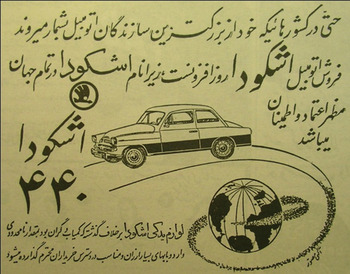
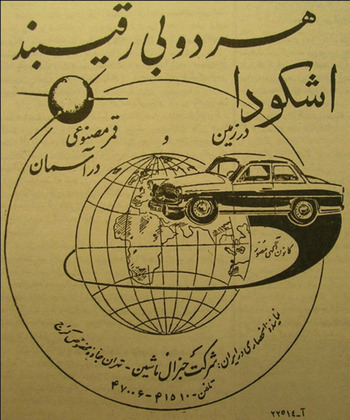
Iran was fully part of that war. I have already noted that Payam-i naw, and pre-coup Iranian communist papers ridiculed U.S. developmentalist aid actions (such as importing Cypriote jackasses, with their proverbial dumbness portrayed as epitomizing American cluelessness).Footnote 98 And while the Tudih was repressed after the coup, Soviet radio broadcasts in Persian continued apace. They praised Moscow not only as the protector of world peace but also as the guarantor of fair development, and damned American and international development aid to Iran as “colonialist.”Footnote 99 With Khrushchev's rise, the Soviet Union and Communist-block countries again intensified exports to the Third World (Iran came second in 1953 and 1955, and fifth in 1956). They made an impression at trade fairs and even organized them, as the Czechs did in Tehran in 1954.Footnote 100 And although they focused on industry, they also sold cars and home consumer goods. The domestic electrical products displayed included electricity counters, transformers, kitchen appliances, and sewing machines.Footnote 101 Sometimes advertisements for “communist” products were associated with communist symbols; in one, a red star shined down on a Moscowich car “for all.”Footnote 102 Cold War competition shone through advertisements in more patent ways. In the one in image 3, Škoda boasts about inroads into “the biggest car-producing countries,” that is, the West. Its resemblance to image 4—which appeared a mere week later, after Sputnik's launch, and reads “both are peerless, Škoda on earth, the satellite in the sky”— captures how the 1950s Soviet “standard of life” advance zigzagged between the USSR's need to catch up with the West and the conviction that it would soon do so.Footnote 103 The latter belief was not lost on Iranians, nor was the belief among Westerners that this feat might well be possible.Footnote 104
Advertisement in Ittila‘at (8 Oct. 1957: 9).

Advertisement in Ittila‘at (17 Oct. 1957: 11).

*****
On a January afternoon in 1954, eleven men convened a meeting in the Washington, D.C. headquarters of the U.S. Foreign Operations Administration (FOA), which oversaw U.S. Third World technical assistance, known as “Point Four.”Footnote 105 Norman Paul, the FOA organizer of the meeting, wasted no time in telling them why they were there: “The reason [I have] asked for the meeting [is] that members of the staff have certain questions and reservations about the Karaj Dam project.”Footnote 106 The participants, including FOA head Harold Stassen, knew that both “the Shah and Prime Minister [Zahedi] feel that [the Karaj Dam] is the most important project in Iran, economically, as a monument, as a source of power and water for Tehran, and as a source of irrigation for the area surrounding Tehran.”Footnote 107 They were also aware that Karaj Dam advocates in Iran were preaching to the choir: the idea of the dam dated back to the 1920s and gained wide popularity in the 1940s. It had become more concrete between 1946 and 1951 with World Bank, American, and French surveys and some preparatory work, before being shelved in 1951 with the oil nationalization crisis.Footnote 108
They and other American officials concerned with this project were of two minds. William Warne, from 1951–1955 the first head of the FOA/United States Operations Mission-Iran (USOM-I), for instance, had made a u-turn after the coup. Before that he had campaigned for extensive, low-cost rural assistance as the best way to develop Iran's economy, winning over Mosaddeq despite the latter's interest in dams.Footnote 109 After the coup, though, he became “enthusiastic” about the Karaj Dam project, “although he realize[d] that there are problems involved.” In contrast, “Walker Cisler of the Detroit Edison Company, FOA consultant on electric power … [felt] that thermal power could be developed more quickly and for less money.” Many FOA officials and other bureaucrats shared Cisler's objections, and it was these concerns that had necessitated the January 1954 FOA meeting.Footnote 110 But as it disbanded their orders were clear. “Mr. Stassen … concluded that … we cannot now throw up to the Iranians a mass of negative considerations without creating an explosion. The project may not be the best solution, but it does meet the political requirements” of buttressing the new, rickety Iranian regime.Footnote 111
Worried Iranian officials maintained pressure: they passed on to Washington the stressful demands with which Tehranis confronted them for much more and cheaper electricity as part and parcel of a growing mass consumer culture, and they issued ominous warnings about the political consequences of answering “no.” This pressure climaxed during an October 1954 visit by Khalil Taleghani to Stassen. The Karaj Dam Authority director dramatically stressed Tehranis’ desire to see material progress after Mosaddeq's removal. Visible steps were imperative, and the Karaj Dam was the best prospect.Footnote 112 Pressure was also put on the Americans by Abol-Hassan Ebtehaj, from 1954 to 1959 the head of the powerful Plan Organization.Footnote 113 In an October 1954 meeting with U.S. Ambassador Loy Anderson, timed to coincide with Taleghani's visit of Stassen, Ebtehaj claimed that Iran was waiting “with baited breath for [the] U.S. decision…. These decisions might determine whether or not Iran would be able [to] lay firm foundations for its future economic and social development.”Footnote 114 The pressure of Tehrani electricity demands on Iran's government is clear from a revealing example of the politics of promise: the Karaj Dam adorned 10 rial bills in 1958, three years before the dam's inauguration.
By 1955, the FOA and the State Department had accepted the Karaj Dam construction as a fait accompli, but the debate was not over. It flared again the following spring, and this time not in a FOA back room but in the U.S. House of Representatives. Many legislators were attacking FOA's allegedly wasteful, mistakenly state- rather than market-led, and politically futile Third-World assistance program. They argued that it fed nothing but the delusions of a clique of New Dealers.Footnote 115 While Point Four had had its share of critics since its start in 1949,Footnote 116 the conservative backlash during the Eisenhower administration was particularly scathing (and paralleled a domestic rollback of New Deal public dam building).Footnote 117 The scope and rush of Washington's aid to post-coup Iran made that country a perfect target for attacking the FOA more broadly and establishing legislative control over a new field of executive action, whose sprawling nature mirrored the global reach of the new American superpower. In spring of 1956, the Government Operations Committee's International Operations Subcommittee in the House of Representatives initiated a series of fifteen hearings about USOM-I. The subcommittee submitted its conclusions in early 1957: “Aid and technical assistance programs in Iran,” it asserted, “were administered in a loose, slipshod, and un-businesslike manner.” The Karaj Dam in particular, it said, was a bottomless pit into which USOM-I was throwing millions without stipulating any production timeline or obtaining financial assurances from Iran.Footnote 118 This congressional inquiry buoyed those American critics who charged that FOA operations worldwide were often grandiose and wasteful. To some, Iran was the example for what had gone wrong, and the Karaj project was at the very heart of the problem.Footnote 119
But such analyses were partial—attacking the FOA for the Karaj Dam, and making Warne a bogeyman, ignored the key role played by Iranian officials. The latter turned their weakness into a strength by playing on American worries about Soviet gains in a fragile post-coup Iran.Footnote 120 In matters of infrastructure and development, although Tehran received money from Washington, it pursued aggressive policies that at times clashed with the agendas of certain U.S. decision-makers.Footnote 121 Put another way, without the Cold War and resultant U.S. aid, the Karaj Dam might not have been built, or at least it would have been built later than 1958–1961. But that it was built despite protracted American opposition reveals both the limits of the U.S. patron's power and the leverage of its Iranian client. In January 1954, Stassen's concluded that “the political factor is overriding,” and we must agree with that assessment—the Karaj project was unstoppable for political reasons. U.S. congressional protests and internal FOA dissent faltered in the face of Iranian pressure and State Department acquiescence. Major construction started in 1958, and three years later, in October 1961, the dam's electricity flooded Tehran.
Directly responsible for this success were the shah, Prime Minister Zahedi, and technocrats of the Karaj Dam Authority and the PO. It was they who made the decisions and pushed the Americans. Indeed, not only the Karaj Dam but dams in general received strong support from various technocratic quarters.Footnote 122 As for the shah, his enthusiasm for the Karaj Dam extended to his backing numerous other dams.Footnote 123 In his eyes, dams expedited development, were a powerful symbol of his commitment to modernize the country, and would help him gain legitimacy.Footnote 124 The shah also visited dams abroad, for instance in India and Japan. (Such visits were customary; Indian Prime Minister Jawaharlal Nehru visited the Karaj construction site.)Footnote 125 This international dimension was vital for Iran's technocratic planners, too. Their journals discussed and depicted both Iranian and foreign dams and other developmentalist projects and emphasized the help that foreign specialists gave to Iran.Footnote 126 That most Iranian technocrats stressed the importance of dams was unexceptional: dams were a common means for Third-World countries to competitively show, and show off, their aspirations for modernity, and a way for their technocrats to connect with and even join the increasingly well-networked, global technocratic elite.Footnote 127
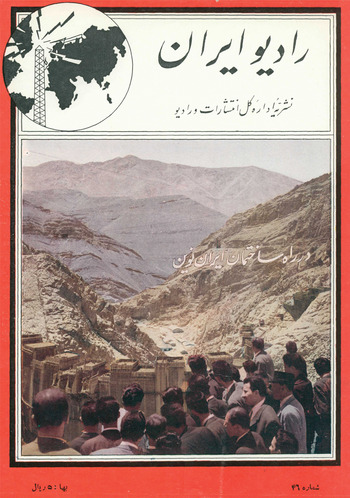
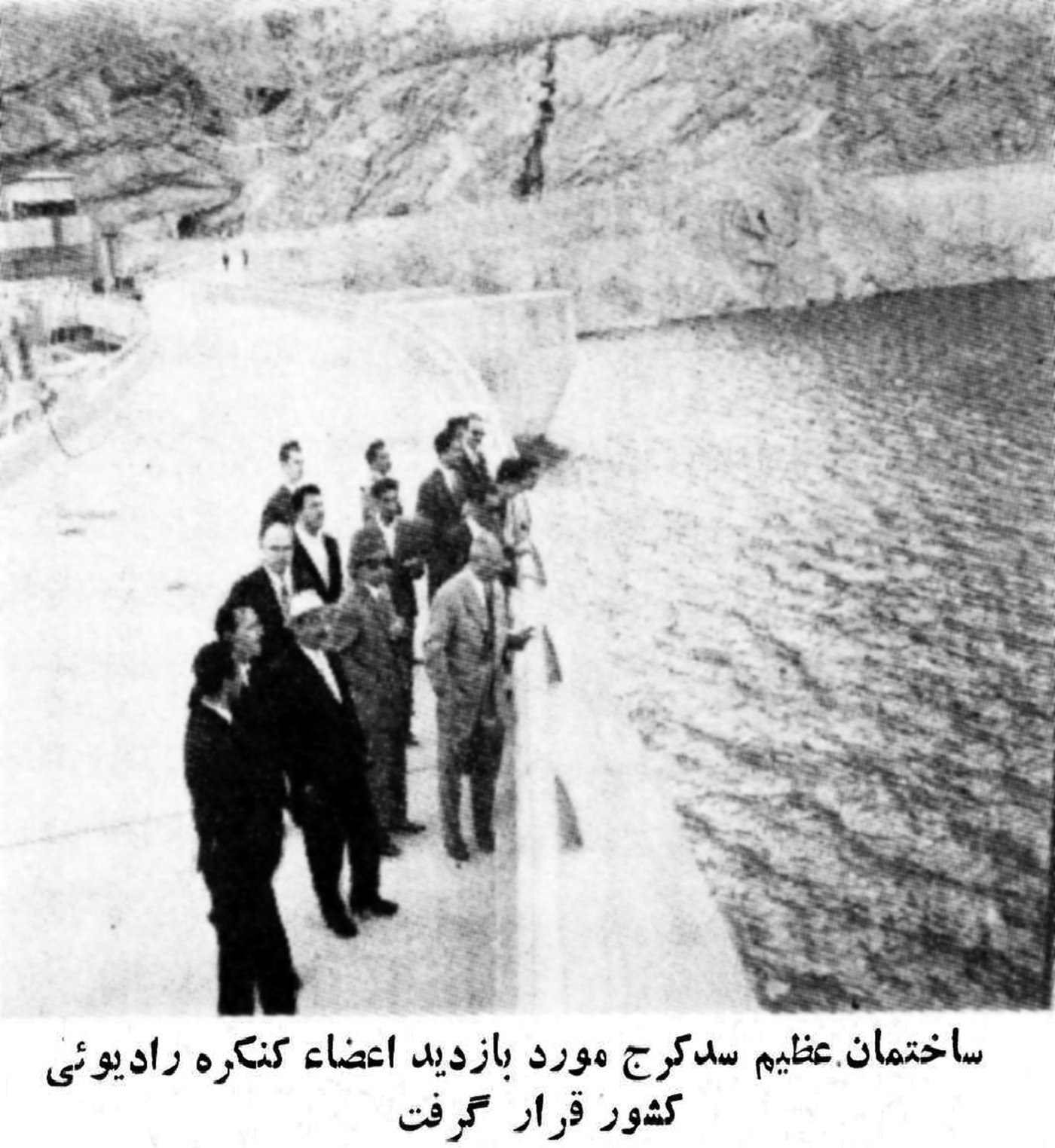
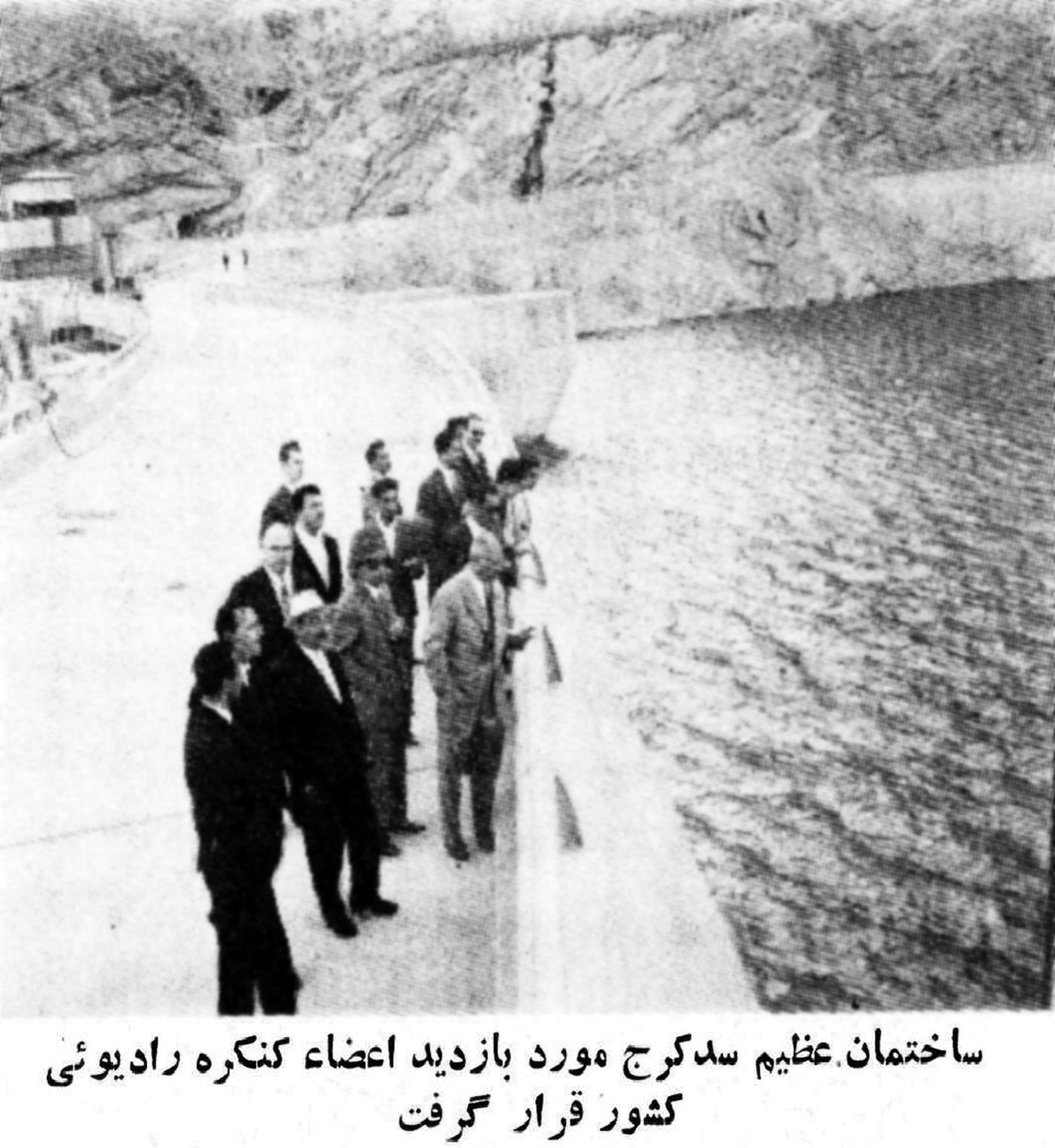
What is more, state agencies and employees tirelessly communicated with the public about development projects. Dams like the Karaj adorned bills and stamps, teachers explained them to students, and they were discussed on radio programs. Radio Iran organized tours “for representatives of different classes of people” to the Karaj construction site, and after the dam's inauguration officials attending conferences in Tehran sometimes used their leisure time to visit there.Footnote 128 But did the people shown in image 6 visit the dam simply as Radio Iran employees? And did the people in image 5 go to the building site simply because the state invited, or perhaps ordered them to be there, or because it manipulated them by educational means, bills, or radio programs? That was not the case; if, as shown earlier, the Karaj Dam was intended to meet a ravenous demand for electricity, then more was involved in its construction than high politics or elite technocratic considerations. Persistent, popular expectations were a powerful impetus.
The cover of Radio Iran 46, from 1960.

“Kungrih-yi radio-yi kishvar,” from Radio Iran 70 (1962): 11.
The belief in a massive technological solution to Tehran's electricity crisis had old roots and enjoyed contemporary support far beyond the technocratic elite. In the interwar years, many small dams were repaired or constructed across Iran, and this may have helped prepare the ground for the planning of larger dams.Footnote 129 We have seen that the idea of building a dam on the Karaj River to improve Tehran's water supply was first formulated in the 1920s. It began to receive more serious consideration in the 1940s, at which point its electricity component also became important. The state was at that time administratively and financially incapable of turning the idea into reality, but it was already popular, as was the notion of dam construction more generally. Its advocates included the powerful Ayatollah Abol-Ghassem Kashani and Prime Minister Mosaddeq. Talking with USOM-I head Warne in 1952, Kashani opined, “The friendship between the United States and Iran might be strengthened … if we built one or two large, spectacular dams … on the Ziandehrud River near Isfahan … [and] on the Karun in Khuzistan.” Mosaddeq longed for “some big, spectacular project, like a dam, undertaken to provide the immediate action which Iran craved.”Footnote 130 In fact, construction of Iran's first large dam after World War II, the Kuhrang, commenced during Mosaddeq's tenure as a democratically elected prime minister. A few persons critical to the post-coup planning of the Karaj Dam had held key positions under Mosaddeq, such as his Minister of Agriculture Taleghani. Even before Mosaddeq's tenure, specialized journals had started to seriously publish about dams and report government progress on a number of small ones.Footnote 131 It is clear that the post-coup flurry of dam constructions was far more than a high-modernist autocratic idea of the shah and a few technocrats; it had solid historical roots and considerable popular support.
This did not mean that after 1953 all dams received equal public support. For example, Ebtehaj's enormous Dez Dam project in Khuzistan, started in 1955, was often attacked as inanely expensive, of little use, and beneficial mainly to foreign contractors, planners, and financers, and Ebtehaj's rivals even managed to have him imprisoned for a few months in 1961 and 1962.Footnote 132 It is telling that no such accusations were directed against the Karaj Dam. Critiques of dams often focused not on the fact that they were built but rather on their faulty construction.Footnote 133 Financial and political reasons help to explain this difference. The Karaj and a host of other smaller dams were cheaper than the Dez Dam, which was the only dam in Iran explicitly patterned on the model of the Tennessee Valley Authority. Moreover, the main builders of the Karaj Dam were the Karaj Dam Authority and the Tehran Power Authority rather than the PO, whose director Ebtehaj talked so bluntly and had such contempt for the older ministries that he lost his post in 1959. But the fundamental reason for the widespread acceptance of the Karaj Dam was not that it was the linchpin of a grandiose technocratic vision of development, but rather that it met a popular need.
Popular embrace of the dam was expressed in cultural practices surrounding the dam, and these had historical precursors. During the 1928–1939 construction of the Trans-Iranian Railway, Iran's first massive modern technological project, crowds often attended opening ceremonies of this station or that track section.Footnote 134 The railway was “a spectacle,” not only as an exhibition of “western technique on a grand scale”Footnote 135 but also as a new, impressive leisure site. In the late 1930s, “no sooner had the first train pulled into Shahi than people from Tehran, too impatient to wait for the road bed to reach the capital, patronized the railway, mixing pleasure with patriotism. First they traversed hundreds of kilometres by automobile over the Elburz mountain range, then boarded a Persian train in Shahi for a 120 kilometre journey to Bander-Shah only to return immediately.”Footnote 136 Riding the train was an end in itself—it mixed pleasure with the use of modern technology, which in turn induced a feeling of belonging to modernity. One might say that such practices formed part of a complex process of becoming modern. The railway was not exceptional in this regard, and in the 1950s Tehran's Mehrabad International Airport became a popular leisure destination for Tehranis, a place where families could watch planes while pampering their palates in a café.Footnote 137
Against this background, we can grasp that peoples’ visits to the Karaj Dam are more than state-organized events. Beginning in the early 1960s, family excursions there became a cultural practice for tens of thousands of middle- and upper-class Tehranis. They went simply to see it and to take in the enormity of a paragon of modern technology, and perhaps to picnic, promenade, or hike near the dam basin, or even to practice water sports on the lake.Footnote 138 Consider “Visit to Karaj Dam, Iran 1962,” a short, amateur 8 millimeter film accessible on YouTube.Footnote 139 It begins with a quick shot taken from a moving car of the mountains above the dam. It then cuts to the dam wall: a shot from afar, pure cement, not a soul in sight. The dam is placed at center stage here, an enormous structure that demands respect even from a distance. The next cut is a radical change of dimension and perspective, and we find ourselves in a roadside parking space next to the dam basin. We see people walking about, sitting in cars, or chatting in standing groups. They have become the center, and by making the dam the stage on which they socialize, they domesticate and appropriate it, and turn it from a monumental object into something almost banal, so much so that it literally disappears from the camera's view.
To be sure, it was the Pahlavi state that built the Karaj Dam. But what with that structure meeting the electricity demands of middle- and upper-class Tehranis, and their using it as a place of leisure, it belonged to them, as well.
*****
Today, even more than before 1979, the Karaj Dam area is a common leisure destination, and building dams remains as popular as it was in the Pahlavi past.Footnote 140 By examining that past, I have shown the possibilities of writing socio-cultural histories of development and the Cold War in the Third World.
For one thing, the cultural Cold War between a capitalist West and a communist East was tangible also in the global South. Furthermore, Third World elites as well as “ordinary people” like urban middle classes helped influence decision makers in the Cold War centers of Washington and Moscow, as well as in London, Beijing, and other powerful First World and Second World capitals.
Furthermore, by exploring the role of ordinary Third World, middle-class people in development I have illustrated that development was not a seamless process. Technocrats and ordinary people disagreed, including among themselves, not only about broad directional questions—More industrialization? More agriculture?Footnote 141—but also about policy specifics and the usefulness of particular projects. Certainly dams were in fashion in the 1950s and 1960s, in Iran not the least because they had a pre-war history. But the population, and to lesser degrees also the political and technocratic elites, debated the value of and justifications for specific projects. To middle-class Tehranis, the Karaj Dam made sense because it served their needs. By contrast, many criticized the Dez Dam importantly because it promised no tangible benefits. While the existence across many post-war countries of specific technocratic practices, like dams, suggests the existence of global trends, I have shown with the Iranian case that we must also keep sight of cultural idiosyncrasies and social constellations that gave different shapes to these trends.
Finally, this case study indicates the research possibilities inherent in connecting two fields of historiographic inquiry. One is the maturation of mass consumerism in the capitalist West (and the promise thereof, especially under Khrushchev, in the communist East), the other the role played in Third World development by emerging mass consumerism, and more broadly, by mushrooming expectations for higher living standards. These two subjects were linked on various levels, not least through trade and culture during the global Cold War. No doubt, Third World markets, where few could afford mass-produced consumer goods, were secondary at best to most Western exporters. Nevertheless, in a Third World capital like Tehran hundreds of thousands did buy goods, and many more dreamed not only of political emancipation but also of a materially better future, a dream that increasingly fed off images of a materially comfortable West.