Some scholars (Carmona Macías Reference Carmona Macías, Perea, Montero and García-Vudelta2004:321; Solís Olguín and Velasco Alonso Reference Solís Olguín, Alonso, Moctezuma and Olguín2002:444; Young-Sanchez Reference Young-Sanchez1996:107) have asserted that many, if not most, of the gold ornaments the Spanish found in the Basin of Mexico were imported from the Mixteca or likely made by Mixtec craftsmen working in Tenochtitlan or Azcapotzalco. This theory has been refuted (López Luján and Ruvalcaba Sil Reference López Luján and Ruvalcaba Sil2015:43–48; Nicholson Reference Nicholson and Boone1982:234–238) but persists in the assumption that any gold object in the South Mexican International Style (Bray Reference Bray and Mirambell1989:243, 246–251), also known as the Mixteca-Puebla tradition or Nahua-Mixteca Style (Pohl et al. Reference Pohl, Fields, Lyall, Fields, Pohl and Lyall2012:26), without provenience or with provenience outside the Basin of Mexico, was very likely made by a Mixtec goldsmith. By the late fifteenth century, however, the Triple Alliance (the coalition of Mexica of Tenochtitlan, Acolhua of Texcoco, and Tepaneca of Tlacopan established in 1428) had seen the development of a large, multi-ethnic, and highly skilled goldworking community in the urban centers of Tenochtitlan-Tlatelolco, Texcoco, Azcapotzalco, and Tlacopan, as well as neighboring towns, that each year produced thousands of gold ornaments, and exported an appreciable proportion of them to other regions of the empire.
There are three main lines of evidence for this development. First, the three early colonial tribute lists—the Codex Mendoza (Clark Reference Clark1938; Berdan and Anawalt Reference Berdan and Anawalt1992), the Matrícula de Tributos (Garcia Reference Garcia1997), and the Información sobre los tributos que los indios pagaban a Moctezuma, Año de 1554 (Scholes and Adams Reference Scholes and Adams1957) [abbreviated as Información of 1554]—document the large amount of gold tribute in native and bullion form that the Triple Alliance received from eight of its southern provinces. This, together with estimates of gold tribute from other sources, was equivalent to about 500 kg of pure gold annually, sufficient to make tens of thousands of gold ornaments. (Michael Smith [Reference Smith2014] has asserted that the term ‘tax’ should be substituted for ‘tribute’ in the Aztec context. I have retained the term ‘tribute’ pending further discussion in the literature). Second, the Spaniards who invaded the Basin of Mexico in 1519 reported very large quantities of fine gold objects that they encountered, and expressed great admiration for the skill of the many native goldsmiths, especially those in Azcapotzalco, near Tenochtitlan (Cortés Reference Cortés and Alcala1975:61; Díaz del Castillo Reference Díaz del Castillo and Cabañas1976:169). That there were indeed many goldsmiths was affirmed by Fray Bernardino de Sahagún (Reference Sahagún and Garibay Kintana1977:III:58). Third, Triple Alliance leaders followed a two-pronged strategy of using sumptuary artifacts for gifts as part of their system of political control, and as a means of developing trade in luxury goods, which required a high output of fine quality gold ornaments. The transformation of such a large amount of tribute gold in native and bullion form into ornaments could only have been achieved with a strong goldworking community in the urban centers of the Alliance.
Ornaments manufactured by these goldsmiths made their way to many parts of the empire as a result of trade, gift-giving, and even as spoils of war. Thus, some number of gold objects found far from Tenochtitlan, or of unknown provenience, likely originated in the Alliance urban centers. It is not yet possible to demonstrate this conclusively through archaeometallurgical studies that distinguish between gold objects made in these centers from those made elsewhere, although substantial progress has been made with a comprehensive analysis of the gold objects discovered in the Templo Mayor (López Luján and Ruvalcaba Sil Reference López Luján and Ruvalcaba Sil2015). This study found that the gold ornaments in a set of offerings associated with the deity Tlaltecuhtli dating to 1486–1502 had a chemical signature clearly distinct from that of Mixtec objects, as did a gold bar cast by the conquistadors and found in Mexico City in 1981. As I discuss below, however, this set of offerings is not necessarily representative of all gold ornaments produced at that time or later. Thus in many cases the presence of iconographic elements with particular Aztec connotations is key to distinguishing Aztec from Mixtec ornaments. In this paper, I use the term Aztec to refer to the people living in the Basin of Mexico under the rule of the Triple Alliance, irrespective of their ethnicity. The objects they produced were Aztec, made in an increasingly distinctive Aztec style, and were part of the Aztec culture.
THE NATURE OF AZTEC GOLD OBJECTS
Colonial writers recorded the wide range and high quality of objects made with gold in the Alliance centers. Hernán Cortés (Reference Cortés, Pagden and Elliott1986:100) wrote in his second letter to Emperor Carlos V, “[L]et me say that all the things of which Mutezuma has ever heard, both on land and in the sea, they have modeled, very realistically, either in gold and silver or in jewels or feathers, and with such perfection that they seem almost real.” Likewise, Peter Martyr, a member of the Spanish court, wrote to Pope Leo X about the Mexican jewelry Cortés sent to the Spanish emperor:
“If ever artists of this kind of work have touched genius, then surely these natives are they. It is not so much the gold or the precious stones I admire, as the cleverness of the artist and the workmanship, which much exceed the value of the material and excite my amazement. I have examined a thousand figures, which it is impossible to describe. In my opinion I have never seen anything, which for beauty could more delight the human eye” (Martyr Reference Martyr D'Anghera1912[1530]:2:46).
Sahagún (Reference Sahagún, Anderson and Dibble1950–1982:VIII:27–28) described the ornaments worn by rulers when they danced which included headbands with quetzal feathers highlighted with gold, drums covered with gold, and gold arm bands, earplugs, necklaces, and lip pendants (Figure 1). Fray Diego Durán (Reference Durán and Garibay Kintana1967:II:543) recorded that in a chamber, which contained treasure collected mostly in the late fifteenth century by the rulers preceding Moctezuma II (1502–1520), there was a mound of gold, jewels, and precious stones, as high as a man, as well as gold dishes, porringers, elaborately worked platters, and chocolate cups. When disassembled this all produced three heaps of gold of unknown purity weighing over 600,000 pesos (2,800 kg) (Díaz del Castillo Reference Díaz del Castillo and Cabañas1976:203). In addition, Moctezuma II had amassed much gold and jewelry in his own palace (Sahagún Reference Sahagún, Anderson and Dibble1950–1982:XII:46–47). The inventory lists accompanying the treasure shipments to Spain during the 1520s (Saville Reference Saville1920:15–18, 21–31, 56–101) set out the impressive nature and extraordinary variety of the gold ornaments that the elite of the Triple Alliance prized. They included anthropomorphic figures that often incorporated other materials such as green stones and feathers, animals including eagles and turtles, flowers, arms such as shields and spear-throwers, jewelry, and tableware. Gold was also applied as loops, stripes, and streamers, and formed into chains and clasps. The largest recorded object was a disk of gold with a representation of the Mexican calendar on it, which Moctezuma II gave to Cortés for the Emperor of Spain; some 150 to 210 cm in diameter and 0.2 to 0.4 cm thick, it probably weighed 18 to 22 kg (Saville Reference Saville1920:36).
Tocuepotzin, a nobleman from Texcoco, with gold ear and lip ornaments, gold necklace, and gilded armband and leggings (Durand-Forest Reference Durand-Forest1976:f. 105r). Photo from, and reproduction authorized by, the Bibliothèque Nationale de France.

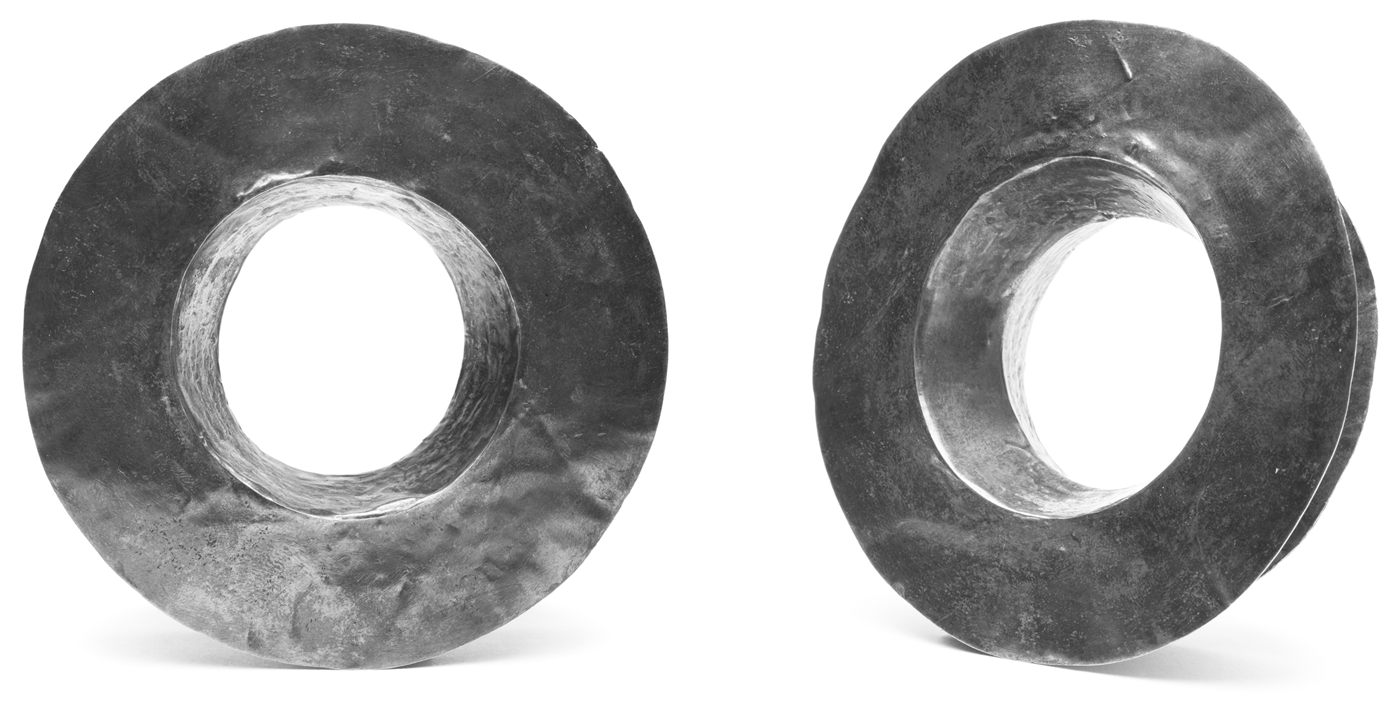
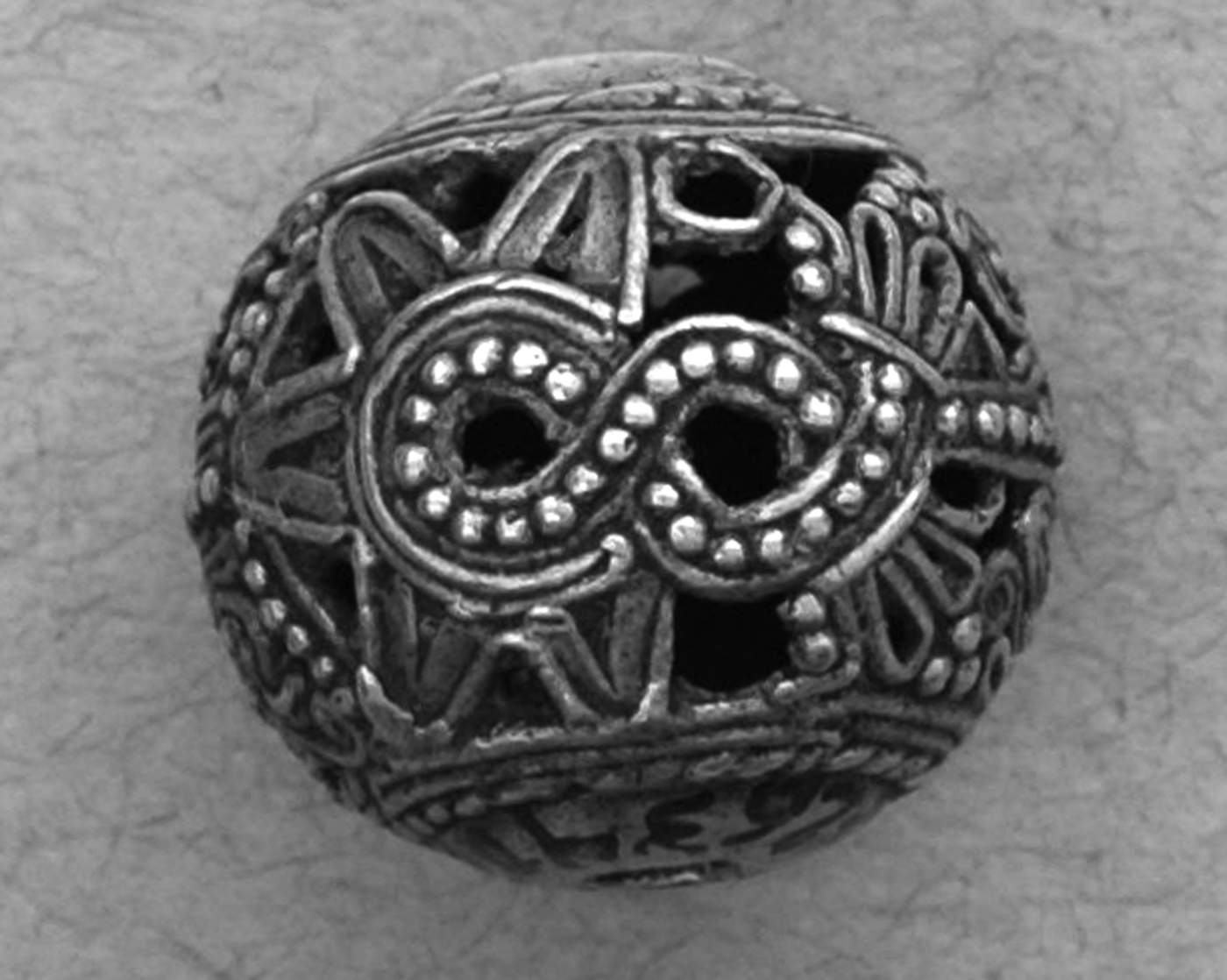
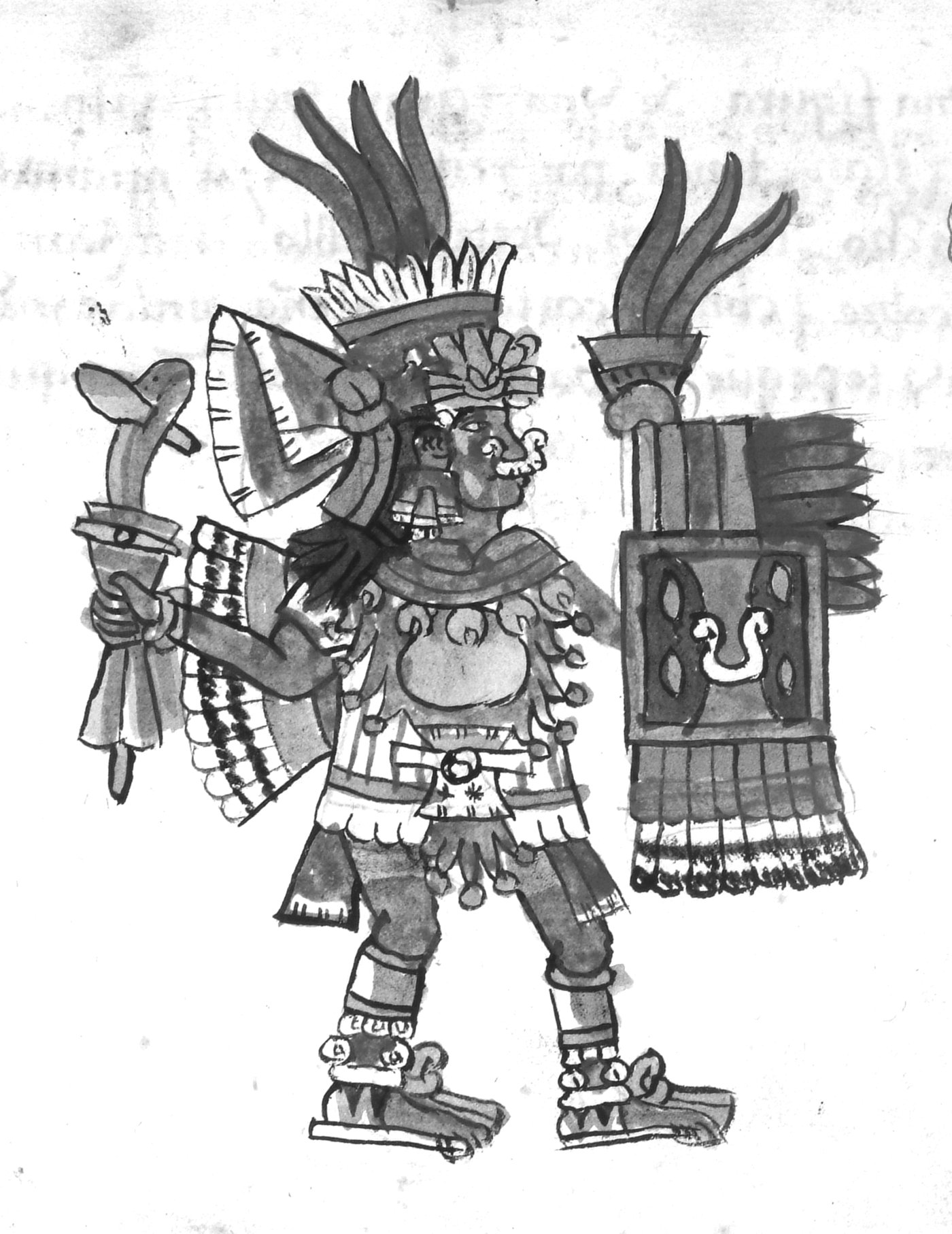
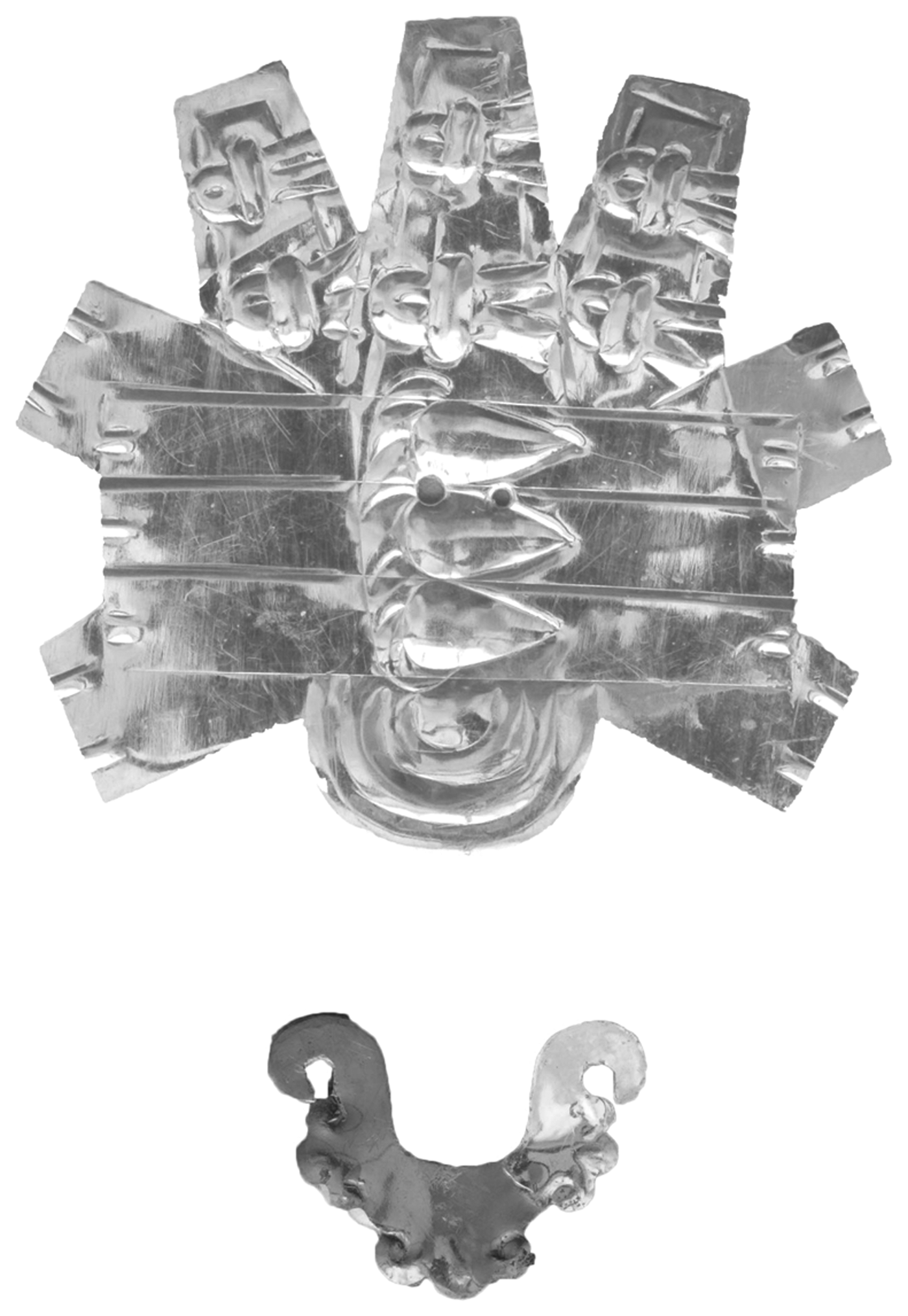
Fewer than 400 examples of these gold ornaments are known today, 267 of them from the Templo Mayor. Many of them are small, undecorated beads, bells, disks, and ear ornaments (Figure 2). Some are more elaborate and have been attributed by Warwick Bray (Reference Bray and Mirambell1989:246) to the South Mexican International Style (Figure 3). However, several of the gold objects from the Tlaltecuhtli offerings have the attributes of pulque deities such as those illustrated in the Codex Magliabechiano (Figures 4 and 5). Others are representations in gold of pleated paper rosettes, an Aztec innovation (Esther Pasztory, personal communication 2010). Still others are parts of sacrificial knives, adorned as though they were little deities (López Luján and Aguirre Molina Reference López Luján, Aguirre Molina, Luján and McEwan2010:320); they are made of sheet metal, and employ repoussé to create simple yet elegant, unique designs. They are in an Aztec sub-tradition that is clearly distinguishable from the Mixteca-Puebla one of which it is part (Nicholson Reference Nicholson and Easby1973:73,74). Leonardo López Luján and José Luis Ruvalcaba Sil (Reference López Luján and Ruvalcaba Sil2015:46–48) in fact go further and express their doubts that the gold of the Mexicas and the Mixtecs even belongs to the same tradition, and propose the ‘Basin of Mexico’ as a new geographic goldworking zone, distinct from the Mixteca.
Ear spools found in Calixtlahuaca. 2.1 × 7.7 cm and 1.9 × 7.6 cm. Museo Nacional de Antropología, Mexico, 10–187 and 10–186. Photo: Archivo Digital de las Colecciones del Museo Nacional de Antropología. CONACULTA-INAH-CANON. Reproduction authorized by the Instituto Nacional de Antropología e Historia.
Bead from Offering 3, Templo Mayor. 1.6 cm. Museo del Templo Mayor 10–263402. Photo: Leonardo López Luján, courtesy Proyecto Templo Mayor.
Pulque deity with gold ornaments (Codex Magliabecchiano Reference Magliabechiano1904:f. 49r). Photo: Banco Rari 232: c. 49r, GAP/Biblioteca Nazionale Centrale, Florence. Reproduction authorized by MiBACT.
Forehead ornament from Offering 125, Templo Mayor. 5.6 × 6.0 cm. Nose ornament, possibly from Offering 122, Operation 4, Templo Mayor. 1.5 × 1.9 cm. Museo del Templo Mayor, artifacts 13 and 113. Photos: Leonardo López Luján, courtesy Proyecto Templo Mayor.
SOURCES AND AMOUNTS OF TRIBUTE GOLD
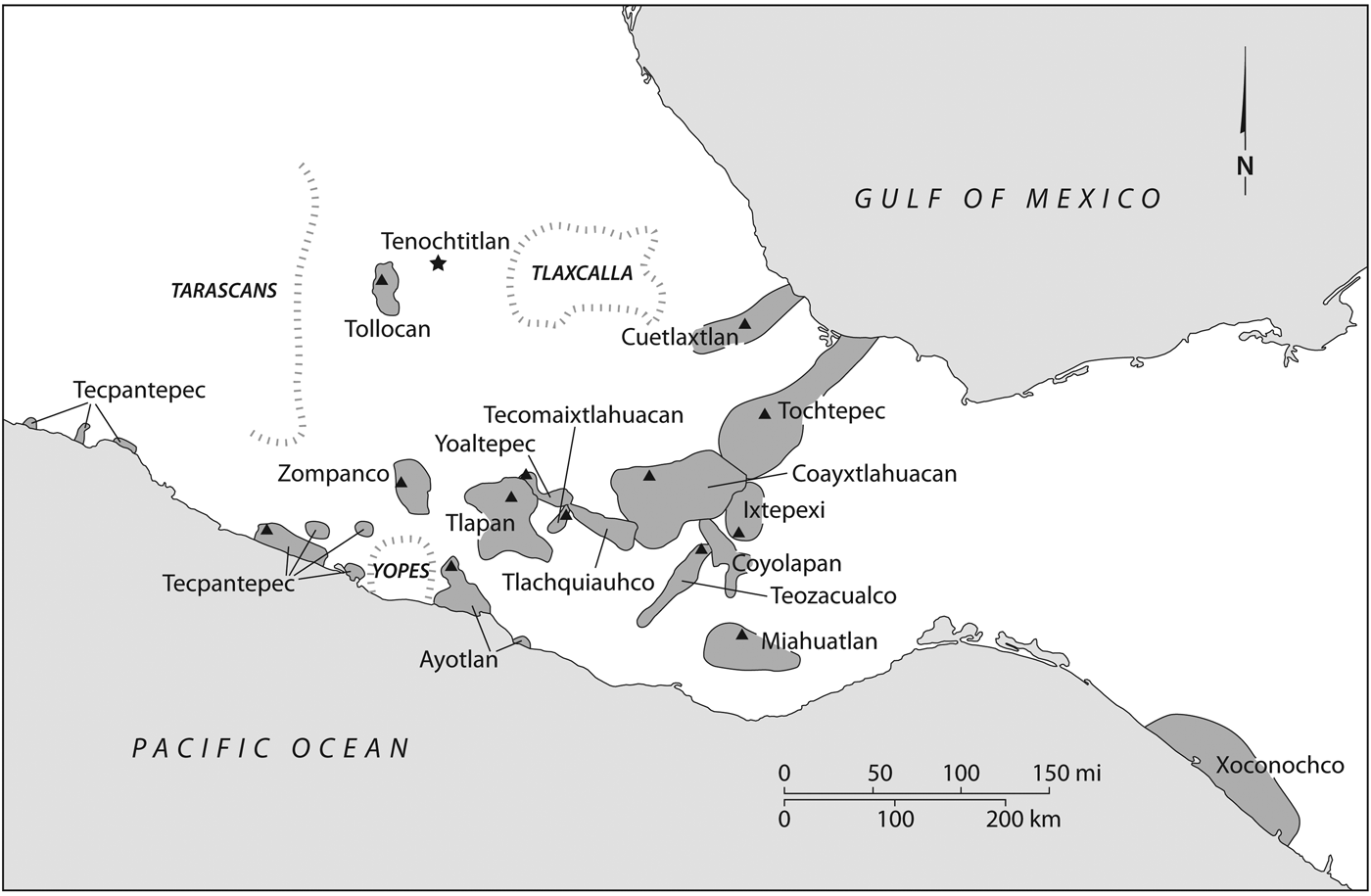
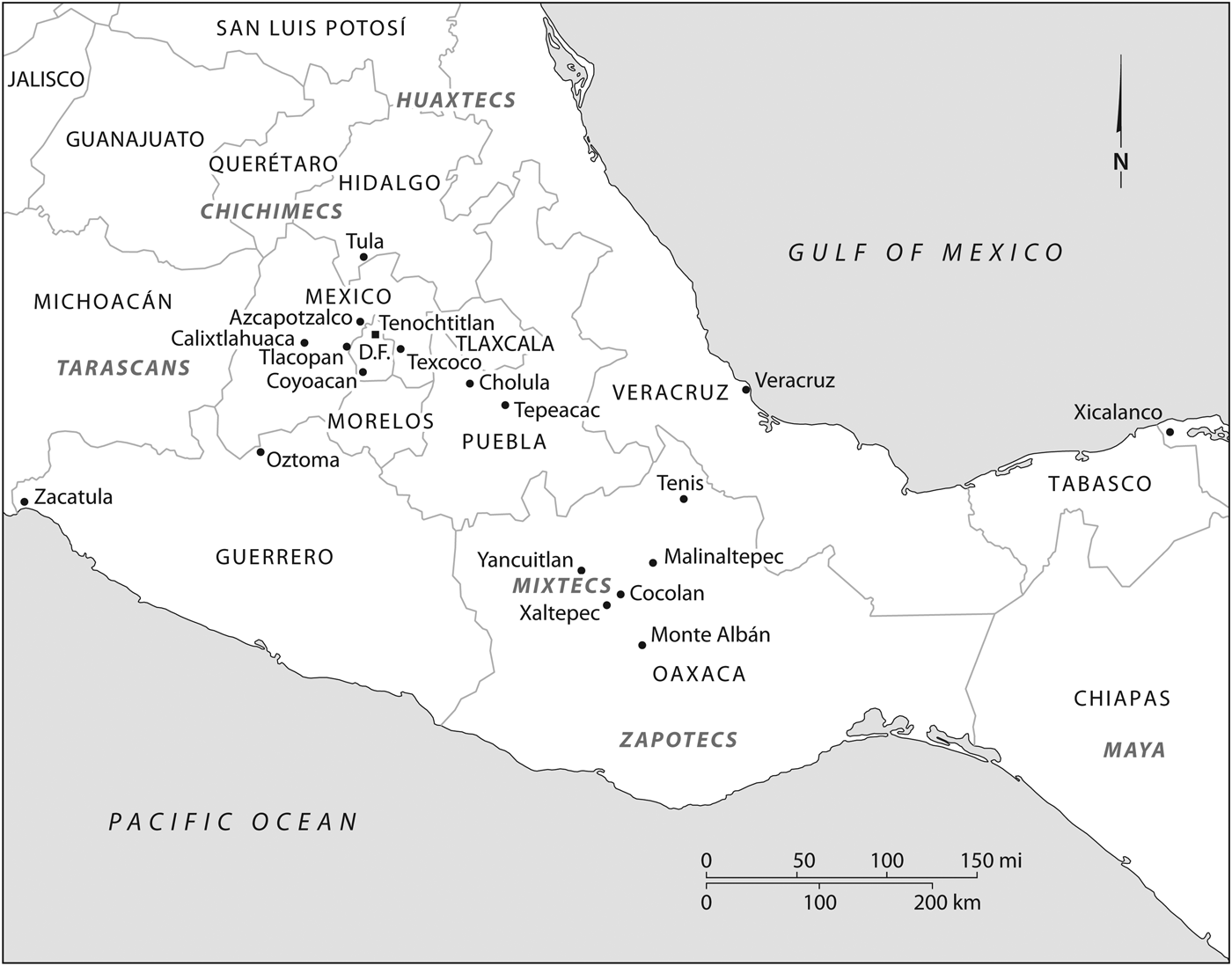
Since the Basin of Mexico was not a source of gold, Triple Alliance rulers had to obtain it from provinces in the south. Moctezuma II provided guides to lead Spanish soldiers to four places to investigate his sources of gold: Cuzula (Çoçolan) and Malinaltebeque (Malinaltepec), both in the north of the state of Oaxaca, and Tenis (in the Chinanteca) and Tuchitebeque (Tochtepec), both in the northeast Oaxaca-Veracruz region (Cortés Reference Cortés and Alcala1975:56–57) (Figures 6 and 7). Pizarro, Díaz del Castillo and others observed Indians extracting gold from placers in Zacatula in Guerrero, and Xaltepeque (Xaltepec) in Oaxaca (Díaz del Castillo Reference Díaz del Castillo and Cabañas1976:201, 392). Forty-three towns are known to have had gold resources in the sixteenth century although not all paid gold tribute to the Triple Alliance (Smith and Berdan Reference Smith, Berdan, Berdan, Blanton, Boone, Hodge, Smith and Umberger1996:308–323): 19 are in Oaxaca. 21 in Guerrero, and one each in the states of Veracruz, Mexico, and Puebla.
Map of Mexico showing the provinces of the empire of the Triple Alliance referred to in this paper, and those of their Tarascan, Tlaxcallan and Yope enemies. Provincial capitals indicated by ▴. Drawing by Bill Nelson, after Smith and Berdan (Reference Smith, Berdan, Berdan, Blanton, Boone, Hodge, Smith and Umberger1996:324).
Map of Mexico showing the modern day states, ethnic regions, and towns referred to in this paper. Drawing by Bill Nelson, after Umberger (Reference Umberger, Berdan, Blanton, Boone, Hodge, Smith and Umberger1996:158).
Of the three tribute lists, the Matrícula de Tributos (Garcia Reference Garcia1997) is thought to have been created by indigenous artists shortly before or after the conquest with glosses in Nahuatl and Spanish added later. The Codex Mendoza (Clark Reference Clark1938; Berdan and Anawalt Reference Berdan and Anawalt1992), completed in 1541 or 1542, and the Información of 1554 (Scholes and Adams Reference Scholes and Adams1957; Rojas Reference Rojas1997) may both be based on the Matrícula de Tributos. As all three documents were finalized under colonial direction to serve a specific agenda, their accuracy has been contested. A fourth document, the Códice Humboldt Fragmento 1 y Códice Azoyú 2 (Gutiérrez et al. Reference Gutiérrez, König and Brito2009) reports from the perspective of the kingdom of Tlapa-Tlachinollan (Tlapan) the tribute paid to the Triple Alliance over a period of 36 years, from 1486 to 1522. Though there are differences in the amounts of gold tribute specified, this document can be reconciled with the information given in the three primary lists (Gutiérrez Reference Gutiérrez, Hirth and Pillsbury2013:141–167). Other than in this instance, the data in the three main tribute lists have not been correlated with data generated in the provinces and towns themselves. The Codex Mendoza includes more tributary towns than the Matrícula de Tributos. It also indicates that gold tribute payments were made annually, as does the Información of 1554, whereas the Matrícula de Tributos is less clear regarding annual tribute payments for some provinces, with Frances Berdan (Reference Berdan and Chiaramonte1976:138, 141) asserting payments were made every 80 days. The Información of 1554, apart from being prepared later than the Codex Mendoza, exhibits some significant differences from the other tribute lists (Berdan Reference Berdan and Chiaramonte1976:136). I consider the Codex Mendoza to be the one most appropriate to serve as the primary source for a new estimate of the total amount of tribute gold received by the Triple Alliance at the time of the conquest.
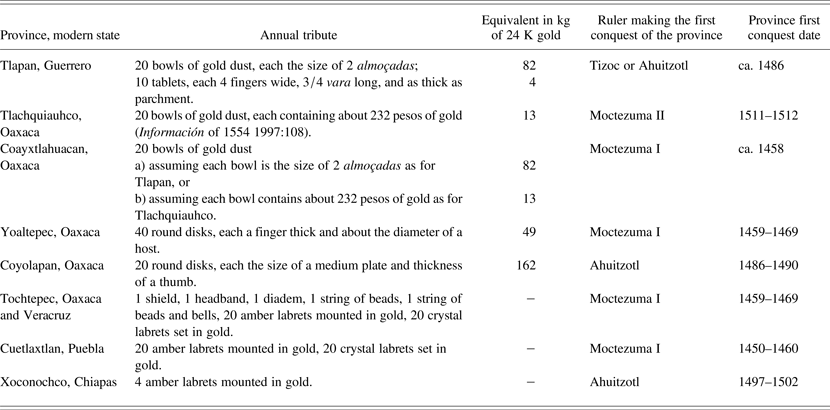
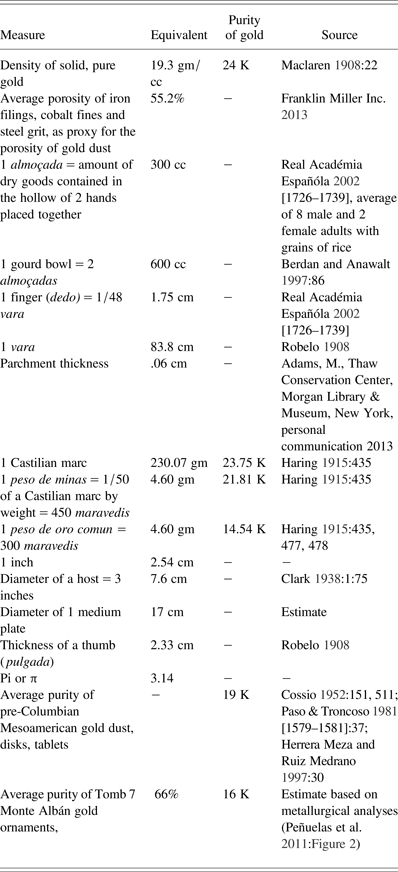
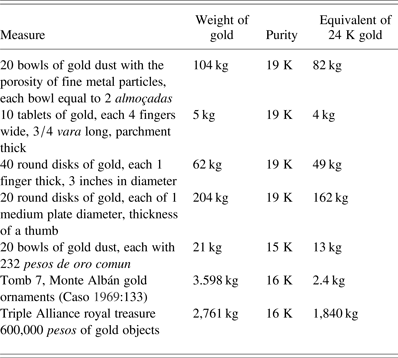
Table 1 shows the annual gold tribute payments by province given in the Codex Mendoza (Berdan Reference Berdan and Boone1987:164), as well as my estimate of the weight of this gold, expressed in kilograms of 24 K gold, based on the calculations in Tables 2 and 3. It also provides the names of the Triple Alliance rulers who oversaw the first conquest of each province, and the approximate dates of conquest (Berdan and Anawalt Reference Berdan and Anawalt1997), which is probably when some form of tribute payment began.
Gold Tribute to the Triple Alliance as Recorded in the Codex Mendoza
Triple Alliance Gold Tribute Assumptions
Triple Alliance Gold Tribute Calculations
My calculations are provided in some detail as the total estimated weight of tribute gold is much lower than previous estimates, as explained later. The calculations must be taken as indicative rather than precise due to a number of uncertainties including the equivalents of measures used in the sources such as the almoçada, and the diameter of a host or a medium-sized plate; whether bowls of gold dust were all the same size; the porosity of panned gold dust; and the amount of tribute paid by provinces not included in the Codex Mendoza.
Based on these calculations, I estimate that the Triple Alliance received some 323 to 392 kg of 24 K gold in the form of gold dust and bullion annually from the eight provinces listed in the Codex Mendoza, along with 84 labrets of amber or crystal set in gold, and a few gold ornaments. The vast majority—261 to 330 kg—came from Tlapan, Coayxtlahuacan, and Coyolapan, which included nine towns where gold was available locally (Smith and Berdan Reference Smith, Berdan, Berdan, Blanton, Boone, Hodge, Smith and Umberger1996:308–323); on average, each of these nine towns supported the delivery of 29–37 kg of 24 K gold. Tlachquiauhco and Yoaltepec had to import gold to make their tribute payments.
The Codex Mendoza does not mention seven provinces known to have sent tribute or gifts of gold to Tenochtitlan (Smith Reference Smith, Berdan, Blanton, Boone, Hodge, Smith and Umberger1996:148; Smith and Berdan Reference Smith, Berdan, Berdan, Blanton, Boone, Hodge, Smith and Umberger1996:278). Five of these provinces: Zompanco, Tecpantepec and Ayotlan in Guerrero, Miahuatlan and Teozacualco in Oaxaca included 13 towns with gold available locally (Smith and Berdan Reference Smith, Berdan, Berdan, Blanton, Boone, Hodge, Smith and Umberger1996:314–316). Two provinces: Ixtepexi and Tecomaixtlahuacan in Oaxaca included three towns that paid gold tribute although they had no locally available gold. Other than for Miahuatlan, we do not have contemporary records of how much each town paid. It is reasonable to suggest that each of these 16 towns paid about as much annually as Miahuatlan did, that is 7 to 9 kg of 24 K gold, (about a quarter as much as those mentioned in the Codex Mendoza), in total 112 to 144 kg of 24 K gold.
The total gold tribute Tenochtitlan received annually then ranged from 435 to 536 kg of 24 K gold. This is about 180 to 220 times the weight of gold in the 121 gold objects found in Tomb 7 at Monte Albán (Caso Reference Caso1969:74, 133) that collectively incorporate some 2.4 kg of 24 K gold (Table 3). Thus, the total annual gold tribute would be sufficient to make approximately 22,000 to 27,000 ornaments with weights similar to the average weight of a Tomb 7 gold object. Other estimates of the total weight of gold tribute range from about two tons (ca. 1,800 kg) (Miller and Taube Reference Miller and Taube1993:90) to 580,000 pesos (ca. 2,700 kg) (Pijoán Reference Pijoán1946:X:226). André Emmerich (Reference Emmerich1965:149), referring to José Pijoán's estimate, states, “The total of 560,000 pesos is equivalent to 2,883 pounds or almost 2 tons of gold,” but these numbers are internally inconsistent. All these tribute totals refer to gold of unspecified purity and, though Pijoán and Emmerich both refer to the Codex Mendoza, the manner in which they have been calculated is unclear. If these totals, or Berdan's (Reference Berdan, Berdan and Anawalt1992:I:159) calculation of the quantity of gold tribute detailed in the Matrícula de Tributos, were used the number of ornaments that could be made annually would be about three to five times larger.
Despite the uncertainties inherent in any estimate of the size of the annual gold tribute, it is evident that the amount was sufficient to make a very large number of ornaments. It is striking that the greatest amount of gold was delivered as gold dust or bullion; only one province sent fine gold jewelry, and three others delivered labrets comprised of amber or crystal cylinders set in gold that required difficult lapidary work but relatively straight forward gold casting. The Codex Mendoza does not list the Mixtec provinces of Coayxtlahuacan, Tlachquiauhco and Yoaltepec as providing any finished gold ornaments at all, which is surprising given the reputation enjoyed by Mixtec goldsmiths (Smith Reference Smith2012:99). Thus it appears that, while the pochteca merchants imported ornaments as well as unworked gold (Sahagún Reference Sahagún, Anderson and Dibble1950–82:IX:2), the Triple Alliance preferred native gold or bullion as tribute. This indicates that the manufacture of gold objects for the Alliance was carried out primarily in their urban centers, and on a large scale. There were strong strategic and political reasons for this, as I discuss below.
THE IMPORTANCE OF GOLD TO THE TRIPLE ALLIANCE ELITE
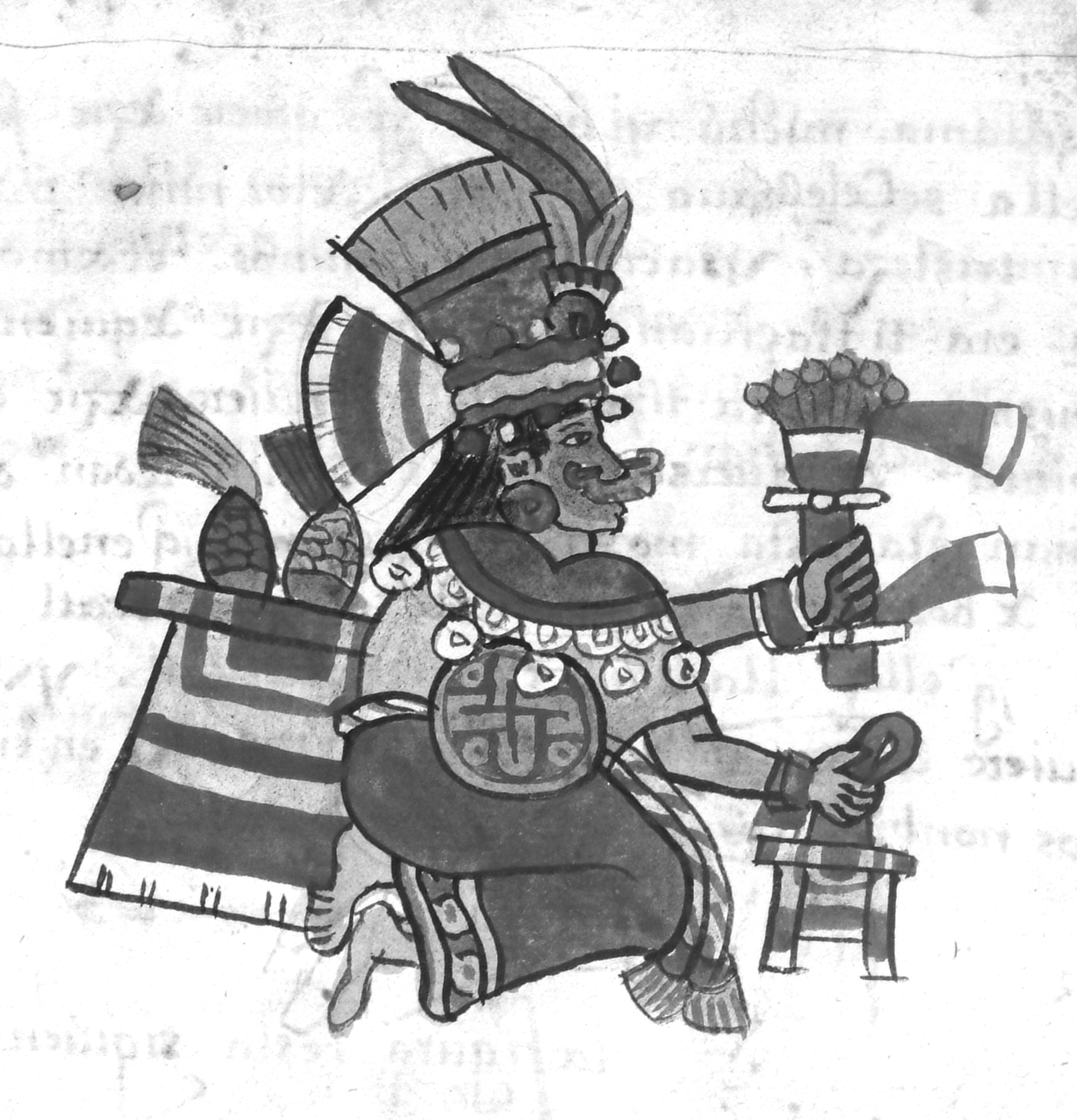
Gold—which the Nahuas called teocuitlatl, the excrement of the sun—had both religious and political significance. It was considered a sacred material that emanated from, and belonged to, the gods, the sun, and the earth. Thus it has been related to the solar deities Huitzilopochtli and Tonatiuh and, through the former, to war (Baquedano Reference Baquedano2005:360; Klein Reference Klein1993:25); the five young solar deities known as the Macuiltonaleque (Sahagún Reference Sahagún, Nicholson, Anderson, Dibble, Keber and Ruwet1997:101n43); Xilonen (Figure 8) and Chicomecatl, the goddesses of young and ripe corn respectively, who wore disk-like, gold pectorals on their breasts; and to Xipe Totec, a major god of fertility and regeneration, who was the patron deity of goldsmiths (Solís Olguín and Carmona Macías Reference Solís Olguín, Macías and Seipel1997:22). Gold ornaments also were part of the attire of numerous other deities or their impersonators (Sahagún Reference Sahagún, Anderson and Dibble1950–1982:I:3–20, IX:69, 79–80, 85; 1977:IV:280–288) and the sound of gold bells was considered powerful, with the elites wearing sets of bells while dancing, in rituals celebrating human and agricultural fertility, and also when preparing for battle. Indeed bell sounds were thought to protect warriors during combat (Hosler Reference Hosler1995:107). A full understanding of the significance of gold to the Nahuas, however, remains elusive (Torres Montúfar Reference Torres Montúfar2015:151–168).
The deity, Xilonen, with gold pectoral and other gold ornaments (Codex Magliabechiano Reference Magliabechiano1904:f. 36r). Photo: Banco Rari 232: c. 36r, GAP/Biblioteca Nazionale Centrale, Florence. Reproduction authorized by MiBACT.
Apart from gold's symbolism and religious use, important strategic and political interests fueled the Triple Alliance's need for large quantities of unworked tribute gold. Gold ornaments played a crucial role in maintaining political control and formed a key component in the trade of luxury goods. The possession of gold objects and sumptuary goods fabricated from other precious materials established one's social status, justified the power that came with this status (Hosler Reference Hosler1995:105), and validated social and political relationships within a given city-state. Once the Triple Alliance was formed, its leaders, in order to maintain control, established a centralized system of political patronage that distributed three types of favors: rule of remote city-states, grants of tribute-producing agricultural lands, and gifts of luxury craft products. Increasingly, preference was given to the latter. Such gifts solidified military alliances, tightened allegiance from subordinate territories, and strengthened bonds between members of different city-states (Brumfiel Reference Brumfiel, Brumfiel and Earle1987:111–114).
During the reign of Moctezuma I (1440–1469), the Alliance started receiving gold tribute from the Mixtec provinces of Coayxtlahuacan and Yoaltepec, and the scope and scale of gifting gold ornaments expanded dramatically (Brumfiel Reference Brumfiel, Brumfiel and Earle1987:114). This high level of imperial gift giving led to a significant increase in gifting at all upper levels of society (Hicks Reference Hicks, Claessen and van de Velde1987:98). While the noble class made up less than five percent of the total Aztec population (Smith Reference Smith2012:134), by the sixteenth century this group numbered in the tens of thousands (Calnek Reference Calnek and Edmonson1974:202) and was expanding rapidly. The combination of these two trends led to a material increase in the demand for sumptuary goods in the urban setting (Berdan Reference Berdan and Boone1987:162). Furthermore, although Moctezuma I's legal code restricted ownership of gold ornaments to the king, provincial rulers, and high nobles (Durán Reference Durán and Garibay Kintana1967:II:211–212), in reality, distribution was probably more widespread (Anawalt Reference Anawalt1980:43). Warriors customarily received gold and other ornaments from rulers in recognition of their achievements (Durán Reference Durán and Garibay Kintana1967:II:151, 368), and Ahuitzotl (1486–1502) permitted merchants to wear certain jewels and mantles (tilmatli) on particular holidays. Certainly the quantity of elite jewelry sold in the Tlatelolco market contradicts the strict application of the sumptuary laws (Anawalt Reference Anawalt1980:41). Finally, luxury ornaments could be exchanged for other high value goods by the pochteca, long-distance merchants who traded precious materials for the ruler or the state, as well as on their own account, in territories beyond the empire's political and military control. Sahagún (Reference Sahagún, Anderson and Dibble1950–1982:IX:17–18), for example, tells of traders arriving at Xicalanco at the Tabasco-Campeche border with jewels of gold and precious stones that they knew would be welcomed in the province. These included gold crowns, forehead ornaments, and necklaces, as well as other jewelry, for men. For women, they brought gold vases to hold spindles, and ear ornaments of gold and crystal. In all probability, commercial exports of gold ornaments by Alliance rulers via the pochteca greatly exceeded their imports since the costs of commercially imported ornaments would have included those of materials, foreign manufacture, and transport.
The Triple Alliance had several reasons to control a major part of Mesoamerica's elite product manufacture, and did so by importing precious raw materials, some—such as gold—as tribute at minimal cost, and exporting high-value, easily transportable ornaments through long distance trade channels (Blanton Reference Blanton, Berdan, Blanton, Boone, Hodge, Smith and Umberger1996a:47). The large volume of work enabled them to support and control the activities of many, highly qualified artisans. This specialist workforce provided the Alliance with rapid delivery, complete design control, flexibility, and coordination, a capability well illustrated in the preparations for Ahuitzotl's coronation (Durán Reference Durán and Garibay Kintana1967:II:323). It raised the perceived value of their political gifts because of their unique designs and quality and, in the case of gold, possibly size (they did not have to bear the cost of the raw material). It also limited the availability of gold ornaments from other sources because the tribute the Alliance received likely reduced the amount of gold available to other goldsmiths. An exception to the focus on individual design and local production appears to have been made when the Alliance needed insignia and warrior costumes corresponding to specific military or social ranks with designs that did not change materially from year to year. In such instances, they were prepared to import finished articles as tribute, for example, amber and crystal labrets set in gold, and warrior costumes and shields covered with precious feathers. These were awards, not gifts.
We do not know whether the nobility received any tribute gold from the Alliance rulers, though some researchers have suggested that the Alliance channeled certain tax goods, especially elite raw materials, through the marketplaces, and there is some evidence that recipients of “gifts and commissions” exchanged some of their awards in the marketplace (Hirth and Pillsbury Reference Hirth, Pillsbury, Hirth and Pillsbury2013:7; Isaac Reference Isaac, Hirth and Pillsbury2013:438). If not, they would have had to buy jewelry or unworked gold from the pochteca. It is difficult to evaluate the nature and scale of such transactions although it is probable that private sector trade must have been considerable (Berdan Reference Berdan and Boone1987:178; Blanton Reference Blanton, Berdan, Blanton, Boone, Hodge, Smith and Umberger1996a:48). According to Smith (Reference Smith2012:100, 111, 112), the nobility commissioned many gold ornaments, while traders and craftsmen offered some for sale at the largest regional markets. Certainly gold dust and gold objects were available at the Tlatelolco market, as José Luis de Rojas (Reference Rojas1986:164–166) documents in his succinct overview of goldworking in Tenochtitlan. Smaller markets also sold luxury goods including those in Coyoacan and Cholula (Smith Reference Smith2012:111, 112), Texcoco (Blanton Reference Blanton, Berdan, Blanton, Boone, Hodge, Smith and Umberger1996a:74), Tepeacac (Berdan Reference Berdan and Boone1987:177), and Coayxtlahuacan (Torres Montúfar Reference Torres Montúfar2015:125–126). If a significant amount of unworked gold was imported commercially, then the size of the goldworking community in the Alliance urban centers would have been materially larger than that needed to process the tribute gold alone.
THE DEVELOPMENT OF GOLDWORKING IN THE BASIN OF MEXICO
There is no archaeological information on the actual production of gold objects in the Basin of Mexico (Smith Reference Smith2012:96), nor any that demonstrates when or from where goldworking arrived there. Some archaeological reports, however, provide information on the introduction and development of copper working in central Mexico. As West Mexican metalsmiths made extensive use after a.d. 1200 of alloys of gold and silver with copper for the production of sheet metal ornaments (Hosler Reference Hosler1994:153), it is likely that the development of goldworking followed the same pattern. For example, several copper objects dating to a.d. 900–1050 and found at Teotihuacán (Pendergast Reference Pendergast1962:524–528) were probably imported from west Mexico as metal was unknown in the city while it still flourished (Hosler Reference Hosler1994:11). The first excavated evidence for copper-lead bells comes from Calixtlahuaca where they date to the Middle Postclassic period (a.d. 1150–1340) (Hosler Reference Hosler, Shugar and Simmons2013:239). Hosler (Reference Hosler1994:201) states that Period 2 developments in West Mexico (a.d. 1200 or 1300) stimulated the development of a copper-lead alloy tradition in or very near the Basin of Mexico where metalworkers used the alloy to cast bells by at least 1438. About 10 copper-lead bells dredged from the Cenote of Sacrifice at Chichén Itzá are thought to have come from central Mexico where they were probably produced after 1450 (Lothrop Reference Lothrop1952:92, 108). A significant percentage of over 3,000 copper bells excavated from offerings at the Templo Mayor in Tenochtitlan date to the 1470s; less than 10 percent of the bells were found in earlier contexts (Schulze Reference Schulze, Shugar and Simmons2013:205). In summary, it appears that copper working had entered central Mexico by the late fourteenth century, could be found in or near the Basin of Mexico by the first part of the fifteenth century, and was well established in the Alliance urban centers by about 1470; goldworking may well have experienced a parallel development.
The evidence from colonial sources regarding the introduction of goldworking is circumstantial but accords with the archaeological record for copper working. Although Fernando de Alva Ixtlilxóchitl (Reference Alva Ixtlilxóchitl and O'Gorman1975:285, 420) and Sahagún (Reference Sahagún, Anderson and Dibble1950–1982:X:166, 168) attribute the origins of goldworking to the Toltecs, no published archaeological evidence of goldworking in Tula (Diehl Reference Diehl1983:116) supports their claims. I suggest that knowledge of metalworking came to the Alliance centers, if not from Toltecs who migrated to Culhuacan after the fall of Tula, then from one or more regions where Xipe Totec, or his counterparts (Tlatlauhqui Tezcatlipoca in West Mexico, Yopi among the Zapotecs, 7 Rain among the Mixtecs), was worshipped as the god of metals. Several such regions have been identified, among them Tzapotlan, Jalisco (Sahagún Reference Sahagún and Garibay Kintana1977:I:65), the area around Guadalajara (Pomar Reference Pomar and Acuña1986:59), Michoacan (Roskamp Reference Roskamp2010:72), Guerrero (Aguilar-Moreno Reference Aguilar-Moreno2007:215; Hosler Reference Hosler1995:109), and the Zapotec and Mixtec regions (Miller and Taube Reference Miller and Taube1993:188).
It is likely that some goldsmiths were living in the Alliance urban centers by the early fifteenth century, possibly in Culhuacan, but more likely among two of the major Nahua ethnic groups first to arrive in central Mexico: the Tepanecs in Azcapotzalco, and the Acolhuas in Texcoco who, during the fourteenth and early fifteenth centuries, conquered neighboring cities and obtained tribute from them (Carrasco Reference Carrasco, Lombardo and Nalda1996:176–180). Again, there is no direct evidence for this hypothesis, but colonial sources offer compelling hints. For example, by the time of the Tepanec king, Tezozomoc (1371–1426), the elites of both polities had become wealthy, possessing significant amounts of gold jewelry with precious stones. Following Tezozomoc's defeat of the Acolhua king, Ixtlilxóchitl (1409–1418), the Acolhuas were forced to pay tribute that included weapons, rich feathers, and jewels of gold and precious stones (Alva Ixtlilxóchitl Reference Alva Ixtlilxóchitl and O'Gorman1975:347; Torquemada Reference Torquemada and León-Portilla1975:162). At his funeral in 1426, Tezozomoc was dressed in his royal robes with his ornaments of gold and beautiful stones and other precious items (Alva Ixtlilxóchitl Reference Alva Ixtlilxóchitl and O'Gorman1975:351). Also, when the warriors of Azcapotzalco advanced against the Mexica army and their allies in 1428, they were richly dressed with gold, silver, jewels, and feathers, which they had inherited or obtained, by force of arms (Durán Reference Durán and Garibay Kintana1967:II:80). After defeating the Tepanecs and destroying Azcapotzalco, the Mexicas are reported to have returned with much plunder (Durán Reference Durán and Garibay Kintana1967:II:82). While it is possible that the Tepanecs and the Acolhuas obtained gold solely by trade or spoils of war, I suggest that by the early fifteenth century, some goldsmiths worked in Azcapotzalco and Texcoco, at least for the purposes of repairing and replacing damaged jewelry, and manufacturing some ornaments.
In fact, Alva Ixtlilxóchitl (Reference Alva Ixtlilxóchitl and O'Gorman1975:444; 1985:124) and Fray Juan de Torquemada (Reference Torquemada and León-Portilla1975:205) imply that goldsmiths were in the Alliance centers by the 1430s. They relate that when in 1433 King Nezahualcoyotl (1430–1472) determined to develop Texcoco into the magnificent center of his kingdom, he requested specialists “in all the mechanical arts” from Tenochtitlan, Azcapotzalco and its empire, from Xochimilco, and other places. These he located in the city in barrios according to their specialty, such as goldsmithing, painting, or stone working. As part of this project, he allegedly built a zoo in which he kept many species of birds and animals, including some modeled in gold and precious stones (Alva Ixtlilxóchitl Reference Alva Ixtlilxóchitl and Chamorro1985:136). That he was able to bring together goldsmiths to execute such complex work indicates that smiths were active in the Alliance centers three decades before Moctezuma I invaded the Mixtec region in about 1460 and secured access to its gold. Indeed, Sahagún (Reference Sahagún, Anderson and Dibble1950–1982:IX:2) reported that gold ornaments were being sold in the Tlatelolco market during the reign of Quauhtlatoatzin (1428–1460).
Once the Triple Alliance received tribute gold from the Mixteca, more goldworkers, or copper workers who learned to work gold, probably migrated to Tenochtitlan. The Basin of Mexico was a “booming economic system capable of attracting immigrants in large numbers” (Blanton Reference Blanton, Berdan, Blanton, Boone, Hodge, Smith and Umberger1996b:222), and their participation in the urban labor force was largely responsible for Tenochtitlan's rapid demographic growth during the late fifteenth and early sixteenth centuries. In general, the city-states that emerged during this time, including Tenochtitlan, are thought to have become more ethnically heterogeneous (Calnek Reference Calnek and Graham1981:333). There is no archaeological evidence about the immigrants’ origins, however, and no evidence of forced relocation to Tenochtitlan as a result of imperial conquests (Blanton Reference Blanton, Berdan, Blanton, Boone, Hodge, Smith and Umberger1996b:221). Nor is there convincing colonial testimony in this regard. Durán (Reference Durán and Garibay Kintana1967:II:437, 482) reports that, after the Triple Alliance had made its first conquests in the Mixteca, a few thousand Mixtecs were brought to Tenochtitlan for sacrifice, but he does not mention any being brought to work. In fact, Nicholson (Reference Nicholson and Boone1982:236–237) states, “I am aware of no passage in any primary source which indicates that Mixtec-speaking craftsmen from Oaxaca were ever brought to Mexico Tenochtitlan to practice their skills”. Future archaeological research may, of course, cast more light on the situation.
THE GOLDSMITH COMMUNITY IN THE ALLIANCE URBAN CENTERS
Goldsmiths in the Alliance centers formed two main groups (Sahagún Reference Sahagún, Anderson and Dibble1950–1982:IX:69), sheet metal workers (teucuitlaoaque) and casters (teucuitlapitzque) (Figure 9). The former consisted of smiths (tlatzotzonque), whose task was to hammer gold sheet until it was extremely thin, and finishers (tlatlaliani) who were responsible for chasing designs worked out by featherworkers on gold sheet (Figure 10), as well as for gold leaf work. Those who made cast gold objects employed the complicated lost-wax process that required great skill. Several pages in the Florentine Codex (Sahagún Reference Sahagún, Anderson and Dibble1950–82:IX:73–78) are devoted to describing goldworking processes. Although his indigenous informants had prepared these pages in Nahuatl, Sahagún chose not to translate them into Spanish for the original publication of Historia general de las cosas de Nueva Espaňa as he considered goldworking unimportant, and recommended that those interested in the technology talk to goldsmiths directly (Sahagún Reference Sahagún and Garibay Kintana1977:III:58). That the Nahua artists reported so extensively on the processes of goldworking (as well as featherworking) despite Sahagún's lack of interest indicates that the Indians valued highly the process of making a precious object, perhaps as much as the object itself (Peterson Reference Peterson and Schwaller2003:240). In the Florentine Codex, the goldworkers often have beards, appropriate for senior people who are transmitting specialized knowledge; to emphasize that these great artisans are Indian, they are shown bare-footed and wear the Aztec tilmatli (cape or mantel) (Peterson Reference Peterson and Schwaller2003:249–250). Frequently, they are shown working in pairs in modest environments: on bare earth, or on a tiled floor in a bare landscape, or outside the walls of a town or a house. Featherworkers, by contrast, are usually shown working singly, dressed in fine clothes, in a courtyard with often-elaborate floor tiles. In one case, two featherworkers are pictured with Moctezuma II and a pochteca. This suggests both that goldworking held lower status than featherworking, and that certain steps in the goldworking process were carried out away from population centers, reflecting the dusty and potentially dangerous aspects of the craft. Nevertheless, goldworkers belonged to the same category of hereditary elite artisans as the featherworkers, lapidaries, manuscript painters, and carpenters. Although they were not members of the nobility and could not wear their products or otherwise display any wealth they may have gained, they enjoyed a privileged status in Tenochtitlan as their art had great symbolic worth (Peterson Reference Peterson and Schwaller2003:237).
Goldsmiths melting and casting gold. Detail from the Florentine Codex (Sahagún Reference Sahagún, Anderson and Dibble1950–82:IX:Plate 62). Photo: Med. Palat. 219, c. 362v, Biblioteca Medicea Laurenziana, Florence. Reproduction authorized by MiBACT.
Goldsmith with featherworker painting a design. Detail from the Florentine Codex (Sahagún Reference Sahagún, Anderson and Dibble1950–82:IX:Plate 54). Photo: Med. Palat. 219, c. 360r, Biblioteca Medicea Laurenziana, Florence. Reproduction authorized by MiBACT.
It is likely that the goldworking community initially included the Nahuatl-speaking Acolhuas, Tepanecs, and Colhuas, and that it expanded after the formation of the Triple Alliance because of internal growth and immigration from regions with metalworking knowledge. Gold- and silversmiths are thought to have lived in their own barrios in Tenochtitlan, Azcapotzalco and Texcoco, with Xipe Totec as their patron deity. The smiths of Tenochtitlan are assumed to have lived in their own calpulli (ward) in the barrio of Yopico with its temple dedicated to Xipe Totec, near the center of the city (Sanders Reference Sanders, Brumfiel and Feinman2008:79). It appears, however, that goldsmiths also lived in other barrios. In one case, a platero (gold- or silversmith), while acknowledging the authority of the plateros’ guild in Yopico, lived with his wife's family in the Zacatlan barrio of the city's Atzacualpa quarter (Calnek Reference Calnek and Graham1981:338). This platero employed an apprentice from Copolco in Cuepopan (another district of Tenochtitlan), who is later mentioned as an independent craftsman. While goldsmiths customarily trained their children in the craft (Berdan and Anawalt Reference Berdan and Anawalt1992:IV:144, 145), this example may indicate that some goldsmiths took on apprentices who were not family members so as to meet the rapid growth in demand that took place in the latter part of the fifteenth and early sixteenth centuries. Some goldsmiths worked out of their homes with a few assistants, and others possibly in larger workshops with specialists for individual functions, for instance in Moctezuma II's palace or in Azcapotzalco (Díaz del Castillo Reference Díaz del Castillo and Cabañas1976:169). It is not known whether goldsmiths worked mostly for the Alliance rulers, the treasury, or were independent, though only a minority of the featherworkers in Tenochtitlan and Tlatelolco are thought to have worked directly for the rulers, with the rest being independent (Calnek Reference Calnek, Carrasco and Broda1978:109).
We have no information on the size of the goldworking community in the Alliance centers at the time of the conquest other than Sahagún's (Reference Sahagún and Garibay Kintana1977:III:58) comment that there were goldsmiths ‘everywhere’ (en toda parte). However, by the early sixteenth century, because of the rapid growth in the demand for gold ornaments by elites and merchants, the goldsmiths in the urban centers and neighboring towns likely numbered in the hundreds and formed a larger goldworking community than those found in contemporary Mixteca or Michoacan, seat of the Purépecha (or Tarascan) empire. Even if some tribute gold was hoarded as gold dust or bullion, or used to create large scale objects like those mentioned above, thousands of gold ornaments must have been made in the Alliance centers each year. The quality of work would have quickly risen to match the best produced elsewhere—it is difficult to imagine proud Mexica rulers presenting gifts to foreign dignitaries that were of lower quality than those they received.
AZTEC GOLD OBJECTS IN THE PROVINCES
Not all of the gold ornaments made in the Alliance centers stayed there. They would have circulated throughout Mesoamerica in a manner similar to that of codices (Boone Reference Boone, Smith and Berdan2003:207). Apart from the trading activities mentioned above, some portion of Alliance rulers’ gifts went to the provinces as imperial favors to foreign elites. Diplomatic missions, alliances, coronations, funerals and religious festivals all afforded opportunities for gifts, as did visits by provincial nobles to Tenochtitlan and Alliance nobles to the provinces (Torres Montúfar Reference Torres Montúfar2015:85–98). For instance, Moctezuma I liberally distributed gold jewels to neighboring and foreign rulers (Durán Reference Durán and Garibay Kintana1967:II:151, 172), Axayácatl (1469–1481) made gifts to provincial rulers to celebrate his victory over the Matlatzinca (ca. 1476), and Ahuitzotl did the same to celebrate his coronation (Durán Reference Durán and Garibay Kintana1967:II:279, 325). Gold ornaments would also have left the Basin of Mexico as gifts among members of elite families who, through a provincial posting, marriage or some other alliance, were located outside the basin. Some Triple Alliance princesses, for instance, resided in far-away places such as Oaxaca and Guatemala; imperial officials were stationed all over the empire (Umberger Reference Umberger, Berdan, Blanton, Boone, Hodge, Smith and Umberger1996:152); and settlements with thousands of central Mexican colonists were established in several places including the Valley of Oaxaca, the Tollocan valley, and Oztoma and adjacent towns in Guerrero.
Elite craft products also moved to and from the Basin of Mexico as spoils of war, a result of the frequent military campaigns undertaken by the Triple Alliance. Elite warriors on both sides customarily wore gold ornaments such as bells, pectorals, anklets, and ear, nose, and lip ornaments (Baquedano Reference Baquedano2005:368). When such a warrior was captured, his ornaments became property of the victors. Thus, the ornaments of Alliance warriors captured or killed in battle would have remained outside the basin.
It follows from the arguments above that at the time of the Conquest there were significant numbers of gold ornaments in the provinces that had been made in the Alliance urban centers. Identifying some of these objects will support this contention. There are three categories of gold ornaments made in these centers: those that are clearly in the Aztec sub-tradition mentioned earlier, those that generally adhere to the South Mexican International Style, and those that are plain. The former, found mainly in the Tlaltecuhtli offerings at the Templo Mayor, can be distinguished from those in the South Mexican International Style by their low copper content (less than 3.5 percent), style, functional characteristics and iconography (López Luján and Ruvalcaba Sil Reference López Luján and Ruvalcaba Sil2015:35–46). Gold ornaments with these traits found outside the Basin of Mexico, or without provenience, will be readily identifiable.
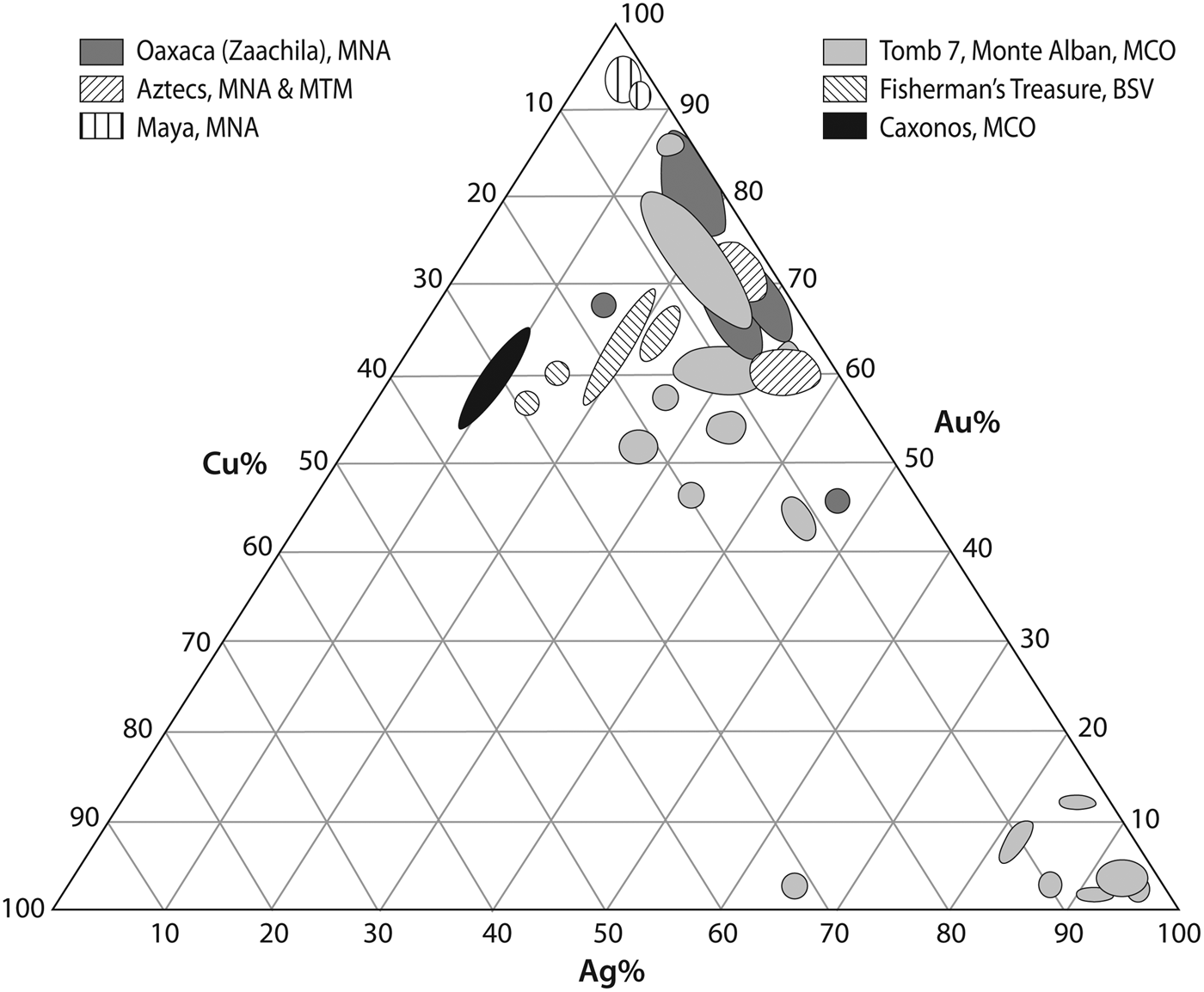
It has been difficult to distinguish objects in the South Mexican International Style, found in the Basin of Mexico, stylistically and iconographically from Mixtec metalwork (Bray Reference Bray and Mirambell1989:253–254; Umberger and Klein Reference Umberger, Klein and Rice1993:324). Metallurgical analysis has also been inconclusive in that it is not evident that the chemical composition and style of the gold ornaments in the Tlaltecuhtli offerings are representative of all goldwork in the Alliance centers from the end of the fifteenth century to the conquest. I suggest that they were not as these ornaments were votive offerings that were mostly made of sheet metal and probably not worn and low copper content would have been an advantage so as to achieve high malleability of the sheet gold from which they were made. Ornaments made to be worn, and ones made by the lost-wax process, would have benefited from a higher copper content that provides greater rigidity and better casting quality. Thus the metallurgical composition of one collection of Aztec-style gold objects does have a higher copper content than those in the Tlaltecuhtli offerings and overlaps that of objects from the Valley of Oaxaca (Ruvalcaba Sil et al. Reference Ruvalcaba Sil, Peñuelas Guerrero, Vargas, Díaz and Hernández Vázquez2009). Also an analysis of gold and silver artifacts from Monte Albán's Tomb 7 concluded that some Aztec pieces do share the Mixtec metallurgical features (Peñuelas et al. Reference Peñuelas, Ruvalcaba, Contreras, Hernández, Ortiz and Turbanti-Memmi2011:627) as shown in Figure 11. (This study was completed before the analysis of the Tlaltecuhtli offerings.) In such cases, iconographic elements with particular Aztec characteristics are key to distinguishing Aztec from non-Aztec ornaments, an approach that has been followed for stone sculpture with the identification of imperial imagery that marks Aztec origin (Umberger and Klein Reference Umberger, Klein and Rice1993:318–322), and as part of a broader discussion of the pictorial codices and painting styles (Boone Reference Boone and Cordy-Collins1982; Reference Boone, Smith and Berdan2003).
Comparison of the compositions of gold objects from Tomb 7, Monte Albán, Museo Nacional de Antropología (MNA), Museo del Templo Mayor (MTM), Museo Baluarte de Santiago (BSV), Museo de las Culturas de Oaxaca (MCO). Drawing by Bill Nelson, after chart by José Luis Ruvalcaba, IF-UNAM, in Peñuelas et al. Reference Peñuelas, Ruvalcaba, Contreras, Hernández, Ortiz and Turbanti-Memmi2011:Figure 2.
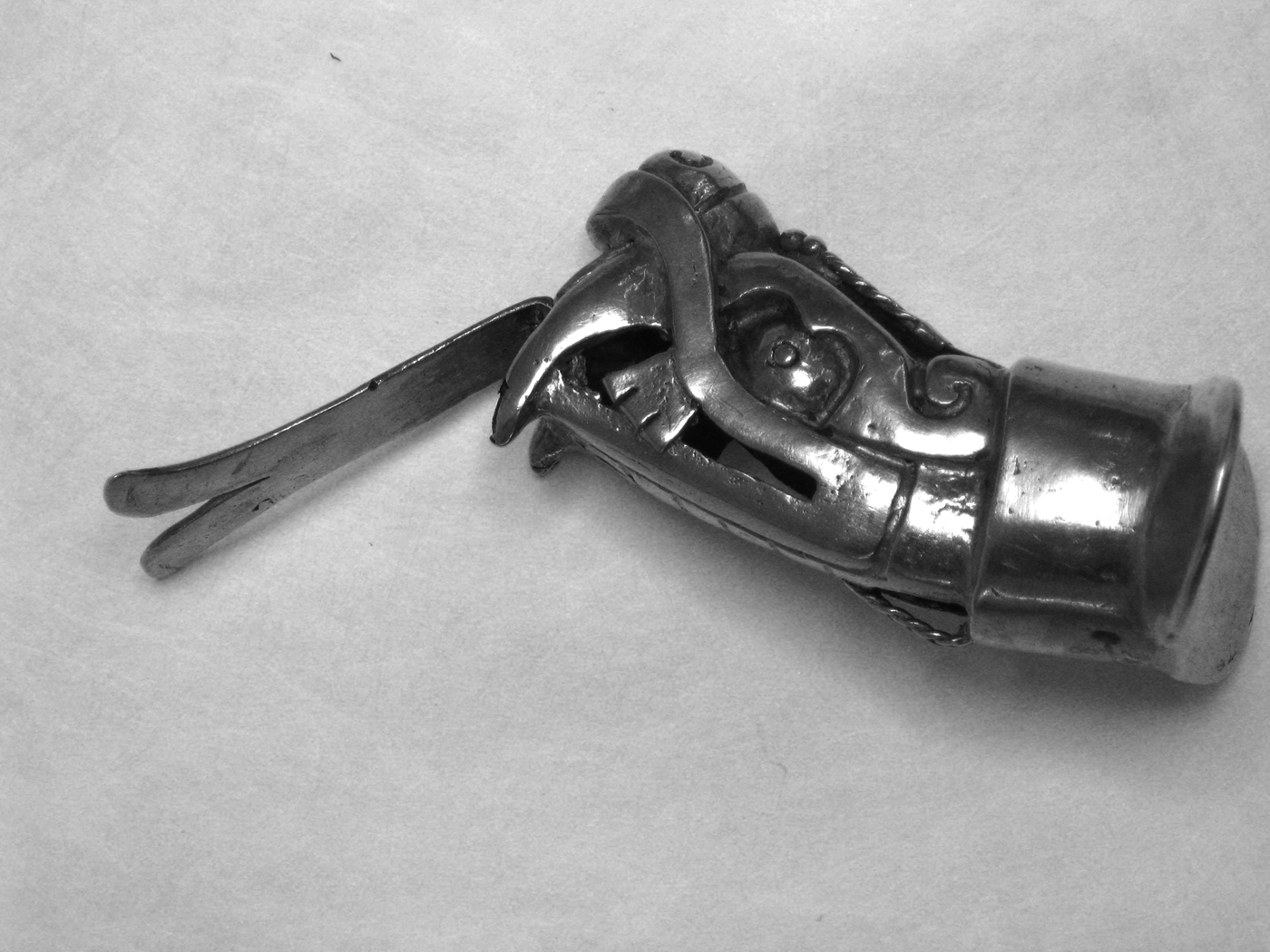
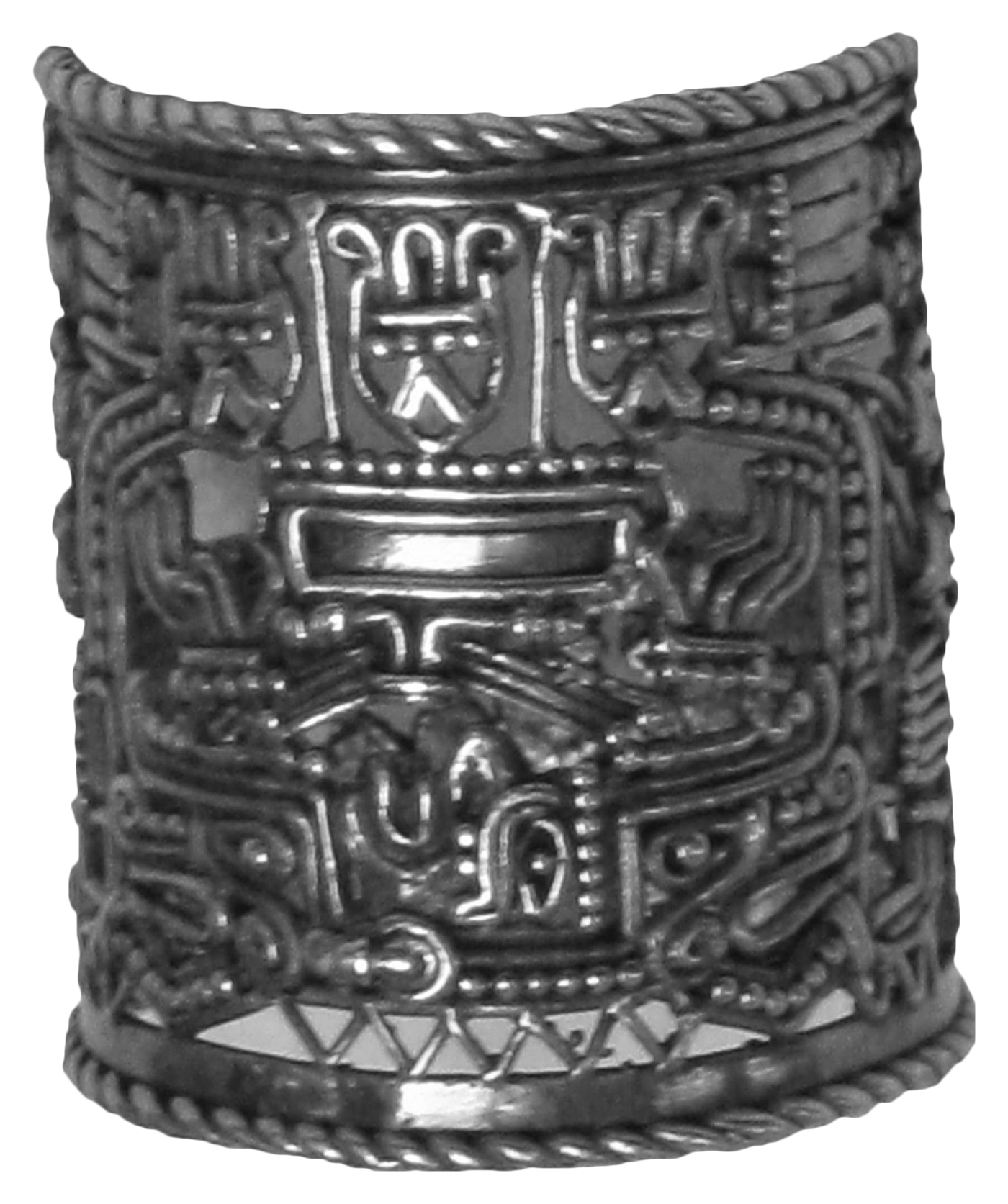
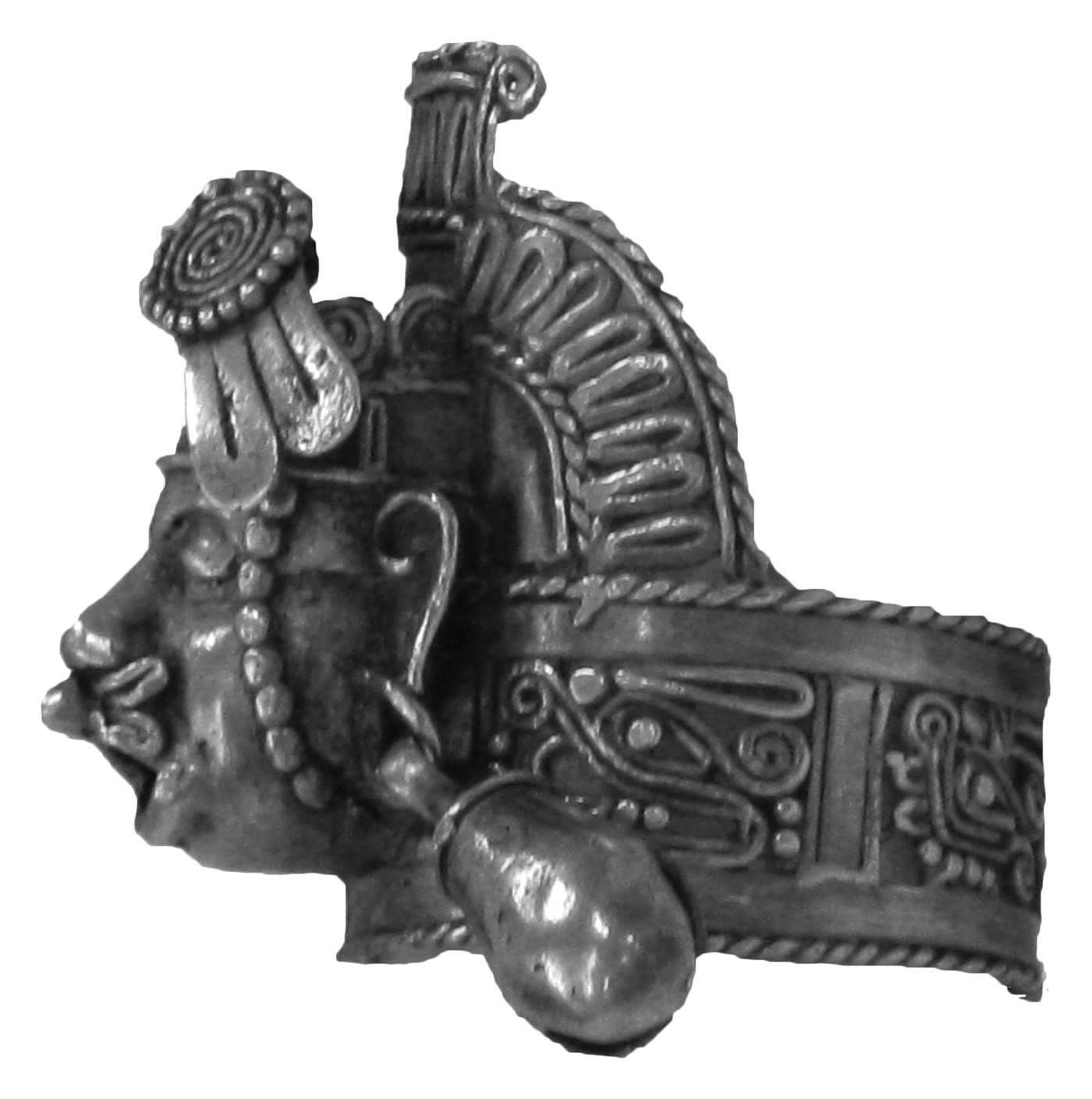
A detailed iconographic study of gold objects cannot be undertaken here but it is worth noting that art historians have already attributed to the Aztecs several objects in the Mixteca-Puebla stylistic tradition found outside the Basin of Mexico. These include a Coyolxauhqui figure (Velasco Alonso Reference Velasco Alonso and Olguín2004:16), a labret in the shape of a serpent, a ring with serpents in filigree, and a Xipe Totec ring (Solís Reference Solís Olguín2004:40, 41, 68) (Figures 12–15). These four objects are reportedly from Oaxaca and thus support the contention that, at the time of the conquest, Aztec gold ornaments were present in locations outside the Basin of Mexico. Further iconographic research may result in the re-attribution from the Mixtec to the Aztec of other gold ornaments such as the bracelets from the Tesoro del Pescador in Veracruz, and even the Broche de Mictlantecuhtli from Tomb 7 at Monte Albán (King Reference King2015, Reference King, Finegold and Hoobler2017.
Coyolxauhqui figure. Attribution: Aztec. 4.9 × 4.0 × 1.4 cm. Provenience: Oaxaca. Museo Nacional de Antropología, Mexico, 10–3322. Photo: Archivo Digital de las Colecciones del Museo Nacional de Antropología. CONACULTA-INAH-CANON. Reproduction authorized by the Instituto Nacional de Antropología e Historia.
Labret with serpent head. Attribution: Aztec. 6.8 x 8.2 x 5.3 cm. Provenience: Ejutla, state of Oaxaca. National Museum of the American Indian, Smithsonian Institution, Washington DC, 18/756. Photo by the author.
Ring with serpents in filigree. Attribution: Aztec. 2.2 × 1.8 cm. Provenience: State of Oaxaca. National Museum of the American Indian, Smithsonian Institution, Washington, DC, 16/3447. Photo by the author.
Ring with image of Xipe Totec. Attribution: Aztec. 3.2 x 2.5 x 1.8 cm. Provenience: State of Oaxaca. National Museum of the American Indian, Smithsonian Institution, Washington, DC, 20/6218. Photo by the author.
CONCLUSION
The expansion of the goldworking community in the Alliance urban centers gained momentum with the formation of the Triple Alliance in 1428 and continued growing until the Conquest. This growth was driven in part by a system of imperial patronage that used gifts of luxury craft products as one technique to solidify military alliances, strengthen bonds between different city-states and maintain control. This system led to the Alliance's domination of the long-distance trade of elite raw materials, and the craft products made from them. As the volume of tribute gold grew, especially following Moctezuma I's first conquests of provinces in the Mixteca, demand for the services of goldsmiths to meet the needs of rulers and elites also rose. By the end of the fifteenth century, with its empire extending over most of central and southern Mexico, the Alliance's power and wealth would have ensured that its gold ornament output exceeded that of centers in the Mixteca and Michoacan in quantity, and matched or exceeded them in quality. Some appreciable portion of this output must have made its way to the provinces by means of trade, gifts, or spoils of war; thus some gold objects today without provenience, or with provenience outside the Basin of Mexico, are likely to have originated in the Alliance urban centers. The attribution of some of these objects as Aztec may result from further stylistic and iconographic research.
RESUMEN
Desde la década de 1460 la Triple Alianza obtuvo oro en polvo y lingotes como tributo de varias provincias de Oaxaca y Guerrero. De acuerdo con cálculos basados en el Códice Mendoza, en la época de la conquista, la Alianza estaba recibiendo el equivalente de alrededor de 500 kg de oro puro anualmente de estas provincias. Esta cantidad sería suficiente para crear unos 25.000 adornos de pesos similares a los encontrados en la Tumba 7 de Monte Albán, y hubiera requerido los servicios de un gran número de orfebres talentosos. La gama de objetos fabricados en oro, y oro combinado con plumas y piedras preciosas, era amplio, desde brazaletes y collares hasta representaciones de animales y escudos. La calidad y la creatividad de este trabajo impresionaron mucho a los españoles.
Informes arqueológicos sobre trabajo de cobre, y las fuentes coloniales tempranas, indican que la orfebrería probablemente había entrado en la Cuenca de México a principios del siglo XV y fue bien establecida en los centros urbanos de la Alianza a finales del siglo XV. Orfebres probablemente inmigraron a los centros de la Alianza de las regiones donde se adoraba a la deidad patrona de los metalúrgicos, Xipe Totec, o fueron formados en los centros. Algunos trabajaban para los gobernantes, mientras que otros eran independientes. A principios del siglo XVI, la Alianza había ganado el control de una gran parte del mercado mesoamericano en objetos de oro, y la comunidad orfebrería en los centros urbanos probablemente era más grande que cualquier otro similar en la Mixteca o el imperio purépecha.
El oro, considerado como excreciones del sol, tenía un valor simbólico para los mexicanos. Los adornos de oro mejoran la posición social del que los lleva y justificaron el poder que viene con este estado. Los gobernantes de la Triple Alianza empleaban adornos de oro con fines políticos y comerciales importantes. Los regalos de oro y otros objetos de artesanía de lujo tuvieron un papel clave en la consolidación de las alianzas militares y el fortalecimiento de la lealtad de las elites subordinadas tanto en la Cuenca y en las provincias, y muchos adornos fueron entregados a los dignatarios extranjeros. El uso de adornos de lujo entre la nobleza aumentó en paralelo con las prácticas de los gobernantes, y preciosos regalos fueron intercambiados entre las familias de élite con sus miembros y socios en las provincias. El comercio de exportación de joyas de oro también creció. El resultado fue un crecimiento sustancial en la demanda de objetos de oro, una cierta porción de la cual se exportó, algunos incluso como botín de guerra. Como resultado, es muy probable que algunos adornos de oro que se encuentran fuera de la Cuenca, o sin procedencia, que se atribuyen actualmente a los mixtecos, bien pueden ser de los aztecas.
ACKNOWLEDGMENTS
I would like to thank Esther Pasztory for her advice and guidance on my master's thesis, from which this paper evolved; Leonardo López Luján for his great generosity in showing me some of the recently discovered Templo Mayor offerings, sharing some of the findings of his and José Luis Ruvalcaba's recent work on the gold collection at the Museo del Templo Mayor, and for his invaluable review of an earlier version of this paper; Susan Bergh for her excellent editorial advice and suggestions; Heidi King for her careful reviews, recommendations, and assistance with illustrations; Andrew Finegold and Julie Jones for their thoughtful comments on versions of this paper; Ellen Hoobler for her advice and assistance with sources; Justin Kerr for his insights on metalworking; and Emilia Cortés for assisting with the abstract in Spanish. Of course, all errors of fact and interpretation are mine alone.