Over the past 2 decades, rates of food insecurity (defined as limited access to adequate food due to a lack of financial and other resources) have risen dramatically in the United States because of changes in the proportion of income spent on food, eligibility and funding levels for food assistance, and in market factors over time. 1 - Reference Gundersen and Ziliak 3 During the time frame from 2004 to 2013 the prevalence of food insecurity in the United States has risen from 11.9% to 14.1%. This translates to a total of 17.5 million US households experiencing food insecurity in 2013, with ~49 million people living in these food-insecure households.Reference Coleman-Jensen, Gregory and Rabbitt 4
Food insecurity poses serious health risks such as poor nutrition,Reference Tarasuk and Beaton 5 - Reference Rose-Jacobs, Black and Casey 8 hypertension, hyperlipidemia, cardiovascular disease,Reference Seligman, Laraia and Kushel 9 poor quality of life,Reference Campbell 10 poor self-rated physical and mental health,Reference Stuff, Casey and Szeto 11 increased depressive symptoms,Reference Okechukwu, El Ayadi, Tamers, Sabbath and Berkman 12 poor functional health, and restricted activity.Reference Webber, Sobal and Dollahite 13 In addition, emerging evidence has linked food insecurity to an increased risk for overweight and obesity.Reference Olson, Rauschenbach, Frongillo and Kendall 14 , Reference Dinour, Bergen and Yeh 15 Food insecurity has also been associated with poor health outcomes in children, including higher rates of acute infections, developmental problems, mental health problems, and chronic conditions like asthma and frequent colds.Reference Rose-Jacobs, Black and Casey 8 , Reference Weinreb, Wehler and Perloff 16 - Reference Alaimo, Olson, Frongillo and Briefel 19 This is especially concerning given the fact that the rates of food insecurity in households with children (19.2%) are considerably higher than the national average (14.0%).Reference Coleman-Jensen, Rabbitt, Gregory and Singh 20 Given the deleterious consequences of food insecurity, it is important to identify high-risk households in order to target prevention efforts.
Food insecurity disproportionately impacts households in rural areas, those headed by single adults with children,Reference Olson, Rauschenbach, Frongillo and Kendall 14 , Reference Rose 21 - Reference Alaimo, Briefel, Frongillo and Olson 23 black and Hispanic households, and those with children under the age of 6 years.Reference Coleman-Jensen, Rabbitt, Gregory and Singh 20 In addition, food insecurity is also high among individuals who experience a change in their life circumstances such as changes in household composition or housing stability,Reference Cristofar and Basiotis 7 , Reference Rose, Gundersen and Oliveira 24 financial obligations or economic changes,Reference Olson, Rauschenbach, Frongillo and Kendall 14 , Reference Rose 21 or as individuals age (age >60 years).Reference Alaimo, Briefel, Frongillo and Olson 23 , Reference Hamilton, Cook and Thompson 25
Unexpected changes in life circumstances can also result from disruptions in one’s typical routine brought about by a catastrophe or a natural disaster. Alleviating limited access to food that arises during disasters is the focus of many recovery efforts. 26 - 30 Understanding the process by which food insecurity changes during the course of a disaster event, ranging in time from event to recovery, can help guide current practices in communities impacted by similar disruptions to their normal daily routine. Identification of the factors that influence persistent food insecurity that continues during the disaster recovery process is critical to developing effective and sustainable food-aid programs.
Using the frameworks of social cognitive theoryReference Bandura 31 and the social-ecological model of disaster recovery,Reference Abramson, Stehling-Ariza, Park, Walsh and Culp 32 3 spheres of influence have been identified that may impact continued food insecurity post disaster (see Figure 1). The 3 spheres of influence include structural factors, physical and mental health, and psychosocial factors. Structural factors such as age,Reference Nord 33 , Reference Wehler, Weinreb and Huntington 34 housing,Reference Kirkpatrick and Tarasuk 35 marital status,Reference Cutts, Pheley and Geppert 36 race/ethnicity,Reference Kaiser, Baumrind and Dumbauld 37 , Reference Chávez, Telleen and Kim 38 and socio-economic statusReference Alaimo, Briefel, Frongillo and Olson 23 , Reference Rose, Gundersen and Oliveira 24 have all been associated with food insecurity in a non-disaster context. It is hypothesized that these factors will also play an important role in influencing food insecurity in the post-disaster context. Both physical and mental health have been examined as predictors of post-disaster outcomes, and are hypothesized to be related to a household’s ability to obtain sufficient food.Reference Clay, Goetschius, Papas and Kendra 39 Vulnerable populations, such as those with underlying chronic disease or mental illness, are at an increased risk for negative outcomes in disasters, which may be due to the difficulty in evacuation and the need for additional assistance.Reference Norris, Friedman, Watson, Byrne, Diaz and Kaniasty 40 - Reference Eisenman, Zhou, Ong, Asch, Glik and Long 43 Finally, increases in psychological distress occur after a disaster experience.Reference Galea, Nandi and Vlahov 44 - Reference Neria, Nandi and Galea 46 Dimensions of positive psychological attributes such as self-efficacy and social characteristics such as social support have been found to buffer the impact of a disaster on psychological distress.Reference Benight, Swift, Sanger, Smith and Zeppelin 47 - Reference Norris and Kaniasty 49 Greater social support and increased self-efficacy also play important roles in increasing food security in populations; although results have been strongest in high-income individuals.Reference Garasky, Morton and Greder 50 , Reference Frongillo, Valois and Wolfe 51
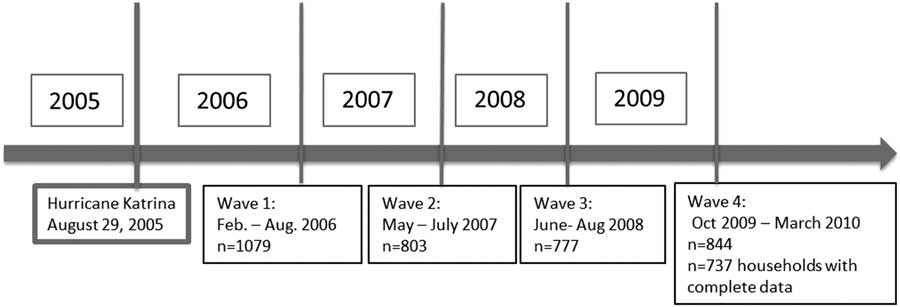
Gulf Coast Child and Family Health Study Data Collection Timeline and Sample Size.Reference Abramson, Stehling-Ariza, Park, Walsh and Culp 32 , Reference Abramson, Stehling-Ariza and Park 52

The goal of the current study is to examine the association between factors operating within 3 critical spheres of influence including structural, physical and mental health, and psychosocial domains on continued food insecurity experienced by a cohort established shortly after Hurricane Katrina. We hypothesize that factors operating within all 3 domains will independently influence continued food insecurity among post-Hurricane Katrina residents and that the associations will be similar to those evident in non-disaster-impacted populations.
METHODS
Sample
The study sample used in this investigation comes from the Gulf Coast Child and Family Health (G-CAFH) Study. In 2006, the G-CAFH study enrolled 1077 households and collected data annually through 2010, see Figure 1. The current investigation examined cross-sectional data on households with complete data in 2010, resulting in the inclusion of 737 households.Reference Abramson, Stehling-Ariza, Park, Walsh and Culp 32 , Reference Abramson, Stehling-Ariza and Park 52 A bias analysis conducted by the G-CAFH study team determined that there were no significant differences between the baseline cohort and those interviewed in wave 4.Reference Abramson, Stehling-Ariza, Park, Walsh and Culp 32 Detailed information on the cohort and methodology of the study has been published elsewhere.Reference Abramson, Stehling-Ariza, Park, Walsh and Culp 32 , Reference Abramson, Stehling-Ariza and Park 52
Measures
Food Insecurity
Measuring food insecurity was not a specific research aim of the G-CAFH study. Findings related to the question “In the last three months, how often has it happened that there was not enough money in the household for food that you (the family) should have?” led to examination of this concept in greater detail. To align with the United States Department of Agriculture (USDA) food-insecurity reporting standards for food secure (high or marginal food security) or insecure (low or very-low food security), respondents answering “fairly often” or “very often” were categorized as food insecure, and respondents answering “never” or “once in a while” were categorized as food secure. 53
Structural Factors
Partnered
The “partnered” category was assessed by asking respondents to indicate their marital status (married, single, never married, separated, divorced, widowed, or living as married). Respondents reporting “married” or “living as married” were categorized as “partnered” whereas all others were categorized as “non-partnered”.
Sex
To assess sex, respondents were asked to indicate male or female for all household members as part of the household-composition section of the interview.
Home Owner
Home ownership was assessed by asking respondents whether they were home owners before Hurricane Katrina. Responses were coded as yes or no.
Economic Stability
Economic stability was determined for households that reported a positive cash inflow to the household and no job-loss. Those that had both positive cash inflow and no job-loss were categorized as economically stable. Those that had either a negative cash inflow or experienced job loss were categorized as not economically stable.
Ethnicity
To assess ethnicity, respondents were asked, “Do you consider yourself... Black, White, Asian/Pacific Islander, Native American/Aleutian/Native Alaskan/Eskimo, or Other?” and “Do you consider yourself Hispanic or Latino?” On the basis of their response, individuals were categorized into 1 of 4 racial/ethnic groups: black, white, Latino, and other.
Employed
Employment was assessed by asking respondents whether they were currently employed full time, part time (20+ hours/week), or occasionally (<20 hours/week), were retired, homemakers, or unemployed, or were disabled, student, or other. Respondents indicating full- or part-time employment were categorized as employed, and all other responses were categorized as other.
Age
Age was self-reported by respondents during wave 4 of data collection and was grouped into 4 categories: 18-34, 35-49, 50-65, and 66+ years.
Years to Stable Housing
Years to stable housing was measured as the number of days to initial stable housing following Hurricane Katrina and was coded as <1 year, 1-2 years, 2-3 years, 3-4 years, >4 years.
Children in the Household
To determine whether there were children in the household, respondents were asked whether there were any children under 18 years old currently living in the household during the fourth wave of data collection.
Physical and Mental Health
Physical and Mental Health Distress
Physical and mental health was assessed using the Short Form (SF)-12 Health Survey.Reference Ware, Kosinski and Keller 54 The Physical Component Summary (PCS) and Mental Component Summary (MCS) scores were computed from the SF-12, providing a measure of physical health distress and mental health distress. Respondents were categorized as having physical health distress if they scored <45 on PCS domains and as having mental health distress if they scored <42 on MCS domains, consistent with past research studies.Reference Ware, Kosinski and Keller 54 , Reference Abramson, Stehling-Ariza, Garfield and Redlener 55
Disabled
Respondents were classified as disabled if they indicated their employment status as “disabled” when reporting on household composition. Otherwise, they were classified as non-disabled.
Post-Traumatic Stress Disorder (PTSD)
PTSD was assessed using the Trauma Screening Questionnaire (TSQ), a 10-item symptom screener that asked respondents to report on reactions in the past 4 weeks.Reference Brewin, Rose and Andrews 56 Respondents were categorized as having PTSD if they had a score of 6 or more on the TSQ.Reference Brewin, Rose and Andrews 56
Psychosocial Factors
Social Support
Social support was assessed as a measure of practical functional support by asking respondents whether there was anyone they could count on for everyday favors like getting a ride, taking care of them whether they were confined to bed for several weeks, lending them several hundred dollars for a medical emergency, talking to them whether they were having troubles with a family relationship, and helping them locate housing if they had to move. Respondents answering yes to 2 or more of these statements were categorized as having high social support, otherwise they were classified as having low social support.
Sense of Community
Sense of community was assessed using the 12-item Sense of Community Index 57 that assesses community membership, influence, reinforcement of needs, and shared emotional connection. A median score of 6 was used as a cut-off point to categorize respondents as having a high or low sense of community to enable interpretation in a logistic model.
Self-Efficacy
Self-efficacy was assessed using the General Self-Efficacy Scale (GSE, 10 items).Reference Schwarzer and Jerusalem 58 – Reference Scholz, Doña, Sud and Schwarzer 60 The GSE asks respondents to report on their beliefs about performing tasks and coping with adversity in different functional domains. Self-efficacy scores were dichotomized as high or low using the mean as a cut-off point.
Neighborhood Disorder
Neighborhood social and physical disorder status was assessed with a neighborhood surveyReference Raudenbush and Sampson 61 - Reference Sampson and Raudenbush 63 that asked respondents how concerned they were on a scale of 1-10 about a series of neighborhood issues such as letting children play outside during the day or night or having property stolen, and about problems found in their neighborhood such as gang activity or graffiti. Neighborhood disorder measures were then grouped into social- and physical-disorder classifications and, consistent with work on neighborhood disorder conducted by Sampson et al, confirmatory-factor analysis was used to compute social- and physical-disorder variables.Reference Raudenbush and Sampson 61 , Reference Sampson, Raudenbush and Earls 62 Respondents with positive factor loadings were categorized as having social- or physical-disorder “problems” and respondents with negative factor loadings were categorized as having “less problem” with social or physical disorder.
Statistical Analysis
Logistic regression models were fitted to assess the potential associations between structural, physical and mental health, and psychosocial factors on the likelihood that respondents would report they were food insecure. First, we conducted a Pearson χ2 test to determine which of the structural factors (partnered, home owner, economic stability, race/ethnicity, employment, age, years to stable housing, children in household, and change in employment status pre- to post-Katrina), physical and mental health (PTSD, mental health, chronic health, disability, physical health distress, and mental health distress), and psychosocial factors (social support, sense of community, self-efficacy, neighborhood physical disorder, and neighborhood social disorder) were statistically significantly associated with food insecurity. We then included each of the statistically significant factors in a logistic regression model. The log-likelihood, Akaike information criterion, Bayesian information criterion, and Hosmer-Lemeshow goodness of fit tests were performed to determine the best fitting model.Reference Hosmer and Lemeshow 64 - Reference Burnham and Anderson 66 Models were built in 3 steps, starting with structural factors, then adding physical and mental health, and psychosocial factors in subsequent steps. Odds ratios (OR) and 95% CI assessing associations between factors within each of the 3 domains and food insecurity are reported.
RESULTS
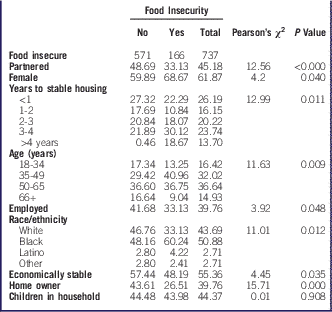
In our sample of 737 respondents, 166 (22.52%) reported problems with having enough money to purchase food to meet family needs during the past 3 months. Over half of the respondents in this study sample are black (n=375, 50.88%), 43.69% are white (n=322), 2.71% are Latino (n=20), and 2.71% report their race or ethnicity as other (n=20). The sample is 61.87% female (n=456), and 45.18% of respondents report being partnered (n=333). Nearly 70% of the respondents in the study sample are between the ages of 35 and 65 years (n=506). Over 55% report being economically stable (n=408), and 60% report less than part-time employment (n=444) (see Table 1).
Characteristics of Sample and Bivariate Relationship with Food Insecurity

Logistic regression was performed to assess the impact of structural, physical and mental health, and psychosocial factors on the likelihood that respondents would report whether they had problems with having enough money to purchase food to meet family needs in the past 3 months. Three models were fit in a stepwise approach, first examining structural characteristics, then including physical and mental health, and finally creating a fully adjusted model including structural, physical and mental health, and psychosocial factors.
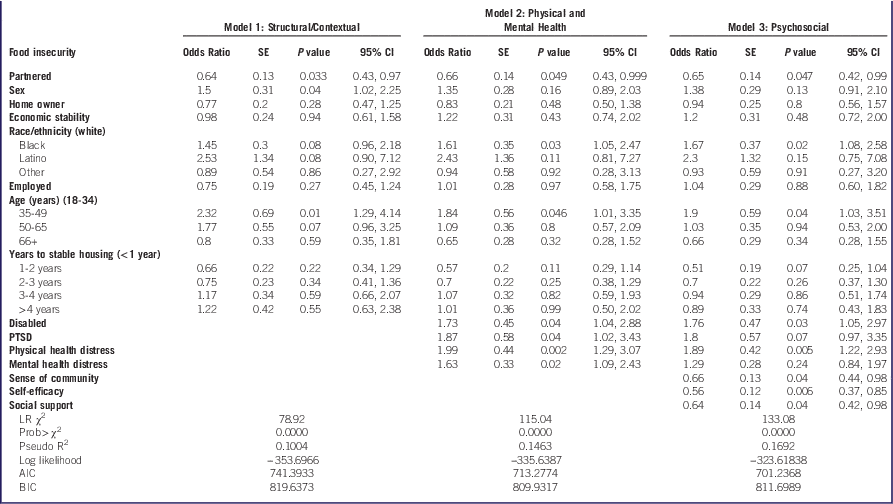
The first model examined the influence of structural factors on food insecurity in our sample. A Pearson χ2 test indicated an association between the outcome of food problem and partner status (χ2=12.56, P<0.001), home ownership (χ2=15.71, P<0.001), economic stability (χ2=4.45, P<0.05), race/ethnicity (χ2=11.01, P<0.05), employment (χ2=3.92, P=0.05), age (χ2=11.63, P<0.01), years to stable housing (χ2=12.99, P<0.05), and sex (χ2=4.2, P<0.05) (see Table 2). The first logistic regression model included these 8 structural factors. The model provided a good fit (χ2=78.92, P<0.001). As shown in Table 4, being female, partnered, and 35-49 years of age made a unique statistically significant contribution to the model. Respondents reporting ages 35-49 years (OR: 2.32, 95% CI: 1.29, 4.14) were more than twice as likely to report food insecurity compared with respondents aged 18-34 years, and female respondents were 1.5 times more likely to report food insecurity than males (OR: 1.5, 95% CI: 1.02, 2.25). Respondents reporting being partnered (OR: 0.64, 95% CI: 0.43, 0.97) were 36% less likely than those not partnered to report food insecurity.
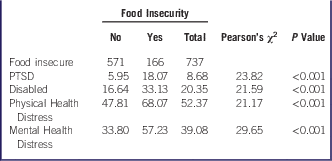
Bivariate Relationship Between Physical/Mental Health Characteristics and Food Insecurity

Abbreviation: PTSD, post-traumatic stress disorder.
The second model examined the influence of physical and mental health factors on food insecurity in the study sample. A χ2 analysis of mental and physical health factors demonstrates that PTSD (χ2=23.82, P<0.001), disability (χ2=21.59, P<0.001), physical health distress (χ2=21.17, P<0.001), and mental health distress (χ2=29.65, P<0.001) were each associated with whether a respondent reported food insecurity (see Table 2). The second logistic regression model we fit included the structural factors from model 1 and the 4 physical and mental health factors. The model was statistically significant (χ2=98.21, P<0.001). As shown in Table 4, disability, PTSD, physical health distress, mental health distress, being partnered, of age 35-49 years, and being black (race) were statistically significant contributors to the model. Respondents reporting a disability were 1.73 times more likely (OR: 1.73, 95% CI: 1.04, 2.88) to report food insecurity than respondents without a disability. Respondents with physical health distress were twice as likely (OR: 1.99, 95% CI: 1.29, 3.07), and respondents with mental health distress were 1.63 times more likely (OR: 1.63, 1.09, 2.43), to report food insecurity. Respondents with PTSD had nearly twice the odds of reporting food insecurity (OR: 1.87, 95% CI: 1.02, 3.43). Respondents reporting their race as black were 1.61 times more likely (OR: 1.61, 95% CI: 1.05, 2.47) than white respondents to report food insecurity, and partnered respondents (OR: 0.66, 0.43, 0.999) were 34% less likely to report food insecurity than those without a partner. Being 35-49 years of age also remained a risk factor for food insecurity (OR: 1.84, 95% CI: 1.01, 3.35).
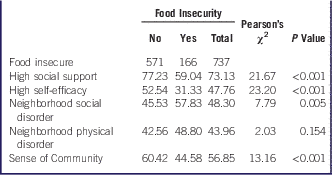
The third and final model adds psychosocial factors. A χ2 analysis of psychosocial factors demonstrates that sense of community (χ2=13.16, P<0.001), self-efficacy (χ2=23.20, P<0.001), social support (χ2=21.67, P<0.001), and neighborhood social disorder (χ2=7.79, P<0.01) are associated with food insecurity (Table 3). The third logistic regression model we fit included these psychosocial factors with the structural and physical and mental health factors. The model was statistically significant (n=737; χ2=133.08, P<0.001). As shown in Table 4, sense of community, self-efficacy, social support, disability, physical health distress, being black (race), of age 35-49 years, and being partnered made a statistically significant contribution to the model. Sense of community (OR: 0.66, 95% CI: 0.44, 0.98), self-efficacy (OR: 0.56, 95% CI: 0.37, 0.85), social support (OR: 0.64, 95% CI: 0.42, 0.98), and being partnered (OR: 0.65, 95% CI: 0.42, 0.99) were protective against food insecurity, whereas physical health distress (OR: 1.89, 95% CI: 1.22, 2.93), being of black race (OR: 1.67, 95% CI 1.08, 2.58), being of age 35-49 years (OR: 1.9, 95% CI: 1.03, 3.51), and disability (OR: 1.76, 95% CI: 1.05, 2.97) were risk factors for food insecurity.
Bivariate Relationship Between Psychosocial Characteristics and Food Insecurity

Relationship Between Structural, Health, and Psychosocial Factors and Food Insecurity

Abbreviation: PTSD, post-traumatic stress disorder; LR, likelihood ratio; AIC, Akaike information criterion; BIC, Bayesian information criterion.
DISCUSSION
Within the disaster context, food insecurity is driven by a combination of access issues as well as social and network factors. This highlights a departure from existing food insecurity literature that stresses the critical importance of access issues. The emergence of social factors is a novel finding that enhances our understanding of food insecurity in a post-disaster context. The results from this study reveal important relationships between factors that may impact food security during recovery from disasters. Findings demonstrate that the outcome of food insecurity is driven by a combination of access issues (physical health distress and disability) and social-network factors (partnered, sense of community, social support, and self-efficacy).
Households in this sample were heavily impacted by Hurricane Katrina. Nearly a quarter of the respondents reported experiencing difficulty with getting enough food for the household 5 years after Hurricane Katrina. This is above the national food insecurity average for 2010 of 14.5% of households experiencing food insecurity at some point during the year, and above the average prevalence of food insecurity for the states of Louisiana (12.6%) and Mississippi (19.4%) in 2010.Reference Coleman-Jensen, Nord, Andrews and Carlson 67 From food insecurity prevalence data, we expected to observe a higher prevalence of food insecurity among black and Hispanic families; whereas the number of Hispanic respondents in this study sample was low (n=20), respondents identifying as black made up half of the sample (n=375, 50.88%). Among black respondents, there was a 60% (n=100) prevalence of food insecurity.Reference Coleman-Jensen, Nord, Andrews and Carlson 67
Structural Factors
When examining structural characteristics, being partnered was protective against food insecurity, and being of age 35-49 years and female were risk factors. Partnership may be indicative of having social support in the household. We did not observe an effect of income when examining structural factors, thus being partnered may be more related to having social support rather than a second income. For respondents aged 35-49 years, there were increased odds of reporting problems with getting enough food. This could possibly be attributed to their dual roles as caretakers of their children and aging parents, which is faced by individuals in this “sandwich generation” role.Reference Riley 68 Although we do not include data in this model on whether the female respondents are single heads of household, the high prevalence of food insecurity among females in the sample, and the finding of female sex as a risk factor could be in line with the higher prevalence of food insecurity observed nationally in single-female headed households (35.1%). Future analyses including household composition could shed light on both influence of the “sandwich generation” and female sex on food insecurity following disasters.
Physical and Mental Health Factors
Disability, physical health distress, mental health distress, and PTSD were all critical physical and mental health factors that increased the odds of reporting problems with getting enough food. They contribute to our understanding of food insecurity after accounting for the impact of partnership, race, and sex. This aligns with what we know from disaster research exploring the role of physical and mental health on post-disaster outcomes. It also aligns with research on health outcomes following disasters, which shows that a pre-disaster history of psychological or psychiatric problems, chronic disease, poor mental health, and poor self-rated health are predictive of adverse outcomes post disaster.Reference Bonanno, Galea, Bucciarelli and Vlahov 45 , Reference Abramson, Stehling-Ariza, Garfield and Redlener 55 , Reference Yzermans, Donker, Kerssens, Dirkzwager, Soeteman and Ten Veen 69 - Reference Chang, Connor, Lai, Lee and Davidson 73
Psychosocial Factors
Sense of community, social support, and self-efficacy protect against food insecurity post disaster. Disaster research shows that individuals with poor physical and mental health are at an increased risk for adverse consequences following disaster. Our sample aligns with those in the literature regarding physical health; however, they diverge when we look at mental health in light of psychosocial factors. Mental health factors are explained away when factors like sense of community, social support, and self-efficacy are added to the post-disaster picture. Future research examining causal pathways between psychosocial factors and food insecurity would help us better understand the role of psychosocial support as a moderator of post-disaster food insecurity.
Abundant research studies detail the prevalence of poor mental health status in the short- and long-term periods of disaster recovery,Reference Galea, Nandi and Vlahov 44 , Reference Neria, Nandi and Galea 46 and the initial result that mental health factors are associated with food insecurity is critical to understand. The finding that mental health factors were no longer significantly associated with food insecurity once social support, sense of community, and self-efficacy were added to the model provides an important insight into specific factors that protect people following disasters. These social factors may be able to be leveraged following disasters to provide social support for families impacted.
It is also interesting to note what we did not observe in this sample of households heavily impacted by Hurricane Katrina. On the basis of the literature, we expected to see that housing stability, economic stability, and elderly age would be risk factors for food insecurity.Reference Cristofar and Basiotis 7 , Reference Rose, Gundersen and Oliveira 24 , Reference Hamilton, Cook and Thompson 25 , Reference Alaimo, Briefel, Frongillo and Olson 74 The final model shows that housing stability is not associated with food insecurity post disaster. In a non-disaster context, research findings show a clear relationship between housing instability and food insecurity,Reference Cristofar and Basiotis 7 , Reference Rose, Gundersen and Oliveira 24 whereas the results from this study indicate that a combination of social-network and physical capabilities in the post-disaster context provides a more significant protection against food insecurity post-disaster than the availability of stable housing. This finding suggests that psychosocial factors may have important implications for food security post disaster.
This study has some potential limitations to note. To measure the outcome of “food insecurity,” we asked respondents “In the last three months, how often has it happened that there was not enough money in the household for food that you (the family) should have?” We acknowledge that this measure is open to interpretation by study participants. To address the possibility that this question targeted respondents’ concern about financial resources rather than food, we specifically examined the impact of economic stability (households that reported a positive cash inflow to the household and reported no job-loss) on the outcome of food insecurity and found that economic stability did not present a statistically significant impact. We argue that if respondents primarily answered the food-insecurity question with regard to the availability of money in general, rather than regarding having enough money specifically for food, results would show a significant association between economic stability and food insecurity, but they do not. On the basis of the findings of this study, it may be that social-support networks make adequate food available, which counteracts lack of money. Informal or temporary food networks commonly emerge around disasters, which may offer social-support networks in addition to food, and hence this may be a protective factor and may matter even more than the structural factor of housing stability and the physical space to prepare food.Reference Kendra and Wachtendorf 75 - 77 This may be an opportunity for emergency managers and other disaster-response agencies to intervene to not only ameliorate post-disaster food insecurity but also to build community resilience. Future studies should use a more direct measure of food security to circumvent this potential measurement concern, and efforts to validate the 1-question assessment used in the G-CAFH survey could potentially offer an effective 1-item food-security screener. A 1-item screener may be particularly beneficial in post-disaster research or other settings where research fatigue or other constraints may be a concern for research protocols and participants.
Acknowledgments
The authors would like to thank the original research team that conducted the Gulf Coast Child and Family Health Study at the National Center for Disaster Preparedness, the Children’s Health Fund for funding the original research study, and the families that participated in the study for generously sharing their experiences in Hurricane Katrina so that we may learn about and work to improve the disaster recovery process.
Financial Support
This research received no specific grant from any funding agency, commercial or not-for-profit sectors.