After hepatitis B (HB) vaccination during infancy, a decrease in blood levels of antibody to hepatitis B surface antigen (anti-HBs) occurs and most persons will have anti-HBs levels less than the accepted threshold of protection (10 mIU/mL) when tested 10–15 years later.Reference Mast, Margolis and Fiore 1 , Reference Leuridan and Van Damme 2 Persons who receive HB vaccine early in life may later seek employment or training in healthcare professions and be required, as young adults, to document seroprotection against hepatitis B virus (HBV) infection.Reference Lindley, Lorick and Spinner 3 Universal infant HB vaccination was recommended in the United States in 1991; thus, an increasing proportion of persons who begin healthcare employment or training in this decade received HB vaccination in the remote past. Among those tested many years after the primary series and found to have an anti-HBs level less than 10 mIU/mL, demonstration of immune memory by an anamnestic response (ie, a rapid increase in anti-HBs level) requires 1 additional vaccine dose followed by quantitative anti-HBs testing. In settings such as occupational and student health clinics where such testing occurs frequently and consumes considerable resources (eg, vaccine purchase and administration, laboratory testing, staff time, patient visits), a more direct means to identify persons who retain HB vaccine–induced immunity despite having experienced a decrease in anti-HBs level to less than 10 mIU/mL is desirable. There is a need to identify persons who retain vaccine-induced immune memory despite having experienced such a decrease. Following completion of a clinical trial to determine the status of vaccine-induced immunity among US-born adolescents who initiated HB vaccination during infancy, we conducted a subanalysis to compare serologic response to challenge with HB vaccine among participants who, up to 19 years after receipt of the primary series, had anti-HBs levels ranging from 0 to 9.9 mIU/mL.
METHODS
From March 22, 2010, through December 31, 2011, we conducted a trial to determine long-term immunity among US-born 16–19-year-olds who completed the HB vaccine series during the first year of life (ClinicalTrials.gov identifier: NCT01341275). US-born adolescents aged 16 to 19 years who had documented (by medical records, state vaccine registry, or personal documentation, all of which had to include vaccination dates) receipt of exactly 3 doses of recombinant HB vaccine during the first year of life with no subsequent doses were eligible to participate in the study. A complete description of the study methods and results is published elsewhere.Reference Middleman, Baker and Kozinetz 4
Briefly, blood was drawn for pre-challenge (hereafter, termed baseline) serologic testing, including anti-HBs and total antibody to hepatitis B core antigen using the VITROS ECi platform (Ortho-Clinical Diagnostics). After collection of serologies, participants were immediately randomized and administered an intramuscular 10 μg- or 20 μg-dose of recombinant HB vaccine (Engerix-B). Participants returned 2 weeks after challenge for a second blood draw to determine the postchallenge anti-HBs level. Postchallenge specimens were tested for anti-HBs only and the results were quantified to 1 decimal point. A response to vaccine challenge was defined as attaining a postchallenge anti-HBs level of at least 10 mIU/mL with at least a 4-fold rise in the baseline anti-HBs level among participants with a baseline anti-HBs level less than 10 mIU/mL. The study was approved by the institutional review boards of Baylor College of Medicine and the Centers for Disease Control and Prevention. Parental permission from parents and guardians and the assent of all minor children were required for participation.
For our subanalysis, among participants with a baseline anti-HBs level less than 10 mIU/mL, we compared response to challenge dose between those with an anti-HBs level of 0 mIU/mL (group 1) vs those with levels of 0.1 to 9.9 mIU/mL (non-zero) at baseline (further divided into group 2 [0.1–4.9 mIU/mL] and group 3 [5.0–9.9 mIU/mL]). The 2-tailed Fisher exact test was used to compare categorical variables. The distributions of the postchallenge dose anti-HBs levels were examined and then log-transformed to achieve approximately normal distribution for parametric modeling and testing. For those anti-HBs values of 0, we used 0.05 for valid transformation. We compared the geometric mean concentrations between groups by the nonparametric log-rank test of differences. All analyses were conducted using a spreadsheet applicaton (Excel; Microsoft) and SAS software (SAS Institute); a box plot of postchallenge anti-HBs levels among the 3 groups was produced using R statistical programming language, version 3.1.0.
To assess the degree to which baseline specimens from the 3 groups yielded consistent zero vs non-zero anti-HBs levels when retested with the same quantitative Vitros ECi assay, we repeated the assay on a selection of baseline specimens from each of the 3 groups. Each specimen selected was retested at least 5 times on the same day (on the basis of available residual serum) to determine the frequency with which the initial baseline value differed from retested values. Compared with groups 2 and 3, more group 1 (“zero”) specimens were retested to determine (1) the frequency with which such specimens had non-zero values upon retesting, and (2) whether having non-zero values on retesting was associated with a response to the challenge dose (ie, whether such occurrences were associated with a response to challenge dose among those with 0 mIU/mL at baseline).
RESULTS
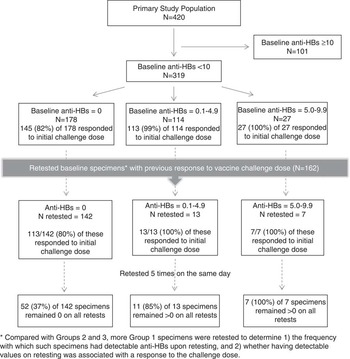
For our subanalysis, there were 319 persons with a baseline level of anti-HBs less than 10 mIU/mL; 178 (56%) had a level of 0 (group 1), 114 (36%) a level from 0.1 to 4.9 (group 2), and 27 (8%) a level from 5.0 to 9.9 mIU/mL (group 3) (Figure 1). The median age of participants was 17 years (range, 16–19 years); none tested positive for hepatitis B core antigen. There were no differences in age, sex, body mass index (calculated as weight in kilograms divided by height in meters squared), or challenge dosage received among persons in the 3 groups (90 vs 88 persons in group 1, 63 vs 51 in group 2, and 12 vs 15 in group 3, received a 10 vs 20 µg dose, respectively; P=.54).
Schematic representation of study population and groups used in the subanalysis, according to baseline anti-HBs results, the response to initial hepatitis B vaccine challenge dose, and results of retested baseline specimens.

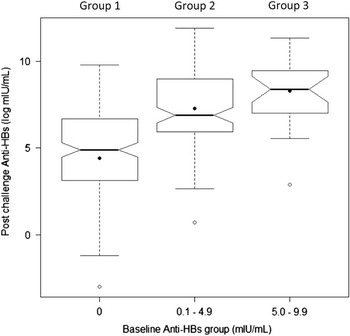
The anti-HBs responses to challenge according to baseline anti-HBs level are shown in Table 1. Persons with non-zero anti-HBs levels were significantly more likely to respond to the challenge dose (irrespective of 10- or 20- µg dosage) than those with anti-HBs levels of zero (group 3, 27/27 [100%] vs group 2, 113/114 [99%] vs group 1, 145/178 [82%]; P<.0001). Figure 2 shows a box plot of log-transformed anti-HBs levels after challenge dose of hepatitis B vaccine, according to nontransformed baseline anti-HBs levels among the 3 groups. Although the 95% CIs for the median postchallenge anti-HBs levels do not overlap among the 3 groups, they nearly overlap between the groups 2 and 3, suggesting these 2 groups share greater affinity than either does with group 1.
Box plot of log-transformed anti-HBs levels after challenge dose of hepatitis B vaccine (y-axis), according to (raw) pre-challenge anti-HBs levels among 3 groups (x-axis): 0, 0.1–4.9, and 5.0–9.9 mIU/mL. Pre-challenge levels were obtained 16–19 years after receipt of 3 doses of hepatitis B vaccine during infancy; postchallenge levels were obtained 2 weeks after the challenge dose. For each box, solid line represents the median; dot represents the geometric mean concentration; box top and bottom represent the 75th and 25th quartiles, respectively; notches represent 95% CIs for the median concentration.

Response to Hepatitis B Vaccine Challenge Dose Among 319 Persons With an Anti-HBs Level <10 mIU/mL 16–19 Years After Receipt of the 3-Dose Hepatitis B Vaccine Series During Infancy, According to Baseline Anti-HBs Level

NOTE. Baseline levels of antibody to hepatitis B surface antigen (anti-HBs) were obtained immediately prior to vaccine challenge dose. Postchallenge anti-HBs levels were obtained 2 weeks after the challenge dose. GMC, geometric mean concentration.
a Fisher exact test (2-tailed).
b Nonparametric log-rank test of differences.
Figure 1 also shows retested baseline anti-HBs levels among 162 participant specimens from each of the 3 groups; 142 were from group 1, 13 from group 2, and 7 from group 3. Eleven (85%) of 13 group 2 and 7 (100%) of 7 group 3 specimens remained 0.1–9.9 mIU/mL on all retests (ie, only 2 baseline specimens [10%] measured 0 mIU/mL on any of the retests conducted). In contrast, among the 142 group 1 specimens, 52 (37%) were 0 mIU/mL on each retest conducted, while 89 (63%) yielded at least 1 retest value ranging from 0.1 to 9.9 mIU/mL. When response to the challenge was compared among the 142 participants from group 1, those with specimens that retested 0 mIU/mL on all 5 retests responded to challenge less frequently (38/52 or 73%) compared with those whose anti-HBs level measured greater than 0 mIU/mL on at least 1 of the 5 retests (75/90 or 83%), but the difference was not significant (P=.11).
DISCUSSION
In this study of US-born adolescents who received 3 doses of recombinant HB vaccine during the first year of life (and none subsequently), residual anti-HBs levels greater than 0 but less than 10 mIU/mL 16–19 years later were strongly associated with an anamnestic response after a vaccine challenge dose—demonstrating the persistence of immune memory to HBsAg—compared with persons of similar age and vaccination history with anti-HBs levels of 0 mIU/mL. Although the typical clinical cutoff level for seroprotection against HBV infection is 10 mIU/mL, we were particularly interested in assessment of challenge dose response at the low end of detection of the VITROS ECi assay, as 114 (80%) of 141 participants with a non-zero residual anti-HBs level had a level from 0.1 to 4.9 mIU/mL. We found that the aforementioned association held true not only for persons whose baseline anti-HBs level ranged from 5.0 to 9.9 mIU/mL (group 3, all 27 of whom responded to challenge) but also for those with levels that ranged from 0.1 to 4.9 mIU/mL (group 2), a level considered “negative” and below the limit of detection for the assay. 5 Although only 18% of group 1 (“zero”) participants failed to respond to the HB challenge dose, only 1 (0.9%) of 114 group 2 participants failed to respond, and this group constituted 36% of all study participants. Postchallenge geometric mean concentrations were significantly higher among group 2 compared with group 1 participants; these differences could not be explained by the quantity of challenge dose, as there was no difference in the distribution of persons who received a 10- vs 20-µg dosage among all 3 groups. Other studies involving persons vaccinated at older ages or in regions of higher HBV endemicity have shown that those with measurable but low residual anti-HBs levels (ie, 1–9 mIU/mL) have a better response to a HB vaccine challenge dose than persons with an anti-HBs level equal to 0 mIU/mLReference Clemens, Sänger and Kruppenbacher 6 – Reference Szmuness, Stevens and Harley 9 ; however, to our knowledge, this study is the first to do so among US-born persons vaccinated during infancy.
Anti-HBs levels below the limit of detection of this assay (4.23 mIU/mL) are typically considered qualitatively indistinguishable from 0 mIU/mL. In this study, baseline specimens with initial levels from 0.1 to 4.9 mIU/mL remained the same 90% of the time with repeated measurements. Although not all specimens were retested, those selected from each of the 3 groups were representative of their parent groups with regard to their initial response to the challenge dose (eg, for group 1, 80% for retested selection vs 82% for all group 1).
Peak antibody response after completion of the primary HB vaccination series correlates with persistence of anti-HBs and long-term protection.Reference Leuridan and Van Damme 2 , Reference Szmuness, Stevens and Harley 9 – Reference Jack, Hall, Maine, Mendy and Whittle 11 Persons vaccinated during infancy with measurable anti-HBs 16–19 years later probably had a favorable response to the primary series. Participants in our study with baseline anti-HBs levels of 0 mIU/mL either had lost all antibody or, less likely, were a primary vaccine nonresponder. Unfortunately, we did not have data on the dosage, vaccine manufacturer, or anti-HBs response associated with the primary series. Our participants were vaccinated before 1998, when a lower dosage of Recombivax (2.5 µg) was recommended. Infants vaccinated after 1998 with 5-µg doses might have better peak antibody response to the primary series, which would bode favorably for sustained protection, relative to our cohort.
As noted, the limit of detection of the anti-HBs assay used for all testing was 4.23 mIU/mL, below which there is no longer a 95% probability of obtaining a measurable quantity of antibody. 5 Most of our 114 group 2 specimens were less than 4.23 mIU/mL, and all but 1 responded to challenge. The limit of detection for this assay notwithstanding, group 2 had greater affinity with group 3 than with group 1 specimens (Figure 2) with regard to response to challenge dose. We do not suggest that persons of similar age and vaccination history with low but non-zero anti-HBs levels forego assessment of their HBV immune status, particularly if there is ongoing risk of HBV exposure. Nor do we suggest that our findings should alter current Centers for Disease Control and Prevention guidelines for evaluating healthcare personnel for HBV protection.Reference Schillie, Murphy and Sawyer 12 However, future studies with more participants might compare the performance of this as well as other anti-HBs assays at the lower levels of detection. Studies that aim to identify correlates of cellular immunity to HBV infection and disease among persons vaccinated in the remote past might consider comparison of persons with zero vs non-zero anti-HBs levels less than 10 mIU/mL before challenge, rather than examining all persons with less than 10 mIU/mL as a homogeneous group. From a clinical practice standpoint, the cost-effectiveness of a differential approach to revaccination of previously vaccinated persons found to have an anti-HBs level less than 10 mIU/mL could be compared between those with zero vs non-zero levels many years after primary immunization. Most importantly, ongoing surveillance or periodic serosurveys are needed to detect breakthrough infections and illness among healthcare personnel, health professional students, and other vaccinated persons at risk of HBV exposure to ensure long-term effectiveness of HB vaccination.
ACKNOWLEDGMENTS
We acknowledge the assistance of Natasha Khudyakov of the Centers for Disease Control and Prevention in performing the serological assays and Carol Baker, MD, of Baylor College of Medicine in the production of this manuscript.
Financial support. US Centers for Disease Control and Prevention.
Potential conflicts of interest. A.B.M. reports that she received grant funding from Society of Adolescent Health and Medicine in 2012–2013 for the Public Health Demonstration Project Immunization grant, which was ultimately funded by Merck. She received funding in 2014 from an education grant from Novartis as a subcontract for Society of Adolescent Health and Medicine. She also receives royalties from Up-To-Date as Adolescent Medicine Section Editor. All other authors report no conflicts of interest relevant to this article.
The findings and conclusions in this report are those of the authors and do not necessarily represent the official position of the Centers for Disease Control and Prevention.