DOES electoral fraud stabilize authoritarian rule or undermine it? On the one hand, electoral fraud may help the regime “win” elections and signal strength to elites.Footnote 1 This view suggests that manufacturing dominant electoral victories deters potential challengers. On the other hand, electoral fraud also carries a clear set of risks. Fraud can serve as a focal point around which the opposition can organize mass protests, as the color revolutions clearly demonstrate.Footnote 2
But fraud holds another liability for autocrats, one that is underappreciated: it can undermine popular support for the authorities, even among those who back the regime. In this article, we examine how voters in contemporary Russia respond when they find out that the regime is manipulating elections. We argue that because voters view fraud as morally inappropriate, they disapprove of its use and withdraw support from the candidates who use it.
The effects of increasing awareness of electoral fraud are largest among core regime supporters. In electoral authoritarian regimes, regime partisans are more likely to believe ex ante that elections are conducted fairly. This can happen for a number of reasons. Regime supporters are more exposed (and possibly susceptible) to regime propaganda, and partisanship biases may inhibit the internalization of rumors about fraud. Alternatively, those who support the regime may do so precisely because they believe it’s holding free and fair elections. Given these preconceived notions, core supporters will be most likely to punish regime incumbents when fraud is revealed to them. By contrast, swing voters or those who are weakly aligned are already skeptical about electoral integrity, so the revelation of fraud will do less to affect their vote choice. Expectations of electoral fraud are already factored in for these voters.
To test these claims, we conducted a framing experiment through the 2016 Russian Election Study (res), a nationally representative survey following that year’s State Duma election. Our survey experiment randomly prompted respondents to evaluate a hypothetical United Russia (ur) candidate who was known to have engaged in different types of fraud, and then asked them to rate their likelihood of voting for the candidate. We find that all types of electoral fraud—ballot-box fraud, vote buying, and intimidation—reduce support for the ur candidate.
Using data from the same survey, we report several other findings that reinforce our main arguments. First, the vast majority of Russians express moral disapproval of electoral fraud, regardless of their affinity for the regime in power. Second, a surprisingly large share of Russians believe that elections are held honestly and—more important for this study—regime supporters are much more likely to believe that elections are free and fair. Third, we find that learning about ur candidates’ use of fraud produces a much larger reduction in support among strong regime backers than it does among weakly aligned voters. We conclude that if information on fraud were to become widespread in Russia, Vladimir Putin’s electoral coalition would diminish significantly in size. We replicate these findings with a second survey experiment conducted in Russia in May 2018, which also examines how an individual’s likelihood of voting depends on perceptions of fraud.
Our findings demonstrate that excessive use of fraud can destabilize autocracy not just because it leads to mass protest, but also because it erodes the regime’s electoral base. Some recent accounts suggest the opposite. For instance, Milan Svolik argues that regime supporters in polarized societies will endorse illiberal acts if doing so helps their party defeat the opposition.Footnote 3 Our experiments suggest this is not the case in Russia: polarization isn’t strong enough that regime supporters are willing to excuse regime candidates for fraud. Instead, they punish them for it.
Whereas many neo-institutional accounts of autocracy suggest that regimes should publicize fraud to convey strength, our argument helps to explain why autocrats actually go to great lengths to conceal their use of fraud. Indeed, contemporary electoral autocracies like Russia often commit significant resources to improve public perceptions of electoral integrity. More generally, our findings suggest that autocratic regimes maintain a facade of electoral democracy because many voters believe in that facade and express support for free elections. The neo-institutional literature on autocracy has also usefully pointed out that elections can provide dictators with important instrumental benefits, such as information and co-optation. But our findings suggest that scholars of autocracy shouldn’t overlook the more prosaic reasons why dictators retain (or introduce) elections. Elections are held simply because voters value them and expect them to be free and fair.
Literature Review
Autocrats turn to electoral manipulation for a number of reasons. Obviously, such tactics can help the regime win elections. Ballot-box fraud adds votes in a straightforward manner, and some studies show that vote buying can also be effective.Footnote 4 And although there’s less research on intimidation, at least one recent study finds that threatening voters can be effective for turning out the vote.Footnote 5 Fraud may have other benefits as well, such as allowing the regime to manufacture large vote margins that convey an image of strength.Footnote 6 Fraud can signal to potential challengers that resistance is futile. To regime insiders, it demonstrates that defection will not be rewarded with success. And some scholars argue that fraud can make opposition voters believe their vote is useless, and thereby reduce turnout among these voters.Footnote 7
But fraud is no electoral panacea for autocrats. A major contribution of the new literature on electoral authoritarianism is to point out that these regimes actually use electoral manipulation sparingly. Simply faking an election is rare.Footnote 8 Instead, autocratic regimes put considerable effort into securing electoral victories that reflect the revealed preferences of voters. Genuine victories are preferable to manufactured ones because electoral manipulation is costly. Administrative costs are one factor—it’s expensive to coordinate and implement nationwide fraud— but most accounts imply that the more important downside of fraud is that the masses react negatively to it. Indeed, that autocrats usually try to hide fraud indicates that they believe they would suffer some consequence for committing it openly.
It has been argued that electoral fraud can undermine the legitimacy of an autocrat’s electoral victoryFootnote 9 and may be used to convey an image of invincibility.Footnote 10 More worrying for autocrats is the number of models that link electoral fraud to the eruption of mass protest.Footnote 11 These models assume that the opposition detests electoral manipulation and is able to capitalize on that anger to solve collective action problems, mobilize supporters, and overthrow the incumbents deemed responsible.
But fraud has another potential cost. It may reduce levels of political support for the regime, even among those who back it. In almost all countries, electoral manipulation is illegal: those who commit fraud are breaking the law. Moreover, individual acts of electoral manipulation have moral valence. Voter intimidation involves coercion, which in most cultures is viewed as immoral. To the extent that voters prefer virtuous candidates, they should punish those candidates who use coercion to win votes. Moral evaluations of vote buying are more complicated, but the available evidence indicates that most voters view it as inappropriate.Footnote 12 And although the moral calculus of ballot-box fraud hasn’t been explored in the literature, it’s conceivable that voters find this type of fraud inappropriate if they view it as a form of stealing or cheating.
Thus, there are good reasons to think that incumbents may lose votes if voters discover that they manipulated elections. But few studies examine this notion empirically. On the one hand, work by Eric Kramon suggests that vote buying helps candidates demonstrate competence, trustworthiness, and electoral viability to potential voters in places where patronage is pervasive.Footnote 13 On the other hand, Rebecca Weitz-Shapiro uses a survey experiment in Argentina to show that middle-class voters withdraw their support from candidates who engage in vote buying.Footnote 14 Using vignette experiments, Roxana Gutiérrez-Romero and Adrienne LeBas show that voters in Kenya are less likely to express support for candidates rumored to have engaged in preelection violence.Footnote 15 These studies are relevant for our research, but it’s hard to directly compare our findings with theirs. Acts of physical violence—Gutiérrez-Romero and LeBas reference murder in their experiment—hold much greater moral valence than do the types of electoral manipulation we study in this article. Isabela Mares and Lauren Young conducted a survey experiment to examine how rumors of vote buying and intimidation affect support for hypothetical candidates in rural Bulgaria.Footnote 16 Their research is the closest to ours but, as we discuss below, their main focus is on how sociodemographic factors affect evaluations of manipulation. In addition, we use an expanded definition of electoral manipulation that includes intimidation, vote buying, and ballot-box fraud.
Consequences of Electoral Manipulation: A Survey Experiment in Russia
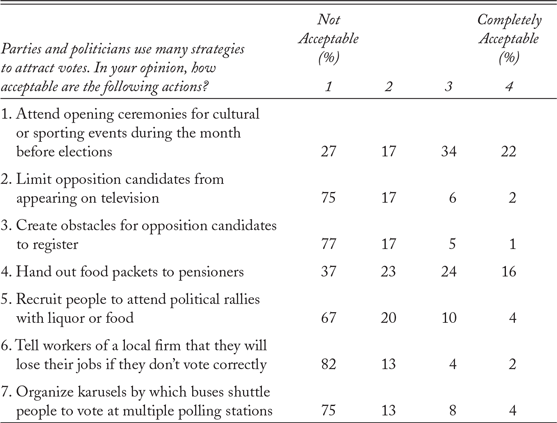
Our study’s main goal is to examine this question: When autocratic regimes commit fraud, which voters do they risk losing? But before turning to that, we seek to determine whether electoral manipulation affects mass support for the authorities at all. We first address this question by investigating how Russians view the moral appropriateness of different types of electoral manipulation. The 2016 res, the main data source for our study, included a battery of questions that tapped respondents’ views on the acceptability of different types of electoral subversion.Footnote 17 The wording of the questions and distribution of responses are shown in Table 1.
Acceptability of Electoral Manipulations

These specific acts of manipulation were chosen because they’re common in Russian elections. The first row in the table is presented as a baseline. Attending ribbon-cutting ceremonies may be perceived by some as an abuse of state resources, but it’s unlikely to elicit a strong negative response from most voters. Indeed, as the table shows, 56 percent of voters consider it mostly acceptable. The next two rows assess the acceptability of two common forms of systemic manipulation: restricting the opposition’s access to the media and to the ballot. Voters strongly disapprove of both practices.
The last four rows show how Russians view different forms of election-day manipulation. Not surprisingly, most disapprove of vote buying. But interestingly, they evaluate various types of positive inducements differently. Thirty-seven percent of voters approve of distributing food packets to pensioners, but only 14 percent approve of handing out food or alcoholic drinks at rallies.
What’s shown in row six is also no surprise. Most voters (82 percent) strongly disapprove of electoral intimidation. The question in row seven taps voters’ assessments of karusels, a type of ballot-box fraud.Footnote 18 Voters are slightly less disapproving of karusels, but the vast majority (88 percent) do disapprove to some degree. On the whole, voters find all types of electoral subversion—with the possible exception of some types of vote buying—to be unacceptable.
These descriptive statistics are informative. Nondemocratic practices aren’t supported by the vast majority of the population. But our primary goal is to determine how awareness of electoral manipulation affects regime support. These questions don’t tell us whether voters use the ballot box to punish the authorities for manipulating elections. Voters may view manipulation as unacceptable, but such considerations may not enter into their voting calculus or may be crowded out by other concerns.
One way to approach our question is to ask respondents about their assessments of electoral manipulation and to correlate such attitudes with regime approval ratings. This correlation is informative—and we explore such analyses below—but it suffers from several limitations. For one, the direction of causality is unclear. Perceptions of electoral integrity might increase support for the regime, or support for the regime might increase the likelihood that voters evaluate regime institutions, such as elections, in a positive light. There are other endogeneity concerns as well. It could be that perceptions of electoral integrity have no effect on regime support, but rather that both attitudes are codeter-mined by some other factor. Additionally, the correlation doesn’t tell us how the revelation of information about electoral manipulation might affect those who think elections are free and fair. Those who think elections are honest may still turn against the regime if they discover that elections are manipulated.
To address such shortcomings, we analyze a survey experiment that we embedded in the 2016 res survey. The experiment was designed to assess the likelihood that respondents would vote for a hypothetical candidate from the ruling party, United Russia, in the next State Duma election conditional on electoral manipulation by that candidate and his professional background. The experiment had a 3 × 4 factorial design and each respondent was asked the following:
Imagine that during the next State Duma elections, a [candidate professional background treatment here] is nominated by United Russia in your voting district. He is 50 years old and his program focuses on increasing support for local schools and building new roads in the district. During the campaign, some interesting information emerges about the candidate. On the one hand, it becomes known that he adopted two disabled children from a local orphanage. On the other hand, he [electoral manipulation treatment here]. How likely is it that you would vote for this candidate?
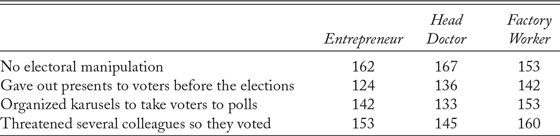
Respondents were asked to rate their likelihood of voting for this candidate on a five-point scale ranging from “definitely will not vote” to “definitely will vote.” Respondents were randomly assigned to one of twelve combinations of candidate professional background and electoral manipulation, as shown in Table 2. Covariate balance checks presented in Section A of the supplementary material indicate that randomization was successful.Footnote 19 This type of candidate vignette is broadly similar to that used in several recent experimental studies that vary such attributes as gender and policy positions.Footnote 20
Experiment Coveragea

a Total number of respondents who received “no electoral manipulation” (control), 535; total number of respondents who received “any fraud” treatment (three treatments), 1,475.
We invoke three professional backgrounds in the first experimental arm: an entrepreneur, a doctor, and a worker (rabochii). Our experiment was designed with two purposes: to examine voter assessments of workplace mobilization and to examine how electoral manipulation affects regime support. We are interested in the second question, so here we focus on the parts of the experiment that are relevant to it. We collapse the professional background treatments in the subsequent analyses.
Three types of electoral manipulation are included as treatments. The first refers to vote buying. Although middle-income countries like Russia typically see less vote buying than low-income countries, the practice became well known during the 1990s, and poorer segments of the population still report being offered cash or gifts in exchange for their votes. The second is a treatment that references workplace threats against employees. This is by far the most common type of electoral intimidation in RussiaFootnote 21 and is likely familiar to respondents. The third is a treatment that refers to ballot-box fraud—specifically, a candidate who organized a multiple-voting scheme using buses to ferry voters to multiple precincts. This type of ballot-box fraud is also common in Russia and is one that respondents could envision candidates organizing. As Table 1 shows, respondents easily interpreted and evaluated all three treatments in terms of their acceptability during elections, with the latter two getting especially low marks.Footnote 22
Several features of the experiment are worth noting. First, we took care to choose wording that maximizes and equalizes the credibility of the fraud information for all respondents. In the real world, information about fraud—whether it comes via mass media, the internet, or rumor—is often discounted. The extent of this discounting can depend on the respondent’s disposition or education and the credibility of the source. For this reason, it would be ill-advised to design an experiment that prompts respondents with a specific news story detailing an actual instance of fraud.
Our experiment is designed to hold constant the credibility of the source by prompting respondents to consider a situation in which information on electoral manipulation is internalized with some degree of certainty. We do this through the formulation “it becomes known.” This prompts respondents to think that the information about the candidate committing fraud is already public knowledge, rather than being cued to think about whether the information is accurate or who might be disseminating it.Footnote 23 In other words, we invite respondents to consider how they would react in this hypothetical scenario if they knew that the fraud had occurred.Footnote 24 We return to consider how respondents might accept information about fraud in real life in the conclusion.
To make the vignette more realistic, we focus on a specific candidate and hold constant their partisan affiliation (United Russia) and, as such, their proregime status. Fraud by UR candidates reflects poorly on the party and on Putin, who’s closely associated with the party.Footnote 25 One reason we focus on proregime candidates is because, as we discuss below, we’re particularly interested in how proregime voters react to the revelation of electoral fraud.Footnote 26 Including a partisan affiliation also reduces the respondents’ need for speculation. A common problem with hypothetical survey prompts is that a large proportion of respondents are unable to speculate about their behavior in an imagined situation. Cueing partisanship along with the adoption trait makes it more likely that a large share of respondents can form an opinion about this baseline candidate.
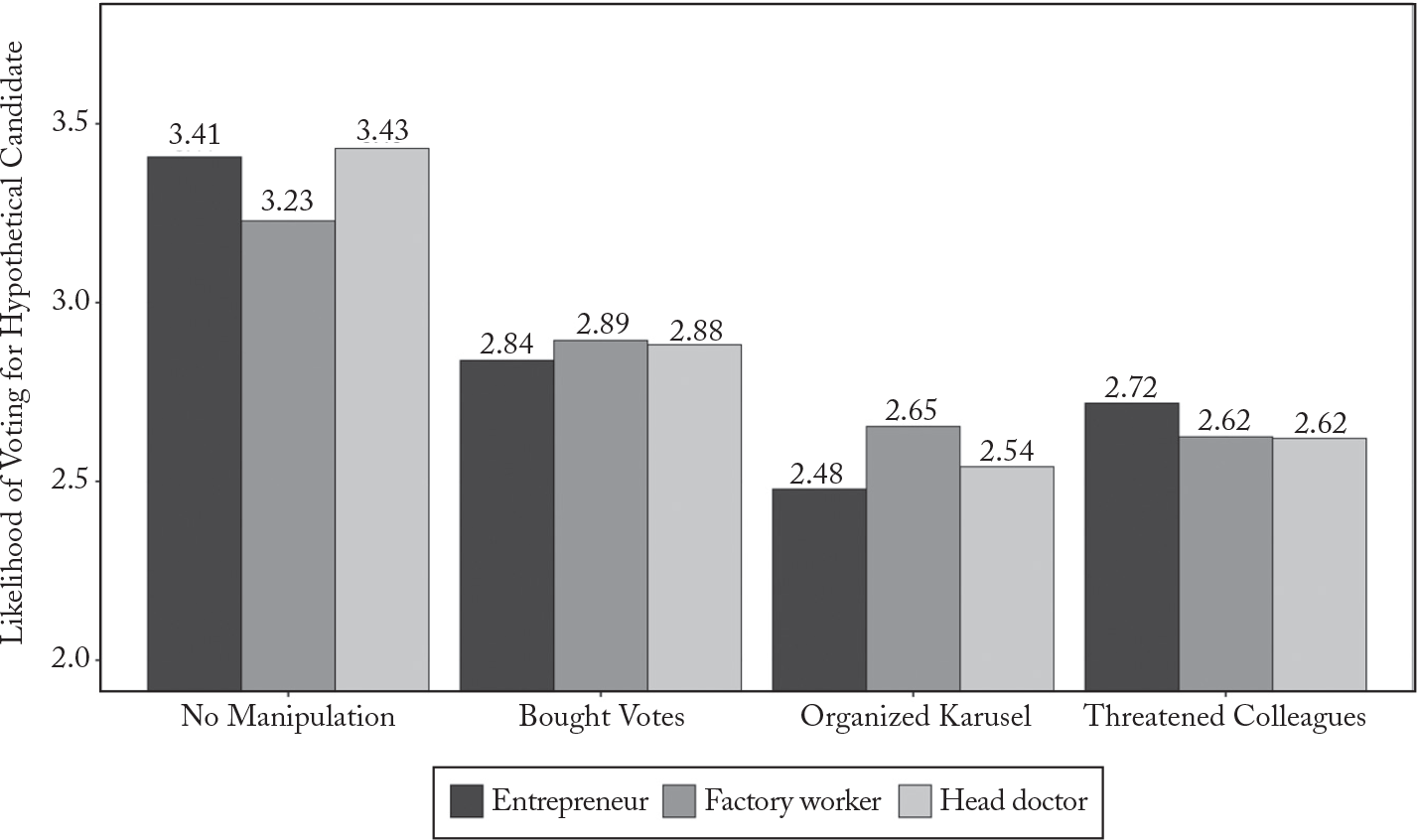
The full results of the experiment are presented in Figure 1.Footnote 27 The y-axis shows the mean response on the vote propensity scale. Differences between professional backgrounds are slight, and aren’t the focus of this study. The most important result is the difference in mean vote propensity between the three electoral manipulation treatment groups and the control group. As the figure shows, respondents who were told that the hypothetical candidate engaged in some form of electoral manipulation were significantly less likely to express support for the candidate. This effect holds for all types of electoral manipulation, but there are interesting differences across types. Voters are more turned off by ballot-box fraud than by vote buying and threats.Footnote 28 Perhaps it’s not surprising that vote buying is less offensive. We explore this finding, as well as variation between the treatment arms, in Section C4 of the supplementary material.Footnote 29
Support for Hypothetical Candidate by Treatment Status

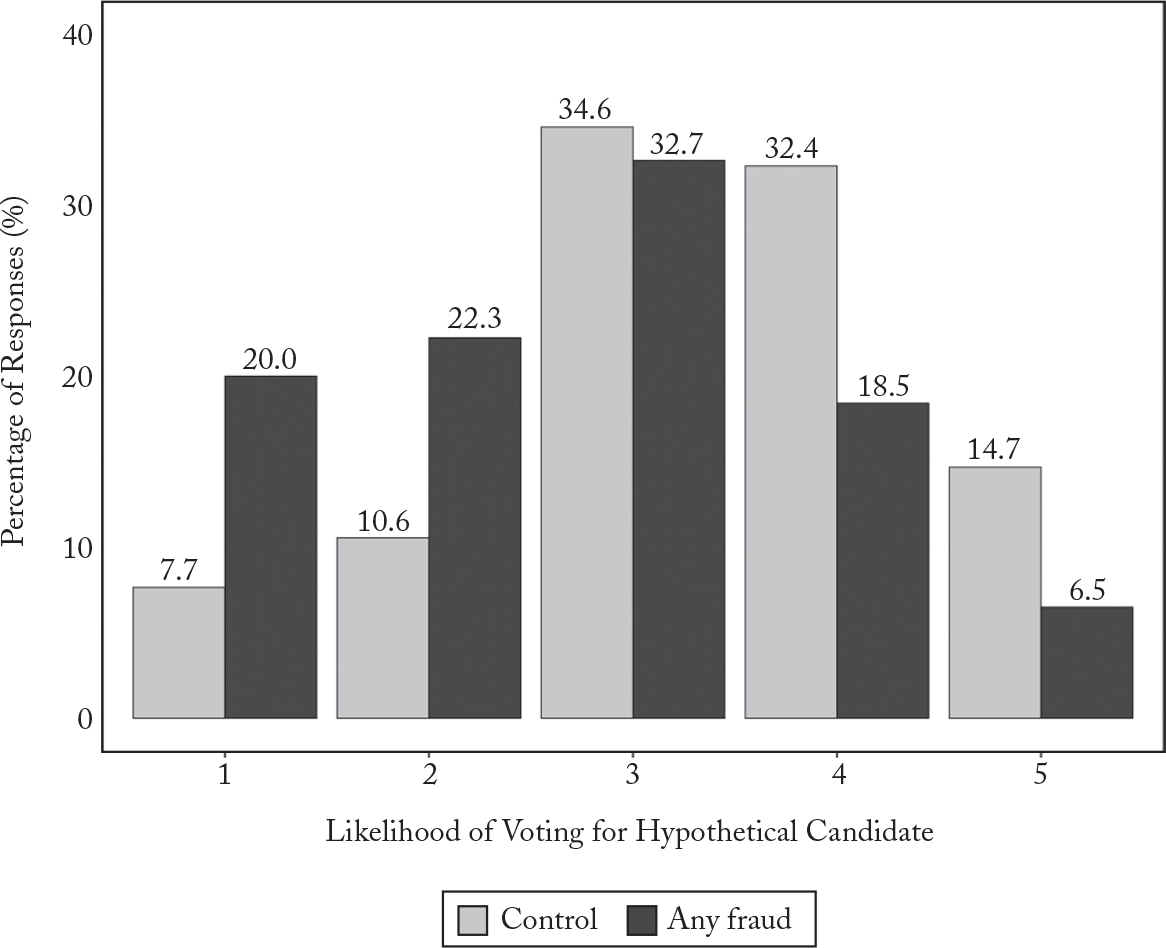
Our main interest, however, is the total effect of electoral manipulation on regime support. Therefore, for all subsequent analyses we collapse the manipulation treatment groups. The difference in means between the control group (the set of bars on the left in Figure 1) and the remaining treatment groups (all other bars) is 0.67 (p = .000), which translates into a 13.4 percent decrease in vote propensity.Footnote 30 This is a substantively large effect. Since the vote propensity variable is an ordinal scale, this quantity can’t be directly interpreted as a 13 percent decrease in the probability of voting for the candidate. Rather, it makes more sense to evaluate effect sizes across the range of the vote propensity variable. Figure 2 compares the distribution of responses on the five-point vote propensity scale for the two groups. We see a sharp increase in the number of respondents, indicating a very low likelihood of voting for the ur candidate (the values of one and two on the five-point scale) upon receiving any of the manipulation treatments.
Distribution of Experimental Outcomes by Treatment Status

Main Argument: Electoral Manipulation and Core Supporters
The results described in the section above indicate that information about electoral manipulation committed by proregime candidates reduces support for those candidates. But what types of voters are turned off by electoral manipulation? One conditioning factor that has received little attention is regime affinity. Do so-called swing voters recoil more upon learning about electoral fraud, or would strongly aligned regime supporters be more likely to withdraw their backing? If it’s only the swing voters, then electoral manipulation might not be so costly for the regime, since many of these voters wouldn’t vote for the regime in any case. But if electoral fraud leads to the loss of core supporters, it could have important consequences for regime stability.
In this section, we argue that strong regime supporters will be just as likely, if not more likely, to punish ur candidates upon learning about electoral manipulation. This will happen if preexisting awareness of fraud varies with regime affinity. If regime partisans have stronger preexisting beliefs that elections are free and fair, they will be more likely to punish incumbents when information about manipulation is revealed. By contrast, if swing or weakly aligned voters are already skeptical about electoral integrity, then the revelation of new information about fraud will do less to affect their vote choice. These voters have already incorporated expectations of significant electoral fraud into their political beliefs, and therefore do not update.
There are a number of reasons to think that on average, strong regime supporters will be less aware of electoral fraud. To the extent that voters disdain electoral fraud—and indeed, the previous section demonstrates that most do—then strong regime supporters might continue to support the regime only because they haven’t been exposed to information about electoral manipulation. Fraud is not easy to perceive. It’s an illicit activity, and regime officials go to great lengths to cover it up. Regime supporters could be even less attuned to it because they’re apolitical or because they’re more exposed to proregime media outlets and, therefore, to regime propaganda.Footnote 31 Alternatively, strong regime partisans might be oblivious to fraud for some of the reasons outlined above, including that they have been exposed to rumors in the past, but discounted them because they conflicted with prior notions of the regime’s propriety.Footnote 32 Indeed, a recent study in Mexico finds evidence of this phenomenon.Footnote 33
The tendencies described above will necessarily be strengthened if propriety is a trait that regime voters value highly. To the extent that regime supporters—or some subset of them—support the ruling party precisely because they perceive it as more trustworthy or honorable than the opposition, they will be more likely to withdraw support when information of malfeasance is revealed. In other words, if new information about fraud erodes a core assumption that they hold about the regime, supporters may punish the regime at the polls.
We can derive two possible hypotheses from these observations. The weak version of the argument suggests that both strongly and weakly aligned regime supporters will withdraw their support from UR candidates when information about electoral manipulation is revealed. The strong version of the argument suggests that strongly aligned regime supporters will be more likely to withdraw their support than will weakly aligned voters. Both arguments contrast with the expectations derived from arguments based on motivated reasoning, as we discuss below.
There are few existing studies on our research question. But a review of work in adjacent literatures suggests there’s a strong case to be made that electoral manipulation will only affect vote choice among swing or weakly aligned voters. Strongly aligned voters could be practicing motivated reasoning, and therefore would be more accepting of negative information about United Russia.
Motivated reasoning is a well-established phenomenon in political behavior.Footnote 34 One particularly important contributor is partisanship, which in many political settings is as much a determinant of one’s world-view as it is a consequence of it.Footnote 35 Partisan biases affect public opinion on a huge number of issues, from evaluations of the economy to foreign and public policy,Footnote 36 and they can operate via several mechanisms.
One such mechanism is selective exposure to information. Partisans may only seek out information that supports their existing views. This mechanism isn’t relevant for our study because our experimental manipulation provides subjects with information about fraud. A second possible mechanism is motivated skepticism. Individuals use their reasoning power to downplay or denigrate information that runs counter to their existing beliefs.Footnote 37 In our case, motivated skepticism could lead strong UR partisans to discount information about electoral manipulation, perhaps reasoning that the use of fraud is somehow justified or serves a higher purpose.
There’s little scholarship on how partisanship affects assessments of electoral manipulation, but related studies suggest that we could expect motivated reasoning to play a role. Several scholars show that voters downplay scandals that afflict leaders of their own party.Footnote 38 One recent study from Spain finds that voters are more likely to tolerate corruption if the offending politician is from their own party.Footnote 39 Graeme Robertson finds that in Russia, regime supporters are less likely to have knowledge of GOLOS, the country’s largest domestic vote-monitoring NGO (sometimes viewed as oppositional), and are less likely to express trust in vote-monitoring organizations.Footnote 40 Also, Svolik provocatively argues that political polarization leads voters to tolerate undemocratic policies if it will help their preferred party defeat a detested opponent.Footnote 41 In our empirical models below, we seek to adjudicate between this alternative hypothesis and our own. Interestingly, John Carey and colleagues find that partisans in the United States are just as willing to punish copartisans who support undemocratic positions as they are to punish opposition candidates.Footnote 42
Partisanship and Perceptions of Electoral Integrity
The preceding section suggests that the costs of electoral manipulation depend on whether fraud is already common knowledge and who is aware of fraud. We investigate these questions in this section. There are differing views on the integrity of Russian elections. For one, election monitor reports paint a grim picture of opposition candidates being restricted from running, biased media coverage, intimidation, and fraud.Footnote 43 Statistical election forensics show a similar picture, demonstrating that ballot-box fraud has become commonplace.Footnote 44 All this accords with the Western scholarly consensus that views Russia as an authoritarian regime.
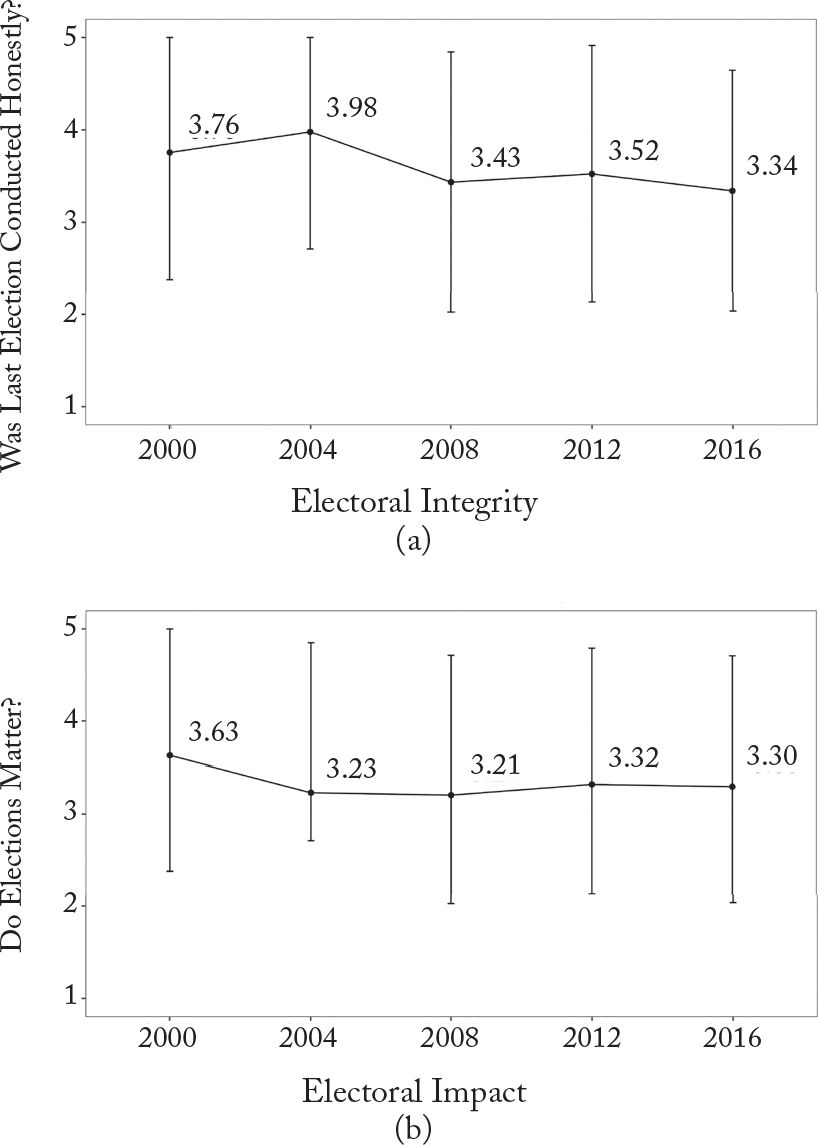
But substantial portions of the Russian electorate hold a much rosier view of how these elections were held. Nationally representative polls find that although citizens detect weaknesses in the electoral process, their perceptions of electoral integrity are generally much more favorable than one might expect from reading the election monitor reports. To demonstrate this, we draw on data from five Russian election surveys held between 2000 and 2016. Each survey included the same set of questions. Respondents were asked whether they agreed with the following statements: elections in Russia are conducted honestly (on a five-point scale, where five indicates that they were completely honest), and voting makes a difference to what happens in the country (also on a five-point scale). Figure 3 plots the averages from respondents following the five national elections.
Beliefs about Electoral Integrity over Timea
a The panels display the mean agreement among respondents across five RES surveys to the following statements: (a) elections in Russia are conducted honestly (on a five-point scale, where 5 indicates that they were completely honest); and (b) voting makes a difference to what happens in the country (also on a five-point scale). The error bars show the distribution within one standard deviation above and below the mean.

We see that throughout this period, a large share of the electorate believes that elections are conducted honestly and, to a slightly lesser degree, that electoral outcomes can affect their daily lives (panels [a]and [b]).Footnote 45 Interestingly, opinions on these two issues don’t shift markedly over time, even as the Russian government took steps to consolidate media ownership in state hands and to limit the ability of opposition parties to contest elections.
The results from the RES polls are by no means unique among work on Russia. Separate opinion polls have found that since 2000, a majority of Russian citizens believe that votes are being counted honestly, media outlets are covering campaigns fairly, and real competition takes place between candidates.Footnote 46 Less than 15 percent of respondents felt that electoral results in general could not be trusted.Footnote 47
Russian respondents aren’t unique in viewing their elections as relatively clean, even while most outside observers think otherwise. Juliet Pietsch reports that most respondents in Southeast Asian electoral autocracies also believe they’re living in democracies.Footnote 48 Scott Williamson finds that in most Arab autocracies, a majority of respondents think their elections are free and fair.Footnote 49 Table F1 of the supplementary material presents summary statistics from the latest wave of the World Values Survey (2010—2014) about how respondents living in electoral autocracies (top panel) view the state of elections in their countries.Footnote 50 We see that even in regimes generally considered to be unfree, such as Jordan, Singapore, and Zimbabwe, substantial portions of the population believe that their elections are clean, often to the same degree as in more established democracies.
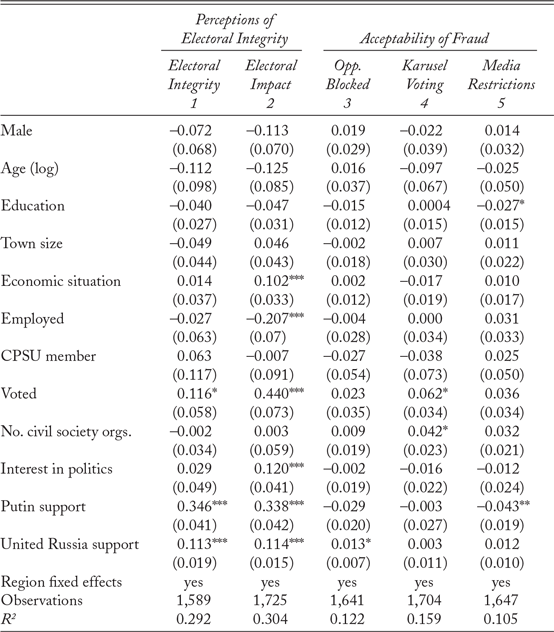
Digging deeper into the 2016 RES survey results, we find that regime supporters are much more likely to have positive perceptions of electoral integrity. In Table 3, columns 1 and 2 present multivariate regressions in which the outcome variables are the same measures of election integrity perceptions as those discussed above. Interestingly, basic demographics—gender, age, employment status, and economic situation—explain little of the variation in how people view the quality of elections.Footnote 51 What matters most is people’s political leanings. Respondents who approve of Putin’s performance in office or who support the ruling party United Russia are significantly more likely to believe that elections were held fairly (column 1) and that voting in elections can influence political events in the country (column 2).Footnote 52
These patterns aren’t specific to the 2016 Duma elections. In Table B5 of the supplementary material, we show that even during the 2011—2012 electoral cycle, when information about electoral fraud was more widespread across Russian media, regime supporters still held substantially more-positive views of electoral integrity than those who didn’t support the regime. In fact, partisanship is the largest predictor of whether respondents viewed the elections as free and fair.
Moreover, as shown in tables B2 and B3, regime supporters are not only more likely to believe that elections are free and fair, but they’re also less likely to think that there were electoral violations during either the 2011 or 2016 parliamentary elections. Table B4 also shows that supporters were less likely to have heard of GOLOS. Core UR supporters appear less aware of fraud, and may update more strongly when they find out that fraud has occurred.
But regime supporters may also define electoral integrity differently, and this could be what’s driving the correlation between partisanship and views of electoral integrity. By holding electoral processes to a lower standard, supporters may be more likely to believe that the government is administering elections adequately and that a more minimal definition of integrity is being met. We explore this possibility in columns 4—6 of Table 3, which investigates whether respondents believe that common electoral violations are broadly acceptable (the exact statement wordings are shown in Table 1). We find no evidence that support for Putin or the ruling party United Russia is associated with holding a different concept of what electoral integrity means.Footnote 53
Regime Support and Views of Electoral Integritya

*** p > 0.01, ** p > 0.05, *p > 0.1
a This table examines the correlates of perceptions of electoral integrity and the acceptability of different types of electoral fraud using OLS models. The outcomes in the first two columns are measured on five-point scales, with higher values indicating more positive perceptions. The outcomes in columns 3—5 are all measured on four-point scales, with higher values indicating greater acceptance of these activities. All models cluster standard errors at the region level.
Moreover, few predictors are consistently associated with an individual’s approval of different electoral malpractices, which might be expected given the tight distribution around unacceptability as shown in Table 1. Cross-national surveys suggest there’s remarkable congruence worldwide among masses and elites regarding the normative standards required to make an election free and fair.Footnote 54
Of course, these correlations don’t allow us to identify the direction of causality. Respondents who view elections as free and fair may reward the regime for upholding democratic procedures. Or they may view elections as honest because they themselves are under the influence of partisanship or propaganda. Either way, what’s significant for our study is that such a correlation exists. The next section explores some important implications of this finding.
Heterogeneous Effects of Learning about Electoral Manipulation
Our main argument is that core regime supporters should be more sensitive than weakly aligned voters to electoral fraud. We test this by examining the heterogeneous treatment effects from the framing experiment outlined above. We hypothesize that support for a regime-affiliated candidate will fall more among individuals with a stronger preexisting affinity toward United Russia (and Putin) than among those with a weaker commitment to the regime. We use several measures of regime support for these purposes: a five-item scale measuring personal approval of Putin’s time in office, a ten-item scale measuring support for ur, and a binary indicator for whether a respondent voted for ur in the 2016 parliamentary elections. The first two indicators capture respondents’ self-reported support for the regime; the third measures actual behavior taken in support of ur . For our main analyses, we collapse the three types of electoral manipulations employed in the framing experiment into a binary treatment indicator (any fraud) for whether a respondent received any information about a candidate engaging in this type of behavior.
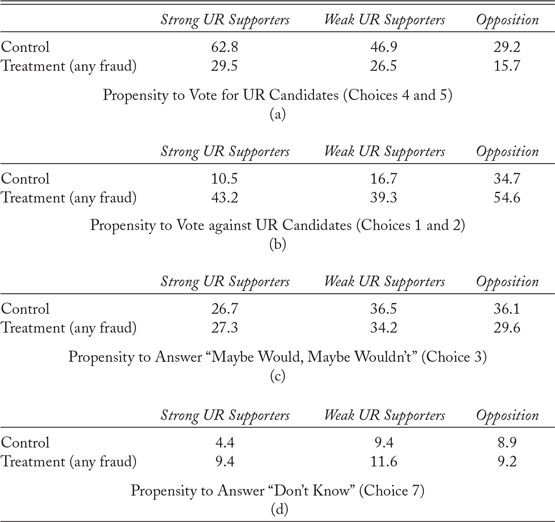
In Table 4, we show differences in means across both the different treatment conditions and the levels of regime support. In each panel, the three columns divide the sample into strong ur supporters (values nine and ten), weak ur supporters (values four through eight), and opposition supporters (values one through three). We then transform the five-point vote-intention scale into binary indicators that are easier to interpret as reflecting likelihood to vote (or to not vote) for the hypothetical ur candidate. In panel (a), we use a binary indicator coding equal to one if a respondent answered 4 or 5 on the turnout scale, indicating that they were likely or definitely likely to vote for the candidate. Responses of 3 (50/50), 2 (unlikely), and 1 (definitely unlikely) were all coded as zero. The panel then shows the raw percentages for this variable based on treatment conditions (the rows). The control group didn’t receive any of the three treatments indicating the candidate committed fraud, while the treatment group collapsed all respondents assigned to any of the three treatments.
Treatment Effects Broken Down by Regime Supporta

a All numbers are percentages. The outcome in panel (a) is a binary indicator if a respondent answered 4 or 5 on the five-point scale about whether they would vote for the hypothetical UR candidate (that is, likely voters). The outcome in panel (b) is a binary indicator if a respondent answered 1 or 2 on the five-point scale about whether they would vote for the hypothetical UR candidate (that is, unlikely voters). The outcome in panel (c) is a binary indicator, one if a respondent answered “maybe I would vote for him, maybe not” (response 3) to the question, and zero otherwise. The outcome in panel (d) is a binary indicator, one if a respondent answered “don’t know/difficult to respond” (response 7) to the question, and zero otherwise.
The results show that strong UR supporters in the control group have a 62.8 percent chance of voting for the hypothetical candidate, which makes sense given their partisanship. But when they’re assigned any of the three fraud treatments, their average likelihood of voting for that candidate falls to 29.5 percent, a drop of 33.3 percentage points (or 53 percent, 33.3/62.8). Weak UR supporters don’t react as strongly, showing only a 20.4 percentage-point drop (or 43 percent). The treatment effect for opposition supporters is roughly the same.
In panel (b) of Table 4, we code respondents who answered 1 (definitely unlikely) or 2 (unlikely) on the five-point scale as one, and zero otherwise. This measure gives the probability of the respondent voting against the UR candidate. Here again we see larger treatment effects for strong UR supporters, whose propensity to vote against the candidate increases by roughly four times (43.2 percent versus 10.5). It’s noteworthy that 43 percent of strong UR supporters affirmed that they would not vote for the UR candidate if that candidate committed fraud. The treatment effects for the other two groups are sizable but not nearly as large. Weak UR supporters are a little more than twice as likely to oppose the UR candidates, while opposition supporters oppose slightly less than twice as often.
In panel (c), we perform the same exercise but with a binary indicator if the respondents answered that they might vote for the UR candidate, but they might not (that is, one if they responded 3 on the scale, and zero otherwise). We don’t see any significant differences between treatment and control across the three groups. In addition, respondents in the experiment were allowed to answer “difficult to respond” instead of picking a value on the five-point scale of support for the UR candidate. Since approximately 11 percent of respondents struggled to answer, we might expect that difficulty to reflect differences in the way partisans handle information that conflicts with their priors about their preferred candidates. To explore this, we code a binary indicator in panel (d) for whether a respondent answered “don’t know” (response 7). There is a treatment effect among strong UR supporters, although part of that may be because strong UR supporters in the control group were especially likely to have a concrete opinion about the UR candidate (only 4.4 percent answered “don’t know”). Alternatively, these supporters could simply be unsure about whether they would vote for their copartisan.Footnote 55
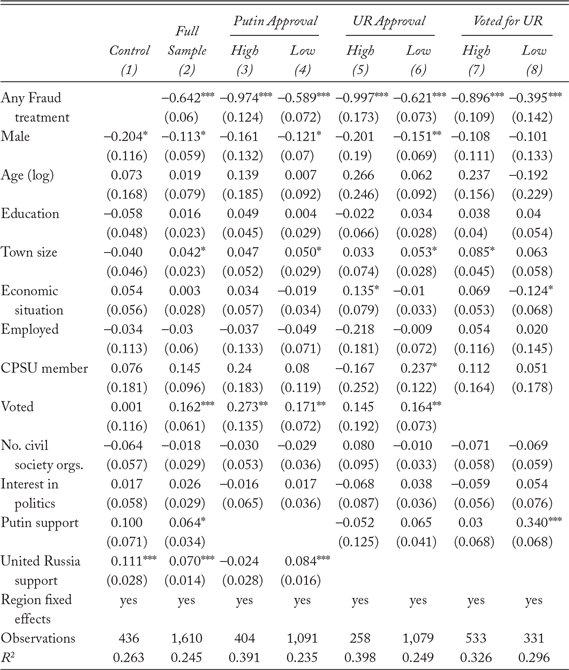
Taken together, we see that learning about fraud produces the largest effect on strong UR supporters. They become less likely to vote for UR candidates and more likely to affirm that they will not vote for them. We show a series of OLS models in Table 5, in which we regress the likelihood of a respondent voting for the candidate described in the experimental vignette on the any fraud treatment indicator and a range of covariates. In column 1, we exclude the treatment group from the model to examine the benchmark case (the control group). Intuitively, we find that individuals with a stronger affinity for the party are more likely to support its candidates, but that no other demographic characteristics predict support.Footnote 56 Adding the any fraud treatment in column 2 confirms the results presented above in Figure 1. Overall support for UR candidates drops when respondents learn about electoral manipulations being committed.
Heterogeneous Effects of Learning about Electoral Frauda

*** p > 0.01, ** p > 0.05, * p > 0.1
a This table uses OLS models to examine ordinal responses from the framing experiment. Column 1 restricts the analysis to only the control group, which received no information about fraud. Column 2 estimates the treatment effect graphically depicted in Figure 1 and includes covariates. Columns 3 and 4 use a five-point scale to subset to respondents with high levels of approval of Putin’s performance in office (a value of five) and low levels (values of three and four). Columns 5 and 6 use a ten-point scale to subset the sample to respondents with high levels of approval of United Russia (values higher than seven) and low levels (values between four and seven). Columns 7 and 8 subset the sample by whether the respondent voted for United Russia in the 2016 Duma Election.
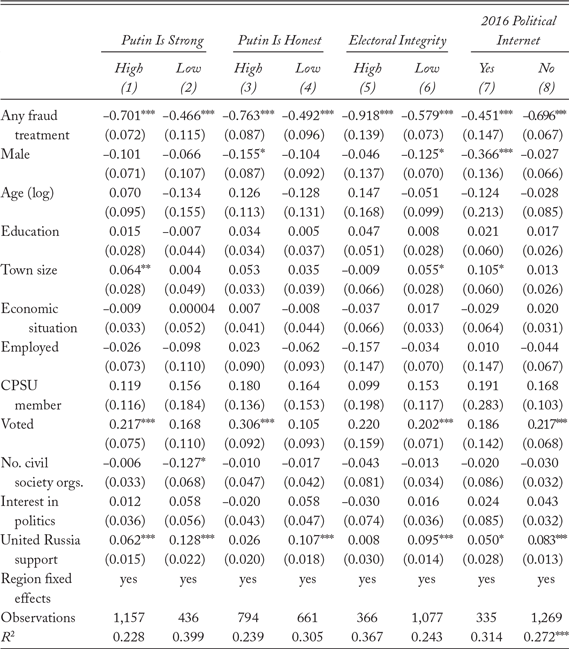
Columns 3-8 present heterogeneous treatment effects along three measures of support for the regime. We find consistent evidence in favor of our main hypothesis. UR candidates who engage in fraud see their electoral support drop more among core supporters than among weakly aligned voters. It makes little difference how the survey population is subset, whether it’s by high versus low approval ratings of Putin in office (columns 3 and 4), by high or low levels of UR support more broadly (columns 5 and 6), or by having voted for UR (columns 7 and 8).Footnote 57 For the variables measuring Putin and UR approval ratings, the sample is subset among those at the very top of the scale (a rating of five out of five for Putin, or a rating above eight out of ten for ur) and those in the middle (a rating of three or four out of five for Putin, or a rating between four and eight for ur).Footnote 58 In each instance, the difference in coefficients on the treatment between regime and opposition supporters is large and statistically significant.
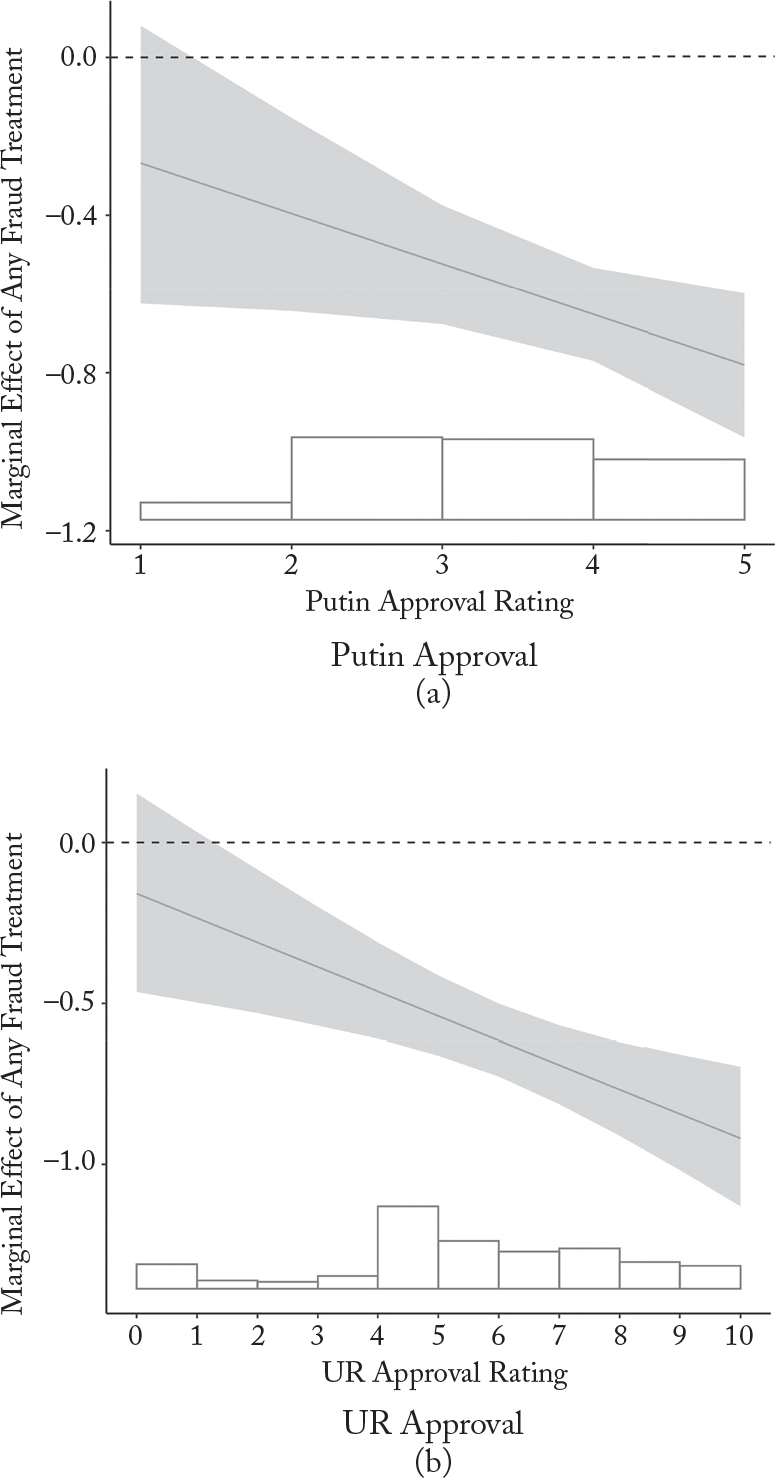
In Table C1 of the supplementary material, we show models including interactions between the treatment dummy and the three measures of regime support; the coefficients on the interaction terms are significant at the 95 percent level or above.Footnote 59 Figure 4 is produced on the basis of models 1 and 2 from that table, with the marginal effect of the any fraud treatment shown on the y-axis across different values of Putin’s approval rating (a) and support for UR (b); the distribution of responses is shown as inlaid histograms. There is a strong negative relationship between the degree of support for the regime and the effect of learning about electoral fraud committed by affiliated candidates.
Marginal Effects

One concern is that these large differences could be driven by a mechanical feature of our measurement strategy. Since regime supporters are more likely to back the UR candidate ex ante (that is, without any knowledge of their campaign activities), their pretreatment level of candidate support will obviously be higher and therefore, these respondents have farther to fall on the five-point scale. For example, consider an extreme scenario in which the effect of revealing fraud is to induce all respondents to report that they will “definitely not vote” for the candidate (this is equal to 1, the lowest point on the scale). Swing voters, whose pretreatment level of support is 3, exhibit a treatment effect of 2, while core supporters, whose pretreatment level of support is 5, will exhibit a treatment effect of 4. This scenario is patently implausible, but it illustrates the mathematical problem.
But our results are not driven by this floor effect. The percentage drop relative to the group is still higher among strongly aligned regime partisans than it is among those weakly aligned. For example, support for the ur candidate among strong Putin supporters (column 3 in Table 5) falls by 24 percent (relative to their baseline level) when they’re informed of electoral fraud; among swing voters (column 4), support drops 18 percent relative to the baseline. Differential effects are still present. Strong regime supporters are more turned off by learning that ur candidates commit electoral violations than are weak ones.
Regime Perceptions, Information, and the Effect of Electoral Fraud
Why does evidence of electoral fraud have such a strong effect on core regime supporters? What are these voters learning that makes them withdraw their support? In Table 6, we explore several explanations. One possibility is that electoral fraud undermines the regime’s reputation for propriety. It’s hard to measure a respondent’s views on the honesty of the regime, especially when different respondents may conceive of the regime in different ways. In Russia, almost all regime supporters also support Putin, and most associate United Russia closely with him. Thus, one adequate proxy could be the respondent’s views of Putin’s character.
How Electoral Fraud Undermines Perceptions of the Regimea

***p > 0.01, ** p > 0.05, *p > 0.1
a This table uses OLS regression analysis to examine additional heterogeneous treatment effects. Columns 1 and 2 use a four-point scale to subset the sample into respondents who rank Putin highly as a strong leader (top value of four) and those who rank him lower (values of less than four). Columns 3 and 4 use a four-point scale to subset the sample into respondents who rank Putin highly as an honest person (top value of four) and those who rank him lower (values of less than four). Columns 5 and 6 use a five-point scale about whether respondents believe elections are conducted honestly to subset the sample by those with positive views (top value of five) and those with less positive views (values of less than five). Columns 7 and 8 subset according to a binary indicator for whether the respondent read Internet news during the 2016 campaign.
Surveys find that Russians identify several positive traits in Putin. In our survey, 71 percent of respondents agreed with the statement that he is a “strong leader” (24 percent said “mostly yes”).Footnote 60 Another trait that voters associate with Putin is honesty. In the 2016 res, 54 percent of respondents agreed that Putin is honest and deserving of trust (33 percent said “mostly yes”).
Learning about electoral fraud may undermine perceptions of Putin’s virtues. Voters who receive objective information about their politicians being corrupt and dishonest are more likely to rescind their electoral support.Footnote 61 Despite the appeal of lying to hide undesirable characteristics, honest candidates still enjoy electoral advantages because voters highly value trustworthy candidates whatever their policy promises.Footnote 62 Similarly, committing electoral fraud can signal weakness—autocrats need to break the formal electoral rules to ward off challengers.
In Table 6, we construct model specifications that are similar to those used above to examine heterogeneity in treatment effects based on respondents’ views of Putin’s character and on their appraisal of elections in Russia. We find that those who believe Putin is strong (columns 1 and 2) and honest (columns 3 and 4) are more likely to react negatively when they learn that a UR candidate has committed fraud.Footnote 63
Another possibility is that the effect depends on preconceived notions of fraud. Those who already believe elections are fraudulent should be less likely to update their views on UR candidates when they learn about fraud. Conversely, those who think elections are free and fair should be more likely to update their candidate preferences when they learn about fraud. Columns 5 and 6 examine whether the treatment effect varies according to whether respondents believe that Russian elections are free and fair. The results strongly suggest that they do. The effect of the fraud treatment is much larger among respondents who think Russian elections are free and fair.
Columns 7 and 8 take a different approach to the same question. Specifically, we examine whether respondents who are plausibly less exposed to information about fraud are more affected by the fraud treatment in our experiment. In Russia, information on fraud is rarely encountered on television or radio or in (most) print media. The Internet is practically the only media platform where Russians might learn about fraud. But not all Russians actively use the Internet, and most don’t use it for reading political news. In columns 7 and 8, we subset our models according to whether respondents reported that they used the Internet for reading political news during the 2016 election campaign. We find that the treatment had smaller effects for those who reported having read political news on the Internet during the campaign. These individuals are more likely to be preexposed to information on fraud. The treatment effects were larger for those respondents who accessed Internet political news.Footnote 64
Replication and Extension
One shortcoming of our experiment is that it can’t distinguish between two mechanisms that could be driving the observed drop in support among core regime supporters. Electoral fraud may be leading regime supporters to consider other candidates or to consider abstention. Either way, the findings indicate that regime supporters are withdrawing their political support from regime candidates, but it’s interesting to separate these potential mechanisms.
In particular, it’s possible that fraud might drastically reduce turnout by the opposition, which would offset any decrease in support by regime supporters. Several studies find that fraud deters participation by the opposition.Footnote 65 Our findings would have less meaning if fraud produced a drop in regime support that was outweighed by a concomitant decline in opposition turnout. In other words, UR may not fear a slight diminishment in its core support if violations of electoral integrity also cause opposition supporters to disengage from politics and to cease voting against the regime.
To address this, we placed two additional survey experiments on a representative survey of sixteen hundred Russian adults conducted in May 2018, roughly eighteen months after our original survey. The vignette used in both 2018 experiments was nearly identical to that used in September 2016. We gave respondents information about a fictional fifty-year-old businessman from UR who was running for the State Duma in the next elections; this person had also adopted two children.Footnote 66 The experimental treatment gave half the sample this additional information: the candidate had organized a multiple-voting scheme, ferrying voters by bus to multiple precincts. Our wording was identical to that used in the “organized karusels” treatment in the 2016 experiment, as shown in Table 2 (see Section E1 of the supplementary material for the exact wording).Footnote 67
The important difference in this second set of experiments is the outcome variable. Our 2018 turnout experiment asked respondents to state their likelihood of turning out to vote on a scale of one to five, and was administered to half the respondents. Our 2018 vote choice experiment was given to the other half of the respondents, who were asked to state their likelihood of voting for this candidate on a scale of one to five. Thus, the outcome in the 2018 vote choice experiment is identical to that asked in the 2016 experiment analyzed above, while the 2018 turnout experiment focuses only on whether respondents would vote at all. Table 7 presents the breakdown of respondents across the different treatment arms and outcome variables. Each respondent was assigned to receive either the turnout or vote choice experiment, and within each one, each respondent had a 50 percent chance of receiving the treatment— that is, learning that the UR candidate had committed fraud.
2018 Experiments Coveragea

a Total respondents who received “turnout” outcome, 725; total respondents who received “vote choice” outcome, 721.
These experiments accomplish several objectives. First, the 2018 vote choice experiment is essentially a replication check of our initial results from the 2016 experiment, but it uses a simplified set of treatment conditions. This helps to build confidence that the patterns identified above analyzing the 2016 experiment aren’t specific to the Russian political climate that year. Second, the 2018 turnout experiment lets us investigate whether learning about fraud decreases turnout or support for the candidate responsible for it.
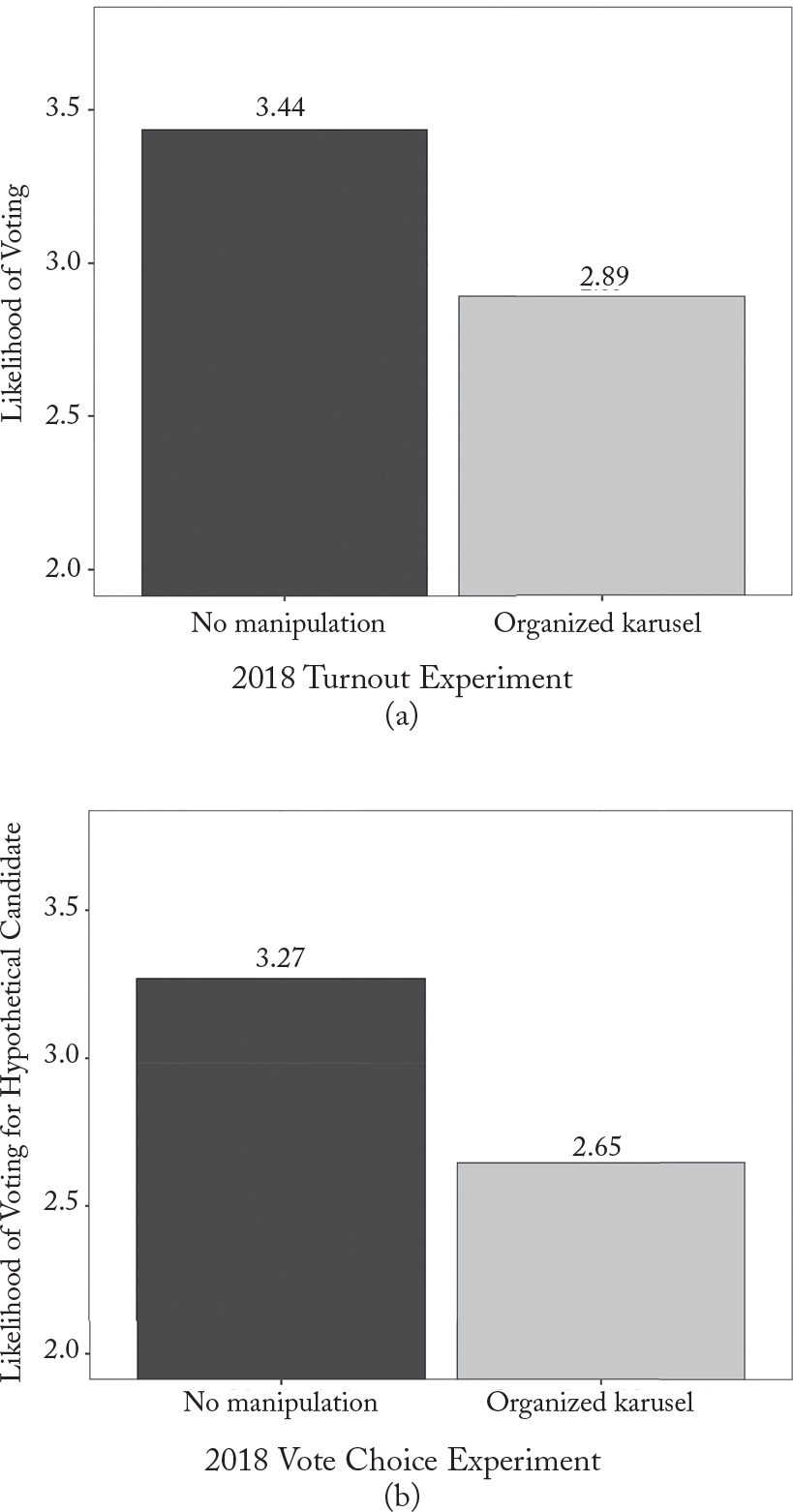
Figure 5 presents the results. In panel (a), we see that the treatment effect of fraud on turnout is negative. In the control group, the mean turnout propensity on a five-point scale, with 3 indicating uncertainty, is 3.44. When respondents learn that the candidate has committed fraud, that number drops to 2.89, an effect of –0.55 that is statistically significant at the 99 percent level. In general, people are less likely to vote when electoral integrity suffers. In the right panel, we again see that support for the candidate committing the fraud also drops. The treatment effect of –0.62 is roughly the same using a five-point scale measuring candidate support.
Fraud, Turnout, and Vote Choice

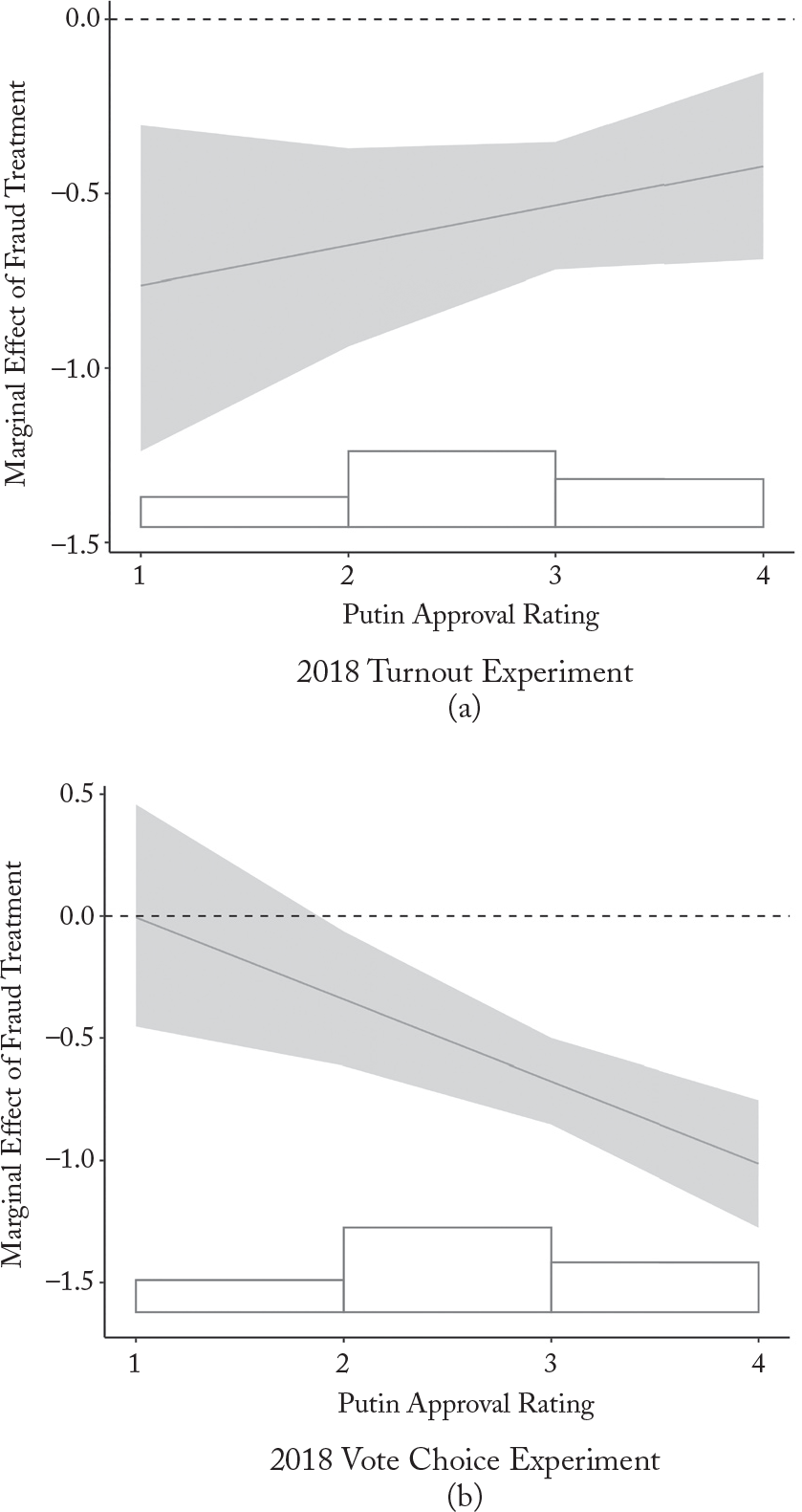
In Figure 6, we explore heterogeneity across different levels of support for Putin, measured on a four-point scale. As before, we show the marginal effects of the fraud treatment for each outcome in the panels: turnout (a) and vote choice (b). The point estimates come from models that control for demographics such as age, income, and employment status. First, we see a slightly positive, but not statistically significant interaction effect of fraud and Putin support on turnout. Both regime and opposition supporters are less likely to turn out after learning that a UR candidate committed fraud, and the degree to which fraud dissuades them from voting is relatively small. Just as important, we repli cate our findings from the 2016 experiment in the right panel: regime supporters are significantly more turned off than opposition supporters by new information on UR-sponsored fraud. The substantive effect sizes are roughly the same as they were two years prior. In the supplementary material, we show that the effects are robust to interacting the treatment with a ten-point scale of support for United Russia.Footnote 68
Heterogeneous Effects of Fraud on Turnout and Vote Choice

Several things about these results are worth noting. First, contrary to some existing accounts, the findings demonstrate that fraud reduces turnout not only among the opposition, but also among regime supporters. Several studies argue that fraud creates the perception that opposition votes will not count.Footnote 69 But it stands to reason that fraud could produce a similar effect among regime supporters who, if they realize that electoral outcomes are predetermined, should have less reason to think their vote will matter and less incentive to vote. Consistent with this idea, our experiment shows that fraud reduces turnout across the electorate. Indeed, observational evidence from the 2016 RES shows that perceptions of electoral manipulation reduced self-reported turnout among regime supporters just as much as it did among the opposition and swing voters.Footnote 70
Note that this finding isn’t necessarily at odds with the theoretical arguments in previous work. Even if fraud reduces feelings of electoral efficacy among opposition supporters more than it does among regime supporters, it could still be the case that regime supporters would be more disillusioned by the revelation of fraud. In other words, the mechanism we propose in this study could be operating alongside the differential electoral efficacy argument to produce the findings we see in the 2018 turnout experiment.
Taken together, the results suggest that the heterogeneous effects in our main 2016 experiment are driven by changes in vote choice rather than changes in turnout. Since fraud appears to reduce turnout equally among regime supporters and the opposition, it stands to reason that the larger treatment effects for regime supporters in the 2016 experiment (and in the 2018 vote choice experiment) are being driven by decisions to withdraw support from regime candidates. Once inside the voting booth, core regime supporters appear to be abandoning ruling party candidates who commit fraud.
These findings reinforce our contention that fraud is electorally costly for the regime. If fraud reduced opposition turnout to such a degree that it offset any loss of support from regime supporters, then fraud would not undermine the regime’s chances of winning. Our findings suggest that this is not the case. The 2018 vote choice experiment shows that fraud reduces turnout for opposition and regime supporters to an equal degree. Moreover, fraud appears to cause regime supporters to withdraw their support from fraudulent United Russia candidates.
Discussion and Implications
In summary, our findings suggest that voters in Russia punish regime candidates who engage in fraud. This effect is largest among those who are the strongest supporters of the regime. Polarization is not so strong in Russia that regime supporters excuse regime candidates for fraud.Footnote 71 Instead, they punish them for it. Most regime supporters believe that elections are free and fair and most believe that is how it should be. Gaining awareness of electoral fraud dispels preconceived notions about the regime and its electoral propriety. When fraud is revealed, many proregime voters withdraw their support, which appears to be conditional on the government maintaining its commitment to clean elections.
These findings have important implications for the comparative literature on autocracy and for the study of contemporary Russian politics. For studies on comparative autocracy, our findings highlight an understudied consequence of electoral fraud. Much of the recent neo-institutional literature on electoral fraud has centered on how fraud sends a signal of strength to elites.Footnote 72 One puzzle that emerges from this literature is why autocrats try so hard to conceal fraud. If fraud deters all sorts of subversive and oppositional activity, why don’t autocrats publicize it? Scholars of contentious politics suggest that they don’t publicize it because it may lead to opposition protest.Footnote 73 That seems hard to deny, but we highlight another reason why autocrats disguise fraud— their core supporters are turned off by it and if they learn of it, they will withdraw their support from the regime. That polarization is relatively limited in Russia suggests that findings from this survey experiment reflect actual behavior: strong partisan biases are less likely to outweigh normative concerns in the voting booth in Russia than they might be in polarized countries like Venezuela or the United States.
More generally, our study suggests that scholars of autocracy should pay more attention to the democratic features of nondemocratic elections. The neo-institutional literature on autocracy has made great strides in pointing out the autocratic functions of nominally democratic institutions. But in the midst of the neo-institutional revolution, research continues to show that these elections also serve a democratic function, improving accountabilityFootnote 74 and providing legitimacy to the regime.Footnote 75 Large parts of the electorate expect that elections will be democratic.
These findings also have important implications for how scholars study politics in Russia. This article should serve as a reminder that the demand for democratic institutions remains strong in Russia. In a revealing analysis of Putin’s Pryamaya Liniya call-in shows, Susanne Wengle and Christine Evans note that Putin frequently touts the role of formal democratic institutions.Footnote 76 These authors wonder why Putin seems to frame so much of his political discourse around institutions. Our account demonstrates why the performance is so important. Many voters believe in electoral democracy or at the very least, behave as if they do. Thus, one of the reasons that elections are maintained in Russia is because voters support them.Footnote 77 This isn’t to say that Russia is a democracy; it is not. But important parts of the electorate behave as if elections are democratic and expect them to be so. Analyses of authoritarian Russia would be remiss to ignore these voters. Understanding their behavior is key to understanding the stability of the regime.
We also provide insight into why the Putin regime goes to such great lengths to both hide and limit electoral fraud. After the 2011-2012 election cycle, regime leaders made it clear to regional subordinates that they wanted future elections to be cleaner—or at least to be perceived as clean. The government spent more than $800 million to install live-streaming cameras in electoral precincts in 2012, and then later appointed the former human rights ombudsman Ella Pamfilova to oversee the Central Election Commission. Available evidence indicates that election cycles since 2011 have been marked by less blatant election-day fraud.Footnote 78 The conventional explanation for this new emphasis on electoral legitimacy is that the regime wanted to stem the opposition protest movement that had erupted during the 2011-2012 cycle. But our findings suggest another possibility: regime leaders believed that their electoral base would evaporate if the curtain on fraud was pulled back. The scope of these efforts suggests that fraud could become a salient voting issue if voters were to find out about it.
We believe that such dynamics could also be at play in other electoral autocracies. Our analyses in Table F2 of the supplementary material show that regime supporters in countries as diverse as Kazakhstan, Malaysia, Singapore, and Nigeria all give their governments high marks for upholding democratic practices.Footnote 79 Their support for the regime may be contingent on a belief that electoral integrity continues to be respected. This may be especially true in countries where autocrats initially won free elections and then stealthily undermined democratic systems to hold onto power. Voters may believe that electoral results fairly reflect the autocrat’s popularity, but they may not be fully aware of the degree of malpractice being committed. Providing information about fraud could change their calculus of support for the regime.
Of course, such conclusions come with caveats. These survey experiments are hypothetical and although they do suggest why new information can cause voter defections, they can’t illuminate the conditions under which that happens. But they can illuminate the ways by which fraud impacts voter affect: they suggest that voters have a psychological reaction to fraud. Nevertheless, they can’t be extrapolated directly to explain real events. On the one hand, in the real world, information on fraud is contested and subject to perceptual bias. Thus, our experimental estimates may represent a higher bound for the effect of fraud on regime vote totals. On the other hand, the hypothetical nature of survey experiments may mute respondents’ reactions. Voters who learn about real candidates committing real fraud could be even more disappointed. Future research could profit by extending these analyses into real-world settings.
In addition, our study can’t precisely quantify the net costs of engaging in fraud in the real world. Even if fraud costs autocrats votes by driving away supporters, stuffing ballots or rewriting protocols still adds to a regime’s vote totals. The point of our study is not to claim that the former must outweigh the latter, but rather to demonstrate that the loss of votes is a real concern. Factors like the presence of independent media and the competitiveness of the election are likely to affect this calculus. As we show in Section B3 of the supplementary material, regime supporters who rely heavily on state-sponsored news for information are more affected by the experimental treatment.Footnote 80 In addition, a strong opposition not only has greater resources and the incentive to inform the public about any electoral fraud committed during election, but it will also attract more support from voters newly disillusioned by the regime’s false claims to be upholding free and fair elections.
Our study suggests some other avenues for future research as well.
For one, little is known about how voters become informed about fraud. Our experimental intervention induced voters to believe that fraud had occurred, but in an autocracy with a partially closed media environment, it’s difficult for voters to find out about electoral fraud. Social and independent media clearly play a role here,Footnote 81 as do election monitors.Footnote 82 Even less is known about how opposition activists can break through partisan biases to broaden the awareness of fraud. The field seems to be moving in the right direction toward answering these questions, but more work is needed.
We also know little about how the vote-depressing effects of fraud compared to other types of unethical and socially undesirable behavior. For example, do voters punish candidates more for committing fraud than for engaging in corruption, committing other crimes, or performing unpatriotic acts? Future research could advance the literature by benchmarking the vote-depressing effects of fraud against other such issues.
Supplementary Material
Supplementary material for this article can be found at https://doi.org/10.1017/S0043887120000234.
Data
Replication files for this article can be found at https://doi.org/10.7910/DVN/ITLVMH.
Acknowledgments
We would like to thank Bryn Rosenfeld, Adrienne LeBas, Hilary Appel, Mai Hassan, Jan Pierskalla, Timothy Frye, Henry Hale, Graeme Robertson, and seminar members at the University of Wisconsin-Madison for helpful comments. All errors and omissions are our own.
Funding
This article was prepared within the framework of the Basic Research Program at the National Research University Higher School of Economics and supported within the framework of a subsidy from the Russian Academic Excellence Project 5-100.
Authors
Ora John Reuter is an associate professor of political science at the University of Wisconsin-Milwaukee and a senior research fellow at the National Research University Higher School of Economics, Russian Federation. He is the author of The Origins of Dominant Parties: Building Authoritarian Institutions in Post-Soviet Russia (2017). His research focuses on authoritarianism and Russian politics. He can be reached at reutero@uwm.edu.
David Szakonyi is an assistant professor of political science at George Washington University and a research fellow at the National Research University Higher School of Economics, Russian Federation. He is the author of Politics for Profit-Business, Elections, and Policymaking in Russia (2020). His research interests include autocracy, corruption, and business-government relations. He can be reached at dszakonyi@gwu.edu.