Introduction
Differentiated thyroid carcinoma is a common malignancy of the thyroid; it is prevalent worldwide but is more common in women.Reference Yang, Gu, Wang, Xiang and Chen1, Reference Davies and Welch2 Conventional open thyroidectomy is an effective cure for thyroid cancer; however, it leaves a long conspicuous scar on the anterior of the neck.Reference Jeryong, Jinsun, Hyegyong, Eilsung, Jiyoung and Insang3 Recent developments in endoscopic thyroidectomy have improved the aesthetic outcome, as no scar is left on the neck.Reference Bae, Cho, Sung, Oh, Jung and Lee4, Reference Kang, Jeong, Yun, Sung, Lee and Lee5 However, endoscopic thyroidectomy is associated with limitations, including a narrow working space on the neck, two-dimensional operative visualisation and inadequate endoscopic instrumentation.Reference Fan and Jiang6–Reference Ikeda, Takami, Sasaki, Takayama, Niimi and Kan8 Robotic thyroidectomy performed using the da Vinci® S surgical robotic system overcomes these limitations by providing hand-tremor filtration technology, a three-dimensional operative view, and multi-articulated and fine instrumentation.Reference Fan and Jiang6, Reference Lee, Rao and Youn9, Reference Kandil, Noureldine, Yao and Slakey10
Recently, a few studies have reported the applicability of robotic thyroidectomy for thyroid cancer.Reference Tae, Ji, Jeong, Lee, Jeong and Park7, Reference Kang, Lee, Lee, Lee, Jeong and Lee11, Reference Lee, Kim, Koo do, Choi, Kim and Youn12 However, the general application of robotic thyroidectomy for malignant thyroid tumours continues to be debated.Reference Kang, Jeong, Yun, Sung, Lee and Lee13, Reference Lee, Lee, Lee, Park, Kim and Son14 This is partly because of the small sample size of the studies conducted, which assessed patients within a single institution, and a lack of definitive evidence about recurrence and survival rates.
To date, three published meta-analyses have reported on the feasibility and safety of robotic thyroidectomy compared to that of conventional open thyroidectomy.Reference Lang, Wong, Tsang, Wong and Wan15–Reference Sun, Peress and Pynnonen17 However, these meta-analyses included patients with benign and malignant thyroid diseases. No meta-analysis has systematically reviewed the differences between robotic thyroidectomy and conventional open thyroidectomy for differentiated thyroid cancer patients only. Furthermore, since those meta-analysis studies were published, several new studies with greater numbers of participants have been published.Reference Lee, Lee, Lee, Park, Kim and Son14, Reference Kim, Kang, Kang and Park18–Reference Noureldine, Jackson, Tufano and Kandil20 Thus, a systematic and comprehensive analysis of the published data on robotic thyroidectomy and conventional open thyroidectomy for differentiated thyroid cancer was undertaken to compare the peri-operative outcomes.
Materials and methods
Systematic literature search
In order to compare robotic thyroidectomy with conventional open thyroidectomy for differentiated thyroid cancer, the databases Medline, Embase, Science Citation Index Expanded and the Cochrane Central Register of Controlled Trials in the Cochrane Library were systematically searched for relevant articles published between January 2003 and May 2014. The following Medical Subject Headings and key words (and the combinations of these headings) were used: ‘robotics’, ‘da Vinci surgical system’, ‘robotic assisted thyroidectomy’, ‘robotic thyroidectomy’, ‘conventional thyroidectomy’, ‘open thyroidectomy’, ‘thyroid neoplasms’ and ‘differentiated thyroid cancer’. Only human studies published in English language with full text descriptions were considered for inclusion. Reference lists from retrieved articles were also examined to identify further relevant studies. The final inclusion of articles was determined by consensus from two reviewers; when this failed, a third author adjudicated.
Inclusion criteria
All included studies fulfilled the following criteria: (1) they compared the outcomes of robotic thyroidectomy with those of conventional open thyroidectomy in differentiated thyroid cancer patients; (2) they clearly documented the operative techniques as ‘robotic’ or ‘conventional open’; and (3) they reported at least one of the outcomes mentioned below. When similar studies were published by the same institution or authors, either the one of higher quality or the most recent publication was included in the analysis.
Exclusion criteria
The following publications were excluded from the analysis: (1) abstracts, case reports, letters, editorials, expert opinions and reviews; (2) studies with no clearly reported outcomes of interest; (3) studies with no control groups; and (4) studies evaluating patients with benign thyroid lesions.
Outcomes measured
Intra-operative and post-operative outcomes were evaluated to compare robotic thyroidectomy and conventional open thyroidectomy. Intra-operative outcomes included operative time and number of retrieved central lymph nodes. Post-operative outcomes included post-operative hospital stay, transient recurrent laryngeal nerve (RLN) palsy, permanent RLN palsy, transient hypocalcaemia, permanent hypocalcaemia, chyle leakage, post-operative suppressed serum thyroglobulin levels and post-operative thyroid stimulating hormone (TSH)-stimulated serum thyroglobulin levels.
Data extraction and quality assessment
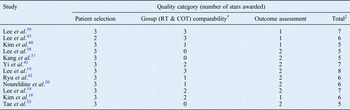
Two researchers independently extracted data using standardised forms. Data extracted from each study included patient characteristics, operative details, and post-operative outcomes. The quality of the studies was assessed using the Newcastle–Ottawa Scale,Reference Stang21 with some modifications. Specifically, three factors were examined: patient selection, comparability of the two groups (robotic thyroidectomy and conventional open thyroidectomy) and assessment of outcome. Studies awarded six or more stars were considered as higher quality.Reference Athanasiou, Al-Ruzzeh, Kumar, Crossman, Amrani and Pepper22
Statistical analysis
The meta-analysis was performed using Review Manager software, version 5.0 (Cochrane Collaboration, Oxford, UK). Categorical variables were analysed in terms of odds ratios and corresponding 95 per cent confidence intervals (CIs). Continuous variables were analysed using weighted mean differences and corresponding 95 per cent CIs. The pooled effect was calculated using either a fixed-effects or random-effects model based on heterogeneity. Heterogeneity was measured using the chi-square test and I2 statistic, with a p value of <0.1 considered significant.Reference Higgins, Thompson, Deeks and Altman23 If the I2 statistic was over 50 per cent, the random-effects analysis was performed. Subgroups were used for the sensitivity analysis. Funnel plots were created to evaluate the potential publication bias.
Results
Study characteristics
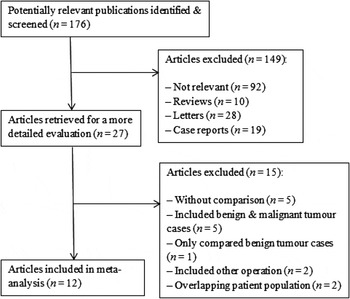
The search strategy initially identified 176 potentially relevant clinical studies. Twenty-seven articles were selected for further assessment following application of the study criteria. Of these, five studies were published without comparison,Reference Lee, Kim, Koo do, Choi, Kim and Youn12, Reference Kang, Jeong, Yun, Sung, Lee and Lee13, Reference Lee, Yun, Nam, Choi, Chung and Soh24–Reference Son, Park, Lee, Lee, Kim and Kang26 five studies reported benign and malignant tumour cases,Reference Tae, Ji, Jeong, Lee, Jeong and Park7, Reference Kim, Kim, Chang, Yoo and Kim27–Reference Landry, Grubbs, Warneke, Ormond, Chua and Lee30 one study only investigated benign tumour cases,Reference Park, Lee, Park, Jeong, Kang and Jeong31 and two studies included other operations;Reference Ji, Song, Bang, Lee, Park and Tae32, Reference Foley, Agcaoglu, Siperstein and Berber33 these studies were excluded from the analysis. In addition, four studies were published by the same institute and had overlapping patient populations;Reference Kim, Kang, Kang and Park18, Reference Kim, Kang and Park34–Reference Tae, Ji, Cho, Lee, Kim and Kim36 only the higher quality studiesReference Kim, Kang, Kang and Park18, Reference Tae, Song, Ji, Kim, Kim and Choi35 were included.
A total of 12 studies published between 2010 and 2014 that matched the inclusion criteria were included in this study.Reference Lee, Lee, Lee, Park, Kim and Son14, Reference Kim, Kang, Kang and Park18–Reference Noureldine, Jackson, Tufano and Kandil20, Reference Tae, Song, Ji, Kim, Kim and Choi35, Reference Kang, Lee, Park, Jeong, Park and Lee37–Reference Lee, Koo do, Im, Park, Choi and Paeng43 All 12 studies were non-randomised, controlled trials. A flow chart demonstrating the process of article selection is shown in Figure 1.
Flow chart showing the process of article identification and selection.

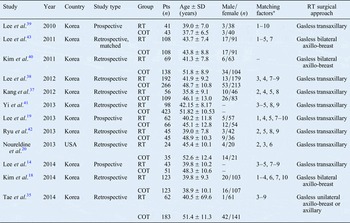
The general characteristics of studies included in the meta-analysis are summarised in Table I. The quality assessment results for these 12 studies are presented in Table II.
Characteristics of included studies

*1 = age, 2 = gender, 3 = tumour size, 4 = multiplicity, 5 = bilateralism, 6 = type of thyroidectomy, 7 = extrathyroidal extension, 8 = tumour classification, 9 = node classification, 10 = tumour–node–metastasis stage. Pts = patients; SD = standard deviation; RT = robotic thyroidectomy; COT = conventional open thyroidectomy
Quality assessment results*

* Quality was assessed using the Newcastle–Ottawa Scale,Reference Stang21 with some modifications. †Comparability variables include age, tumour size, multiplicity, bilateralism, extrathyroidal extension, type of thyroidectomy and tumour–node–metastasis stage. ‡Studies awarded six or more stars were considered higher quality.Reference Athanasiou, Al-Ruzzeh, Kumar, Crossman, Amrani and Pepper22 RT = robotic thyroidectomy; COT = conventional open thyroidectomy
The 12 studies involved 2513 patients: 923 patients in the robotic thyroidectomy group and 1590 patients in the conventional open thyroidectomy group. In terms of surgical approaches, eight studies were performed using a gasless transaxillary approach,Reference Lee, Lee, Lee, Park, Kim and Son14, Reference Lee, Kwon, Bae and Chung19, Reference Noureldine, Jackson, Tufano and Kandil20, Reference Kang, Lee, Park, Jeong, Park and Lee37–Reference Lee, Nah, Kim, Ahn, Soh and Chung39, Reference Yi, Yoon, Lee, Sung, Chung and Kim41, Reference Ryu, Lee, Park, Kang, Jeong and Hong42 three studies were performed using a bilateral axillo-breast approach,Reference Kim, Kang, Kang and Park18, Reference Kim, Kim, Hur, Kim, Lee and Choi40, Reference Lee, Koo do, Im, Park, Choi and Paeng43 and one study was performed using a gasless unilateral axillo-breast or axillary approach.Reference Tae, Song, Ji, Kim, Kim and Choi35 One study focused on robotic modified radical neck dissection for papillary thyroid carcinoma with lateral neck metastasis.Reference Lee, Kwon, Bae and Chung19 Two studies reported on patients with papillary thyroid cancer and follicular thyroid cancer.Reference Noureldine, Jackson, Tufano and Kandil20, Reference Lee, Nah, Kim, Ahn, Soh and Chung39 The patients in the other studies had only papillary thyroid cancer. Eleven studies were performed in KoreaReference Lee, Lee, Lee, Park, Kim and Son14, Reference Kim, Kang, Kang and Park18, Reference Lee, Kwon, Bae and Chung19, Reference Tae, Song, Ji, Kim, Kim and Choi35, Reference Kang, Lee, Park, Jeong, Park and Lee37–Reference Lee, Koo do, Im, Park, Choi and Paeng43 and one study was carried out in the USA.Reference Noureldine, Jackson, Tufano and Kandil20
Meta-analysis results
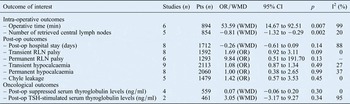
The results of the meta-analysis are summarised in Table III.
Meta-analysis results of interest

Pts = patients; OR = odds ratio; WMD = weighted mean difference; CI = confidence interval; post-op = post-operative; RLN = recurrent laryngeal nerve; TSH = thyroid stimulating hormone
Intra-operative outcomes
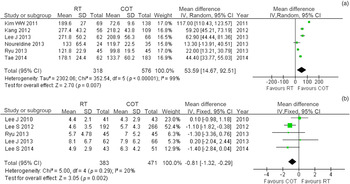
The operative time was reported in six studies.Reference Lee, Kwon, Bae and Chung19, Reference Noureldine, Jackson, Tufano and Kandil20, Reference Tae, Song, Ji, Kim, Kim and Choi35, Reference Kang, Lee, Park, Jeong, Park and Lee37, Reference Kim, Kim, Hur, Kim, Lee and Choi40, Reference Ryu, Lee, Park, Kang, Jeong and Hong42 The pooled data revealed that the operative time was significantly longer in the robotic thyroidectomy group than the conventional open thyroidectomy group (weighted mean difference = 53.59, 95 per cent CI = 14.67–92.51, p = 0.007), although there was significant heterogeneity between the studies (I2 = 99 per cent) (Figure 2a). The number of retrieved central lymph nodes, reported in five studies,Reference Lee, Lee, Lee, Park, Kim and Son14, Reference Lee, Kwon, Bae and Chung19, Reference Lee, Ryu, Park, Kim, Kang and Jeong38, Reference Lee, Nah, Kim, Ahn, Soh and Chung39, Reference Ryu, Lee, Park, Kang, Jeong and Hong42 was found to be significantly lower in the robotic thyroidectomy group than in the conventional open thyroidectomy group (weighted mean difference = −0.81, 95 per cent CI = −1.32 to −0.29, p = 0.002) (Figure 2b).
Forest plots displaying (a) operative time and (b) number of retrieved central lymph nodes, comparing robotic thyroidectomy with conventional open thyroidectomy. RT = robotic thyroidectomy; COT = conventional open thyroidectomy; SD = standard deviation; IV = inverse variance; CI = confidence interval

Post-operative outcomes
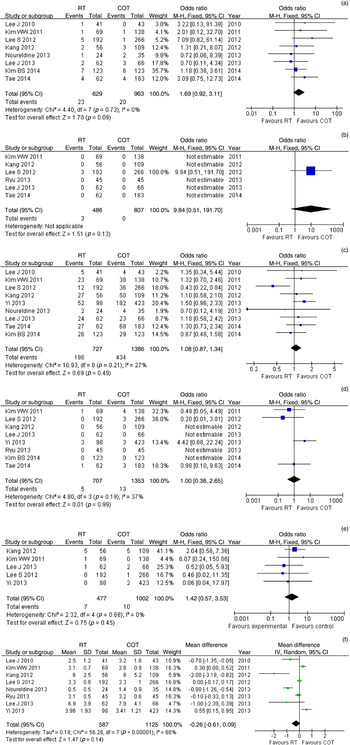
With respect to complications, eight studies reported transient RLN palsy,Reference Kim, Kang, Kang and Park18–Reference Noureldine, Jackson, Tufano and Kandil20, Reference Tae, Song, Ji, Kim, Kim and Choi35, Reference Kang, Lee, Park, Jeong, Park and Lee37–Reference Kim, Kim, Hur, Kim, Lee and Choi40 but analysis of the pooled data showed that the two groups (robotic thyroidectomy and conventional open thyroidectomy) did not differ significantly (odds ratio = 1.69, 95 per cent CI = 0.92–3.11, p = 0.09) (Figure 3a). Analysis of the pooled data from the six studies that reported permanent RLN palsyReference Lee, Kwon, Bae and Chung19, Reference Tae, Song, Ji, Kim, Kim and Choi35, Reference Kang, Lee, Park, Jeong, Park and Lee37, Reference Lee, Ryu, Park, Kim, Kang and Jeong38, Reference Kim, Kim, Hur, Kim, Lee and Choi40, Reference Ryu, Lee, Park, Kang, Jeong and Hong42 again revealed no significant difference between the two groups (odds ratio = 9.84, 95 per cent CI = 0.51–191.70, p = 0.13) (Figure 3b). Nine studies reported transient hypocalcaemia,Reference Kim, Kang, Kang and Park18–Reference Noureldine, Jackson, Tufano and Kandil20, Reference Tae, Song, Ji, Kim, Kim and Choi35, Reference Kang, Lee, Park, Jeong, Park and Lee37–Reference Yi, Yoon, Lee, Sung, Chung and Kim41 which also did not differ significantly between the two groups (odds ratio = 1.08, 95 per cent CI = 0.87–1.34, p = 0.49) (Figure 3c). The pooled data on permanent hypocalcaemia, provided in eight studies,Reference Kim, Kang, Kang and Park18, Reference Lee, Kwon, Bae and Chung19, Reference Tae, Song, Ji, Kim, Kim and Choi35, Reference Kang, Lee, Park, Jeong, Park and Lee37, Reference Lee, Ryu, Park, Kim, Kang and Jeong38, Reference Kim, Kim, Hur, Kim, Lee and Choi40–Reference Ryu, Lee, Park, Kang, Jeong and Hong42 also revealed no significant difference between the two groups (odds ratio = 1.00, 95 per cent CI = 0.38–2.65, p = 0.99) (Figure 3d). No significant differences were seen between the two groups regarding chyle leakage (odds ratio = 1.42, 95 per cent CI = 0.57–3.53, p = 0.45) (Figure 3e) or post-operative hospital stay (weighted mean difference = −0.26, 95 per cent CI = −0.61–0.09, p = 0.14) (Figure 3f).
Forest plots displaying incidences of (a) transient recurrent laryngeal nerve (RLN) palsy, (b) permanent RLN palsy, (c) transient hypocalcaemia, (d) permanent hypocalcaemia and (e) chyle leakage, and (f) duration of post-operative hospital stay, comparing robotic thyroidectomy with conventional open thyroidectomy. RT = robotic thyroidectomy; COT = conventional open thyroidectomy; M-H = Mantel–Haenszel; CI = confidence interval; SD = standard deviation; IV = inverse variance

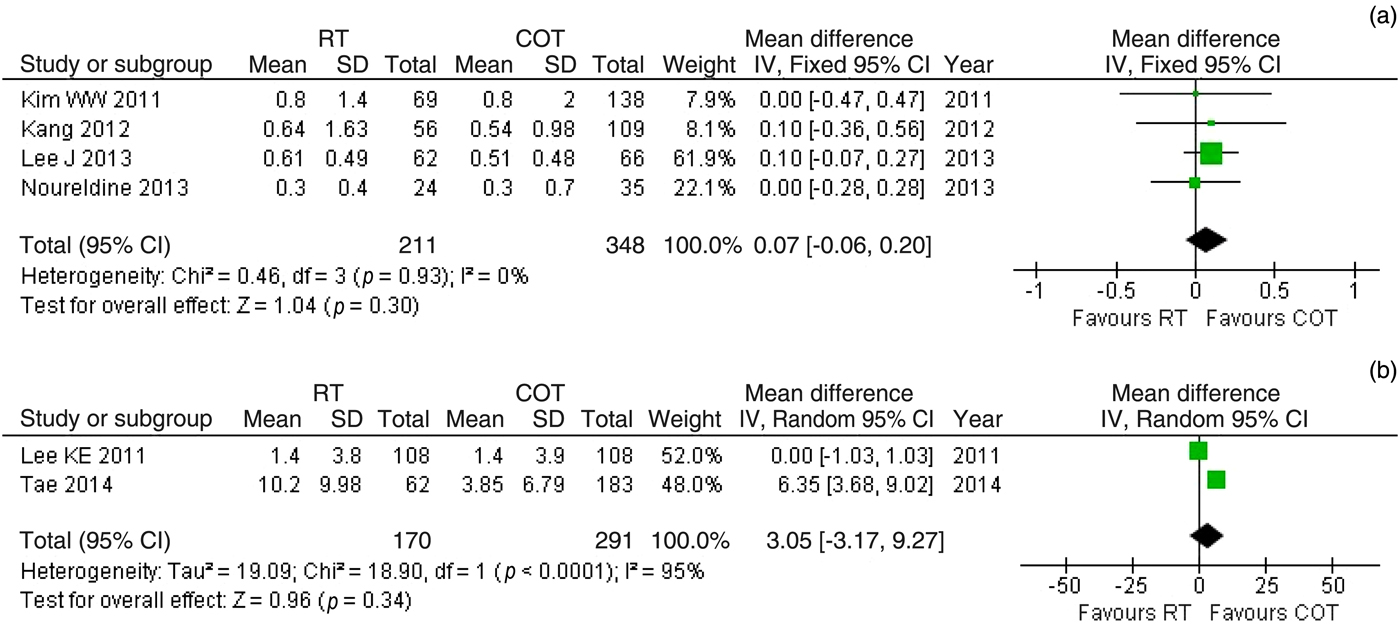
With regard to oncological outcomes, there was no statistically significant difference in either post-operative suppressed serum thyroglobulin levels (weighted mean difference = 0.07, 95 per cent CI = −0.06–0.20, p = 0.30) (Figure 4a) or in post-operative TSH-stimulated serum thyroglobulin levels (weighted mean difference = 3.05, 95 per cent CI = −3.17–9.27, p = 0.34) (Figure 4b). Three studies reported no tumour recurrences in either the robotic thyroidectomy or conventional open thyroidectomy groups during 12-months' follow up.Reference Lee, Kwon, Bae and Chung19, Reference Tae, Song, Ji, Kim, Kim and Choi35, Reference Kang, Lee, Park, Jeong, Park and Lee37 However, significant heterogeneity among the studies was observed for post-operative hospital stay (I2 = 88 per cent) and post-operative TSH-stimulated serum thyroglobulin levels (I2 = 95 per cent). None of the included studies reported the long-term survival outcome.
Forest plots displaying (a) post-operative suppressed serum thyroglobulin levels and (b) post-operative thyroid stimulating hormone stimulated serum thyroglobulin levels, comparing robotic thyroidectomy with conventional open thyroidectomy. RT = robotic thyroidectomy; COT = conventional open thyroidectomy; SD = standard deviation; IV = inverse variance; CI = confidence interval

Publication bias
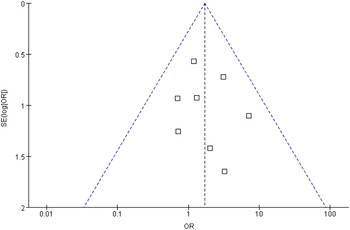
A funnel plot of the studies reporting transient RLN palsy is shown in Figure 5. There was no evidence of publication bias. None of the study findings lay outside the limits of 95 per cent CIs.
Funnel plot for transient recurrent laryngeal nerve palsy. SE = standard error; OR = odds ratio

Sensitivity and subgroup analysis
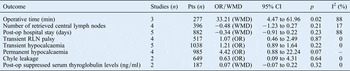
Sensitivity analyses were conducted by removing individual studies from the data set. These exclusions did not change the overall results of the analyses. Subgroup analyses were undertaken by including only the higher quality studies. Analysis of the higher quality studies showed results that were similar to those of all studies together, except for the cumulative number of retrieved central lymph nodes. The cumulative numbers of retrieved central lymph nodes were comparable between groups (weighted mean difference = −0.48, 95 per cent CI = −1.23–0.27, p = 0.21). The results of the sensitivity analyses are summarised in Table IV.
Sensitivity analysis results*

* Only the higher quality studies were analysed. Pts = patients; OR = odds ratio; WMD = weighted mean difference; CI = confidence interval; post-op = post-operative; RLN = recurrent laryngeal nerve
Discussion
Recently, with the improvement of endoscopic apparatus and accumulation of surgical skills, robotic thyroid surgery has gradually been applied to thyroid cancer. However, there seems to be a lack of consensus regarding oncological safety and surgical completeness.Reference Perrier44, Reference Miyano, Lobe and Wright45 To the best of our knowledge, this is the first meta-analysis to compare robotic thyroidectomy with conventional open thyroidectomy for patients with differentiated thyroid cancer.
The results of this meta-analysis showed that operative time was significantly longer in the robotic thyroidectomy group as compared to the conventional open thyroidectomy group, which can be explained by the extra time needed to prepare the working space and robotic docking.Reference Tae, Ji, Jeong, Lee, Jeong and Park7, Reference Lee, Lee, Nah, Soh and Chung46, Reference Kang, Lee, Ryu, Lee, Jeong and Nam47 This result is consistent with previous studies.Reference Lang, Wong, Tsang, Wong and Wan15–Reference Sun, Peress and Pynnonen17 We believe that robotic thyroidectomy operative time may decrease with accumulation of the surgeon's experiences and skills.
With regard to lymph node dissection, as one factor of surgical radicalism for malignancy, our results also demonstrated that the robotic thyroidectomy group was associated with significantly fewer retrieved central lymph nodes. This can be attributed to the high degree of patient selection in the robotic thyroidectomy group; in contrast, the conventional open thyroidectomy group comprised more cases of bilateral cancer and multiple central node metastases.Reference Lee, Ryu, Park, Kim, Kang and Jeong38 However, analysis of only the higher quality studies revealed no significant difference in the number of removed central lymph nodes between the two groups. This indicates that the clearance of central lymph nodes achieved by robotic thyroidectomy is similar to that of conventional open thyroidectomy. We attribute this to the magnified, three-dimensional operative views of the robotic system.Reference Lee, Kwon, Bae and Chung19
The major complications of thyroid surgery are RLN palsy and hypocalcaemia. Our results demonstrate no significant differences between the two groups in terms of the incidence rates of transient RLN palsy, permanent RLN palsy, transient hypocalcaemia, permanent hypocalcaemia or chyle leakage. This may largely be a result of the amplified surgical field and excellent apparatus in the robotic system, which enables identification of the RLN, parathyroid gland and thoracic duct.Reference Kim, Kang, Kang and Park18
Oncological outcomes following thyroid cancer, such as completeness of thyroid resection and tumour recurrence, are a concern for surgeons. The findings revealed no significant differences between the two groups in terms of post-operative suppressed serum thyroglobulin levels and TSH-stimulated serum thyroglobulin levels (markers of surgical completeness). This indicates that robotic thyroidectomy can be as complete as conventional open thyroidectomy.Reference Kim, Kim, Hur, Kim, Lee and Choi40 Three studies reported no tumour recurrences during the 12-month follow up.Reference Lee, Kwon, Bae and Chung19, Reference Tae, Song, Ji, Kim, Kim and Choi35, Reference Kang, Lee, Park, Jeong, Park and Lee37 However, none of the studies reported on overall long-term survival. There is still insufficient available data on long-term outcomes to adequately investigate tumour-free survival. Randomised, controlled trials with long-term follow up are needed to more precisely evaluate oncological outcomes following thyroid cancer.
Two of the studies in this analysis reported on cosmetic satisfaction and quality of life,Reference Lee, Nah, Kim, Ahn, Soh and Chung39, Reference Ryu, Lee, Park, Kang, Jeong and Hong42 but the measurements of evaluation were different, making it difficult to pool the results together. Tae et al.Reference Tae, Ji, Cho, Lee, Kim and Kim36 and Lee et al.Reference Lee, Nah, Kim, Ahn, Soh and Chung39 found that cosmetic satisfaction was significantly higher in the robotic thyroidectomy group than in the conventional open thyroidectomy group, because there was no operative scar on the anterior neck and the incision scar in the axilla was almost shaded when the arms were in a natural position.
• General application of robotic thyroidectomy for malignant thyroid tumours continues to be debated
• A meta-analysis was conducted to compare short-term outcomes of robotic thyroidectomy and conventional open thyroidectomy for differentiated thyroid cancer
• The results demonstrated that robotic thyroidectomy is feasible and safe for treating patients with differentiated thyroid cancer
Of course, the meta-analysis has some limitations and hence the results should be interpreted with caution. Firstly, all studies included were non-randomised, observational clinical studies, which might either overestimate or underestimate the measured effect. Secondly, some heterogeneity was observed in certain results between the two groups. This might be explained by differences in patient selection and surgeons' experiences. Thirdly, we were unable to analyse some other important outcomes, such as cosmetic results and quality of life, because of insufficient data. Finally, the follow-up period was short in all studies, and long-term follow-up data are required to properly evaluate the survival of patients with differentiated thyroid carcinoma who undergo robotic thyroidectomy.
In conclusion, the results of this meta-analysis demonstrate that robotic thyroidectomy is feasible and safe for the treatment of patients with differentiated thyroid carcinoma, although robotic thyroidectomy is not superior to conventional techniques with respect to operative time. Further randomised, controlled trials are needed to confirm the effects of robotic thyroidectomy for differentiated thyroid carcinoma patients.