Introduction
Like many other cities, Hong Kong's population suffers from an ageing population. Hong Kong's Census and Statistics Department's latest population estimations predict a rise in the number of persons aged 65 or above of 17 per cent, from 13 per cent in 2011 to 30 per cent by 2041 (Census and Statistics Department 2012). An ageing population will increase the demand for financial security amongst Hong Kong's expanding population of elderly people. Needless to say, financial security in retirement is proportional to one's quality of life after retirement (Taylor and Geldhauser Reference Taylor, Geldhauser, Shultz and Adams2007; Wang and Shultz Reference Wang and Shultz2010). With the increasing numbers of adults who do not have the financial resources to support their elderly parents, a substantial number of future retirees are further prioritising their own private savings, expecting savings to become their primary source of income and expecting to rely on it during their retirement (AXA 2005; HSBC 2006). However, the amount that people need to save for retirement remains one of the most pondered and complex of decisions for many working people. Despite the hypothesised significance of private retirement savings, certain individuals – even those with substantial financial resources – still fail to meet the quota for a secure retirement.
Perceived retirement savings adequacy assesses the extent to which individuals believe that they have saved sufficiently for retirement, and it serves to structure individuals' perceived opportunities and constraints in their financial management (Kemp, Rosentahal and Denton Reference Kemp, Rosenthal and Denton2005). Furthermore, it has been shown to be associated with both asset and actual saving rates (Hershey, Mowen and Jacobs-Lawson Reference Hershey, Mowen and Jacobs-Lawson2003). On the other hand, previous studies have indicated that perceived retirement savings adequacy is affected by not only issues of knowledge and individual psychological characteristics, but also social and institutional factors that can determine one's capacity to develop and implement a savings plan (Adams and Rau Reference Adams and Rau2011; Van Dalen, Henkens and Hershey Reference Van Dalen, Henkens and Hershey2010).
Consequently, previous studies have examined the associations of institutional, social and psychological factors with perceived retirement savings adequacy or planning activities based on an interdisciplinary psycho-motivational model of financial planning developed by Hershey and colleagues (Hershey, Henkens and Van Dalen Reference Hershey, Henkens and Van Dalen2010a; Van Dalen, Henkens and Hershey Reference Van Dalen, Henkens and Hershey2010). However, this psycho-motivational model has not been investigated in Asian societies. Therefore, to fill this research gap, we aim to replicate the findings of previous studies in Western countries (Hershey, Henkens and Van Dalen Reference Hershey, Henkens and Van Dalen2010a; Van Dalen, Henkens and Hershey Reference Van Dalen, Henkens and Hershey2010) in the Hong Kong Chinese context, with its rapidly ageing population. Specifically, we examine the associations of institutional, social and psychological factors with perceived retirement savings adequacy or planning activities using path analysis. Moreover, we investigate age differences by comparing younger (25–44) and older workers' (45–64) mean scores in factors believed to be associated with perceived retirement savings adequacy.
The situation in Hong Kong
To meet the challenge of financial income protection for a globally ageing population, the World Bank has recommended a multi-pillar approach (Holzmann, Palacios and Zviniene Reference Holzmann, Palacios and Zviniene2004). The first pillar is public and is funded by general tax. It serves as a social safety net to satisfy the basic needs of older persons. The second pillar is mandatory privately managed retirement schemes where the contributions of individuals (usually as a percentage of income earned) are saved and invested to meet the costs of life beyond retirement. The third pillar is the voluntary savings of individuals made during their lifetime – in addition to familial support – to supplement the first two pillars.
In Hong Kong, the first pillar includes three schemes (Chou Reference Chou2010; Chou, Chow and Chi Reference Chou, Chow and Chi2004): the Old Age Category of Comprehensive Social Security Assistance (Old Age CSSA) scheme, Old Age Living Allowance (OALA) and Old Age Allowance (OAA). The Old Age CSSA scheme is non-contributory, means-tested and financed by tax revenues, providing financial assistance to about 13.7 per cent of adults aged 60 and over (Social Welfare Department 2013). In an average Old Age CSSA case, the elderly recipient receives approximately US $6,154 per year, which is around 40 per cent of the median salary (Chou, Chow and Chi Reference Chou, Chow and Chi2004). The criteria of the means test for one older adult are US $4,872 in assets and US $4,454 in annual income. Second, individuals aged 65 and above are eligible to apply for OALA, though it is means-tested. The OALA criteria are more lenient than Old Age CSSA, as the amount of OALA is fixed at about US $3,385 annually. When adults reach 70, they are eligible for OAA, which is universal. The amount the OAA permits is fixed at US $1,677 annually, and approximately 60 per cent of elderly people receive benefits from this scheme (Social Welfare Department 2013). In sum, the Hong Kong Government only provides minimal residual income protection for the aged population (Chou, Chow and Chi Reference Chou, Chow and Chi2004).
A new protection programme for retirement income, the Mandatory Provident Fund (MPF) scheme, was implemented at the end of 2000. It is employment-based, contribution-defined, privately managed and involves compulsory savings. Everyone employed and self-employed between the ages of 18 and 65 are required to partake in registered MPF schemes. Prior to the MPF's implementation, approximately 30 per cent of Hong Kong's 3.4 million workforce were participants of retirement protection programmes such as the Occupational Retirement Scheme Ordinance (ORSO) programme provided by employers or the pension provision scheme for civil servants (Siu Reference Siu2002). Thus they were excluded from the MPF scheme. These schemes and the MPF are components of the second pillar of the retirement protection system in Hong Kong.
While benefits from the pension scheme for civil servants can be paid through a combination of lump sums and annuities, benefits from the MPF and ORSO programme scan only be paid in a lump sum. As of the end of September 2012, 2,589,000 employees (including self-employed persons) have enrolled in the MPF programme (MPF Authority 2012), with accumulated assets totalling US $52.8 billion. Meanwhile, ORSO schemes (including both MPF-exempted and non-MPF-exempted ORSO schemes) cover around 407,771 employees, totalling US $33.7 billion in accumulated assets.
The third pillar of retirement protection in Hong Kong is private savings and familial support, primarily by adult children (Chou Reference Chou2010; Chou, Chow and Chi Reference Chou, Chow and Chi2004). Similar to other Chinese societies, Hong Kong follows traditional morals and principles of filial piety (Cheng and Chan Reference Cheng and Chan2006; Lee and Kwok Reference Lee and Kwok2005; Zhan Reference Zhan2004). A substantial proportion (58.4%) of elderly people receive financial support from their adult children. Support from adult children works out to a median annual income of around US $2,460 (Census and Statistics Department 2001). The total annual financial support received from adult children amounts to approximately US $2.97 billion (HK $23.2 billion). This is greater than the expenditures on Old Age CSSA and OAA, which combine to around US $1.54 billion (HK $12 billion) each year (Chou Reference Chou2010).
However, financial support from adult children is expected to decline considerably in the following three decades due to: reduced expectations for adult children for dependency and support; a lower proportion of older adults who are co-residing with their adult children; and a reduction in the adult children population as a result of a low fertility rate, which undermines intergenerational family obligations (Chou Reference Chou2010; Knodel et al. Reference Knodel, Friedman, Anh and Cuong2000; Logan and Bian Reference Logan and Bian2003; Zimmer and Kwong Reference Zimmer and Kwong2003).
Slightly over 70 per cent (71.1%) of persons aged between 35 and 64 have financially prepared for their retirement, and the most common method to prepare for retirement is savings (55.5 per cent; AXA 2005). Similarly, the findings of our prior study reveal that slightly over two-thirds of workers between the ages of 30 and 59 prepare for their retirement financial sustenance through savings (HSBC 2006). These results suggest that savings will become the preferred alternative for secure retirement income in the foreseeable future. A crucial question remains for Hong Kong's retirement income protection system: can the future predicted decline in familial support be compensated for by the maturation of MPF schemes and increases in private retirement savings? Therefore, it is of the utmost importance to examine the factors that contribute to the perceived retirement savings adequacy in Hong Kong.
Factors affecting perceived retirement savings adequacy
The first group of factors associated with retirement savings adequacy involves an individual's psychological disposition to save. Future time perspective, retirement goal clarity and level of financial knowledge are three important psychological factors that have been shown to be associated with retirement savings planning and practice. Future time perspective is conceptualised as a personality trait and is defined as the extent to which individuals perceive the future as important compared with the present. In the context of savings, it refers to the degree to which people can resist the immediate pleasures of current consumption to save up money for their future financial needs. As expected, future time orientation is positively associated with retirement planning, retirement savings and savings adequacy (Burtless Reference Burtless, Schaie and Carstensen2006; Hershey, Henkens and Van Dalen Reference Hershey, Henkens and Van Dalen2010a; Howlett, Kees and Kemp Reference Howlett, Kees and Kemp2008; Kemp, Rosentahal and Denton Reference Kemp, Rosenthal and Denton2005; Lusardi Reference Lusardi and Aaron1999; Van Dalen, Henkens and Hershey Reference Van Dalen, Henkens and Hershey2010).
Another psychological dispositional factor is retirement goal clarity, which is having clear financial goals for retirement. It is associated with retirement savings behaviour and perceived savings adequacy (Hershey, Henkens and Van Dalen Reference Hershey, Henkens and Van Dalen2007, Reference Hershey, Henkens and Van Dalen2010a; Hershey, Mowen and Jacobs-Lawson Reference Hershey, Mowen and Jacobs-Lawson2003; Hershey et al. Reference Hershey, Jacobs-Lawson, McArdle and Hamagami2007; Stawski, Hershey and Jacobs-Lawson Reference Stawski, Hershey and Jacobs-Lawson2007).
Lastly, financial knowledge is an important cognitive factor affecting retirement savings. Individuals with a high level of financial knowledge are more likely to plan, save and have a higher level of perceived adequacy (Banks and Oldfield Reference Banks and Oldfield2007; Chan and Stevens Reference Chan and Stevens2003; Ekerdt and Hackney Reference Ekerdt and Hackney2002; Grable and Lytton Reference Grable and Lytton1997; Hershey, Henkens and Van Dalen Reference Hershey, Henkens and Van Dalen2007, Reference Hershey, Henkens and Van Dalen2010a).
Besides these psychological factors, social influence from spouses and friends can also contribute to retirement savings decisions through the social norms they provide (Hershey, Henkens and Van Dalen Reference Hershey, Henkens and Van Dalen2010a; Van Dalen, Henkens and Hershey Reference Van Dalen, Henkens and Hershey2010). It is well known that people's retirement decisions are very often affected by the timing of the retirement of spouses and peers (Henkens Reference Henkens1999). It is likely that such spousal or peer influence also affects decision making during middle age (Hershey, Henkens and Van Dalen Reference Hershey, Henkens and Van Dalen2010a; Van Dalen, Henkens and Hershey Reference Van Dalen, Henkens and Hershey2010). It is also suggested that early parental socialisation may shape workers' thoughts on the importance of retirement savings (Hershey, Henkens and Van Dalen Reference Hershey, Henkens and Van Dalen2010a; Van Dalen, Henkens and Hershey Reference Van Dalen, Henkens and Hershey2010). As a matter of fact, individuals who were encouraged to save in their childhood tend to save more as adults (Bernheim, Garrett and Maki Reference Bernheim, Garrett and Maki2001). A recent study also indicates that the impact of such economic socialisation is long lasting and has an influence on financial behaviour in adulthood (Webley and Nyhus Reference Webley and Nyhus2006). These findings suggest a positive association between childhood socialisation to save and retirement savings adequacy.
The third group of factors associated with retirement savings adequacy is institutional factors. At a basic level, people who place trust in the government to provide adequate retirement income protection tend to have more confidence that sufficient funds will be available (Hyde, Dixon and Drover Reference Hyde, Dixon and Drover2007). The government may act as not only the provider of public pensions, but also the guardian of the public interest, regulating the pension industry. It has therefore been shown, for example, that younger Dutch people who are more confident that their government can manage their future retirement security are likely to have a higher level of perceived retirement savings adequacy (Hershey, Henkens and Van Dalen Reference Hershey, Henkens and Van Dalen2010a).
Besides the government, the majority of Hong Kong employees need to have a certain level of trust in the banks and fund managers who manage and invest the funds in their MPF account or ORSO schemes. Among American and Dutch workers, there is a significant association between trust in banks and insurance companies to manage pensions and perceived retirement savings adequacy (Van Dalen, Henkens and Hershey Reference Van Dalen, Henkens and Hershey2010). Furthermore, if employees can put their trust in employers to provide a good retirement scheme, they may also be more likely to believe that their anticipated retirement replacement rate is adequate (Hershey, Henkens and Van Dalen Reference Hershey, Henkens and Van Dalen2010a; Van Dalen, Henkens and Hershey Reference Van Dalen, Henkens and Hershey2010).
Previous studies and our contribution
Although the influence of psychological factors on retirement savings has been documented in the literature (Benartzi and Thaler Reference Benartzi and Thaler2007; Mitchell and Utkus Reference Mitchell and Utkus2004; Thaler Reference Thaler2005), few studies have explored the role social and institutional factors play in retirement savings. To our knowledge, only two studies have analysed the effects of institutional, social and psychological factors on perceived retirement savings adequacy among American and Dutch working adults (Hershey, Henkens and Van Dalen Reference Hershey, Henkens and Van Dalen2010a; Van Dalen, Henkens and Hershey Reference Van Dalen, Henkens and Hershey2010). No study has addressed this large issue in Asian societies. Studying the factors that are associated with perceived retirement saving adequacy may improve the effectiveness of measures targeted at encouraging retirement savings among individuals. To address this research gap, the objective of the current study is to examine the association between institutional, social and psychological factors with subjective adequacy of retirement savings in Hong Kong's Chinese society.
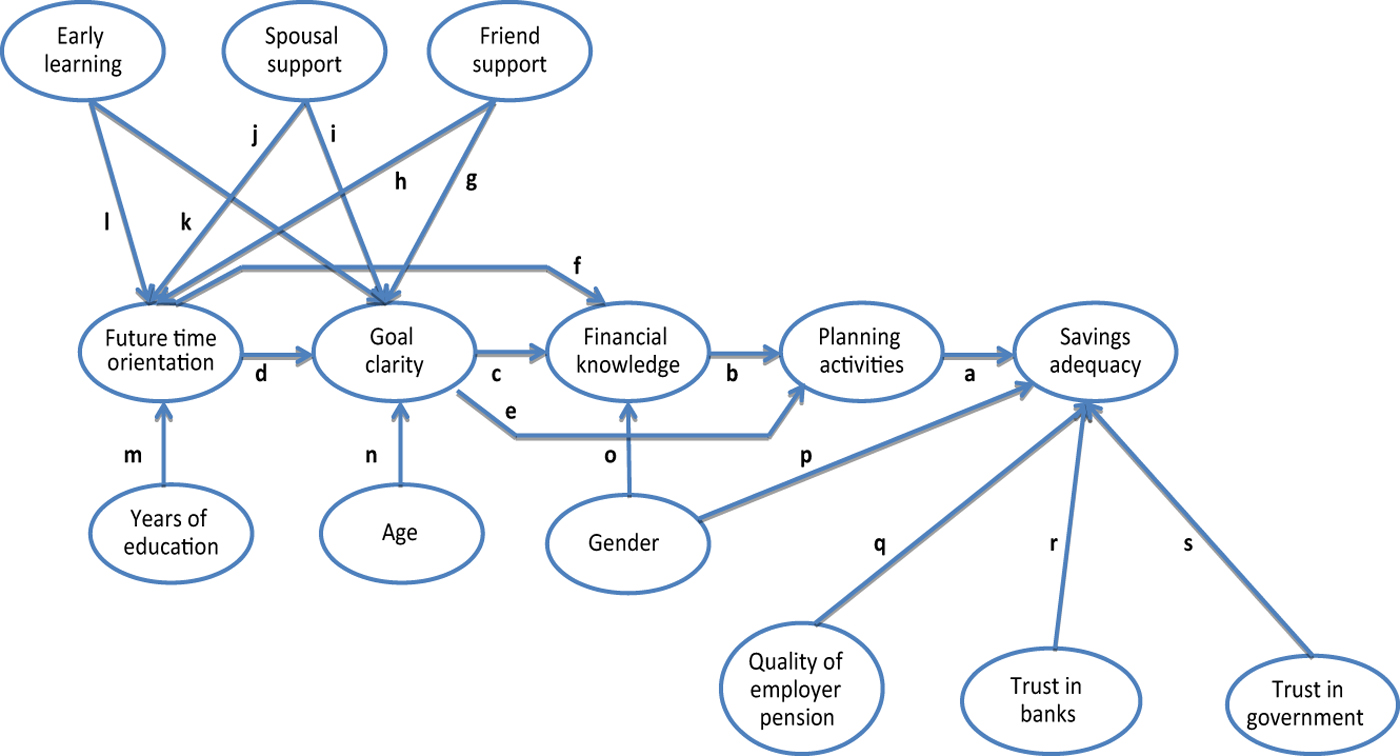
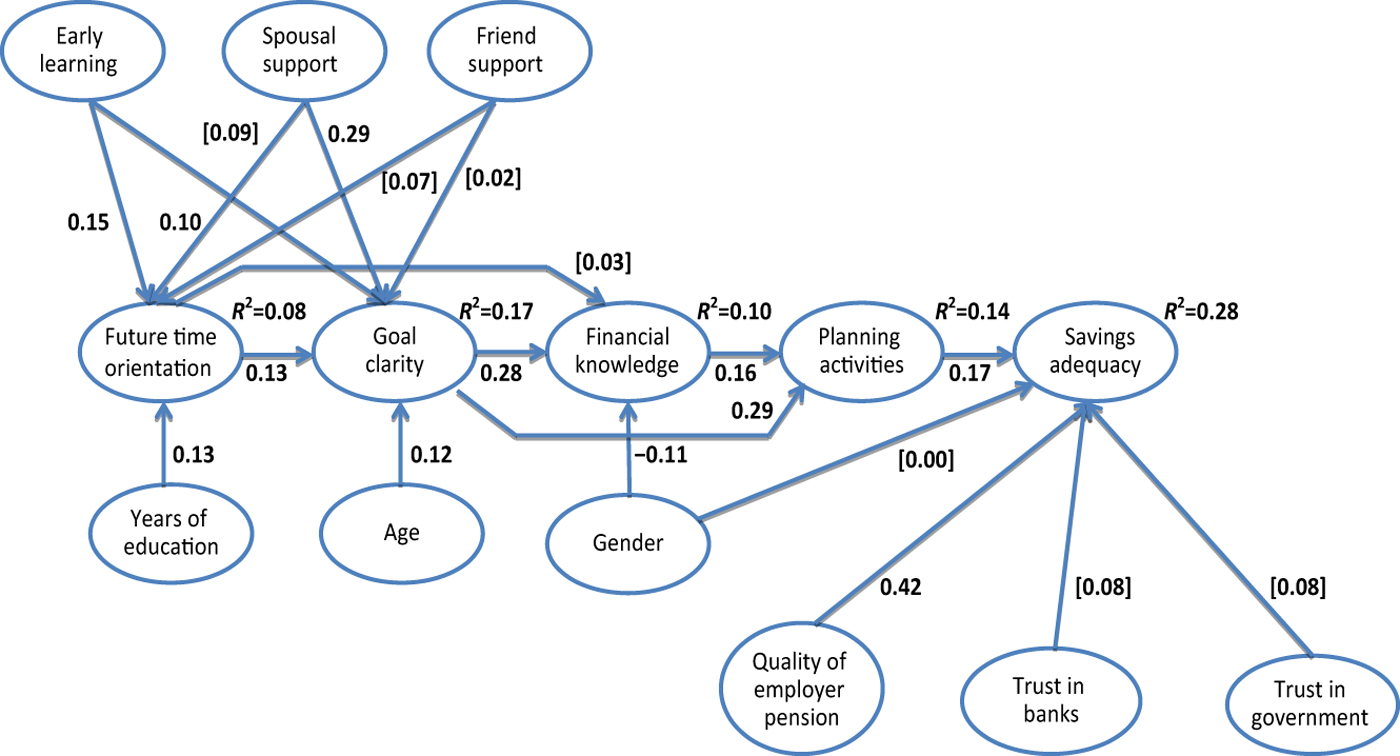
The framework used to explain retirement savings adequacy is an interdisciplinary psycho-motivational model of financial planning that has been developed and tested in previous studies (Hershey, Henkens and Van Dalen Reference Hershey, Henkens and Van Dalen2010a). This model incorporates institutional, social and psychological factors that contribute to retirement savings planning and implementation. Figure 1 illustrates the conceptual model tested in this study. As can be seen, the proximal determinants of retirement savings adequacy and planning are psychological factors (future time orientation, goal clarity and financial knowledge) and institutional factors (trust in government, trust in banks and fund managers, and quality of employer pension). Social forces (early learning, spousal support and friend support) are also believed to shape retirement savings planning and practices but are mediated through two psychological dispositions: future time orientation and goal clarity.
Interdisciplinary financial planning model.

The interdisciplinary financial planning model to be empirically tested in this study is shown in considerable detail in Figure 1, which proposes a sequential organisation of the five variables from future time perspective (personality construct), goal clarity and financial knowledge (both cognitive constructs), retirement planning activities (behaviour) and then savings adequacy (outcome). As can be seen in Figure 1, hypotheses ‘a’ to ‘f’ are the core of the model. Goal clarity is a partial mediator in the link between future time orientation and financial knowledge, while the three psychological factors (future time orientation, goal clarity and financial knowledge) are antecedents to retirement savings planning activities and savings adequacy. Beside this core set of five variables, nine additional variables are included in the model. First among these are the three social force indicators (early learning, spousal support and peer support), which affect planning and savings adequacy through two psychological variables (future time orientation and goal clarity in hypotheses ‘g’ to ‘l’).
It is well known that people in Chinese cultures save more than people in Western countries (Kuijs Reference Kuijs2006; Mees and Ahmed Reference Mees and Ahmed2012; Zhou Reference Zhou2012). One possible explanation is the cultural factor of Confucianism, which values thrift, self-discipline, moderation and an aversion to extravagance. Another cultural explanation is the language, since Chinese speakers are not required to grammatically mark future events, in contrast with English (Chen Reference Chen2013). Chen's argument is that the Chinese language grammatically treats the present and future equally; therefore, the future appears closer to Chinese speakers, and they are more likely to save for it. In contrast, English speakers are more likely to dissociate the future from the present, making it more difficult to save for tomorrow. Moreover, previous studies have shown the importance of parental encouragement to save money and memory of parental saving habits in childhood for saving behaviour in adulthood (Peng et al. Reference Peng, Bartholomae, Fox and Cravener2007; Webley and Nyhus Reference Webley and Nyhus2012).
Based on these findings, we anticipate that the impact of early learning on two psychological constructs will be stronger than what has been found in Western countries. Moreover, we hypothesise that the three institutional factors (quality of employer pension, trust in banks and fund managers, and trust in government pension) will have a direct impact on perceived savings adequacy (hypotheses ‘r’, ‘s’ and ‘t’). This is because the Hong Kong government only provides residual minimal retirement income protection for retirees, as described above (Chou, Chow and Chi Reference Chou, Chow and Chi2004). We expect that the link between trust in government and perceived savings adequacy will be weak or even non-significant. Three background variables (education, age and gender) are also incorporated as control variables in the model (Figure 1).
Lastly, we also examine age differences in retirement savings adequacy, as well as factors associated with retirement savings planning and adequacy. Older pre-retirees not only plan more for their retirement savings, they also save more (DeVaney and Zhang Reference DeVaney and Zhang2001; Ekerdt et al. Reference Ekerdt, Hackney, Kosloski and DeViney2001; Hershey, Henkens and Van Dalen Reference Hershey, Henkens and Van Dalen2010a; Stawski, Hershey and Jacobs-Lawson Reference Stawski, Hershey and Jacobs-Lawson2007). Moreover, age differences have been found in factors associated with savings adequacy, such as early learning, friend support, trust in government, future time perspective, retirement goal clarity and financial knowledge (Hershey, Henkens and Van Dalen Reference Hershey, Henkens and Van Dalen2010a). Age differences have also been found in an examination of the structure of the interdisciplinary motivational model of financial planning (Hershey, Henkens and Van Dalen Reference Hershey, Henkens and Van Dalen2010a). Specifically, financial knowledge is a more important determinant of planning activities in older Dutch people (Hershey, Henkens and Van Dalen Reference Hershey, Henkens and Van Dalen2010a).
Method
Participants
The data were collected in a telephone survey conducted by the Public Opinion Programme at The University of Hong Kong in August and September 2012. The sampling procedure involved two steps. First, a fixed set of telephone numbers was randomly drawn from the latest residential telephone directories as ‘seed’ numbers, and another set was then generated using the ‘plus/minus one/two’ method to capture new and unlisted numbers. Second, one person per household aged 25–64 who was a Hong Kong resident, currently working and a speaker of Cantonese was randomly selected for an interview using the ‘next birthday’ rule, which selects the person with the soonest upcoming birthday. All interviewers were trained and monitored by qualified supervisors and subject to real-time camera surveillance. All interviews were conducted anonymously, and no remuneration was provided. The sample size was 999, with a response rate of 73.0 per cent.
Variables and measures
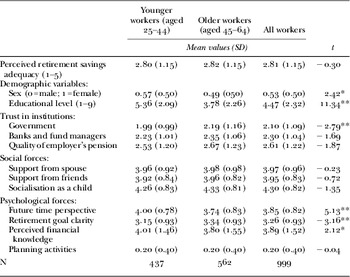
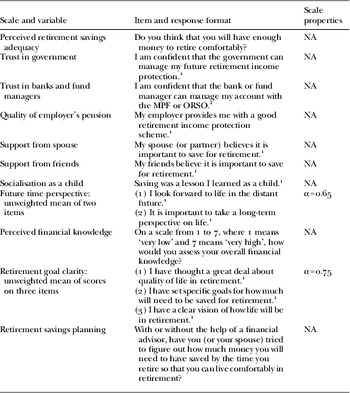
Four socio-demographic variables were included in this study: age, gender, marital status and education. Age was divided into two categories: 25–44 (younger workers) and 45–64 (older workers). Education was measured in nine categories ranging from primary school and below (1) to doctoral degree (9). Table 1 shows the mean scores for all institutional, social and psychological variables, as well as the retirement savings adequacy constructs. Table 2 presents a full description of each. Table 2 also provides a description of the scale items and characteristics, including internal consistency as evaluated by Cronbach's alpha. The major dependent variable in this study (perceived retirement savings adequacy) was based on the following question: ‘Do you think that you will have enough money to retire comfortably?’ Interviewees rated the item on a five-point Likert-type scale as follows: 1=strongly disagree; 2=disagree; 3=neither disagree nor agree; 4=agree; and 5=strongly agree. All of these measures were adopted from previous studies (Hershey, Henkens and Van Dalen Reference Hershey, Henkens and Van Dalen2010a; Van Dalen, Henkens and Hershey Reference Van Dalen, Henkens and Hershey2010).
Socio-demographic and financial experience profile of Hong Kong workers

Note: SD: standard deviation.
Significance levels: * p<0.05, ** p<0.01.
Scale characteristics, psychometric properties and wording of survey items for psychological and retirement variables

Notes: NA: not applicable. MPF: Mandatory Provident Fund. ORSO: Occupational Retirement Scheme Ordinance. 1. 1=strongly disagree; 5=strongly agree.
Statistical analysis
We first computed descriptive statistics for all dependent and independent variables and compared younger and older workers using t-tests. We then tested the structural model in Figure 1 using path analysis in SAS. To test for age differences in retirement savings adequacy, we also calculated two separate path models for younger and older workers in Hong Kong.
Results
Age differences
Table 1 shows the mean scores for each independent and dependent variable used in this study for the two age groups. For each variable, a t-test was performed to compare younger and older workers. Age differences were found in gender, education, trust in government, future time orientation, retirement goal clarity and perceived financial knowledge. Education, future time orientation and perceived financial knowledge were significantly greater for younger than older workers, whereas the reverse was true for trust in government and goal clarity.
Path analyses
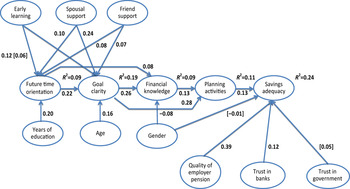
The model presented in Figure 2 was analysed using SAS (Procedure CALIS). We used the fit indices suggested by Hu and Bentler (Reference Hu and Bentler1999) to evaluate its quality, with excellent fit being denoted by Comparative Fit Index (CFI) values of greater than 0.95 and Root Mean Squared Error of Approximation (RMSEA) values less than 0.06. As described in the methodology section, we began by testing a model that included all participants in the study (Figure 1). Results indicated that the model did not provide an excellent fit to the data χ2(36)=322.3, p<0.01, CFI=0.853, RMSEA=0.089, which may indicate substantial differences between younger (25–44) and older workers (45–64). Moreover, the hypothesised path between age and goal clarity (path ‘n’) was significant, which provides another justification for retesting the data separately for these two age groups.
Path analysis model for all respondents.

The standardised beta weights of each path and the R 2 values for each endogenous variable are shown in Figure 2. The values shown in square brackets are not significant at the 0.05 level. As can be seen in Figure 2, all hypothesised paths were significant, with three exceptions: the link between gender and savings adequacy, between early learning and goal clarity, and between trust in government and savings adequacy. Five core variables were related to each other: future time orientation, goal clarity, financial knowledge, planning activities and savings adequacy (in that order). Future time orientation had a direct effect on financial knowledge, and goal clarity had a direct effect on planning activity. Both spousal and friend support were positively associated with both future time orientation and goal clarity, but early learning was only significantly related to future time orientation. Lastly, both quality of employer pension and trust in banks were associated with savings adequacy. However, the model only accounted for a moderate amount of variation: 24 per cent in savings adequacy, 11 per cent in planning activities, 9 per cent in financial knowledge, 26 per cent in goal clarity and 9 per cent for future time orientation.
Age differences in the path models
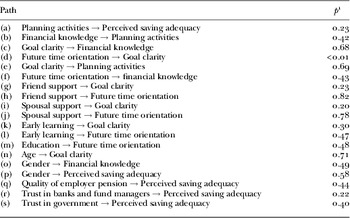
Table 3 presents the results of slope comparisons (z-tests) between younger and older workers in Hong Kong. Figures 3 and 4 show the pair-wise comparison between parallel paths. As can be seen in Table 3, only one of the 20 beta weight comparisons between age groups was significant. These results provide indirect evidence that this model could be applied to both younger and older workers in Hong Kong. However, the near-absence of age differences in Table 3 must be interpreted carefully because it does not constitute evidence that there are no age differences at all in this investigation. As can be seen in Table 1, age differences were found in three psychological variables (future time orientation, retirement goal clarity and perceived financial knowledge) and trust in government. The absence of age differences in the path analysis indicates that the way in which these variables operate in the model was similar for both younger and older workers.
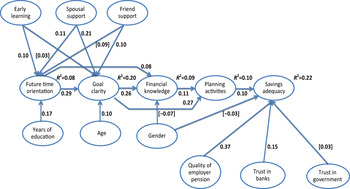
Path analysis model for younger respondents.

Path analysis model for older respondents.

Probability-level outcomes for pair-wise slope comparisons across age groups

Note: 1. Differences in the observed slopes for younger and older respondents.
Comparison of the path analyses for younger (Figure 3) and older workers (Figure 4) showed that the model for the younger group, χ2(36)=129.7, p<0.01, CFI=0.886, RMSEA=0.077 provided a better fit than for the older group, χ2(36)=219.5, p<0.01, CFI=0.815, RMSEA=0.095. However, seven out of the 20 hypothesised paths were not statistically significant in the model for younger adults, while five of the 20 were not significant for the older group.
In younger workers, regarding the associations between those five core variables, future time orientation was not significantly associated with financial knowledge. Among the three institutional factors, only quality of employer pension was associated with savings adequacy. Early learning was significantly related to both future time orientation and goal clarity, but spousal support was only associated with goal clarity. Friend support had no impact on these two psychological factors.
Among older respondents, although all five core variables were associated as anticipated in the model, we found that goal clarity had no direct impact on planning activities, counter to our hypothesis. Only quality of employer pension and trust in banks were positively related to savings adequacy. Trust in government was not. Spousal support was significantly associated with both future time orientation and goal clarity, while early learning was only linked to future time orientation, and friend support was only linked to goal clarity.
Four results of the path analyses in both groups are worth discussing. First, in general, the hypothesised paths between the core set of five variables were all significant for both age groups. Second, early learning had a more significant effect on future time orientation and goal clarity for younger workers. Third, support from friends was an important factor associated with retirement goal clarity in older but not younger people. Finally, both trust in banks and trust in fund managers were significantly associated with savings adequacy, but only for older workers.
Discussion
The primary aim of this study was to evaluate an interdisciplinary model of financial planning for retirement savings among Hong Kong workers. Although such a model has been evaluated among American and Dutch adults (Hershey, Henkens and Van Dalen Reference Hershey, Henkens and Van Dalen2007, Reference Hershey, Henkens and Van Dalen2010a; Van Dalen, Henkens and Hershey Reference Van Dalen, Henkens and Hershey2010), no previous study has tested this in an Asian society, so we conducted this study to fill this research gap. We also examined age differences by comparing data drawn from two age groups: people aged 25–44 and 45–64. Age differences were found in most of the psychological variables in the model. Moderate empirical support was found for the interdisciplinary model, which accounted for a significant amount of variance in perceived retirement savings adequacy for both younger and older workers. Furthermore, there were few significant age differences in slope parameters in the interdisciplinary model, which is similar to the studies of American and Dutch workers (Hershey, Henkens and Van Dalen Reference Hershey, Henkens and Van Dalen2010a). In other words, our findings suggest that there is age invariance in the model among Hong Kong Chinese workers, as there is in American and Dutch workers. In summary, our findings suggest that the interdisciplinary model is useful for investigating retirement savings activity and practices in Asian societies such as Hong Kong.
Three psychological factors (future time orientation, goal clarity and financial knowledge) have significant direct and/or indirect impact on retirement savings planning and adequacy. These findings were anticipated, given the results of similar work in other countries (Burtless Reference Burtless, Schaie and Carstensen2006; Chan and Stevens Reference Chan and Stevens2003; Hershey, Henkens and Van Dalen Reference Hershey, Henkens and Van Dalen2010a; Hershey et al. Reference Hershey, Jacobs-Lawson, McArdle and Hamagami2007; Stawski, Hershey and Jacobs-Lawson Reference Stawski, Hershey and Jacobs-Lawson2007; Van Dalen, Henkens and Hershey Reference Van Dalen, Henkens and Hershey2010). However, it should be noted that the associations of these three psychological variables with savings activity and adequacy are not as strong as was found for American and Dutch adults (Hershey, Henkens and Van Dalen Reference Hershey, Henkens and Van Dalen2010a). In particular, future time orientation was highly associated with worry about future retirement income and retirement savings practices in 23 European countries (Hershey, Henkens and Van Dalen Reference Hershey, Henkens and Van Dalen2010b).
The lower associations of the psychological factors with retirement savings planning and adequacy in this study may be due to the fact that old age financial security is mainly dependent on support from adult children, especially for middle-aged workers. Moreover, the retirement income protection scheme (the MPF), which emphasises individual financial responsibility for retirement savings, has only been implemented in Hong Kong for 13 years. Therefore, Hong Kong workers have not yet developed a mind-set for private retirement savings. Another explanation is that we have not included other variables such as self-efficacy and self-control, which may account for the discrepancies between our study and previous studies of American and Dutch adults. As a matter of fact, significant differences were also found between American and Dutch adults in the association of five core variables (Hershey, Henkens and Van Dalen Reference Hershey, Henkens and Van Dalen2007). As mentioned in Introduction, language use may also lead to cultural differences in retirement savings. Therefore, future studies must be undertaken to examine this issue in more detail.
In the whole-sample model, the three social support variables were found to have a direct impact on both future time orientation and goal clarity, with the exception that no association was found between early learning from parents and goal clarity. These results are even more interesting when we examine the effect of social support on retirement savings through future time orientation and goal clarity among younger and older adults. Surprisingly, in younger workers, friend support had no impact on either future time orientation or goal clarity. On the other hand, savings-related support from spouses affects retirement savings practices by encouraging people to set goals, and early savings-related learning experiences also have an impact through extending one's perspective on time further into the future and helping clarify retirement goals. For older workers, it seems that their parents helped them to cultivate a long-term perspective, and support from friends and colleagues has enhanced their retirement goal clarity, but spousal support has had an impact on both. These findings are consistent with findings from older Americans (Hershey, Henkens and Van Dalen Reference Hershey, Henkens and Van Dalen2010a) and indicate that the operation of these social support variables is quite different for younger and older workers in Hong Kong.
Even more importantly, all these results may have implications for designing programmes to encourage retirement savings in the future. Specifically, our findings suggest that spouses could be encouraged to discuss long-term retirement plans so as to improve retirement goal clarity for both younger and older workers, as well as cultivate future time orientation for older workers. Moreover, couples savings accounts for retirement could be developed so that couples can save for their retirement together. Studies have shown that one spouse's participation in an individual savings account retirement plan increases the odds of the other spouse's participation rate in this kind of retirement savings plan (Sung and Hanna Reference Sung and Hanna1998).
Our findings also suggest that public education encouraging retirement savings could be directed at couples instead of one spouse. According to our findings, parents could be persuaded to develop a future time perspective and enhance retirement goal clarity in their children. It is well known that parents' financial management practices play an important role in the development of economic behaviour and saving behaviour in children and young adults (i.e. economic socialisation) (Beutler and Dickson Reference Beutler, Dickson and Xiao2008; Otto Reference Otto2012; Webley and Nyhus Reference Webley and Nyhus2012). The impact of parents could be manifested through role modelling, direct teaching, and parental practices like teaching budgeting and providing pocket money. Therefore, parents could be encouraged to use these means to boost their children's saving behaviour.
Lastly, interventions could be developed that emphasise the social benefit of retirement saving. A randomised experimental study has indicated that there is a social network effect on retirement savings (Duflo and Saez Reference Duflo and Saez2003). Therefore, interventions could be used to deliver messages on descriptive norms and injunctive social norms, especially for older workers (Wiener and Doescher Reference Wiener and Doescher2008). In terms of descriptive norms, people could be told that the majority of their peers are saving for their retirement. In terms of injunctive social norms, people could be convinced that, if they save for retirement, they will gain approval from their friends. Friends should also be encouraged to discuss long-term savings plans and retirement goals in order to improve retirement goal clarity, especially among older workers.
In addition to the social support variables, some institutional factors were found to be directly associated with retirement savings adequacy. Specifically, the quality of one's employers' retirement income protection scheme improves perceived retirement savings adequacy for both younger and older workers. Similar findings have been found in Dutch and American adults of different ages (Hershey, Henkens, and Van Dalen Reference Hershey, Henkens and Van Dalen2010a). On the other hand, trust in the government to provide sufficient retirement income protection was not significantly associated with perceived retirement savings outcome in this study. Again, these findings replicate those obtained with both older and younger Americans (Hershey, Henkens and Van Dalen Reference Hershey, Henkens and Van Dalen2010a).
Lastly, our results indicate that trust in banks and fund managers is positively associated with retirement savings adequacy, which is similar to findings with American and Dutch workers (Van Dalen, Henkens and Hershey Reference Van Dalen, Henkens and Hershey2010). However, we found an age difference in the association of trust in banks and fund managers with retirement savings adequacy. Specifically, trust in banks and fund managers only has an effect on retirement savings adequacy for older workers, not younger workers. These results suggest that this variable only works for older workers. Thus, further work should be undertaken to examine the reasons underlying this age difference. We do not know whether our result reflects a ‘true’ age effect (i.e. the association of their trust in banks and fund managers with retirement savings adequacy changes as they grow older) or whether this age difference is a cohort effect, due perhaps to the higher education and perceived financial knowledge of younger workers or the introduction of the MPF in 2000. Due to low investment returns and high administration fees, Hong Kong workers generally hold a negative attitude toward the MPF. This may be one of the reasons why younger workers tend not to rely on banks and fund managers for their retirement savings.
Limitations
This study is based on cross-sectional data. We recognise that longitudinal data are required for further understanding of the causal and temporal relations between influencing factors and retirement savings among workers in Hong Kong. Furthermore, despite the inclusion of three institutional factors, five social factors and five psychological factors in this study, the list is by no means comprehensive. For instance, self-control and self-efficacy were not included. A third limitation is that certain constructs were assessed by single items. Lastly, our primary variable (savings) is a sensitive topic for many, which means it may have been either under-reported or overly reported as a result of social desirability or recall problems (Agree, Biddlecom and Valente Reference Agree, Biddlecom and Valente2005; Roan, Hermanlin and Ofstedal Reference Roan, Hermanlin and Ofstedal1996).
Conclusion
This study used a variety of data on private retirement savings in Hong Kong from the perspective of workers to test an interdisciplinary model of financial planning. To sum up, despite the limitations mentioned above, our findings demonstrate that the model is a useful way to represent how different groups of factors contribute to retirement savings adequacy. Although there are some age differences in the ways the variables operate within the model, overall the data support the notion that a common set of motivational processes underlies retirement savings planning. It would be interesting to examine to what extent this model could be generalised to other aspects of retirement planning, such as living arrangements, retirement, health and leisure activities.
Acknowledgements
The authors wish to express their thanks to the respondents who participated in this study. The authors are also indebted to the reviewers who provided valuable comments and suggestions. This work was funded by the grants from the Research Grant Council Strategic Public Policy Research (HKIEd 7001-SPPR-11).