INTRODUCTION
Schistosoma bovis infection in West African Dwarf goats has proved useful for experimental studies on host regulation of ruminant schistosomosis bovis (Kassuku et al. 1986; Monrad et al. 1991, 1995; Johansen et al. 1997). Migration and deposition of eggs in tissues are the key factors determining the pathogenicity. A strong regulatory response to an early primary infection is manifested as a gradual reduction in clinical disease, starting shortly after the onset of patency. The regulating mechanism – presumably immunologically mediated – has proved to be an anti-fecundity effect with reduced egg production and excretion but with a persistent worm population (Johansen et al. 1997). The response to a challenge infection is also pronounced and again mediated through an anti-fecundity effect. Thus, challenge worms do establish, but their egg production capacity is markedly suppressed, resulting in only limited pathological consequences (Johansen et al. 1997; Lindberg et al. 1997).
Praziquantel has been shown to be highly effective, with an almost complete worm elimination measured 1 week following treatment of a 13-week-old primary S. bovis infection (Johansen et al. 1996a). However, anthelminthic removal of the worms may lead to prominent hepatic damage due to tissue reactions to killed worms ending up in the liver (Johansen et al. 1996b). These studies on the S. bovis/goat model have, however, all focussed on regulatory responses and treatment effects during infection of limited duration (max. 32 weeks). Apart from an early study indicating that anthelminthic treatment does not interfere with resistance to reinfection in naturally S. bovis-resistant cattle (Bushara et al. 1983), experimental studies on effects of therapy on immunoregulatory events in ruminants are lacking. Furthermore, several aspects of old and chronic S. bovis infection, such as duration of resistance to challenge infection as well as regression of infection and of treatment-induced hepatic damage with increasing time after treatment, have not been explored. Such information is of utmost importance, because ruminant S. bovis infection is most often chronic under natural transmission conditions (Taylor, 1987).
The present parasitological, pathological and clinico-pathological study on S. bovis infection in West African Dwarf goats was conducted to provide information on regulatory and treatment responses in old, chronic infections. Primary infections and liver pathology were followed for up to 1 year, resistance to challenge infection in chronically infected goats was assessed, and the long-term effect of praziquantel treatment was elucidated.
MATERIALS AND METHODS
Forty-two castrated West African Dwarf goats, 3–5 months old and weighing an average of 15·3 kg (range 10 to 20 kg) at the start of the experiment, were used. The goats were kept indoors, randomly mixed in 3 pens independently of infection and treatment status. Feeding consisted of 2–3 kg of deer pellets (63·5% grain, 17% oil seed cakes, 14% dried roughage, and 5·5% mineral supplement) per animal per week, and hay ad libitum. A bovine isolate of a Tanzanian S. bovis strain was used for percutaneous infection, employing the leg immersion technique (van Wyk et al. 1975). The infection dose was 800 cercariae per goat for both primary and challenge infections. Praziquantel was given at a dose of 60 mg kg−1, using a formulation of praziquantel powder (Bayer) dissolved in propylene glycol (10% solution) and applied orally using a syringe.
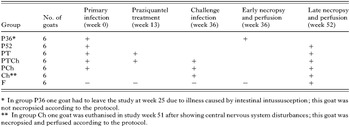
On the basis of initial body weight, the goats were allocated into 7 groups, each of 6 animals, which were treated according to the experimental schedule shown in Table 1.

Weighing, and blood and faeces sampling, were carried out every 2 weeks throughout the experiment. Faecal egg counting, expressed as eggs per gram faeces (epgf) was performed using a modified Bell technique as described by Johansen et al. (1997). Haemoglobin concentrations were determined as described previously (Monrad et al. 1991).
Goats were killed by an intravenous overdose of pentobarbital. On opening the abdominal cavity, gross pathological changes were noted. Prior to killing, heparin (0·25 mg kg−1) was given intravenously in order to prevent blood clotting during the subsequent perfusion of the portal and mesenteric vascular systems for collection of S. bovis worms. Perfusions were performed as described by Johansen et al. (1996a), and the number of worms per animal (males+females+immature worms) was determined.
After perfusion, the liver and the intestinal tract were removed. Representative tissue samples, totalling 20–25 g, were taken from the central and dorsal parts of the liver, and a 10 g sample was taken at pre-determined sites of the duodenum, jejunum, ileum, caecum, and colon. The samples were frozen and later used for determination of egg counts per gram tissue using a KOH digestion technique as described by Bjørneboe and Frandsen (1979). The weights of the liver and the different intestinal sections were determined, and organ-specific total tissue egg counts were calculated.
In all groups, except P36, livers were examined macroscopically and photographed. Hepatic fibrosis was assessed semi-quantitatively. Two types of fibrous changes, i.e. fibrosis affecting the liver diffusely (generalized fibrosis) and multi-focal fibrous scarring, were evaluated separately. Generalized fibrosis was assessed both visually and by the degree of firmness of the liver. A second observer, blinded to the identity and group affiliation of the goats, assessed the degree of fibrous scarring on colour photographs of the parietal and visceral aspects of the entire organ. Both types of lesions were graded as 0=no fibrosis, 1=mild fibrosis (mild generalized fibrosis or presence of 1–2 fibrous scars), 2=moderate fibrosis (moderate generalized fibrosis or presence of multiple fibrous scars), and 3=marked fibrosis (severe generalized fibrosis or marked fibrous scarring). Mean scores for generalized fibrosis and fibrous multi-focal scarring were determined for each group. A few fibrous scars from 4 livers of praziquantel-treated goats were examined histologically.
SAS Version 8(2) (SAS Institute 1999) was used for statistical analysis. Statistical assessment of group mean differences of total tissue egg counts and of total worm counts was carried out by one-way analysis of variance applying the general linear models procedure (PROC GLM/SAS); for total worm counts pairwise comparisons of groups were performed following detection of overall group differences. The female[ratio ]male worm ratios were assessed by logistic analysis, comparing the proportions of female[ratio ]total adult worms for groups P36, P52, PTCh, PCh and Ch (PROC GENMOD/SAS). Comparisons between group means of worm counts was carried out by one-way analysis of variance (ANOVA/SAS). For the comparison PTCh vs PCh-P36 (i.e. the difference between PCh and P36), the ANOVA was followed by a Student's t-test of the hypothesis: H0: μPTCh−(μPCh−μP36)=0. This test used the ANOVA error term (MSe) as estimator of the variance. Longitudinal data on eggs per gram faeces (epgf) and the haemoglobin group means were analysed for relevant periods (weeks 8–12, weeks 14–36 and weeks 42–52) by repeated measures analysis of variance (PROC MIXED/SAS); due to variance instability, individual epgf values were log-transformed prior to statistical comparison of group means. Body weight gains (periods: weeks 0–12, weeks 14–36 and weeks 38–52) of all groups were compared statistically by one-way analysis of variance (PROC MIXED/SAS). In all assessments, P<0·05 was considered statistically significant.
The experiment was designed so as to not cause excessive egg excretion. Thus, the pathogenic effects were minimal and the infection course was generally subclinical. The experiment was approved by the Danish Animal Ethical Committee (Experimental animal permission licence: 1994-101-115).
RESULTS
Faecal egg excretion
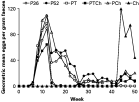
Egg excretion profiles of all infected groups of goats (geometric means) are shown in Fig. 1. Egg excretion was observed in all 5 infected groups from week 6 after primary infection and peaked at weeks 10 to 12, being in the moderate range of 54 to 102 epgf. The statistical comparison revealed no significant differences between the groups. Egg excretion in the untreated, primary-infected control groups (P36 and P52) declined gradually from week 14, to reach a steady low level of less than 10 epgf from week 32 and onwards in group P52; the egg excretion pattern did not differ significantly between these two groups. Praziquantel treatment of groups PT and PTCh at week 13 led to an abrupt decline in egg excretion to <10 epgf in week 14. From week 16 onwards egg excretion was not detected in these treated groups.

Fig. 1. Mean (geometric) faecal egg counts from goats infected with Schistosoma bovis. Group P36: primary infection, necropsy at week 36; P52: primary infection, necropsy at week 52; PT: primary infection, treatment at week 13; PTCh: primary infection, treatment at week 13, challenge at week 36; PCh: primary infection, challenge at week 36; Ch: challenge infection at week 36. Dose at each infection: 800 cercariae.
The challenge control group of goats (Ch) started excreting eggs week 44, i.e. 8 weeks after exposure. Maximum egg excretion and the pattern of subsequent decline were comparable with those observed previously in the primary-infected groups. Challenge infection of primary-infected groups (PTCh and PCh) resulted in an only very moderate increase in egg excretion with the figure never exceeding 35 epgf. The egg excretion in group Ch exceeded significantly that of groups PTCh and PCh during weeks 44 and 46 (P<0·05).
Worm counts
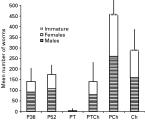
Worm recovery at perfusion is shown in Fig. 2. Moderate and comparable mean worm burdens (±S.D.) of 143±60 and 174±47 were recovered from groups P36 and P52, respectively. The worm burden in the primary-infected and treated group (PT) was very small (4±3), and only male worms were recovered. When comparing groups PT and P52, the worm burden difference was highly significant (P<0·001) with a treatment efficacy of 97·7%.

Fig. 2. Mean number (±S.D.) of mature (male and female), immature, and total number of worms recovered by perfusion of goats infected with Schistosoma bovis.
The worm burden in the challenge control group (Ch) was 289±95, while that in the primary-infected and challenged group (PCh) was 457±107. This difference (mean 168 worms) was significant (P<0·01) and compares well with the number of worms recovered in groups P36 and P52. Thus, the challenge worm infection did fully establish. In contrast, the worm count of group PTCh of 141±98 was significantly lower than that of group PCh-P36, i.e. the difference between the worm burdens of groups PCh and P36 (P<0·05). The mean worm count of group PTCh was also significantly lower than that of group Ch (P<0·05). The number of immature worms was extremely low in all groups (<4% in groups PCh and Ch and <0·4% in other groups), and no statistical differences were noted when comparing the female[ratio ]male ratios of groups P36, P52, PTCh, PCh and Ch (P>0·05 in all comparisons).
Tissue egg counts
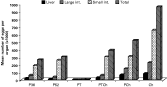
The total tissue egg counts of the liver, small intestine, large intestine, and all tissues combined are shown in Fig. 3. Groups P36 and P52 revealed relatively low and rather similar mean total tissue egg counts (±S.D.) for liver and intestines combined of 265×103±143×103 and 303×103±109×103, respectively. Treatment of group PT goats resulted in a dramatic reduction in the total tissue egg count to only 9169±9040. This reduction was highly significant (Group PT vs group P52: P<0·001). Challenge infection of primary-infected untreated (PCh) and treated (PTCh) groups resulted in an only limited increase in the total tissue egg counts to 514×103±342×103 and 390×103±306×103, respectively. These counts were only moderately higher than those in groups P36 and P52 (no statistical significance). In comparison, the total tissue egg count of the challenge control group (Ch) reached 966×103±506×103 (group Ch vs group PTCh: P<0·01; group Ch vs PCh: P<0·05).

Fig. 3. Mean tissue egg counts (number of Schistosoma bovis eggs per organ) in the small intestine, the large intestine and the liver of infected goats. The total egg load for all three organs is also shown.
Blood haemoglobin concentrations
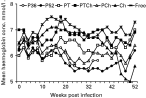
The haemoglobin values are shown in Fig. 4. From around week 8 after infection, moderately declining haemoglobin concentrations developed in the overall group of primary-infected goats (groups P36, P52, PT, PTCh and PCh compiled). Those values differed significantly from the mean haemoglobin values of uninfected goats (groups Ch and F compiled) at weeks 10–12 (P<0·001). This declining trend continued in groups P36, P52 and PCh during the subsequent period (week 14 onwards), whereas treatment of groups PT and PTCh week 13 after infection resulted in increasing values in the latter 2 groups, so that their mean compiled haemoglobin value exceeded significantly that of the non-treated primary-infected groups (P<0·001 for the period weeks 16–36). No reductions in haemoglobin concentrations were seen in response to challenge infection in groups PTCh and PCh (P>0·05 for the period weeks 42–52). In contrast, a marked drop in haemoglobin concentration was seen during the same period in the challenge control group (Ch) resulting in significantly lower mean haemoglobin values in this group than in group PTCh (P<0·01).

Fig. 4. Mean haemoglobin values (mmol/l) of goats infected with Schistosoma bovis (groups P36, P52, PT, PTCh, PCh, Ch – for details see legend of Fig. 1) and of non-infected control goats (group F).
Weight gains
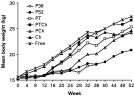
Mean body weights of all groups of goats are shown in Fig. 5. During weeks 2–12 the primary-infected groups (P32, P52, PT, PTCh and PCh) showed significantly reduced growth rate (P<0·05), when compared with the non-infected groups (Ch and F). This relatively slow growth continued in groups P36 and P52 during the subsequent period (weeks 14–36) with an average mean weight gain of around 90 g wk−1 goat−1. In contrast, groups PT and PTCh responded promptly to treatment and achieved a mean weight gain of close to 200 g wk−1 goat−1 during the same period, which was significantly higher than that of groups P36 and P52 (P<0·01), so that the growth rates of the 2 primary-infected and treated groups were subsequently comparable to that of the parasite-free control group (group F).

Fig. 5. Mean body weight of goats infected with Schistosoma bovis (groups P36, P52, PT, PTCh, PCh, Ch – for details see legend of Fig. 1) and of non-infected control goats (group F).
Challenge infection of primary-infected, treated (PTCh) and of primary-infected, non-treated (PCh) groups of goats did not affect their growth rate. This contrasts with the picture in the challenge control group (Ch) which, from week 6 after infection, experienced an average weight loss of around 300 g wk−1 goat−1, a difference which was significant in comparison with group PCh (P<0·001), group P52 (P<0·05) and the parasite-free control group (P<0·01). During weeks 34–52 there was a tendency for group PCh to grow faster than the primary control group (P52), but this difference was not statistically significant (P>0·05).
Liver pathology
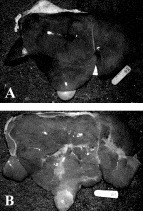
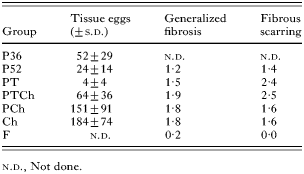
Liver fibrosis was present in all infected groups (Table 2) and most often occurred as a combination of generalized fibrosis and multi-focal fibrous scarring. The degree of generalized fibrosis varied greatly within groups. Liver fibrosis was still present up to 52 weeks after primary exposure (P52) but this group had the lowest mean scores for both generalized fibrosis and fibrous scarring when comparing all groups (Fig. 6A).

Fig. 6. Parietal aspects of livers from Schistosoma bovis-infected goats. (A) Mild fibrous scarring (grade 1). (B) Marked fibrous scarring (grade 3).
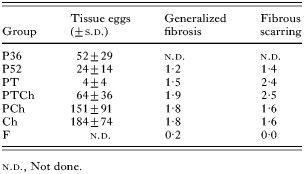
Fibrous scarring was prominent in both treated groups. Thus, groups PT and PTCh had higher mean scores for fibrous scarring than the untreated primary infected group (P52) and the untreated, primary infected and challenged group (PCh). Of all groups, group PTCh had the highest percentage (66%) of livers with marked (grade 3) fibrous scarring (Fig. 6B). Challenge infection of the non-treated primary-infected group (PCh) resulted in liver fibrosis scores comparable to those of group Ch. Histopathological examination of a fibrous scar from a liver of group PT revealed 2 sites with a granulomatous reaction around necrotic and mineralized material with adjacent schistosome pigment, consistent with material of dead worms.
DISCUSSION
Previous parasitological studies on the S. bovis/goat model have focussed on single or repeated infections of up to 34 weeks duration. Those studies showed that West African Dwarf goats suppress a primary infection and develop strong resistance to reinfection, mediated primarily through an anti-fecundity effect (Monrad et al. 1991, 1995; Johansen et al. 1997). Regulation of egg excretion through fecundity depression is a feature shared particularly by infections with S. bovis and the closely related human species Schistosoma haematobium. Circumstantial evidence indicates that the phenomenon is immune-mediated and studies on various species have demonstrated anti-fecundity effects of immunization against schistosome glutathione-S-transferase enzyme (Agnew et al. 1992, 1996; Bushara et al. 1993; Boulanger et al. 1999). Very little is known regarding patterns of resistance in older and more chronic infections that are common in ruminants under field conditions (Taylor, 1987). This knowledge gap was addressed in the present investigation, in which, for the sake of comparison, similar overall experimental designs, treatment regimens, goat descent and parasite material were used as in our earlier studies (Monrad et al. 1991, 1995; Johansen et al. 1997) using this model.
Previous studies have shown a strong regulatory response in goats with a moderately heavy primary S. bovis infection, revealed by a markedly reduced faecal egg excretion after a peak level 8–12 weeks after exposure (Johansen et al. 1997). This was confirmed in the present study which furthermore showed that egg excretion was persistently suppressed for up to 52 weeks, remaining consistently low (<20 epgf). However, anaemia and poor weight gains persisted throughout this long time-course, indicating that no protection seems to develop against clinico-pathological consequences of infection. An earlier study of S. bovis-infected goats showed no attrition of the adult worm population between the 16th and 32nd week of infection (Johansen et al. 1997). Our present results, showing comparable worm burdens at weeks 36 and 52, indicate a remarkable longevity of the schistosome populations. All observations, including those on tissue egg counts, indicate that the regulatory anti-fecundity response to primary infection persists also in a very late and chronic stage of infection.
It was earlier shown that resistance to challenge infection, again expressed through an anti-fecundity effect, is marked in goats when the time-interval between primary and challenge infection is up to 16 weeks (Johansen et al. 1997). The present study demonstrated the same effect, also when challenge was delayed until the primary infection was 36 weeks old. The challenge infection established fully, but its egg production was markedly diminished, and the goats showed normalizing weight gains and haemoglobin values. It thus appears that in goats, the degree of chronicity of S. bovis infection is not an important factor for resistance to challenge infection.
Johansen et al. (1996a) demonstrated that praziquantel treatment of a 13-week-old S. bovis infection resulted in an almost 100% reduction in worm counts. This finding was confirmed in the present study in which the treatment efficacy was as high as 97·7%. However, this investigation, which covered an extended post-treatment time-period, also proved the beneficial long-term treatment effects, using weight gain and haemoglobin values as parameters. In addition, the almost complete anthelminthic elimination of the primary infection in week 13 did not diminish the ability of the goat to develop a marked resistance to challenge infection week 36. The resistance is in our study again apparently expressed through an anti-fecundity effect. However, the data on worm burdens actually indicate that a partial anti-worm effect may contribute, since the challenge worm burden following praziquantel-eliminated primary infection (group PTCh) was significantly reduced in comparison with that of the challenge control group (Ch) and also in comparison with the difference between the worm burdens of the primary-infected and challenged group (PCh) and the primary control group (P36), i.e. the estimated net challenge worm burden of group PCh.
Several immuno-epidemiological studies indicate that chemotherapy influences resistance also in human schistosomosis, conferring augmented protection to reinfection after chemotherapy, associated with altered immune responses (Hagan et al. 1991; Roberts et al. 1993; Medhat et al. 1998; Karanja et al. 2002). Bushara et al. (1983) studied ‘naturally S. bovis-resistant’ cattle, showing that praziquantel therapy did not abolish resistance to challenge. Though the results of that investigation are in agreement with ours, the results are not really comparable since, in their study, challenge infection was given in multiple doses, the cattle harboured most likely a minor worm burden before treatment, and the time-intervals between treatment and challenge were quite different. Both duration of infection prior to treatment and the interval between treatment and homologous challenge were shown to influence the degree of resistance to challenge in Schistosoma mansoni-infected mice (Tawfik and Colley, 1986).
The previous study of praziquantel treatment of S. bovis-infected goats by Johansen et al. (1996b) showed enhanced liver fibrosis 4 weeks after chemotherapy, with prominent fibrous lesions, obviously induced by inflammatory destruction of killed worms carried to the liver in response to treatment. In the present study we demonstrate that enhanced post-treatment fibrosis can be present for at least 39 weeks. Our evaluation of fibrosis differentiated between 2 types of lesions, i.e. generalized fibrosis and multi-focal fibrous scarring. Although the results indicate that fibrous scarring was a characteristic feature post-treatment, no negative effects of liver lesions were reflected in weight gains of treated goats.
The active inflammatory response to worm residues found in scar tissue of one liver of the primary-infected, treated group, indicates the relationship of the scars to dead worms as seen early after treatment (Johansen et al. 1996b). Obviously, cellular inflammatory reactions may persist as late as 9 months post-treatment. The findings are of interest based on recent hypotheses that protective immune responses after therapy in human schistosomosis may result from exposure to antigens released from dead worms in response to treatment (Woolhouse and Hagan, 1999; Mutapi, 2001).
Our results provide ample evidence that the earlier demonstrated marked resistance to both primary and challenge infection in newly established S. bovis infections will even persist in older and more chronic infections, with anti-fecundity as the key effector mechanism. Another key finding is the demonstration that resistance to challenge infection is not abolished by anthelminthic elimination of the primary S. bovis infection, using praziquantel; in fact, such elimination appears to enhance the degree of acquired resistance. This shows that neither presence of adult worms nor tissue deposited live eggs are required for acquisition of resistance. Furthermore, it indicates that praziquantel treatment of young domestic stock might be a relevant and sustainable approach in anthelminthic-based treatment and preventive programmes.
This study was supported by the Danish Centre for Experimental Parasitology (DCEP) under the auspices of the National Research Foundation and by the Danish Bilharziasis Laboratory (DBL). Statistical expertise kindly rendered by Stig Milan Thamsborg, Niels Kyvsgaard and Ulf Olsson is highly appreciated; the same applies to the skilled laboratory assistance rendered by Susanne Kronborg, Pernille Strom, Annette Pedersen, Tina Skov and Margrethe Pearmann.