In 1875, the young poet Alice Thompson (soon to be Alice Meynell) published Preludes (1875), a slender volume of lyrics illustrated by her sister, Elizabeth. Given the professional musical training of the Thompson women,1
Mrs. Thompson, neé Christina Weller, was a concert pianist who gave up her career, much to her parents' regret, on her marriage to Thomas James Thompson. Both daughters received serious, sustained musical training.
What was Meynell's Preludes a prelude to? We know, in retrospect, that it was not a prelude to a long, distinguished career as a poet, for Meynell soon ceased writing verse and turned instead to prose, becoming the most important woman essayist of the late nineteenth century; as Joanne Shattock notes, in a typical assessment of her career, Meynell was “an accomplished essayist, her work at its best equal[ing] that of Virginia Woolf in its range, poise, and style” (292). However accurate this retrospective judgment, it cannot account for Meynell's ambitions – or poetry's possibilities – in 1875 when “A. C. Thompson” entered the field. What was it like to be a young woman poet in 1875 – fifteen years after Elizabeth Barrett Browning's death, a dozen after Christina Rossetti's Goblin Market and Other Poems, less than a decade after Swinburne's Poems and Ballads? To explore the ambitions and ambivalences of the Preludes, this essay pursues these questions: What lyric traditions did Meynell embrace or reject or revivify? With what women's traditions did she affiliate (or de-affiliate) herself? What future did she imagine for her own – and modern – poetry?
In her maturity Meynell dismissed the Preludes as unimportant, saying: “My first book of verse was accepted by a publisher only because my elder sister, who had just made a great reputation as a battle-painter, was kind enough to illustrate it” (Badeni 52). Her daughter, Viola Meynell, reported that her mother would never acknowledge the merit of these early poems: “Hardly without a feeling of treachery can a member of her family pronounce their achievement already fine, so thorough was her own repudiation of them later,…[f]or in maturity she liked in her own work only that which had more compact thought in it” (54). We might be tempted to explain Meynell's dismissal of her early work in terms of the archetypal encounter of young woman artist with severe male critic – in this case, with Coventry Patmore, who later praised her prose but said of her poetry “that though it was true, beautiful, and negatively almost faultless, it did not attain the classical and only sound standard” (Badeni 72). (At least the severe male critic was not John Ruskin, who admired the volume and singled out a “Letter from a Girl to Her Own Old Age” for special praise.2
Ruskin also praised “San Lorenzo's Mother” and “To a Daisy,” saying that the poems “have done me more good than I can well thank you for” (qtd. in Viola Meynell 51–52).
Alice Meynell's disavowal of her Preludes derives, I believe, from a sense that the poems were not what they claimed – or she hoped – them to be: that is, not preludes to a future of verse, her own or women's more generally. The volume suggests an ambivalence about the direction her poetry would take, about its relation to a nineteenth-century women's lyric tradition, as well as to the poetry of male predecessors and contemporaries whom she admired. In making this argument, this essay provides a historical perspective on a debate that has recently emerged about Meynell's poetry – whether it is best read with a women's tradition of Sapphic verse, as Angela Leighton suggests, or whether it should be de-segregated and read alongside the work of her male contemporaries, as Maria Frawley argues (Leighton 244–65, Frawley 62–76).3
Taking a different approach, Schaffer suggests that Meynell manipulated masculine and feminine elements of her public persona – an argument that complements mine, except that I believe Alice Thompson to have been uncertain about her poetic alignments in 1875.
The Woman Poet and the Romantic Nature Tradition
Meynell's ambivalence emerges in the opening poem, “In Early Spring.” The poem begins with an apostrophe and a lyric “I” – “O Spring, I know thee!” – and then catalogues the delights of spring that the nature poet knows: “the yet/Leaf-folded violet,” “The cuckoo's fitful bell,” the “wild hedge-roses” of June, the “songs yet half devised” of the “wild birds silent yet,” and so on (1–2).4
All citations will be to Preludes (1875), with significant variants from the complete edition, Poems of Alice Meynell (1940), noted. Many poems in the original Preludes included epigraphs not reprinted in later editions, including the Poems: Collected Edition (1913) published during Meynell's lifetime.
The poet mused upon the dusky height,
Between the stars towards night,
His purpose in his heart. I watched, a space[.] (27–29)
The break is both grammatical and spatial, with the final twelve lines set off from the first twenty-six. The “I” emerges as an on-looker, not the lyric poet herself but someone who watches for “The meaning of his face,” “the secret…/ Hid in his grey eyes” (29, 31, my italics). The disjunction between the “I” and the “he” signals an uncertainty about inhabiting the lyric voice. It suggests that the young woman writing cannot imagine herself as a poet in the Wordsworthian tradition, that there is a secret in the nature poet that she cannot fathom and that she can represent this sort of poet only with the pronoun “he.”
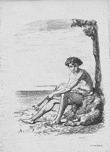
Meynell's uncertainty may well reflect her appreciation of, yet acknowledged alienation from, a major tradition of Romantic lyric. As Margaret Homans has argued in Women Writers and Poetic Identity, Romantic nature poetry utilizes (perhaps strategically creates) a gendered binary, a separation of the male poet from the natural world, the lyric “I” from the feminine object, Mother Nature. Even as a young poet, Meynell may have felt the difficulty that Homans describes as inhibiting other nineteenth-century women writers: “her association with nature and her exclusion from a traditional identification of the speaking subject as male” (12). Elizabeth Thompson's frontispiece to the volume underscores this exclusion: the pastoral poet she depicts is unmistakably male, displaying well-muscled calves and thighs as well as oaten flute, and clad only in a loin-cloth (Figure 1).5
In illustrating the opening poem, Elizabeth Thompson was influenced by its epigraph from Victor Hugo: “L'ocean connu, l'âme reste a sonder,” as Gray notes at the Meynell website. The epigraph does not necessitate a male poet, however.

Elizabeth Thompson, frontispiece illustration for Preludes by A. C. Thompson. (London: Henry S. King, 1875.) Courtesy of Sterling Memorial Library, Yale University.
Alternatively, the opening lyric of Preludes may signal the burden of the past that any young poet feels when beginning a literary career. As the speaker of “In Early Spring” admits after cataloguing the season's delights:
But not a flower or song I ponder is
My own, but memory's.
I shall be silent in those days desired
Before a world inspired. (21–24)
These lines, which appear just before the shift from the lyric “I” to the descriptive “he,” suggest that the celebration of spring is derivative, that its representations come not from nature but from literary tradition. The speaker registers, too, the difference between the “sweet surprise” of spring in “the young children's eyes” and the knowledge of spring in the older poet's experience: “I have it all by heart” (1–2, 16). The opening lyric is thus, more generally, a meditation on the richness of the poetic past and the difficulty of imagining an original poetry of the future. It recognizes that the things of earth are, poetically speaking, well known:
O all brown birds, compose your old song-phrases,
Earth, thy familiar daisies! (25–26)
In this recognition Meynell joins other Victorian poets who felt the burden of the past – from Tennyson's doubt in In Memoriam (“What hope is here for modern rhyme?” [sec. 77]) to Swinburne's Sapphic (re)possession in “Anactoria” (“Men shall not see bright fire nor hear the sea, / Nor mix their hearts with music…But…Memories shall mix and metaphors of me” [204–05, 210, 214]).
Meynell's uncertainty in this opening lyric encompasses more than Wordsworthian – or nature – poetry per se. For as she commented in later life, in her youth “Wordsworth's poetry was the normal poetry par excellence” (Badeni 36). Thus to register a difficulty in writing Wordsworthian or nature poetry was to acknowledge a difficulty in writing poetry in the “normal” nineteenth-century vein.
We can infer, moreover, from other poems Meynell wrote during the late 1860s or early 70s but excluded from Preludes, that she pondered long and hard about the burden of the past for the modern poet. In “Singers to Come,” omitted from the volume but published soon after in the Irish Monthly in 1876, she begins with a seemingly unanxious relation to tradition and an optimistic vision of future poets:
No new delights to our desire
The singers of the past can yield.
I lift mine eyes to hill and field,
And see in them your yet dumb lyre,
Poets unborn and unrevealed. (Poems 1940, 1–5)
This poem confidently portrays her own role in shaping the future, in that she sees herself, the lyric speaker, as a forward-looking counterpart to “the maid who found, / And knelt to lift, the lyre supreme / Of Orpheus from the Thracian stream” (21–23). Whereas this maid of classical mythology merely preserved the Orphean lyre from destruction, unable to create her own poetry –
She bears it in her wanderings
Within her arms, and has not pressed
Her unskilled fingers but her breast
Upon those silent sacred strings. (26–29)
– the skilled modern woman poet, “clasp[s] mystic strings at rest,” and finds in her modern world “a more mysterious lyre.” The ending of “Singers to Come” associates Meynell with the origins of lyric in Lesbos, home of the poets Terpander, Arion, Sappho, and Alcaeus (in Greek myth, the head of Orpheus drifted to the isle of Lesbos and was buried there), but without anxiety about the impossibility of modern achievement in the face of past glory. “Singers to Come” ends without achievement, but with confidence: 6
Despite this confidence, I would note that the final lines recall Swinburne's more intense version of Sappho's domination of nature through lyric – and thus the lines themselves are derivative of another poet.
For I, i' the world of lands and seas,
The sky of wind and rain and fire,
And in man's world of long desire –
In all that is yet dumb in these –
Have found a more mysterious lyre. (Poems 1940, 31–35)
This poem was nonetheless excluded from Preludes, whether as too self-asserting or too self-conscious of its calling. So, too, was “A Song of Derivations,” also written in the 1870s but omitted from the volume. In this “Song” Meynell writes more ominously of poetry as possession: “Voices, I have not heard, possessed / My own fresh songs” (16–17). The past has the capacity to enrich modern poetry, making immortality possible through poetic tradition:
…my thoughts are blessed
With relics of the far unknown.
And mixed with memories not my own
The sweet streams throng into my breast. (17–20)
Yet, as the concluding lines suggest, consciousness of the past carries a burden, what we have come to call “the anxiety of influence.” The mingling of “the past poets of the earth” with “my own fresh songs” inhibits or weighs down the young poet: “Heavily on this little heart / Presses this immortality” (24–25). The achievement, the “immortality,” of prior poets diminishes the speaker. Is her heart “little” because it is young or because it is female (and implicitly lesser and more fragile)? Is the difficulty gender, or generic tradition, or both?
Meynell's Lyrics and the Nineteenth-Century Women's Sapphic Tradition
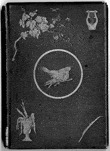
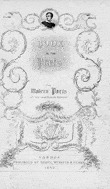
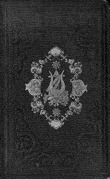
Like the poem with which Preludes opens, the volume itself, in its material and symbolic form, is burdened with the weight of poetic tradition. The cover displays five symbols: the lyre, the pen, the acanthus, the urn, and two turtle-doves (Figure 2), the first two representing modes of literary production, the second two, symbols of the arts and artistic achievement (Seaton 168–69). All four appear commonly on covers, title pages, and frontispieces of lyric volumes published in the 1820s through 1850s. The fifth derives from the “voice of the turtle” in the Song of Songs, and is special, if not unique, to the cover of Preludes.7
Song of Songs 2: 12 (KJV): “The flowers appear on the earth; the time of the singing of birds has come, and the voice of the turtle is heard in our land.” It is tempting to think that Meynell knew the fourth sonnet of Christina Rossetti's Monna Innominata in manuscript, particularly the lines “I loved you first: but afterwards your love / Outsoaring mine, sang such a loftier song / As drowned the friendly cooings of my dove” (1–3). She could not have read them in print, as Rossetti's sonnet sequence was published six years after Meynell's Preludes.

Cover for Preludes by A. C. Thompson. (London: Henry S. King, 1875.) Courtesy of Sterling Memorial Library, Yale University.
The cover symbols pose a question, perhaps unintended, about Meynell's alignment with women's poetic traditions, especially with the dominant nineteenth-century tradition of “creative but suffering femininity” (265), as Angela Leighton phrases it.8
As the title of her book suggests, Leighton sees all Victorian women poets as, in some way, resisting this tradition. In her treatment of Meynell, she focuses not on Preludes but on later poems about motherhood that “issue a quiet challenge to the still-standing icon of the sublime Madonna” (265).
For the other discussions and illustrations, see Prins, 174–245, and Lipking, 1–31.

Title page for Book of the Poets. (London: Scott, Webster & Geary, 1842.) Courtesy of Sterling Memorial Library, Yale University.

Cover for The Poets and Poetry of England in the Nineteenth Century, ed. Rufus Wilmot Griswold. (Philadelphia: Carey and Hart, 1846.) Courtesy of Sterling Memorial Library, Yale University.

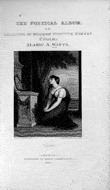
Title page for The Poetical Album, ed. Alaric Alfred Watts. (London: Hurst, Chance, 1830.) Courtesy of Sterling Memorial Library, Yale University.
About this women's tradition Meynell was ambivalent. When she resolved in her late teens to work at her poetry, she wrote in her diary: “I must try to cultivate that rhyming faculty again which I used to have, if it is not quite gone from me. But whatever I write will be melancholy and self-conscious as are all women's poems” (Badeni 29)10
Badeni cites a ms. diary at Greatham, qtd. here and elsewhere in this article.
Perhaps to resist this fall, Meynell omitted two of her most intense lyric laments – the sonnet “Renouncement” and the three-stanza “After a Parting.” Dante Gabriel Rossetti (who read the first in manuscript and memorized it) judged it to be “one of the three finest sonnets ever written by women” (Meynell, Poems 211, n. 69).11
According to the notes, “Renouncement” was first printed in Hall Caine's Sonnets of Three Centuries (1882).
I must not think of thee; and, tired yet strong,
I shun the thought that lurks in all delight –
The thought of thee – and in the blue Heaven's height,
And in the sweetest passage of a song. (1–4)
“After a Parting,” also omitted, similarly turns from earthly love “heavenward”:
Farewell has long been said; I have foregone thee.
I never name thee even.
But how shall I learn virtues and yet shun thee?
For thou are so near Heaven
That Heavenward meditations pause upon thee.12
Badeni reads “Parted” and “After a Parting” biographically, as “inspired by the separation from her Jesuit friend” (40).
These suppressed lyrics, as well as other 1869 poems in manuscript, especially the sonnet “To the Reader who Should Love Me,” suggest that Alice Thompson was writing, whether inevitably or not, in the nineteenth-century Sapphic tradition, and that this was her strong suit.13
See also the sonnet “To the Reader who Should Love Me,” published in The Poems of Alice Meynell (1940) from a ms. dated 1869.
Even with the omissions of these key poems, many of the lyrics in Preludes join the Sapphic strain. “Parted,” the second poem of the volume, begins as a muted Sapphic lament:
Farewell to one now silenced quite,
Sent out of hearing, out of sight, – (1–2)
Another of the lyrics written after Alice's separation from Father Dignam, this poem attempts a swerve away from a feminine lyric lament to a Wordsworthian Lucy poem. Despairing of consolation, the speaker reminds herself of the natural pleasures left to her – “The morning crowns the mountain-rim; / Joy is not gone from summer skies” (17–18) – and then, in a gesture repeating Wordsworth's in “Three Years She Grew,” recalls her lost beloved's presence in nature, though removed from her sight:
He is not banished, for the showers
Yet wake this green warm earth of ours.
How can the summer but be sweet?
I shall not have him at my feet,
And yet my feet are on the flowers. (21–15)
Meynell's swerve here – away from the Sapphic lament and toward a masculine tradition – is typical throughout Preludes; many other poems – indeed, the most critically acclaimed of her lyrics – participate in the Sapphic tradition but disguise their affiliation.
This disguise takes various forms – from the placement of the poems, to their epigraphs, to the self-conscious allusions within them. For example, “To the Beloved Dead,” subtitled “A Lament,” imagines the woman poet's body as a lyre, awaiting a “pulse” at “windy dawn,” or “a strain of thee from outer air,” to move her “lonely soul” to music (18–19, 20–21). “Sonnet,” re-titled “A Shattered Lute” in the collected Poems, continues the theme of the silent lute, of the abandoned poetess who stands “as mute / As one with full strong music in his heart / Whose fingers stray upon a shattered lute” (13–14) – a theme invoked in the English Sapphic tradition by Mary Robinson, Laetitia Landon, Christina Rossetti, and others. Yet these two lute poems are separated in the volume, a choice that lessens their combined Sapphic impact. The second sonnet, moreover, carries an epigraph from Petrarch – “Senza te son nulla” (“who without you am nothing”) from Petrarch's canzone 359 – to suggest not an English and feminine, but an Italian and masculine source. Like the epigraph to “Parted” – “Come vedi, ancor non m'abbandona” (“As you see, [Love] has still not abandoned me”) from Dante's Inferno – the allusion to a male poet suggests Meynell's unwillingness to place her verse within a women's tradition, and her desire rather to see it as participating in a major western literary tradition.
Other poems in Preludes extend the Sapphic mode but align themselves with contemporary European male poets. Taking its epigraph from Victor Hugo, “Alors je te plaindrai, pauvre âme” (“Well, I pity you, poor soul”), “In Autumn” reflects on the “dead delights” of “That tuneful Spring,” and the sad knowledge that “his heart has beat to bright / Sweet loves gone by” (33–34, 16–17). “A Tryst that Failed” cites Alfred de Mussett: “Ce pauvre temps passé” (“That sorry time gone by”). These epigraphs seem unnecessary, even superficial, in that neither Hugo's nor de Mussett's verse is deeply relevant to the poems.14
Victor Hugo's poetry was deeply meaningful to Meynell personally, as she explains in her essay “Poetry and Childhood” (Poetry and Prose 137–41), but it is difficult for the reader to grasp its significance. This too-private significance may be one reason Meynell removed the epigraphs from later published volumes.
Perhaps, in her epigraphs to male poets, she wished to make a critical point about the genre and history of the love lament. In addition to its Dantean source, “Regrets” alludes to the contemporary poetry of male writers – to Leigh Hunt's The Story of Rimini (1816) and Matthew Arnold's “Marguerite” poems (1853), as Meynell uses the ebbing tide as a vehicle for expressing the slow, painful, but inevitable process of loss:
As when the seaward ebbing tide doth pour
Out by the low sand spaces,
The parting waves slip back to clasp the shore
With lingering embraces,
So in the tide of life that carries me
From where thy true heart dwells,
Waves of my thoughts and memories turn to thee
With lessening farewells[.] (1–8)
By displaying the poetic interchange with the “ebb and swell” of feelings in Arnold's “Isolation: To Marguerite” and the “enclasping flow” of “To Marguerite–Continued,” as much as to the Sapphic laments of Laetitia Landon or Felicia Hemans, Meynell suggests that passionate longing and loss appear as much in manly poetry as in feminine.15
Badeni convincingly pursues this reading (40–41, 48–50), using Meynell's diaries as well as poetry.
If Meynell's ambition in Preludes was to represent a wide variety and vividness of mood, and to demonstrate her competence in playing variations on the themes of other poets, then these poems in a minor key represent the sad and mournful tones of lyric, much like Chopin's preludes in E minor or the finale in D minor. Yet the epigraphs and allusions to male poets in Preludes are a double-edged sword. With them, Meynell limits the Sapphic presence in her inaugural volume, as if the young poet wished not to be known as a poetess, as if her ambition reached beyond the “melancholy,” “self-conscious” poems that she thought “all women” could write. Yet her attempts at affiliations with other poets make her work seem secondary, subject to the influence of eminent (or currently prominent) male poets.
Sharon Smulders has suggested that, by the 1890s when she wrote “The Shepherdess,” Meynell had found a “creative response to the problem of gender and genre”: by “parodically engag[ing] the conventions of lyric verse” of male poets (in this specific case of Wordsworth and Byron), she could also “accommodate a distinctly feminine perspective” (35). In 1875 Meynell does not yet employ this “creative response.” Parody – or the technique Antony Harrison has identified as “reinscription” of “specific texts…with clearly defined significance for their culture in order to subvert the accepted interpretation of those texts” (2) – is largely absent from the Preludes.16
There are hints of what Smulders calls parody, Harrison reinscription, in Meynell's rewriting of Wordsworth in “To a Daisy” (discussed below), but aimed at Wordsworth's natural philosophy.
Preludes and the Future of Meynell's Verse
A prelude is an introductory piece, anticipating a longer, more substantial work. What did the Preludes anticipate? To what new form of, or direction in, lyric poetry did Meynell's ambition reach? Coventry Patmore thought to the grotesque rhythms of Robert Browning, which he urged her to excise or revise; certainly, Meynell admired “Love among the Ruins” and “At [By] the Fireside,” which she thought “the loveliest things that Browning ever wrote,” and she later praised his “difficulty of thought,” which she considered “the very heart of poetry.”17
For her admiration of Browning, see her letter of 23 January 1877 to Wilfrid Meynell (Badeni 65), as well as her essay “Robert Browning” (Poetry and Prose 93–97), originally published in The Pen (1880).
To that prior generation of women poets, the writing of male predecessors and contemporaries posed a challenge. To Rossetti, the celebrated, inaccessible Beatrice of Dante's Vita Nuova and Laura of Petrarch's sonnets had provoked a desire to let the lady speak for herself, to create “an inimitable ‘donna innominata’ drawn not from fancy but from feeling, and worthy to occupy a niche beside Beatrice and Laura” (294). To Aurora Leigh, the treasure trove of her father's books, “the secret of a garret-room” (1: 833), provoked the question:
My own best poets, am I one with you,
That thus I love you, – or but one through love? (1: 881–82)
What was Alice Thompson's response to these (masculine) traditions of lyric and epic? Did she imagine herself as one with her own best poets? Was her ambition to create a voice for herself and for silenced women?
For her sister Elizabeth Thompson, today known as Lady Butler, a painterly genre unbreached by a woman artist presented a challenge. Elizabeth took up battle painting and produced Missing for the 1873 Royal Academy Exhibition, her more famous The Roll Call for the 1874. The latter took the public by storm: “The crowds before the picture were so great that a policeman had to stand there to control them; and the newspapers made much of the young female artist who had painted so terrible a scene of war” (Badeni 51). Elizabeth was called an Amazon, both for her interest in war and for her entry into masculine territory. The Prince of Wales singled out her Roll Call as “deserving of the highest admiration.” “Amazon's work this; no doubt about it” was Ruskin's tribute (see Usherwood and Spencer-Smith, 16, 22–23).
Alice Thompson, in the same period, articulated feminist views in her diary. Her biographer June Badeni quotes a stirring passage, in the spirit of Brontë's Jane Eyre, in which Alice compares the possibilities for young men and women:
Answer O World, man-governed, man-directed, answer for the sanity of your laws and your morals. Of all the crying evils in this depraved earth, ay, of all the sins of which the cry must surely come to Heaven, the greatest, judged by all the laws of God and of Humanity is the miserable selfishness of men that keeps women from work…. A girl may go mad with her own soul over needlework, but she could not do so at college, or studying for the bar or for a civil service examination. That is what I demand for myself and my sisters. (Badeni 28)
Despite this private feminist outburst, in Preludes Meynell seems uninterested in breaching walls forbidden to women poets or in pursuing “things unattempted yet in prose or rhyme” (Milton, Paradise Lost, Book I, l. 16). There may be a generational factor involved here. Mid-Victorian women poets like Barrett Browning and Christina Rossetti made it part of their poetics, and often their politics, to reform what they considered weaknesses in the women's lyric tradition before them – hence such poems as Barrett Browning's “L. E. L.'s Last Question” and Rossetti's “L. E. L.,” in which the female poet both praises and critiques her predecessor. The mid-Victorian poets also felt obliged not just to engage the work of their male predecessors but to improve on it – hence Barrett Browning's vision of modern epic in Aurora Leigh: “Never flinch, / But still, unscrupulously epic, catch / Upon the burning lava of a song / The full-veined, heaving, double-breasted Age” (5: 213–36).
Elizabeth Thompson, the painter, was in a parallel position in terms of the pro-fessionalization of the Victorian woman artist. She trained before the Slade School had been founded and when the Academy Schools took only a very few women students (Usherwood and Spencer-Smith, 19–20). When she took up battle-painting, it was not just a personal quirk but a political intervention on behalf of women artists. Alice Thompson, the poet, entered a profession (or embraced a vocation) that had made those poetic and political interventions a generation earlier. Perhaps, in 1875, there was less need for her and her female contemporaries to struggle with her male poetic predecessors.
Or perhaps in her inaugural volume Meynell blunted her revisionary engagement with masculine poetry by being (in Barrett Browning's terms) too scrupulous – a point worth note before exploring other explanations. A significant number of poems in Preludes seem appreciative of, or merely expansive on, the work of male poets, without suggesting a new direction for her own poetry. In “The Spring to the Summer: A Poet Sings to Her Poet,” with its Dantean epigraph (“I miei desiri Che te menavano,” “My desires, which led you”), Meynell celebrates Dante and invokes his blessing:
O Poet of the time to be,
My conqueror, I began for thee.
……………………….
Take thou the parable of my days;
I trust thee with the aim of all. (1–2, 9–10)
In “At a Poet's Grave,” she celebrates Keats and the Truth manifest to the immortal dead, “Meanings beyond the deepest poet's heart” (l. 8). In the sonnet, “Spring on the Alban Hills,” with its Shelleyan epigraph (“Silent with expectation” from “Adonais”), she again celebrates Keats as she recalls her own youthful days in the Roman campagna and at Keats's Roman grave. In the sestet, Keats remains a mystery – “I fain would put my hands about thy face” (l. 9) – and Meynell cannot penetrate his secret: “I touch not this day's secret, nor the thing / That in the silence makes thy soft eyes wild” (13–14).
Imitation and appreciation are, arguably, normal stages in literary development. Tennyson's juvenilia is littered, as the notes in Ricks's edition attest,18
In Illustrations of Tennyson Collins makes a similar point about all of Tennyson's poetry, not just his youthful verse.
Frawley makes a version of this argument and connects it with “emerging modernist interests in psychology” and “interiorization as a technology of knowledge” (63).
Meynell's “To a Daisy” provides a telling example. The sonnet imitates and comments on Wordsworth's “To the Daisy” and “To the Same Flower”; in Harrison's terms, it “reinscribes” a “culturally resonant text” in order to revise its meaning (2). In “To the Daisy” Wordsworth had derived from the flower “Some steady love; some brief delight; / Some memory that had taken flight; / Some chime of fancy wrong or right; / Or stray invention” (45–48) – that is, what his fancy pleases. In “To the Same Flower” he again used the daisy to exercise his poetic fancy:
Oft on the dappled turf at ease
I sit and play with similes,…
And many a fond and idle name
I give to thee for praise or blame. (9–12)
Then follows a catalogue of fanciful possibilities: “A nun demure of lowly port; / Or sprightly maiden, of Love's court,…A queen in crown of rubies drest; / A starveling in a scanty vest; / Are all, as seems to suit thee best, / Thy appellations” (17–24). Meynell's “To a Daisy” refuses to exercise poetic fancy in this mode; it remains content to acknowledge that the daisy, “slight as thou art,” hides “secrets” (l. 1). In its final lines, the “I” “abides” to watch the daisy “grow and fold and be unfurled “:
Literally between me and the world.
Then I shall drink from in beneath a spring,
And from a poet's side shall read his book. (10–12)
Here, as in other nature poems, the female poet seems to displace the work of nature poetry onto the male poet and “his book” – to be a reader of verse, not a writer.
However, the refusal to repeat Wordsworth's act of fancy carries with it an implicit critique, as the critic Richard Le Gallienne noted when he praised Meynell's “Daisy” and compared it favorably to Wordsworth's, which he thought had a “somewhat aimless aim” and took “several ‘shots’ [that] resulted in several charming but comparatively superficial reflections” (I, 204).20
Le Gallienne's review, dated 1892, praises Meynell's verse, yet undermines this poem somewhat when he adds that this is “the same transfiguration of the unit by the absolute as Tennyson's vision of the ‘Flower in the crannied wall’” – a comparison that makes Meynell's poem secondary to Tennyson's (203–04).
The reservations about Wordsworthian nature poetry surface again in “To A Poet” (retitled “To Any Poet” in later volumes). In this poem Meynell characterizes the poet “who singest through the earth” (l. 1) as one whom “unfallen Nature” (l. 7) dumbly defies:
Sing thy sorrow, sing thy gladness,
In thy songs must wind and tree
Bear the fictions of thy sadness,
Thy humanity.
For their truth is not in thee. (16–20)
The revelations of the nature poet are, in fact, fictions; the truth of Nature, her secrets and “silent labour,” become available only after death:
Nought will fear thee, humbled creature.
There will lie thy mortal burden
Pressed unto the heart of Nature,
Songless in a garden,
With a long embrace of pardon. (41–45)
This critique of nineteenth-century nature poetry – that it fails to penetrate the veil – suggests an alternative to two other positions represented in 1875: Swinburne's agnostic insistence that nature is empty, without spiritual meaning, resulting in what Susan E. Lorsch has called his “language of negation” (51) and Anna Mary Howitt Watts's spiritualist belief, expressed in Aurora (1875), that the eternal Truth comes to those who listen to “Nature's Psalmist”:
“They alone serve Truth,” sings the holy Bird,
“Who, awaiting ever his blissful call,
At midnight arise their loins to gird,
Reckless if sorrow or pain befall;
Lo! it cometh, it cometh, the call of God,
To every Flower that springeth from Earth,
To every creeping worm of the sod,
To every Creature of mortal birth.[”] (18)21
Both Preludes and Aurora were published in the same year by the same publisher, Henry S. King.
Meynell allows neither nature's emptiness, “no transparent rapture” in Swinburne's phrase, nor human access to the “wild strains of music echoing back from hill and dale,” in Anna Watts's. But neither does “To A Poet” allow much possibility for the future of nature poetry. It ends in “Silence, the completest / Of thy poems, last and sweetest” (49–50).
It seems ironic, at least from a modern perspective, that Meynell's critical intelligence should have caused an ambivalence, in Preludes, about the Sapphic strain that enabled her best youthful verse, and also a reluctance to engage a tradition of nature poetry about which she had such insight. In the long term, however, she continued to pursue the questions that her inaugural volume raised, and ultimately her critical intelligence allowed Meynell to mature as a writer and, a generation later, make a strong contribution in both verse and prose to the future of lyric.
When Meynell revised her verse for the republication of her Poems (1893), she omitted many of the epigraphs that made her work seem derivative and let her poems stand alone on their own terms. In some, moreover, she took possession of the lyric “I,” as in her revision of the sonnet, “A Poet of One Mood.” Whereas, in the original version, this sonnet addresses a poet in the second-person singular (“Thou poet of one mood in all thy lays” [l. 1]) and seems anxious about assuming Shelleyean power (“Like a west wind across the world” [l. 3]), in the revision Meynell inhabits the “I,” not only claiming the natural power that Shelley invokes in the “Ode to the West Wind,” but harnessing that power for her art:
Like a west wind across the world I move,
Sweeping my harp of floods mine own wild ways.
……………………………….
I make the whole world answer to my art
And sweet monotonous meanings…(3–4, 9–10)
This poem, which draws also on the regenerative power of Shelley's “The Cloud” in its penultimate line (“A small cloud full of rain on my heart”), appears near the end of the volume, and thus expresses an alternative to (even a possible overcoming of) the “silence” of the earlier lyric, “To A Poet.” Thirty years later, in the 1923 Poems, “A Poet of One Mood” is placed within a sequence called “A Poet's Fancies” and followed by three lyrics affirming the future of poetry, including a final lyric, “Unlinked,” which asserts: “No, I shall live a poet waking, sleeping, / And I shall die a poet unaware” (7–8). In other words, Meynell's poems of lyric ambivalence are subsumed into a developmental sequence from youth to maturity.
In her critical prose of the decades following Preludes, Meynell would also return to the question of modern nature poetry. She would articulate a challenge to all English poets: how, “fostering Letters and loving Nature,” they might continue a tradition of nature writing without falsifying or becoming “silly” (Poetry and Prose 80).22
These phrases come from “Tennyson,” originally collected in Hearts of Controversy (1913), later in Poetry and Prose (1947).
This Beast not unobserved by Nature fell,
His death was mourned by sympathy divine. (163–64)
In Meynell's analysis, Wordsworth falsifies here, asking the reader to believe in an expression of divine sympathy “fatally rebuked by the truths of Nature,” because he “shows us the ruins of an aspen wood, a blighted hollow, a dreary place, forlorn because an innocent stag, hunted, had there broken his heart in a leap from the rocks above.” Yet we as readers know, because we daily see, “the world blossoming over the agonies of beast and bird” and thus the world “is made less tolerable to us by such a fiction.” The falsifying of nature in “Hartleap Well” – a more serious transgression than the flights of fancy in “To a Daisy” – reveals Wordsworth in an exercise of bad faith: “We are tempted to ask whether Wordsworth himself believed in a sympathy he asks us – on such grounds! – to believe in? Did he think his faith to be worthy of no more than a fictitious sign and a false proof?” The challenge Meynell poses is two-fold: how to avoid the falsification of a natural supernaturalism and how to continue a Tennysonian expansion “of our national apprehensions of poetry in nature” (Poetry and Prose 86–88).
In her later lyrics, Meynell would strive for accurate “apprehension” of nature, and achieve it in a handful of poems written about the experience of nature in urban London, mostly in autumnal or winter scenes. She would also pursue, in her prose, the particularly feminine contribution to such poetic apprehension. Most famously in her essay “The Rhythm of Life” (1893), Meynell would contemplate the ancient worship of sun and moon, masculine and feminine deities, and link the moon's tidal recurrences, her regular irrigation of lands, with measurement and metricality in poetry: “Her metrical phases are the symbol of the order of recurrence” (Poetry and Prose 218). She would further link the moon's phases to the ebbing and flowing of a poet's Muse – “three times or ten times in the course of a long life, the Muse has approached, touched, and forsaken” – and suggest, possibly as an explanation of the patterns in her own poetic career, that a poet's recognition of the Muse's absence “is expressed in one only way – silence” (218).
But Meynell's most intriguing postscript to the problem of the woman poet writing nature poetry comes in her Last Poems (1923), in a pair titled “‘The Return to Nature’: Histories of Modern Poetry.” The first of the pair, “Prometheus,” links a masculine, heroic poetry, the poetry of “Prometheus the forgiven,” with the sun:
It was the south: mid-everything,
Mid-land, mid-summer, noon;
And deep within the limpid spring
The mirrored sun of June. (1–4)
The second of the pair, “Thetis,” links a feminine nature poetry with “the wild eye of fancy,” with “argent foam” and “silver feet” – adjectives that suggest the moon and potentially a secondary “light” or status:
In her bright title poets dare
What the wild eye of fancy sees –
Similitude – the clear, the fair
Light mystery of images.
Round the blue sea I love best
The argent foam played, slender, fleet[.] (1–6)
Yet the age-old hierarchy is not, finally, what Meynell's gendering of masculine and feminine nature poetry suggests. Rather, Prometheus's is a “mirrored” poetry, reflected and refracted through the (male) poet who has undergone the trial of being bound and returned to a “splendour in freshness” (l. 5) only after plunging into the abyss. Thetis's poetry, in contrast, gives access to an original, “natural” poetry, achieved without violence; as Meynell claims in the final lines:
I saw – past Wordsworth and the rest –
Her [the blue sea's] natural, Greek, and silver feet. (7–8)
Thus the usual gender hierarchy – sun/moon, masculine/feminine, primary/secondary, original/reflected – is undone as the lyric poet, here a feminine “I,” claims access to a “blue sea,” the Mediterranean that gave Thetis birth and that Meynell knew as a child.
I do not mean to suggest that this late poem, presented as two “Histories of Modern Poetry,” provides a final resolution to the problems of lyric that Meynell's Preludes raised in 1875. Yet in her critical engagement with two nineteenth-century traditions of verse, one masculine, the other feminine, Meynell set the stage for the next generation of women poets, even as she thought through the issues – and expressed ambivalence – in her own work. If, as Bonnie J. Robinson has argued, that next generation achieved a “poetry of incorporation, absorb[ing] into their work male precedessors” while cultivating “the ‘female’ voice” of their female predecessors (7),23
See also Smulders's discussion of the poetics of creative parody (48, n. 26).