Introduction
Alzheimer's disease (AD) is the sixth leading cause of death in the U.S.A., affecting one in eight persons aged 65 years and older (Alzheimer's Association, 2009). People with AD require substantial support and services. Consequently, the costs of caring for AD patients range from three to five times the costs of caring for those without AD (Taylor and Sloan, Reference Taylor and Sloan2000; Alzheimer's Association, 2009). Total costs for AD care reached US$148 billion in 2005 (Alzheimer's Association, 2009). This is expected to rise substantially in the coming decades as the number of AD cases increases from 5.3 million to 13.0 million between 2007 and 2050 (Hebert et al., Reference Hebert, Scherr, Bienias, Bennett and Evans2003; Alzheimer Association 2009).
The growing prevalence of AD will increase the demand for nursing home care. Estimates suggest that from 48 to 54% of nursing home residents have dementia (Magaziner et al., Reference Magaziner2000). People with AD and other dementias are substantially more likely to be admitted to a nursing home (Miller and Weissert, Reference Miller and Weissert2000; Miller and Rosenheck, Reference Miller and Rosenheck2006). They also incur substantially higher nursing home costs (Taylor and Sloan, Reference Taylor and Sloan2000; Alzheimer's Association, 2009). No treatment has been shown to cure, reverse or arrest AD. However, pharmacological interventions continue to be developed to slow the progression of the disease. The high costs and prevalence of nursing home placement suggests that it would be useful to identify predictors of future placement as intermediate targets for pharmacologic or psychosocial intervention.
A large number of studies have examined the correlates of nursing home use among community-dwelling patients with dementia generally (Smith et al., Reference Smith, O'Brien, Ivnik, Kokemen and Tangalos2001; Chan et al., Reference Chan, Kasper, Black and Rabins2003; Gaugler et al., Reference Gaugler, Yu, Krichbaum and Wyman2009) and AD specifically (Stern et al., Reference Stern1997; Knopman et al., Reference Knopman, Berg, Thomas, Grundman, Thal and Sano1999; Yaffe et al., Reference Yaffe2002; Gilley et al., Reference Gilley, Bienias, Wilson, Benett, Beck and Evans2004; Hatoum et al., Reference Hatoum, Thomas, Lin, Lane and Bullock2009). Several examine the relationship between psychotic symptomatology and nursing home placement (Stern et al., Reference Stern1997; Chan et al., Reference Chan, Kasper, Black and Rabins2003; Gilley et al., Reference Gilley, Bienias, Wilson, Benett, Beck and Evans2004; Gaugler et al., Reference Gaugler, Yu, Krichbaum and Wyman2009), with some finding a positive relationship between the presence of psychotic symptoms and nursing home use, others finding no statistically significant relationship between the two variables (Gaugler et al., Reference Gaugler, Yu, Krichbaum and Wyman2009). No study, however, as far as we can determine, has examined the predictors of nursing home admissions among AD patients with prominent psychotic symptoms or agitation/aggression more generally. This is important because AD patients with psychosis can be distinguished from those with “uncomplicated” AD and agitation alone (Schneider and Dagerman, Reference Schneider and Dagerman2004); and as such, the factors underlying nursing home use among AD patients with prominent psychotic symptoms may differ from those underlying use among other patients with AD.
Dimensions of AD-related psychosis include delusions, hallucinations, and misidentifications, frequently accompanied by agitation, aggression or depression. Prevalence estimates of psychosis in AD vary with setting and definition but range from 10% to 73% in clinic populations and from 7% to 20% in community and clinical trial populations (Schneider and Dagerman, Reference Schneider and Dagerman2004). Approximately 20% of AD patients without psychosis develop it after one year (Schneider and Dagerman, Reference Schneider and Dagerman2004). These symptoms tend to endure for indefinite periods of time; in 40–50% of community-dwelling AD patients with psychosis, hallucinations and delusions persist for at least three to 12 months.
In an effort to better understand nursing home use among AD patients, the goals of the present study were (1) to determine the incidence of nursing home entry among AD patients with prominent psychosis; and (2) to identify the sociodemographic and baseline clinical correlates of eventual nursing home entry in this population. We used data from the Clinical Antipsychotic Trial of Intervention Effectiveness – AD (CATIE-AD), a 9-month randomized trial designed to evaluate the performance of second generation antipsychotics (SGAs) and placebo in relation to the psychological and behavioral symptoms associated with dementia (Schneider et al., Reference Schneider2006). Since participants had to have moderate to severe hallucinations, delusions, agitation, aggression, or conceptual disorganization in order to participate, CATIE-AD provides an excellent setting within which to model time to nursing home placement in this population.
Methods
Sample and source of data
Details about CATIE-AD have been provided elsewhere (Schneider et al., Reference Schneider2006; Rosenheck et al., Reference Rosenheck2007). The trial was conducted at 42 sites in the U.S.A. and included 421 ambulatory outpatients who fulfilled criteria dementia of the Alzheimer's type (DSM-IV) and probable AD on the basis of history, physical examination, structural brain imaging and Mini-mental State Examination (MMSE) scores ranging from 5 to 26 (Folstein et al., Reference Folstein, Folstein and McHugh1975). Participants had to be living in the community, either in their own home or in the home of a friend or relative, or in assisted living. They had to have clinically significant delusions, hallucinations, aggression, or agitation, occurring after the onset of dementia that was severe enough to disrupt their functioning and, in the opinion of the study physicians, to justify treatment with antipsychotic drugs. These had to have occurred nearly daily during the week prior to randomization or at least intermittently for four weeks.
Eligible participants also had a severity rating of at least “moderate” for conceptual disorganization, suspiciousness, or hallucinatory behavior on the Brief Psychiatric Rating Scale (BPRS) (Beller and Overall, Reference Beller and Overall1984), or a frequency rating of “often” or “more frequently” and a severity rating of at least “moderate” for delusions, hallucinations, agitation/aggression, or “aberrant motor behavior” on the Neuropsychiatric Inventory (Cummings et al., Reference Cummings, Mega, Gray, Rosenberg-Thompson, Carusi and Gornbein1994). In all, 82% of participants had delusions, 49% hallucinations, and 86% agitation; 76% fulfilled criteria for psychosis of AD. A caregiver who lived with or visited the participant for at least three days per week for a total of 8 hours was required to contribute to the assessments. The study was approved by the institutional review board for each site. Written informed consent was obtained from participants or their legal representatives and from the study partners.
Measures
Of the 421 individuals enrolled in CATIE-AD, 418 showed no evidence of nursing home use in the month preceding baseline. This is in contrast to three participants who had used at least some nursing home care. Those 418 participants without prior nursing home use served as our study population and were followed for nine months post-random assignment. Participants determined to be nursing home users during the follow-up period were identified, along with the date of first nursing home use. Independent variables were measured at baseline.
Andersen's behavioral model of health services use suggests that an individual's use of health services is a function of predisposing, enabling, and need characteristics (Anderson, Reference Anderson1995). It also suggests that future health services use is, in part, a function of health services use in the past. We measured need – or one's state of health or illness – using several clinical indicators. Cognitive functioning was measured on a 0–30 scale using the MMSE, with lower scores indicating poorer performance (Folstein et al., Reference Folstein, Folstein and McHugh1975). Psychiatric symptoms were assessed using the NPI, with higher scores indicating more severe problems (Cummings et al., Reference Cummings, Mega, Gray, Rosenberg-Thompson, Carusi and Gornbein1994). Alternative measures based on the psychosis items of the NPI and the BPRS were assessed as well with no difference in results. Physical functioning was measured using the AD Cooperative Study Activities of Daily Living Scale (ADCS-ADL), with lower scores indicating greater impairment (Galasko et al., Reference Galasko1997). Quality of life was assessed using the AD-Related Quality of Life scale (ADRQoL), with lower scores indicating poorer quality of life (Rabins et al., Reference Rabins, Kasper, Kleinman and Black1999). Health utilities were assessed using the Health Utilities Index (HUI)-III, a generic, multi-attribute preference-based utility instrument validated for use in AD (Feeny et al., Reference Feeny2002). Scores range from 0 (dead) to 1 (perfect health), with negative values indicating states worse than death. Original HUI-III scores were multiplied by 10 to facilitate interpretation, so that a unit difference on the transformed HUI-III corresponds to a 0.10 difference on the original.
We measured predisposing characteristics using demographic and social structure indicators. Demographic factors were represented by age and gender. Social structural factors were represented by race and education. We measured enabling characteristics using indicators of personal/familial resources. These include residence (own home vs. other – family/other home, assisted living). Most participants (73.2%) lived in their own homes. Few lived in the home of a family member (15.6%) or someone else's (0.5%); few lived in assisted living (9.6%) or in some other, unspecified location (1.2%). Given the predominance of participants living in their own homes, it was most sensible to use a single indicator variable comparing those living at home to those living in other locations. This also proved to be the most parsimonious approach to take. Results reported are the same as when residence is measured using multiple indicator variables (e.g. living at home vs. living in assisted living vs. other). In addition to residence, enabling characteristics include caregiver burden. This was measured using a four-item version of the Caregiver Activity Survey (CAS), which measures the number of hours assisting AD patients with transportation, eating, dressing, and their appearance during a 24-hour period (Davis et al., Reference Davis, Marin, Kane, Patrick, Raskind and Puder1997). Time spent supervising patients was excluded; results are similar no matter whether supervision time is used or not. Three alternative measures of caregiver burden were also assessed: the Caregiver Distress Scale, Beck Depression Inventory, and Caregiver Burden Interview Scale. Results are the same no matter which caregiver burden measure is used, both alone and in combination with others. For the sake of parsimony, a single measure – the CAS – was chosen.
Service utilization was measured using three indicators of outpatient care use in the month prior to baseline assessment: AD-specific services, general mental health, and medical-surgical. AD-specific services include outpatient services commonly used by patients with AD, including various home- and community-based supports, therapies, and caregivers. Mental health includes outpatient care addressing drug/alcohol abuse, or emotional/psychiatric problems. Medical-surgical includes medical-surgical visits to various settings, including private offices, outpatient clinics, day surgeries, and community health centers.
Approximately one-third of CATIE-AD participants (33.7%) were initially assigned to placebo; the remainder to one of three atypical antipsychotic medications: olanzapine (23.7%), quetiapine (22.3%), and risperidone (20.2%). Thus, a final predictor variable indicates whether participants were assigned to one of the three “treatments” or placebo. Results reported do not differ from those including receipt of each antipsychotic medication as separate indicator variables.
Analysis
The analysis proceeded in several steps. First, we identified the percentage of participants who eventually entered a nursing home, including the average number of days to admission. Second, we used t-tests and χ2 tests to compare baseline characteristics of participants who eventually entered a nursing home to those who did not. Third, we employed Cox proportional hazard modeling to estimate adjusted hazard ratios for nursing home admission associated with the baseline independent variables described above. This involved use of PROC PHREG in SAS 10.0.
Results
Eventual nursing home entry
Of the 418 psychotic/agitated individuals participating in CATIE-AD without any nursing home use in the month preceding baseline, 64 (15.0%) were eventually placed in a nursing home during the 9-month follow-up period. The average time to nursing home use among these individuals was 122 days.
Baseline characteristics
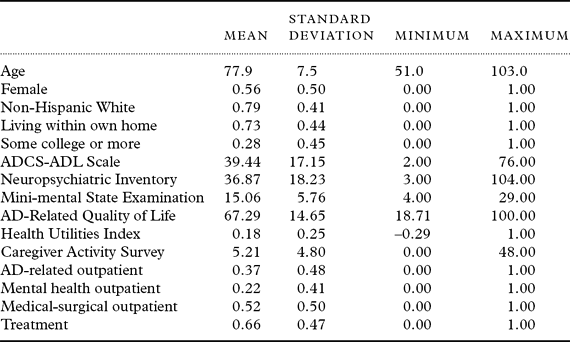
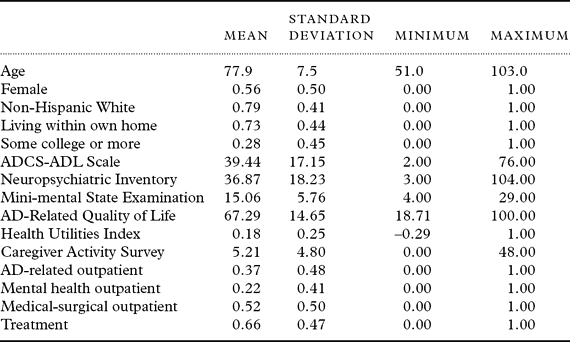
The average age of study participants was 77.9 years at baseline. The majority were female (56.0%), white (79.0%), and residing within their own home (73.2%). Less than one third (28.0%) were college educated (Table 1). Average HUI-III scores at baseline were 0.18, with individual scores ranging from −0.29 (worse than death) to 1.0 (perfect health). Average ADCS-ADL, NPI, MMSE, ADRQoL and CAS scores were 39.4, 36.9, 15.1, 67.3, and 5.21, respectively. Outpatient service utilization in the month preceding baseline was as follows: 37.0% used at least one AD-related outpatient services, 22.0% an outpatient mental health service, and 52.0% a medical-surgical outpatient service. Two-thirds (66.0%) were assigned to one of the three study medications; the remainder to placebo.
Characteristics of study sample at baseline (n = 404–418)a
an varies depending on the number of missing values.
Bivariate associations with eventual nursing home entry
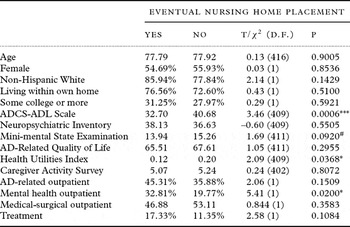
Table 2 reports bivariate associations between participant characteristics and eventual nursing home service use. Results indicate that those with prior outpatient mental health use at baseline (p < 0.05) were more likely to be admitted to a nursing home during the 9-month follow-up period. They also indicate that those with worse physical functioning (lower scores on ADCS-ADL (p < 0.001)), weaker utilities (lower scores on the HUI-III (p < 0.05)), and worse cognition (lower scores on the MMSE (p < 0.10)), were also more likely to enter a nursing home.
Bivariate associations between participant characteristics and eventual nursing home use (n = 404–418)

Percentages and χ2 test results reported for dichotomous variables; means and t-test results reported for continuous variables.
n varies depending on the number of missing values.
#p < 0.10, *p < 0.05, **p0<0.01, ***p < 0.001.
Multivariate model of time to nursing home entry
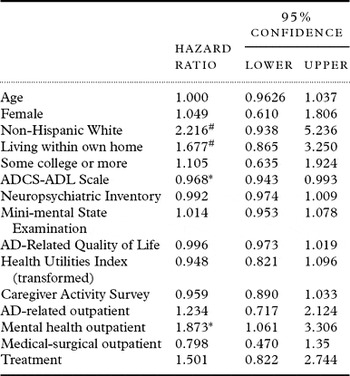
Table 3 reports results from the Cox proportional hazard model. The likelihood of nursing home use was more than two times greater for non-Hispanic white than minority patients with AD (hazard ratio [HR] = 2.16) (p < 0.10). Prior use of outpatient mental health services was associated with an 87.0% increase in the likelihood of nursing home entry as well (HR = 1.87) (p < 0.05). The likelihood of nursing home use declined with improved physical functioning, with every one unit increase on the ADCS-ADL being associated with a 3% reduction in the probability of being placed (HR = 0.97) (p < 0.05).
Cox proportional hazard model of eventual nursing home placement in CATIE-AD (n = 391)

–2 Log Likelihood: 642.845*.
|Wald χ2 | #p < 0.10, *p < 0.05, **p < 0.01, ***p < 0.001.
Discussion
Few, if any studies, have examined nursing home use among AD patients with prominent psychotic symptoms or agitation. Our results indicate that 15% of participants in CATIE-AD without any nursing home use in the month preceding baseline were eventually placed in a nursing home during the 9-month follow-up period, translating to an annualized rate of placement of 20%. This figure is substantially higher than annual rates of incidence reported in probability samples of community-dwelling elderly people, both with (5.6% to 8.5%) and without (1.0% to 5.5%) ADL limitations (Miller and Weissert, Reference Miller and Weissert2001). It is also higher than the annual rates of incidence reported in most studies of community-dwelling patients with AD and other dementia (8.4% to 12.3%) (Knopman et al., Reference Knopman1996; Smith et al., Reference Smith, O'Brien, Ivnik, Kokemen and Tangalos2001; Chan et al., Reference Chan, Kasper, Black and Rabins2003; AD2000 Collaborative Group, 2004; Gilley et al., Reference Gilley, Bienias, Wilson, Benett, Beck and Evans2004; Hatoum et al., Reference Hatoum, Thomas, Lin, Lane and Bullock2009). Hatoum et al. (Reference Hatoum, Thomas, Lin, Lane and Bullock2009), for example, report that 16.8% of AD patients enrolled in a randomized trial comparing rivastigmine and donepezil (R-D) entered a nursing home during a two-year study period for an average annual rate of placement of 8.4%. Another example, AD2000 Collaborative Group (2004), report that 11.6% of AD patients enrolled in a randomized trial of donepezil or placebo entered a nursing home during the first year of observation. What explains the marked difference in incidence found among AD patients recruited for CATIE-AD (20.0%) and the R-D and AD2000 trials (8.4% and 11.5%, respectively)? Both CATIE-AD and R-D report similar levels of cognitive impairment (average MMSE scores of 15.1 and 15.2, respectively). Collaborative Group reports that 49% and 51% of study participants had MMSE scores in the 10–18 and 19–26 range, respectively. But whereas CATIE-AD recruited subjects with prominent agitation or psychosis, R-D and AD2000 Collaborative Group did not, thereby possibly explaining why higher rates of nursing home placement were found in CATIE-AD.
Perhaps the primary reason that community-dwelling AD patients with prominent psychosis or agitation are more likely than other AD patients to be placed in a nursing home is that they are more difficult for caregivers to manage. Psychosis in AD and other dementias includes simple delusions, misidentifications, hallucinations, agitation, aggression, and depression (Schneider and Dagerman, Reference Schneider and Dagerman2004). Furthermore, AD patients with psychosis differ demographically and clinically from AD patients without psychotic symptoms. Those with psychosis are more likely to be characterized by female gender, neuropsychological deficits, anxiety, physical aggression and accelerated cognitive impairment (Schneider and Dagerman, Reference Schneider and Dagerman2004). They are also more likely to be verbal and ambulatory. Community-based caregivers face substantial financial, physical, mental, and emotional challenges caring for frail and disabled individuals (Alzheimer's Association, 2009; Miller et al., Reference Miller, Allen and Mor2009). This is particularly true among those caring for dependent people afflicted with AD or other dementias (Orry et al., 1999), of whom more burdened caregivers have been shown to be less able to prevent care recipients from being placed in a nursing home (Herbert et al., Reference Hebert, Dubois, Wolfson, Chambers and Cohen2001; Spruytte et al., Reference Spruytte, Audenhove and Lammertyn2001). It is likely that the challenges and subsequent risk of nursing home placement that caregivers face are only magnified further when caring for those AD sufferers with additional psychotic symptomatology.
It should be noted that there are a few exceptions to the general finding that studies investigating the rate of nursing home placement among the general population of AD patients is lower than the rate of placement among the AD patients with psychosis or agitation in CATIE-AD. This is reflected in Knopman et al. (Reference Knopman, Berg, Thomas, Grundman, Thal and Sano1999), which reports that 33.0% of AD patients enrolled in the AD Cooperative Study (ADCS) trial of alpha-tocopherol and selegiline entered a nursing home during the course of the two-year study period for an average annual incidence of 16.5%. It is also reflected in the study by Yaffe et al. (Reference Yaffe2002), which reports that 22.0% of AD patients enrolled in the Medicare AD Demonstration (MADD) of expanded case management and home- and community-based services entered a nursing home during that study's first year. Neither the tocopherol/selegiline trial nor MADD focused on AD patients with prominent psychotic symptoms. Yet the annualized incidence rates reported for nursing home placement – 16.5% and 22.0% – correspond roughly with what we found in our investigation, namely 20.0%. If most other studies demonstrate that AD patients with prominent psychoses are more likely to be institutionalized, why would the incidence rates in these two studies approximate our results? Participants in the two earlier studies reported greater cognitive impairment than the participants in CATIE-AD. This is reflected in average MMSE scores at baseline for ADCS, MADD and CATIE-AD of 12.6, 14.2, and 15.1, respectively. Thus, greater cognitive impairment could be one reason why the incidence of nursing home entry found in the tocopherol/selegiline trial and MADD approached the incidence found in CATIE-AD despite the prominence of psychotic symptoms in the latter but not the former.
No matter whether average cognitive impairment is high or low it has been found to be a consistently significant correlate of nursing home placement, both in general and among cognitively-impaired populations (Knopman et al., Reference Knopman, Berg, Thomas, Grundman, Thal and Sano1999; Miller and Weissert, Reference Miller and Weissert2000; Smith et al., Reference Smith, O'Brien, Ivnik, Kokemen and Tangalos2001; Yaffe et al., Reference Yaffe2002; Gaugler et al., Reference Gaugler, Duyal and Anderson2007; Reference Gaugler, Yu, Krichbaum and Wyman2009; Hatoum et al., Reference Hatoum, Thomas, Lin, Lane and Bullock2009). This, too, is reflected in our study but with respect to the bivariate findings only; in the multivariate model, MMSE score did not prove significantly related to nursing home placement. One possible explanation can be found in the moderate correlation between the MMSE and ADCS-ADL (r = 0.63, p < 0.001), which is consistent with extant research revealing significant functional impairment and medical comorbidities among those with AD or other dementias (Blaum et al., Reference Blaum, Ofstedal and Liang2002). However, when we reran the multivariate model without the ADCS-ADL, results for MMSE still did not prove statistically significant. Another possible explanation, therefore, is that MMSE scores do not adequately capture disease cognitive severity or progression in AD patients with prominent psychotic symptoms. This possibility is reflected in one recent review which concluded that the “dominance of cognitive function in the modeling literature is a big drawback in the area of AD, where disease progression is characterized by a number of factors and not just cognitive scores alone” (Green, Reference Green2007). Indeed, agitation and/or psychotic symptomatology may serve to moderate the effect of cognitive impairment on the risk of nursing home placement where the effect is weaker in AD patients with prominent psychotic symptoms and stronger in AD patients without, possibly because the former are more difficult to manage no matter whether the degree of cognitive impairment is high or low.
Perhaps the most consistently significant correlate of nursing home use, both in general and among cognitively impaired elderly populations, is physical functioning, typically measured using basic and instrumental activities of daily living (Knopman et al., Reference Knopman, Berg, Thomas, Grundman, Thal and Sano1999; Miller and Weissert, Reference Miller and Weissert2000; Smith et al., Reference Smith, O'Brien, Ivnik, Kokemen and Tangalos2001; Yaffe et al., Reference Yaffe2002; Chan et al., Reference Chan, Kasper, Black and Rabins2003; Gaugler et al., Reference Gaugler, Duyal and Anderson2007, Reference Gaugler, Yu, Krichbaum and Wyman2009; Hatoum et al., Reference Hatoum, Thomas, Lin, Lane and Bullock2009). This too is reflected in the current study where each unit increase on the ADCS-ADL scale was associated with a 3% reduction in the likelihood of being placed. A similar result is reported in Hatoum et al. (Reference Hatoum, Thomas, Lin, Lane and Bullock2009), which found a 3% change over two years in the likelihood of nursing home placement for each unit change in ADL-score.
Similar to earlier studies, we found that non-Hispanic white participants were twice as likely to be placed in a nursing home than minority participants (Miller and Weissert, Reference Miller and Weissert2000; Yaffe et al., Reference Yaffe2002; Chan et al., Reference Chan, Kasper, Black and Rabins2003; Miller and Rosenheck, Reference Miller and Rosenheck2006; Gaugler et al., Reference Gaugler, Duyal and Anderson2007, Reference Gaugler, Yu, Krichbaum and Wyman2009). This is typically attributed to cultural and attitudinal differences as well as differences in socioeconomic characteristics, which, in the present study, were controlled for using education. Findings also reveal a direct association between prior utilization of outpatient mental health services and eventual nursing home placement, with those using one or more services in the month preceding baseline being 78% more likely to be placed. Though few studies examine the association between outpatient mental health and nursing home use, this finding is consistent with previous research documenting a positive association between any outpatient mental health use and nursing home admission among mentally ill patients within the U.S. Department of Veterans Affairs (Miller and Rosenheck, Reference Miller and Rosenheck2006). It is also consistent with studies demonstrating a positive association between nursing home admission and health services utilization more generally (Miller and Weissert, Reference Miller and Weissert2000; Gaugler et al., Reference Gaugler, Duyal and Anderson2007; Reference Gaugler, Yu, Krichbaum and Wyman2009).
Twenty-two percent of CATIE-AD participants used outpatient mental health services at baseline. This use may be positively related to subsequent nursing home admission because it serves as an additional measure of psychiatric impairment and severity. However, it may also be related because it serves as a measure of access in two respects. On the one hand, those patients and caregivers using outpatient mental health care in the month prior to randomization may have been better able to navigate the health system and obtain particular types of services when needed. On the other hand, those patients and caregivers using outpatient mental health care in the month prior to randomization may have done so because they had not accessed those services previously. Consequently, they may have been less likely to have been on a cholinesterase inhibitor, antidepressant, or conventional or atypical antipsychotic, which, if effective, may have slowed down the trajectory toward subsequent nursing home use. The extent to which they did so would only be temporary, however; cholinesterase inhibitors, for example, have only been shown to work for a maximum of 6 to 12 months.
The fact that prior mental health services use is positively related to the risk of nursing home placement among AD patients with psychosis or agitation highlights the need to have sufficient psychiatric resources and staff available to ensure continuity of care for this population once they enter a facility. Doing so, however, is problematic in the current environment where the “treatment of mental disorders in the nursing facility population still does not receive the emphasis and attention that the prevalence of such disorders warrants” (Colenda, et al., Reference Colenda, Streim, Greene, Meyers, Beckwith and Rabins1999). Less than half of nursing home residents in the U.S.A. with a serious mental illness receive appropriate preadmission screening (Office of the Inspector General, 2001). Furthermore, nursing homes continue to be cited for deficiencies in mental health care, including failing to assess mental, psychosocial and cognitive status and inappropriate treatment of mental conditions (Castle, Reference Castle2002). The result, according to one nationally representative study, is that two-thirds of nursing home residents with identified mental illness do not receive any mental health services (Shea et al., Reference Shea, Russo and Smyer2000). Prevailing deficits are also recognized by nursing home staff who perceive that the need for psychosocial services far exceeds the level of care provided (Reichman et al., Reference Reichman1998). Given persistent problems providing mental health care to nursing home residents, it is critical that additional funding be provided to hire and educate the additional staff needed to care not only for the growing population of nursing home residents with AD but also for those AD cases complicated by delusions, hallucinations and other psychotic features.
Limitations
The present study breaks new ground by examining the relationship between sociodemographic and clinical/disease-specific characteristics and time to nursing home placement among AD patients with prominent delusions, hallucinations, and agitation/aggression participating in a clinical trial. It also employs previously unexamined correlates such as health utilities, which proved marginally significant in the bivariate analyses. Several limitations are worth noting, however. First, it may not be possible to generalize the results derived from CATIE-AD. All participants had active caregivers who were given basic information and education, two counseling sessions, and could speak with staff members as needed. Furthermore, CATIE relied exclusively on a cohort of AD cases who it was thought could benefit potentially from antipsychotic therapy. Given the limited impact of the antipsychotic medications, however, on the primary outcomes of the trial (discontinuation from treatment for any cause, at least minimal improvement on the Clinical Global Impression Change scale) (Schneider et al., Reference Schneider2006) or cost effectiveness (Rosenheck et al., Reference Rosenheck2007), we did not expect the presence of the study medication to influence eventual nursing home placement, which our results confirm. Second, our analyses might have been improved if certain additional data had been available. Although Cox proportional hazard modeling enabled us to make maximal use of the available data, a longer follow-up period would have been preferable. We also did not have direct access to measures of medical comorbidity, though it tends to be highly correlated with age, functional limitations, cognitive impairment, and HUI-III score, and is only rarely found to be significant after controlling for other factors (Smith et al., Reference Smith, Kokmen and O'Brien2000). Furthermore, data on caregiver characteristics – age, gender and relationship – were incomplete. These were excluded rather than conducting the analyses with over 100 fewer observations, and this may have biased the results. Lastly, the data used in this study derived from proxy raters rather than from the patients themselves. Though this is also true of most other AD studies, it remains uncertain whether caregiver proxy or patient provided information is most appropriate, especially since proxies often rate impairments differently than patients or objective measures, including when measured using functional capacity, health utilities, or quality of life (see, for example, Loewenstein et al., Reference Loewenstein2001).
Conclusion
This is the first study to examine the risk of nursing home admission in a population of AD patients characterized by prominent psychotic symptoms and/or symptomatic agitation. Results lend support to the proposition that the incidence of nursing home entry among such patients may be considerably higher than the incidence of entry among AD patients more generally. As such, the high incidence of nursing home placement during the nine-month study period highlights the importance of accounting for such utilization in health economic studies of AD outcomes associated with patients with prominent agitation and/or psychotic symptomatology.
Factors leading to nursing home entry among AD patients with delusions and hallucinations were similar to the broader population of AD sufferers, as well as to community-dwelling elderly people more generally. Although a number of studies have modeled nursing home admission, the algorithm reported in Stern et al. (Reference Stern1997), incorporating psychosis, extrapyramidal symptoms, MMSE score, duration of illness and age at onset, has been widely used to predict AD patients’ risk for eventual nursing home placement. Our study, however, indicates that the algorithm used to predict the risk of placement needs to be adjusted for the particular population examined. Indeed, at least one predisposing variable (race/ethnicity), need (physical functioning), and utilization variable (mental health) proved significantly related to time to nursing home entry, thereby suggesting that the risk of nursing home placement in AD sufferers characterized by prominent psychotic symptoms can be explained, in part, by drawing on Andersen's behavioral model of health services use.
That the ADCS-ADL proved significantly related to subsequent nursing home placement implies that ADLs may be used to help predict service use among AD patients with delusions and hallucinations. This suggests that results from our study could inform the development of profiles identifying those at greater or lesser risk of nursing home entry, and in so doing inform population planning associated with AD and identification of those individuals and caregivers who might benefit most from interventions to prevent eventual placement (Miller and Weisert, Reference Miller and Weissert2000; Weissert and Miller, Reference Weissert and Miller2001; Weissert et al., Reference Weissert, Hirth, Chernew, Diwan and Kim2003). Through risk assessment those individuals deemed most at risk for nursing home entry could be directed toward additional resources and supports, including more simplified access to a broad array of services and the provision of timely and accurate information (Miller et al., Reference Miller, Allen and Mor2009). Examples range from respite and adult day care, to home modification and in-home support, to care coordination and counseling, to integrated service delivery and consumer direction. Since risk assessment may be key to prioritizing participation in nursing home diversion programs, it is important that further research be undertaken to substantiate the relationship identified between ADLs and nursing home admission, perhaps by modeling future admission, in part, as a function of ADL scores at baseline and using longer observation periods and larger, more representative samples of AD patients with prominent psychosis.
Conflict of interest
LSS has received research support from Astra-Zeneca, Bristol Myers Squibb, Eli Lilly, Johnson and Johnson, and Pfizer; and has been a consultant to Astra-Zeneca, Bristol Myers Squibb, Forest Laboratories, Johnson and Johnson, Lundbeck, Merz, and Pfizer, all manufacturers of antipsychotics and antidepressants related to CATIE-AD. He has served as an expert witness in litigation involving these drugs. He has been a consultant to Wyeth. RAR has received research support from Eli Lilly, Janssen Pharmaceutica, Astra-Zeneca and Wyeth Pharmaceuticals. He has been a consultant to GlaxoSmithKline, Bristol Myers Squibb, Organon and Janssen Pharmaceutica. He provided expert testimony for the plaintiffs in UFCW Local 1776 and Participating Employers Health and Welfare Fund et al. v. Eli Lilly and Company; for the respondent in Eli Lilly Canada Inc v. Novapharm Ltd and Minister of Health, respondent; and for the Patent Medicines Prices Review Board. Canada, in the matter of Janssen Ortho Inc. and “Risperdal Consta.”
Description of authors’ roles
EAM made substantial contributions to the conception and design, analysis and interpretation of data, preparation of the paper, and final approval of the version submitted. LSS made a substantial contribution to the interpretation of data, revising the paper critically for important intellectual content, and final approval of version submitted. RAR made a substantial contribution to the conception and design, interpretation of data, preparation of the paper, and final approval of the version submitted.
Acknowledgments
This study was supported by a grant (N01 MH9001) from the NIMH, in addition to a grant from Wyeth Research, Philadelphia, PA. Views expressed are those of the authors only.