Implications
During mammary infections, production can be lost directly, indirectly or both. Knowing which losses are the most significant is important for identifying efficient preventive and therapeutic measures and for establishing genetic selection objectives. Here, we propose a mathematical model to estimate these losses using routine information from regional milk recording databases and bacteriological samples. For the specific pathogens found in our study (mostly Staphylococcus sp.), indirect milk losses were the most important.
Introduction
In cattle, subclinical mastitis is a frequent disease, more frequent than the clinical form, that may relapse after a few weeks or last for a long period, and that leads to milk loss (for a meta-analysis, see Seegers et al., Reference Seegers, Fourichon and Beaudeau2003). Breeders have two alternatives to decrease such production losses. One is to utilize management practices and/or drugs that reduce the negative effects of mastitis. Another is to select cows more tolerant to the infection, that is, cows able to withstand the infection resulting in minimal loss of milk. Tolerance can be further classified as direct tolerance, that is, the ability to reduce the damages caused by pathogens, and indirect tolerance, that is, the ability to reduce the damages caused by the immune response triggered by the infection (Schneider and Aires, Reference Schneider and Aires2008). The distinction is important for different reasons. One is to identify the most effective treatment protocols. For example, is it necessary to use antibiotics against bacteria or anti-inflammatory drugs to reduce inflammation, or both? Another is to determine selection objectives. These can be different if losses are mainly direct or indirect. If the majority of losses were indirect, then the priority would be to select cattle able to clear an infection without mounting a severe immune response. Conversely, if the majority of losses were not associated with the immune response, then the immune response should be boosted, either pharmaceutically or by selection. If genetic correlations between direct and indirect mechanisms of tolerance are not favorable then improving one type of tolerance mechanisms would worsen the other, thereby negating any benefit. A third reason is that improving direct or indirect processes of tolerance (by genetic selection or preventive practices) may have different effects on the epidemiology of the disease and host–parasite coevolution in the long and short-terms.
By definition, direct and indirect tolerances can be measured by regressing milk yield against an increasing number of pathogens (Kause et al., Reference Judd and Kenny2012) and an indicator of the intensity of the immune response to these pathogens (Detilleux et al., Reference Detilleux, Kastelic and Barkema2013), respectively. Higher tolerance is indicated by flatter slopes and lower losses.
Therefore, to estimate both levels of tolerance to mammary infection, we need information on milk yield, level of immune response and bacterial load. Test-day milk yield and somatic cell counts (SCC) are recorded routinely on dairy cows enlisted in national milk recording systems. And, because SCC are constituted mainly of phagocytic cells in infected cows (e.g. Burton and Erskine, Reference Burton and Erskine2003), they can be used as an indicator of the intensity of the immune response to mammary pathogens. Bacterial load can be measured by the number of colony forming units (CFU) in culture. However, methods to measure CFU are costly and time consuming, and they are not recorded routinely in field studies.
Mediation models may be appropriate to estimate the effects of mammary infection on test-day milk yields that are mediated or not by test-day SCC. Mediation (VanderWeele, Reference VanderWeele2012) is the name given to models in which one independent variable X (e.g. CFU) affects a second variable M (e.g. SCC) which, in turn, affects a third one Y (e.g. milk yield). In its linear form, it is also called a three-variable path analysis. The direct effect represents the portion of the relationship between X and Y that is not transmitted through the intermediate variable M, which we will call ‘direct tolerance.’ The indirect effect represents the portion of the relationship between X and Y that is transmitted through M, which we will call ‘indirect tolerance.’
Therefore, the objective of this paper was to perform a mediation analysis to estimate direct and indirect tolerance to bacterial pathogens responsible for subclinical mastitis.
Material and methods
Herds and cows
Three dairy herds were chosen from the coalition group ‘Observatory for Udder Health’ (OSaM) that federates researchers, dairy associations and breeders to collect information on farm, animal and clinical events in Wallonia (Reding et al., Reference Reding, Theron, Detilleux, Bertozzi and Hanzen2011). Herds had accurate and complete information. Cows free from clinical mastitis were sampled at random. Herd, month in milk (stage of lactation), parity and test-day data on udder-composite SCC (n cells/103 per ml) and milk yield (kg) were extracted from the regional milk-recording database.
Bacteriological samples
From February to April 2013, two surveyors sampled 95 clinically healthy cows, immediately before evening milking. Milk samples were taken three times, 1 week apart, on each cow. The surveyors cleaned teat ends with alcohol swabs and allowed them to dry. They discarded the first few streams and collected milk samples in sterile plastic tubes. Samples were immediately cooled, transported in cool bags to the Bacteriology laboratory of the Veterinary Faculty in Liège, and stored overnight at 4°C.
The procedure for the bacteriological analysis of the milk samples has already been described (Detilleux et al., Reference Detilleux, Kastelic and Barkema2013). Briefly, 1 ml of milk with no macroscopic alteration from each quarter of a cow were pooled and 100 μl of the pool were inoculated onto Columbia base agar (Merck-VWR, Leuven,Belgium) plates supplemented with 5% bovine blood and incubated overnight at 37°C. Counts from duplicate plates were averaged and CFU/ml were recorded as total bacterial load for each pool. Pools with over 100 CFU/ml were marked as ‘positive’ if a maximum of two types of colonies were detected. Pools with over 100 CFU/ml and more than two colony types were also marked as ‘positive’ (but contaminated) if one colony type counted for over 100 CFU/ml. Pools with <100 CFU/ml of one/two or of several different colony types were marked as ‘negative’ or ‘contaminated,’ respectively. In addition, colonies from ‘positive’ pools were identified to the genders according to the procedure already described (Detilleux et al., Reference Detilleux, Kastelic and Barkema2013).
Data
For the statistical analyses, three groups of cows were created. The group is called ‘NNN’ if pools at the three sampling times were all negative, ‘PPP’ if pools at the three sampling times were all positive, and ‘unP’ otherwise. Records on milk and SCC were collected up to 3 test-days before and 3 test-days after the date of the first bacteriological sample, within the same lactation. Lactations needed to have at least 5 test-day records, and only the first 300 days in milk were considered. Parities were grouped as 1, 2, 3 and over. The CFU were summed over the 3 sampling dates. Total number of CFU and test-day SCC were expressed in 1000 cells/ml and log-transformed (base 2) so their distributions were closer to normality. Then, one unit increase of log2-transformed SCC or CFU corresponds to an increase of 2000 cells/ml.
Statistical analyses
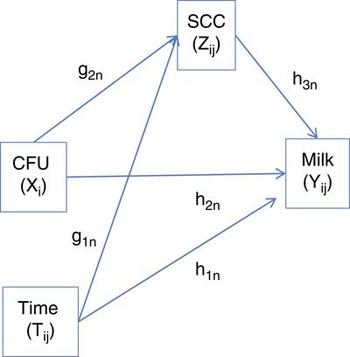
The mediation model (Figure 1) is given by the corresponding equations:
 $$Z_{{ij}} \,{\rm {\equals}\,}g_{{\rm 0}} {\rm {\plus}}g_{{{\rm 1}n}} T_{{ij}} {\rm {\plus}}g_{{{\rm 2}n}} X_{i} {\rm {\plus}}R_{r} {\rm {\plus}}M_{m} {\rm {\plus}}P_{p} {\rm {\plus} }e_{{ij}} $$
and
 $$\hskip-8pt Y_{{ij}} {\rm \,{\equals}}\,h_{{\rm 0}} {\rm {\plus}}h_{{{\rm 1}n}} T_{{ij}} {\rm {\plus}}h_{{{\rm 2}n}} X_{i} {\rm {\plus}}h_{{{\rm 3}n}} Z_{{ij}} {\rm {\plus}}R_{r} {\rm {\plus}}M_{m} {\rm {\plus}}P_{p} {\rm {\plus}}b_{{ij}} $$
where Y ij is the test-day milk yield and Z ij the log2-transformed SCC, T ij the number of days relative to sampling time (T ij =−40 to +40), i the index for the cow (i=1 to 95) and j the index for the time when milk and SCC were recorded (j=1 to 6). In both equations, n is the index for the group (n=1, 2, 3), X i the total number of CFU at sampling, R r the herd (r=1 to 3), M m is the month in milk at sampling (m=1 to 10), and P p the parity (P=1, 2, 3). Parameters g 0 and h 0 are the intercepts. Regression coefficients g 1n and g 2n represent the effect of the number of days relative to sampling and of log2-transformed CFU on log2-transformed SCC, respectively. Regression coefficients h 1n , h 2n and h 3n represent the effect of the number of days relative to sampling, of log2-transformed CFU and of log2-transformed SCC on test-day milk yield, respectively. These effects were estimated for each group (n=1 to 3) separately. The effects e ij and b ij are independent random variables with normal distributions. Within cows, the covariance structures across repeated errors follow an auto-regressive pattern of order one. The fit of the models was assessed by computing the concordance correlation coefficients between observed and estimated values (Lin, Reference Lin1989). All interaction terms were not significant (P>0.10) and not included in the final models. Mediation analysis makes the same assumptions of general linear model, including assumptions of linearity, normality and homogeneity of error variance. Measurement errors and the existence of variables affecting both SCC and milk yield could bias the conclusions of the mediation analysis if these were not included in the models.
Mediation analysis model. The CFU (X i ) is the log2-transformed number of bacterial colony forming units, SCC (Z ij ) is the log2-transformed somatic cell counts, time (T ij ) is the number of days relative to sampling time, i is the index for the cow, j is the index for the time when milk and SCC were recorded, relative to sampling time. The parameters g 1n , g 2n , h 1n , h 2n and h 3n are regression coefficients relating independent to dependent variables.

Following the product method (Judd and Kenny, Reference Kause, van Dalen and Bovenhuis1981), direct (DE n ) and indirect (IE n ) effects on milk were derived, for each group (n=1, 2, 3) as DE n =ĥ 2n X i and IE n =ĥ 3n ĝ 2n X i . The coefficients ĥ 2n , ĥ 3n and ĝ 2n are the REML estimates of the corresponding parameters, adjusted for other effects in the equations. Such effects can be interpreted under the counterfactual framework (Vansteelandt and VanderWeele, 2012): Direct effects measure the change in milk per unit increase in log2-transformed CFU, as if no change occurrs in log2-transformed SCC. Indirect effects measure the change in milk yield due to an increase in log2-transformed CFU that elicits one unit increase in log2-transformed SCC. Total effects are the sum of the direct and indirect effects, that is, TE n =(ĥ 2n +ĥ 3n ĝ 2n ) X i . All effects are adjusted for the effects in model 2. Standard errors were also computed for both direct and indirect effects (Tofighi and MacKinnon, Reference Tofighi and MacKinnon2011). All analyses were done on SAS Version 9.1 (PROC MIXED) to obtain REML estimates of parameters.
Results
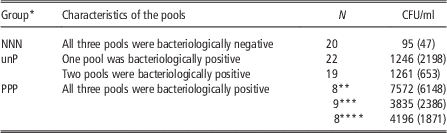
Results of the bacteriological pools are summarized in Table 1. Of the 95 sampled cows, nine were not sampled three times. Out of the 86 remaining cows, 25 were found positive at the three sampling times (PPP) with an average of 5147 (SE=821) CFU/ml over the three pools; 20 were negative at the three sampling times (NNN) with an average of 95 (SE=47) CFU/ml and 41 were positive at one or two sampling times (unP) with an average of 1253 (SE=1655) CFU/ml. For SCC, the geometric means were 54 040, 160 875 and 83 970 cells/ml in ‘NNN,’ ‘PPP’ and ‘unP’ cows, respectively. Means (and standard deviations) of milk, log2-transformed SCC and log2-transformed CFU were 29.6 (6.90), 6.41 (1.79) and −0.79 (2.30), respectively.
Frequency (n) and average (SE) of the number of colony forming units (CFU/ml) observed in milk pools from 86 cows

* See Material and Methods for information on the groups.
** The three pools were positive for Staphylococcus sp.
*** Two of the three pools were positive for Staphylococcus sp.
**** No staphylococci identified.
Most bacteriological cultures were negative (52.38%). Others contained either staphylococci (23.08%), streptococci (9.16%), mixed bacteria (8.79%) or were contaminated (6.59%). Considering cows with three positive consecutive samples, we observed staphylococci in at least one sample of 17 cows and in all three samples of eight cows.
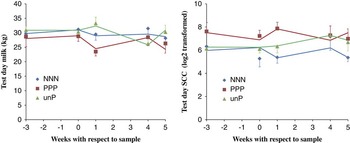
A total of 165 test-day records were used for the statistical analyses. Records were from 25 days before up to 39 days after sampling with 1 to 3 records per cow (median=3). Observed and estimated means of test-day milk and log2-transformed SCC with respect to the week of sampling are shown in Figure 2 for each group. The fit of the models was better for equations on milk (Lin’s concordance coefficient was 88.1%) than for the equations on log2-transformed SCC (Lin’s concordance coefficient was 77.9%). This suggests higher discrepancy between observed log2-transformed SCC is less.
Test-day milk and log2-transformed SCC for cows with three positive (square), three negative (diamond), and one or two negative (triangle) bacteriological findings. The dots and lines represent weekly means of the observed and estimated data, respectively.

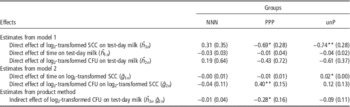
Estimates of the direct and indirect effects are given in Table 2. In the group ‘PPP,’ test-day log2-transformed SCC were higher by +0.40 units for each unit increase in log2-transformed CFU. This increase prompted a decrease in test-day milk of 0.69 kg for each unit increase in log2-transformed SCC. The product (0.40×0.69) is 0.28 and corresponds to the (indirect) decrease in test-day milk (in kg) for each unit increase in log2-transformed CFU that elicited one unit increase in log2-transformed SCC. The (direct) decrease in test-day milk associated with one unit increase in log2-transformed CFU but not mediated by an increase in SCC (h 2 in the Table 2) was not significantly different from null. In the group ‘unP,’ test-day log2-transformed SCC increased by 0.02 units per day and test-day milk decreased by 0.74 kg for each unit increase of log2-transformed SCC. However, test-day milk and log2-transformed SCC were not significantly influenced by the values of log2-transformed CFU. Thus, direct and indirect milk losses associated with one unit increase in log2-transformed CFU were not statistically different from null. No significant direct or indirect losses were observed in the group ‘NNN.’ All other factors in the model (herd, parity and month in milk) significantly affected test day milk.
Direct and indirect effects (SE) of log2-transformed CFU on test-day milk yield for cows with three positive (PPP), three negative (NNN), and one or two negative (unP) bacteriological findings

CFU=colony forming units; SCC=somatic cell counts.
*P<0.05, **P<0.01.
Total milk losses, that is, the sum of direct and indirect effects, were estimated at 0.71 and 0.69 kg for each unit increase of log2-transformed CFU for cows in the ‘PPP’ and ‘unP’ group, respectively. This implies a loss of 8.7 kg for cows with 5147 CFU/ml, that is, the average of ‘PPP’ cows (Table 1) and 7.1 kg for cows with 1253 CFU/ml, that is, the average of ‘unP’ cows (Table 1). These losses are adjusted for the effects in model 2, that is, month in milk at sampling, number of days relative to sampling time, parity and herd.
Discussion
Making the distinction between milk losses due to mammary pathogens or due to the response of the host to them is important for identifying optimal approaches for treating and preventing underperformances associated with intra-mammary infections (Detilleux et al., Reference Detilleux, Theron, Duprez, Reding, Humblet, Planchon, Delfosse, Bertozzi, Mainil and Hanzen2015). On the one hand, bacteria release toxins that may destroy mammary epithelial cells and damage milk-producing tissues. They may also invade and multiply within the bovine mammary epithelial cells before causing cell death (Zhao and Lacasse, Reference Zhao and Lacasse2008). A therapeutic approach against such damages is to milk cows and to give them antibiotic treatment. Cows able to rapidly reduce the number of pathogens present in the gland, for example through a medically boosted or a naturally operational immune response, are also directly tolerant to bacterial injuries. On the other hand, mammary epithelial cells may be injured by products released during the immune response, products against which antibiotics are ineffective. During the immune response, neutrophils migrate from blood capillaries into gland secretions. These are the most abundant and the most important phagocytes of the innate immunity and they constitute more than 90% of somatic cells in cows with clinical mastitis (Sharma et al., Reference Sharma, Singh and Bhadwal2011). If neutrophils are effective as antimicrobial defences, they are also a putative source of molecules with proinflammatory and proteolytic roles which harm the mammary epithelium (Capuco et al., Reference Capuco, Paape and Nickerson1986; Mehrzad et al., Reference Mehrzad, Duchateau and Burvenich2005). In such cases, a therapeutic approach is to treat cows with anti-inflammatory agents (McDougall et al., Reference McDougall, Bryan and Tiddly2009). Another method would be to breed animals whose neutrophils are best able to kill bacteria (Detilleux et al., Reference Detilleux, Kehrli, Stabel, Freeman and Kelley1995) so that few somatic cells are necessary to kill pathogens, or animals with superior antibody-mediated immune responses (Thompson-Crispi et al., Reference Thompson-Crispi, Sewalem, Miglior and Mallard2012) so they do not need to rely on their cellular immunity, or animals with beneficial anti-oxidant defenses and tissue repair mechanisms (Lauzon et al., Reference Lauzon, Zhao, Bouetard, Delbecchi, Paquette and Lacasse2005).
Here, we evaluated the importance of total, direct and indirect milk losses from field data and estimated the effects of CFU on test-day milk and SCC measured up to 3 weeks before and after bacteriological samples. In both groups of infected cows (‘PPP’ and ‘unP’), direct losses were null while losses mediated by an increase in SCC were significantly greater than null. This observation confirms previous results in cows with notable SCC changes before and after a clinical case (Detilleux et al., Reference Detilleux, Kastelic and Barkema2013). Even though SCC remained below the threshold of 200 000 cells/ml considered as normal (Dohoo et al., Reference Dohoo2001), test-day milk losses were estimated at around 0.7 kg (95%CI: 0.1 to 1.3) per unit increase in log2-transformed SCC (Table 2). This is within the range of estimates obtained by Hagnestam-Nielsen et al. (Reference Hagnestam-Nielsen, Emanuelson, Berglund and Strandberg2009), that is, from 0.2 to 1.2 kg per log2-transformed SCC in cows free of clinical mastitis. In another study, test-day milk losses varied from 0.34 to 1.35 kg per unit increase in log2-transformed SCC, according to the pathogen species (Detilleux et al., Reference Detilleux, Theron, Duprez, Reding, Humblet, Planchon, Delfosse, Bertozzi, Mainil and Hanzen2015).
Cows in the ‘PPP’ group were suspected to be chronically infected because they had three consecutive bacteriological positive samples, following the definition of Leitner et al. (Reference Leitner, Yadlin, Glickman, Chaffer and Saran2000). Compared to the other groups, log2-transformed SCC in these ‘PPP’ cows remained at the highest values at all test-days (Figure 2) and effect of time on log2-transformed SCC was not significantly different from null (Table 2). Such a long lasting high SCC response is typical of Staphylococcus aureus infection (Leitner et al., Reference Leitner, Yadlin, Glickman, Chaffer and Saran2000), a bacterial species found in 17 out of our 25 ‘PPP’ samples (Table 1). Within the ‘PPP’ group, cows with the highest CFU load presented the highest SCC and lowest test-day milk. Similarly, Reksen et al. (2007) observed a higher decrease in test-day milk yield in cows subclinically infected with >1500 CFU/ml of S. aureus than in cows infected with <1500 CFU/ml. Total losses were estimated at 8.7 kg (for the average CFU of ‘PPP’ cows). Gröhn et al. (Reference Gröhn, Wilson, Gonzalez, Hertl, Schulte, Bennett and Schukken2003) and Hertl et al. (Reference Hertl, Schukken, Welcome, Tauer and Gröhn2014) observed a drop of >8 kg in the week following a first case of clinical mastitis due to S. aureus.
Cows in the ‘unP’ group were suspected to be a mix of cows either recently infected or recovering from an earlier infection because only one or two of the three bacteriological samples were positive. In this group, regression coefficients for time on test-day milk and SCC were significantly different from null while the level of CFU was not associated with both test-day values (Table 2). It is well known that SCC increase more or less rapidly at the start of mammary infection (Burvenich et al., Reference Burvenich, Paape, Hill, Guidry, Miller, Heyneman, Kremer and Brand1994). For example, Leitner et al. (Reference Leitner, Yadlin, Glickman, Chaffer and Saran2000) observed, after intra-cisternal inoculation of S. aureus or Escherichia coli, a higher SCC increases in cows with acute than chronic infections. Similarly, we observed a higher SCC increase in the group ‘unP’ than in the group ‘PPP.’ Total losses in test-day milk yield were estimated at 7.1 kg (for the average CFU in ‘unP’ cows). Halasa et al. (Reference Halasa, Nielen, De Roos, Van Hoorne, de Jong and Lam2009) reported a loss of 0.31 kg in primiparous (and 0.58 kg in multiparous) cows for which SCC was >100 000 cells/ml after a test day with SCC <50 000 cells/ml, that is, suspected to suffer from a new subclinical mastitis.
Findings in the present article should be interpreted and used with caution and confirmed in other studies since ours has obvious limitations. A first one is the smallness of the data sample due to financial and personnel restrictions. According to Fritz and MacKinnon (Reference Fritz and MacKinnon2007), 74 records would have been needed to reach a 80% power for (moderate) effect sizes of the same amplitude as the one observed in this study. Indeed, a completely standardized indirect effect (Preacher and Kelley, Reference Preacher and Kelley2011) can be computed as the product of the indirect effect size by the ratio of the standard deviations of CFU on milk. For example, completely standardized indirect effect of total CFU on milk was estimated at 0.09 (i.e. 2.30/6.90×0.28=0.09) in ‘PPP’ cows, which is considered as ‘moderate’ by Kenny and Judd (Reference Kenny and Judd2014). Another limitation is the impossibility to construct pathogen-specific models because infection by the same pathogen was observed in only eight consecutive cultures samples (Table 1). Even if S. aureus was present in almost 50% of infected samples, this is unfortunate as pathogen species have different effects on SCC trends (de Haas et al., Reference de Haas, Barkema and Veerkamp2002). Other limitations are linked to the model assumptions which are necessary for obtaining unbiased estimates of the indirect effects. They consist in having uncorrelated error terms, linear relationships, no interaction terms and no unmeasured confounding (Ten Have and Joffe, Reference Ten Have and Joffe2012). Here, effects of CFU on test-day milk and SCC were adjusted for the effects of potential confounders, that is time (T), herd (R), stage of lactation (M) and parity (P). Indeed, it was shown in numerous studies that milk losses associated with increased SCC are most extensive in late lactation and late parities (e.g. Hagnestam-Nielsen et al., 2009). However, we cannot rule out the presence of unmeasured confounders that would have biased one or another relationship. Finally, due to budget constraints, information on test-day CFU (i.e. at the same time SCC and milk were collected) was unavailable and was replaced by information on CFU observed at three consecutive dates. If we had obtained information on test-day CFU, the mediation model would have included two ‘causally ordered’ mediators (CFU and SCC), with test-day CFU affecting test-day SCC (VanderWeele and Vansteelandt, Reference VanderWeele and Vansteelandt2014). With such model, it is possible to compute eight estimates of milk loss not mediated by any changes in SCC and CFU, eight estimates of milk loss mediated only by changes in CFU, eight estimates of milk loss mediated by changes in SCC alone and eight estimates of milk loss mediated by changes in both SCC and CFU (Albert and Nelson, 2011). Suggestions to reduce such complexities have recently been proposed by Daniel et al. (Reference Daniel, De Stavola, Cousens and Vansteelandt2015)
Conclusions
In this study, milk loss due to infection by mastitis pathogens was decomposed into its direct and indirect components in cows tested three times for bacteriological cultures at one week interval. For the specific pathogens found in our study, mostly Staphylococcus sp., results stress the importance of milk loss mediated by an increase in SCC in cows free of clinical signs but suspected to be chronically infected. If proven in studies with larger sample sizes than ours, such cows should be treated with anti-inflammatory agents and selection goals for better (indirect) tolerance should be for animals whose neutrophils are best able to kill bacteria, animals with superior antibody-mediated immune responses, and/or animals with beneficial anti-oxidant defenses and tissue repair mechanisms.
Acknowledgment
This study was supported by EADGENE (European Animal Disease Genomics Network of Excellence for Animal Health and Food Safety).