Introduction
Soil-transmitted helminths, especially Ascaris lumbricoides, Trichuris trichiura and hookworm species (Ancylostoma duodenale and Necator americanus), occur worldwide in humans. Higher prevalences in many developing countries are due to poverty, poor environmental hygiene and impoverished health services (Naish et al., Reference Naish, McCarthy and Williams2004). Epidemiologically, geohelminths are found in every age group for both males and females. Worldwide prevalence of these parasites is in the hundreds of millions and A. lumbricoides infections occur in one of every four individuals (Ash & Orihel, Reference Ash and Orihel1991). While A. lumbricoides has a worldwide distribution, it is more prevalent in warm, moist regions of the world. Hookworm infection is most prevalent in the western hemisphere, Central and South Africa, southern Asia, India, Melanesia and Polynesia. Trichuris trichiura occurs worldwide and is especially prevalent in warm, moist regions of the world. It is more prevalent in some areas and age groups, especially in developing countries, where it is common to encounter children who are co-infected with both Ascaris and Trichuris (Howard et al., Reference Howard, Donelly, Kabalereine, Retard and Brooker2002). Numerous studies have been undertaken in many geographic regions worldwide, indicating that the maximum worm burdens of Ascaris and Trichuris occur in human populations between the ages of 5 and 10 years (Naish et al., Reference Naish, McCarthy and Williams2004). Aksoy et al. (Reference Aksoy, Akisu, Tuncay, Delibas, Iceboz, Over and Oral2005) noted that the prevalence of pathogenic parasites in Turkey was high among people lacking indoor plumbing.
Sewage disposal constitutes a major source of contamination in Cameroon, as in other developing countries. Fresh stools are sometimes used as fertilizer and may contain viable eggs and larvae (Kouontchou et al., Reference Kouontchou, Quakyi and Leke2002). In Kumba, in the south-western region of Cameroon, favourable environmental and climatic conditions and rampant defecation on farmlands expose most people to these infections. Ascaris lumbricoides showed the highest prevalence, followed by T. trichiura and least by hookworms. Also in Kumba, it was observed that the prevalence was generally higher in females than males, while the intensity of infection was higher in males than females (Ndamukong, Reference Ndamukong2005). However, a related study in a rural community in central Nigeria found that T. trichiura was significantly lower than other parasites encountered, with hookworm being the most prevalent, followed by A. lumbricoides (Anosike et al., 2006). Elsewhere, Hamida et al. (Reference Hamida, Chawdhury and Zarine1999) reported that infection in boys was higher than in girls in Bangladesh.
Susceptibility to heavy infections has genetic, immunological and behavioural components. However, the greatest single predictor of heavy worm burden is age (Hotez et al., Reference Hotez, De Silva, Brooke and Bethony2003). Although children are also at risk for heavy hookworm infections in many regions, the highest hookworm burdens occur in adults, with pregnant women and the elderly having an elevated risk. These infections pose many health problems worldwide and the World Health Organization (WHO) estimates that more than 1 billion of the world's population is chronically affected by such transmitted helminths. Some intestinal protozoan parasites, such as Entamoeba histolytica, Entamoeba coli and Giardia lamblia, were also encountered in this study. Entamoeba histolytica has been observed worldwide and is more prevalent in the tropics and subtropics than in colder climates. In poor sanitary conditions in temperate and colder climates, however, prevalences have been found to equal those seen in the tropics (Kouontchou et al., Reference Kouontchou, Quakyi and Leke2002). In a related study in Ardabil, Iran, Daryani et al. (Reference Daryani, Eltehad and Ziael2003) identified a total of ten species, with G. lamblia (14%), Blastocystis hominis (10%) and Entamoeba coli (4.1%) being the most common parasites.
Intestinal parasitic infections are among the most common infections in the world and are responsible for considerable morbidity and mortality (Kongs et al., Reference Kongs, Marks, Verl and Vander2001). Although they continue to have a significant impact on health, quality of life and economic development in Cameroon as a whole, and Buea in particular, these parasites have been neglected because their direct impact on human life has not been well defined. So, the aim of the present study was to investigate the prevalence and intensity of human intestinal helminths and protozoa in the Buea sub-division of Cameroon, as we found that few studies had been conducted previously.
Materials and methods
Study population and area
A total of 356 subjects (174 males and 182 females aged 1–90 years) were recruited following informed consent. The present study was conducted between October 2006 and July 2007 at the Buea Regional Hospital Annex, which serves both the town of Buea and its environs in the south-west region of Cameroon. Buea is situated on the slope of Mount Cameroon, and was divided into urban and rural areas for this study: Buea Town, Sandpit, Bokwango, Great Soppo, Long Street, Bonduma, Molyko and Clerk's Quarters were considered urban, while Muea, Sasse, Small Soppo, Mile 17, Bolifamba, Bova, Bomaka and Bonakanda were considered to be rural.
Collection and analysis of faecal samples
In a cross-sectional study, the age, sex and locality of each participant were obtained from a questionnaire and all were interviewed to ascertain the presence of symptoms of helminth and protozoan infections. Each participant was provided with a specimen bottle, labelled with name and identification number, for the collection of stool samples. The quantity of specimen collected was approximately 1 g. The collected specimens were then immediately taken to the University of Buea Laboratory for analysis, and stool samples not observed on the collection day were treated with 10% formol–saline solution and stored in a refrigerator for subsequent observation. The samples were analysed using the formol–ether concentration technique of Christensen et al. (Reference Christensen, Gotsche and Frandsen1984) and the different protozoan species were identified using standard identification tables (World Health Organization, 1997).
Ethical clearance
Ethical clearance for the study was obtained from the South West Regional Delegate for Public Health, and authorization to carry out the research in the Provincial Hospital Annex was obtained from the Director of the hospital. Signed consent was obtained from all participants (or guardian for those under 16 years of age) before the start of the study.
Statistical analysis
Statistical analysis was undertaken using SPSS (version 9; SPSS Inc., Chicago, Illinois, USA) and χ2 tests were used to compare prevalences. Student's t-test was used to compare the means of differences in age and the number of eggs in faeces between groups. Statistical significance was set at the 5% level.
Results
Study participants
A total of 356 participants were examined [174 (48.9%) males and 182 (51.1%) females; mean age 26 years] and divided by locality so that 212 (60.0%) participants were found to be living in the urban areas of Buea, while 144 (40.0%) lived in the rural areas. They were divided into five age groups: 1–5 years (31; 8.7%), 6–12 years (70; 19.7%), 13–19 years (48; 13.5%), 20–30 years (97; 27.2%) and >30 years (110; 30.9%).
Prevalence and intensity of helminth infections
Of those who showed signs of infection, 59 (32.4%) were females and 53 (30.5%) were males, and although females showed a higher prevalence rate than males, the difference was not significant. The prevalence of geohelminth infections in patients from rural areas (47.2%; 67/142) was higher than in those from urban areas (21.0%; 45/214) and the difference was highly significant ( < 0.1%). With respect to age, the 6–12-year age group (41.4%) was found to be the one with the highest number infected with helminths, followed by those aged 20–30 years of age (34.2%). The least number of infections were found among those aged 1–5 years (19.4%). The difference in the prevalence of helminths in the different age groups was not significant.
The intensity of infection was measured as egg per gram (epg) of faeces. Variations in the intensity of helminth infections according to sex, age and locality were also assessed. Males had a higher geometric mean intensity (1099 epg) than females (929 epg), though the difference was not significant. Comparing the different age groups, the highest geometric mean intensity was seen in the 6–12-year age group (1464 epg), followed by the 1–5-year age group (1422 epg) and the lowest was seen in those above the age of 30 years (764 epg). Again, this difference was not significant. Comparing rural and urban subjects, the geometric mean was higher in participants from rural areas (1208 epg) than those from urban areas (770 epg); significance < 5%.
The prevalence and intensity of helminth species
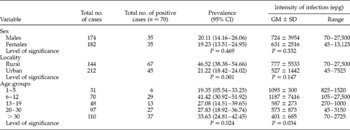
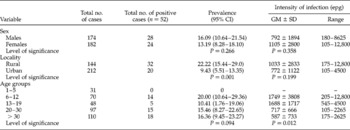
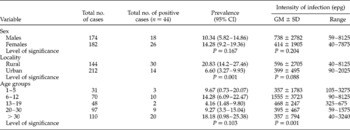
The prevalence of infections caused by A. lumbricoides is presented in table 1 and shows that males and females were infected in equal numbers. Table 2 presents the infections caused by hookworm and shows that more males (16.1%) were infected than females (13.2%), although the difference was not significant. Table 3 presents the infections caused by hookworm T. trichiura, and shows that more females (26; 14.3%) were infected than males (18; 10.3%). This difference was also not significant.
The prevalence and intensity of infections with A. lumbricoides by sex, locality and age groups in patients attending hospital in Buea Sub-Division.

Prevalence in %; epg, eggs per gram; GM, geometric mean; SD, standard deviation; CI, 95% confidence interval.
The prevalence and intensity of infections with hookworm by sex, locality and age groups in patients attending hospital in Buea Sub-Division.

Prevalence in %; epg, eggs per gram; GM, geometric mean; SD, standard deviation; CI, 95% confidence interval.
The prevalence and intensity of infections with T. trichiura by sex, locality and age groups in patients attending hospital in Buea Sub-Division.

Prevalence in %; epg, eggs per gram; GM, geometric mean; SD, standard deviation; CI, 95% confidence interval.
Table 1 also shows that the number of people infected with A. lumbricoides in rural areas (46.5%) was higher than in urban areas (21.2%) and the difference was highly significant ( < 0.1%). Table 2 shows that the same trend was seen in hookworm cases from rural areas, which had a higher prevalence (22.2%) than urban areas (9.4%). This difference was also highly significant ( < 0.1%). Table 3 shows that a similar trend was observed in T. trichiura, with rural areas having a higher prevalence (20.8%) than the urban areas (6.6%). This difference was also found to be significant ( < 0.1%).
The egg intensity of different species of helminths with respect to sex, locality and age group was also analysed. Our results show that the geometric mean parasite intensity was highest in hookworm (938 epg), followed by A. lumbricoides (721 epg) and the least was seen in T. trichiura (598 epg). Rural areas also had a higher intensity of infection (845 epg) than urban areas (462 epg). The intensity of infection for A. lumbricoides was also higher in rural areas (777 epg) than in urban areas (527 epg) (table 1).
The geometric mean egg intensity of A. lumbricoides was found to be higher in males (724 epg) than females (631 epg), though the difference was not significant. Table 1 also indicates that the age group of 6–12 years had the highest Ascaris load (1187 epg) of faeces, followed by the 1–5-year age group (1095 epg) of faeces and the least was in the age group >30 years (401 epg). The difference between these groups was significant. The highest parasite load for hookworm infection was in the 6–12-year age group, followed by those aged 13–19 years, with the least among the age group +30 years (table 2). This difference was significant at 1%. Like Ascaris and hookworm, Trichuris also had its peak geometric mean parasite intensity in the age group 6–12 years (1555 epg), followed by age group 13–19 years (468 epg) and least among 1- to 5-year-olds (357 epg) (table 3). The difference between the age groups was significant (0.1%).
Prevalence of single and mixed helminth infections
Out of the 112 samples infected with helminths, the prevalence of mixed infections (presence of two or more parasite species) was 36.6% (41/112). The prevalence of mixed infections was significantly higher ( < 0.1%) in rural areas (41.8%; 28/67) than in urban areas (28.9%; 13/45). Although the prevalence in males (41.5%; 22/53) was higher than in females (32.2%; 19/59), the difference was not significant. The highest prevalence of helminths with respect to age groups was seen in those aged 30 and up (45.9%; 17/37), while the least was observed among 13- to 19-year-olds (7.7%; 1/13); however, these differences were not significant.
Ascaris showed the highest single infection (36; 10.1%), followed by hookworm (23; 6.4%) and the least single infection was seen in Trichuris (12; 3.4%). The highest mixed infections involving two species was seen in Ascaris and Trichuris (14; 3.9%), while the least prevalence of mixed infections was seen in hookworm and Trichuris (8; 2.2%). The frequency of mixed infections involving all the three species was 8 (2.2%).
Prevalence and intensity of intestinal protozoan species
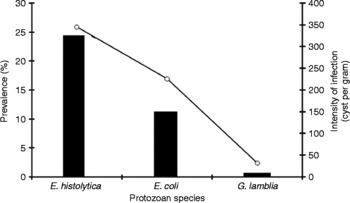
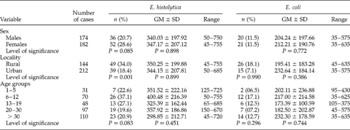
The prevalence of the different species of intestinal protozoans is shown in fig. 1. Three species of protozoans were encountered in the study: E. histolytica (with a prevalence of 24.4%), E. coli (11.2%) and G. lamblia (with a prevalence of 0.6%). In the different age groups, the prevalence of E. histolytica was higher in patients aged between 6 and 19 years and least in subjects aged between 20 and 30 years. The geometric mean parasite intensities were 345 cysts/g (cpg), 226 cpg and 32 cpg of faeces for E. histolytica, E. coli and G. lamblia, respectively (fig. 1). Table 4 shows that infection with E. histolytica and E. coli was higher in females than males. More people were infected with E. histolytica in the rural areas (34.0%; 49/144) than in urban areas (18.4%; 39/212), and this difference was found to be highly significant ( < 0.1%). The same trend was seen in E. coli, as patients from rural areas experienced a higher prevalence (18.1%; 26/144) when compared with those from urban areas (7.1%; 15/212). The difference was also significant (1%). Only two cases of G. lamblia were recorded in the present study, both observed in stool samples provided by participants from urban areas.
The prevalence (black bars) and intensity of infection (○) of E. histolytica, E. coli and G. lamblia in hospital patients in Buea.

The prevalence and intensity of infections with intestinal protozoans by sex, locality and age groups in patients attending hospital in Buea Sub-Division.

n, number of positive cases; %, prevalence in percentage; GM, geometric mean (cysts per gram); SD, standard deviation.
The intensity of protozoan cysts was found to be higher in females than males (table 4). Similarly, participants with E. histolytica infections from rural areas had higher parasite load (350 cpg) than those from urban areas (344 cpg), while E. coli intensities were higher in urban areas (232 cpg) than in rural areas (195 cpg) (table 4). In both species, these differences were not significant. Table 4 also shows that the highest intensity of infection with E. histolytica was seen in the 6–12 years age group (400 cpg) and the least among those in the >30 years age group (298 cpg). The difference in the intensity of infection in the different age groups was not significant.
Discussion
Soil-transmitted helminth infections are prevalent in many countries, especially in the tropics and subtropics, and continue to be of importance due to their high prevalence and effects on morbidity in the population (World Health Organization, 1981).
The present study revealed that the prevalence and intensity of infections with helminths were high, which could probably be related to the large number of eggs produced by helminths, increasing the chances of infection. Another reason could be that when individuals are treated for helminth infections, they tend to be predisposed to pick up large numbers of eggs after treatment.
Ascaris lumbricoides, T. trichiura and hookworm infections were the intestinal helminths identified in the study area, which confirmed results by both Booth & Bundy (Reference Booth and Bundy1992) and Ndenecho et al. (Reference Ndenecho, Ndamukong and Matute2002) in related studies in Cameroon. These intestinal helminths were present in males and females, urban and rural areas, and in all ages. The prevalence was higher in females than males, though the intensity of infection was higher in males than in females. A higher prevalence in females was also observed in studies carried out in the Philippines (Kim et al., Reference Kim, Yong and Lee2003) and Cameroon (Ndamukong, Reference Ndamukong2005). However, Hamida et al. (Reference Hamida, Chawdhury and Zarine1999) reported that the prevalence in males was higher than that in females in Bangladesh.
The difference observed in prevalence between males and females might be related to their different activities. In the study area, more women are engaged in farming activities than men, and these women usually do their farming barefooted, which causes the penetration of hookworm larvae, as these farmlands are usually contaminated with helminth eggs due to indiscriminate defecation. The practice of geophagy (eating earthy or soil-like substances) among women and girls also contributed to the high prevalence in females. In the present study, females had a higher mean epg than males. Other studies have also demonstrated that females have heavier worm burdens (Kightlinger et al., Reference Kightlinger, Seed and Kightlinger1998) but the cause of this is yet unknown (Crompton, Reference Crompton, Scott and Smith1994) and could be related to behavioural differences between males and females. A study of schoolchildren in South Africa showed that girls were more likely to be infected with Ascaris and also had a higher prevalence of soil-eating than boys (Saathoff et al., Reference Saathoff, Olsen, Kvalsvig and Geissler2002).
We found a significantly higher prevalence and intensity of infection in rural areas as compared with urban areas. This corroborated similar results reported by Albonico et al. (Reference Albonico, Crompton and Savioli1999) and Ndenecho et al. (Reference Ndenecho, Ndamukong and Matute2002). The low prevalence in urban areas can be attributed to the availability of toilet facilities and a proper means of faecal disposal. Such facilities are rare in rural areas, where it is common to find faecal matter along the road. People in villages are therefore at higher risk of infections because of their greater exposure to contaminated soils. Needham et al. (Reference Needham, Kim, Hoa, Cong, Michael, Drake, Hall and Bundy1998) reported that the environmental and climatic conditions in a community, and also certain farming practices, favour the transmission and distribution of soil helminths. In 1988, the WHO reported a prevalence of 82% of A. lumbricoides in poor peri-urban and urban communities in Nairobi. The prevalence of infection with intestinal parasites among food handlers was almost half (41.1%) of those examined, with 3% having multiple protozoan and helminth infections. The risk of infection with intestinal parasites to the population is increased because contaminated vegetables are sometimes eaten raw, undercooked to retain the natural taste and preserve heat-labile nutrients, or unclean (Slifko et al., Reference Slifko, Smith and Rose2000). Additionally, vegetables purchased at urban markets have been found to have higher rates of infestation with intestinal parasites (Cifuentes et al., Reference Cifuentes, Gomez, Blumenthal, Tellez-Rojo, Romieu, Ruiz-Palacios and Ruiz-Velazco2000). Peak prevalence and intensity of infection were observed in the 6–12-year age group. These were children in primary schools. These results corroborate those of Bundy et al. (Reference Bundy, Hall, Medley and Savioli2004). The presence of helminth eggs and larvae around toilets, especially school toilets, makes these surroundings a point of contamination. The prevalence of A. lumbricoides increased with age. Maximum prevalence values for A. lumbricoides are usually observed when children are 5–10 years old (Crompton, Reference Crompton, Scott and Smith1994). A previous study in Nigeria demonstrated the prevalence of A. lumbricoides to be 88.5% in schoolchildren aged 5–15 years (Holland et al., Reference Holland, Asaolu, Crompton, Stoddart, Macdonald and Torimiro1989). Higher prevalences of Ascaris in studies of children aged 0–48 months have been found in China (80%) (Yu et al., Reference Yu, Jang and Qi1989), the Philippines (77%) (Cabrera et al., Reference Cabrera, Lorenzo, Abrantes, Go and Ortiz1989) and Sri Lanka (62%) (Ismail et al., Reference Ismail, Rajapakse, Suraweera and Amarasinghe1993). Prevalence can vary geographically; lower prevalences have been found in children aged 12–48 months in Zanzibar (41.5%) (Stoltzfus et al., Reference Stoltzfus, Kvalsvig, Chwaya, Montresor, Albonico, Tielsch, Savioli and Pollitt2001) and children aged 12–47 months in Nigeria (Asaolu et al., Reference Asaolu, Ofoezie, Odumuyiwa, Sowemimo and Ogunniyi2002).
The study showed that A. lumbricoides infections were most prevalent, followed by hookworm and T. trichiura. This relatively high prevalence of A. lumbricoides agrees with the findings of Ndamukong (Reference Ndamukong2005), who observed, however, that T. trichiura was second and hookworm the third in terms of prevalence. The difference in prevalence between the species was highly significant in this study. Ascaris has been found worldwide to be the most common and most infectious of all helminths. The high prevalence of Ascaris might probably be related to the fact that the eggs of Ascaris have a very resistant capacity and can embryonate under the most adverse environmental conditions. Although hookworm was the second in terms of prevalence, it showed the highest intensity of infection. The high intensity of infection by hookworm species, especially in the rural areas, was probably due to lifestyle. Most people in the study area were farmers and thus were regularly in contact with the soil which also facilitated penetration.
Most of the infected people (79.2%) carried egg loads ≤ 2000 epg of faeces, while only 20.8% carried egg loads >2000 (2025–39,625) epg of faeces. This finding confirms studies by Bundy & de Silva (Reference Bundy and de Silva1998) and Behnke et al. (Reference Behnke, Declercy, Sacko, Gilbert, Valtara and Vercryyese2000), who reported that few people tend to carry very heavy egg loads, such that the worm burdens are neither uniformly nor randomly distributed, but are overdispersed, with a few individuals carrying disproportionately large worm burdens. It was also observed that approximately 82% of the worm population was harboured by 20.8% of the host population. This suggested that only a small fraction of the population was responsible for contamination of the environment. Hall (Reference Hall1993) also observed that hosts tend to be infected for long periods of time with slowly fluctuating numbers of worms and noted that even if all children in a community are infected, the majority are usually lightly infected. Thus it was not unusual to find in this study that only 20.8% of infected people carried very heavy worm loads.
Single and mixed helminth infections constituted 63.4% and 36.6% of the infections investigated in this study, respectively. The prevalence of mixed infections was significantly higher in rural areas than in urban areas. This is probably due to poor hygiene practices in rural areas, which increase the chances of helminth species co-occurring. Ascaris and Trichuris had the highest mixed prevalence. This confirms findings by Ndenecho et al. (Reference Ndenecho, Ndamukong and Matute2002), who observed that Ascaris and Trichuris infections were often present concurrently in infected individuals. This also supports findings that these two parasites probably have the same mode of infectivity and transmission (Scolari et al., Reference Scolari, Torti, Beltrame, Metleelli, Castelli, Gulletta, Rabai, Mosdrana and Urbani2000). Hall (Reference Hall1993) reported that each worm establishes itself in a host as a result of a separate infection event. The higher prevalence of human intestinal protozoans in females, compared with males, may be attributed to the fact that, in the farms, women usually eat unwashed fruits and vegetables that may be contaminated with protozoan cysts.
We found that participants from rural areas also showed higher prevalences than those from urban areas. This is often related to poverty, poor living and hygiene conditions prevailing in the rural areas. The study also revealed a significant positive correlation between the prevalence and intensity of infection amongst different age groups, with peak values amongst the 6–12-year age group. Kouontchou et al. (Reference Kouontchou, Quakyi and Leke2002) reported on a similar age group in which peak infection occurred.
With respect to the different species of protozoans identified, E. histolytica and E. coli showed a relatively higher prevalence than G. lamblia. These results are similar to those reported in other regions of Cameroon by Rossignol et al. (Reference Rossignol, Ayman and Marc2001), but they are not in agreement with those reported by Beltran et al. (Reference Beltran, Garaycochea, Bellido, Garcia, Rios, Bernui and Gonzales2004) and Daryani et al. (Reference Daryani, Eltehad and Ziael2003), who observed that the most prevalent protozoan species was G. lamblia. The high prevalence of E. histolytica and E. coli in our study could be due to the existence of resistant cysts of both parasite species in the present study area. Giardia lamblia was very scarce in the study area; the two cases reported could have been imported from another area. Single and mixed protozoan infections of E. histolytica and E. coli constituted 69.0% and 31.0%, respectively. Earlier studies indicated that multiple and mixed parasite infections are often encountered in children from endemic areas in developing countries (Hohmann et al., Reference Hohmann, Panzer, Phimpachan, Southivong and Schelp2001; Lopiso et al., Reference Lopiso, Yared and Ayele2002). In 1988, a cross-sectional stool sample survey performed among children living in a garbage dump site in Metro Manila, Philippines, revealed a prevalence rate of 96% for intestinal parasitism (Auer, Reference Auer1990). In another Philippine community, children had a prevalence of 78.1% (Lee et al., Reference Lee, Ahn and Yong2000). The high prevalence of parasitism shown in this study, although lower than that of other examinations reported from children in communities and schools (Auer, Reference Auer1990; Lee et al., Reference Lee, Ahn and Yong2000; Belizario et al., Reference Belizario, Amarillo, de Leon, de los Reyes, Bugayong and Macatangay2003), suggests that there is still much room for improvement in areas of health provision and health programme implementation. Sanitation practices and water quality should be improved, as these are the major contributory factors for the spread of helminth and protozoan infections.