Implications
There is an urgent need for new plant proteins for poultry nutrition. As is, the majority of protein needs for poultry production are covered by the soybean products. The dependence of European feed production industry on soybean as well as the growing economic, environmental and ethical concerns on the loss of ecologically important rainforests have led to an increasing demand for home-grown and sustainable protein sources (e.g. European domestic grain legumes) for feeding livestock. The present study aimed to evaluate innovative and classic biotechnological approaches for production of high quality alternatives for soybean meal from domestic European peas.
Introduction
Soybean meal (SBM) is the most common plant protein source in poultry nutrition. Environmental factors remarkably limit cultivation of soybean in many parts of the world, especially Europe. In Europe, domestic legumes like peas, beans and lupines or oilseeds like rapeseed can be alternative plant protein sources. Peas have relatively high CP. They also can potentially provide considerable amount of energy due to their high starch contents. However, peas contain also variable amounts of anti-nutritional factors (ANF) such as α-galactosides, trypsin inhibitors (TI), resistant starch (RS), pectin, tannins, lectin, phytic acid and non-starch polysaccharides (NSP), which can significantly impair the digestive process especially in young chicks. This may lead to pancreatic hypertrophy, increased nutritional requirement for sulfur-containing amino acids (AA) and finally poor bird performance (Igbasan and Guenter, Reference Igbasan and Guenter1996; Nalle et al., Reference Nalle, Ravindran and Ravindran2011; Frikha et al., Reference Frikha, Valencia, de Coca-Sinova, Lázaro and Mateos2013).
Different processes like soaking, autoclaving, dehulling and micronization followed by air classification have been proposed to improve the nutritional value of peas for poultry (Igbasan and Guenter, Reference Igbasan and Guenter1996; Laudadio et al., Reference Laudadio, Nahashon and Tufarelli2012; Frikha et al., Reference Frikha, Valencia, de Coca-Sinova, Lázaro and Mateos2013). These various processing techniques tended to reduce the content of ANF in peas but not efficient enough to be practically used in poultry feed production.
Fermentation processes have been used for centuries in human food production. Fermentation of legumes could eliminate ANF, for example tannins, TI, α-galactosides and modify AA profile by microbial synthesis and breakdown (Ouoba et al., Reference Ouoba, Cantor, Diawara, Traore and Jakobsen2003; Ouoba et al., Reference Ouoba, Diawara, Christensen, Mikkelsen and Jakobsen2007; Gefrom et al., Reference Gefrom, Ott, Hoedtke and Zeyner2013). Moreover, fermentation of an ingredient could provide a high number of beneficial microorganisms with probiotic effects on the microbiology and morphology of the gastrointestinal tract (GIT). Fermentation of rapeseed meal (RSM) could reduce glucosinolate (Chiang et al., Reference Chiang, Lu, Piao, Hu, Gong and Thacker2010) and phytic acid, while increased CP (Nair and Duvnjak, Reference Nair and Duvnjak1990).
One of the major beneficial impacts of fermentation processes on ANF seems to be through enzymatic digestion. Using enzymes as feed additives in poultry diets could inactivate or/and eliminate certain ANF, improve the digestive process and availability of nutrients that were physically or chemically sequestered by ANF substances (Bedford, Reference Bedford2000). The retention time of feed in the GIT of poultry, especially broilers, is very short (~2 to 4 h) and can vary depending on chemical and physical characteristics (i.e. particle size, feed form, NSP concentration, etc.) of the feed. On the other hand, the optimum pH of most exogenous enzymes is between 4 and 6. Consequently, because of the GIT pH and the fact that enzymes can be subjected to hydrolysis by endogenous proteolytic enzymes in the GIT, the degradation activity of exogenous enzymes seems mainly limited to the crop, proventriculus and gizzard (Ravindran, Reference Ravindran2013). The short retention time of digesta in the proximal GIT (60 to 90 min) and the wide range of pH which feed encounters along the poultry GIT limits the efficiency of exogenous enzymes (Svihus et al., Reference Svihus, Uhlen and Harstad2002; Ravindran, Reference Ravindran2013).
Fermentation with probiotic microorganisms and treatment of peas for a certain period of time with appropriate exogenous enzymes in a moist environment may be an effective approach to improve the nutritional quality of peas. Despite promising nutritional effects of fermentation and enzymatic treatment of plant materials, there is little information available assessing the effects of these technological processes on nutritional quality of pea as well as on performance and nutrient digestibility in broilers. Therefore, the present study was conducted to investigate the effects of different inclusion levels of native, fermented or enzymatically treated pea products on performance and nutrient digestibility in broilers.
Material and methods
A commercial batch of Madonna pea (Pisum sativum L.) was hammer milled as full seeds (including hulls) to 2 mm screen size. The ground pea (909 g/kg DM) was used for the continuous production of pea dough (500 g/kg DM) during fermentation and enzymatic treatment as well as for the animal trials, as native pea in the diets.
Solid state fermentation
A commercial probiotic, GalliPro® (EU authorized probiotic to be used in broiler feed) containing 1.60×10⁹ spores/g of Bacillus subtilis (Chr. Hansen, Denmark) was employed for the solid state fermentation (SSF) process. In the fermentation process the used water for dough production was inoculated with the probiotic spore, resulting in final concentration of ~2.57×10⁸ B. subtilis spores/kg pea. The dough was pumped in internal cathodic protected (ICP) tanks and incubated in temperature controlled containers (30°C) for 48 h.
Treatment with exogenous enzymes
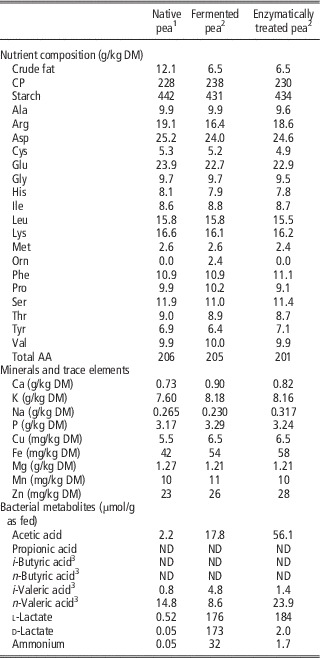
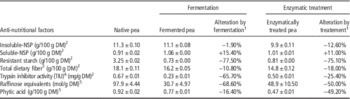
For enzymatic treatment, the used water for dough production contained three different commercial exogenous enzymes plus organic acids mixture (10 ml/kg pea dough; 8 ml lactic acid and 2 ml acetic acid). The acidification of water, resulting in a final pH of 4.5 in the dough, was to inhibit the growth of pea associated microorganisms and uncontrolled fermentation of pea by its associated microorganisms (spoilage) during the incubation time. Three commercial enzymes used for enzymatic treatment process were 0.1 g/kg pea AlphaGalTM (Kerry EMEA, USA) containing an α-galactosidase (enzyme activity: 115 μ/kg pea), 0.2 g/kg pea RONOZYME® ProAct (DSM, Switzerland) containing a protease (enzyme activity: 15 000 μ/kg pea), and 0.2 g/kg pea RONOZYME® VP (DSM) containing a blend of β-glucanase and pectinases (enzyme activities: 10 μ/kg pea). After filling in ICP tanks, the prepared dough was incubated for 24 h at 30°C. The effects of fermentation and enzymatic treatment on nutrients and ANF composition of pea products are presented in Tables 1 and 2, respectively.
Analyzed nutrient composition of pea products

ND=not detected.
1 Dry matter of native pea: 909 g/kg.
2 Dry matter of fermented and enzymatically treated pea: 921 g/kg.
3 Branched chain volatile fatty acids.
Anti-nutritional factors of pea products (mean±SD)

NSP=non-starch polysaccharides.
1 Compared with native pea.
2 Data were obtained from duplicate measurements and are stated as mean value±standard deviation.
3 Cellulose, hemicellulose, lignin, gums, modified celluloses, mucilages, ligosaccharides, and pectins and associated minor substances, such as waxes, cutin and suberin.
4 Trypsin inhibitor activity unit.
5 Data were obtained from triplicate measurements and are stated as mean value±standard deviation. Raffinose equivalents represent the number of α-1-6-glycosidic bonds that is cleavable in 1 mol of raffinose.
Drying and milling of processed pea
After the processes, the wet materials were simultaneously dried and ground using an Ultra-Rotor dryer mill (Ultra-Rotor Type U III a, Jäckering Mühlen- und Nährmittelwerke GmbH, Hamm, Germany). The dryer, with generating of a very high turbulence and using of heated air (6000 m3/h), simultaneously milled and dried the material. The drying process lasted <3 s (throughput of 160 kg dry product per h). The maximum product temperature was below 75°C. In total, seven samples from dried products were analyzed concerning their particle size via laser particle size analyzer (Type 930; Cilas S.A., Orléans, France). The mean particle size of the final products was ~55±5.2 µm. The DM content of the final products was about 921 g/kg.
Animals and experimental design
The experimental protocol was approved by the State Office of Health and Social Affairs Berlin (LAGeSo Reg. No. 114-G 0203/14).
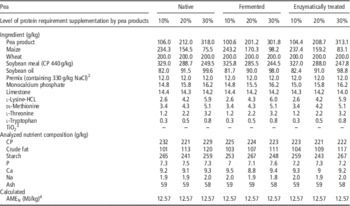
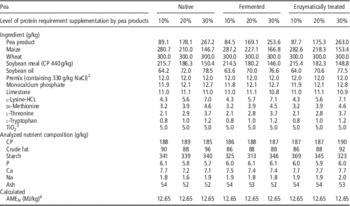
Nine starter (days 1 to 21) and nine grower (days 22 to 35) diets were formulated by supplying 10%, 20% and 30% of the required CP with three different pea products tested (native, fermented and enzymatically treated peas). The diets were formulated to be isocaloric and isonitrogenous for each phase and, meet or exceed the recommendations of the Society of Nutritional Physiology (GfE, 1999). The grower diet contained 5 g titanium dioxide per kg feed (Sigma Aldrich, St. Louis, MO, USA) as an indigestible marker to allow for the determination of ileal apparent nutrient digestibility. The compositions of the starter and grower experimental diets are shown in Tables 3 and 4, respectively.
Ingredients (g/kg unless noted) and analyzed nutrient composition of the starter (1 to 21 days) dietsFootnote 1

1 As-fed basis.
2 Contents per kg diet: 4800 IU vitamin A; 480 IU vitamin D3; 96 mg vitamin E (α-tocopherole acetate); 3.6 mg vitamin K3; 3 mg vitamin B1; 3 mg vitamin B2; 30 mg nicotinic acid; 4.8 mg vitamin B6; 24 µg vitamin B12; 300 µg biotin; 12 mg calcium pantothenic acid; 1.2 mg folic acid; 960 mg choline chloride; 60 mg Zn (zinc oxide); 24 mg Fe (iron carbonate); 72 mg Mn (manganese oxide); 14.4 mg Cu (copper sulfate-pentahydrate); 0.54 mg I (calcium iodate; 0.36 mg Co (cobalt- (II)-sulfate-heptahydrate); 0.42 mg Se (sodium selenite); 1.56 g Na (sodium chloride); 0.66 g Mg (magnesium oxide).
3 Indigestible marker (Sigma Aldrich, St. Louis, MO, USA).
4 Nitrogen-corrected apparent metabolizable energy estimated from chemical composition (based on the EU Regulation – Directive 86/174/EEC): 0.1551×% CP+0.3431×% crude fat+0.1669×% starch+0.1301×% total sugar.
Ingredients (g/kg unless noted) and analyzed nutrient composition of the grower (22 to 35 days) dietsFootnote 1

1 As-fed basis.
2 Contents per kg diet: 4800 IU vitamin A; 480 IU vitamin D3; 96 mg vitamin E (α-tocopherole acetate); 3.6 mg vitamin K3; 3 mg vitamin B1; 3 mg vitamin B2; 30 mg nicotinic acid; 4.8 mg vitamin B6; 24 µg vitamin B12; 300 µg biotin; 12 mg calcium pantothenic acid; 1.2 mg folic acid; 960 mg choline chloride; 60 mg Zn (zinc oxide); 24 mg Fe (iron carbonate); 72 mg Mn (manganese oxide); 14.4 mg Cu (copper sulfate-pentahydrate); 0.54 mg I (calcium iodate; 0.36 mg Co (cobalt-(II)-sulfate-heptahydrate); 0.42 mg Se (sodium selenite); 1.56 g Na (sodium chloride); 0.66 g Mg (magnesium oxide).
3 Indigestible marker (Sigma Aldrich, St. Louis, MO, USA).
4 Nitrogen-corrected apparent metabolizable energy estimated from chemical composition (based on the EU Regulation – Directive 86/174/EEC): 0.1551×% CP+0.3431×% crude fat+0.1669×% starch+0.1301×% total sugar.
One thousand and eighty, 1-day-old male broiler chicks (Cobb 500), were randomly allocated into 72 pens (2.20×1.80 m) with a softwood shaving floor. Using a completely randomized design with a 3×3 factorial arrangement of treatments, the nine different diets were randomly assigned to birds within pens (eight replicate-pens per diet).
The diets were offered in mash. The experiment lasted 35 days. The temperature was 33°C for the first 7 days of the experiment, after which the temperature was gradually reduced by 3°C per week until reaching 24°C. The lighting program consisted of full time light for the first 3 days and 20 h of light until day 7 and 16 h of light thereafter. All birds had access to the experimental diets and water ad libitum.
Performance measurements
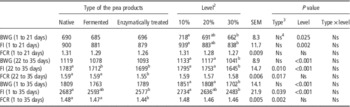
BWs of the chicks were recorded at day 1 and weekly during the experiment. Feed intake (FI) was recorded weekly and feed conversion ratio (FCR) was calculated. The birds were healthy in the entire experiment and the total mortality was about 2%. Performance variables are presented in Table 5.
Effect of the experimental diets on the performance variables (meanFootnote 1 values)

SEM=pooled standard error of mean; FCR=feed conversion ratio (g of feed intake/g of BW gain); FI=feed intake (g); BWG=BW gain (g)
a,bMeans of each main factors with different superscripts in a row differ significantly (P⩽0.05).
1 Data are means of eight replicate pens with 15 birds per pen.
2 Level of protein requirement supplementation by pea products.
3 Type of the pea products.
4 Not significant (P>0.05). Differences were considered significant at P⩽0.05.
Nutrient digestibility and relative organ size
At the end of the experiment, nine birds per pen were randomly selected, stunned and killed by exsanguination. The ileum was dissected from Meckel’s diverticulum to the ileo–caeco–colic junction and the digesta was collected from the distal 2/3 for the apparent ileal digestibility (AID) determinations. The digesta of all the birds within each pen were pooled and immediately frozen (−80°C) until further analysis. The pooled digesta was freeze dried before chemical analysis.
The following formula was used for AID calculation:
 $$\eqalignno{ & {\rm AID}\,{\rm of}\,{\rm nutrient{\,\equals\,} 1{\minus}[(concentration}\,{\rm of}\,{\rm marker}\,{\rm in}\,{\rm feed\,/\,} \cr & \quad\quad\quad\quad\quad\quad{\rm concentration}\,{\rm of}\,{\rm marker}\,{\rm in}\,{\rm ileum){\times}} \cr & \qquad\qquad\qquad{\rm (concentration}\,{\rm of}\,{\rm nutrient}\,{\rm in}\,{\rm ileum\,/\,} \cr & \qquad\qquad\qquad{\rm concentration}\,{\rm of}\,{\rm nutrient}\,{\rm in}\,{\rm feed)]} $$
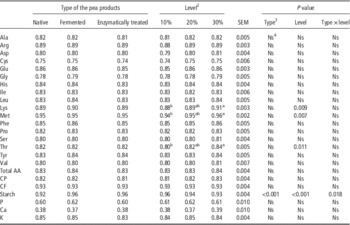
The AID of nutrients are presented in Table 6.
Effect of the experimental diets on the apparent ileal digestibility (AID) of nutrient (meanFootnote 1 values) in broilers (day 35)

SEM=pooled standard error of mean; AA=amino acids; CF=crude fat.
a,bMeans of each main factors with different superscripts in a row differ significantly (P⩽0.05).
1 Data are means of eight replicate pens. Pooled digesta of nine birds per pen.
2 Level of protein requirement supplementation by pea products.
3 Type of the pea products.
4 Not significant (P>0.05). Differences were considered significant at P⩽0.05.
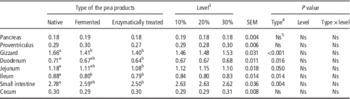
Another two birds per pen were weighed, and killed by exsanguination. Carcasses were dissected and the proventriculus, gizzard, duodenum, jejunum, ileum, cecum and pancreas were removed and their empty weights were recorded. Organ size was expressed as a percentage of live BW (Table 7).
Effect of the experimental diets on relative organ weight (day 35) of broilersFootnote 1 (meanFootnote 2 values)

SEM=pooled standard error of mean.
a,bMeans with different superscripts in a row differ significantly (P⩽0.05).
1 [Empty organ weight (g)/live BW (g)]×100.
2 Data are means of eight replicate pens (two birds per pen).
3 Level of protein requirement supplementation by pea products.
4 Type of the pea products.
5 Not significant (P>0.05). Differences were considered significant at P⩽0.05.
Chemical analysis
Basic composition analysis were conducted, using standard procedures (Naumann and Bassler, Reference Naumann and Bassler2004). A commercial enzymatic test (Starch UV-Test; R-Biopharm, Darmstadt, Germany) was applied to determine starch content (Naumann and Bassler, Reference Naumann and Bassler2004). The P content was measured using the ammonium vanadate/molybdate method (Gericke and Kurmies, Reference Gericke and Kurmies1952). Other minerals were analyzed by using an atomic absorption spectrophotometer (AAS vario®; Analytik Jena, Jena, Germany). TiO2 content was measured using the method described by Short et al. (Reference Short, Gorton, Wiseman and Boorman1996). The AA analyses were conducted using a Biochrom 20 Plus amino acid analyzer (Amersham Pharmacia Biotech, Piscataway, NJ, USA) using standard method (VDLUFA, 2003).
The soluble and insoluble NSP were determined using Englyst and Cummings (Reference Englyst and Cummings1984) method. The American Association of Cereal Chemists (2003) methods were used to determine RS (AACC 32-40.01) and total dietary fiber (TDF; AACC method 32-25 – Uppsala method). Trypsin inhibitor activity (TIA) was measured according to Kakade et al. (Reference Kakade, Rackis, McGhee and Puski1974) method. The α-galactosides content (in pea mainly raffinose, stachyose and verbascose) was determined via enzymatic assay (raffinose/d-galactose Assay Kit; Megazyme International, Bray, Ireland), presented as raffinose equivalent (RE). Phytate was analyzed using phytate (total P) assay kit (Megazyme International).
Determination of bacterial metabolites
Determination of short chain fatty acids was performed by gas chromatography (Agilent Technologies 6890N coupled with an auto sampler G2614A and an auto injector G2613A; Santa Clara, CA, USA) using standard procedure (Schäfer, Reference Schäfer1995). The column was an Agilent 19095N-123 HP-INNOWAX polyethylene glycol.
Following standard procedure, d- and l-lactate were determined by HPLC, using an Agilent 1100 system with a Phenomenex C18 (4.0×2.0 mm) guard column followed by a Phenomenex Chirex 3126 (d)-penicillamine column (150×4.6 mm) (Agilent Technologies). The UV detector wavelength was 253 nm and the column temperature was 35°C. The carrier was CuSO4 in a gradient from 0.5 to 2.5 mmol/l with a flow rate of 1 ml/min at 35°C and the injection volume was 20 µl.
Ammonia was quantified using the Berthelot reaction assay. Briefly, 20 µl of the sample was chlorinated with 100 µl of 0.2% alkaline hypochloride (Sigma Aldrich, Deisenhofen, Germany) to convert NH3 to chloramine (NH2Cl) following reaction with thymol to N-chloro-2-isopropyl-5-methylchinon-monoimin and further to indophenol using 100 µl of 5% phenol nitroprusside (Sigma Aldrich). After incubation for 100 min in microtitration plates at room temperature, a photometric measurement was carried out at 620 nm with a Tecan microtiterplate reader (Tecan Austria GmbH, Grödig, Austria).
Statistical analysis
Data were subjected to ANOVA using the GLM procedure of SPSS 19.0 (SPSS Inc., Chicago, IL, USA) as a 3×3 factorial arrangement of treatments that included three pea products (native, fermented or enzymatically treated pea) and three different inclusion levels (10%, 20% or 30% of diet’s CP) as the main effects and their interactions. Treatment means were separated by the Tukey least significant difference post hoc test at P⩽0.05 statistical level. Replicate-pen was the experimental unit for all variables measured.
Results
Influence of technological processing on nutrients and anti-nutritional factors of the pea products
Except a reduction in crude fat (CF) and a negligible increase in CP, no other notable changes for the main nutrients like AA and starch were observed for the both processed pea products. Both processes caused a minor increase in the concentration of P, Ca, K, Fe and partially Zn. The Na content of enzymatically treated pea was higher than native and fermented ones.
In accordance with pH value of fermented pea, which decreased from 6.34 down to 4.37 within 48 h incubation time, the concentration of acetic acid, l-lactate, d-lactate and ammonium in fermented pea were considerably higher than native pea. As expected, the pH value of the enzymatically treated pea did not vary with time (4.54±0.14).
The RE content of pea was reduced by 69% in the fermented end product (30.7 mol/g) and by 50% in the enzymatically treated one (48.9 mol/g). Fermentation decreased TIA in the pea (0.67 TIU mg/g) to approximately one third (0.23 TIU mg/g), whereas TIA in the enzymatically treated pea was ~25% (0.50 TIU mg/g) lower than the native pea. Enzymatic treatment caused a 49% reduction in phytic acid concentration, whereas the reduction by fermentation process was only of 16% (0.92 g phytate/100 g native pea).
Both processes caused a slight increase in S-NSP and a slight reduction in I-NSP and TDF, with reductions being more pronounced for the enzymatically treated pea. Moreover, a remarkable decrease in RS was observed in both processed peas (more than 75% reduction).
Broiler performance
Increasing the level of dietary peas in the diets up to 30% reduced BWG and FI of broilers (P⩽0.05). Pea processing decreased FI after day 21 (P⩽0.05), whereas broilers fed enzymatically treated pea had the best FCR for the growing and entire experimental period (P⩽0.05). At the end of the experiment, FI of birds fed enzymatically treated pea diets was considerably lower than those received native pea diets (P⩽0.05).
Apparent ileal nutrient digestibility and relative organ size
The AID of Thr, Lys and Met at 30% inclusion level was higher than 10% inclusion group (P⩽0.05). The interaction between type of the pea products and inclusion levels of peas was only significant for the AID of starch (P⩽0.05). Chicken fed 30% native pea diet had the lowest AID of starch (0.89) among all the nine groups and chicken fed 10% fermented and enzymatically treated pea diets (0.97 and 0.97, respectively) had higher AID of starch compared with 20% and 30% native pea groups (0.93 and 0.89, respectively). In native pea groups, AID of starch for 20% (0.93) and 30% (0.89) native pea diets were similar but 10% native pea diet (0.95) showed similar AID to 20% and higher AID than 30% one (P⩽0.05). In fermented pea groups (0.97, 0.95 and 0.95, respectively) as well as enzymatically treated groups (0.97, 0.96 and 0.96, respectively), all three levels had identical AID of starch.
The size of gizzard, duodenum, jejunum and ileum, were significantly lower for birds fed enzymatically treated pea compared with those received native pea (P⩽0.05). The size of gizzard and ileum in broilers received fermented pea diets followed the course observed for those fed enzymatically treated peas (P⩽0.05).
Discussion
Fermentation processes to improve nutritional quality of legumes, particularly soybean, have been studied for long (Feng et al., Reference Feng, Liu, Xu, Wang and Liu2007). The application of exogenous enzymes in poultry diets to overcome the negative impacts of ANF substances and improve the nutritional quality of feed is a common practice in poultry feed production. The main limits for optimal enzyme responses in poultry nutrition seem to be the retention time and variable pH in the different segments of the GIT (Adeola and Cowieson, 2011). Selective treatment by enzymes and also fermentation of SBM could eliminate the allergenic proteins and soluble carbohydrates, and led to a reduction in fiber, TI, oligosaccharides and lectins (Berrocoso et al., Reference Berrocoso, Serrano, Cámara, López and Mateos2013), consequently, they could improve growth performance and nutrient digestibility in poultry (Frikha et al., Reference Frikha, Valencia, de Coca-Sinova, Lázaro and Mateos2013). Subjecting pea to fermentation with probiotic microorganisms or treatment with appropriate exogenous enzymes, may be a sound alternative to improve feeding value of plant protein sources to replace SBM in poultry diet.
Fermentation of African locust bean (Parkia biglobosa) at pH 7.5 to 9 by different Bacillus subtilis subspecies increased essential AA and unsaturated fatty acids, for example linoleic and linolenic acids content, and also decreased oligosaccharides (Ouoba et al., Reference Ouoba, Cantor, Diawara, Traore and Jakobsen2003 and Reference Ouoba, Diawara, Christensen, Mikkelsen and Jakobsen2007). Fermentation of RSM with Lactobacillus fermentum and B. subtilis increased CP, Lys, sulfur AA and considerably decreased isothiocyanates (from 108.7 to 13.1 mmol/kg) (Xu et al., Reference Xu, Zeng and Ding2012). In the present study none of the two processes modified the AA content of the peas, except a reduction in CF and a slight increase in CP. Since the alteration in fat content was also presented in the not fermented samples (enzymatically treated sample), it is very likely that fat reduction was due to the lipase activity of peas. This is in accordance with other study which reported a distinct reduction of lipids and an increase in lipase activity during fermentation of soybean by its associated (native flora – no bacteria added) microorganisms (Ruiz-Teran and Owens, Reference Ruiz-Teran and Owens1996). In the present study, the reason for observed minor increases in the concentration of analyzed minerals by the processes is not clear. Fermentation and enzymatic treatment of pea in lab scale did not cause any change in ash content of the final products (unpublished data). Thus, considering the amount of water used for pea dough production (50%), this minor increases might be explained by mineral content of the water in the production site (Jäckering Mühlen- und Nährmittelwerke GmbH, Hamm, Germany) and also wear of metallic pieces in the Ultra-Rotor dryer. Increase in mineral content of poultry feed due to the wear of metallic pieces in hydrothermal processing machines has been reported before (Goodarzi Boroojeni et al., Reference Goodarzi Boroojeni, Svihus, von Reichenbach and Zentek2016). Both types of pea processing resulted in a remarkable decrease in RS. The slight reductions in I-NSP and TDF of the processed peas were more pronounced for the enzymatically treated pea than the fermented one. Enzymatic treatment reduced TIA and phytic acid by 25% and 49%, while these were reduced by 66% and 16% in the fermented pea. The RE was reduced by 50% and 69% in the enzymatically treated and fermented peas, respectively. The results are in accordance with recent study which showed that SSF of SBM with B. subtilis decreased the TIA of SBM up to 95% (Teng et al., Reference Teng, Gao, Yang, Liu, Tian and Wang2012). The changes in phytic acid, RE, I-NSP and TDF might be explained by activation of exogenous/microbial enzymes and pea’s endogenous enzymes. Furthermore, the acidic pH value in the processed peas might have induced an increase in activity of endogenous amylase and phytase (Selle et al., Reference Selle, Ravindran, Caldwell and Bryden2000; Adeola and Cowieson, 2011). The drastic pH drop during the SSF process seemed to be due to the accumulation of lactic and acetic acids, caused by the metabolic activity of native and added microorganisms (Ying et al., Reference Ying, Zhu, Lu and Gong2009). The high concentration of acetic and l-lactic acids in the enzymatically treated pea was mainly due to the addition of organic acids during the processing. The increase of ammonium, valeric and d-lactic acids by enzymatic treatment could be because of activity and proliferation of the pea’s native microflora as well as existent microorganisms in the production environment, which were able to survive and maintain their metabolic activity at the created acidic pH (4.5).
The information available regarding the effects of enzymatic treatment on nutrient and ANF composition of peas is scarce. In a broiler study, enzymatic treatment of pea with several carbohydrase enzymes (i.e. cellulase, pectinase, xylanase, glucanase, galactanase, and mannanase) and their combinations reduced arabinose, xylose, galactose, glucose, uronic acids and total NSP. These reductions were more pronounced when a combination of enzymes was used (Meng et al., Reference Meng, Slominski, Nyachoti, Campbell and Guenter2005). In another broiler study, soaking of barley for 24 h at room temperature with a commercial complex (with protease, xylanase and β-glucanase activity) reduced acid extract viscosity as well as soluble, insoluble and total β-glucan concentration in barley (Svihus et al., Reference Svihus, Newman and Newman1997). Treatment of brewers’ spent grain with xylanase for 3 h reduced the concentration of xylose and arabinose by 15% to 30% (Denstadli et al., Reference Denstadli, Westereng, Biniyam, Ballance, Knutsen and Svihus2010).
Inclusion of processed peas in the diets reduced FI during the growing period, with birds fed enzymatically treated pea showing the best FCR for the growing (days 22 to 35) and entire experimental period. Treatment of whole barley with a mixture of protease, xylanase and β-glucanase improved BWG and FCR in broiler chicks (Svihus et al., Reference Svihus, Newman and Newman1997), whereas in another study inclusion of enzymatically treated (with xylanase) brewers’ spent grain in broiler diets increased FI with no beneficial impact on BWG and FCR (Denstadli et al., Reference Denstadli, Westereng, Biniyam, Ballance, Knutsen and Svihus2010). The observed FCR improvement in the enzymatically treated group might be due to the observed lower FI or/and the lower concentrations of ANF in the enzymatically treated peas as well as the degradation effect of supplemented enzymes on complex nutrients. In an experiment, Chen et al. (Reference Chen, Kho, You, Yeh, Tang and Hsieh2009) investigated whether the beneficial effect of fermented feed on broiler growth performance was because of the probiotics per se or the fermentation process. Inclusion of probiotic, with similar microflora population to the fermented feed, did not enhance growth performance as much as fermented feed did. The authors explained this observation by degradation effect of fermentation process on complex material and production of beneficial substances for broiler growth and health. In the present study, inclusion of fermented pea in broiler diets did not improve growth performance and nutrient digestibility. The total tract apparent digestibility of DM, energy and Ca were higher in broilers received SSF RSM than in those fed native RSM (Chiang et al., Reference Chiang, Lu, Piao, Hu, Gong and Thacker2010). Chickens fed fermented SBM with Aspergillus oryzae showed better FI, BWG and FCR compared with those received native SBM (Feng et al., Reference Feng, Liu, Xu, Wang and Liu2007). Broilers fed diets containing 10% fermented RSM (with L. fermentum, Enterococcus faecium, Saccharomyces cerevisae and B. subtilis) had better BWG and FCR compared with those fed diets containing 10% native RSM (Chiang et al., Reference Chiang, Lu, Piao, Hu, Gong and Thacker2010). The BWG and FCR of broilers fed diets containing 15% fermented RSM were worse than those received feed containing 0, 5 and 10% fermented RSM, while the other three groups (0%, 5% and 10%) were similar (Xu et al., Reference Xu, Zeng and Ding2012).
The interaction between type of the pea products and inclusion levels of peas was significant for AID of starch. Increasing in inclusion level of native pea in broiler diets form 10% to 30% reduced AID of starch. In agreement with the present results, Brenes et al. (Reference Brenes, Rotter, Marquardt and Guenter1993) and Igbasan and Guenter (Reference Igbasan and Guenter1996) showed that inclusion of native pea in broiler diets resulted in significant reduction of ileal starch digestbility. This reduction in AID of starch by increasing inclusion level was not observable anymore when fermented and enzymatically treated peas were used in broiler diets. This might be explained by the reduction of RS as well as starch swelling and gelatinization that might have happened during processing and drying. In a review manuscript, it was demonstrated that the temperature threshold for the stabilization of starch gelatinization has a negative correlation with the starch hydration (Abdollahi et al., Reference Adeola and Cowieson2013). For instance, at excess water content (above 40%), the starch gelatinization was stabilized at a temperature between 50°C and 70°C. This temperature increased to above 100°C with <35% water content (Svihus et al., Reference Svihus, Hetland, Choct and Sundby2005). Processed peas in the present study were incubated in a moist condition (>40% water content) and were dried using a relatively mild thermal and shear treatments (<75°C for <3 s). The applied production and drying conditions might lead to starch swelling and partial gelatinization which may have caused alteration in starch digestibility.
In the present study, the inclusion level of pea products had no remarkable effect on digestibility of AA. The observed increase in the AID of Thr, Lys and Met in the 30% inclusion group seemed to be only due to the higher levels of crystalline Thr, Lys and Met in 30% inclusion diets. Furthermore, 30% inclusion group had lower FI and BWG compared with 10% inclusion group. It has been recommended that peas can be used up to 200 g/kg in broiler diet as a protein source with no negative impact on growth performance (Nalle et al., Reference Nalle, Ravindran and Ravindran2011). In a review paper, the maximum inclusion level of 200 g/kg peas in broiler diets has been recommended (Castell et al., Reference Castell, Guenter and Igbasan1996), while in another study the maximum inclusion level of 300 g/kg in broiler diets was suggested (Farrell et al., Reference Farrell, Perez-Maldonado and Mannion1999). Increase in inclusion levels of whole canola/pea mixture (0, 100, 200 or 300 g/kg) in broiler diets linearly declined BWG and curvilinearly FI, while the reduction in FI was most apparent at higher concentrations (Fasina and Campbell, Reference Fasina and Campbell1997).
It is a well-documented phenomenon that the GIT of broilers adapts quickly to the alterations in diet structure and composition (Svihus, Reference Svihus2011). The lower relative organ weight of the different gut sections in both processed pea groups, particularly for birds fed enzymatically treated pea, could be explained by observed reduction in ANF, degradation of complex material and better availability of nutrients in the processed peas. It has been reported that a decrease in ANF content of feed could lead to reduction in digesta viscosity, alteration in the gut microbiota and changes in the morphology of the digestive tract (Svihus et al., Reference Svihus, Newman and Newman1997; Bedford and Cowieson, Reference Bedford and Cowieson2012). In agreement with the present data, broilers fed enzymatically treated barley diets had lower relative gizzard and small intestine weights as well as similar relative cecum and pancreas weights compared with broilers fed native barley diets (Svihus et al., Reference Svihus, Newman and Newman1997). Gizzard development is directly related to the feed particle size. Fine feed particles in poultry diets coincide with gizzard under-development (Svihus, Reference Svihus2011). In the present study, the Ultra-Rotor dryer mill which has been used to dry fermented and enzymatically treated peas, simultaneously milled and dried the material. Therefore the final particle sizes of the processed peas were considerably smaller than the initial particle size of the ground native pea which has been used for production of the processed peas as well as the native pea diets in the animal trial. As the particle sizes of wheat, corn and other feed ingredients used in broiler diets were similar, it can be speculated that finer particle sizes of fermented and enzymatically treated peas led to poor gizzard development.
Fermentation and enzymatic treatment could improve the nutritional quality of pea by reduction in ANFs. Furthermore, taken into account insignificant interactions between type of the pea products and inclusion levels for variables measured (except for ileal starch digestibility), it can be concluded that inclusion of enzymatically treated pea in broiler diets could improve broiler performance compared with other pea products while, it showed neither positive nor negative impact on nutrients digestibility. However, the mode of action for feed efficiency improvement by inclusion of enzymatically treated pea is not clear enough and needs to be studied further. The present findings indicate the feasibility of these processes, particularly enzymatic treatment, for improving the nutritional quality of pea as a protein source for broiler nutrition.
Acknowledgment
This work has been funded by CORNET through AiF Projekt GmbH (106 EN/1 (OE142/13a)). The authors express deep appreciation to Dr W. Vahjen, Dr T. Roick, Dr J. Jacobi, Dr S. Rohn, A. Kriesten, K. Topp, L. Rod, I. Bebert, C. Schmidt, P. Feige and I. Bayram for technical support during the animal experiment and laboratory analysis.