INTRODUCTION
Parasites are known to directly decrease their host fitness. In addition they may also influence community structures through the regulation of keystone species, or modify competitive interactions and biodiversity patterns (e.g. Poulin, Reference Poulin1999; Preston and Johnson, Reference Preston and Johnson2012). Considering that more than 50% of living organisms are estimated to be parasites (Price, Reference Price1980), their impact on food webs within an ecosystem are considerable. Thus there is a growing interest in the role of parasites in modulating biological invasions (e.g. Dunn and Perkins, Reference Dunn and Perkins2012). Populations of exotic species may either escape their typical parasites during the translocation process because of sampling bottlenecks, or be less sensitive to parasites present in colonized areas, i.e. the parasite release hypothesis (PRH). This phenomenon may result in an increase of the invasion success (e.g. review in Torchin and Mitchell, Reference Torchin and Mitchell2004).
Although many reports of PRH have been documented (MacLeod et al. Reference MacLeod, Paterson, Tompkins and Duncan2010) the co-introduction of a host and parasite are also common (Dunn, Reference Dunn2009). Co-introduced parasites can affect the new community. They may be a potential threat to the local fauna as an emerging disease (Tompkins et al. Reference Tompkins, White and Boots2003; Bacela-Spychalska et al. Reference Bacela-Spychalska, Wattier, Genton and Rigaud2012), or the ‘invasive’ parasite may control the population size of its invasive host and limit its negative impact on the newly colonized community (Goddard et al. Reference Goddard, Torchin, Kuris and Lafferty2005). In addition there are indirect moderations of the relationships among species composing the community and from parasites affecting a host's behaviour, especially when the host is a key species in the food-web (Prenter et al. Reference Prenter, MacNeil, Dick and Dunn2004; Hatcher et al. Reference Hatcher, Dick and Dunn2006). Parasites infecting predators are of particular interest in ecosystems since they may indirectly affect prey populations through host behaviour moderations. Assemblages including amphipod crustaceans are well described (e.g. Dick et al. Reference Dick, Armstrong, Clarke, Farnsworth, Hatcher, Ennis, Kelly and Dunn2010; Médoc et al. Reference Médoc, Piscart, Maazouzi, Simon and Beisel2011). In these amphipods, phylogenetically diverse parasites such as microsporidia and acanthocephalans alter predation rates of infected individuals in different ways, a phenomenon that will also depend on the native or invasive nature of their hosts. Médoc et al. (Reference Médoc, Piscart, Maazouzi, Simon and Beisel2011) showed that the acanthocephalan Polymorphus minutus affects the diet and therefore the trophic ecology of its invasive host Gammarus roeseli. Another acanthocephalan, Pomphorhynchus laevis may either decrease (Fielding et al. Reference Fielding, MacNeil, Dick, Elwood, Riddell and Dunn2003) or increase (Dick et al. Reference Dick, Armstrong, Clarke, Farnsworth, Hatcher, Ennis, Kelly and Dunn2010) the predatory impact of the infected individuals of the invasive species Gammarus pulex. Studies of MacNeil et al. (Reference MacNeil, Fielding, Dick, Briffa, Prenter, Hatcher and Dunn2003) demonstrated that when infected by a microsporidian, Gammarus duebeni celticus, that is native to Ireland, it will not only reduce this species predation on two small gammarid invaders, but will also facilitate its own predation by another invasive species G. pulex. The coexistence of different gammarid species is therefore mediated by the parasite's ability to modulate intraguild predation (Hatcher et al. Reference Hatcher, Dick and Dunn2008; MacNeil and Dick, Reference MacNeil and Dick2011).
Studies conducted here were used to determine if a co-invasive parasite will modulate the behaviour of its host: i.e. in the predatory behaviour of the amphipod Dikerogammarus villosus (Sowinsky 1894). This invader, of Ponto-Caspian origin, has dispersed successfully to the main waterways of Western and Central Europe within two decades (Bollache et al. Reference Bollache, Devin, Wattier, Chovet, Beisel, Moreteau and Rigaud2004; Grabowski et al. Reference Grabowski, Jazdzewski and Konopacka2007) and was found recently in England (MacNeil et al. Reference MacNeil, Platvoet, Dick, Fielding, Constable, Hall, Aldridge, Renals and Diamond2010). Its arrival has led to drastic changes in macroinvertebrate communities, outnumbering other taxa in these newly colonized ecosystems (Dick and Platvoet, Reference Dick and Platvoet2000; Bollache et al. Reference Bollache, Devin, Wattier, Chovet, Beisel, Moreteau and Rigaud2004). This was facilitated by its high fecundity, short maturation time, and above all, by its extremely effective predatory behaviour (Bollache et al. Reference Bollache, Dick, Farnsworth and Montgomery2008; Pöckl, Reference Pöckl2009; Van der Velde et al. Reference Van der Velde, Leuven, Platvoet, Bacela, Huijbregts, Hendriks and Kruijt2009). The microsporidian parasite Cucumispora dikerogammari (Ovcharenko and Kurandina 1987) infects D. villosus in its native habitats but also spread successfully with this host throughout Europe (Wattier et al. Reference Wattier, Haine, Beguet, Martin, Bollache, Musko, Platvoet and Rigaud2007; Ovcharenko et al. Reference Ovcharenko, Bacela, Wilkinson, Ironside, Rigaud and Wattier2010). This muscle-infecting parasite is virulent to its host and is mainly trophically transmitted, with D. villosus being easily infected after consumption of parasitized conspecific (Bacela-Spychalska et al. Reference Bacela-Spychalska, Wattier, Genton and Rigaud2012). After infection, the parasite will eventually kill its host along with intense within-host multiplication, but as compensatory response, infected females of D. villosus will reproduce earlier (Bacela-Spychalska et al. Reference Bacela-Spychalska, Wattier, Genton and Rigaud2012). A recent theoretical model suggests that an infectious pathogen infecting a predator will strongly stabilize the dynamics of a predator–prey system, provided that the fitness of infected predators is not zero and that infected individuals are less effective predators than uninfected individuals (Kooi et al. Reference Kooi, van Voorn and Das2011). We tested if C. dikerogammari influences the predatory behaviour of D. villosus, as a proxy for parasite-modulation of the invader's impact on prey communities. Since parasite-induced feeding rate may be a by-product of the pathogenic effect of the parasite, we also tested if the host locomotory activity is reduced by the infection.
METHODS
Sampling, acclimatization and infected status
Dikerogammarus villosus were sampled in 2008 in a Reservoir on the Bug River in Zegrze, Poland (52°23′1.52″N; 20°11′7.03″E). Before the experiments began, specimens were kept in the laboratory for acclimatization for 48 h under stable conditions (15±1 °C, light:dark cycle 12:12 h) in a tank filled with de-chlorinated, UV-treated and aerated tap water. Animals were fed ad libitum with a mixture of frozen commercial chironomid larvae (Katrinex, Poland), decaying oak leaves and commercial fish food pellets (SERA, Germany). For the experiments, three categories of animals were determined: I WS – infected with phenotypic signs of infection, I NS – infected with no phenotypic signs of infection and U – Uninfected. The first group consisted of 30 adult animals showing visible signs of the disease (as described by Ovcharenko et al. Reference Ovcharenko, Bacela, Wilkinson, Ironside, Rigaud and Wattier2010) associated with late stages of infection. However early-stage infected animals cannot be distinguished phenotypically from uninfected animals. Therefore, to ensure comparable sample sizes with I WS animals, given that the prevalence in the natural population was around 50% (Bacela-Spychalska et al. Reference Bacela-Spychalska, Wattier, Genton and Rigaud2012), 60 non I WS animals were taken. Infection status of all animals was checked after the experiments, using a PCR–RFLP diagnostic method as described by Ovcharenko et al. (Reference Ovcharenko, Bacela, Wilkinson, Ironside, Rigaud and Wattier2010). All 90 individuals were isolated in small individual chambers (6 cm diameter) filled with aerated water. Light and temperature were the same as during acclimatization.
Experiment 1: activity
To measure activity level, animals were placed individually in horizontal transparent glass tubes (length 23 cm and diameter 3 cm) filled with aerated water.
After a 5 min acclimatization period, the activity of each specimen was measured as the number of crosses of a line partitioning the tube in two equal volume areas over 3 bouts of 2 min, each separated by 2 min without recording (adapted from Fielding et al. Reference Fielding, MacNeil, Robinson, Dick, Elwood, Terry, Ruiz and Dunn2005). Animals were then relocated to their individual chamber and left without food for 12 h.
Experiment 2: predation
Each D. villosus individual was given eight live chironomid larvae, a prey species known for D. villosus. Krisp and Maier (Reference Krisp and Maier2005) have shown that D. villosus can consume up to eight prey items under typical temperatures (as used in this study) over a 24 h period. The number of larvae eaten was noted after 1, 6 and 24 h. Individuals which moulted during the experiment were excluded from the analysis.
After this second experiment was completed, the sex of each individual was determined (using setosity of antennae 2). Specimens were then measured (linear dimension of the fourth coxal plate, see Bollache et al. Reference Bollache, Gambade and Cezilly2000) using a stereoscopic microscope (Nikon SMZ 1500) and Lucia G 4.81 software. Individuals were then anaesthetized with CO2-saturated water, and placed individually in 1·5 mL tubes filled with pure ethanol for subsequent infection status and parasite species diagnostic PCR-RFLP analysis, as described in Ovcharenko et al. (Reference Ovcharenko, Bacela, Wilkinson, Ironside, Rigaud and Wattier2010).
Statistical analyses
Activity data were analysed using non-parametric tests since homoscedasticity conditions were not met, even after transformations (Wilcoxon signed-rank test for analysing repeated measurements, Kruskal–Wallis tests for comparison among groups and Spearman's correlation). Analysis of predation data was made using a linear model for repeated measures, with infection status and sex as factors and size as a co-variable. Statistical analyses were done using JMP 6.0 software (SAS Institute).
RESULTS
Among the animals with no phenotypic signs of infection, the diagnostic PCR–RFLP revealed that 29 individuals did not harbour parasite (U) while 31 were infected (I NS). All infected individuals (including the 29 with visible signs) were only infected by C. dikerogammari microsporidia.
Repeated measures analyses on activity revealed no significant difference over time (Wilcoxon signed-rank test between the first two measures and between the second and the third, T = 74·5, N = 89, P = 0·20 and T = 47·5, N = 89, P = 0·45, respectively). The sums of the scores from the three replicates were therefore used as the activity index. The I WS individuals were more active than U or I NS individuals (Kruskal–Wallis test: χ 2 2 = 14·72, P = 0·0006, N = 29, 29 and 31, respectively) (Fig. 1). Males were also slightly more active than females (median and interquartile range were 1 [0–14] and 0 [0–2·75], respectively, Wilcoxon test: z = −2·10, P = 0·036, N = 45 and 44, respectively), but we found no relationship between gammarid size and activity (Spearman's correlation: r s = 0·07, P = 0·50, N = 89).
Activity of Dikerogammarus villosus according to their infection status by Cucumisprora dikerogammari. U: uninfected; I NS: infected but with no phenotypic signs of infection; I WS: infected with phenotypic signs of infection.

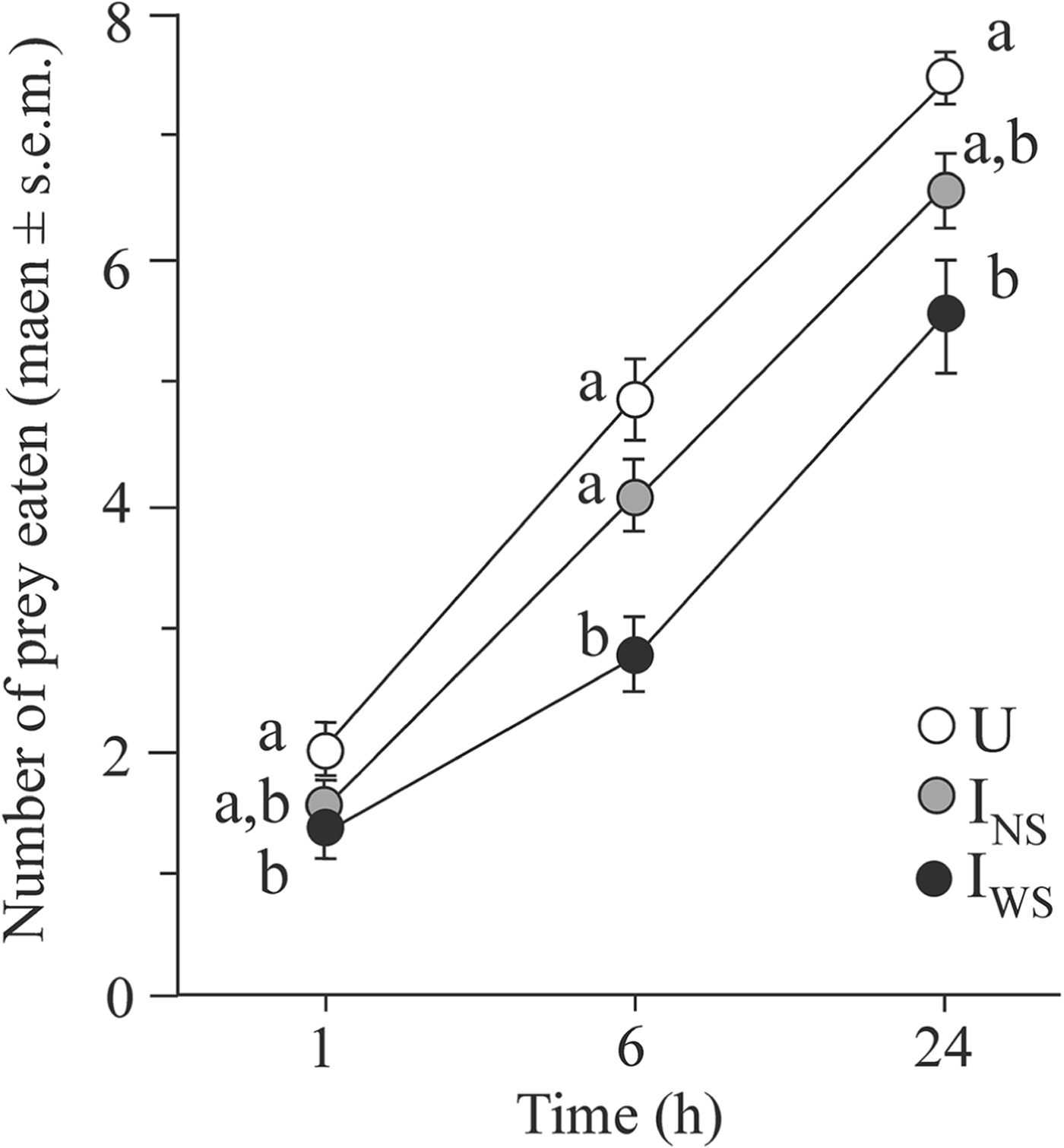
For the predation rate, the ‘size’ covariate and the ‘sex’ factor were not significant, nor were the interactions among variables. Thus they were removed from model. Predation rate was significantly different according to the infection status (F 2, 86 = 11·98, P<0·0001) and increased with time (F 2, 85 = 12·81, P<0·0001). The interaction between time and infection status was significant (Pilai's trace: F 4, 172 = 6·98, P<0·0001). It was demonstrated that the I WS gammarids preyed significantly less on chironomids compared with the U ones, while the predation rate of I NS individuals was intermediate between these two values (Fig. 2). In addition, while the predation pressure increased constantly with time for U individuals, I WS animals preyed less in the first 6 h of the experiment.
Number of prey eaten by Dikerogammarus villosus according to time, and according to their infection status by Cucumisprora dikerogammari. U: uninfected; I NS: infected but with no phenotypic signs of infection; I WS: infected with phenotypic signs of infection. At each time, values followed by the same letters were not significantly different after a Tukey HSD post-hoc test at α = 0·05.

Finally, we found no correlation between the level of activity and the intensity of feeding rate at 24 h, whatever the infection status was (r s = −0·29, P = 0·12 for U, N = 29; r s = 0·02, P = 0·90 for I NS, N = 31; r s = 0·32, P = 0·09 for I WS, N = 29).
DISCUSSION
We suggest that a parasite co-introduced with its invasive host will significantly modify its activity and predatory behaviour.
Dikerogammarus villosus, at a late stage of infection by C. dikerogammari, are much more active than early-stage infected and uninfected individuals. This pattern is opposite from what was observed by Fielding et al. (Reference Fielding, MacNeil, Robinson, Dick, Elwood, Terry, Ruiz and Dunn2005) in G. duebeni celticus that was infected with Pleistophora mulleri, a microsporidia that will necrotize the host's muscles. Although there are similarities in the description of infection signs (Terry et al. Reference Terry, MacNeil, Dick, Simth and Dunn2003; Ovcharenko et al. Reference Ovcharenko, Bacela, Wilkinson, Ironside, Rigaud and Wattier2010) the differing results in infections are difficult to explain. It is possible however, that these parasites have a different location in host muscles, have a different impact on their functioning, or that the muscle tissue response for the infection varies (e.g. Bulnheim, Reference Bulnheim1975). However our results here, nor any other published study for that matter, cannot support these hypotheses. In the current study, an increase in activity after infection could have been associated with increased foraging, since microsporidia are known to impose a metabolic demand on their host (e.g. Naug and Gibbs, Reference Naug and Gibbs2009). However, such an association between activity and foraging is not always shown after parasitic infection (e.g. larvae of freshwater mussels infecting the gills of rainbow darters, Crane et al. Reference Crane, Fritts, Mathis, Lisek and Barnhart2011), and we found no relationship between activity and predation behaviour in our study. Another possible explanation for this higher activity of infected D. villosus could be the parasite ‘manipulation’ of the host itself. Several parasite groups are known to increase their transmission rate by inducing various behavioural changes in their hosts (e.g. Thomas et al. Reference Thomas, Adamo and Moore2005). Could it be the case for C. dikerogammari? This parasite is transmitted mainly trophically with the uninfected host becoming infected after consuming its dead infected conspecifics (Bacela-Spychalska et al. Reference Bacela-Spychalska, Wattier, Genton and Rigaud2012). Dikerogammarus villosus are living mainly under stones and hunting from individual shelters (Platvoet et al. Reference Platvoet, Dick, MacNeil, Van Riel and Van der Velde2009). Therefore, parasites of C. dikerogammari could benefit by mediating the host's move from its shelter before dying, thus increasing the probability of consumption by conspecifics, which would in turn promote parasite transmission. In line with this hypothesis, higher activity was observed only when the body of the host is full of spores (the transmission stage). However, additional studies are needed to understand this behavioural change, which could, after all, just be a behavioural disorder with no translation in parasite transmission.
Heavily infected D. villosus exert a lower predation rate on chironomid larvae compared with healthy individuals. Animals at an early stage of infection show an intermediate behaviour between these extreme categories. While parasites may increase feeding activity in their hosts (Bernot and Lamberti, Reference Bernot and Lamberti2008; Naug and Gibbs, Reference Naug and Gibbs2009; Dick et al. Reference Dick, Armstrong, Clarke, Farnsworth, Hatcher, Ennis, Kelly and Dunn2010), many other studies reported a decrease in food consumption (Kyriazakis et al. Reference Kyriazakis, Tolkamp and Hutchings1998), and notably in gammarids (Fielding et al. Reference Fielding, MacNeil, Dick, Elwood, Riddell and Dunn2003, Reference Fielding, MacNeil, Robinson, Dick, Elwood, Terry, Ruiz and Dunn2005; MacNeil et al. Reference MacNeil, Fielding, Dick, Briffa, Prenter, Hatcher and Dunn2003). However in such studies this lower predation rate was explained by the decrease of activity, as muscles are damaged by the presence of parasite spores (Terry et al. Reference Terry, MacNeil, Dick, Simth and Dunn2003). In our case the situation is definitely different as these most infected individuals were also the most active.
Whatever the underlying causes for this change in predation rate, consequences can be important for resident macroinvertebrate communities affected by D. villosus. This predator is ranked high in the food web (Van Riel et al. Reference Van Riel, Van der Velde, Rajagopal, Marguiller, Dehairs and Bij de Vaate2006) and its introduction is usually associated with the displacement of other macroinvertebrates from the assemblages (e.g. Dick and Platvoet, Reference Dick and Platvoet2000). Thus we may expect that a high prevalence of C. dikerogammari may significantly decrease D. villosus’ impact on invaded ecosystems, as suggested by the model of Kooi et al. (Reference Kooi, van Voorn and Das2011). In another predatory–prey system involving amphipods, field studies were congruent with experimental data: the parasite-induced reduction of predation allowed the co-existence of predators and prey (MacNeil and Dick, Reference MacNeil and Dick2011). Cucumispora dikerogammari is a parasite present in most D. villosus populations (Wattier et al. Reference Wattier, Haine, Beguet, Martin, Bollache, Musko, Platvoet and Rigaud2007). Its prevalence may exceed 50% locally (Bacela-Spychalska et al. Reference Bacela-Spychalska, Wattier, Genton and Rigaud2012) and in those situations we may expect that the predatory pressure exerted by D. villosus is significantly reduced when compared with parasite-free populations. Furthermore this parasite in D. villosus will negatively impact its survival (Bacela-Spychalska et al. Reference Bacela-Spychalska, Wattier, Genton and Rigaud2012). Nevertheless D. villosus is known to prey upon a wide range of invertebrate species (e.g. Boets et al. Reference Boets, Lock, Marjolein Messiaen and Goethals2010). Our experiment, although limited to only one prey species, does not allow for too much generalization because the predatory behaviour as seen in D. villosus might not be the same towards all types of prey. However, our results are conservative since D. villosus preferentially prey upon on slow-moving animals, among which chironomids appear to be a preference (Boets et al. Reference Boets, Lock, Marjolein Messiaen and Goethals2010). The host (D. villosus) – parasite (C. dikerogammari) relationship could therefore provide an example where a co-invasive parasite could limit the impact of its invasive host on native biodiversity. The co-occurrence of D. villosus with other macroinvertebrates at a local scale (and not only at a regional scale as shown by Piscart et al. Reference Piscart, Bergerot, Laffaille and Marmonier2010), in cases of high infection rate by C. dikerogammari (Bacela-Spychalska et al. Reference Bacela-Spychalska, Wattier, Genton and Rigaud2012) supports our conclusions.
ACKNOWLEDGEMENTS
We thank Dr J. T. A. Dick and Dr A. Baldinger, and two anonymous reviewers for their valuable comments on a previous version of the manuscript.
FINANCIAL SUPPORT
A post-doctoral grant (Région Bourgogne grant no. 07HCP 59) and the French Foreign Office (Egide grant no. 604506E) funded Karolina Bacela-Spychalska.