Introduction
Wellbeing is a holistic concept defined as the quality of life for an individual or societal group. These factors can be defined differently depending on purpose; and in social, culture, environment and political contexts (Organisation for Economic Co-operation and Development [OECD], 2011). Measures of wellbeing can be subjective or objective and cover the many different aspects of life that contribute to its quality including health, education, employment, economy as well as other social and cultural factors (OECD, 2011). In Australia, Aboriginal and Torres Strait Islander people score well below national averages on mainstream indicators of wellbeing, with the lowest outcomes recorded in remote communities (Steering Committee for the Review of Government Service Provision [SCRGSP], 2014). Consequently, government policy has focused on reducing inequities across education, employment and health outcomes with little gain recorded despite significant investment (Department of Prime Minister and Cabinet [DPMC], 2017).
Social determinants including education and employment strongly influence health outcomes, particularly in underprivileged groups such as Aboriginal and Torres Strait Islander people (Marmot, Reference Marmot2011). Reduced access to power and resources are considered to be key mediators in these relationships (Marmot, Reference Marmot2011). According to Marmot (Reference Marmot2011), it is fundamentally important to create the conditions that enable people to take control of their own lives and live lives they value. Education and employment are therefore both identified determinants for health, as is the need for people to have control over their own lives – defined as empowerment – however there is less empirical evidence for the latter (Marmot, Reference Marmot2011).
Mainstream measures of success in education include attendance, retention rates and standardised test results. These measures have been challenged in this context as they do not take into account Aboriginal and Torres Strait Islander peoples knowledge and practices, including local languages, and community aspirations (Guenther, Reference Guenther2015a; Osborne & Guenther, Reference Osborne and Guenther2013; Wilson, Guenther, & Cairney, Reference Wilson, Guenther and Cairney2016). McRae-Williams (Reference McRae-Williams2014) notes that conventional education to employment pathways are ‘. . . inherently challenging for Aboriginal and/or Torres Strait Islander peoples in remote communities, (and) . . .(a) spirations for belonging to family, community and country which shape economic engagement can be overlooked by a system that values different goal orientations and privileges certain ways of getting there’ (p. 1).
In our previous research, aspirations for education recorded by Aboriginal people in remote communities included: to remain strong in language and culture; to be strong in two worlds (both Western and Aboriginal) and to be strong with family (Cairney & Abbott, Reference Cairney and Abbott2014; Guenther, Reference Guenther2015b; Wilson, Guenther, & Cairney, Reference Wilson, Guenther and Cairney2016).
Western constructs of ‘employment’ or ‘work’ are also different to those of remote communities with growing research highlighting the need for policy makers to consider the broader concept of working for ‘livelihoods’ beyond formal paid jobs in this context (Cairney, Abbott, & Yamaguchi, Reference Cairney, Abbott and Yamaguchi2015; Nguyen & Cairney, Reference Nguyen and Cairney2013). For example, responsibilities to culture, family, and the land – such as passing on traditional knowledge, hunting and fishing, and mediating relationships – are valued as fundamental to wellbeing and therefore prioritised over paid employment (Altman, Reference Altman2009; Biddle & Swee, Reference Biddle and Swee2012; Cairney & Abbott, Reference Cairney and Abbott2014). This suggests a disconnect for both mainstream definitions of wellbeing and assumptions underlying pathways between education and employment and the realities of life for Aboriginal and/or Torres Strait Islander people in remote communities. Our research suggests the need to redefine wellbeing in remote communities and for the pathway between education and employment to be better understood (Guenther, Reference Guenther2015a; McRae‐Williams & Guenther, Reference McRae-Williams and Guenther2014).
Interplay Wellbeing Framework
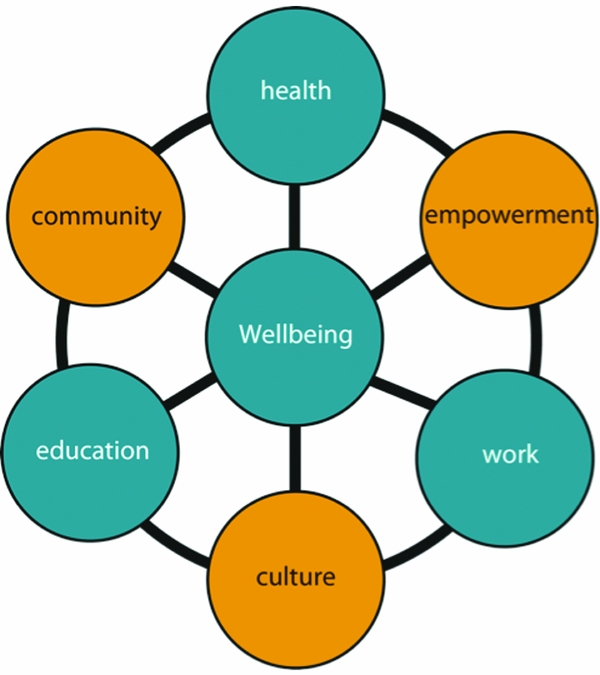
As a holistic representation, the Interplay Wellbeing Framework was developed through an active collaboration between remote Aboriginal communities, governments and researchers as part of a ‘shared space’ approach to represent Aboriginal values in a quantifiable framework to inform policy (Abbott & Cairney, Reference Abbott and Cairney2014; Cairney et al., Reference Cairney, Abbott, Quinn, Yamaguchi, Wilson and Wakerman2017). This framework and an accompanying survey were developed and validated – both scientifically and culturally – as a holistic monitoring system and knowledge base to guide the improvement of wellbeing in remote communities nationally (Cairney, Abbott, & Yamaguchi, Reference Cairney, Abbott and Yamaguchi2015, Reference Cairney, Abbott, Quinn, Yamaguchi, Wilson and Wakerman2017). The framework combines government priorities of education, employment and health with Aboriginal-identified priorities of culture, empowerment and community, in a holistic model of wellbeing (see Figure 1; Cairney et al., Reference Cairney, Abbott, Quinn, Yamaguchi, Wilson and Wakerman2017).
The Interplay Wellbeing Framework.

As an approach to statistical analysis that is capable of accommodating the holistic nature of wellbeing, structural equation modelling was applied to cohort survey data (described below) to both statistically validate the framework and survey (Cairney et al., Reference Cairney, Abbott, Quinn, Yamaguchi, Wilson and Wakerman2017) and to identify key interrelationships or pathways within the framework (Cairney et al., Reference Cairney, Abbott, Quinn, Yamaguchi, Wilson and Wakerman2017; Wilson, Quinn, Abbott, & Cairney, Reference Wilson, Quinn, Abbott and Cairney2017). Initial analysis identified that empowerment correlated highly with education and employment (Cairney et al., Reference Cairney, Abbott, Quinn, Yamaguchi, Wilson and Wakerman2017).
In this paper, we use the Interplay Wellbeing Framework and survey data to further understand this interrelationship between empowerment, education and employment and to specifically understand what drives the pathway and positive outcomes across the government priority areas of education and employment for Aboriginal people in remote Australia (Cairney, Abbott, & Yamaguchi, Reference Cairney, Abbott and Yamaguchi2015, Reference Cairney, Abbott, Quinn, Yamaguchi, Wilson and Wakerman2017; Cairney & Abbott, Reference Cairney and Abbott2014; Nguyen & Cairney, Reference Nguyen and Cairney2013). Self-reported survey items define empowerment, education and employment. For example, empowerment is made up of survey items relating to resilience, identity and self-efficacy. Education is made up of items relating to English literacy and numeracy and employment is made up of items relating to paid work, voluntary work and training.
Methods
Setting
This research is a component of a broader ‘Interplay Project’; that explores the interplay between culture, community, empowerment, education, employment, health and wellbeing. As part of the Cooperative Research Centre for Remote Economic Participation (CRC-REP) managed by Ninti One Ltd., the Interplay project recognises unique cultural and social factors are relevant to Aboriginal and Torres Strait Islander people living in remote Australia that are not easily represented in existing western models of government service delivery. As part of this approach, 42 Aboriginal Community Researchers (ACRs) were recruited, trained and employed to contribute to research design and data collection. The shared space model is both ground-up (or ‘grass roots’) and top–down, ensuring strong links between science, community development and policy impact (Cairney & Abbott, Reference Cairney and Abbott2014). By bridging community and government priorities, the Interplay project is building an evidence base to inform policy and practice towards improved wellbeing in remote communities (Cairney & Abbott, Reference Cairney and Abbott2014).
During project development, an extensive national ‘grass-roots’ consultation process was conducted with remote Aboriginal communities nationally over 3 years from 2011 to 2013, with 242 people engaged through 17 workshops and a series of meetings, interviews and community visits (Abbott & Cairney, Reference Abbott and Cairney2014). This widespread community consultation informed the design of an Interplay Wellbeing Framework and data collection tools (Abbott & Cairney, Reference Abbott and Cairney2014). Importantly, a thematic analysis of these qualitative data identified that – despite significant cultural diversity – three core priorities were consistent for Aboriginal people from remote communities nationally. These were: culture, empowerment and community. Project development and methodology is described in detail elsewhere (Cairney, Abbott, & Yamaguchi, Reference Cairney, Abbott and Yamaguchi2015, Reference Cairney, Abbott, Quinn, Yamaguchi, Wilson and Wakerman2017). Validation of the framework and survey is reported separately, as is qualitative data collected through focus groups (Cairney et al., Reference Cairney, Abbott, Quinn, Yamaguchi, Wilson and Wakerman2017; McRae-Williams et al., Reference McRae-Williams, Yamaguchi, Wilson, Schultz, Abbott and Cairney2018).
Survey
Based on both the community and government priorities, a survey was designed to collect quantitative data, part of which is reported here. The survey was designed to collect locally relevant, contextual, quantitative information on wellbeing and the factors that may potentially influence wellbeing outcomes in remote communities (Cairney, Abbott, & Yamaguchi, Reference Cairney, Abbott and Yamaguchi2015). Each question was extensively analysed to ensure that it held true in crosscultural settings and when translated to local languages (Cairney, Abbott, & Yamaguchi, Reference Cairney, Abbott and Yamaguchi2015). The survey was administered by ACR's using iPads loaded with the iSurvey software. Each individual survey took approximately one hour to complete.
Participants
From 2014 to 2015, surveys were collected from 917 Aboriginal and Torres Strait Islander people aged 15–34 years. A total of 73 participants were excluded based on their age >34 years, and a further 3 for other selection criteria. The final cohort comprised 841 participants (mean age = 25.2 years, SD 5.3; 352 Males, 489 Females). Participants were classified as either remote (46%) or very remote (54%) based on community location (Australian Institute of Health and Welfare (AIHW), 2004). The ACR's selected participants based on a number of sampling strategies, including age, Aboriginality, availability, door knocking and random sampling. Great effort was taken to ensure that all kinship and language groups were represented from each community. This age range was selected as that closest to when individuals undergo the life course transition from education through to employment; these ensured meaningful outcomes were delivered within the project's 6-year life-cycle (Cairney, Abbott, & Yamaguchi, Reference Cairney, Abbott and Yamaguchi2015)
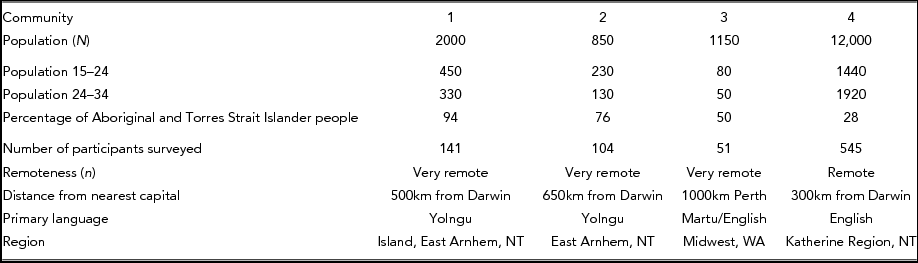
Community selection was based on a combination of sampling methods, established relationships with partner organisations within communities and community self-selection (Cairney, Abbott, & Yamaguchi, Reference Cairney, Abbott and Yamaguchi2015). Initially, eight community groups approached the research team and expressed interest to be involved in the study (Cairney, Abbott, & Yamaguchi, Reference Cairney, Abbott and Yamaguchi2015). This was later consolidated to four communities that participated in the research (Cairney, Abbott, & Yamaguchi, Reference Cairney, Abbott and Yamaguchi2015). This process of self-selection established a strong sense of ownership and empowerment for the community groups, who therefore initiated the research in their communities and were then heavily involved in its development (Cairney, Abbott, & Yamaguchi, Reference Cairney, Abbott and Yamaguchi2015). Final participating communities represented diversity across geography, culture, language, population size and characteristics of infrastructure and service delivery (see Table 1).
Community Characteristics

Data based on Australian Bureau of Statistics (ABS) 2011, 2016.
Based on Indigenous Location (ILOC) by Indigenous Status (INGP) and Age (AGEP), 2011; Source: ABS unpublished data; N = population count; n = minimum sample sizes for each cohort.
Ethics
Ethical clearances were obtained from the Human Research Ethics Committee (HREC) of the Northern Territory Department of Health and Menzies School of Health Research, and from the Western Australian Aboriginal Health Ethics Committee. Additional approvals and support were received from local health and education boards, government data-linkage services, land councils and local partner organisations. Written informed consent was given by all participants.
Measures
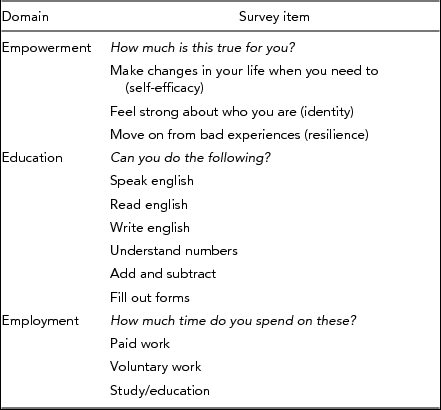
Survey items that loaded together statistically form a ‘domain’. The three domains that combined to provide a ‘best fit’ interrelationship, based on structural equation modelling approach outlined below, included empowerment, education and employment. Table 2 shows the domains and their corresponding survey items. Survey items were modelled with a 5- point Likert scale from 0 (Not at all), 2 (Sometimes), to 4 (Lots) (Cairney, Abbott, & Yamaguchi, Reference Cairney, Abbott and Yamaguchi2015). Higher scores indicate higher levels of the domain.
Domains and Survey Items Taken from the Interplay Survey Tool

Each domain is made up of its corresponding survey items answered by participants on a 5-point Likert Scale.
Statistical Analysis
Data analysis was conducted using the statistics package SPSS and Analysis of Moment Structures (AMOS) version 23. Initially, exploratory factor analysis (EFA) using maximum likelihood extraction with promax rotation was conducted. Survey items were allocated to domains according to their pattern matrix factor loadings. Items that did not load well or that decreased reliability beyond an unacceptable level were deleted. Bivariate Pearsons correlations were calculated between each pair of domains and a Structural Equation Model (SEM) was created to examine hypothesised relationships between these domains. The SEM was validated by checking a variety of Model Fit Indices, including chi-square, CMIN, GFI, PCFI, PCLOSE, SRMA and RMSEA. The lower and upper Confidence Intervals (CI) reported are 95% and a p-value (two-tailed) less than 0.05 is deemed to be statistically significant. Covariances between survey items loading on the same domains were used to improve model fit, and residuals were examined via standardised residual covariances. The final model included a consistent mediated effect. Gender, Age, Language and Remoteness were all controlled as well as tested as Confounding Factors, when examining the final model.
Results
Descriptive Frequencies
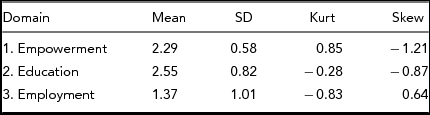
Table 3 presents the means, standard deviations, and correlations of the study domains. Univariate skewness values ranged from −1.21 to 0.64 and univariate kurtosis values ranged from −.87 to 0.85, confirming that the domains show reasonable spread (Kline, Reference Kline2011).
Descriptive Frequencies (N = 841)

SD: Standard Deviations, Kurt: Kurtosis, Skew: Skewness.
Bivariate Relationships
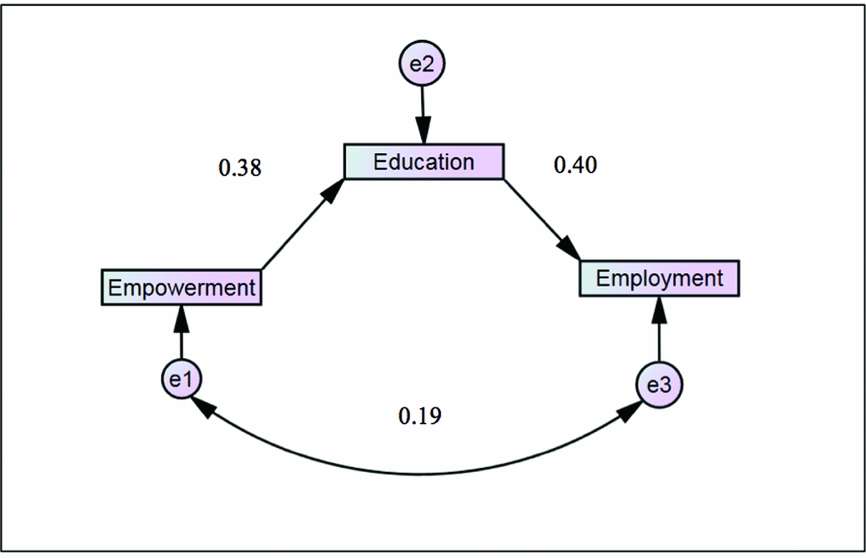
Bivariance Pearson correlations were calculated with each domain to examine the association between them. All the correlations were statically significant (p < .001). The results from the SEM showed that empowerment and employment were covaried (β = 0.19, 95% CI 0.11, 0.27) and empowerment has a direct effect on education (β = 0.38, 95% CI 0.28, 0.46). The direct effect between education and employment (β = 0.40, 95% CI 0.33, 0.47) was also highly significant. The indirect effect from empowerment, via education, to employment was highly significant (β = 0.15 95% CI 0.11, 0.20).
Figure 2 shows the structural equation model presenting the strongest statistical pathways. The model had good fit statistics, χ2/df = 2.47, CFI = 0.99 and RMSEA = 0.04, Pclose = 0.89. The model showed ‘consistent mediation’ in that the mediation effects on the dependent domain and independent domain had the same signs, and all path were significant (MacKinnon, Krull, & Lockwood, Reference MacKinnon, Krull and Lockwood2000; Tzelgov & Henik, Reference Tzelgov and Henik1991).
SEM showing bivariate correlations. χ2/df = 2.47, CFI = 0.99, RMSEA = 0.04, Pclose = 0.89. P <.001 e = error.

Robustness
In order to examine the robustness of our results we checked for exposure-mediator and mediator-outcome model for confounders, using: age, gender, remoteness and number of languages spoken. No evidence of confounding by other variables was found.
Summary
In summary, the results showed that the domain empowerment predicted employment via the mediator education, and education had a strong direct effect on employment. The direct effect and indirect effects were approximately the same.
Discussion
Our analysis identifies empowerment as a fundamental building block to achieving optimal outcomes for education and employment, based on self-reporting. Empowerment was defined and measured based on survey items relating to identity, resilience and self-efficacy. Self-reported levels of English literacy were used as a proxy for education outcomes. Empowerment has a strong direct impact on education and correlates strongly with employment, with an additional mediated effect whereby building empowerment influences employment indirectly through the pathway of improving education. Direct relationships between education and employment that are commonly observed in other populations were confirmed here for this population (Dockery, Reference Dockery2013; Guenther & Bat, Reference Guenther and Bat2013; Purdie & Buckley, Reference Purdie and Buckley2010). Our analysis suggests that successful pathways between education and employment are contingent upon their capacity to build from empowerment. These findings suggest that the ability of policy and practice in education and employment to improve outcomes depends on their capacity to genuinely empower people. That is the more programs empower people the more likely they are to succeed.
In Australia, the mainstream economic assumption is that individuals undertake postcompulsory education for reasons related to income and wealth acquisition (McRae-Williams, Reference McRae-Williams2014). Aboriginal and Torres Strait Islander people with strong connections to culture and community do not necessarily fit this model (Guenther, Osborne, & Bat, Reference Guenther, Osborne and Bat2013). Further, Aboriginal and Torres Strait Islander people undertake significant amounts of vital, relevant and time-consuming employment in unpaid capacities – usually as part of cultural or family occupations (McRae-Williams, Reference McRae-Williams2008). Although this type of employment is difficult to measure in government statistics, many Aboriginal and Torres Strait Islander people see unpaid voluntary cultural and community work as their ‘occupation’ rather than seeing themselves as ‘unemployed’ (Gelade & Stehlik, Reference Gelade and Stehlik2004). Subsequently in remote Australia in recent years, employment of Aboriginal people has declined while employment of non-Aboriginal people has increased (Guenther & McRae-Williams, Reference Guenther and McRae-Williams2016). Any available employment in remote Australia is generally taken by non-Aboriginal and Torres Strait Islanders (Gelade & Stehlik, Reference Gelade and Stehlik2004). Our research indicates that greater empowerment of individuals would be conducive to a reversal of this trend.
Building empowerment in Aboriginal and Torres Strait Islander communities has been previously shown to increase wellness and wellbeing outcomes (Auger, Reference Auger2016; Lucero, Reference Lucero2014, Wexler, Reference Wexler2014, Tsey et al., Reference Tsey, Wilson, Haswell-Elkins, Whiteside, McCalman, Cadet-James and Wenitong2007; Whiteside, Tsey, & Earles, Reference Whiteside, Tsey and Earles2011). In Australia a family empowerment program has shown an increase in wellbeing outcomes for Aboriginal Australians through building empowerment based on cultural and spiritual beliefs (Tsey et al., Reference Tsey, Wilson, Haswell-Elkins, Whiteside, McCalman, Cadet-James and Wenitong2007; Whiteside, Tsey, & Earles, Reference Whiteside, Tsey and Earles2011). Empowerment constructs have been shown to help individuals and groups achieve positive growth and effectively address the social and psychological impacts of historical oppression, marginalisation and disadvantage (Haswell et al., Reference Haswell, Kavanagh, Tsey, Reilly, Cadet-James, Laliberte and Doran2010). Other researchers suggest that cultural alignment to western philosophical positions of employment will enable (empower) people to do well at education and employment (Guenther & McRae-Williams, Reference Guenther and McRae-Williams2014; McRae-Williams, Reference McRae-Williams2014; McRae-Williams & Guenther, Reference McRae-Williams and Guenther2014; McRae-Williams, Guenther, Jacobsen, & Judith, Reference McRae-Williams, Guenther, Jacobsen and Judith2016). Our research indicated that the connection between education and employment was actually moderated by an individual's sense of empowerment. That is, our research confirmed the importance of an individual's sense of empowerment as the key moderator in the relationship between education and employment.
Recognising Aboriginal values and ways of being and building on and amplifying strengths, capacities and identity, have shown to be important building blocks of learning and engagement (McRae-Williams, Reference McRae-Williams2014, p.12). However, governments struggle to reconcile the values, ways of being and knowings associated with Aboriginal cultures into related policies and programs. This misunderstanding becomes a disempowering process that suppresses local Aboriginal cultures and consequently local engagement in employment (McRae-Williams, Reference McRae-Williams2014). This inability or unwillingness of governments and service providers to genuinely collaborate and engage with communities in supporting local culture and needs is a major contributor to the failure of many programs (Guenther & McRae-Williams, Reference Guenther and McRae-Williams2015). Engagement with local people and local cultures provides the necessary conditions to empower individuals to achieve success in education and subsequent pathways to employment (McRae-Williams et al., Reference McRae-Williams, Yamaguchi, Wilson, Schultz, Abbott and Cairney2018). Our research reaffirmed the importance of collaboration and engagement in supporting empowerment towards improving education and employment in Aboriginal and Torres Strait Islander communities.
Quality education is more than just literacy and numeracy – in this context, it is vital that it include community-based approaches that empower parents and communities (Guenther, Disbray, & Osborne, Reference Guenther, Disbray and Osborne2015, Reference Guenther, Disbray and Osborne2016). So long as policy makers see education and training primarily as pathways to employment, considerable tensions will prevail when set against Aboriginal and Torres Strait Islander forms of development, deeply held spiritual and cultural beliefs, and peer and kin affiliations (Interplay Wellbeing Framework, 2016; Nguyen & Cairney, Reference Nguyen and Cairney2013; Wilson, Guenther, & Cairney, Reference Wilson, Guenther and Cairney2016). Education and training systems that accommodate cultural beliefs and values provide more positive outcomes for Indigenous people, as recognised in the benefits of Aboriginal land management employment (e.g., Ranger) programs (Davies, Maru, Hueneme, Grey-Gardner, & Chings, Reference Davies, Maru, Hueneme, Grey-Gardner and Chings2010). Our research provides empirical evidence that the connection between education and employment was actually moderated by an individual's sense of empowerment.
In order for those designing and promoting Aboriginal and Torres Strait Islander strategic policies to engage with the specific needs of remote communities, the concept of employment needs to be redefined to take into account unpaid voluntary cultural, family and community-based activities (Altman, Reference Altman2009). Policy also needs to be developed within the context of collaborative processes, which engages with and draws from community leadership and ownership, thus incorporating Aboriginal and Torres Strait Islander identities, cultures, knowledge and values (Miller, Reference Miller2005, p. 5). This suggests that genuine engagement with, and empowerment of, local communities and cultures are the critical foundations in the success of employment and educations programs in remote communities.
Conclusion
By considering a holistic concept of wellbeing as represented by the Interplay Wellbeing Framework, this analysis has identified empowerment – defined by personal identity, resilience and self-efficacy – as the fundamental basis to foster the pathways and achieve positive outcomes in education and employment. This suggests that education and employment strategies that foster and build on a sense of individual empowerment are most likely to succeed, providing guidance for policy and programs.
About the Authors
Byron Wilson is a PhD student through Menzies School of Health Research (Charles Darwin University). He is a science teacher with over 10 years experience, including 6 years as Science Coordinator.
John Guenther is the Research Leader Education and Training, with Batchelor Institute of Indigenous Tertiary Education, based in Darwin, Northern Territory. Over the last 10 years John has been conducted research and evaluation projects, which have focused on remote contexts, particularly in the Northern Territory of Australia. A recurring theme in all his work is the importance of learning, whether it be for adults, young people or children. He is also interested in education systems and their impact on learning. In recent work on remote education systems, a focus has been on the importance of Aboriginal and Torres Strait Islander knowledge systems and their accompanying epistemologies, ontologies, axiologies and cosmologies. Understanding the interface between cultures in the context of schooling in remote communities has also been a key concern.
Tammy Abbott is of the Western Arrernte and Luritja/Pintupi people, was educated in Alice Springs and Victoria. Tammy came to Ninti from a career with the Australian Government Department of Human Services in the Northern Territory. She is currently working as the Senior Research Officer for Ninti One's Interplay project, which aims to strengthen and grow community-based research activity and employment of Aboriginal Community Researchers.
Stephen J. Quinn joined Swinburne University of Technology in 2016. He completed his Ph.D. in 2002 (UTAS) and worked for the Menzies Research Institute Tasmania as a consultant biostatistician from 2004 to 2010, in the area of population health and noncommunicable diseases. In 2010, he moved to Flinders University to take up a position as a Senior Consultant Biostatistician, where most of his work involved Phase 3 clinical trials in biomedical research. So far he has coauthored on around 100 peer reviewed publications, and been successful in attracting funds on 15 NHMRC, ARC and partnership grants as well as many more minor grants. Steve is experienced in all forms of multilevel mixed modelling and structural equation modelling. He also has his own statistical methodological research stream in assessing goodness-of-fit in binary regression models.
Eva McRae-Williams has worked in the Social Anthropology and Community Livelihood research space for nearly 10 years, with most of this work situated in the Northern Territory. As Principal Researcher and Lecturer, she has extensive experience as an educator, researcher and consultant.
Sheree Cairney has worked as a Neuroscientist in remote Aboriginal communities for 17 years. Her research has shed light on the transformation of brain and behaviour that happens-with petrol sniffing, alcohol and other drugs-and led to ground-breaking clinical evidence the brain can repair itself if substance abuse stops early enough. She now leads a national longitudinal study on wellbeing in remote Aboriginal communities, ‘The Interplay Project’. She is an Associate Professor at the Centre for Remote Health, Flinders University in Alice Springs, and a Principle Research Leader at Ninti One Ltd.