Introduction
Pearl millet (Pennisetum glaucum (L.) R. Br.) is an important food, feed and fodder crop in Africa and Asia. It is used for pasture, silage, hay making and grazing in several countries such as Australia, South America and the USA. Its green fodder is a valuable feed for livestock. Being tall vigorous with exceptional fodder yielding potential, it is indispensable fodder for the animals in arid and semi-arid regions of the world.
Pearl millet uses less water per unit quantity of forage production, tolerates heat and drought. Therefore, it is generally grown in areas where environmental conditions, especially rainfall, temperature and soil fertility are too harsh to grow other cereals (Hanna and Cardona, Reference Hanna, Cardona, Rios and Pitman2001; Khairwal et al., Reference Khairwal, Rajpurohit and Kumari2009). The dry fodder and straw of pearl millet is used to feed the livestock in marginal production environments, particularly during the dry season when green fodder is limited. It is a promising crop for green fodder supply especially in the lean periods in several countries. Both plant growth and development are affected by changing climate, particularly due to high temperatures during summer resulting in shortage of fodder. In India, the demand for green fodder would be high during summer months (March to June). Pearl millet is a quick growing cereal with large number of tillers, leaves and panicles as compared with maize and sorghum. Its fodder is low in anti-nutritional factors such as hydrocyanic acid and oxalic acid and can be used at any stage of the crop (Gupta, Reference Gupta1975). Hence, unlike sorghum, being all time forage, pearl millet can be grazed or cut and fed at any crop growth stage. Identification of potential landraces would be helpful in development of forage or dual purpose pearl millet cultivars. The gap in fodder demand and its supply can be bridged by developing high fodder yielding cultivars of pearl millet. Extent of genetic variability for fodder traits in the collection under study is critical in developing fodder varieties. Hence, efforts are needed to identify germplasm adaptable to high temperature and less sensitive to climate change and produce more fodder in summer or off-seasons across the countries.
ICRISAT genebank at Patancheru, India conserves the world collection of 22,888 pearl millet germplasm accessions from 51 countries. The collection has enormous diversity for several morphoagronomic traits including those related to high fodder yield. Therefore, the present study was carried out to identify promising accessions for fodder traits from the world collection of pearl millet, in rainy, postrainy and summer seasons at ICRISAT, India, for their utilization in pearl millet improvement for fodder.
Materials and methods
The experimental material for the present study comprised a total of 326 pearl millet germplasm accessions originating in 23 countries, including those selected from ICRISAT pearl millet characterization database consisting over 20,000 accessions, selections made by breeders in germplasm characterization fields at ICRISAT and selections in forage type pearl millet germplasm evaluation trials conducted at different locations in India. The accessions growing more than 400 cm height, producing more than 10 tillers with high score (7–9) for fodder yield potential were selected from characterization database.
The selected 326 accessions along with four controls were evaluated at ICRISAT, Patancheru, India (17.53°N latitude, 78.27°E longitude and 545 m a.s.l.), in alfisols, during three consecutive diverse seasons viz. 2013 rainy (June–October), 2013–14 postrainy (November–March) and 2014 summer (February–June). These three seasons are typical of semi-arid conditions and vary considerably for day length, temperature and solar radiation (Supplementary Table S1). In all seasons, fertilizers were applied at the rate of 100 kg/ha N and 40 kg/ha P2O5. Accessions were grown in alpha-design with two replications. Four control cultivars used in this study were IP 3616, a promising landrace for fodder; IP 17862, a released cultivar for grain; IP 22269, high tillering genepool promising for high fodder yield and ICMV 05555, a fodder variety developed at ICRISAT. Field planting of experimental material was done using tractor mounted four-cone planter, wherein each accession was sown as one row of 4 m with an inter-row spacing of 75 cm. Thinning was done 15–20 days after sowing maintaining 10 cm spacing between plants accommodating approximately 40 plants in a row. Life-saving irrigations were provided in the rainy season, while the crop was irrigated at regular intervals in postrainy and summer seasons to provide sufficient moisture to the growing crop. Crop was protected from weeds, pests and diseases to raise a good crop.
Observations
Observations were recorded on six important fodder related traits viz. plant height, stem thickness, total tillers per plant, number of leaves per plant and leaf length and width, following the descriptors for pearl millet (IBPGR and ICRISAT, 1993). Observations were also recorded on days to 50% flowering, which will help in identifying promising sources for diverse seasons. Except days to 50% flowering, all other traits were recorded on five random plants at dough stage and mean was computed. Emergence of stigma in 50% of plants in a plot (accession) was recorded as days to 50% flowering. The plant height was recorded from base to the tip of panicle in centimetres. The stem diameter was measured in millimetres between 3rd and 4th node from top. The total number of tillers was recorded for five plants and mean was computed. The number of leaves on main stem of plant was counted. The leaf on 4th node from the top on main tiller was used for recording leaf length and width at panicle emergence stage. Leaf length was measured from ligule to tip in centimetres, while leaf width was measured at widest point in millimetres.
Seasons
The selected 326 pearl millet accessions along with four controls were evaluated in three different seasons at ICRISAT, Patancheru, India. These seasons differed for meteorological parameters wherein, day length varied from 11.7 to 13.2 h in 2013 rainy, 11.1–12.0 h in 2013–14 postrainy and 11.5–13.2 h in 2014 summer season (Supplementary Table S1). The monthly mean day length was low in postrainy season (11.4 h) when compared with rainy (12.6 h) and summer (12.4 h). Monthly mean minimum temperature was lowest in postrainy season (15.3 °C), while monthly mean maximum temperature (34.9 °C) and solar radiation (19.3 mj/m2) was highest in summer season. Two months April and May recorded highest monthly mean maximum temperature (37.1 °C) and solar radiation (20.9 mj/m2) indicating summer season as hottest when compared with rainy and postrainy seasons. Weather factors play a critical role in the rate of photosynthesis, canopy transpiration and surface evaporation affecting the water balance and physiology of the plants. Therefore, meteorological data such as monthly mean day length (h), minimum and maximum temperature (°C), solar radiation (mj/m2) and total rainfall (mm) for all three seasons were retrieved from ICRISAT meteorological database for the evaluation location i.e. ICRISAT, Patancheru, India.
In the present study, photoperiod and temperature responses were defined by the differences in flowering during rainy and postrainy season (Upadhyaya et al., Reference Upadhyaya, Reddy, Irshad Ahmed, Naresh and Gowda2012). When the measurements (days to 50% flowering) are high in the relatively cool short-day postrainy season, the accession was considered as temperature sensitive and requires higher temperature for flowering. When the measurements are high in the warm long day rainy season, then the accession was considered as photoperiod sensitive and requires short days for flowering. When there was no difference in measurements (rainy-postrainy = 0 days), then the accessions were considered as insensitive to both temperature and photoperiod.
Data analysis
Data were analysed using Residual Maximum Likelihood method (REML) using Genstat 13.1 release (http://www.vsni.co.uk) considering genotypes as random (Patterson and Thompson, Reference Patterson and Thompson1971; VSN International, 2010). Variance components attributable to genotypes (σ 2 g) in all three seasons and pooled over all seasons were estimated for all traits and tested for their significance against their respective standard errors. Variance components attributable to genotype × environment (σ 2 ge) were estimated for all traits. Range, mean, phenotypic variances were calculated for all traits in all seasons and mean values were compared using Newman–Keuls procedure (Newman, Reference Newman1939; Keuls, Reference Keuls1952). The homogeneity of phenotypic variances was tested by Levene's test (Levene, Reference Levene and Olkin1960). The differences among the seasons were tested using Wald statistic (Wald, Reference Wald1943). Principal component analysis (PCA) was performed using GenStat 15th edition and clustering of accessions was performed based on first three principal components using Ward's method (Ward, Reference Ward1963). Phenotypic correlations were estimated among all traits in each season and also for pooled data and tested for their significance (Snedecor and Cochran, Reference Snedecor and Cochran1980). Promising accessions were identified for fodder traits in different seasons based on least significance difference (P = 0.05).
Results
REML analysis
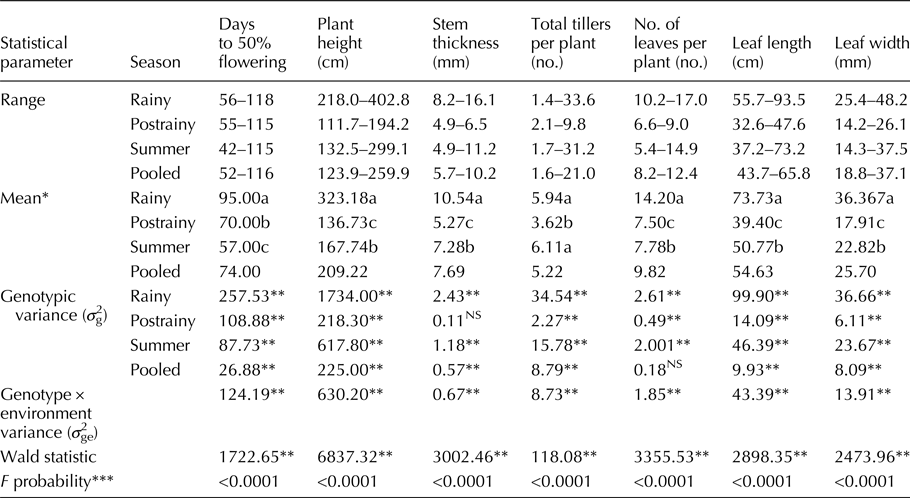
The REML analysis of variance for all seasons individually indicated highly significant genotypic variances (σ 2 g) for all traits, except for stem thickness in the 2013–14 postrainy season, indicating considerable variation in the collection for these traits (Table 1). The pooled genotypic variances were also highly significant for all traits, except number of leaves per plant suggesting high variation in the collection. Variance due to genotype × environment interaction (σ 2 ge) was also highly significant for all traits indicating high influence of seasons on the performance of accessions.
Range, mean, genotypic (σ 2 g) and genotype × environment (σ 2 ge) variances for important fodder traits of pearl millet germplasm evaluated during 2013 rainy, 2013–14 postrainy and 2014 summer seasons at ICRISAT, Patancheru, India.

*Mean values were tested using Newman–Keuls test and means with different alphabets are significantly different. **Significant differences at P = 0.01. ***Significance at P < 0.0001.
Levene's test and Wald statistic
The homogeneity of phenotypic variances was tested for all traits by Levene's test. The variances were heterogeneous (P = ≤ 0.0001) for all traits except stem thickness in postrainy season and number of leaves per plant over all seasons, which were non-significant. Adequacy of selected environments (seasons) in differentiating the accessions are important. The highly significant Wald statistic (P < 0.0001) revealed the adequacy of seasons in differentiating accessions for all traits under study (Table 1).
Range
Wide range of variation was observed in the collection for all traits under study during all the three seasons (Table 1). However, range of variation was high during rainy season for plant height, stem thickness, total tillers per plant, number of leaves per plant and leaf length and width and during summer for days to 50% flowering. Range of variation was less in postrainy season for all traits. Across the seasons, days to 50% flowering ranged from 52 to 116 days; plant height from 123.9 to 259.9 cm, stem thickness from 5.7 to 10.2; total tillers per plant from 1.6 to 21; number of leaves from 8.2 to 12.4; leaf length from 43.7 to 65.8 cm and leaf width from 18.8 to 37.1 mm.
Means
Newman–Keuls test of significance for mean values showed significant differences between seasons for all traits under study (Table 1). Accessions flowered significantly late, grew tall and produced thick stems, more tillers and long and broad leaves in rainy season when compared with postrainy and summer seasons. Number of total tillers per plant was more in rainy and summer season compared with postrainy season. Accessions flowered significantly earlier in summer and produced more tillers. During postrainy season, accessions flowered in medium duration, grew short and produced thin stems and a few narrow and short leaves.
Correlation coefficients
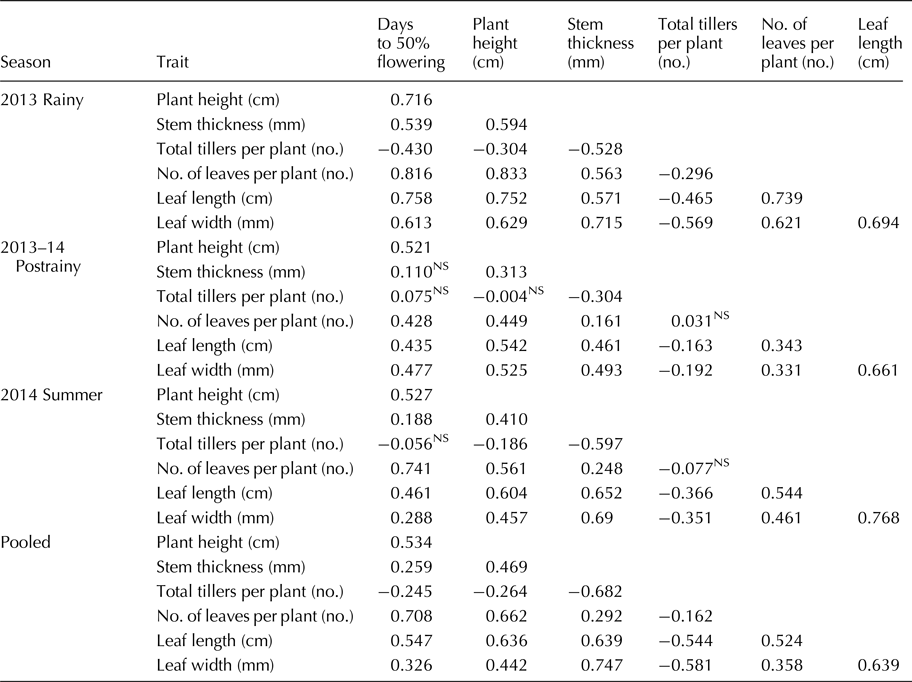
Correlations among fodder traits are important in assessing fodder yield potential of germplasm under study. In the present study, most of the trait combinations showed significant (P = 0.05) positive correlation in all three seasons (Table 2). During rainy season, except total tillers per plant combination with all other trait combinations had positive correlations. Correlations over all seasons indicated significant correlation among all traits with exception of total tillers per plant with all other traits. High magnitude of correlation coefficients were observed between most of the traits during rainy season than in postrainy and summer seasons revealing good expression of traits in rainy season. High magnitude of correlation coefficients was observed between days to 50% flowering and number of leaves in rainy season (r = 0.816) and summer (r = 0.741); stem thickness and leaf width in rainy season (r = 0.715), summer (r = 0.690) and postrainy season (r = 0.493); leaf length and leaf width in summer (r = 0.768), in rainy (r = 0.694) and postrainy season (r = 0.661); number of leaves and plant height in rainy (r = 0.833), summer (r = 0.561) and postrainy season (r = 0.449) indicating the importance of these trait combinations in assessing fodder yield potential.
Pearson correlation coefficients for fodder traits of pearl millet germplasm evaluated in different seasons at ICRISAT, Patancheru, India.

All the correlation values were significant at P = 0.05, except for those with NS, which indicates non-significant correlation.
Principal component analysis
PCA carried out using standardized data of seven quantitative traits revealed that the first three PCs explained 84.1% of the total variation. The first principal component (PC 1) was the most important and explained 56.7% of the total variation (Supplementary Table S2). The PC 1 had large positive factor loadings from traits such as plant height, stem thickness, leaf length and leaf width, while total tillers per plant showed negative loading. As a result, the first PC differentiated the accessions mainly by the contribution of these traits. The second principal component (PC 2) explained 20.05% of the total variation and showed positive loadings from number of leaves per plant, and number of total tillers per plant. The third principal component (PC 3), which explained 7.34% of total variation, differentiated the accessions by positive loadings for days to 50% flowering.
Clustering
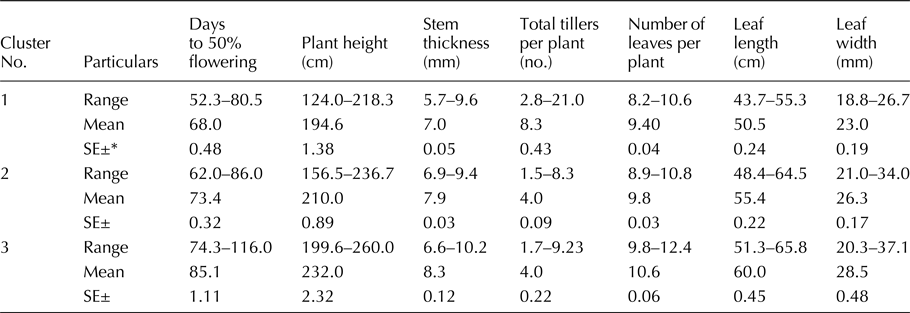
Clustering of 326 pearl millet accessions and four controls representing 23 countries was done by Ward's method (Ward, Reference Ward1963) using scores of first three principal components, which explained 84.1% of the variation. The 330 entries were grouped into three major clusters consisting 102 entries in cluster 1, 168 in cluster 2 and 60 in cluster 3 (Supplementary Table S3). Three fodder type controls, IP 3616, IP 22269 and ICMV 05555 were included in cluster 2, while IP 17862, an early maturing grain type released cultivar in cluster 1. Geographically, cluster 1 was predominant with accessions from two Asian countries, India and Yemen, while clusters 2 and 3 had accessions from West and Central African countries. More than 50% of accessions originated in India were in cluster 1, those from Burkina Faso, Cameroon and Central African Republic in cluster 2 and those from Nigeria in cluster 3. Among the clusters, highest range of variation was noted in cluster 1 for plant height, stem thickness and total tillers per plant; in cluster 2 for leaf length and in cluster 3 for days to 50% flowering, number of leaves per plant and leaf width (Table 3). Cluster means revealed that the cluster 1 accessions were early flowering and produced more tillers per plant while those of cluster 3 flowered late, grew tall and had thick stems more long and broader leaves per plant.
Range of variation for fodder traits of pearl millet germplasm in different clusters.

*Standard error of mean.
Promising sources identified
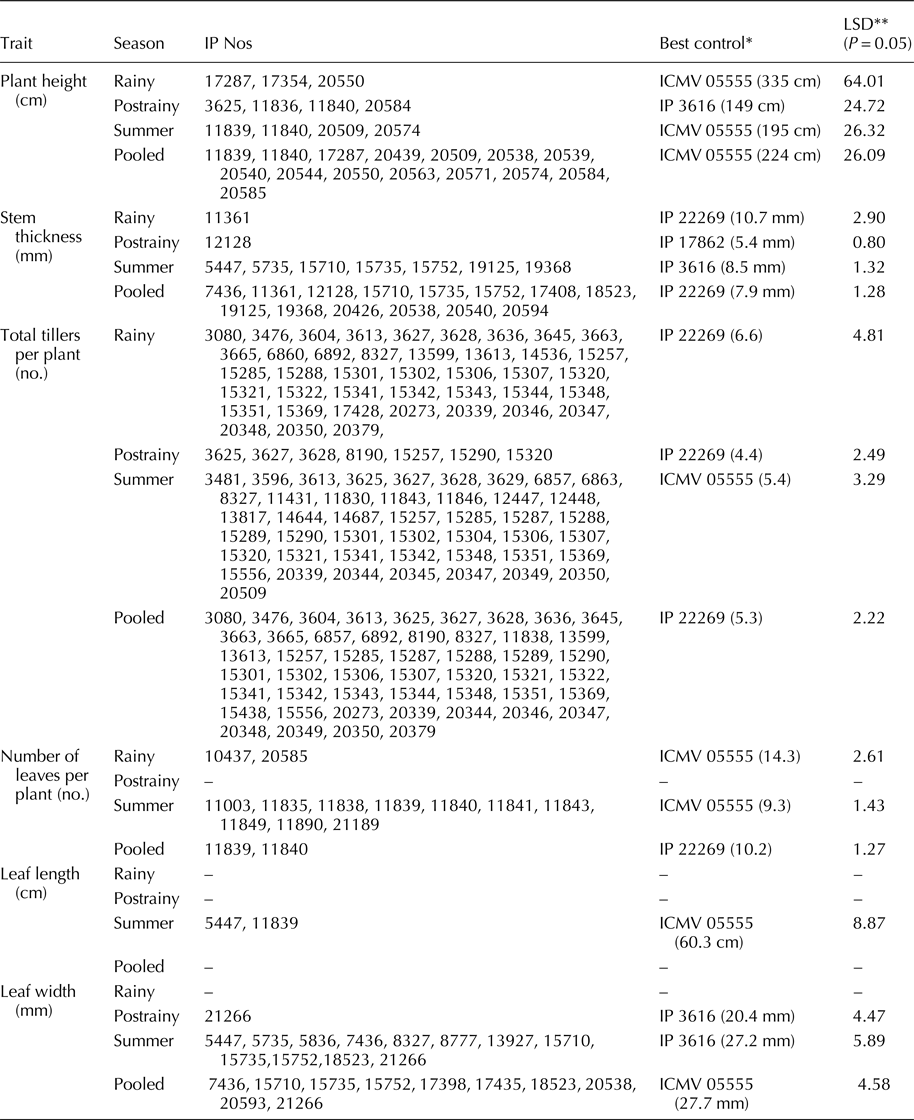
Accessions performing superior over best control for traits under study were considered as promising sources. A total of 140 accessions were identified as promising sources for one or more traits in three seasons (Table 4). Irrespective of seasons, trait-wise, 11 accessions for plant height, nine for stem thickness, 93 for total tillers per plant, 12 for number of leaves per plant, two for leaf length and 13 for leaf width have performed better than best control. In rainy season, a total of 47 accessions were identified as promising sources. Three (IP 17287, IP 17354 and IP 20550) accessions for plant height, one (IP 11361) for stem thickness, 41 for total tillers per plant and two (IP 10437 and IP 20585) for number of leaves per plant performed better than the best controls (Table 4). In postrainy season, 13 accessions were identified as promising sources. Four accessions for plant height, one for stem thickness, seven for total tillers per plant and one for leaf width were identified as promising sources. In summer season, 80 accessions were identified as promising sources. Four accessions for plant height, seven for stem thickness, 45 for total tillers per plant, 10 for number of leaves per plant, two for leaf length and 12 for leaf width performed superior over best controls.
Promising pearl millet accessions identified for fodder traits in 2013 rainy, 2013–14 postrainy and 2014 summer seasons.

*Value in bracket indicates mean value of control.
**LSD, least significant difference at P = 0.05.
Four accessions (IP 3627, IP 3628, IP 15257 and IP 15320) from Tamil Nadu province of India were identified as promising sources for total tillers in all the three seasons (Table 4). Two accessions (IP 3625 and IP 15290) for total tillers and one accession (IP 21266) for leaf width performed well in both postrainy and summer seasons. Fourteen accessions (IP 3613, IP 8327, IP 15285, IP 15288, IP 15301, IP 15302, IP 15306, IP 15307, IP 15321, IP 15341, IP 15342, IP 15348, IP 15351, IP 15369) from Tamil Nadu province of India and two accessions (IP 20347 and IP 20350) from Hudaydah province of Yemen performed better than the best control in both rainy and summer seasons for total tillers per plant. None of the accessions were found superior in both rainy and postrainy seasons. Among the four control cultivars used in the study, ICMV 05555, a released fodder cultivar for plant height and number of leaves during rainy and summer, while IP 22269, a high tillering genepool developed at ICRISAT for stem thickness and total tillers per plant during rainy season, were found as superior.
Pooled mean over seasons indicated significant performance of 90 accessions over best controls for one or more traits (Table 4). Of the 90 accessions, 15 for plant height, 14 for stem thickness, 49 for total tillers per plant, two for number of leaves per plant and 10 for leaf width were found as promising sources. Only one accession (IP 20538), a landrace originating in Nigeria performed better than the best control for plant height, stem thickness and leaf width. Eight accessions were found promising for two traits. Six accessions (IP 7436, IP 15710, IP 15735, IP 15752, IP 18523 and IP 20538) were superior over best controls for stem thickness and leaf width while two accessions (IP 11839 and IP 11840) were superior for plant height and number of leaves per plant. IP 11840 for plant height and leaves per plant and IP 15710, IP 15735 and IP 15752 for stem thickness and leaf width, performed well in summer season were also found promising based on pooled analysis.
Out of 112 unique accessions identified as promising for one or more traits in one or more seasons, include 106 landraces, five breeding materials and one advanced cultivar indicating the importance of landraces for fodder yield potential. These promising sources are from 14 countries. A maximum of 53 out of 77 accessions (68%) are from Andhra Pradesh (five), Odisha (eight) and Tamil Nadu (40) provinces of India, 17 out of 49 (35%) are from Nigeria and 10 out of 17 (59%) are from Yemen. All other countries represented for less than seven accessions. The promising sources from Tamil Nadu, India include eight accessions (IP 3628, IP 15290, IP 15285, IP 15288, IP 15301, IP 15302, IP 15342 and IP 15351) of landrace Kattu cumbu from Tamil Nadu, India were found superior over best controls for total tillers per plant in more than one season indicating superiority of this landrace for fodder yield potential.
In the collection of 326 accessions under study, 293 showed photoperiod sensitivity, 26 temperature sensitivity, while seven accessions showed insensitivity (Rainy-postrainy = 0). IP 17541 showed high photoperiod sensitivity (rainy to postrainy, 57 days difference), while IP 12482 showed high temperature sensitivity (rainy to postrainy, 12 days difference). In the collection under study, four accessions originating in India (IP 11839 and IP 11840) and Senegal (IP 5836) and developed at ICRISAT (IP 21189) showed less than 5 days difference for flowering during rainy and postrainy season and summer and postrainy season indicating their superiority for photoperiod and temperature insensitivity for flowering (Upadhyaya et al., Reference Upadhyaya, Reddy, Irshad Ahmed, Naresh and Gowda2012). Seven accessions originating from Cameroon (IP 14448), India (IP 3474, IP 3613, IP 3645 and IP 11834), Namibia (IP 19125) and USA (IP 9778) showed 1 day difference in flowering during rainy season and postrainy season indicating their superiority for insensitivity, but the differences in flowering during long day summer and short day postrainy season was high and varied from 10 to 22 days.
Discussion
The development of high fodder yielding pearl millet varieties suitable for different agro-climatic conditions depends upon the nature and extent of genetic variability in the germplasm collection. Considerable variation was observed in the collection under study for all traits in all seasons, except for stem thickness in postrainy season, indicating adequate variability in material for fodder traits. The highly significant variance due to genotype × environment interaction (σ 2 ge) indicated high influence of seasons over accessions. Long days, optimal temperature and sufficient soil moisture due to high rainfall during crop growth in rainy season has resulted in late maturity, tallness, thick stems, long and broad leaves when compared with postrainy season. Results of present study are in conformity with the results of several other studies. Based on their adaptation, each crop species has its own range of temperature maxima and minima at different developmental stages beyond which all these processes get inhibited. Ashraf and Hafeez (Reference Ashraf and Hafeez2004) reported an optimum temperature of 33–34 °C for pearl millet and that the growth could be retarded when the temperature is too high or too low. Ong (Reference Ong1983) reported 12 °C as base temperature, 30–35 °C as optimum and 45 °C as lethal temperature for pearl millet. Pucher et al. (Reference Pucher, Sy, Angarawai, Gondah, Zangre, Ouedraogo, Sanogo, Boureima, Hash and Haussmann2015) reported high proportion of late flowering landraces in Sierra Leone (146 days) and Central African Republic (129 days) due to high annual rainfall (>1200 mm) and more rainy days. Haussmann et al. (Reference Haussmann, Boubacar, Boureima and Vigouroux2006) noted positive correlation between time to flowering in pearl millet and annual rainfall. Being a short-day species, pearl millet collection grown during postrainy season, which is characterized by short days and low temperature, revealed relatively less variation for all traits. Wareing and Phillips (Reference Wareing and Phillips1981) observed a day length change as short as 15–20 min will have significant effect on flowering in many plant species. Ong and Everard (Reference Ong and Everard1979) also reported delayed flowering in pearl millet due to long days. Highly variable day length (11.5–13.2 h) and temperature (15.6–25.0 °C and 30.5–37.1 °C) have led to high range of variation in summer for flowering, leaf width and number of leaves. Photoperiod and temperature sensitivity of the accessions have also contributed for high range of variation during summer season. In summer, probably because of high temperatures, accessions experienced stress conditions resulting in early flowering and high tillering leading to more variation in the collection. Exposure to high temperature shortens the life cycle, increases senescence and severely affects potential yields (Porter, Reference Porter2005). Hellmers and Burton (Reference Hellmers and Burton1972) found substantial effect of temperature on flowering of pearl millet. McIntyre et al. (Reference McIntyre, Flower and Riba1993) reported a 2-day reduction in length of pearl millet growth period for each degree rise in temperature.
In the present study, all character combinations showed significant (P = 0.05) positive correlation, except the correlation of total tillers with all other traits in all seasons. Plant height showed strong positive correlation with all other traits except total tillers per plant (Appa Rao et al., Reference Appa Rao, Mengesha, Sibale and Reddy1986; Mathur et al., Reference Mathur, Appa Rao, Sapra, Mengesha and Rana1993; Reddy et al., Reference Reddy, Rao and Mengesha1996; Lopez-Dominguez et al., Reference Lopez-Dominguez, Maiti, Wesche-Ebeling, Ramirez and Verde-Star2001; Naeem et al., Reference Naeem, Shahid Munir Chauhan, Khan and Salahuddin2002). Reduction in plant height and increase in tiller number due to water stress during early stages and stem elongation period was observed in summer (Mahalakshmi et al., Reference Mahalakshmi, Bidinger and Raju1987). In the present study, total tillers had significant negative correlation with stem thickness, leaf length and width and plant height in summer; with all traits in rainy season and with stem thickness, leaf length and width in postrainy season. Therefore, for genetic improvement of green fodder yield in pearl millet, the selection based on traits showing positive correlations was suggested.
Biological status of the accessions under study indicated, 318 of the 326 accessions were landraces indicating the superiority of landraces for fodder yield and intensive selection by farmers for high fodder yielding pearl millet. High adaptation to varying agroclimatic conditions, high fodder yield, yield stability, resistance to abiotic and biotic stresses, perception of good quality food, nutritional and processing qualities, traditional intercropping patterns, religious ceremonies and filling unique market niches are the main reasons for liking of landraces by farmers (Bellon, Reference Bellon1990; Bhatnagar, Reference Bhatnagar2002). As the landraces are readily available sources for several useful genes including those for fodder traits, knowledge on genetic potential of landraces in the collection helps to broaden the genetic base of new cultivars and enhances the use of pearl millet germplasm resources (Escribano et al., Reference Escribano, Santalla, Casquero and De Ron1998). More landrace accessions from India (53) and Dauro landrace accessions (nine) from Nigeria performed superior over best controls for fodder traits. Interestingly, most of the sources, which performed well are from Tamil Nadu province in India, suggesting the need for further exploration of the region for pearl millet with high fodder yield potential. Probably, because most of the accessions from Tamil Nadu are named landraces evolved through decades of selection pressure by farmers for fodder traits, met the initial criteria of selection. Relatively more rainy days, coastal climate and red loamy soils in Tamil Nadu might have also contributed for tall high tillering fodder type pearl millet. Four out of six landraces from Tanzania performed well for more than one fodder traits. Pearl millet germplasm from West Africa, which flowered late, grew tall and produced broader leaves and high biomass when compared with that from India, may be exploited for developing high fodder yielding pearl millet (Mathur et al., Reference Mathur, Appa Rao, Sapra, Mengesha and Rana1993). Accessions of cluster 1 flowering early and producing more tillers per plant may be suitable for low rainfall areas. On the other hand, accessions of cluster 3, which flowered late, grew tall and produced large leaves are useful in developing fodder varieties and hybrids.
Results of present study emphasize the characterization of pearl millet germplasm during contrasting seasons to assess their true performance for fodder traits and sensitivity to photoperiod and temperature. Four accessions originating from India (IP 11839 and IP 11840), ICRISAT (IP 21189) and Senegal (IP 5836) showed less than 5 days difference in flowering during rainy, postrainy and summer season showing their superiority for photoperiod and temperature insensitivity for flowering across the seasons (Upadhyaya et al., Reference Upadhyaya, Reddy, Irshad Ahmed, Naresh and Gowda2012). IP 17862, a released cultivar and one of the controls in the present study also showed 1 day difference in flowering during rainy and postrainy season. As a first step towards developing climate resilient genotypes, landrace accessions identified as promising sources for fodder related traits and showing temperature and photoperiod insensitivity (IP 5836, IP 11839 and IP 11840) may be further evaluated at different locations and used. The photoperiod sensitive late maturing forage varieties of pearl millet are reported to be leafier and have a better seasonal distribution for forage production (Burton and Powell, Reference Burton and Powell1968).
Fodder quality can be enhanced by improving tillering capacity, leafiness and sweetness of stem through genetic modifications (Mathur et al., Reference Mathur, Appa Rao, Sapra, Mengesha and Rana1993). The value of forage pearl millet depends on the sugars left in the stover or accumulated in green forage. This is particularly true of pearl millet stover, which has comparatively low feeding value than sorghum. In the present study, the collection under study includes some sweet stalks reported by Appa Rao et al. (Reference Appa Rao, Mengesha and Subramanian1982). Considerable variation was observed for juiciness and sweetness of the stalks of pearl millet in the germplasm. Accessions IP 13817, IP 14687 and IP 15320, which are good for tillering in the present study were found to have sweet stocks (Appa Rao et al., Reference Appa Rao, Mengesha and Subramanian1982). IP 8777 producing broad leaves were found to be resistant to rust disease (Singh et al., Reference Singh, Wilson, Navi, Talukdar, Hess and Reddy1997). These accessions are useful in developing pearl millet varieties with good fodder quality and rust resistance. The leaves consists high soluble protein (7.66%) and crude protein (9.96%) compared with stem soluble protein (3.86%) and crude protein (5.23%). Therefore, accessions such as IP 10437 and IP 20585 in rainy season and IP 11839 and IP 11840 in summer, producing more than 13 leaves per plant, are important sources for high value fodder (Kumar et al., Reference Kumar, Arya, Kumar, Kumar, Kumar and Panchta2012).
Besides plant population and harvesting time, sowing time and irrigation have been found to have the greatest effects on fodder yield and quality. For instance, significant reduction in green fodder and dry matter content was observed with delay in planting from 25 October to 25 November at Urulikanchan, India (Khandale and Relwani, Reference Khandale and Relwani1991). The effects of irrigation during summer on forage yields have been reported to be variable, depending on the genotype, soil type and potential evapotranspiration. However, optimum plant population, sowing time, fertilizers and irrigation have been found to have the greatest effect on fodder yield and quality (Kumar et al., Reference Kumar, Arya, Kumar, Kumar, Kumar and Panchta2012). Therefore, further evaluation of the promising sources identified in this study is required to identify suitable genotypes for diverse environments. Seeds of all promising sources identified in the present study are available at ICRISAT genebank, India, under Standard Material Transfer Agreement (SMTA) of the International Treaty on Plant Genetic Resources for Food and Agriculture (ITPGRFA), for developing good fodder varieties and hybrids of pearl millet.
Supplementary material
The supplementary material for this article can be found at https://doi.org/10.1017/S147926211700003X.
Acknowledgements
Authors sincerely acknowledge the contribution of all former and present staff of genebank at ICRISAT, Patancheru, India in collection, assembly and conservation of pearl millet genetic resources. The help of Mr Sube Singh, Lead Scientific Officer, Genebank in analysing the data is gratefully acknowledged. The help of D Bapa Rao, G Dasaratha Rao and G Ram Reddy, all Research Technicians, Genebank, in recording observations and documentation of data for this study is highly appreciated.