Congenital heart diseases are the commonest type of birth defects with an incidence of 7–8 per 1000 live births. About one-third of these babies have critical congenital heart disease (CCHD) that require catheter intervention or surgery within the first year of life.Reference Frank, Bradshaw and Beekman 1 Despite fetal ultrasonography detecting a substantial proportion of heart defects, 30% of newborns with congenital heart disease are discharged from the hospital with an undiagnosed CCHD.Reference Wren, Reinhardt and Khawaja 2 , Reference de-Wahl Granelli, Wennergren and Sandberg 3 The newborns discharged from the hospital without a diagnosis of congenital heart disease may manifest with hemodynamic impairment, metabolic acidosis, cardiovascular collapse, and even death.Reference Wren, Reinhardt and Khawaja 2 , Reference Abu-Harb, Hey and Wren 4 As symptoms and signs may be subtle or lacking, CCHD may be missed in the routine clinical examination of newborns.Reference Hoffman 5
In 2011, the American Academy of Pediatrics recommended the screening of newborns with pulse oximetry for an early diagnosis of CCHD.Reference Kemper, Mahle and Martin 6 Pulse oximetry is a universal tool for detecting and differentiating pre- and post-ductal hypoxemia. Pulse oximetry screening provided improvements in congenital heart disease case detection and management. A large number of studies have reported a high sensitivity and specificity for pulse oximetry in the early detection of CCHD in newborn babies.Reference Ewer 7 – Reference Riede, Worner and Dahnert 9 Today, CCHD screening has been conducted in many developed countries. In 2012, a large meta-analysis of 13 high-quality studies comprising nearly 230,000 infants has confirmed the test accuracy of universal pulse oximetry screening.Reference Thangaratinam, Brown and Zamora 10 In a multi-centre study from China, 122,738 babies were screened, and the authors stated a significant improvement in the detection of CCHD by adding pulse oximetry screening.Reference Zhao, Ma and Ge 11
Recently, at a meeting in Ankara driven by the Ministry of Health of Turkey, steps were taken by neonatologists, pediatric cardiologists, cardiovascular surgeons, and screening experts to promote CCHD screening by pulse oximetry. We conducted a pilot study to investigate the feasibility of CCHD screening in different geographical regions of Turkey, before implementation of a nationwide screening program.
Material and methods
Study design
It was a prospective multi-centre screening study performed in four centres of four geographical regions with different altitudes in Turkey, between December, 2015 and May, 2017.
Study centres were as follows:
Centre 1 (altitude 3077 feet/938 m): Health Science University, Dr Sami Ulus Research and Application Center, Ankara, Central Anatolia Region.
Centre 2 (altitude 328 feet/100 m): Mersin Maternity and Children Hospital, Mersin, Mediterranean Region.
Centre 3 (altitude 2198 feet/670 m): Muğla Sıtkı Kocman University, Medical Faculty, Muğla, Aegean Region.
Centre 4 (altitude 6233 feet/1900 m): Ataturk University, Medical Faculty, Erzurum, East Anatolia Region.
Subjects
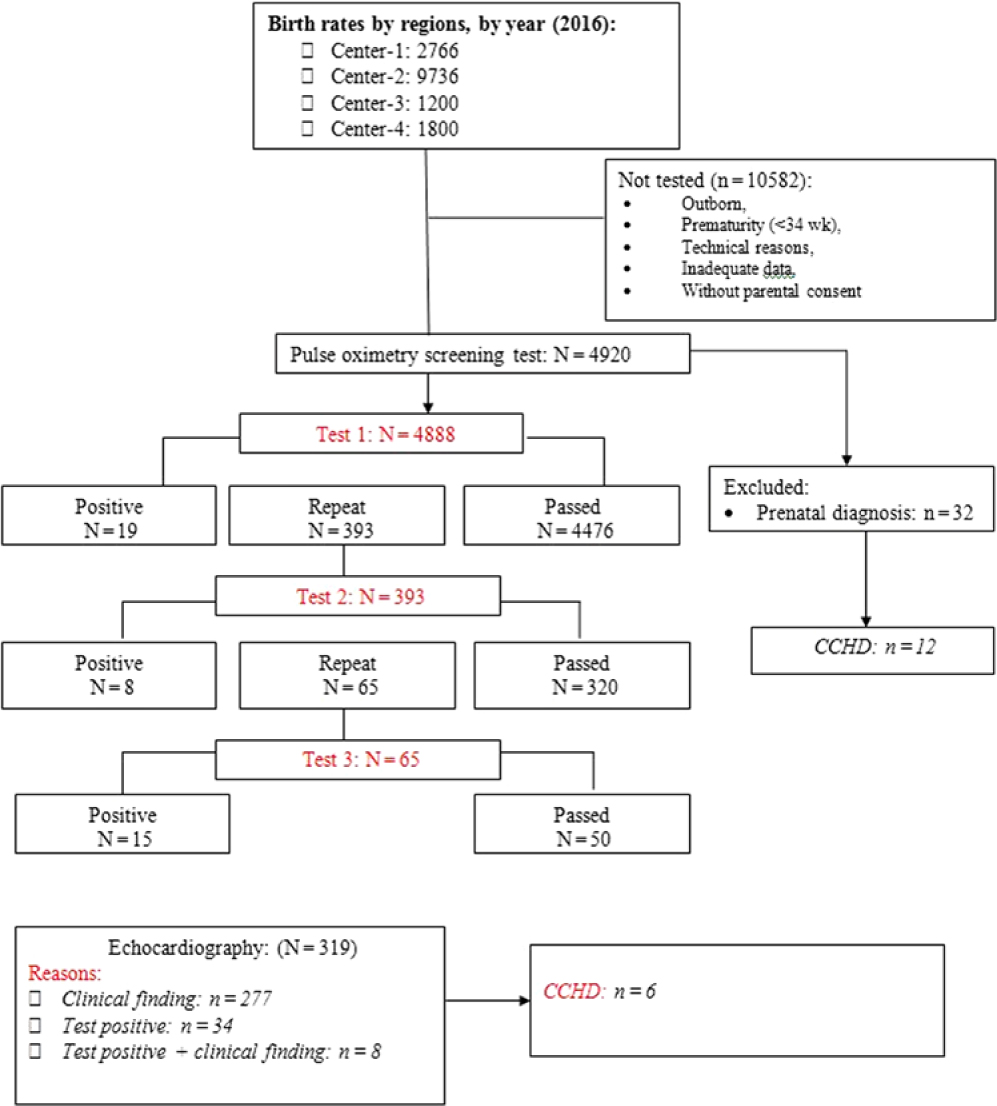
The newborns delivered in these centres and ≥34 weeks of gestational age were eligible for the study. Outborn and premature babies (<34 weeks) were not included. Babies with a prenatal diagnosis of congenital heart disease were excluded. Babies not tested because of technical reasons or without parental consent were also not included (Fig 1). An informed written consent was obtained from one of the parents (preferably by father – due to our traditions) and the procedure was explained to them.
Flow chart of the study. CCHD = critical CHD.

Methods
Pre-ductal (right hand) and post-ductal (foot) oxygen saturations and perfusion indices (PI) were measured using Masimo Radical-7 pulse oximeter (Masimo Corp., Irvine, California, United States of America) within the first 5 days of life (postnatally ≥12 hours) by a trained resident or nurse. The tests performed before 24th hour of life were defined as early screening and after 48th hour as late screening.Reference Kemper, Mahle and Martin 6 The pulse oximeter probe was held manually to the palm or wrist and to the sole, following a random order.
The results were evaluated according to the algorithm recommended by the American Academy of Pediatrics.Reference Kemper, Mahle and Martin 6 Additionally, a PI value <0.7 was accepted to be significant. For Masimo Radical-7, the upper and lower limits of PI reported by the manufacturer were 0.02–20.0%.
Any screening saturation ≥95% and saturation difference between right hand and foot of ≤3% was defined as “passed”. If the saturation was between 90% and 94%, or PI was <0.7, or difference between right hand and foot was >3%, the test was repeated twice after 1 hour and accepted to be “positive” if failed. When saturation was <90% in the right hand or foot, the test was “positive”. Echocardiography was performed in all test-positive babies. The definitions for heart defects used in our study were as follows: CCHD was defined as pulmonary atresia, tricuspid atresia, transposition of great arteria, truncus arteriosus, tetralogy of Fallot, total anomalous pulmonary venous return, and left-sided obstructive lesions, including critical aortic stenosis, coarctation of the aorta, severe aortic isthmus hypoplasia, interrupted aortic arch, and hypoplastic left heart syndrome.
Non-CCHD was defined as any atrial septal defect >5 mm, patent ductus arteriosus >2 mm, ventricular septal defect, valvular pulmonary stenosis, and aortic stenosis. Patent foramen ovale or atrial septal defect <5 mm and patent ductus arteriosus <2 mm were considered normal variants.
Physical examination was done in all babies for signs and symptoms related to the cardiovascular system to detect congenital heart disease. The presence of central cyanosis, abnormal peripheral pulses, abnormal precordium, murmurs on cardiac auscultation, tachypnea, and chest retractions were considered as positive findings suggesting congenital heart disease. Babies with positive clinical findings also underwent echocardiography.
Ethics
The study protocol was approved by the ethical committees of the local institute (52/2015).
Statistical analysis
The Statistical Package for the Social Sciences 16.0 (SPSS, Chicago, Illinois, United States of America) was used for statistical analysis. Data were expressed as mean and standard deviation. Differences among the four groups were tested by one-way analysis of variance (ANOVA). Chi-square test was performed for categorical variables. A two-tailed p-value <0.05 was accepted as significant. The diagnostic accuracy of pulse oximetry in detecting the CCHD was measured by computing the sensitivity, specificity, positive and negative predictive values, and likelihood ratio.
Results
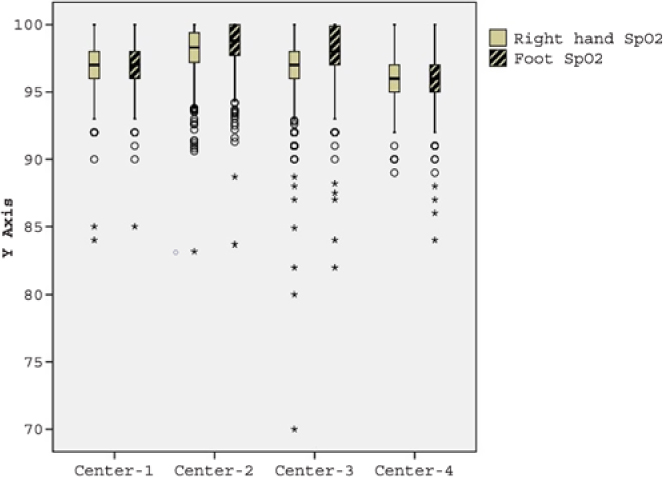
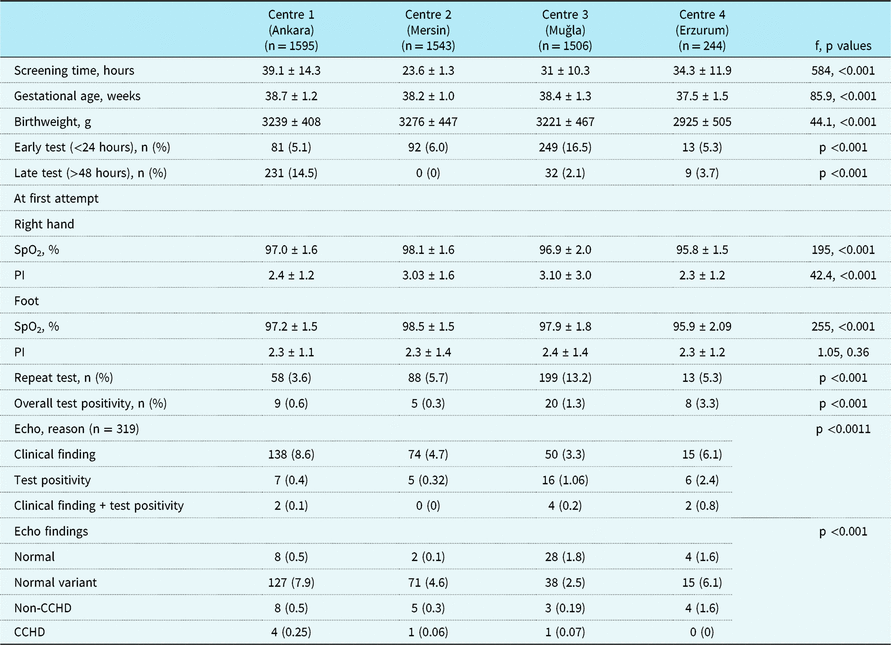
A total of 4920 babies were screened during the study period. Thirty-two babies were excluded due to a prenatal diagnosis of congenital heart disease (Fig 1). In 4888 newborns, the mean gestational age and birthweight were 38.4 ± 1.2 weeks and 3229 ± 450 g, respectively. Prematurity rate was 7.5% (n = 367). The mean screening time was 31.5 ± 12.1 hours (median 25 hours; IQR 24–38 hours; min–max 12–120 hours). A total of 435 babies were tested before 24th hour of life (early screening), and 272 after 48th hour (late screening). The most common reason for early screening was early discharge from hospital, and for late screening was medical problems related to babies or mothers. At first attempt, the mean values of pre- and post-ductal measurements were saturation 97.3 ± 1.8%, PI 2.8 ± 2.0 versus saturation 97.7 ± 1.8%, PI 2.3 ± 1.3, respectively. One repeat was needed in 393 babies (8.0%) and two repeats in 65 babies (1.3%). Overall test positivity rate was 0.85% (n = 42) with a false positivity rate of 0.76%. When compared by centres, gestational age and birthweight were the smallest in centre 4. The median screening time was the lowest in centre 2, which had the highest birth rate. The frequencies of early screening and repeat testing were the highest in centre 3. The late screening rate was the highest in centre 1. At first attempt, pre-ductal saturation and PI and post-ductal saturation were the lowest in centre 4 with the highest altitude (Fig 2). False positivity rate (3.2%) was the highest for the same centre (Table 1).
At first attempt, right hand and foot saturation (SpO2) values (%) by centres.

Clinical characteristics of the newborns by centres

CCHD = critical congenital heart disease; PI = perfusion index; SpO2 = oxygen saturation by pulse oximetry.
Echocardiography was performed in 319 babies. The indications were presence of clinical finding (n = 277), test positivity (n = 34), or both (n = 8). We showed that if a murmur (n = 288) was heard there was a 7.4% (n = 17) chance of there being an underlying cardiac malformation. For all 319 babies with echo, the detected lesions were: normal variants in 251 (5.1%), non-CCHD in 20 (0.4%), and CCHD in 6 (0.12%). The CCHDs were severe pulmonary stenosis (n = 1), transposition of great arteria (n = 1), total anomalous pulmonary venous return (n = 2), aortic isthmus hypoplasia (n = 1), and aortic coarctation (n = 1). Among the babies with CCHD, the indications for echocardiography were test positivity in 3, test positivity plus clinical finding in 2, and clinical finding in 1. Sensitivity, specificity, positive predictive value, negative predictive value, and likelihood ratio of the pulse oximetry test were 83.3%, 99.9%, 11.9%, 99.9%, and 99.2%, respectively. In patients with CCHD, right hand saturation (91 ± 6.3%) and foot saturation (92.1 ± 4.3%) were lower compared to others (p <0.05, for all comparisons). Right hand PI (1.7 ± 1.3) and foot PI (1.7 ± 1.0) were also lower in these patients, but not significantly (p >0.05). PI was <0.7 in only one patient with severe aortic isthmus hypoplasia with a right hand PI of 0.3. The patient with aortic coarctation had passed the test at the third attempt (right hand and foot PI were >0.7). This case was diagnosed via echocardiography performed because of cardiac murmur.
Ballon valvuloplasty was performed in a patient with pulmonary stenosis, while the others underwent surgical interventions.
Discussion
This study represents a multi-centre report of CCHD screening data in late preterm and term newborns at different altitudes (100–1900 m). It is the first study to assess the feasibility of the national CCHD screening guidelines in Turkey. Turkey is a predominantly mountainous country, and true lowland is confined to the coastal fringes. About one-fourth of the surface has an elevation >4000 feet (1200 m), and less than two-fifths lie below 1500 feet (460 m).
In a previous study, Samuel et al.Reference Samuel, Bromiker and Mimouni 12 used the currently recommended sea-level CCHD screening and found the average pre-ductal saturations of 97.86–98.49% with a 2 SD range encompassing 94.7–100% from 2559 feet (780 m). Thilo et al.Reference Thilo, Park-Moore, Berman and Carson 13 found term post-ductal saturations of 92–93% with a range of 80–98% and a 2 SD value of 85% in Denver (5280 feet/1610 m). Recently, Wright et al.Reference Wright, Kohn, Niermeyer and Rausch 14 reported that this protocol resulted in a failure rate of 1.1% at a moderate altitude of 5557 feet (1694 m). The authors stated that the hypothesised failure rate would be at least 3.2%, or an absolute difference of 3% points from previously published sea-level data.Reference de-Wahl Granelli, Wennergren and Sandberg 3 In our study, we observed that the same 10 CCHD screening protocol resulted in a failure rate of 0.25% at a low altitude of 100 m (centre 2) and 3.2% at a high altitude of 1900 m (centre 4). We also showed that both pre- and post-ductal saturation (95.8 ± 1.5% versus 95.9 ± 2.09%) were the lowest in centre 4 with the highest altitude.
A newborn’s saturations are theorised to be affected by altitude through two physiologic mechanisms. The first is related to delayed transition from fetal to neonatal circulation. The lower partial pressure of oxygen will result in limited pulmonary vasodilation. The resulting pulmonary artery to aortic artery shunting via the ductus arteriosus causes post-ductal desaturation. There can be an atrial-level shunt from the right to left atrium, resulting in equivalent but decreased pre- and post-ductal saturations.Reference Miao, Zuberbuhler and Zuberbuhler 15 The limited respirations after birth can result in extra cardiac shunting with ventilation–perfusion mismatch directly in the lungs.Reference Wright, Kohn, Niermeyer and Rausch 14
The target of screening is the identification of CCHD before discharge. For developing countries, clinical evaluation and pulse oximetry after birth have increased the chances of detection of congenital heart disease. An abnormal screening requires prompt echocardiography. Cruz De Fernanda et al.Reference Albuquerque, Maia, Figueiredo, Mourato and Mattos 16 reported nine (0.23%) cases with congenital heart disease in their study among 4027 newborns. In another study, Mathur et al.Reference Mathur, Gupta and Kurien 17 found 72 (7.57%) cases with congenital heart disease out of 950 screened cases. In our study, we screened 4888 babies and echocardiography was performed in 319 babies because of clinical finding and/or test positivity. CCHD was detected in six (0.12%) of the 4888 babies.
The initial presentation of congenital heart disease could mimic septicemia, respiratory distress, or other conditions. The symptoms of progressive cardiac failure, such as sweating, feeding difficulty, fast breathing, and failure to thrive, are non-specific in early neonatal periods. The cardiovascular examination of the neonate is important for diagnosing congenital heart disease, especially murmurs, cyanosis, and abnormal heart rate. Ainsworth et al.Reference Ainsworth, Wyllie and Wren 18 reported that neonatal examination could detect only 44% of cardiac malformations that present in infancy. We performed echocardiography in 319 babies because of clinical finding (n = 277), test positivity (n = 34), or both (n = 8). We showed that if a murmur was heard there was a 7.4% (n = 17) chance of there being an underlying cardiac malformation.
The recommendation to screen both preductally and postductally is based on the fact that this could increase the chances of detecting some types of CCHD. In the transposition of great arteria, only post-ductal screening may miss hypoxia as these babies can have a higher, and sometimes normal, post-ductal saturation with concomitant critically low pre-ductal saturation. Newborns with coarctation of the aorta sometimes have a lower post-ductal than pre-ductal saturation and will then be detected by screening if performed in both the right hand and a foot. However, most newborns with coarctation of the aorta have normal saturations both pre- and postductally and will therefore be missed by pulse oximetry screening.Reference de-Wahl Granelli, Wennergren and Sandberg 3 The reason for this is presumably a large left-to-right shunt across the foramen ovale of fully saturated blood and a large pulmonary blood flow resulting in a normal or near-normal saturation in blood shunted right to left across the ductus arteriosus. Another suggested mechanism could be that in some neonates, coarctation may be mild initially when pulse oximetry screening is performed, with a pure left-to-right shunt through the ductus arteriosus. This is an important limitation of the method as coarctation of the aorta is most commonly overlooked in newborn examination.Reference Mellander and Sunnegardh 19 A careful examination of the newborn, including palpation of the femoral pulses and echocardiography before discharge in all neonates with weak or absent femoral pulses, would be useful. There is some promise that the additional use of PI may improve the detection of aortic arch obstructions after birth.Reference de-Wahl Granelli and Ostman-Smith 20 The authors reported the incidence of CCHD as 1 per 1000 live births and added that 75% of the newborns who had a false-negative diagnosis with pulse oximetry had coarctation of the aorta.
In our study, PI was <0.7 in only one patient with aortic isthmus hypoplasia. However, the patient with aortic coarctation had passed the test (right hand and foot PI were >0.7). In this case, echocardiography had been performed because of cardiac murmur. Many studies have showed that CCHD screening program has high sensitivity and specificity. Their results were as follows: 78.9% and 99.9% in 51,698 newborns,Reference Turska Kmiec´, Borszewska Kornacka and Błaz 21 62.0% and 99.8% in 39,821 newborns,Reference de-Wahl Granelli, Wennergren and Sandberg 3 76.5% and 99.9% in 229,421 newborns,Reference Thangaratinam, Brown and Zamora 10 respectively.
Vaidyanathan et al.Reference Vaidyanathan, Sathish and Mohanan 22 mentioned a poor sensitivity of pulse oximetry in the detection of congenital heart disease. Koppel et al.Reference Koppel, Druschel and Carter 23 reported the effectiveness of pulse oximetry screening for congenital heart disease in asymptomatic newborns with sensitivity of 60%, specificity 99.95%, positive predictive value 75%, negative predictive value 99.98%, and accuracy 99.97%. Results of the present study are comparable to the study by Arlettaz et alReference Arlettaz, Bauschatz and Monkhoff 24 Thangaratinam et al.Reference Thangaratinam, Brown and Zamora 10 completed a meta-analysis that included 13 studies and reported a specificity of 99.9% and a false positive rate of 0.05%. Richmond et al.Reference Richmond, Reay and AbuHarb 25 showed that repeat pulse oximetry brought their false positive rate down from 5% to 1%. In a local study from our country, Ozalkaya et al.Reference Ozalkaya, Akdağ and Sen 26 reported the sensitivity and specificity of pulse oximetry screening in the diagnosis of CCHD as 60% and 99.9%, respectively. In the current study, sensitivity and specificity of the test were 83.3% and 99.9%, respectively. We showed a very good sensitivity, but positive predictive value was less than optimal to detect CCHD. In a recent study, Diller et al.Reference Diller, Kelleman, Kupke, Quary, Kochilas and Oster 27 reported that modifying the screening algorithm to one repeat pulse oximetry test instead of two might detect additional infants with significant disease without a substantial increase in the false positive rate.
In conclusion, our study showed that pulse oximetry screening is an effective screening tool for CCHD in newborns at different altitudes. High-altitude locations may have several barriers to implementing the national criteria for CCHD screening, including potentially lower saturations. Studies adjusting for the special relationship between saturations and high altitudes may be helpful. For early detection of CCHD, we offer the implementation of a national screening program with consideration of altitude differences for our country.
Financial Support
This research received no specific grant from any funding agency, commercial or not-for-profit sectors.
Conflicts of Interest
None.
Competing interests
The authors have no competing interests to disclose.