





Introduction
Oyěwùmí (Reference Oyěwùmí, Desai and Nair2005) argues that European colonial regimes reshaped African social categories by imposing a rigid, biological view of gender as binary, a framework largely incongruent with many African indigenous epistemologies (see also Oyěwùmí Reference Oyěwùmí1997). This imposition was enforced through law, education, religion, and bureaucratic classifications that replaced complex indigenous systems of personhood and conflated anatomy with identity and destiny. Oyěwùmí’s argument aligns with Amadiume’s position that pre-colonial Nigeria had non-binary, role-based gender systems. In Amadiume’s classic book, Male Daughters and Female Husbands (1987), the Nnobi (Igbo) culture of Nigeria maintained a societal structure where exclusive access to land inheritance and influential political roles was reserved for men, based on their ability to procreate. In cases where a man was unable to procreate, his wife took on the leadership role, orchestrated the conception of children through other men, asserted authority over other women’s bodies, and laid claim to land and political power. In such cases, she occupied a position that transcends gender binaries. As biologically female but socially a man, she neither fully identified as a man nor exclusively as a woman, and could embody roles as a husband, wife, both, or neither.
Post-colonial Nigeria still does gender differently from the West. Matory (Reference Matory1994) and Sweet (Reference Sweet2009) show how male priests (or ‘wives’) of Ṣàngó, the god of thunder, lightning, fire, and justice in Yorùbá mythology, complicate the Western hegemonic understanding of gender. Ṣàngó is a male god, and his devotees are mostly females. These females serve as intermediaries between Ṣàngó and his worshippers. Ṣàngó possesses these females to communicate with his worshippers. This possession is referred to as gùn ‘to mount’ in Yorùbá, as when men mount women during sex. Some males also serve as priests, but to do the job, they wear similar attire to the females, like skirts, blouses, ‘make-up’,Footnote 1 hair weave, and jewelry. In ritual practice, male-possessed priests do not present themselves as women but rather as the ‘wives of the gods’, embodying their spiritual roles through ceremonial attire, gestures, and verbal expressions. While they are clearly recognized as men, their ritual identity and divine connection are signified through traditionally feminine modes of expression. In certain instances, possessed Ṣàngó male priests have been observed engaging in acts of ritualized intimacy with other unpossessed male priests in Ọ̀yọ́ shrines. However, these behaviors are understood exclusively within the sacred context of religious practice and spiritual embodiment.
Indeed, such gender practices are often termed unconventional and deviant in contemporary Nigerian discourse (Balogun & Bissell Reference Balogun, Bissell, Matebeni, Monro and Reddy2018; Onanuga Reference Onanuga2024; Oyebanji Reference Oyebanji2025). This is not because of unfamiliarity with pre-colonial Nigerian traditions. Rather, it is because of the colonial model of the ‘coatrack’ system (Nicholson Reference Nicholson1994) of gender that conditions, governs, and restricts gender practices in many (urban) parts of the country. At the same time, language use in Nigeria remains deeply entangled with the fractured intertextualities and intermittent circulations of colonial discourses surrounding African languages. These discourses are saturated with tropes that cast African languages as ‘backward’, ‘inferior’, ‘instinctive’, ‘less evolved’, ‘primitive’, and ‘simple’ (see Darwin 1871/Reference Darwin1998; Vinson Reference Vinson1888). European languages were imposed upon African societies in a manner that systematically elevated them above indigenous linguistic traditions and made some Africans define their indigenous languages by the very distorting frames of the colonial gaze. This gaze created a linguistic hierarchy that positioned European languages as inherently superior. Standardized Nigerian English, popularly referred to as Educated Nigerian English, an acrolect variety of Nigerian English (Jowitt Reference Jowitt2018; Ugwuanyi & Aboh Reference Ugwuanyi and Aboh2025), showcases this hierarchy vividly. Its acrolect status is derived from its close resemblance to British English,Footnote 2 not from features it shares with indigenous Nigerian languages. Accordingly, it indexes social standing through colonial valuation. We see, therefore, that European linguistic and gender practices continue to structure linguistic and social norms in many (urban) parts of Nigeria (see also Besnier Reference Besnier, Holmes and Meyerhoff2003 on Tonga; Cowie Reference Cowie2007 and Hall Reference Hall2019 on India; Makoni Reference Makoni2016 on Southern Africa; Borba & Milani Reference Borba and Milani2019 on Brazil; Smalls Reference Smalls2024 on Liberia).
This study aims to critically examine the structuralizing effects of these colonial legacies through an investigation of rhoticity in Nigerian English. I combine variationist and linguistic anthropological approaches to show how Nigerian crossdressers, a group of vilified feminine men, use rhoticity to achieve differentiation (or dislocation in Fanon’s (Reference Fanon1952) termsFootnote 3) from other Nigerians. While I use a variationist approach to systematically calculate the distribution of rhoticity and to understand its socially meaningful patterns in Nigerian English (see also Aminu Reference Aminu2025a,b), I also use a linguistic anthropological approach to show how Nigerian crossdressers’ use of rhoticity has transglobal embeddedness. I argue that the crossdressers use rhoticity, non-prevocalic /r/ in car and farm, for indexical inoculation (Silverstein Reference Silverstein2017; Barrett & Hall Reference Barrett and Hall2024), a process where genderqueer individuals protect themselves from homophobia by recategorizing the meaning of an indexical inventory or by forming new indexical inventories related to enregistered colonial linguistic or social features. As Nigerian English is not rhotic (Jowitt Reference Jowitt2018), I further trace the crossdressers’ recontextualized (Briggs & Bauman Reference Briggs and Bauman1992) use of rhoticity to English in the United States, a country with similarities to Nigeria’s former colonial ruler, the United Kingdom (Britain), in terms of racial subjectivities (i.e. the hegemony of whiteness), media presence, and economic status. During colonial rule, Britain established English as the language of administration, education, and law in Nigeria (Bamgboṣe Reference Bamgboṣe and Kachru1992), but also exerted epistemological colonization (Borba Reference Borba2017) that shaped local linguistic hierarchies and the sociocultural uses of other languages in the country. In essence, through this epistemological colonization—that is, through the distorting frames of the colonial gaze that define the limits of a civilized language—the colonial entailments embedded within US English give it (symbolic) capital in Nigeria’s linguistic marketplace (Bourdieu Reference Bourdieu1977). I also show how some Nigerians use an intersubjective colonial gaze that vilifies Nigerian crossdressers and how Nigerian crossdressers use the same gaze to resist this vilification. That is, Nigerian crossdressers use rhoticity as part of a stylistic bricolage (Eckert Reference Eckert2008) with colonial entailments that consist of other semiotic resources like Americanized accents, skin bleaching,Footnote 4 Western self-renaming practices, and a desire to live Western lives to construct glamorous cosmopolitanism. These semiotic resources function to inoculate them from vilification in Nigeria, and the social meanings they mobilize evoke coloniality (Lugones Reference Lugones and Harcourt2016; Reyes Reference Reyes2017), the ongoing reproduction of colonial structures through recursive processes that continue to shape how cosmopolitanism and personhood are imagined in contemporary Nigeria.
What is rhoticity? Who are Nigerian crossdressers?
Rhoticity, non-prevocalic /r/, referring to the /r/ in words such as bar, carb, and carpenter, is a prominent linguistic variable in the variationist enterprise (Labov Reference Labov1972; Labov, Ash, & Boberg Reference Labov, Ash and Boberg2006; Becker Reference Becker2014; Dickson & Hall-Lew Reference Dickson and Hall-Lew2017; Tod Reference Tod2024). For example, Labov and colleagues (Reference Labov, Ash and Boberg2006:47) identify their primary variable of interest as ‘tautosyllabic (or coda) /r’/, explicitly excluding both intervocalic /r/ and word-final /r/ when followed by a vowel. This exclusion arises from the tendency for /r/ in these contexts to be realized as linking /r/, the articulation of /r/ across word boundaries where it is orthographically present (e.g. ‘Her idea’ [hɜːɹaɪdɪə]). The postvocalic /r/ has been designated by various terms that effectively encapsulate its definition and characteristics, including ‘tautosyllabic post-vocalic /r/’ (Kurath & McDavid Reference Kurath and McDavid1961:115), ‘non-prevocalic /r/’ (Trudgill Reference Trudgill1986:74), and ‘rhoticity’ (Labov et al. Reference Labov, Ash and Boberg2006). This article employs ‘rhoticity’: rhotic (r-ful) and non-rhotic (r-less).
In Nigerian English, rhoticity is notably absent (in the forms of r-vocalization or r-deletion), and thus it has been described as a non-rhotic English variety (Jowitt Reference Jowitt2018). The current article revisits this claim by providing evidence of rhoticity among a group of Nigerians locally referred to as crossdressers. Their use of this variable opens up important questions about history, coloniality, and gender in Nigeria.
Nigerian crossdressers challenge binary gender roles by performing identities that do not strictly conform to the male-female dichotomy. As biologically male individuals who talk and behave in ways that are considered to be womanlike, Nigerian crossdressers transgress normative boundaries of gender and are, therefore, considered to pose a threat to the social order. Despite their ostentatious displays of wealth, claims to fame, and connections to influential figures, Nigerian crossdressers remain under constant threat of harassment, public ridicule, and immolation (what some Nigerians call ‘jungle justice’). Consequently, many crossdressers live in seclusion. While many crossdressers in Nigeria maintain private lives due to social pressures, the relatively few who are openly out quickly attain fame. These famous ones primarily utilize TikTok as a platform to express their gender identities. Their content frequently revolves around displays of affluence, celebrity gossip, prescriptions of women’s behavior, and heated exchanges with homophobic men who attempt to malign them in their TikTok live sessions.
Even though some Nigerian crossdressers adopt female names and feminine referents, they enjoy being both men and women, and they vividly express both (and other) sides of their identities in the media.Footnote 5 For instance, in an interview on YouTube (see With Chude 2024), Tobi the creator, one of the crossdressers in this study, asserted that they are a woman. In the same interview, they later identified as non-binary. Meanwhile, they had just claimed to be a man on TikTok. Therefore, Nigerian crossdressers do not need to dress in traditionally feminine ways to claim womanhood, nor be in a traditionally masculine outfit to claim manhood. While some crossdressers emigrate from Nigeria to Western countries for gender reassignment surgery (Onanuga Reference Onanuga2024), others (falsely) report having undergone such procedures and continue to crossdress. Those who make these false reports do so because they employ prosthetic devices (e.g. silicone breast forms, gluteal implants, and hip pads) to approximate a post-surgical appearance and can remove them when confronted with local moral, legal, familial, or religious pressures. What this means is that the term ‘crossdresser’ does not do justice to their identity; that is, it inadequately captures the fluid, multifaceted, and context-dependent nature of their gendered identity. In fact, the term itself is controversial and ambiguous. It is controversial because it implies a binary understanding of gender, reinforces the idea that particular clothing or behaviors are exclusive to one gender, and can perpetuate stereotypes against genderqueer individuals. It is ambiguous because, first, it implies that Nigerian crossdressers are referred to as crossdressers simply because of their dress, or that the whole significance of crossdressing solely relies on their dress and ability to cross it. Second, cross-culturally, it can connote homosexuality (Mbaye Reference Mbaye2021). Third, in some Nigerian cultural contexts, men (e.g. some ‘wives’ of Ṣàngó) wear attire usually designed for women as part of sacred ceremonies, but such practice is different from the Western understanding of crossdressing and is not referred to by that term (Sweet Reference Sweet2009). However, I have employed the term in this study for two main reasons: (i) Nigerians use ‘crossdresser’ to describe the persona that this study investigates, and (ii) the participants who are the focus of the study (the crossdressers) often refer to themselves as crossdressers.
Nigerian crossdressers are not drag queens. In the Anglo-American context, a drag queen is a person, typically a man, who dresses in clothing designed for women and often exaggerates certain feminine features (e.g. gesticulation, speech production, make-up, and so on) for entertainment purposes (Calder Reference Calder2019; see also Butler Reference Butler1990). However, crossdressing in Nigeria is much less of a theatrical act than drag. Though the crossdressers adopt non-normative femininity, they do not necessarily exaggerate femininity; rather, they embody normative femininity as much as possible. Many Nigerian crossdressers also express vivid interest in traditionally feminine occupations. Aside from the fact that they wear makeup, wigs, heels, and adopt traditionally feminine speech mannerisms, they flaunt their feminine comportment in terms of sociocultural practices and occupations. They express talent in jobs stereotyped as feminine, like hairdressing, make-up artistry, baking, and babysitting, and they record themselves when they engage in stereotypically feminine domestic chores like cooking, child-minding, and laundry-washing. In fact, they overtly express distaste for physically demanding, stereotypically masculine chores and often attribute them to ‘men’s work’. They express passion in gossiping with women, making prescriptions for men’s and women’s behaviors, many times focusing on how ‘useless’ men can be and how women should take advantage of men by demanding large sums of money from them. Even though they consistently reassure their audience that they are neither gay/queer nor drag queens, they talk about their offline engagements with men, how some of these men express sexual advances to them, pointing out flaws these men make in asking them out, and how they turn down or accept some of their sexual advances. In essence, Nigerian crossdressers, though they may exhibit certain practices ideologically linked to the global (specifically, Western) understanding of queerness, create a disjuncture between their identities and queerness. Not only does this rhetorical trope make it problematic to refer to Nigerian crossdressers (and other genderqueer and sexually non-normative individuals in Nigeria) as queer, but it also invokes Oyěwùmí’s (Reference Oyěwùmí1997) questioning of the universality and applicability of Western human relations to Africans. Conversely, Bakare-Yusuf (Reference Bakare-Yusuf2003:138) cautions against designating a particular category (e.g. queer) as Western and, therefore, inapplicable to African contexts, given the ‘intercultural exchange’ and ‘borrowed traditions’ shared between Africa and Europe. But to deny the imperialistic imposition of European culture on Africa and on the divergent experiences of Africans undermines the impact and value of colonialism and epistemological violence on Africa.
Nigerian crossdressers’ gender transgression makes them especially vulnerable to threats from the media, government, and public (Balogun & Bissell Reference Balogun, Bissell, Matebeni, Monro and Reddy2018). They are often seen as individuals with marginal identities not worthy of serious concern or consideration. They are often publicly stripped naked, beaten, mobbed, ridiculed, insulted, and used as the source of jokes for comedians and content creators. In August 2024, a notable crossdresser, Area Mama, was murdered and left on the highway, but to date, to my knowledge, there is no formal, publicly acknowledged account of the people responsible for Area Mama’s murder, how they were murdered, why they were murdered, or the circumstances surrounding their murder. Other notable crossdressers (and genderqueer individuals) like Bobrisky and James Brown have been arrested several times on suspicion of being gay. As Balogun & Bissell (Reference Balogun, Bissell, Matebeni, Monro and Reddy2018) and Mensah (Reference Mensah2021) argue, hegemonic masculinity in Nigeria is patriarchal heterosexual masculinity; therefore, people like Bobrisky, James Brown, and other Nigerian crossdressers who violate this type of masculinity face social exclusion, hate crimes, and often unfounded claims of homosexuality. On other occasions when they were arrested, these crossdressers participated in illegal activities (e.g. excitedly throwing naira notes on a celebrant) that other Nigerians may be pardoned for (Oyebanji Reference Oyebanji2025). Nigerian crossdressers’ TikTok accounts are replete with negative commentaries and curses. Some Nigerians have publicly asserted that they will organize groups expressly aimed at physically attacking and possibly murdering these crossdressers. There is propaganda about Nigerian crossdressers being gay and carrying sexually transmitted diseases, and some crossdressers must constantly debunk such propaganda. Oftentimes, popular bloggers use Nigerian crossdressers as points of mockery and parody. There are also discourses in the media that represent Nigerian crossdressers as ‘un-African’, ‘Western’, ‘ungodly’, ‘unacceptable’, ‘unnatural’, ‘immoral’, and ‘uncultural’. Such representations are examples of indexical disjuncture (Barrett & Hall Reference Barrett and Hall2024), where anti-colonial arguments are made with discourses that have roots in colonialism. Despite the vilification they face, their online presence and large social media following make them ambassadors for several local and international brands, granting them access to some Western countries. This opportunity allows them to engage in adequation (Bucholtz & Hall Reference Bucholtz and Hall2004) with Western culture by using rhoticity, manipulating their accents, bleaching their skin, and expressing pride in having access to men capable of sending them on trips to Western countries.
Indeed, the Anglophone population in Nigeria traditionally gravitates towards southern, urban settings, characterized by a predominantly middle- to upper-class demographic, areas where Nigerian crossdressers are mostly present. Hence, they are more likely to use enregistered Western English linguistic features than other genderqueer individuals in Nigeria, especially those who have had a different ‘colonial’ experience (e.g. ‘yan daudu in northern Nigeria who first had trade, religious, and cultural contact with the Arabs). But Gaudio (Reference Gaudio2009) also features examples of some ‘yan daudu that pepper their Hausa speech with Arabic words, phrases, and phonetic forms and mimic Egyptian and Iraqi accents to convey an image of cosmopolitanism and elite status, as well as showcase social sophistication. This example offers an apparent parallel with the argument of this article as to the reason Nigerian crossdressers use US English rhoticity—to mark a claim to glamorous cosmopolitanism and to display social sophistication. Equally important to note is that ‘queer’ individuals in Nigeria receive legal, physical, and emotional support from US (and other Western) agencies that support queer activism in the country (Onanuga Reference Onanuga2024). Therefore, there is a chance that some Nigerian crossdressers attend queer events organized by these agencies or are at least in contact with these US agencies or representatives. In such cases, speech accommodation is possible. In this article, I show that as a form of indexical inoculation, Nigerian crossdressers recontextualize and use US English rhoticity, which may have been learned from a variety of sources, including these ‘queer’ events hosted by US expats.
According to Borba & Milani (Reference Borba and Milani2019:1), colonial intertexts are texts that show ‘intertextual connections… between the colonial archive and its representational regimes’. The colonial archive in this case is not rhoticity per se; rather, it is the colonial intertexts (e.g. skin bleaching and Western self-renaming practices) that get circulated alongside rhoticity and the colonial gaze that defines the limit of the civilized language (e.g. US English) from which rhoticity is recontextualized. This situation is similar to the Indian context, where the educated elite often turn to English to express sexual modernity, a shift shaped by the colonial-era marginalization of gender/sexual transgressors and moral sanitization of sexual vocabulary in indigenous Indian languages (Hall Reference Hall2019). Crucially, the United Kingdom (Britain), Nigeria’s former colonial ruler, which shaped language use in the country, and the United States share significant relationships. First, both the United Kingdom and the United States fall within what Kachru (Reference Kachru, Quirk and Widdowson1985) describes as the ‘Inner Circle’ of Englishes, the group of countries where English is historically established as a ‘native language’. Second, both countries are arguably the English-speaking countries with the most dominance in the global economy. Third, both feature in Nigerian English and have a strong presence in Nigerian media (Awonusi Reference Awonusi1994; Aminu Reference Aminu2025a). Fourth, as aforementioned, they share similar racial subjectivities where white-identified people constitute most of the population and hold a disproportionate share of social, economic, and political power (Smalls Reference Smalls2024). Fifth, they both have enregistered, performable accents with wide circulation. Sixth, both countries are arguably more queer-friendly than Nigeria. As the United Kingdom (Britain) was Nigeria’s colonizer, it would be logical for Nigerian crossdressers to use an enregistered UK English feature, as many other genderqueer individuals in the Global South do (see e.g. Besnier Reference Besnier, Holmes and Meyerhoff2003 on the fakaleiti of Tonga; and Hall Reference Hall2019 on the gender and sexual minorities in India). However, I argue that because Educated Nigerian English mirrors standardized British English (or Received Pronunciation) closely, it is not so useful as a way of evading the social context that marginalizes and vilifies the identities of the crossdressers. This makes US English (and rhoticity) particularly useful, especially since the United States, to some individuals, still serves as a beacon of freedom and hope for queer identities. In essence, I argue that Nigerian crossdressers’ use of rhoticity is a deliberate act of affective and interpersonal stancetaking (Kiesling Reference Kiesling2022) that aligns them with prestige, mobility, and cosmopolitanism, adopted from the United States, to socially reposition themselves after years of marginalization.
The indexical field of (US) English rhoticity
Though rhoticity has been the subject of linguistic variation in sociolinguistics as far back as the 1950s (see e.g. Reinecke Reference Reinecke1951:81–91), Labov’s (Reference Labov1966) New York department store studies brought it into the limelight, along with a few studies that replicated the New York studies (Fowler Reference Fowler1986; Mather Reference Mather2012; Becker Reference Becker2014; Guy Reference Guy2018). Labov’s findings reveal a clear correlation between rhoticity, gender, and social class. He found that women, particularly those of higher socioeconomic backgrounds, tended to use rhoticity more than men. This pattern suggests that rhoticity was associated with prestige and upward social mobility, and that women may have been more inclined to adopt it in their speech. Subsequent studies reported categorically similar results regarding the use of rhoticity in the United States. The ideologically inflected meanings, what Eckert (Reference Eckert2008) terms the ‘indexical field’, associated with rhoticity in US English are often linked to notions of upper-class status, prestige, and education. Specifically, rhoticity, in the United States, is an index of middle-to-upper-class speakers (Labov Reference Labov1966; Becker Reference Becker2014; Guy Reference Guy2018) and women (Brennan Reference Brennan1983; Labov Reference Labov1990; Schönweitz Reference Schönweitz2001). For Schönweitz (Reference Schönweitz2001), rhoticity among Southern American women is the most systematic and regular gender-based variation pattern in the United States. Brennan (Reference Brennan1983) also found that rhoticity was not only a prestige marker, but it also correlated with higher educational attainment, age, and gender, with women being more rhotic than men in New Orleans. A similar finding was reported in Carmichael (Reference Carmichael2017) in terms of gender in New Orleans. Overall, while the southern parts of the United States (e.g. Alabama and New Orleans) have moved quickly to rhoticity, the north (e.g. Boston, New Hampshire, and New York) is undergoing a slow change (Nagy & Irwin Reference Nagy and Irwin2010; Becker Reference Becker2014).
In the United Kingdom, Dickson & Hall-Lew (Reference Dickson and Hall-Lew2017) show that gender and socio-economic class are significant predictors of rhoticity in Edinburgh. Although they make a phonetic distinction between ‘non-rhotic realizations being linked to (upper-)middle-class Anglo-English varieties’ and ‘derhotics associated with working-class varieties (including Scots)’ (247), they show that ‘new’ middle-class women show ‘extremely high rates of rhoticity,’ while working-class women show ‘very high rates of rhoticity’ (248). Conversely, because the use of rhoticity is stigmatized in Lancashire, United Kingdom, it is used more by men than women (Turton & Lennon Reference Turton and Lennon2023). Turton & Lennon (Reference Turton and Lennon2023) show that not just tokens but also the gradience of rhoticity is stratified by gender in Lancashire. Although women produce more tokens of rhoticity, men realize lower mean F3–F2 values, indicating stronger rhotic realizations than women. Equally important to this study is the status of rhoticity (of particular interest, US English rhoticity) in Outer Circle English contexts like Nigeria.
Kachru’s (Reference Kachru, Quirk and Widdowson1985) influential model of world Englishes distinguishes countries where English is a ‘native language’ (Inner Circle), post-colonial countries where English is widely used but the standard is exonormative (Outer Circle), and countries where English is used as a lingua franca or for specific functions (Expanding Circle). Patterns of rhoticity in Outer Circle Englishes vary; non-rhoticity often reflects historical ties to non-rhotic British varieties and later prestige norms (Jowitt Reference Jowitt2018). Rhotic Englishes used by specific groups of speakers in the Outer Circle are often attributed to rhoticity transfer from the native language of these speakers to English (e.g. Punjabi speakers of Pakistani English, Brunei-Malay speakers of Brunei English, and Afrikaans speakers of South African English; Mesthrie & Bhatt Reference Mesthrie and Bhatt2008; Salbrina & Hasnan Reference Salbrina and Hasnan2018). Other factors influencing the use of rhoticity in these varieties include interpersonal contact, which facilitates the diffusion of linguistic innovations, and the global reach of US English through media exposure (Sayers Reference Sayers2014; Starr Reference Starr, Hall-Lew, Moore and Podesva2021). However, neither interpersonal contact nor media exposure can fully account for observed variation unless rhoticity possesses symbolic capital as a marker of US English in the global linguistic marketplace. In addition to media exposure, therefore, the use of rhoticity in these speech communities depends on local functional fit, ideological alignments with the United States, and rhoticity’s indexical field (Stuart-Smith Reference Stuart-Smith2014; see also Tan & Gupta Reference Tan and Gupta1992 on Singaporean English, Hartmann & Zerbian Reference Hartmann and Zerbian2010 on South African English, and Salbrina & Deterding Reference Salbrina and Deterding2010 on Brunei English). The overall indexicality (Ochs Reference Ochs, Duranti and Goodwin1992) of US English rhoticity in these contexts is related to cosmopolitanism, modernity, class, or education. Using Ochs’ theory of indirect indexicality, where linguistic signs index a particular stance/act/activity, which then becomes constitutive of an identity, rhoticity in these contexts is used to index alignment with US (or Western) culture, which then becomes constitutive of the prestige or modernity its users wish to display. Specifically, for example, Tod (Reference Tod2024:3) shows how the use of rhoticity in Tonga is iconic of US English rhoticity, and its use is led by women to index ‘modernity and (appreciation of) Western cultural values’.
Of particular interest to the context of this article is Hartman & Zerbian (Reference Hartmann and Zerbian2010), who examine the use of rhoticity in a non-rhotic Outer Circle English context, South African English, but even more precisely, Black South African English among ‘more or less’ affluent speakers. What they find is that the use of English among young, urban, and affluent Black South African women indicates overt prestige, unlike men who use African languages to index covert prestige. As rhoticity also indexes greater wealth, they find that affluent Black South African women use rhoticity more than men and that this rhoticity is a prestige marker originally from US English. This is important to this study, as South Africa was colonized by Britain. Since it uses similar English features as British English, one would expect that British English or the use of British English in particular ways will index the prestige that Black South African women want to convey. As US English rhoticity indexes high-class femininity in this and many other contexts reviewed in this article, its use by Nigerian crossdressers fits the pattern where features associated with wealthy women are available to index their identity.
Furthermore, I argue that this indexical field that relates the use of English (or its linguistic features) to cosmopolitanism in many of these Outer Circle English contexts did not arise arbitrarily. Rather, oftentimes, it is intertextually linked to historical frames of the colonial gaze that define the boundary of a civilized language. We might, therefore, assume that, in Hartman & Zerbian’s (Reference Hartmann and Zerbian2010) article, it is through epistemological colonization in South Africa that the use of indigenous African languages by Black South African men carries covert prestige, while the use of English (and US English rhoticity) by Black South African women indexes cosmopolitanism. As Wolff (Reference Wolff2017) argues, the formation of languages through colonial encounters that create language hierarchies fundamentally reshapes pre-existing linguistic practices and alters conceptions and perceptions of language use (see also Irvine & Gal Reference Irvine, Gal and Kroskrity2000; Makoni, Smitherman, Ball, & Spears Reference Makoni, Smitherman, Ball and Spears2003; Mufwene & Vigouroux Reference Mufwene, Vigouroux, Vigouroux and Mufwene2008; Rosa & Flores Reference Rosa and Flores2017). It is, therefore, possible that the colonial logic of primitiveness for the colonized’s indigenous languages is what elevates English (or its structural features) to index this cosmopolitanism some colonized speakers adopt.
Methods
Participants and coding
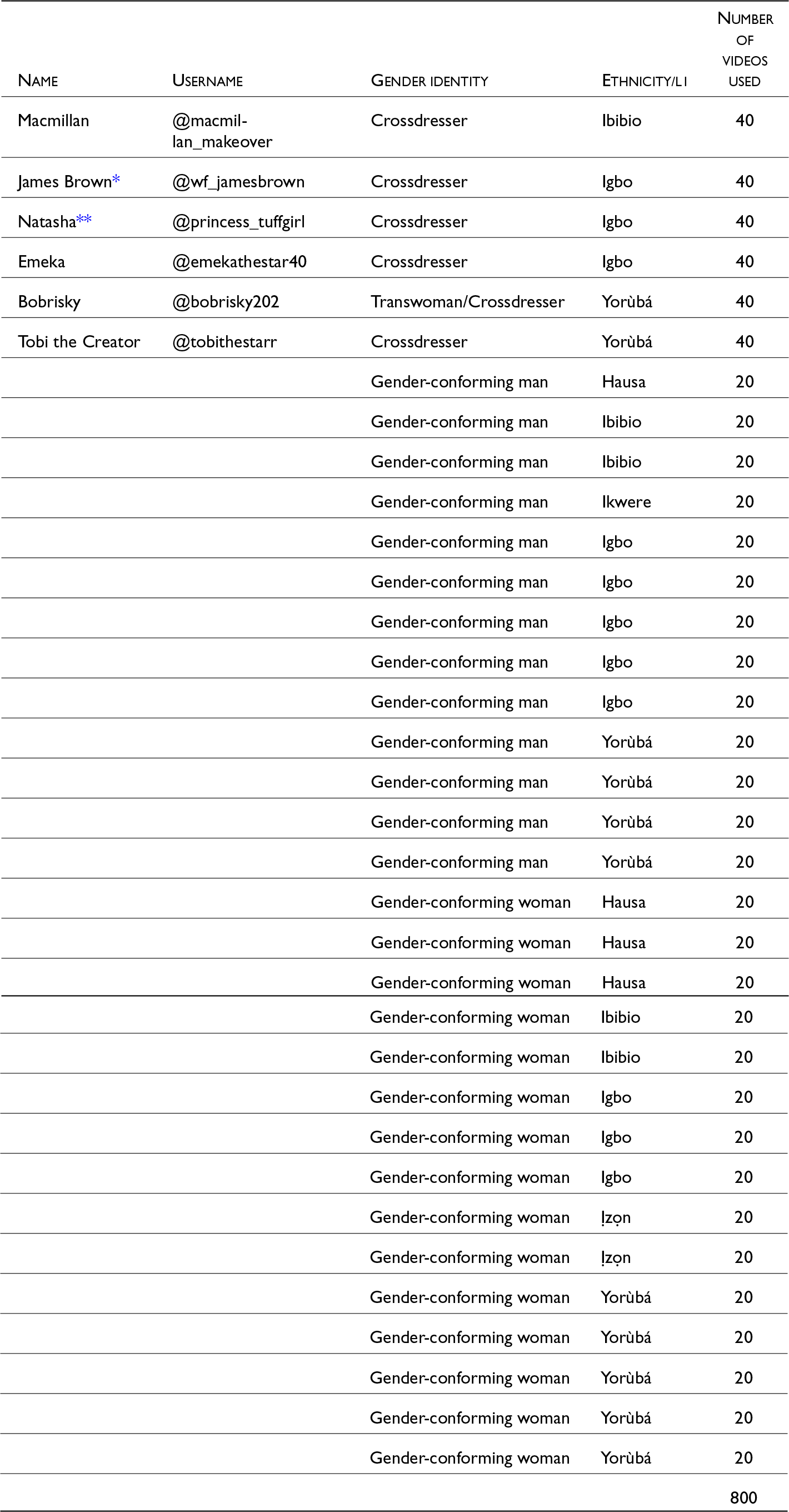
In Nigeria, where non-normative gender expressions may provoke severe acts of violence, such as stoning or immolation from the public (Oyebanji Reference Oyebanji2023), the virtual sphere serves as the primary platform for accessible engagements for Nigerian crossdressers. Hence, the risks associated with public manifestations of crossdressing render the physical identification and participation of crossdressers in this study a formidable challenge. As a form of social interaction, some crossdressers partake in select celebrity gatherings where they are safeguarded by security personnel, and even in these gatherings, they are still susceptible to harassment, disapproval, and hostility. For this study, therefore, to investigate Nigerian crossdressers’ use of rhoticity, I gathered TikTok videos of the crossdressers, as well as those of gender-conforming men and gender-conforming women. Because there are very few crossdressers with media publicity, this study employs six of the most popular ones. There are many more popular crossdressers on TikTok (and other social media platforms), but they mostly engage in non-speech performance. Videos of fifteen gender-conforming women and thirteen gender-conforming men were included alongside the crossdressers’ (see Tables 1, 2, and 3 for full demographics). In total, 800 videos were used for this study: forty for each of the six Nigerian crossdressers, twenty for each of the thirteen gender-conforming men, and twenty for each of the fifteen gender-conforming women (see Table 1 below for more details). The videos lasted an average of five minutes, and in total, there were approximately 780 minutes (or thirteen hours) of recording. There were also 6,476 realized tokens that permitted etymological rhoticity.
Videos per gender identity.

Table 1 Long description
The table lists three gender identity groups, the number of participants in each group, and the total number of TikTok videos analyzed. Gender identities and video counts: Nigerian crossdressers: 6 participants, 240 videos, Gender-conforming men: 13 participants, 260 videos, Gender-conforming women: 15 participants, 300 videos, Total: 34 participants, 800 videos.
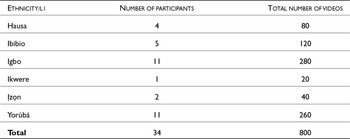
Videos per Ethnicity/L1.

Table 2 Long description
The table lists six ethnic/L1 groups, the number of participants in each group, and the total number of TikTok videos analyzed. Ethnicities/L1 and video counts: Hausa: 4 participants, 80 videos, Ibibio: 5 participants, 120 videos, Igbo: 11 participants, 280 videos, Ikwere: 1 participant, 20 videos, Ịzọn: 2 participants, 40 videos, Yorùbá: 11 participants, 260 videos, Total: 34 participants, 800 videos.
For the gender-conforming men and women, the snowball technique was used to get participants with credible TikTok accounts where they use their voices with as little background noise as possible (see Table 3 for a breakdown of all participants in the study). The participants were briefly interviewed to know their gender identity and L1 before proceeding to use their TikTok accounts. Interestingly, many of them considered the research to be ‘Western’, ‘un-African’, and LGBTQ-driven and wanted no part in it. Therefore, some participants declined to either participate or publicize their accounts. Consequently, this study does not provide the TikTok handles of gender-conforming men and women.
Participants and distribution of TikTok videos.

Table 3 Long description
The table lists named and unnamed TikTok participants, their usernames (where available), gender identity, ethnicity/L1, and number of videos used. Crossdressers and one transwoman/crossdresser each contributed 40 videos. Gender-conforming men and women each contributed 20 videos. Total videos: 800.Crossdressers and Transwoman/Crossdresser (40 videos each): Macmillan (@macmillan_makeover), Ibibio, James Brown (@wf_jamesbrown), Igbo, Natasha (@princess_tuffgirl), Igbo, Emeka (@emekathestar40), Igbo, Bobrisky (@bobrisky202), Yorùbá, Tobi the Creator (@tobithestarr), Yorùbá, Gender-conforming men (20 videos each): Hausa (1 participant), Ibibio (2 participants), Ikwere (1 participant), Igbo (5 participants), Yorùbá (4 participants), Gender-conforming women (20 videos each): Hausa (3 participants), Ibibio (2 participants), Igbo (3 participants), Ịzọn (2 participants), Yorùbá (5 participants)
* Although James Brown is ethnically Igbo and has stated that they acquired Igbo as L1 before Yorùbá, their fluency is markedly greater in Yorùbá than in Igbo.
** Natasha is ethnically Tiv, but they are competent in Igbo and use it much more than Tiv on their TikTok live sessions. Also, during one of their TikTok live sessions, they noted that Igbo is their first language (L1).
Tokens were classified through auditory analysis as either r-0 (absence of constricted /r/) or r-1 (presence of constricted /r/), with spectrographic verification in Praat (Boersma & Weenink Reference Boersma and Weenink2018) used when auditory assessment proved inconclusive. I collaborated with a phonetically trained US English native speaker for an inter-rater reliability test. A simple direct comparison of the results of our analyses showed agreement was at approximately 93%. Because of the copious examples of hyper-rhoticity (i.e. the insertion or exaggeration of rhoticity in unexpected phonological contexts), it was important for my inter-rater and me to pay close attention to every word used in each video carefully. There were instances where vowels in post-vocalic positions were creaked and sounded rhotacized. In those cases, such words were discarded. Additionally, tokens of intrusive /r/, the insertion of /r/ across word boundaries where it is not orthographically present (e.g. ‘Asia(r) and Africa’ [eɪʒəɹ ænd ˈæfɹɪkə]), were excluded from consideration. Cases that permitted etymological rhoticity, like ‘car’, ‘influencer’, and ‘ever’, were not always rhotacized. It is also important to add here that, though in most cases, the alveolar approximant [ɹ] was used, there were other realizations of rhoticity (e.g. [ʀ ɻ ɽ]) in the data. As a full taxonomy of realizations of rhoticity in Nigerian English is outside the scope of this study, this analysis collapsed rhoticity into two categories: rhotic and non-rhotic.
External constraints
Two external constraints are used in this study: ethnicity/L1 and gender identity (see Table 4 for details). The Western mainstream understanding of ethnicity and native language is that they are mutually distinguishable and not necessarily constitutive of each other. For example, one can be named Aimee (a female name of French origin) but have English as their native language. Also, native speakerhood is determined by either birthplace (as in hegemonic Western discourses) or performance (Grammon & Babel Reference Grammon and Babel2024). The way ethnicity and native language are determined in Nigeria is different.
External constraints considered in this study.

Table 4 Long description
The table lists external factors included in the study and the levels associated with each factor. Factors and levels: Ethnicity/L1: Hausa, Ibibio, Igbo, Ikwere, Ịzọn, Yorùbá, Gender identity: Crossdressers, Gender-conforming men, Gender-conforming women
Ethnicity and native language in Nigeria are mutually constitutive (Ogunyemi & Emmanuel Reference Ogunyemi and Emmanuel2020; Aminu Reference Aminu2025c; Aminu, Uyah, & Ajoseh Reference Aminu, Uyah and Ajoseh2025). In other words, native language both expresses and produces ethnic belonging; ethnicity is often organized around native language, and both ethnicity and native language are often reflected in individuals’ names (see Oyěwùmí Reference Oyěwùmí, Oyěwùmí and Girma2023 and Aminu Reference Aminu2025c for the importance of names to Africans). In fact, native speakerhood is not predicated on one’s competence in one’s native language, nor can it be determined by place of birth. Rather, being associated with a particular ethnicity makes one a native speaker of the language associated with that ethnicity (Amoniyan & Gooden Reference Amoniyan and Gooden2025). Although it is expected that people are competent in their native languages and that it is their first language (L1), it is not always the case. This complicates issues for this study since I had no personal contact with any of the crossdressers in order to determine their L1, that is, the language they acquired at home before formal education. In cases where I did not know a crossdresser’s L1, I used their ethnicity (determined by their birth name) and hypothesized that their L1 is the language associated with their ethnicity.
This is the hypothesis I worked with for one crossdresser, Macmillan. Unlike other crossdressers in this article, who repeatedly mentioned their L1 during TikTok live sessions, there is no record (based on my findings) of Macmillan making any claims as to their L1. In fact, there is scarcely any record of Macmillan employing any language other than English, with only occasional instances of Naijá (Nigerian Pidgin). I, therefore, used their birth name, Obot, to determine their ethnicity. Obot is a southern Nigerian name, Ibibio, precisely. Since MacmillanFootnote 6 is ethnically Ibibio, I hypothesized that their L1 was Ibibio. To be clear, gender-conforming men and women noted their L1 during a brief interview that preceded the use of their TikTok videos.
If any of the L1s of my participants had been non-rhotic, we expected that the English used by speakers of those languages would likely be non-rhotic. Conversely, rhotic L1s would likely mean that speakers of those languages would be rhotic English users. Although some of the L1s of my participants have not been attested in literature to have rhoticity or not (e.g. Ikwere and Ịzọn), most of the participants’ L1s have studies that show that they are either non-rhotic (e.g. Yorùbá and Igbo; Jowitt Reference Jowitt2018) or rhotic (e.g. Hausa; Bawa, Burdin, & Cassiani Reference Bawa, Burdin, Cassiani, Skarnitzl and Volín2023). Bawa and colleagues (Reference Bawa, Burdin, Cassiani, Skarnitzl and Volín2023) posit that Hausa is rhotic, though Hausa L1 speakers do not transfer rhoticity to English since Hausa uses retroflex flaps /ɽ/ and alveolar trills /r/, and they are both phonemically contrastive. Overall, this study considered six participant L1s: Hausa, Ibibio, Igbo, Ikwerre, Ịzọn, and Yorùbá. Furthermore, gender identity, as an external constraint in this study, represented the gender-conforming men, gender-conforming women, and Nigerian crossdressers that this study examined (see Table 4).
Internal constraints
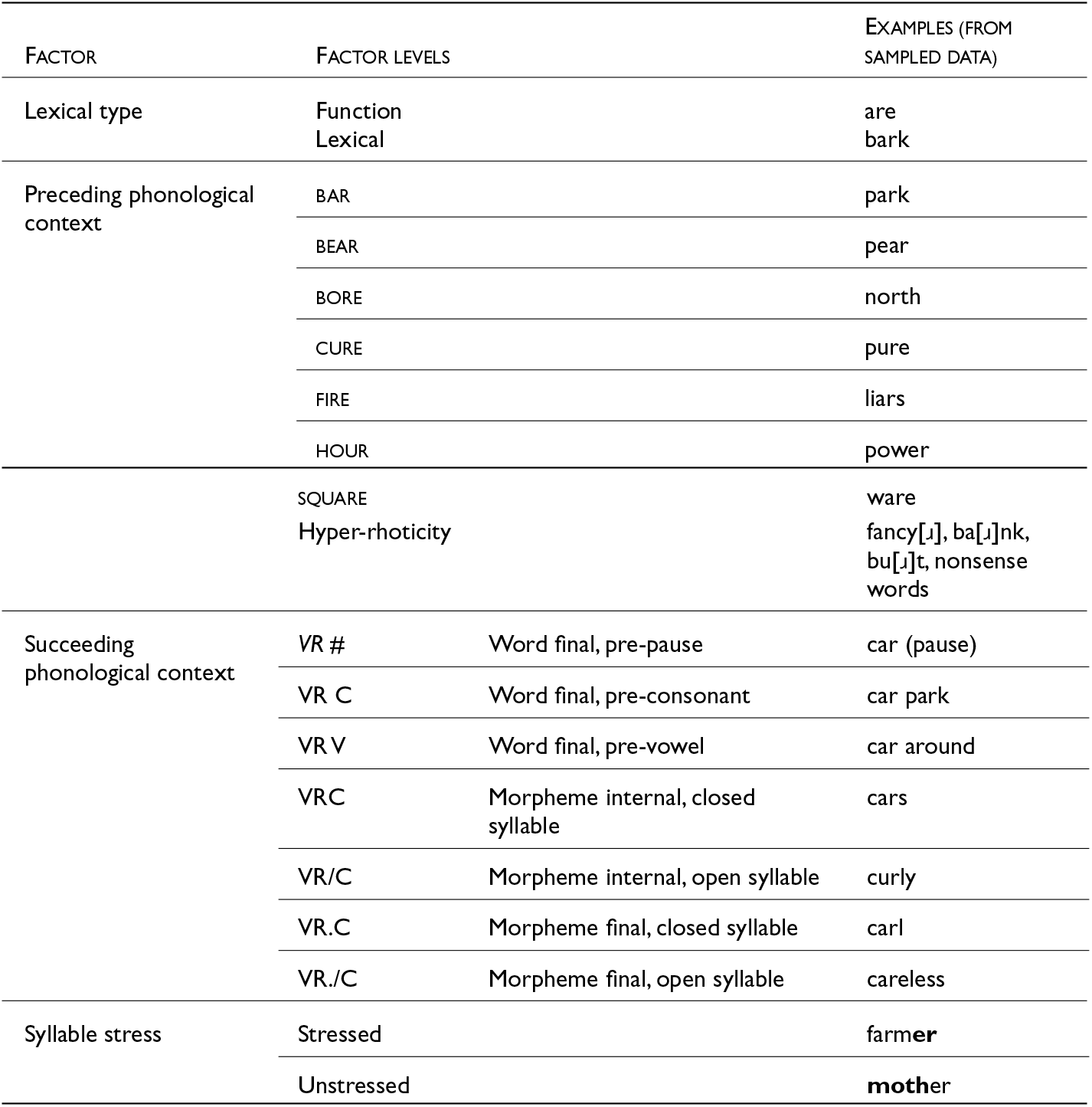
Internal constraints in this study were lexical type, preceding phonological context, succeeding phonological context, and syllable stress (see Table 5 for details). In light of previous studies (e.g. Becker Reference Becker2014), we expected lexical type tokens to favor rhoticity more than function. Preceding vowel is usually a predictor of rhoticity, with bore (Tod Reference Tod2024) and bar (Becker Reference Becker2014) consistently favoring rhotic environments the most. Six factor levels were included based on lexical sets in Nigerian English that can permit rhoticity. Hyper-rhoticity was included to account for cases where words without phonological contexts that permit etymological rhoticity were rhotacized.
Internal constraints considered in this study.

Table 5 Long description
The table lists internal linguistic factors relevant to rhoticity analysis, including lexical type, phonological context, hyper-rhoticity, succeeding context, and syllable stress, with examples. Lexical type: Function, Lexical, Examples: are, bark, Preceding phonological context: BAR, BEAR, BORE, CURE, FIRE, HOUR, SQUARE, Hyper-rhoticity, Examples: park, pear, north, pure, liars, power, ware, fancy, bank, but, nonsense words, Succeeding phonological context: VR # (word final, pre-pause) VR C (word final, pre-consonant), VR V (word final, pre-vowel), VRC (morpheme internal, closed syllable), VR/C (morpheme internal, open syllable), VR.C (morpheme final, closed syllable), VR./C (morpheme internal, open syllable), Examples: car (pause), car park, car around, cars, curly, carl, careless Syllable stress: Stressed, Unstressed, Examples: farmer, mother
Succeeding phonological context had seven levels: word final, pre-pause; word final, pre-consonant; word final, pre-vowel; morpheme internal, closed syllable; morpheme internal, open syllable; morpheme final, closed syllable; and morpheme final, open syllable. Word-final, pre-vowel context was included to account for cases where rhoticity, not linking /r/, was realized in words like ‘car around’. Finally, this study considered syllable stress. Previous studies have shown that syllable stress predicts rhoticity and that stressed syllables favor rhotic realizations (Blake & Shousterman Reference Blake and Shousterman2010; Chand Reference Chand2010; Becker Reference Becker2014). In the cases of ‘farmer’ and ‘mother’, Irwin & Nagy (Reference Irwin and Nagy2007) posit that /ə/ is the least favored preceding phonological context because of its unstressed vowel quality, but in Nigerian English, /ə/ is often realized as a fuller vowel and can be stressed (Ugwuanyi & Aboh Reference Ugwuanyi and Aboh2025). ‘Farmer’ can, therefore, be realized as [faːmˈaː] in Nigerian English, but Nigerian crossdressers in this study sometimes realized it as either [faːmˈaːɹ] or [f aːɹmˈaːɹ]. ‘Mother’ can be realized as either [ˈmɔdaː] or [ˈmɔðaː] in Nigerian English, but Nigerian crossdressers in this study sometimes realized it as either [ˈmɔdaːɹ] or [ˈmɔðaːɹ].
Mixed effects model
Mixed-effects logistic regression was used in this study to account for the internal and external predictors of the binary outcome variable, rhoticity. This model was generated in R (R Core Team 2020), fitted using the ‘glmer()’ function from the ‘lme4’ package (Bates, Mächler, Bolker, & Walker Reference Bates, Mächler, Bolker and Walker2015). This model considered the thirty-four participants and included fixed effects like gender identity, ethnicity/L1, previous phonological context, syllable stress, lexical type, and succeeding phonological context, along with random effects of speaker and word. The model used Nigerian crossdressers as the reference level for gender identity, Hausa as the reference level for ethnicity/L1, function words as the reference level for lexical type, bar as the reference level for preceding phonological context, VR# (word final, pre-pause) as the reference level for succeeding phonological context, and stressed syllable as the reference level for syllable stress.
Results
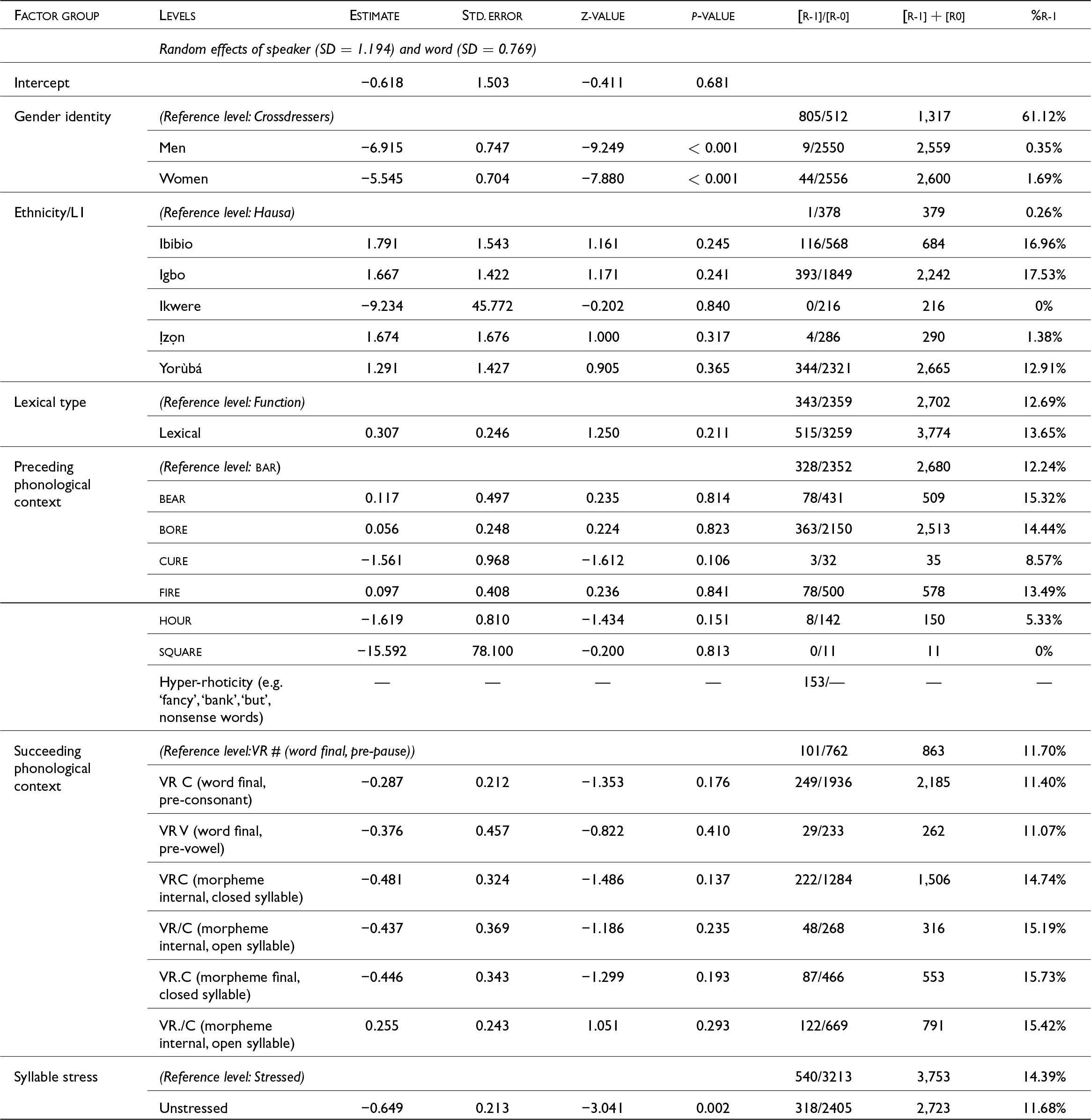
In Table 6, out of the 6,476 realized tokens that permitted etymological rhoticity, 858 tokens were rhotacized. There were 153 tokens of hyper-rhoticity. The random intercept for speaker was (SD = 1.194), and for word was (SD = 0.769).
Mixed-effects logistic regression for the full sample, main effects.

Table 6 Long description
The table presents mixed-effects logistic regression results for rhoticity, including factor groups, levels, estimates, standard errors, z-values, p-values, token counts, and percentages. Random effects include speaker (SD = 1.194) and word (SD = 0.769). Factor groups include: Gender identity (reference: crossdressers), Ethnicity/L1 (reference: Hausa), Lexical type (reference: function), Preceding phonological context (reference: BAR), Succeeding phonological context (reference: VR #), Syllable stress (reference: stressed), Each factor level includes: Estimate, Standard error, Z-value, P-value, R-1/R-0 counts, Total tokens, Percentage rhotic, The table reports significant and non-significant predictors, showing how linguistic and social factors influence rhoticity across the dataset.
External constraints
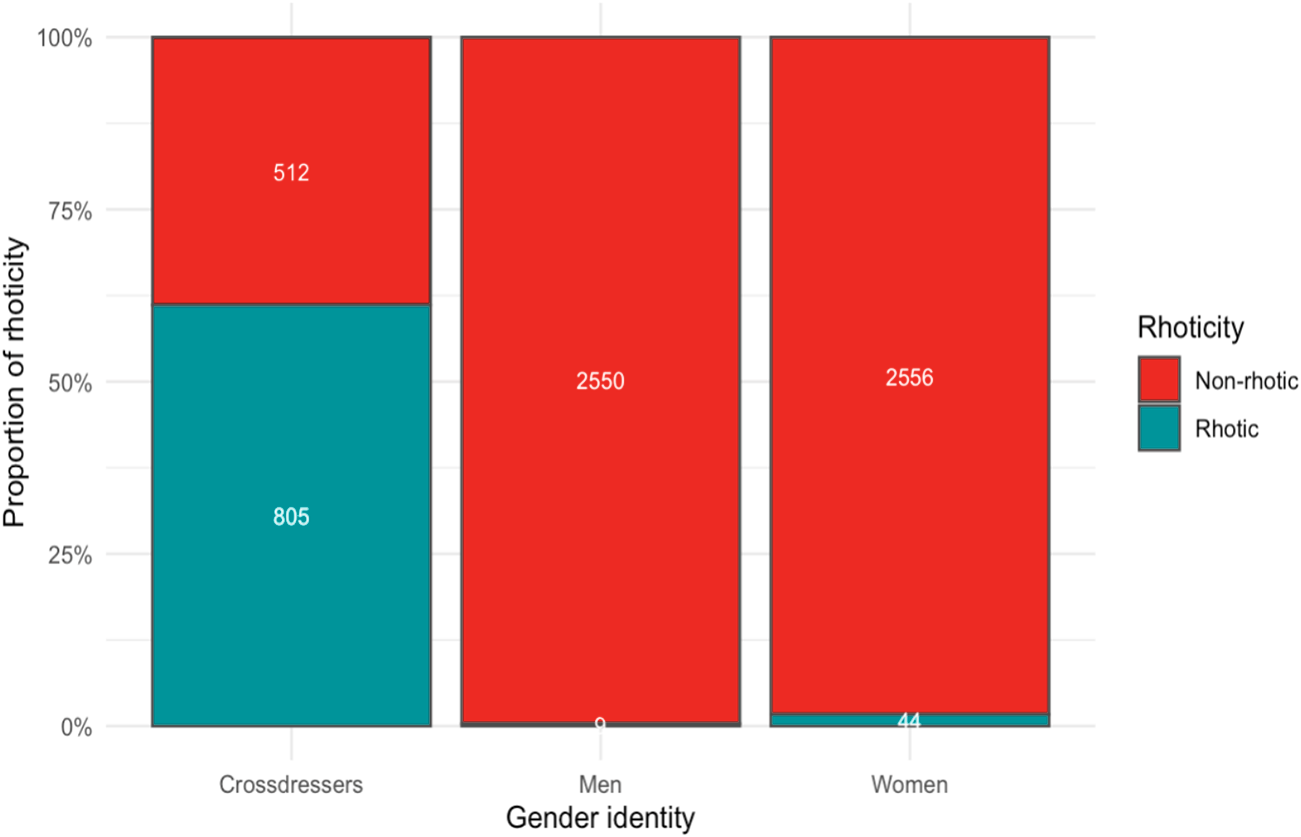
In Table 6, [r-1] represents cases where rhoticity was realized, while [r-0] represents cases that permitted etymological rhoticity, but rhoticity was not realized. In the same table, gender identity is the only external variable that reaches statistical significance. In fact, of all Ibibio, Igbo, and Yorùbá speakers, Nigerian crossdressers are the only participants with the largest count of rhotic realizations (see Figure 1 below for descriptive statistics of rhoticity realization by gender identity). The large raw counts of rhoticity in these ethnicities/L1s in Table 6 are because each of the crossdressers in this study falls under one of these three ethnicities. This is quite unsurprising because Nigerian English is non-rhotic, and as argued, Nigerian crossdressers use rhoticity as a shibboleth register (Silverstein Reference Silverstein2017) to differentiate themselves from other Nigerians. They use rhoticity as a stylistic element to construct a cosmopolitan identity. Another expected result is that, from the estimate (gender-conforming men [-6.915] and gender-conforming women [-5.545]) and [r-1/r-0] (gender-conforming men [9/2550] and gender-conforming women [44/2556]), gender-conforming men and women realize rhoticity much less than Nigerian crossdressers. The relatively smaller counts of rhoticity for Nigerian crossdressers ([1,317]) in the overall relevant environments compared to men ([2,559]) and women ([2,600]) are because of their extensive use of code-switching between indigenous Nigerian languages (including Naijá) and English, a common feature among gender and sexual minorities (Gaudio Reference Gaudio, Livia and Hall1997; Besnier Reference Besnier, Holmes and Meyerhoff2003; Hall Reference Hall2019).
Proportion of rhotic vs. non-rhotic realizations across gender identities. The y-axis shows the percentage of tokens within each gender identity group, and the numbers inside the bars indicate the corresponding raw token counts (e.g. Crossdressers: 805 rhotic, 512 non-rhotic; Men: 9 rhotic, 2,550 non-rhotic; Women: 44 rhotic, 2,556 non-rhotic).

Figure 1 Long description
A stacked bar chart comparing the proportion of rhotic versus non-rhotic speech across three gender identity groups: Crossdressers, Men, and Women. Each bar is divided into a red segment labeled ‘Non-rhotic’ and a teal segment labeled ‘Rhotic.’ Crossdressers show a mix of both (512 non-rhotic, 805 rhotic). Men show only non-rhotic speech (2,550 non-rhotic, 9 rhotic). Women show almost entirely non-rhotic speech (2,556 non-rhotic, 44 rhotic). The y-axis represents the proportion of rhoticity from 0% to 100%.
Additionally, there is a lower count of realized rhoticity among gender-conforming men compared to gender-conforming women. This pattern aligns with a long-established finding in variationist sociolinguistics that women tend to adopt incoming prestige variants more consistently than men (Trudgill Reference Trudgill1972; Labov Reference Labov1990). From an outsider’s perspective, gender-conforming women may be borrowing prestige (Labov Reference Labov1966) from Nigerian crossdressers for social mobility. However, because US English also favorably influences Nigerian English through media consumption and travel (Awonusi Reference Awonusi1994), their linguistic innovation may not necessarily have anything to do with Nigerian crossdressers. Just like Nigerian crossdressers, many gender-conforming Nigerians avoid or create a disjuncture from queer indexicalities (Balogun & Bissell Reference Balogun, Bissell, Matebeni, Monro and Reddy2018; Oyebanji Reference Oyebanji2025). Therefore, the use of rhoticity by gender-conforming women, albeit little (compared to the Nigerian crossdressers), is a socially motivated, indexical strategy of cosmopolitanism, but it indexes a different kind of cosmopolitanism than the one indexed by Nigerian crossdressers.
Internal constraints
Among the internal constraints examined, syllable stress is the only factor that significantly predicts rhoticity. Tokens produced in stressed syllables show higher rates of rhotic realization than those in unstressed syllables ([r-1]/[r-0] = 540/3213; %r-1 = 14.39% vs. 318/2405; %r-1 = 11.68%). This pattern aligns with previous findings in other English varieties (Becker Reference Becker2014; Tod Reference Tod2024), where stressed environments tend to promote stronger articulatory gestures, including a greater likelihood of rhotic production.
The social meaning of Nigerian crossdressers’ rhoticity
In Labov’s (Reference Labov1972) terms, rhoticity among Nigerian crossdressers has achieved stereotype status. It shows stylistic variation, has become noticeable, and is an overt topic of metalinguistic commentary (see Figure 2, where a Nigerian TikTok user makes a post with the caption ‘mediarrrr’ and refers to Bobrisky as the original author of the word). Indeed, the natural environment for rhoticity in US English is immediately after a vowel sound in the syllable coda, though it is also possible to realize rhoticity after flaps (e.g. [wɔɾɹ] for ‘water’). Nigerian crossdressers, however, use rhoticity in unetymological, epenthetic, and non-linking /r/ environments, like after fricatives and in words without /r/. Examples of words where they realize rhoticity in an unetymological environment are ‘pricey’ [pɹaɪsɹ], ‘bank’ [bæɹnk], ‘but’ [bɔɹ], ‘one’ [wɔɹn], ‘so’ [səuɹ], ‘best’ [bɛɹst], ‘you’ [jʊɹ], ‘on’ [ɔɹn], ‘yes’ [jɛɹs], ‘Africa’ [æfɹɪkaːɹ], ‘good’ [gʊɹd], ‘bottle’ [bɔɹtʊl], ‘movie’ [muɹvɪ], and ‘America’ [æmɛɹɪkaːɹ]. This hyper-rhoticity signals the crossdressers’ alignment with glamorous cosmopolitanism in defiant rebuttal of the vilification they face. Furthermore, the crossdressers’ use of other iconic US English phonetic features, such as intervocalic flaps for etymological alveolar stops, shows some investment in this cosmopolitan alignment. They use flapping in words like ‘beautiful’ [bjuɾɪfʊl], ‘bottle’ [bɔɾʊl], ‘water’ [wɔɾaː], ‘better’ [bɛɾaː], and ‘city’ [sɪɾɪ]. These linguistic features serve as stylistic choices for fashioning their identity. By contrast, there are also cases where Nigerian crossdressers do not realize rhoticity in their etymological environment, for example, words like ‘brother’ [bɹɔdaː], ‘her’ [hæ], ‘dare’ [dɜː], ‘power’ [paʊwaː], and ‘hurt’ [hɔːt]. This implies that, while they are invested in the use of rhoticity (and other iconic US English phonetic features like flaps), they may not be familiar with the full possible realizations of rhoticity. Hence, it appears that they consider the use of rhoticity, rather than the correct use of it, to be particularly important in styling or fashioning themselves.
Metalinguistic commentary on Nigerian crossdressers’ use of (hyper-)rhoticity.

Figure 2 Long description
A TikTok video screenshot showing a person in a light blue collared shirt sitting indoors and looking slightly upward. Text at the top reads, ‘POV: your roommate likes to give unsolicited advice to women on the mediarrr.’ TikTok interface icons appear on the right, including counts for likes (19K), comments (229), and shares (555). At the bottom left, the location tag says ‘Nigeria,’ with ‘69.7K people added to Favorites.’ The username ‘Paul Iremide’ and a caption referencing Bobrisky are visible, along with a playlist title reading ‘Bobrisky is your roommate.
As in many other Outer Circle English contexts, British English functions as the primary reference model for Nigerian English. Nonetheless, Nigerian English incorporates elements from both British and US English, with a stronger influence from British English. Awonusi (Reference Awonusi1994) and Jowitt (Reference Jowitt2018) report numerous instances where Nigerians use US English features like the use of [ɑ] in ‘God’, regularizing irregular verbs to form the past simple tense and past participle of verbs like ‘dream’ and ‘learn’ to make ‘dreamed’ and ‘learned’ respectively, the use of the US English just + past simple structure (e.g. ‘They just left’) where British English uses just + present perfect (e.g. ‘They have just left’), and the use of enregistered phonological reduction of ‘going to’ to ‘gonna’ and ‘want to’ to ‘wanna’. Jowitt (Reference Jowitt2018) attributes the primary reasons for this to be Nigerian teachers of English who had studied in the United States, US missionary teachers of English in some parts of Nigeria, and the influence of US media (e.g. music, movies, documentaries, and political debates). Educated Nigerian English, however, mirrors standardized British English closely, with minimal influence from US English (Awonusi Reference Awonusi1994; Jowitt Reference Jowitt2018). This raises the question of why Nigerian crossdressers do not draw on linguistic features associated with standardized British English or Educated Nigerian English to convey prestige identity (as many other Outer Circle English speakers do). The primary objective of these crossdressers, I argue, lies in their evading of the social space that invalidates and marginalizes their voices, identities, and agency, and their moving towards spaces that not only validate their identities and gender expressions but also facilitate economic transcendence within their social space. Given their similarity to each other, neither standardized British English nor Educated Nigerian English works for this purpose. Equally important to note is that there is a close involvement of US expats in ‘queer’ issues in Nigeria, with some ‘queer’ Nigerians receiving asylum in the United States (Onanuga Reference Onanuga2024). ‘Queer’ individuals in Nigeria, therefore, might accommodate to their US expats, especially since some of them might admire the freedom and opportunities enjoyed by these expats as citizens of a ‘queer-friendly country’ and as members of a dominant force in the global economy. In other words, US English enjoys a certain amount of symbolic capital in Nigeria’s linguistic marketplace for ‘queer’ Nigerians, and Nigerian crossdressers, as people with marked identities, use rhoticity to protect themselves from homophobia and vilification in the country.
Rhoticity, in this context, is therefore a US recontextualized feature that is used to align with the ‘friendliness’ and prestige that they do not get from their own country. It is the symbolic capital and indexical value of US English rhoticity in Nigeria that enables the crossdressers to align with an American characterological figure (Agha Reference Agha2007) and that allows them to perform a register shibboleth that saliently intertextualizes this figure. It is possible to argue that Nigerian crossdressers may have recontextualized rhoticity in accommodation to US drag queens, as they belong to similar communities of practice. However, as aforementioned, there is an existing indexical link between the use of English and modernity, education, class, and cosmopolitanism in southern Nigeria. In fact, this indexical link operates along a gradient: the higher one’s level of education, wealth, or cosmopolitan exposure, the greater the likelihood of employing Educated Nigerian English. But this indexical link between the use of English and cosmopolitanism does not arbitrarily exist in Nigeria. Like many other Outer Circle English contexts, this link exists in an intertextual connection to the colonial gaze’s epistemologies that define the limit of a civilized language. That is, Nigerian crossdressers could use any indigenous Nigerian language to index prestige, but because the intermittent circulations of colonial discourses have reduced African languages to ‘primitive’ languages (Irvine & Gal Reference Irvine, Gal and Kroskrity2000; Makoni et al. Reference Makoni, Smitherman, Ball and Spears2003; Mufwene & Vigouroux Reference Mufwene, Vigouroux, Vigouroux and Mufwene2008; Wolff Reference Wolff2017), they do not index sophistication or do prestige work for them.
The intersubjective relation of distinction between genderqueer Nigerians and Nigerian identity generally, and the use of American intertextualized material embodied by these genderqueer individuals to serve as shibboleths and for inoculation, are not completely novel findings. Similarly, my claim that genderqueer Nigerians use a US English enregistered linguistic feature to take on prestige status is not a new argument. Gaudio (Reference Gaudio2001) shows how a dark-skinned Nigerian man, a ‘dan daudu, a genderqueer individual, appropriates enregistered labels (e.g. ‘chocolate queen’), reserved for non-Black American gay men interested in Black men, to reposition himself not only from a desired object to a desiring subject but also from a marginalized identity to an agentive one. Gaudio’s (Reference Gaudio2001) study and argument contribute to the existing literature investigating social acts and stances adopted by genderqueer individuals in sexually oppressive, heteronormative societies and are consistent with my argument that certain genderqueer individuals in Nigeria engage in the process of extracting pre-existing emblems from foreign yet favorable contexts, repackaging them, and using them for agentive purposes. By using rhoticity, Nigerian crossdressers mark not only the claim to their knowledge of rhoticity but also their strong alignment with a foreign identity. Their style, therefore, invokes an ideology of difference from Nigerian identity and, inevitably, an ideology of sameness with an American one.
In a previous study (Aminu Reference Aminu2025a), I attributed this difference and sameness to two tactics of intersubjectivity, adequation (establishing sufficient similarity), and distinction (establishing sufficient differentiation) (Bucholtz & Hall Reference Bucholtz and Hall2004). However, there is more than just difference and similarity here. Nigerian crossdressers enact a social contrast that ideologically differentiates them from the community that has marginalized them for their gender identity. Indeed, they have systematically mapped this contrast onto rhoticity, but rhoticity only works as an element of a stylistic bricolage consisting of other semiotic resources like skin bleaching, Americanized accents, desire to live Western lives, and Western self-renaming practices, each of which I explore in more detail in this section. This stylistic bricolage authenticates Nigerian crossdressers as Americans and denaturalizes their Nigerian identities (Bucholtz & Hall Reference Bucholtz and Hall2004). In other words, by constructing their identities through claims to features that index American-ness and that rupture their Nigerian identity, they enact authentication and denaturalization.
Indeed, Bucholtz & Hall (Reference Bucholtz and Hall2004) submit that the adequation-distinction intersubjective tactic works alongside semiotic processes of highlighting, the foregrounding of certain social or linguistic practices (Goodwin Reference Goodwin1994), and erasure, the process of making certain social or linguistic practices invisible (Irvine & Gal Reference Irvine, Gal and Kroskrity2000). But highlighting and erasing certain social and linguistic practices can also work to authenticate and denaturalize speakers of certain identities. Nigerian crossdressers, therefore, use hyper-rhoticity to highlight their authenticity to American-ness. Hyper-rhoticity, however, can work as a double-edged sword in that it is not the case that the more rhotic one is, the more American one becomes. That is, by using hyper-rhoticity, Nigerian crossdressers might be interpreted as being less American since hyper-rhoticity is an unetymological feature of US English (though Trudgill (Reference Trudgill1986) points out that some Bostonians, who use a non-rhotic US English variety, also hypercorrect rhoticity by saying ‘Japan and Chinar’). Nonetheless, the fact that they are not US English speakers makes it possible that they are not familiar with the actual distribution of rhoticity in US English but are rather interested and invested in its use. After all, Besnier (Reference Besnier, Holmes and Meyerhoff2003:296) argues that the fakaleiti of Tonga, people born male with feminine gender expressions, use English as a ‘symbolic escape hatch out of [their] social marginality’ in a Tongan-speaking community. In one specific example, a fakaleiti uses infelicitous English expressions and engages in code-switching between English and Tongan. With this example, Besnier argues that authenticity to modernity and cosmopolitanism is still claimed because grammatical competence or performance in English is of little concern to the fakaleiti. What really matters is the indexical value embedded in their use of English. In the case of Nigerian crossdressers, the etymologically correct use of rhoticity (and other elements in their stylistic bricolage) is not as important as its use, and its use, whether etymological or not, indexes the symbolic value that authenticates their American-ness and denaturalizes their Nigerian-ness, but also has colonial entailments.
Colonial contact between the United Kingdom (Britain) and Nigeria has indelibly shaped Nigeria within the structures of global white supremacy, sustained by a pervasive racial hierarchy. Like some Ghanaians (Pierre Reference Pierre2012), some Nigerian crossdressers and other genderqueer individuals bleach their skin in an effort to align with white beauty standards (see Figure 3 below for a picture of Bobrisky, who reportedly underwent surgical skin lightening procedures). The practice of skin bleaching among Nigerian crossdressers is deeply rooted in Nigeria’s complex historical relationship with race, especially the interaction between race and skin color, and its intersections with gender identity, class, aesthetics, and cultural identity. This challenges the notion that Nigeria is free from racial bias and demonstrates that race and racism actively shape the country’s contemporary social structure. Additionally, Bobrisky mentioned in one of her earliest interviews that, “I went to America(ɹ)… I was Black, and I didn’t like it” (see Today’s Woman 2016). This suggests that Bobrisky is keenly aware of the distinctions between white-identified/light-skinned and Black-identified/dark-skinned identities, and the economic, social, and systemic advantages or disadvantages associated with them in the United States. Nigerian crossdressers also often change their traditional Nigerian names to Western, English names, such as Natasha or Macmillan. James Brown, for example, uses titles linked to the British royal family, like ‘Queen of Britain’, ‘Duchess of London’, and ‘Princess of Africa’. Although ‘Princess of Africa’ is fictional, it involves decontextualizing ‘princess’ from titles like ‘Princess of Wales, Sussex, Kent’ in England and entextualizing ‘Africa’. In cases where the crossdressers retain their traditional names, such names are often re-pronounced with Americanized accents and spellings. For example, the Igbo name Èméká is decontextualized and re-pronounced as Emekarrr. Therefore, to claim that Nigerian crossdressers do not recontextualize UK or US whiteness (and culture) would be to deny the core principles of global neoliberalism in Africa that continue to reinforce colonial structures and entrenched patterns of racialization.
Picture of Bobrisky.

Figure 3 Long description
A person with long, wavy blonde hair stands indoors in front of ornate black-and-white patterned wallpaper. They are wearing a loose, vertically striped garment in red, white, and gray. The person holds a smartphone in one hand while the other hand is raised near their head. A dark piece of furniture is partially visible behind them.
Nigerian crossdressers’ rhoticity, therefore, gets its colonial entailments through its intermittent circulation with other colonial intertexts, like skin bleaching and Western (self-renaming) practices, and the motivation for its use in the first place—its association with a ‘civilized’ language, English, US English specifically. The historicized homophobia located in the homophobic assertions made by some Nigerians to Nigerian crossdressers is resisted with rhoticity, a linguistic variable with colonial entailments. Barrett & Hall (Reference Barrett and Hall2024) submit that indexical disjuncture involves the juxtaposition of contradictory indexical inventories. I argue that when linguistic and social practices with colonial entailments are used to resist discourses historicized in colonialism, it creates a special kind of indexical disjuncture. This further evokes coloniality, the idea that colonial logics can be reanimated and sustained even beyond formal colonial rule (Reyes Reference Reyes2017). With these considerations in place, I now turn to the indexicality of rhoticity within Nigerian crossdressers’ stylistic bricolage.
Given that certain enregistered Western English linguistic forms index prestige of an overt sort, rhoticity does not directly index queerness or Nigerian crossdresser identity. Hence, while I argue that Nigerian crossdressers are creatively recontextualizing rhoticity in distinctively ‘queer’ manners, rhoticity does not inherently denote queerness. Ochs (Reference Ochs, Duranti and Goodwin1992) suggests a constitutive relationship (indirect indexicality) between language and gender, arguing that a linguistic variable can index social meanings like stance or activity, which, in turn, can come to be gendered. Ochs (Reference Ochs, Duranti and Goodwin1992) illustrates this perspective through the Japanese sentence-final morphological particles, wa and ze, which indirectly index femininity and masculinity by first indexing stances of delicacy and coarseness, respectively. The particle wa in Japanese pragmatically presupposes femininity or that the speaker is female because of the delicate affective stance that the particle directly indexes. Conversely, ze indexes coarse intensity and pragmatically presupposes masculinity or that the speaker is male. Another example is Kiesling (Reference Kiesling2004:282), who shows how the use of the term dude indexes a ‘stance of cool solidarity’. This stance is then linked via indirect indexicality to project a heterosexual masculinity. It is through this approach that we can establish a clear relationship between rhoticity and crossdressing identity.
However, to say that rhoticity directly indexes social acts of high social class in Nigeria and that these acts of high social class are constitutive of queerness does not do justice to the social meaning of rhoticity for two reasons. First, Nigerian crossdressers refute claims that label them as queer and, therefore, they do not explicitly associate themselves with queerness (even though there are leaked videos that say otherwise). Second, the focus of this article and what the crossdressers explicitly present—gender—is missing. Therefore, a better theory is that rhoticity directly indexes social acts of high social class in Nigeria and that these acts of high social class are constitutive of the non-normative femininity that Nigerian crossdressers present, which is ideologically linked to queerness. Its potential to index social acts of high social class is because of its intertextual connection to the colonial archive, viewed as ‘over the standards’ by some Nigerians. This understanding of the relationship between rhoticity and Nigerian crossdressers transcends a mere inventory of associations or assemblages between linguistic styles and gender categories. Instead, this understanding provokes an implicit grasp of how rhoticity is employed to fulfill pragmatic functions; how the norms and anticipations concerning the employment of rhoticity relate to distinct social identities; how gender is policed in Nigeria but can also be regarded as a manifestation of sociolinguistic style; how the boundaries between masculinity and femininity are maintained as standards in Nigeria; and, ultimately, how Nigerian crossdressers traverse these boundaries and prerequisites for such traversal.
Conclusion
This study has illustrated the transglobal circulation of rhoticity within Nigerian English and has highlighted how its uptake by Nigerian crossdressers is imbricated in colonial histories and their ongoing semiotic entailments. Rhoticity, in this case, acquires its colonial entailments through its intermittent circulation alongside other colonial intertexts, such as skin bleaching and Western self-renaming practices, and through the very motivation for its deployment: its association with a ‘civilized’ language, English, specifically US English. Nigerian crossdressers’ association with a foreign identity serves as a deliberate repudiation of the stigmatization they endure for their perceived transgression of Nigerian gender and sexual norms. This stigmatization and perceived transgression come from the Western colonial bio-logics of gender as biological and binary, and the use of a linguistic variable with colonial entailments to resist this stigmatization, I argue, evokes coloniality. In essence, Nigerian crossdressers’ use of rhoticity is not only connected to the global positioning of the United States but also to circulating colonial discourses of the ‘primitiveness’ and ‘inferiority’ of African languages and cultures.
The crossdressers’ stance creates a linguistic differentiation for them, which maps out a putative opposition from other Nigerians, reinforces social boundaries for them to the point that they belong to a recognizable community of practice, and is interpreted iconically as evidence of gender identity difference. Importantly, as aforementioned, there is another social meaning of rhoticity in Nigerian English, the one used by gender-conforming women. I argue that their use of rhoticity indexes a different kind of cosmopolitan identity that is imbued with class or material influence. Unlike Nigerian crossdressers, the women’s use of rhoticity is not motivated by vilification; rather, it is an adequation to American-ness that gives them upward social mobility, and the US media is a significant contributor to this linguistic innovation.
Nigerian crossdressers unsettle the inherent nature of gender binaries, the binary linguistic constructs that stem from them, and the constructed nature of associating binary linguistic constructs with gender binaries. Although cisheteronormativity views gender as only legible through the sexed body, reinforcing the expectation of a binary, heterosexual framework where embodiment and identity must correspond, Nigerian crossdressers denaturalize gender, destabilize the links between particular bodies and stereotyped performances of such bodies, and dismantle the normative links between sex, gender, and sexuality. Nigerian crossdressers subvert and disrupt normative gender frameworks—those that construct masculinity and femininity as oppositional yet mutually reinforcing roles—thereby unsettling the very binaries through which heteronormative gender is made legible. This way, they remind us of male daughters and female husbands (Amadiume Reference Amadiume1987) and the ‘yan daudu (Gaudio Reference Gaudio2009) that disrupt the ‘coatrack’ model (Nicholson Reference Nicholson1994) of sex and gender, which presumes a neat correspondence between biological maleness and masculinity and femaleness and femininity. These African gender identities defy facile traditional binary gender classifications and remake the world through their social and linguistic acts. At its core, the social positioning of Nigerian crossdressers extends far beyond TikTok-mediated gendered presentations; it underscores the broader idea that gender is itself a performative act, continually reiterated and stabilized through prevailing social norms and expectations. This positioning grants the crossdressers a culturally recognizable and socially identifiable status.
Ultimately, this study contributes to more nuanced theorizations of style and social meaning, especially with regard to gender performativity. By exploring the meaning potentials of semiotic emblems in an underexplored sociolinguistic context, this study sheds light on how meaning is construed in specific moments of nuanced language use, as well as how language reflects and reinforces gender ideology and power structures. Hence, it also adds to the literature on critical sociolinguistics.
Acknowledgements
I wish to acknowledge and extend my gratitude to the SMiLe group at the Department of Linguistics, University of Pittsburgh, for their invaluable discussions that undoubtedly improved the quality of this article. My sincere appreciation goes to my supervisors, Shelome Gooden and Scott Kiesling, for their unwavering guidance and wisdom throughout the writing of this article. I thank Rudolf Gaudio for his incisive feedback and critiques. Special thanks are also due to my lecturers, Stephanie Love, Melinda Fricke, Dan Villarreal, and Alexus Brown, as well as my colleagues, Grace Naa Korkoi Amoah, Oluwasegun Amoniyan, and Sara Rosenau, for their support. Lastly, I am immensely grateful to the anonymous reviewers and journal editors for their insightful and thorough comments; an earlier version of this article won the Lilian B. Stueber Best Student Paper award at NWAV52, and I am solely responsible for any remaining errors or shortcomings in this final article.




 Open access

