There is evidence that certain forms of primary inherited dyslipoproteinemias occur much more often in patients with symptomatic coronary arterial disease than in the general population. Familial hypercholesterolemia is an autosomal co-dominantly inherited disease that is characterized by greatly elevated levels of low density lipid cholesterol in the serum, tendinous xanthomas, and premature atherosclerosis.Reference Sprecher, Schaefer and Kent1 It is one of the most common genetic disorders, having a prevalence of 1 per 500 for the heterozygous variant, and 1 per million for the homozygous form.
Patients and methods
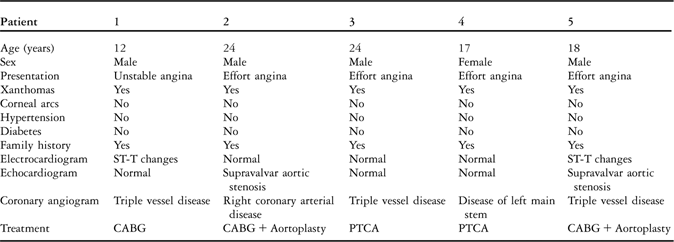
We describe our experience with 5 patients who presented to our cardiology department at Sri Jayadeva Institute of Cardiology, Bangalore, between October, 2006, and May, 2008, with features suggestive of familial homozygous hypercholesterolemia. Of the patients, 4 were male, and 4 presented with effort angina, the other boy presenting with unstable angina. All had multiple xanthomas, found most commonly on the extensor surfaces of the elbows and knee joints. All had multiple family members having xanthomas, but they were asymptomatic. The total cholesterol measured in the serum ranged from 435–551 mg/dl, the mean value being 473.8 mg/dl. The mean value for the low density lipid fraction was 431 mg/dl. All had low levels of the high density lipid fraction. On coronary angiography, 4 patients had lesions in all 3 coronary arteries, and 1 had critical stenosis of the main stem of the left coronary artery. Supravalvar aortic stenosis was also present in 2 patients. In 3 patients, we performed coronary arterial bypass grafting, while in the other 2 we inserted stents percutaneously. All were treated with high doses, 40 mg per day, of atorvastatin and ezetimibe. Both involved and uninvolved family members were screened for coronary arterial disease using non-invasive techniques. These findings are summarised in Table 1.
Clinical characteristics.

CABG – Coronary arterial bypass grafting; PTCA – Percutaneous transluminal coronary angioplasty.
Case 1
A 12 year old South Indian schoolboy, this patient presented to a paediatrician with history of fever with cough of 2 days duration. He gave a history of 1 episode of severe retrosternal chest pain, which lasted for 30 minutes. In view of suspected acute coronary syndrome, with electrocardiogram changes, he was referred to our cardiac centre for further evaluation and management. He had no past history of diabetes mellitus, hypothyroidism, coronary arterial disease, hepatic disease, or renal disease. His body mass index was 12.86 kg/m2. General physical examination revealed multiple soft subcutaneous swellings over his elbow, knee, spine, ankle, and gluteal region suggestive of xanthomas. There was no corneal arcing. His systemic examination revealed tachycardia, a third sound gallop on cardiac auscultation, and basilar crackles in the bases of both lungs. The electrocardiogram showed sinus tachycardia with ST depression in the anterolateral leads. Echocardiographic interrogation showed anteroseptal hypokinesia, with a left ventricular ejection fraction of 53%. The aortic valve was normal. Routine investigations revealed normal blood counts and renal functions. His fasting lipid profile (Table 2) showed high levels for total cholesterol and the low density lipid fraction, with normal triglycerides. He was treated with antianginal and antiplatelet agents, heparin, and atorvastatin, and later subjected for coronary angiography. His angiogram showed 70% stenosis of the anterior descending coronary artery, 70% stenosis of the circumflex coronary artery, and 95% stenosis of the origin of the right coronary artery. The renal arteries were normal. Screening of family members revealed his father, mother, grandfather and uncle to have similar xanthomas, with lipid profiles consistent with familial homozygous hypercholesterolemia. He underwent coronary arterial bypass grafting to all 3 coronary arteries. He was initially treated with atorvastatin at 40 mg once daily, along with ezetimibe 10 mg daily. His lipid profile repeated after few weeks showed slight but unsatisfactory improvement in levels. He has remained asymptomatic during follow-up.
Fasting lipid profiles of patients at presentation.

Case 2
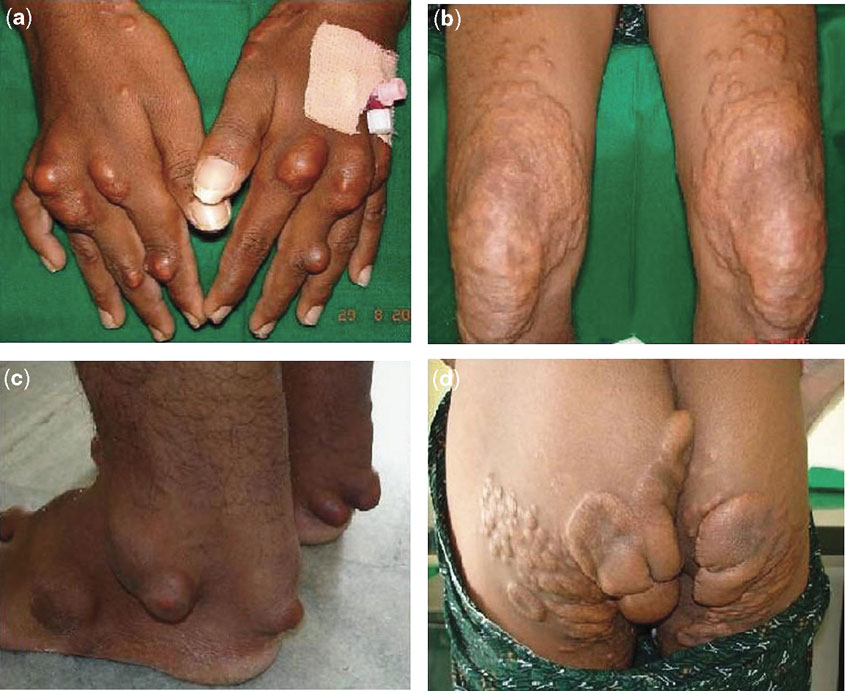
A 24 year old adult male, our second patient, an agriculturist from a rural area, presented with exertional dyspnoea of 6 months duration, and angina of 3 months duration. He had tendinous xanthomas on the extensor surfaces of his hands, elbow, Achilles tendon, buttocks, and left shoulder, which he had noticed when he was 10 years old, and which had gradually increased in size (Fig. 1). His other siblings had similar xanthomas. He was of average build, with a body mass index of 25.5 kg/m2. Clinical examination revealed signs of supravalvar aortic stenosis. Routine biochemical investigations were within normal limits apart from his fasting lipid profile, which was consistent with familial hypercholesterolemia (Table 2). His electrocardiogarm showed normal sinus rhythm with left ventricular hypertrophy. The echocardiographic findings confirmed the presence of severe supravalvar aortic stenosis, and also revealed mild aortic regurgitation, concentric left ventricular hypertrophy, but normal left ventricular function, with the gradient across the supravalvar stenosis calculated at 118/70 mmHg.
The multiple xanthomas in our second patient.

He underwent elective coronary angiography, which showed 95% stenosis at the origin of the right coronary artery, with the other coronary arteries being normal. Left ventricular angiography showed supravalvar aortic narrowing with poststenotic dilation of the aorta. He underwent coronary arterial bypass grafting along with aortoplasty for the supravalvar aortic stenosis. He is currently asymptomatic during follow-up.
Case 3
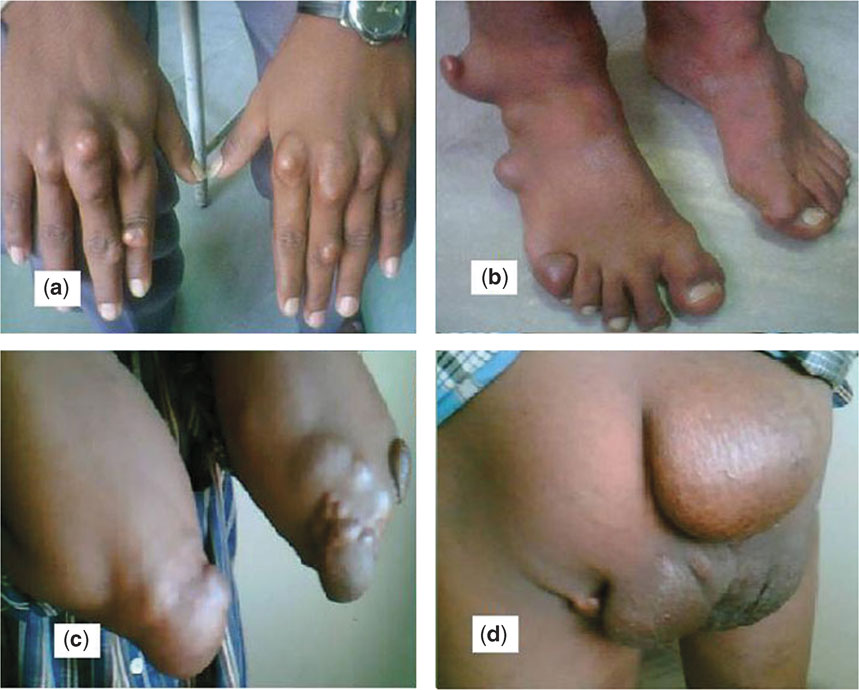
Our third patient, a male aged 24 years, presented with a history of chronic angina of 4 months duration. He was in the third functional class, suffering postprandial angina. He was known to have familial homozygous hypercholesterolemia, tendinous xanthomas having been noted when he was aged 7 years. Exercise stress testing was positive, and he proved to be an ex-smoker, but not diabetic or hypertensive. On examination, he was moderately built, with a body mass index of 26.0 kg/m2. Bilateral tendinous xanthomas were noted on the elbows, Achilles tendon, fingers, and buttocks (Fig. 2). He was in stable haemodynamic condition, and examination of his cardiovascular system proved unremarkable, his other systems also being normal, along with routine blood investigations. His fasting serum lipid profile was consistent with the second type of familial hypercholesterolemia (Table 2). Echocardiographic interrogation showed no abnormal findings. Elective coronary angiography showed a normal main stem of the left coronary artery, but there was 90% stenosis of the proximal part of the anterior descending coronary artery, 80 to 90% stenosis of the distal circumflex artery, and 95% stenosis at the origin of the right coronary artery. He underwent successful percutaneous placement of stents in the diseased arteries, inserting a drug-eluting stent in the anterior descending artery, and a bare metal stent in the circumflex artery. He has had relief of his symptoms over the period of follow-up, but the levels of lipids in his serum remain high.
The multiple xanthomas in our third patient.
Case 4
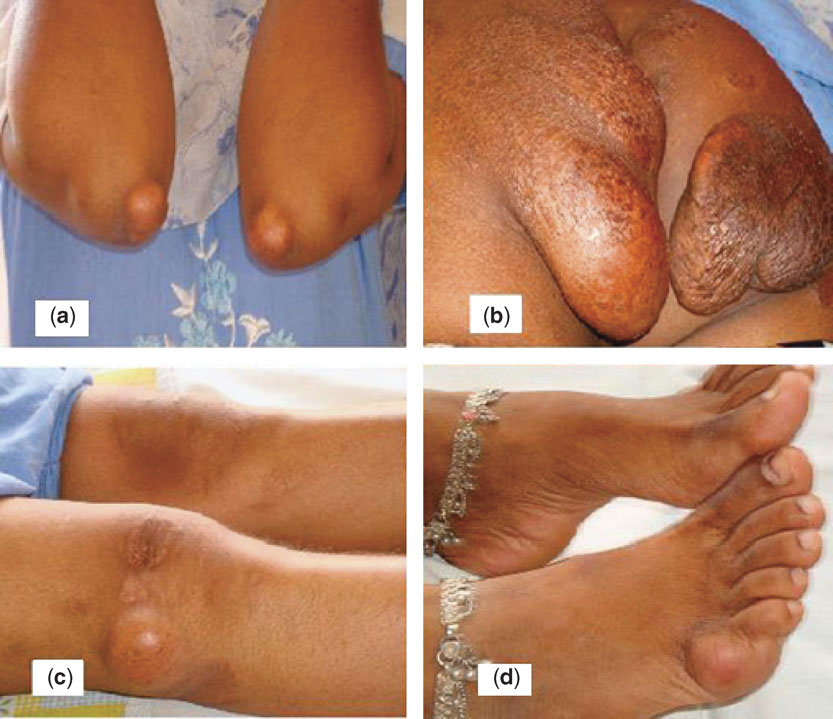
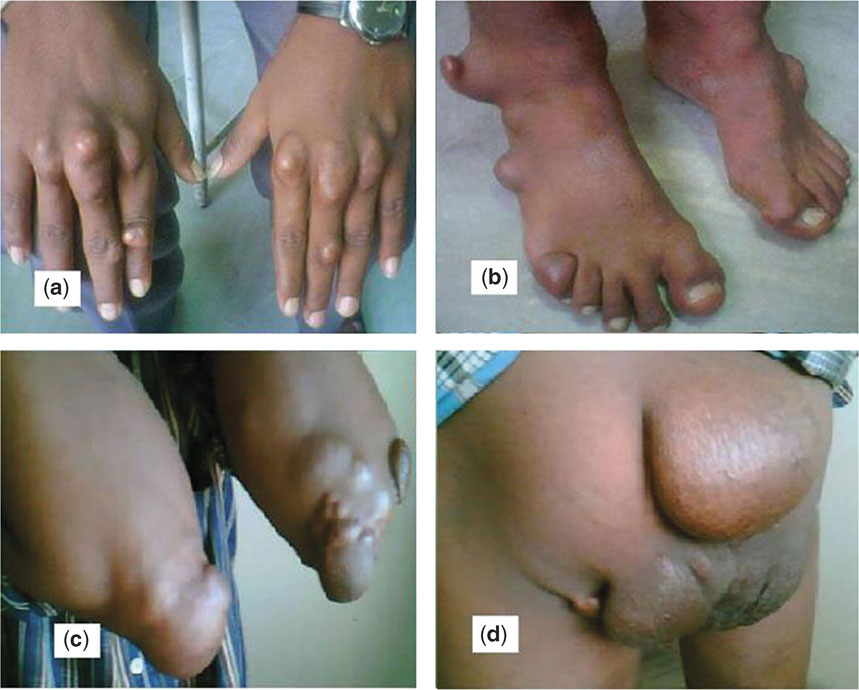
Our fourth patient, a 17 year old female, presented with recent onset of exertional chest discomfort and fatigue of 1 month duration. General physical examination revealed tendinous xanthomas over the extensor surfaces of both elbows and knees and the buttocks (Fig. 3). She was normotensive, with microcytic hypochromic anaemia. Examination of the cardiovascular system was unremarkable. Her fasting lipid profile was consistent with the second type of familial hypercholesterolemia (Table 2). Blood sugars and renal parameters were within normal limits. The electrocardiogram was also normal, with echocardiographic interrogation revealing normal left ventricular function, with no segmental abnormalities of mural motion. The exercise stress test was positive for inducible ischaemia. In the light of these findings, she underwent coronary angiography, which showed 90% stenosis of the orifice and main stem of the left coronary artery. Insignificant lesions were seen in the remaining coronary arteries. She underwent successful placement of a drug-eluting stent in the main stem of the left coronary artery. She is now medicated with atorvastatin, ezetimibe, and triple antiplatelet agents. After 5 months of follow-up, a dramatic improvement had been noted in her symptoms.
The multiple xanthomas in our fourth patient.

Case 5
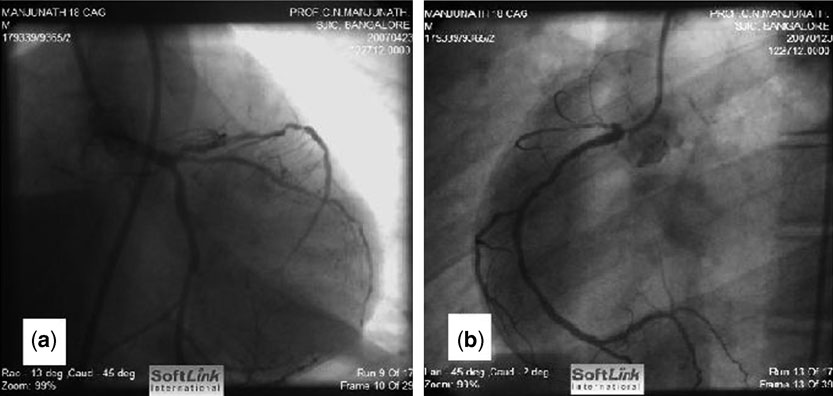
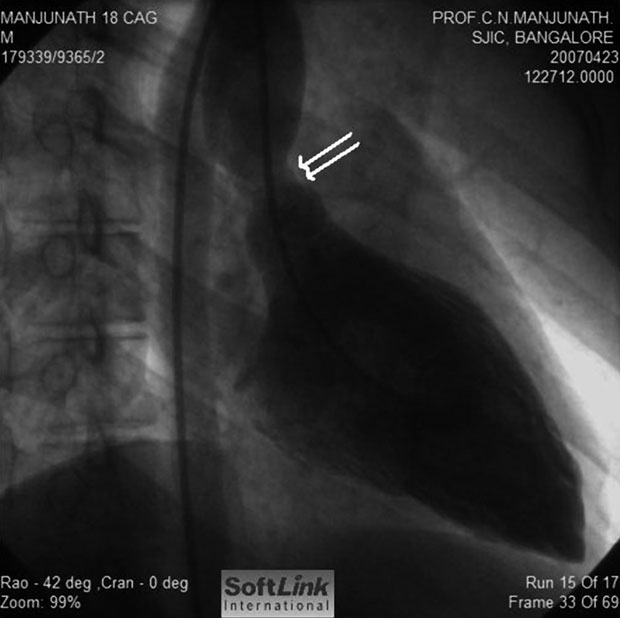
Our final patient, a male aged 18 years, presented with history of effort angina and easy fatigueability of 3 months duration, which had worsened 1 week prior to his admission to hospital. There was no history of consanguinity. His father had died at the age of 50 years following acute myocardial infarction. His eldest sister and brother had hypercholesterolemia. He had a past history of multiple nodules, initially developing over both elbows and knees at the age of 9 years, and then occurring over the knuckles, buttocks, and feet for the last 4 years. He had been diagnosed with hypercholesterolemia, and treated with lipid lowering agents for 2 years. Since there was no improvement in the lesions, he had stopped the medications. He had no past history of diabetes mellitus. On examination, he was overweight, albeit normotensive. Neither xantholesmas nor senile arcing was observed. He did have multiple xanthomas over the knees, buttocks, elbows, and knuckles. Both Achilles tendons, and some extensor tendons, were thickened and showed tendinous xanthomas. Cardiac examination was suggestive of supravalvar aortic stenosis, while his fasting serum lipid profile was suggestive of familial hypercholesterolemia (Table 2). Other laboratory investigations were within normal limit. Electrocardiography showed sinus rhythm with non-specific ST-T changes. Echocardiography confirmed the presence of supravalvar aortic stenosis, with a significant gradient. Coronary angiography showed significant occlusion of the proximal part of the anterior descending artery (Fig. 4a, Video 1 – see www.journals.cambridge.org/CTY), along with the circumflex artery and the orifice of the right coronary artery (Fig. 4b, Video 2). Left ventricular angiography and aortography showed normal left ventricular function with supravalvar aortic stenosis (Fig. 5, Video 3). He subsequently underwent coronary arterial bypass surgery and aortoplasty. His hyperlipidaemia was treated with atorvastatin and ezetimibe. During follow-up, he has been asymptomatic, and there has been an improvement in his lipid profile, along with a slight decrease in size of the cutaneous xanthomas over his hands and knees.
The left coronary angiogram (a) shows significant proximal stenosis of the anterior descending artery and its first diagonal branch. The right coronary angiogram (b) shows critical orifical stenosis.

The left ventricular angiogram and aortogram show supravalvar aortic stenosis (Double Arrow).

Discussion
Familial hypercholesterolemia is known to be strongly associated with coronary arterial disease and premature death, with several reports of homozygotes less than 17 years of age developing severe coronary arterial stenosis or supravalvar aortic stenosis.Reference Sprecher, Schaefer and Kent1, Reference Allen, Thompson, Myant, Steiner and Oakley2 Our patients ranged in age from 12 to 24 years. In 1 boy, we found severe triple vessel disease requiring multiple coronary arterial bypass grafting. Another studyReference Mabuchi, Koizumi and Shimizu3 found that 4 of 5 homozygous patients with familial hypercholesterolemia had coronary arterial disease.
Another group,Reference Goldstein and Brown4 who studied the prevalence of coronary arterial disease in a group of 54 homozygotes, found that the prevalence in those below 10 years of age was 60% for the receptor-negative homozygotes, but zero in the receptor-defective homozygotes. In those aged from 10 to 20 years, the prevalence was 47% and 36%, respectively. Thus, homozygous patients should be treated as soon as the diagnosis is established. Plasma exchange, apheresis of low density lipids,Reference Thompson, Lowenthal and Myant5 or other drastic therapies such as liver transplantationReference Bilheimer, Goldstein, Grundy, Starzl and Brown6 or portacaval shuntingReference Starzl, Chase and Ahrens7 have all been used in preference to drug therapy.
The current approaches to treatment, nonetheless, are suboptimal, with this disorder remaining an excellent candidate for the development of clinical gene therapy. The earlier the treatment of hypercholesterolaemia is started, the better the outcome for those with the familial disease having coronary arterial disease. With adequate long-term pharmacological treatment, many of these patients may achieve substantial reductions in the levels of the low density lipid fraction of cholesterol, and probably increase their life expectancy by up to 10 to 30 years.8 For all these reasons, early identification of patients with familial homozygous hypercholesterolemia and their relatives, and the early initiation of treatment, are major issues in the prevention of premature cardiovascular disease and death among this population.
In children with familial hypercholesterolemia, the increased levels of the low density lipid fraction produces deterioration in endothelial function at a very young age.Reference Celermajer, Sorensen and Gooch9, Reference Stroes, Kastelein and Cosentino10 Along with these functional changes, the accumulation of cholesteryl esters changes the vascular morphology, with the thickness of the intimal and medial layers of the peripheral arteries increasing rapidly.Reference Virkola, Pesonen and Åkerblom11, Reference Wiegman, Rodenburg and Gort12 Indeed, it is rare for homozygous patients to survive to the age of 30.Reference Goldstein and Brown4, Reference Mabuchi, Tatami and Haba13
In our small series of patients, we found significant coronary arterial disease in a patient as young as 12 years of age. All our patients had multiple tendinous xanthomas. The presence of these cutaneous markers, either in the patient or their family members, should be considered as a warning, and such individuals should be evaluated to rule out familial homozygous hypercholesterolemia and its associated coronary arterial disease. In all our patients, the coronary arterial stenoses were proximal, leaving the distal arteries suitable for coronary arterial bypass grafting or percutaneous intervention. If the latter is planned, we strongly recommend usage of drug-eluting stents to prevent restenosis. All these patients should optimally be treated with antiplatelet agents. The importance of a healthy life style, and modifications of diet in all affected family members, cannot be overstressed. After a mean period of follow-up of 18 months, all our patients are doing well, with no recurrence of symptoms. We recognise, nonetheless, the limitations of our study, since the diagnosis made solely on the clinical findings combined with the lipid profile, with no information obtained regarding the low density lipid receptor assay.
In conclusion, familial homozygous hypercholesterolemia is one of the high risk factors that can result in premature coronary arterial disease leading to severe morbidity and premature death in children and young adults. Clinical identification of xanthomas, and knowledge of their association with coronary arterial disease, is essential for every primary care physician and paediatrician, as early diagnosis and treatment can prevent premature deaths due to myocardial infarction. Since the restenosis following revascularisation procedure is likely to be high, aggressive measure to lower lipids, along with optimal antiplatelet agents, are the key to long term survival. Screening of first-degree relatives and extended family members can also play an important role in early detection and treatment.