Introduction
In the past few years, the personalization of politics has become an increasingly relevant concern in the comparative politics scholarship. Many scholars have analysed the causes and consequences of the personalization of politics from many viewpoints: the party viewpoint (Poguntke and Webb, Reference Poguntke and Webb2005; Musella and Webb, Reference Musella and Webb2015), the electoral viewpoint (Costa Lobo and Curtice, Reference Costa Lobo and Curtice2015), and, more crucially for this article, the governmental viewpoint (Helms, Reference Helms2012; Martocchia Diodati and Verzichelli, Reference Martocchia Diodati and Verzichelli2017). Moreover, some have argued that parliamentary governments are increasing ‘presidentialized’ (Poguntke and Webb, Reference Poguntke and Webb2005), even if this concept is highly contested (Webb and Poguntke, Reference Webb., Poguntke and Kolodny2013; Dowding, Reference Dowding2013a,Reference Dowdingb). Moreover, even if the strength of the personalization of politics is a widely debated matter (Karvonen, Reference Karvonen2010; Dowding, Reference Dowding2013b; Musella and Webb, Reference Musella and Webb2015), a strand of the literature argues that Prime Ministers (PMs) are acquiring more relevance in contemporary parliamentary governments (Dowding and Dumont, Reference Dowding and Dumont2009). How can we effectively measure PMs’ governmental relevance?
We argue that a central role should be given to the study of Prime Minister Policy Autonomy (PMPA) from his/her parliamentary majority. This article proposes two noticeable innovations. First, it proposes a novel way to operationalize the policy-related autonomy of PMs in coalition governments, based on a policy-related index, (called PMPA Index), that is able to estimate the room for manoeuvre of each PM with respect to the political parties supporting his/her government. Second, this index is based on data gathered from parliamentary speeches and analysed by a hitherto underused text analysis tool in political science: cosine similarity. This index constitutes a useful tool for researchers interested in investigating, via text analysis, PMPA in parliamentary governments, for several reasons: the high availability of speeches in parliament by heads of government and Members of Parliament (MPs), the possible application of cosine similarity analysis to many different languages, and the easily understandable construction and meaning of the index.
This article tests this new PMPA Index by applying it to the study of the determinants of PMPA in two government cases: we consider two different systems, Italy and Germany, between 1994 and 2014. We test a number of hypotheses via a multilevel regression analysis to detect generalizable explanations. The empirical analysis shows that a coalition’s features (i.e. the type of governing coalition or its polarization) have a crucial impact on a PMPA, whereas political party-related determinants have a much lower importance, and the leader-related determinant (his/her selectorate) does not have a significant impact on his/her autonomy. All in all, we show that a PMPA is a complex phenomenon, which requires multi-sided approaches and explanations.
The article is organized as follows: in the next section, departing from a principal–agent perspective, we devise an original operationalization of PMPA and five hypotheses that are aimed at explaining it; the subsequent section hosts the operationalization of such autonomy, based on the analysis of speeches delivered in the Lower House by both the head of the government and by the parties supporting him/her: specifically, a cosine similarity analysis is implemented to build an index of a PM’s policy autonomy (PMPA Index); next, we perform a multilevel regression analysis on the parliamentary speeches delivered in Italy and Germany between 1994 and 2014; a concluding section follows.
A principal–agent approach to PM autonomy
Within the studies on parliamentary democratic systems, one of the most relevant concerns has been the relationship between the government and the parliament (Lijphart, Reference Lijphart1999). From an institutional viewpoint, in parliamentary systems, the legislative branch is the arena where the sovereignty resides. Consequently, governments need to be ‘appointed, supported and, as the case may be, discharged by the parliamentary vote’ (Sartori, Reference Sartori1997: 101): the delegation from citizens to government is mediated by the parliament.Footnote 1 In parliamentary democracies, voters delegate MPs, who delegate a PM, who delegates ministers (Strøm, Reference Strøm2000: 268–269). Therefore, the chain of delegation is clearly hierarchically organized (Strøm, Reference Strøm2003: 66–67) and characterized by numerous steps, which allows for higher opportunity for agency loss.Footnote 2
Nevertheless, before focussing on the principal/agent relationship itself, a first question arises: who is really the principal of the government in the chain of delegation in parliamentary democracies? In this article, following Müller and Strøm (Reference Müller2000: 10; see also Müller, Reference Müller and Strøm2000; Strøm, Reference Strøm2003), we assume that ‘the cabinet is politically responsible to the parliamentary majority’: the PM and the ministers are the agents of the parties supporting the government. In other words, the government is responsible for those parties supporting it: consequently, the parties that compose the coalition supporting the government represent the government’s principals. The role of parties in a government’s actions and life is indeed crucial: parties are pivotal actors in a number of noticeable processes, such as the making of pre-electoral and post-electoral coalitions (Laver and Shepsle, Reference Laver and Shepsle1996; Golder, Reference Golder2006), or the bargaining of portfolio allocation within the government (Gamson, Reference Gamson1961; Laver and Schofield, Reference Laver and Schofield1990). Thus, ‘parties influence all stages of the chain of delegation’ (Strøm, Reference Strøm2003: 68). Indeed, not only do parties usually control the delegation from the electorate to the MPs but in the classical party government framework, they also influence the selection of cabinet representatives (Strøm, Reference Strøm2003: 68). The delegation between the parliament and the government represents one of the crucial aspects of the chain of delegation in parliamentary democracies. Indeed, the relationship between the government and its PM, on the one hand, and the parliament, on the other, is based on the existence of a confidence vote (be it implicit or explicit). This confidence vote enables the parliament to end the government’s mandate, but ‘paradoxically, the flip side of this procedure enables the cabinet and the party leadership to dominate the legislative branch’ (Strøm, Reference Strøm2003: 69). Indeed, thanks to the confidence vote, the PM can link the cabinet’s fate to – say – specific bills, and obviously, ‘this ability to raise the stakes and redefine the parliamentary agenda often enables PMs to quell policy dissent within their respective parties or coalitions’ (Strøm, Reference Strøm2003: 69). For all of these reasons, the relevant issue of governmental (and PM) autonomy (which is the central concern of this study) fits properly within a principal–agent framework.
After having defined the government’s principal, a second question arises: is the agent delegated by the parliamentary majority parties really the entire government? In the past few decades, party leaders have been gaining autonomy from their political formations (Webb et al., Reference Webb. and Poguntke2012; Musella and Webb, Reference Musella and Webb2015), and party leaders and candidates have also acquired more prominence in the electoral arena (Curtice and Lisi, Reference Curtice and Lisi.2015). More crucially, Western European parliamentary democracies have been witnessing increasing PM autonomy vis-à-vis the parties supporting the cabinet. For some authors, there has also been an increment in the power of the executive leader at the expenses of his/her party (Foley, Reference Foley2000; Webb and Poguntke, Reference Webb and Poguntke2005). This does not necessarily mean that all parliamentary parties have become irrelevant tout court, but rather that there has been an increased distancing between them and their executive leaders (Webb et al., Reference Webb. and Poguntke2012; Webb and Poguntke, Reference Webb., Poguntke and Kolodny2013; Dowding, Reference Dowding2013a). Consequently, these executive leaders ‘become more pre-eminent within executives and more independent of their followers in parliament and party’ (Poguntke and Webb, Reference Poguntke and Webb2015: 251). Moreover, the seminal contribution by Dowding and Dumont (Reference Dowding and Dumont2009) underlines that PMs have gained more autonomy in selecting the ministers: a typical example is the rising presence of technocratic ministers, directly chosen by the PM because of their competences (Verzichelli, Reference Verzichelli2009), therefore reducing the partyness (Katz, Reference Katz1987) of the government. Altogether, these pieces of evidence suggest that the agent delegated by parties is more and more frequently the PM, and not the entire set of people within the government (as perhaps formally represented in Strøm, Reference Strøm2003). Moreover, these pieces of evidence also seem to point at an increasing autonomy – and importance – of the PM.
This work aims at proposing a new method to study PM autonomy and, at the same time, detecting its determinants. We want to answer the following questions: How can we define the PM’s autonomy with respect to the parties that have delegated him/her? Moreover, what are the determinants of this autonomy?
Going into detail, it has been widely shown that politicians’ and parties’ preferences are determined by different aims: maximizing office positions, implementing their preferred policies, or a combination of both (Riker, Reference Riker1962; Müller and Strøm, Reference Müller2000). We argue that a difference can be imagined between a more office-related autonomy and a more policy-related autonomy of the PM. The former has also been widely investigated within the principal–agent framework, especially concerning the allocation of portfolios (Laver and Shepsle, Reference Laver and Shepsle1996; Ceron, Reference Ceron2014) or the selection of ministers itself (Bäck et al., Reference Bäck, Debus and Müller2016). Obviously, a higher power of the PM in selecting his/her agents within the government (i.e. the ministers) is also clear evidence of a growing autonomy of the PM vis-à-vis the parliamentary majority.
On the other hand, the PM’s policy-related autonomy has been rarely addressed. Indeed, Poguntke and Webb (Reference Poguntke and Webb2015) have highlighted an increased PM autonomy in decision-making and agenda-setting tasks. Nonetheless, research has mainly focussed on other aspects not connected to the policy-related autonomy of the PM, like the effect of policy positioning on coalition bargaining (Schofield, Reference Schofield1993). All in all, there is enough room for an analysis focussing on the PM’s policy-related autonomy. More specifically, to define PMPA in coalition governments, we have to focus on the policy preferences of three actors: the PM, the coalition and, finally, the parties composing the coalition.
In particular, by the PM’s policy-related autonomy in coalition governments, we mean the ability of the PM to reduce the constraints of coalition parties on his/her policy preferences. Thus, we investigate the ability of the PM to locate himself/herself on the policy dimension(s) in a freer way than the party/parties supporting his/her government with respect to the coalition’s preferences.
So, the different position-taking of the PM with respect to the coalition supporting him/her may represent a very interesting dimension that should be carefully analysed to better understand PM policy-related autonomy: in this case, the PM may be pushed to implement only the policies that the parties supporting the government (strongly) agree on. Conversely, PMs who behave as pre-eminent decision-makers – thus showing higher levels of autonomy – may advance policy proposals that are more distant from both the positions of the parties supporting the government and from the bargained position of the majority coalition. Therefore, PMs with different levels of policy-related autonomy may put forward different policies, which is another reason why understanding such autonomy might be very fruitful.
Some questions logically follow: why are some PMs more autonomous from the policy viewpoint than others? What are the determinants of a higher policy-related autonomy of the PM with respect to the parties of the coalition? To answer these questions, we identify three main sets of factors that affect a PMPA in a coalition government: coalition-related factors, party-related factors, and a PM-related factor. These factors also represent the three main clusters within which our hypotheses are located.
Coalition-related factors
The first set of factors is related to the characteristics of the majority coalition supporting the PM’s government. Indeed, we expect that not all coalitions constrain the PM in the same way: different characteristics of coalitions may affect the outcome of decisional processes (e.g. see Schofield, Reference Schofield1993). We first expect that the PM will be more autonomous when the coalition that supports the government is a minimum winning coalition (MWC) (Riker, Reference Riker1962). In this situation, the PM would have a higher blackmail potential towards the parties composing the majority, because if the PM is discharged, not only would the PM himself/herself face a loss (risking not leading the new government) but also the entire majority and the parties supporting the government would have strong problems. This situation is true both at the office level (because all of the members of the government would be dismissed and could risk not getting back into the majority) and at the policy level (because parties would risk not being able to implement policies closer to their policy preferences). Thus, the PM could efficiently threaten the majority and play a veto power to push the governmental agenda. Someone could argue that even the opposite relationship could hold: in an MWC situation, parties could threaten the PM to endorse specific positions, and he/she could have fewer incentives to push himself/herself further away from them (on the effects of the relationship between the number of parties in government and the PM’s powers, see Bäck et al., Reference Bäck, Müller and Nyblade2017). Nevertheless, we expect that the abovementioned process of personalization of politics and the contextual party decay (Tormey, Reference Tormey2015; see also Mair, Reference Mair2013) would strengthen the blackmail power of the PM instead of the coalition’s and parties’ blackmail power. Therefore, and recalling Strøm (Reference Strøm2003) reasoning, we expect that the ability of the PM to curb policy dissent within the coalition will be stronger in the case of MWC. More formally:
Hypothesis 1 If the coalition that supports the PM is a minimum winning one, the policy autonomy of the PM increases.
A further coalition-related factor that may affect the policy autonomy of the PM refers to the internal structure of the coalition: the ideological range of the majority (i.e. its polarization). It has been shown that a higher ideological incompatibility of parties negatively affects the probability that such parties may form a coalition (Laver and Budge, Reference Laver and Budge1992). Moreover, such diversity may also affect the time that parties have to spend in pre-coalition negotiations (Martin and Vanberg, Reference Martin and Vanberg2003). A higher level of polarization may also affect the relationship between coalition parties and the PM. Specifically, in case of a higher ideologically diverse parliamentary majority, the probability that all of the parties agree on a high number of policies put forward by the government could decrease, consequently pushing the leader to minimize his/her autonomy with respect to coalition parties; the PM’s main objective would be that of keeping all of the coalition partners together, thus increasing mediations and middle-of-the-road policy proposals. Therefore, a second hypothesis is as follows:
Hypothesis 2 The higher the polarization between the parties of the coalition and the PM, the lower the policy autonomy of the PM.
Party-related factors
The second set of factors is related to party features. The first factor has been a classical concern for parliamentary coalition-making (Schofield, Reference Schofield1993; Laver and Shepsle, Reference Laver and Shepsle1996): we expect that the ideological distance may play a relevant role for PM policy-related autonomy. We expect that whenever a party shows very different policy preferences compared to the PM, the PM would pay particular attention to the party’s stances. Indeed, differently, from the case of parties in coalition-making negotiations, a PM needs to synthesize the various parties’ positions. It can be imagined that the closer the party to the PM, the less relevant (and/or less numerous) will be the differences between the PM and the party itself; because of this ideological increased ‘closeness’, the PM can afford to have more room for manoeuvre, and vice versa. Thus, a third hypothesis can be formulated:
Hypothesis 3 The lower the ideological distance between a party and PM, the higher the policy autonomy of the PM with respect to that party.
A second party-related factor is the size of the party itself within the coalition. We expect that the stronger the party within the coalition is supporting the PM (see Laver and Shepsle, Reference Laver and Shepsle1996), the more the PM will pay attention to that party’s proposals. Specifically, it is very likely that a relevant coalition party will have a greater number of portfolios in the government (Gamson, Reference Gamson1961; for a different perspective, see Ceron, Reference Ceron2014) and thus would be able to more fruitfully condition the PM. This reasoning leads us to a fourth hypothesis:
Hypothesis 4 The stronger the party within the coalition, the lower the policy autonomy of the PM with respect to this party.
A PM-related factor
The last set of factors is strictly related to PMs’ features. Among these features, a very important role is played by PMs’ selection rules. The topic of candidate and leader selection rules has undoubtedly become a very discussed matter. Most works (Hazan and Rahat, Reference Hazan and Rahat2010; Pilet and Cross, Reference Pilet and Cross2014; Sandri et al., Reference Sandri, Seddone and Venturino2015) clearly show an increasing interest in this subfield of research. Even if such studies focus on the selection of party leaders and not of PMs, it is still possible to use this literature for the aims of this article. Indeed, by taking inspiration from the literature studying party leader selection, we can hypothesize that if PMs are selected by a wider selectorate (i.e. by a wider set of people), the PMs can show an increased legitimacy (as briefly suggested, concerning party leaders, in Van Biezen et al., Reference Van Biezen, Mair and Poguntke2012) and have a powerful rhetorical and political weapon with which to put forward their agenda (see also Musella and Webb, Reference Musella and Webb2015). More formally:
Hypothesis 5 The more open the PM’s selectorate, the higher his/her policy autonomy.
Operationalizing PMPA with text analysis
We put forward a definition of a PMPA based on the difference between the political position of both the PM and the parties of the majority with respect to the coalition itself. We then define a PMPA Index, analysing such autonomy from each party of the coalition that supports the PM as follows:
 $$A_{i} \left( x \right)\,{\equals}\,{\rm e}^{{1{\plus}\left( {\left| {{\rm }V_{i} {\minus}V_{c} } \right|{\minus}\left| {V_{x} {\minus}V_{c} } \right|} \right)}} $$
The PM’s autonomy is thus equal to the natural exponential function to 1Footnote 3 plus the difference between, on the one hand, the absolute value of PM i’s position (V i ) minus the position of the coalition c (V c ) and, on the other, the absolute value of the difference between the position of the party x in the majority (V x ) and the position of the coalition c (V c ).
More specifically, the position of the coalition c (V c ) is given by the weighted mean of the position of each party (x) belonging to the coalition (c), where X is the number of parties in the coalition. In mathematical terms:
 $$V_{c} \,{\equals}\,{\rm }{1 \over {s_{c} }}\mathop \sum\limits_{x{\equals}1}^X s_{x} V_{x} $$
Following the literature (e.g. Laver and Budge, Reference Laver and Budge1992; Duch et al., Reference Duch, May and Armstrong2010), the position of each party in the coalition is therefore weighted by the party’s parliamentary weight.
PMPA Index (Equation 1) follows this intuition: we expect a PM to be increasingly autonomous from a member x of the coalition, with respect to the coalition as a whole, when the distance between the PM and the coalition c is greater than the distance between a party x and the coalition c. In cases of high distance between x and c, A i (x) discounts PM’s distance from c by the distance between the radical party x and the coalition c. For instance, let us assume that party x is distant D x from the coalition c and that D x < D i , where D i is the distance between the leader i and the coalition c. Let us also assume the opposite situation, where the distance between another leader l and a coalition c is smaller than the distance between l and a party x. It follows that D l < D x < D i . It is imaginable that the leader i will be more autonomous than l with respect to party x, which would mean that the leader i would have more room for manoeuvre to advance particular policy positions. Conversely, if a leader is quite close to the location of his/her coalition, but a certain party is far away from it, the leader would pay noticeable attention to the party’s positioning exactly because the party is very distant from the coalition, and the interest of the leader is to keep the coalition united. In the opposite situation, a leader would have more room for manoeuvre vis-à-vis a party if this latter is very close to the coalition. This operationalization allows us also to discount for the presence of extreme parties.
The innovation in measuring a PMPA relies on the use of policy proposals by three actors: the PM, each party of the coalition, and the coalition. Until now, a PM’s (or party leader’s) autonomy has been mostly operationalized by analysing the effect of wider party leader selectorates on leaders’ autonomy in position-taking during a general election (Ceron, Reference Ceron2012); by analysing PMs’ degree of freedom in selecting full and junior ministers (Dowding and Dumont, Reference Dowding and Dumont2009); and by considering the effect of his/her personal characteristics or of general changes in leadership’s styles (Campus, Reference Campus2010). These operationalizations mainly concern PMs’ office-related autonomy. Moreover, leaders’ selectorates can be a crucial factor influencing a PMPA, as well as leaders’ features or styles. This difference is fundamental for both the operationalization of the dependent variable and the empirical analysis, as shown below.
Following previous research on parliamentary party positioning (Giannetti and Laver, Reference Giannetti and Laver2005; Curini and Martelli, Reference Curini and Martelli2009), PM policy-related autonomy (our dependent variable) is operationalized via an analysis of the parliamentary speeches during the first vote of confidence for each new government. This decision allows us to avoid introducing arbitrary bias on the selection of information concerning parliamentary speeches and to obtain an overall positioning of the PM and the parties supporting his/her government. Indeed, it is precisely during the first vote of confidence that a PM presents his/her governmental programme, which is then discussed among MPs belonging to the various parties, and thus also to parties building the governmental coalition. This occasion is the best opportunity to observe what we call the policy-related autonomy of the PM from the parties supporting his/her government. The first vote of confidence represents a crucial moment for the newly formed government, both from a communicative and a substantial viewpoint, because PMs and parties exploit this moment to put forward their policy proposals, addressing both the parliament and the citizens, to publicly set the ground of the government’s policies (Curini and Martelli, Reference Curini and Martelli2009; see also Ieraci, Reference Ieraci2006).
Although the discussion on the case selection can be found in the next section, we now delve deeper into the text analysis of the speeches considered in this article. We have collected texts from the official web pages of the Italian and German lower Houses for the 1994–2014 period,Footnote 4 considering the speeches delivered by the PM of each government and by MPs of each party belonging to each governing coalition during the debates concerning the first vote of confidence for each new government. We thus have aggregated speeches by each individual MP at the party level.Footnote 5
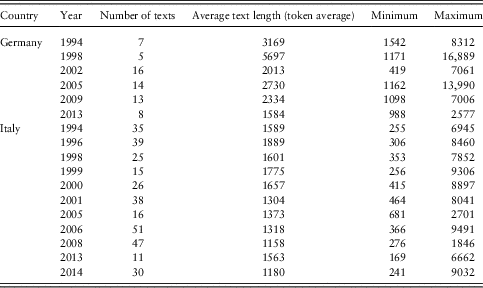
We created 17 different corpora, each of them corresponding to a parliamentary session dealing with a government’s confidence vote. Table 1 presents some basic information regarding the number of texts, the average text length (calculated in token averageFootnote 6 ) and the longest and shortest texts for each corpus.Footnote 7 More specifically, six German governments (the Kohl V, the Schröder I and II, and the Merkel I, II, and III) and 11 Italian governments (the Berlusconi I, the Prodi I, the D’Alema I and II, the Amato II, the Berlusconi II and III, the Prodi II, the Berlusconi IV, the Letta one, and the Renzi one) are considered, with nine different PMs.
Description of the created corpora for Germany and Italy (1994–2014)

Speeches were pre-processed following the general guidelines of quantitative texts analysis (Slapin and Proksch, Reference Slapin and Proksch2008, Reference Slapin and Proksch2010; Proksch et al., Reference Proksch, Slapin and Thies2011; Schwarz et al., Reference Schwarz, Traber and Benoit2017).Footnote 8
To measure similarity/dissimilarity between PM’s speeches and parties’ speeches, we applied a cosine similarity analysis. This method is based on the analysis of term frequencies and their corresponding weight in each text. Despite its simplicity, it is not widely used in social sciences to measure substantive similarities between or among texts, in which case scaling models are preferred.Footnote 9 Nevertheless, it is possible to find interesting applications of this method in other branches, such as computational linguistics (Sebastiani, Reference Sebastiani2002), finance (Hoberg and Maksimovic, Reference Hoberg and Maksimovic2015), and economics (Kang, Reference Kang2015).
We decided to use cosine similarity to measure the degree of similarity/dissimilarity between PM’s and parties’ texts for three main reasons. First, it is a resource-efficient method because its relatively easy implementation allows for the replicability of the analysis on a large sample of data: cosine similarity analysis allows processing a great amount of texts in a matter of seconds, different from other methods of hand-coding of political textsFootnote 10 that require a large amount of technical and infrastructural resources. Second, cosine similarity works independently from differences in document length: texts are indeed represented as vectors in a vector space, and the fundamental value is represented by the angle such vectors create at the origin of the Cartesian axes (see below), therefore making cosine similarity an extremely flexible method. Third, differently, from Wordfish and Wordscore, cosine similarity does not rely on distributional assumptions. Indeed, Wordscore requires the so-called ‘anchor-documents’: reference documents selected by the researcher according to their specific exogenous property (e.g. left-right placement of a party) (see Laver et al., Reference Laver., Benoit and Garry2003). Wordfish, on the other hand, relies on the Poisson assumption (Slapin and Proksch, Reference Slapin and Proksch2008: 709), thus implying that texts are structured according to a single latent dimension (i.e. ideology). Consequently, differently, from Wordscore, the application of cosine similarity allows the researcher to avoid influencing the analysis by choosing reference texts (e.g. relying upon external indicators of parties’ positioning). Moreover, differently from Wordfish, by using cosine similarity, the researcher is not forced to pre-determine a single latent dimension on which texts are distributed, and therefore he/she can reduce biases in the analysis.
All in all, cosine similarity is a flexible method that represents one of the simplest ways to understand how similar (or different) texts are, under the basic assumption that the more similar speeches (texts) are, the closer the respective actors’ positions are. More precisely, as mentioned, the cosine similarity method represents texts as vectors of words on a Cartesian plane. Cosine similarity is based on the distance between two vectors (in this case, the PM’s speech and the speech of each party in the governing coalition), quantified as the size of the angle generated by the two texts and the origin (0) of the Cartesian plane. Formally:
 $${{{\rm }\overrightarrow{{t_{{1d}} }} \cdot \overrightarrow{{t_{{2d}} }} } \over {\left| {\mid {\overrightarrow{{t_{{1d}} }} } \right|} \right|\!\mid\!\left| {\overrightarrow{{t_{{2d}} }} } \right|\!\mid\,}}$$
where the vector product of two documents represented as vectors (
 $\overrightarrow{{t_{1d} }} $
and
 $\overrightarrow{{t_{2d} }} $
) is divided by the product of their norms (
 $$\left| {\mid {\overrightarrow{{t_{{1d}} }} } \right|} \right|$$
and
 $$\,\mid\!\left| {\overrightarrow{{t_{{2d}} }} } \right|\!\mid\,$$
). The values of cosine similarity range between 0 and 1: 0 indicates the complete difference between two texts, whereas 1 means that two texts are identical. For example, in 2006, the Italian PM Prodi stated that ‘in the global politics concerning the fight against terrorism, we will take part in it in a firm way, with our values and our resources, including the military ones’. On the other hand, MPs coming from Communist Refoundation (a member of the 2006 Italian centre-left coalition government), replied by arguing ‘it is alarming that it is said that Italy has the right to send military missions in the world’. Moreover, in 2009, the German PM Merkel posited ‘we are relying on an energy mix that gradually replaces conventional energy sources with renewable energies. Or in one sentence: we want to go the way together into the regenerative energy age’, while MPs from the Free Democratic Party (a member of the 2009 Merkel coalition government) replied by saying that ‘[w]e say very clearly: we cannot do without fossil fuels in this energy mix’. Such policy-related dissimilarities are examples of how the texts under consideration allow us to estimate similar (dissimilar) policy positions between the PM and one of his/her coalition’s parties.Footnote
11
We applied the
 $$tf \cdot idf$$
weighting system (Salton, Reference Salton1989; Manning et al., Reference Manning, Raghavan and Schütze2008) to weight term frequencies in the corpora used.Footnote
12
Then, we measured the degree of cosine similarity between, on the one hand, PM speeches and, on the other, MP speeches aggregated at the party level. The analysis produced a value of cosine similarity for each dyad of documents (PM’s speech vs. each coalition party’s speech) included in each corpus. The higher the cosine similarity value for each dyad, the closer the PM and each party are.Footnote
13
Different systems for a general outcome: analysing Italy and Germany
Case selection and variables
We empirically tested the PMPA Index thanks to an original and comparative dataset. Specifically, to increase the generalizability of our analysis to coalition governments, we performed a comparative and diachronic analysis on Germany and Italy between 1994 and 2014. Indeed, these countries belong to the sub-class of countries in which the government must receive an investiture vote by the Parliament (see the discussion in Bergman et al., Reference Bergman, Müller, Strøm and Blomgren2003): more specifically, in both countries, the new government needs an explicit investiture vote by the Parliament, after the formal proposal by the President of the Republic – thus making the analysis of the first vote of confidence for each new government appealing. However, Germany and Italy can also be considered as two most different cases of coalition governments (Seawright and Gerring, Reference Seawright and Gerring2008). Among several other dimensions, four different characteristics of Italy and Germany allow us to define these two cases as significantly different. First, Italy and Germany have very different electoral systems (on Italy, see D’Alimonte and Chiaramonte, Reference D’Alimonte and Chiaramonte1993; D’Alimonte, Reference D’Alimonte2007; on Germany, see Massicotte and Blais, Reference Massicotte and Blais1999).
Second, these two countries differ in terms of their party system. Although Germany has often been conceived as a ‘two and a half’ party system (e.g. see Siaroff, Reference Siaroff2003), scholars have recently started talking about a ‘fluid five-party system’ (Poguntke, Reference Poguntke2014). In contrast, Italy has been described as a polarized pluralist system (Sartori, 2005 [Reference Sartori1976]), a fragmented bipolar system (Chiaramonte, Reference Chiaramonte2007) or as a ‘tripolar’ and more volatile system (Chiaramonte and Emanuele, Reference Chiaramonte and Emanuele2013). Moreover, although the German political system has basically remained very similar to the one that emerged in the late 1940s and early 1950s, the Italian political system underwent deep transformations at the beginning of the 1990s, with the demise of the so-called Prima Repubblica (First Republic) and the emergence of the so-called Seconda Repubblica (Second Republic) (D’Alimonte and Bartolini, Reference D’Alimonte and Bartolini1997).
Third, the two countries’ cabinet stability is noticeably different: whereas, between 1994 and 2014, in Germany, there were just six governments, in Italy 13 governments were in place.
A fourth difference concerns the structure of governmental coalition-making. Whereas since 1994 onwards, Italian parties have stipulated pre-electoral coalition agreements, this has never been the case for their German counterparts (see Moury, Reference Moury2013). Furthermore, from 1994 onwards, Italian pre-electoral coalitions have been particularly numerous, whereas German post-electoral coalitions have only been made by two parties.
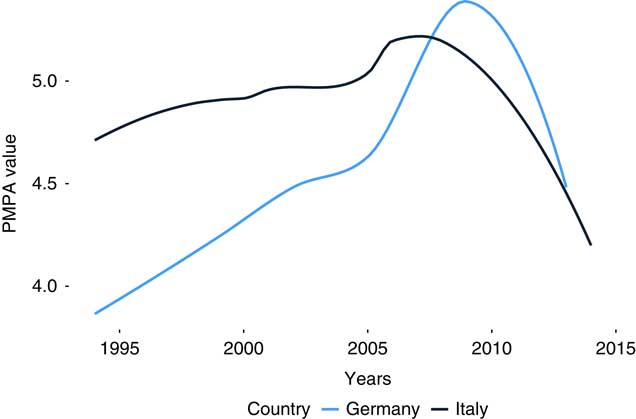
All of these differences suggest that, within the panorama of coalition governments in parliamentary democracies, Italy and Germany represent two quite different cases from the institutional and political viewpoint. Nevertheless, the variation in the average PMPA values for Italian and German governments across time has a similar pattern, as shown in Figure 1. Consequently, if we are able to obtain a reliable and quantitatively solid explanation for the variation in PMPA by accounting for these very different cases, we may also grasp a more generalizable explanation of the phenomenon.
Average Prime Minister Policy Autonomy (PMPA), Germany and Italy (1994–2014).

Figure 1 reports the variation in PMPA average levels for each government in Italy and Germany between 1994 and 2014. In both countries, an initial increase is detectable, although the curve is steeper in Germany than in Italy: passing from the Kohl to the Schröder governments there is an increase in the policy-related autonomy of the German PM; in contrast, centre-right and centre-left governments in Italy in the mid- and late 1990s and early 2000s are accompanied by a slightly less strong increase in the PM’s policy-related autonomy, whereas a sharper increase is detectable when the Prodi II government took office in 2006. The situation changes in both countries at the end of the 2000s: there is a relevant decline in the levels of PM policy-related autonomy, which continues until the mid-2010s. Despite this general negative trend, until the last Berlusconi government (2008), the autonomy of the Italian PM was higher than that of the German PM: with the Merkel II government (2009), the policy-related autonomy of the German PM overtakes the policy-related autonomy of their Italian counterparts.
Turning to the operationalization of the explanatory factors, we have considered coalition-, party-, and leader-related variables. Concerning coalition-related factors, to test Hypothesis 1, we used MWC, a dichotomous variable whose value 1 means that the governing coalition is a MWC, and 0 otherwise. Data for this variable come from the Italian and German Lower Houses’ websites.
Moreover, to test Hypothesis 2, we created POLARIZATION, whose operationalization is given by the absolute value of the difference between the PM’s position (V i ) and the position of the most different party in the coalition with respect to the PM on the cosine similarity/dissimilarity continuum (V X ):
 $$POLARIZATION\,{\equals}\,\left| {V_{i} {\minus}V_{X} } \right|$$
Following the existing literature (Laver and Budge, Reference Laver and Budge1992; Golder, Reference Golder2006), and because we are studying the delegation between the PM and the parties that support his/her government, we evaluate the ideological polarization of the coalition with respect to the distance between the position of the PM and that of the most distant party of the coalition. Moreover, we control for the NUMBER OF PARTIES that compose the majority coalition.
Moving to the party-related variables, to test Hypothesis 3, we created, for each party in a coalition, the variable DISTANCE, which computes the absolute value of the difference between the PM’s position (V i ) and the position of party x in the coalition on the cosine similarity/dissimilarity continuum (V x ); formally:
 $$DISTANCE\,{\equals}\,\left| {V_{i} {\minus}V_{x} } \right|$$
Moreover, to estimate the strength of a party x in the government, which is necessary to test Hypothesis 4, we created the variable MINISTER RATE. The strength of a party can be properly measured by considering the number of a party’s ministers within the government. Indeed, we know that portfolio allocation represents a crucial aspect of government formation (Laver and Shepsle, Reference Laver and Shepsle1996; Bäck et al., Reference Bäck, Debus and Dumont2011; Ceron, Reference Ceron2014) because a higher number of ministers gives parties more room for manoeuvre to condition governmental positioning. MINISTER RATE is given by the number of party x’s ministers in government i over the total number of ministers composing the government i:
 $$MINISTER\,{\rm }RATE\,{\equals}\,{{M_{x} } \over {M_{i} }}$$
Data for this variable come from the Italian and German Lower Houses and Governments websites.
Finally, a PM-related variable is added. To test Hypothesis 5, we created PM SELECTION, an ordinal variable defining the degree of openness of the PM’s selectorate.Footnote 14 We followed the operationalization formulated by Pilet and Cross (Reference Pilet and Cross2014) and by Kenig et al. (Reference Kenig, Rahat and Hazan2015): the variable has value 1 if the PM’s selectorate corresponds to one person, 2 if it is a party’s elite (for instance, an executive organ), 3 if it is made by a party’s MPs, 4 if it corresponds to the party congress, 5 if it is made by party members and, finally, 6 if it corresponds to party voters. Data for this variable are taken from Sandri et al. (Reference Sandri, Seddone and Venturino2014) and Detterbeck and Rohlfing (Reference Detterbeck and Rohlfing2014), and from political parties’ websites.
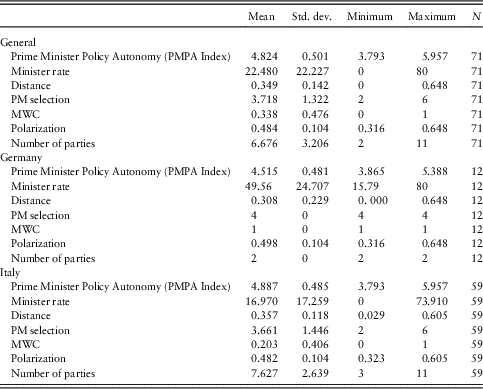
Table 2 shows some descriptive statistics for the entire data set and German and Italian cases. Differently from PMPA’s general trend (Figure 1), in Germany, some independent variables do not show any variation in their values (PM SELECTION and MWC), whereas such variation does exist in Italy. In some cases, the independent variables show a higher mean value for the German cases than for the Italian cases (MINISTER RATE, PM SELECTION, MWC, POLARIZATION) – even if the standard deviation of the first and the fourth variable is higher in Germany than in Italy – whereas the opposite situation is detectable for DISTANCE. All in all, it seems a general analysis of the determinants behind the changes in the PMPA values for Germany and Italy can be very fruitful. The next subsection is devoted to this task.
Descriptive statistics, Germany and Italy (1994–2014)

PM=Prime Minister; MWC=minimum winning coalition.
Empirical analysis
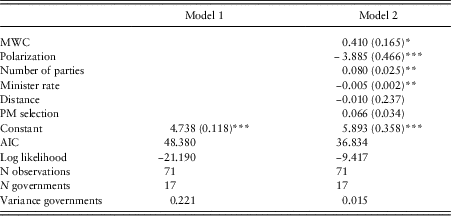
Moving to the empirical analysis, we first notice that our data set is clearly hierarchically organized, with parties clustered in each single government. This specific structure of the dataset has to be taken into consideration; otherwise, incorrect standard errors would be generated, and type I error rates would be inflated (Steenbergen and Jones, Reference Stegmueller2002). Moreover, our dependent variable is continuous. Consequently, we performed a multilevel linear regression,Footnote 15 whose results are reported in Table 3.
Multilevel regression on Prime Minister Policy Autonomy (PMPA Index), Germany and Italy (1994–2014)

MWC=minimum winning coalition; AIC=Akaike information criterion.
Standard errors in parentheses.
*P<0.05, **P<0.01, ***P<0.001.
Model 1 is an a-theoretical model that allows us to assess the level of intra-class correlation (ICC).Footnote 16 Model 1’s ICC shows that 81% of the variation in PMPA Index depends on the fact that they belong to different governments. Therefore, applying a multilevel regression analysis instead of a simple regression analysis is fundamental to substantially increase the reliability of the results.Footnote 17
Moving to Model 2, the results of the empirical analysis provide empirical support for both Hypotheses 1 and 2. Specifically, Table 3 confirms that the characteristics of the governing coalition relevantly affect PMPA: if the coalition that supports the government is an MWC, the PM is more autonomous from the policy-related viewpoint than in the case of an oversized coalition (P<0.05). Therefore, Hypothesis 1 finds empirical support. As mentioned before, this situation can be because, in case of an MWC, the PM could be free to take positions more autonomously from the party composing the majority because he/she, being aware of the parties’ aims, believes that if they interrupt the confidence relationship with him/her, they will face a relevant loss. Therefore, he/she is freer to act as he/she wishes.
Moreover, if the polarization between the PM and his/her coalition increases, his/her policy autonomy with respect to each party of the coalition significantly decreases (P<0.001). This result may be because the PM must bargain with members of the coalition that are very far away from his/her position, and therefore the PM may be tempted to reduce his/her autonomy by moving himself/herself closer to the other members of the coalition to avoid the risk of breaking the coalition. Thus, Hypothesis 2 finds empirical support as well.
Turning to party-related variables, the DISTANCE between the PM and a party does not have a relevant impact on the PM’s autonomy from that party: we cannot consider Hypothesis 3 as empirically supported. Conversely, MINISTER RATE has a negative and significant coefficient, which means that the higher the relevancy of a party within the Government, the higher the capacity of this party to constrain PM autonomy. So, not only is Hypothesis 4 empirically supported, but we can also argue that parties that are more efficient in properly conditioning the policy-related autonomy of the PM (and therefore of the government) are those who have appointed a noticeable number of ministers within the government (Laver and Shepsle, Reference Laver and Shepsle1996).Footnote 18
Finally, Table 3 shows that a wider PM selectorate does not increase his/her room for manoeuvre (Hypothesis 5 not empirically supported): it seems that a higher PM’s legitimization does not have the same effect of a higher party leader legitimization. Indeed, the existing literature shows that a wider party leader selectorate does have a positive impact on the PM’s freedom on taking specific stances notwithstanding internal party factionalization (Ceron, Reference Ceron2012). Conversely, this does not hold for PMs and the parties of the coalition supporting them. It could have been hypothesized that PMs with a higher legitimization, brought about by their wider selectorate, could have acted with less constraints and bounds because their ‘popular’ support could have been used as a very powerful rhetorical weapon to silence or curb both intra-party opposition (e.g. see Mair, Reference Mair1994) and intra-governmental party actors. Nonetheless, it seems that, in regard to the autonomy of the PM in coalition governments, the rules of intra-party politics are different than those of inter-party politics.
Conclusions
A widely held proposition states that, in parliamentary democracies, the heads of governments are acquiring increasing relevance. Within this context, PMs should have more autonomy in leading the cabinets, especially in policy positioning. This article has proposed a new measure of PMPA, thanks to a novel index (called PMPA Index) based on data coming from PM’s and MP’s speeches. More precisely, we gathered data by quantitatively analysing the speeches delivered by the head of government and by the MPs belonging to the parties supporting the government during the Lower House session when the government receives the first confidence vote. We used cosine similarity analysis, and, in addition to the presentation of this new index, this article has been devoted to the analysis of PMPA in coalition governments; however, from a theoretical and an empirical viewpoint, nothing prevents researchers from applying our methodology and operationalization to single-party governments as well.
After proposing this novel index, we investigated the determinants of PMPA in coalition governments in two different systems: Italy and Germany between 1994 and 2014. We considered coalition-related factors, party-related factors, and the PM’s selectorate. A multilevel regression analysis shows that PMPA in these coalition governments is mostly influenced by the features and constraints related to the coalition (its polarization and its minimum winning nature); moreover, the wider selectorate of the PM does not help him/her to be more autonomous. Finally, among party-related factors, only the number of each party’s ministers in the government (and therefore each party’s relative strength in the coalition) shapes PMPA, whereas the PMs’ distance from the party is not relevant for their policy autonomy.
These results are interesting from several viewpoints: first, the importance of the personalization of politics in parliamentary governments might need further clarification. Our analysis has shown that there is a lot of food for thought to properly understand the scope and the impact of PMs’ personal features on their policy-related autonomy in coalition governments. Indeed, a factor that has often been connected to an increased legitimacy of prominent political leaders (i.e. a wider selectorate) does not exert a significant impact on the PM’s policy-related autonomy in Italy and Germany. Further empirical research might cast some light on this result by, for instance, including more cases (governments and/or countries) in the analysis to properly understand the importance of political elites’ selectorate (in this case, the PM’s selectorate) on their (policy-related) autonomy.
Moreover, the role of political parties seems not to be crucial but has not completely vanished. Finally, the strong impact of coalition-related factors points at an interesting evolution of the relationship between the PM and the party (or parties) supporting him/her in parliament: coalitions of parties are more powerful and effective in shaping the PMPA than single parties. It might be, from a purely speculative viewpoint, that, when dealing with coalition governments, political parties, faced with an increasingly weaker membership structure (e.g. see Van Biezen et al., Reference Van Biezen, Mair and Poguntke2012), with augmented levels of electoral volatility (Chiaramonte and Emanuele, Reference Chiaramonte and Emanuele2017) and de-institutionalization (Casal Bértoa, Reference Casal Bértoa2014; Chiaramonte and Emanuele, Reference Chiaramonte and Emanuele2017), and with decreasing levels of legitimacy, can aim to shape a PM’s autonomy by working together. In other words, this situation seems to resemble the well-known saying: united they stand, divided they fall.
Acknowledgements
A previous version of this article was presented at the Amsterdam Text Analysis Conference (21-22 June 2016). The authors wish to thank the anonymous reviewers, Francesca Arcostanzo, Ken Benoit, Jan Kleinnijenhuis, Manuela Moschella, Tom O’Grady, Sebastian Popa, Gijs Schumacher, and Mariken van der Velden for their valuable comments and suggestions.
Conflicts of Interest
No conflicts of interest.
Financial Support
This research received no grants from the public, commercial, or non-profit funding agency.
Supplementary material
To view supplementary material for this article, please visit https://doi.org/10.1017/S1755773918000085